Make the path from a user problem to a product decision visible. Use a complete product designer resume to describe discovery, alternatives, testing and delivery with honest boundaries, then compare three real builder layouts.
These previews use the same layouts as the builder, with identical example content. Open a full preview to inspect the text and spacing.
Fictional candidate, employers, education and results. The optional portrait is AI-generated. Use your own evidence and photo; the example is not inserted into your resume.
Signal
A single-column sequence uses colored headings, square section markers and a date gutter to keep decisions and work history together.
Before sending: Projects come after expertise and education. Read the final pages and confirm that the prototype findings and pilot-account definitions remain complete.
A full-width identity header leads into a narrow left rail for projects, expertise and education, alongside a wider right column for profile and experience.
Before sending: The project rail has less line width, and its content precedes the main column in document order. Preserve the project role and dates, and inspect copied text and every continuation page.
Open unequal columns use thick section rules and blue role accents; experience occupies the main column while projects and supporting details sit in the rail.
Before sending: The project rail gives less line width to tradeoff explanations and URLs. Review continuation pages and copied-text order rather than assuming the visual columns read in the same order.
“Use” opens signup with that design and photo preference selected for the builder. A free account is required. Free-plan PDF downloads include a watermark; see current plans for paid options. Photo conventions vary; follow the employer’s instructions and local expectations.
The three designs use the identical complete record below, with no photo selected by default and an optional AI-generated fictional portrait. Open each preview to inspect every exported page. Choose the hierarchy that keeps your evidence readable; there is no verified popularity ranking or template that guarantees an interview. The example is not inserted into your account.
Compare the actual section placement in Signal, Clarity, Balance. Follow the employer’s file and photo instructions; the default shown here is intended as a starting point for US applications, not a rule for every location.
A complete product designer resume example
Theo Grant is a fictional product designer working on dispatch workflows for coordinators, after an associate role in business approval software. All people, employers, education and results are invented. The example.com portfolio and project URLs demonstrate complete records and link placement; they are not real work or claims to reuse.
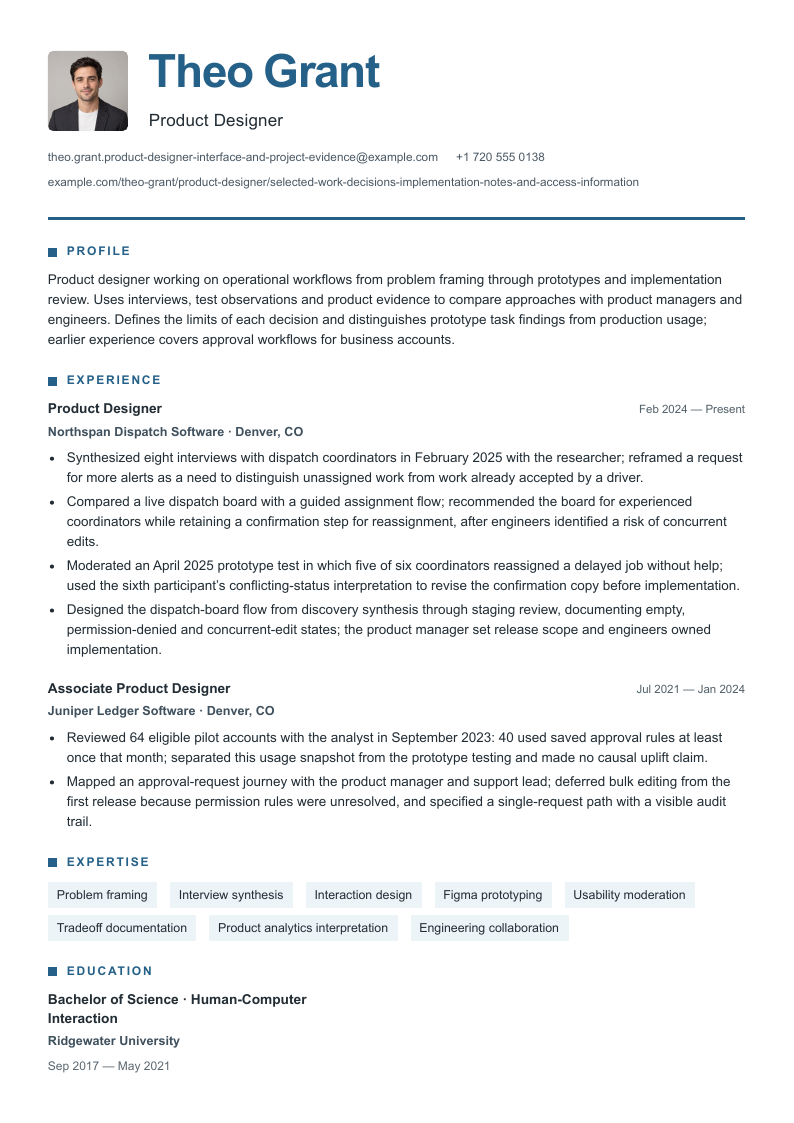
Product designer working on operational workflows from problem framing through prototypes and implementation review. Uses interviews, test observations and product evidence to compare approaches with product managers and engineers. Defines the limits of each decision and distinguishes prototype task findings from production usage; earlier experience covers approval workflows for business accounts.
Synthesized eight interviews with dispatch coordinators in February 2025 with the researcher; reframed a request for more alerts as a need to distinguish unassigned work from work already accepted by a driver.
Compared a live dispatch board with a guided assignment flow; recommended the board for experienced coordinators while retaining a confirmation step for reassignment, after engineers identified a risk of concurrent edits.
Moderated an April 2025 prototype test in which five of six coordinators reassigned a delayed job without help; used the sixth participant’s conflicting-status interpretation to revise the confirmation copy before implementation.
Designed the dispatch-board flow from discovery synthesis through staging review, documenting empty, permission-denied and concurrent-edit states; the product manager set release scope and engineers owned implementation.
Associate Product Designer
Juniper Ledger Software · Denver, CO
July 2021–January 2024
Reviewed 64 eligible pilot accounts with the analyst in September 2023: 40 used saved approval rules at least once that month; separated this usage snapshot from the prototype testing and made no causal uplift claim.
Mapped an approval-request journey with the product manager and support lead; deferred bulk editing from the first release because permission rules were unresolved, and specified a single-request path with a visible audit trail.
Education
Bachelor of Science in Human-Computer Interaction · Ridgewater University
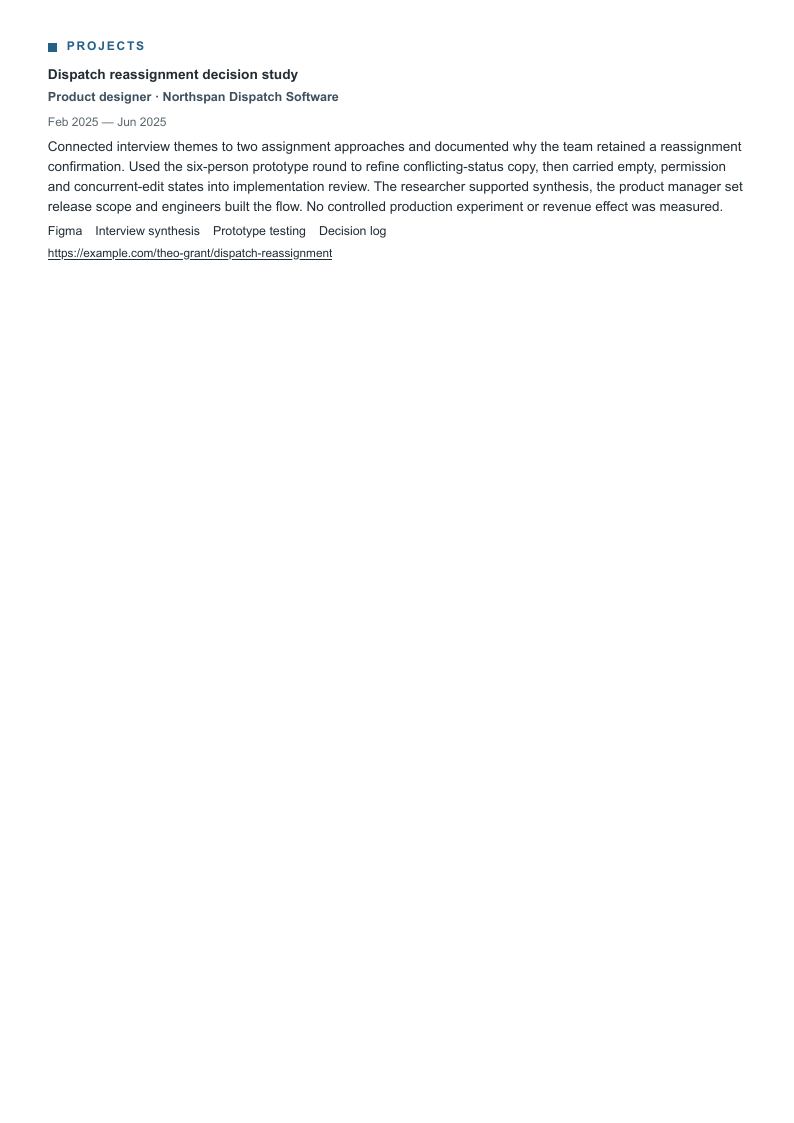
Connected interview themes to two assignment approaches and documented why the team retained a reassignment confirmation. Used the six-person prototype round to refine conflicting-status copy, then carried empty, permission and concurrent-edit states into implementation review. The researcher supported synthesis, the product manager set release scope and engineers built the flow. No controlled production experiment or revenue effect was measured.
A product designer resume needs more than a sequence of process words. Establish who was trying to do what, why the team investigated it, which options you helped compare and what happened next. Theo’s dispatch example connects coordinator interviews to an assignment-status problem, compares approaches, tests a prototype and carries exception states into implementation review. That chain makes the work understandable before someone opens a case study.
Define end-to-end ownership with a product area and partners. Theo contributed design work from discovery synthesis through staging review for the dispatch board. A researcher supported synthesis, a product manager set release scope and engineers implemented the flow. The resume does not claim that Theo owned the research organization, product roadmap, code or release. If you joined a project late, say which decisions were already set and what you changed.
The alternatives matter as much as the chosen interface. In the fictional example, a live board helps experienced coordinators scan work, but concurrent edits make an unchecked reassignment risky. Keeping a confirmation step is a tradeoff with an explicit reason. A resume can show judgment by describing a deferred feature or a constraint that prevented a simpler-looking solution; it does not need to turn every decision into a percentage.
The cited employers show different versions of this role. Livefront describes client and platform constraints; CLEAR connects verification journeys with privacy and security; Figma’s Growth & Monetization role spans user types and product tiers. Their portfolio, seniority and domain expectations apply to those openings. UI, UX/UI and Product Designer titles overlap across companies; read the duties and retain your actual job titles. This guide emphasizes a bounded product decision, while the UI guide concentrates on interface hierarchy, states and implementation craft.
Six annotated product designer resume bullet rewrites
Every after version below appears in the base resume. The before versions deliberately overstate or obscure the work. Use the evidence questions to rewrite your own experience; none of these fictional names, counts or results belong in your application.
Discovery that changes the question
Before: Owned research and solved all customer pain points.
After: Synthesized eight interviews with dispatch coordinators in February 2025 with the researcher; reframed a request for more alerts as a need to distinguish unassigned work from work already accepted by a driver.
Why it works: Identifies participants, period, collaborator and the decision informed. Eight interviews do not estimate the prevalence of the problem across all customers.
Evidence to check: Recruitment criteria, interview notes, synthesis and the agreed problem statement.
An explicit product tradeoff
Before: Simplified the entire platform with a revolutionary redesign.
After: Compared a live dispatch board with a guided assignment flow; recommended the board for experienced coordinators while retaining a confirmation step for reassignment, after engineers identified a risk of concurrent edits.
Why it works: Shows the alternatives, target users and reason a seemingly faster option was constrained. It does not claim unilateral product or technical authority.
Evidence to check: Decision record, alternative prototypes, concurrency constraints and review participants.
A test with a task and denominator
Before: Boosted customer success to 83%.
After: Moderated an April 2025 prototype test in which five of six coordinators reassigned a delayed job without help; used the sixth participant’s conflicting-status interpretation to revise the confirmation copy before implementation.
Why it works: Five of six describes one recruited prototype cohort and task. It is not a customer-success rate, a controlled experiment or evidence of a revenue effect.
Evidence to check: Task script, prototype version, assistance rule and participant-level observations.
Delivery with bounded ownership
Before: Led end-to-end development and launch.
After: Designed the dispatch-board flow from discovery synthesis through staging review, documenting empty, permission-denied and concurrent-edit states; the product manager set release scope and engineers owned implementation.
Why it works: End-to-end describes the designer’s involvement in this flow, with explicit partners and limits. It does not imply sole ownership of research, roadmap, code or release.
Evidence to check: Design history, state specifications, staging review and responsibility agreement.
Production evidence without invented causation
Before: Drove a 30% increase in feature adoption.
After: Reviewed 64 eligible pilot accounts with the analyst in September 2023: 40 used saved approval rules at least once that month; separated this usage snapshot from the prototype testing and made no causal uplift claim.
Why it works: 40 / 64 = 62.5% of this eligible cohort used the feature at least once in the month. There is no comparison period or randomized control, and usage once is not retention.
Evidence to check: Eligibility definition, account-level deduplication, event definition and monthly analytics query.
A deliberate scope decision
Before: Delivered every feature users wanted.
After: Mapped an approval-request journey with the product manager and support lead; deferred bulk editing from the first release because permission rules were unresolved, and specified a single-request path with a visible audit trail.
Why it works: A useful design decision can be a feature withheld. Names the dependency, collaborators and shipped scope without pretending the designer set the roadmap alone.
Evidence to check: Journey map, permission questions, prioritization notes and approved release scope.
Make each skill point to work you can explain
Choose methods and tools you can connect to a decision. “Discovery” should point to a question and how the brief changed. “Figma” should point to a prototype or interaction model you made. “Analytics” should identify the eligible population, event and window, together with the analyst or team who produced the evidence.
The prototype result is five of six recruited coordinators completing one reassignment task without help. It identifies a useful remaining problem and informs a copy revision; it is not an 83% customer-success measure. The separate production pilot counts 40 of 64 eligible accounts using saved rules at least once in September 2023: 62.5% within that cohort. Without a baseline or control, neither observation establishes an adoption uplift, retention increase or revenue effect.
Product Designer skills and evidence in the fictional resume
Skill
Evidence to gather
Example in this record
Problem framing
Who had the problem and how evidence changed the brief.
Eight coordinator interviews informed the assignment-status problem.
Tradeoff decisions
Alternatives, constraints and rationale accepted with partners.
Board versus guided flow; concurrency risk retains confirmation.
Usability testing
Task, cohort, assistance rule and design revision.
Five of six complete a prototype task; one conflict drives copy revision.
Interaction design
A connected flow and its exceptional states.
Empty, permission-denied and concurrent-edit states.
Analytics interpretation
Eligibility, event, deduplication and time window.
40 of 64 eligible pilot accounts used a feature once in September 2023.
Delivery collaboration
Scope of design responsibility and partner decisions.
Designer reviews staging; PM sets release scope and engineers implement.
Use the portfolio to explain decisions the resume introduces
Make the dispatch case study easy to recognize from the resume: the users, initial request, revised problem, options, constraints and your personal contribution should agree. Show what the team rejected and why, then distinguish prototype findings from what actually shipped. A polished final flow is useful, but it does not supply the missing rationale or establish a business result.
Keep production evidence traceable to its definition. If you discuss a pilot, name eligibility and the time window, avoid counting one account repeatedly, and separate first use from repeat use. For a controlled experiment, use the actual variant allocation and outcome definition with the analyst’s interpretation. Do not manufacture a control, baseline or causal explanation after the fact just to create a stronger resume bullet.
Check the portfolio while signed out and test any approved access instructions. Livefront explicitly asks for a link and passwords, while other applications offer different fields; follow the current employer’s request. Password protection does not override an NDA or permit publishing participant recordings, customer identities or private dashboards. Use approved redaction or a permitted process narrative, and label reconstructed or independent work so the reader knows what it represents.
Keep qualifications and domain experience specific
Give your actual degree, field, institution and dates, or describe another real path into the work. Theo’s fictional HCI degree does not establish a universal product-design requirement. The selected vacancies vary in seniority and product context; a senior identity role is not an entry-level hiring standard.
Include a course or certification only with its provider, completion status and relevance clear. Coursework can support methods you practiced, but it is not equivalent to owning a shipped product. If you have prior domain experience, explain the workflow knowledge it contributed without claiming specialist authority or regulated credentials you do not hold.
Build a first product design application around a real decision
An internship, student project or supervised volunteer assignment can demonstrate framing, alternatives and response to feedback. Label the context and the people who made the decisions. If nothing shipped, describe what was prototyped, what you observed and what would need validation next; do not invent active users to make the project sound professional.
Transferable experience can establish useful context. Support work might reveal recurring workflow confusion, while a development role may show implementation constraints. Explain how you used that evidence in a design exercise without relabeling the earlier job as paid product-design employment. A limited, candid case study is easier to discuss than a fictional end-to-end launch.
Fictional early-career adaptation
Digital design intern seeking an associate product designer role. Organizes help content and prepares interface alternatives under a staff designer’s direction. In a labeled course project, compared two account-setup approaches and revised empty-state copy after peer review; the prototype was not deployed and no production adoption or revenue result was measured.
Inspect long contact details with the photo on
Only Theo’s resume email and portfolio contact URL change in this Signal stress example. The photo is on; the two jobs, education, skills, summary and base project are preserved exactly. Read the complete long strings below and inspect each exported page to ensure their last characters remain visible.
Signal places the contacts beneath the identity header. Clarity also leads with a full header, while Balance uses that header above divided body columns. The same contact data can wrap differently because of layout and photo spacing. Test both visible labels and full link destinations in the final file; a cropped screenshot is not a complete export check.
Product designer working on operational workflows from problem framing through prototypes and implementation review. Uses interviews, test observations and product evidence to compare approaches with product managers and engineers. Defines the limits of each decision and distinguishes prototype task findings from production usage; earlier experience covers approval workflows for business accounts.
Synthesized eight interviews with dispatch coordinators in February 2025 with the researcher; reframed a request for more alerts as a need to distinguish unassigned work from work already accepted by a driver.
Compared a live dispatch board with a guided assignment flow; recommended the board for experienced coordinators while retaining a confirmation step for reassignment, after engineers identified a risk of concurrent edits.
Moderated an April 2025 prototype test in which five of six coordinators reassigned a delayed job without help; used the sixth participant’s conflicting-status interpretation to revise the confirmation copy before implementation.
Designed the dispatch-board flow from discovery synthesis through staging review, documenting empty, permission-denied and concurrent-edit states; the product manager set release scope and engineers owned implementation.
Associate Product Designer
Juniper Ledger Software · Denver, CO
July 2021–January 2024
Reviewed 64 eligible pilot accounts with the analyst in September 2023: 40 used saved approval rules at least once that month; separated this usage snapshot from the prototype testing and made no causal uplift claim.
Mapped an approval-request journey with the product manager and support lead; deferred bulk editing from the first release because permission rules were unresolved, and specified a single-request path with a visible audit trail.
Education
Bachelor of Science in Human-Computer Interaction · Ridgewater University
Connected interview themes to two assignment approaches and documented why the team retained a reassignment confirmation. Used the six-person prototype round to refine conflicting-status copy, then carried empty, permission and concurrent-edit states into implementation review. The researcher supported synthesis, the product manager set release scope and engineers built the flow. No controlled production experiment or revenue effect was measured.
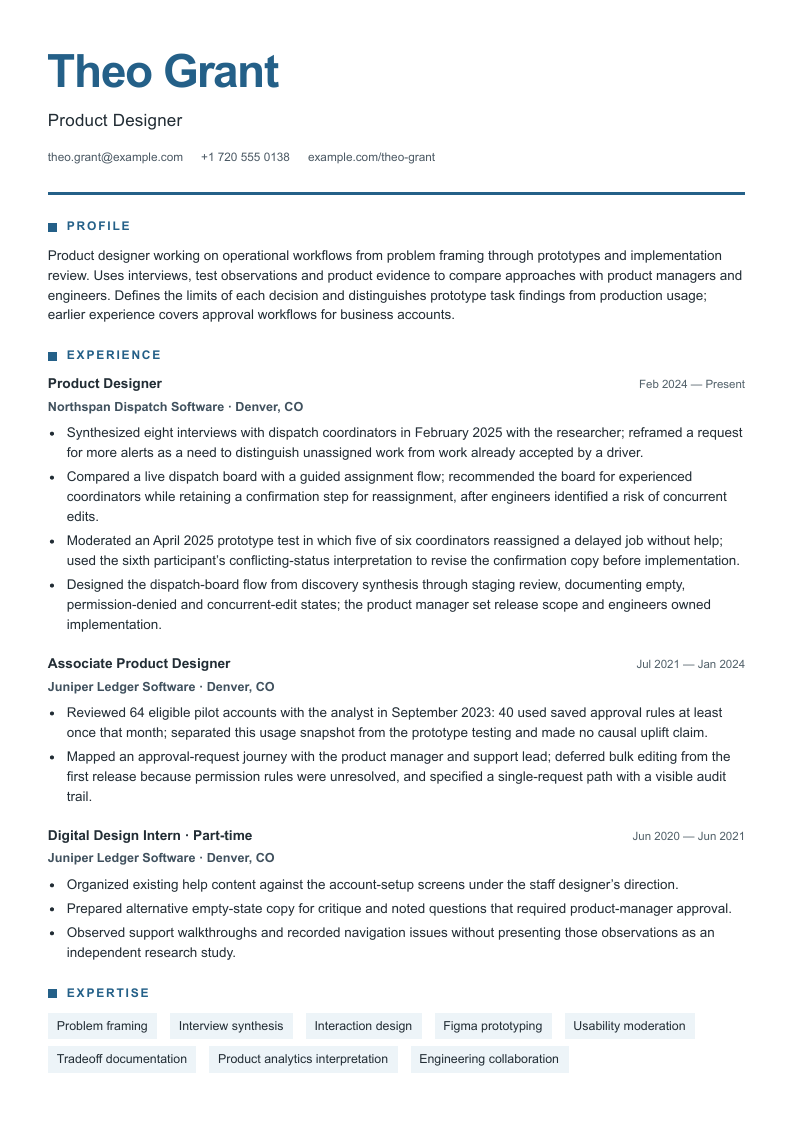
This Signal export has the photo off and keeps every field in the base record. It adds Theo’s earlier part-time design internship and two projects: the saved-rule pilot review and the permission-aware approval scope. Their dates and roles make clear which employer and stage of work they belong to.
Read every continuation page and the complete text below. Projects come late in Signal’s sequence; Clarity places them in a narrow left rail before the main column in document order, and Balance uses a supporting rail. Choose by whether those decisions remain understandable in your actual record. Do not shrink type, drop the limitations or remove dates just to imitate a one-page thumbnail.
Product designer working on operational workflows from problem framing through prototypes and implementation review. Uses interviews, test observations and product evidence to compare approaches with product managers and engineers. Defines the limits of each decision and distinguishes prototype task findings from production usage; earlier experience covers approval workflows for business accounts.
Synthesized eight interviews with dispatch coordinators in February 2025 with the researcher; reframed a request for more alerts as a need to distinguish unassigned work from work already accepted by a driver.
Compared a live dispatch board with a guided assignment flow; recommended the board for experienced coordinators while retaining a confirmation step for reassignment, after engineers identified a risk of concurrent edits.
Moderated an April 2025 prototype test in which five of six coordinators reassigned a delayed job without help; used the sixth participant’s conflicting-status interpretation to revise the confirmation copy before implementation.
Designed the dispatch-board flow from discovery synthesis through staging review, documenting empty, permission-denied and concurrent-edit states; the product manager set release scope and engineers owned implementation.
Associate Product Designer
Juniper Ledger Software · Denver, CO
July 2021–January 2024
Reviewed 64 eligible pilot accounts with the analyst in September 2023: 40 used saved approval rules at least once that month; separated this usage snapshot from the prototype testing and made no causal uplift claim.
Mapped an approval-request journey with the product manager and support lead; deferred bulk editing from the first release because permission rules were unresolved, and specified a single-request path with a visible audit trail.
Digital Design Intern · Part-time
Juniper Ledger Software · Denver, CO
June 2020–June 2021
Organized existing help content against the account-setup screens under the staff designer’s direction.
Prepared alternative empty-state copy for critique and noted questions that required product-manager approval.
Observed support walkthroughs and recorded navigation issues without presenting those observations as an independent research study.
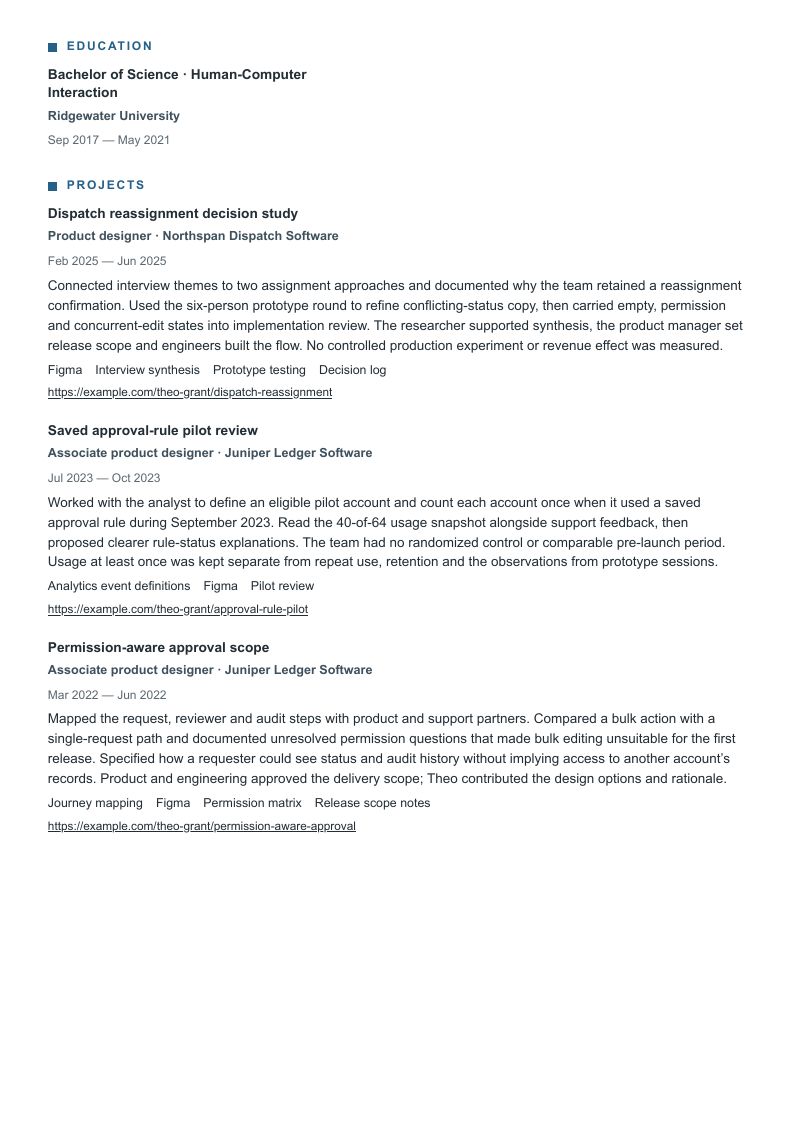
Education
Bachelor of Science in Human-Computer Interaction · Ridgewater University
Connected interview themes to two assignment approaches and documented why the team retained a reassignment confirmation. Used the six-person prototype round to refine conflicting-status copy, then carried empty, permission and concurrent-edit states into implementation review. The researcher supported synthesis, the product manager set release scope and engineers built the flow. No controlled production experiment or revenue effect was measured.
Analytics event definitions · Figma · Pilot review
Worked with the analyst to define an eligible pilot account and count each account once when it used a saved approval rule during September 2023. Read the 40-of-64 usage snapshot alongside support feedback, then proposed clearer rule-status explanations. The team had no randomized control or comparable pre-launch period. Usage at least once was kept separate from repeat use, retention and the observations from prototype sessions.
Mapped the request, reviewer and audit steps with product and support partners. Compared a bulk action with a single-request path and documented unresolved permission questions that made bulk editing unsuitable for the first release. Specified how a requester could see status and audit history without implying access to another account’s records. Product and engineering approved the delivery scope; Theo contributed the design options and rationale.
Read the whole decision chain. Check the user problem, alternatives, remaining issue and delivery responsibility on every page, including the last project sentence.
Test extraction and destinations. Copy text into plain text, verify its sequence and open portfolio and project links from the actual PDF.
Audit metric definitions. Keep the six-person prototype task distinct from the 64-account September pilot. Check eligibility, denominator, event and time window before any claim of change.
Follow the vacancy’s application instructions. Submit the requested format and check parsed titles, dates, contact details and access fields. Layout choice alone does not guarantee application-system compatibility.
Review your resume with the analyzer and assess each suggestion against the actual job and your records. The design buttons open signup with the selected template and photo preference; a free account is required. Free-plan PDFs include a watermark. The preview images here show complete paid-plan output without that watermark.
Questions, answered
How do I show end-to-end ownership without overstating it?
Name a specific flow or product area and the stages you contributed to. Identify the researcher, product manager, engineers and other partners, and state who controlled scope and implementation. Your involvement across stages can be meaningful without claiming sole ownership of every discipline.
What if I do not have a business-impact metric?
Describe a real decision, the constraint behind it, the artifact or test you produced and what changed next. A scoped qualitative finding or a justified feature deferral can be useful evidence. Do not convert prototype task success into a revenue or retention claim.
Should I rename my UI Designer job Product Designer?
Keep the real job title and explain any broader discovery, testing or product-decision work in the bullets. Titles overlap across employers. Match the substance of the target opening without rewriting employment history.
Can I share a locked portfolio?
Use approved access instructions in the field the employer provides and test them signed out. A password does not authorize disclosure of confidential work. If you cannot publish the material, provide a permitted redacted explanation or discuss an alternative with the hiring team.
Continue with the relevant resource
Use the adjacent role guide to compare the emphasis of your real work. Preserve your actual employment titles and tailor the evidence to the vacancy; changing a heading does not create experience.
Prepared by Resumize with AI-assisted research and drafting. All candidate identities, employers, education, projects and results in the complete records are invented; the optional portrait is AI-generated, and example.com destinations are placeholders. The rewrites, metric critique and layout comparisons are original editorial teaching material. Use your own evidence and share only material you are authorized to disclose.
We checked three US employer descriptions on October 27, 2026: Livefront, CLEAR and Figma Growth & Monetization. Each displayed an application form or control; no application was submitted. These selected descriptions show different product contexts and seniority expectations, not universal requirements or a market-wide demand estimate.
CareerOneStop provides general resume guidance. Nielsen Norman Group provides portfolio and usability-method context; its older portfolio research is not presented as a current hiring survey. Sources do not endorse Resumize, these fictional records or the selected designs. No query-volume data, ranking forecast or application-system guarantee is claimed.
Primary description checked October 27, 2026: Apply and full application form present; no publication date shown. Covers client goals, platform constraints, testing and engineering handoff. It explicitly requests a portfolio and provides a field for the link and passwords. Native mobile experience and work-authorization conditions apply to this vacancy.
Primary description checked October 27, 2026: Apply and application form present; no publication date shown. Connects discovery, verification journeys and launch with privacy, security and accessibility tradeoffs. It specifies five days in the NYC office and a senior experience level; these are not requirements for all product designers.
Reached from the current official Figma careers listing on October 27, 2026; primary page displayed Apply and a full form, with no publication date shown. Describes discovery through launch, user and business needs, multiple user types and experimentation. US hubs or US remote; covers varying seniority levels. An older Design, Dev, & AI Tools URL redirected to the careers hub and was not used as a current vacancy.
Read October 27, 2026. US Department of Labor-sponsored guidance on relevant work history, dates, context and specific contributions. Our candidates, employers, projects and calculations are original fiction; this guidance does not certify a design or guarantee application-system results.
Published August 4, 2019; read October 27, 2026. Method guidance on selecting relevant work and explaining the problem, individual role, constraints and decisions, including confidential-work roadblocks. Its older hiring research is not a current market-prevalence estimate.
Published December 1, 2019, reviewed July 15, 2026; read October 27, 2026. Method context on participants, tasks, facilitation and observational findings. Our fictional task counts are not industry benchmarks or evidence of a production conversion effect.