A data scientist resume should let a reader follow a decision question through the data, validation and recommendation. This subscription-product example shows experiment design and offline retention modeling, including an inconclusive result and the limits of a promising model score.
These previews use the same layouts as the builder, with identical example content. Open a full preview to inspect the text and spacing.
Fictional candidate, employers, education and results. The optional portrait is AI-generated. Use your own evidence and photo; the example is not inserted into your resume.
Essential
A plain left header and restrained section titles lead into a single-column profile, experience, skills, education and projects sequence.
Before sending: The understated layout leaves the evidence to carry the application. Inspect long technical terms, URLs and continuation pages; plain styling does not guarantee correct parsing.
A light full-width header sits above a narrow unfilled left rail for projects, expertise and education, with profile and experience in the broader right column.
Before sending: The project appears in the rail before the experience column in document order. Preserve its evaluation cohort and inference limits, and check reading order in copied PDF text.
A centered serif header, ruled contact strip, italic profile and gold section rules frame one body column.
Before sending: The broad body supports methodological explanations, while the ruled contact strip deserves a long-email check. Styling does not validate an experiment or guarantee an interview.
“Use” opens signup with that design and photo preference selected for the builder. A free account is required. Free-plan PDF downloads include a watermark; see current plans for paid options. Photo conventions vary; follow the employer’s instructions and local expectations.
Essential, Clarity and Ledger use Maya’s identical record. Open each full preview and read every page before choosing. The default has no photo; the optional portrait lets you compare the layout. Follow the employer’s instructions and local application expectations. The fictional record and portrait are teaching material and are not inserted into your account.
Essential keeps the body in a restrained single column. Clarity moves projects, expertise and education into a narrow left rail, which precedes the experience column in document order. Ledger uses a centered serif header and ruled contact strip above one body column. Compare the same technical explanation across these structures; decoration cannot establish statistical validity or application-system compatibility.
A complete data scientist resume example
Maya Rowan is a fictional data scientist at a subscription learning-product business, with earlier product-data analysis experience. Her specialty is evaluating product experiments and retention models. Every person, employer, qualification and result is invented. The example.com portfolio addresses are placeholders. The portrait is AI-generated, and this guide uses AI-assisted research and drafting.
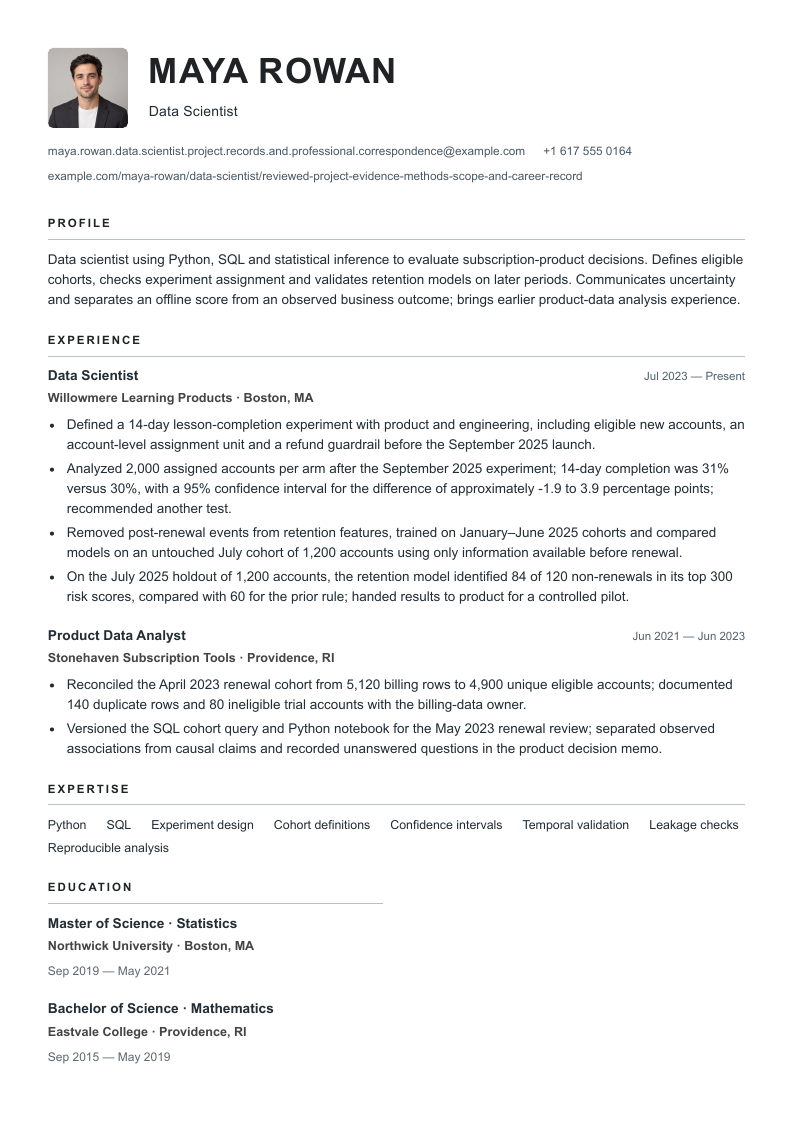
Data scientist using Python, SQL and statistical inference to evaluate subscription-product decisions. Defines eligible cohorts, checks experiment assignment and validates retention models on later periods. Communicates uncertainty and separates an offline score from an observed business outcome; brings earlier product-data analysis experience.
Defined a 14-day lesson-completion experiment with product and engineering, including eligible new accounts, an account-level assignment unit and a refund guardrail before the September 2025 launch.
Analyzed 2,000 assigned accounts per arm after the September 2025 experiment; 14-day completion was 31% versus 30%, with a 95% confidence interval for the difference of approximately -1.9 to 3.9 percentage points; recommended another test.
Removed post-renewal events from retention features, trained on January–June 2025 cohorts and compared models on an untouched July cohort of 1,200 accounts using only information available before renewal.
On the July 2025 holdout of 1,200 accounts, the retention model identified 84 of 120 non-renewals in its top 300 risk scores, compared with 60 for the prior rule; handed results to product for a controlled pilot.
Product Data Analyst
Stonehaven Subscription Tools · Providence, RI
June 2021–June 2023
Reconciled the April 2023 renewal cohort from 5,120 billing rows to 4,900 unique eligible accounts; documented 140 duplicate rows and 80 ineligible trial accounts with the billing-data owner.
Versioned the SQL cohort query and Python notebook for the May 2023 renewal review; separated observed associations from causal claims and recorded unanswered questions in the product decision memo.
Education
Master of Science in Statistics · Northwick University · Boston, MA
September 2019–May 2021
Bachelor of Science in Mathematics · Eastvale College · Providence, RI
September 2015–May 2019
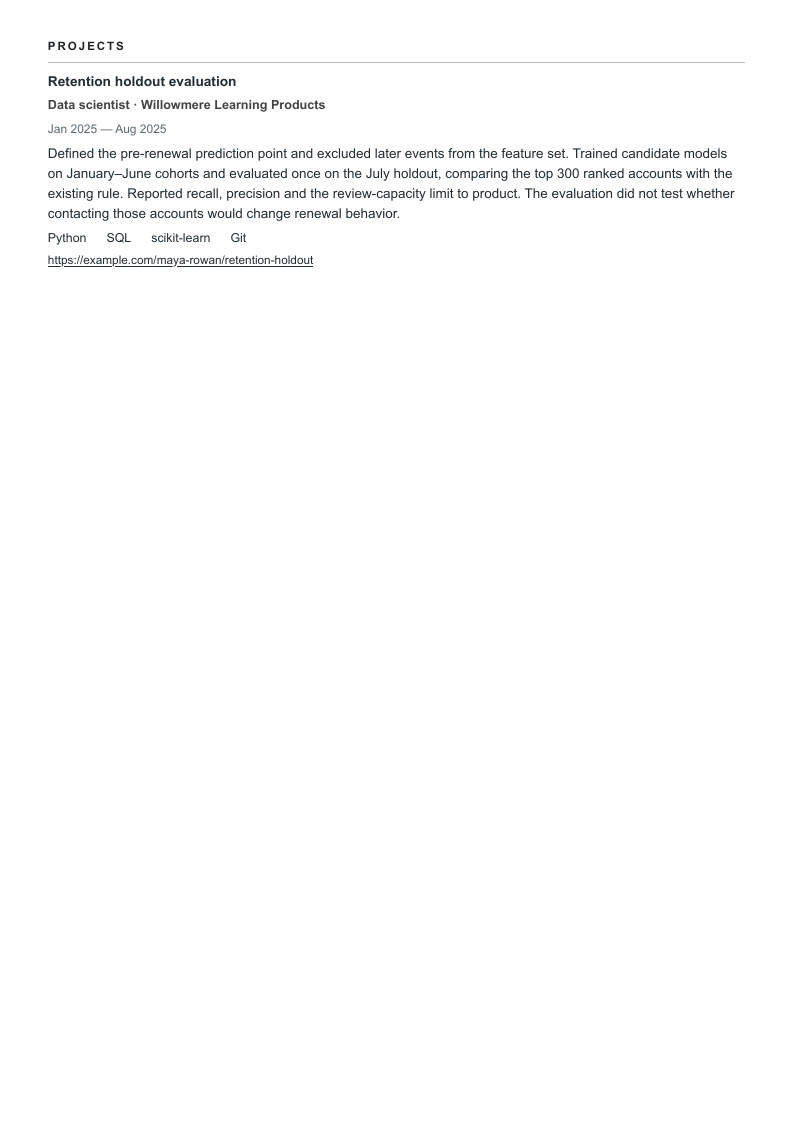
Projects
Retention holdout evaluation
Data scientist · Willowmere Learning Products
January 2025–August 2025
Python · SQL · scikit-learn · Git
Defined the pre-renewal prediction point and excluded later events from the feature set. Trained candidate models on January–June cohorts and evaluated once on the July holdout, comparing the top 300 ranked accounts with the existing rule. Reported recall, precision and the review-capacity limit to product. The evaluation did not test whether contacting those accounts would change renewal behavior.
The record makes two different contributions visible: an experiment that did not resolve whether a new lesson flow improved completion, and an offline ranking model that identified more eventual non-renewals at a fixed review capacity. Neither finding becomes a claim that Maya increased revenue or reduced churn.
Lead with the question, then show why the answer is usable
Start with the decision someone needed to make. For Maya’s experiment, the question concerns a lesson flow and a 14-day completion outcome. Name who qualifies, what is assigned, when measurement ends and which guardrail could stop a launch. “Ran A/B tests” leaves out whether the assignment unit matched the analysis and whether the outcome was chosen before looking at results. A resume needs a compact account; retain enough detail to explain your choices in an interview.
Define the cohort before reporting a percentage. Maya’s earlier reconciliation starts with 5,120 billing rows, removes 140 duplicate rows and 80 ineligible trial accounts, and ends with 4,900 unique eligible accounts. That arithmetic works for this ordered snapshot: 5,120 − 140 − 80 = 4,900. It still requires an account key, an exclusion order and an owner-reviewed source. It does not prove the entire billing system was correct. State whether your unit is a person, account, session, transaction or account-period; repeated observations need appropriate treatment.
In the fictional experiment, 620 of 2,000 treatment accounts completed the lesson, compared with 600 of 2,000 control accounts: 31% versus 30%, a difference of one percentage point. An approximate independent-proportions 95% interval runs from −1.9 to 3.9 percentage points. It includes zero and also includes changes that could matter. Describe the estimate as inconclusive at that precision, rather than proof of improvement or proof of no effect. Account assignment, missing outcomes, exposure and the refund guardrail still need review; a confidence interval cannot repair a broken experiment.
For prediction, say what information existed when a score would have been produced. Maya removes post-renewal events, trains on January–June 2025 cohorts and evaluates on an untouched July cohort. Keep preprocessing and model selection inside training or development data; reserve the final holdout for evaluation. A later-period split supports this time-dependent use case, but does not establish that performance will remain stable in future cohorts. Repeated tuning against a supposedly untouched holdout would invalidate that description.
Judge the model against the decision capacity. In the July holdout, 120 of 1,200 accounts did not renew. At the same top-300 review capacity, the model finds 84 of those 120, while the prior rule finds 60. Recall is 70% versus 50%; precision is 28% versus 20%. Those figures describe this cohort and cutoff, not universal “accuracy.” Product must still test whether an intervention helps, whether its cost is justified and which accounts it may reach. A higher offline recall does not establish a causal reduction in churn.
Fit the method to the decision. A transparent rule can be adequate when review capacity, limited data or explanation needs dominate. A more complex model earns its place through validation and usable tradeoffs. If you owned calibration, subgroup error checks, sensitivity analysis or monitoring, give the real method and finding; Maya’s record does not establish those additional claims. Name the handoff when another team owns deployment or intervention design.
Six annotated data scientist bullet rewrites
Every after version appears verbatim in Maya’s complete base record. Borrow the reasoning and supply your own verified facts.
A decision question before the technique
Before: Used data science to optimize engagement.
After: Defined a 14-day lesson-completion experiment with product and engineering, including eligible new accounts, an account-level assignment unit and a refund guardrail before the September 2025 launch.
Why it works: The design names a decision context, outcome window and unit. It does not claim engagement improved before results existed.
Evidence to check: Experiment plan, eligibility query, assignment specification and pre-launch review.
An inconclusive estimate remains useful
Before: Proved a new flow increased completion by 4%.
After: Analyzed 2,000 assigned accounts per arm after the September 2025 experiment; 14-day completion was 31% versus 30%, with a 95% confidence interval for the difference of approximately -1.9 to 3.9 percentage points; recommended another test.
Why it works: The observed difference is one percentage point, not four percent proof of improvement. The interval includes zero; the recommendation recognizes uncertainty rather than declaring no effect or a winning treatment.
Evidence to check: Complete assigned cohort, outcome counts, interval method and decision memo.
Leakage prevention tied to prediction time
Before: Built a highly accurate churn model.
After: Removed post-renewal events from retention features, trained on January–June 2025 cohorts and compared models on an untouched July cohort of 1,200 accounts using only information available before renewal.
Why it works: Names the forbidden future information and time split. The July cohort is later than training, and feature construction must respect each account’s prediction time.
Evidence to check: Feature timestamps, prediction cutoff, cohort split and frozen evaluation dataset.
Offline evaluation without a business guarantee
Before: Reduced churn by 20% using machine learning.
After: On the July 2025 holdout of 1,200 accounts, the retention model identified 84 of 120 non-renewals in its top 300 risk scores, compared with 60 for the prior rule; handed results to product for a controlled pilot.
Why it works: Recall among the 120 observed non-renewals is 70% versus 50% at the same 300-account capacity; precision is 28% versus 20%. No outreach experiment or measured churn reduction is claimed.
Evidence to check: Holdout labels, ranked scores, equal review capacity, baseline definition and pilot handoff.
A cohort denominator that can be audited
Before: Created perfect customer data for analytics.
After: Reconciled the April 2023 renewal cohort from 5,120 billing rows to 4,900 unique eligible accounts; documented 140 duplicate rows and 80 ineligible trial accounts with the billing-data owner.
Why it works: The exclusions reconcile to 220 rows in this defined snapshot. The count does not establish that all customer data was correct, and the row-to-account mapping must be checked.
Evidence to check: Source snapshot, unique account key, exclusion order and owner-reviewed reconciliation.
Reproducibility and communication
Before: Delivered actionable insights to executives.
After: Versioned the SQL cohort query and Python notebook for the May 2023 renewal review; separated observed associations from causal claims and recorded unanswered questions in the product decision memo.
Why it works: Names the artifacts and limitation rather than inventing a revenue outcome. A reproducible analysis can support a decision without proving what caused it.
Evidence to check: Versioned query, environment notes, reviewed notebook and decision memo.
Make the summary match the work you owned
Maya’s summary names Python, SQL, statistical inference and subscription-product decisions. The jobs substantiate cohort work, experiments and temporal model evaluation. It avoids “AI expert” and an unsupported business-impact total. Use a similar order: domain, kind of decision, methods you actually used and a contribution the experience can support. Preserve your actual job title and dates when moving between analysis and science roles.
A data analyst resume can emphasize analysis and recommendations; a business intelligence analyst may emphasize governed measures, data models and reporting. This example’s distinguishing evidence is the design and interpretation of experiments and predictive evaluation. A machine learning engineer may own serving, pipelines, latency and model operations. These boundaries overlap in employers’ titles: claim only the pieces you performed, and name collaborators instead of assuming that fitting a notebook model means you deployed it.
The three cited vacancies illustrate different levels and scopes. Anthropic’s Growth role emphasizes experiments and guardrails; Discord’s staff role emphasizes causal inference and experimentation methodology; PlayStation’s Decision Science role combines statistical and machine learning methods with decision support. They do not define requirements for the whole occupation, and Maya is not presented as qualified for all three. Read the exact vacancy before choosing which evidence to foreground.
Useful evidence need not be a positive result. A rejected feature, an uncertainty bound or a corrected denominator can show judgment if you explain the recommendation. Keep confidential user records, proprietary queries and private experiment documents out of public portfolios. Use approved aggregate descriptions or a clearly labeled synthetic reproduction when appropriate.
Connect each skill to an inspectable contribution
Choose the relevant tools and methods you can defend. A long library inventory is less informative than evidence of how you selected data, evaluated a method and explained its limits.
Data scientist skills and supporting evidence in the fictional record
Skill
Evidence to gather
Where it appears in this sample
Python and SQL
Versioned cohort query and notebook with reproducible inputs.
The renewal review records both artifacts and unanswered questions.
Experiment design
Eligibility, assignment unit, outcome window and guardrails before launch.
The lesson-completion study assigns accounts and measures a defined 14-day outcome.
Confidence intervals
Counts, denominator, estimation method and an interpretation of uncertainty.
The one-point completion difference has an interval spanning zero.
Temporal validation
Prediction cutoff, training dates and a later untouched evaluation cohort.
January–June training precedes the July retention holdout.
Leakage checks
Feature availability at the actual prediction time.
Post-renewal events are removed from pre-renewal features.
Model evaluation
A baseline, decision capacity and the appropriate denominator.
Both ranking approaches select 300 accounts from the same 1,200-account holdout.
State education accurately and check the vacancy’s alternatives
List the actual degree, field, institution and dates. Maya has a fictional statistics master’s degree and mathematics bachelor’s degree; she has no PhD or supplied certifications. Do not describe her as meeting a vacancy that requires a PhD without an applicable alternative. Discord’s cited staff vacancy uses PhD-or-equivalent wording and its own experience conditions; the example does not establish equivalent qualifications or staff-level scope. PlayStation describes graduate study with experience and considers a BA/BS route with additional relevant experience. Neither posting proves a universal degree requirement.
For your own application, distinguish a completed qualification from current study and use the expected completion date when appropriate. Relevant coursework or a certificate can support the account of your training, but cannot substitute for a required degree, experience condition or production responsibility without the employer allowing it. Include a thesis, publication or certification only when it exists and is relevant; do not add credentials to make a template look complete.
Use a bounded project when paid science experience is limited
A project can demonstrate how you ask a question, build a cohort, choose a baseline and handle uncertainty. Label coursework, personal work and research assistance correctly. Use a public or synthetic dataset that you may share. Explain its provenance and limits, include a reproducible analysis and avoid presenting an offline exercise as a deployed product or an intervention that changed real users’ behavior.
Fictional early-career adaptation
Summary: Statistics graduate seeking a first data scientist role. Uses Python and SQL for reproducible analysis, documents cohort definitions and explains model evaluation choices through supervised research and synthetic-data projects.
Project bullet: Reproduced a supervisor-provided regression exercise on synthetic teaching data; recorded missing-value assumptions and compared notebook output with the reference calculation before discussing discrepancies.
The expanded record below shows Maya’s actual fictional research-assistant scope. An early-career applicant should use their own dates and contribution, select vacancies at the appropriate level and avoid borrowing Maya’s later commercial experiment or retention-model results. A competition score should name the task and evaluation split; it cannot establish business impact or production readiness on its own.
Check long contacts with the optional photo on
Only the resume email and portfolio contact URL change in this scenario. The full career record is preserved. Essential has the photo on here; read every page and compare the final characters of the email and URL with the complete record below. A contact label can look tidy while its exported destination is wrong, so test the actual PDF link as well as the visible text.
Data scientist using Python, SQL and statistical inference to evaluate subscription-product decisions. Defines eligible cohorts, checks experiment assignment and validates retention models on later periods. Communicates uncertainty and separates an offline score from an observed business outcome; brings earlier product-data analysis experience.
Defined a 14-day lesson-completion experiment with product and engineering, including eligible new accounts, an account-level assignment unit and a refund guardrail before the September 2025 launch.
Analyzed 2,000 assigned accounts per arm after the September 2025 experiment; 14-day completion was 31% versus 30%, with a 95% confidence interval for the difference of approximately -1.9 to 3.9 percentage points; recommended another test.
Removed post-renewal events from retention features, trained on January–June 2025 cohorts and compared models on an untouched July cohort of 1,200 accounts using only information available before renewal.
On the July 2025 holdout of 1,200 accounts, the retention model identified 84 of 120 non-renewals in its top 300 risk scores, compared with 60 for the prior rule; handed results to product for a controlled pilot.
Product Data Analyst
Stonehaven Subscription Tools · Providence, RI
June 2021–June 2023
Reconciled the April 2023 renewal cohort from 5,120 billing rows to 4,900 unique eligible accounts; documented 140 duplicate rows and 80 ineligible trial accounts with the billing-data owner.
Versioned the SQL cohort query and Python notebook for the May 2023 renewal review; separated observed associations from causal claims and recorded unanswered questions in the product decision memo.
Education
Master of Science in Statistics · Northwick University · Boston, MA
September 2019–May 2021
Bachelor of Science in Mathematics · Eastvale College · Providence, RI
September 2015–May 2019
Projects
Retention holdout evaluation
Data scientist · Willowmere Learning Products
January 2025–August 2025
Python · SQL · scikit-learn · Git
Defined the pre-renewal prediction point and excluded later events from the feature set. Trained candidate models on January–June cohorts and evaluated once on the July holdout, comparing the top 300 ranked accounts with the existing rule. Reported recall, precision and the review-capacity limit to product. The evaluation did not test whether contacting those accounts would change renewal behavior.
This Essential scenario has the photo off. It preserves the base record and adds one earlier research-assistant job plus two projects. Read the earlier role, both education entries and the final sentence of all three projects. Check that a continuation keeps each method with its evaluation period and limitations. The record has not been shortened to force a page count.
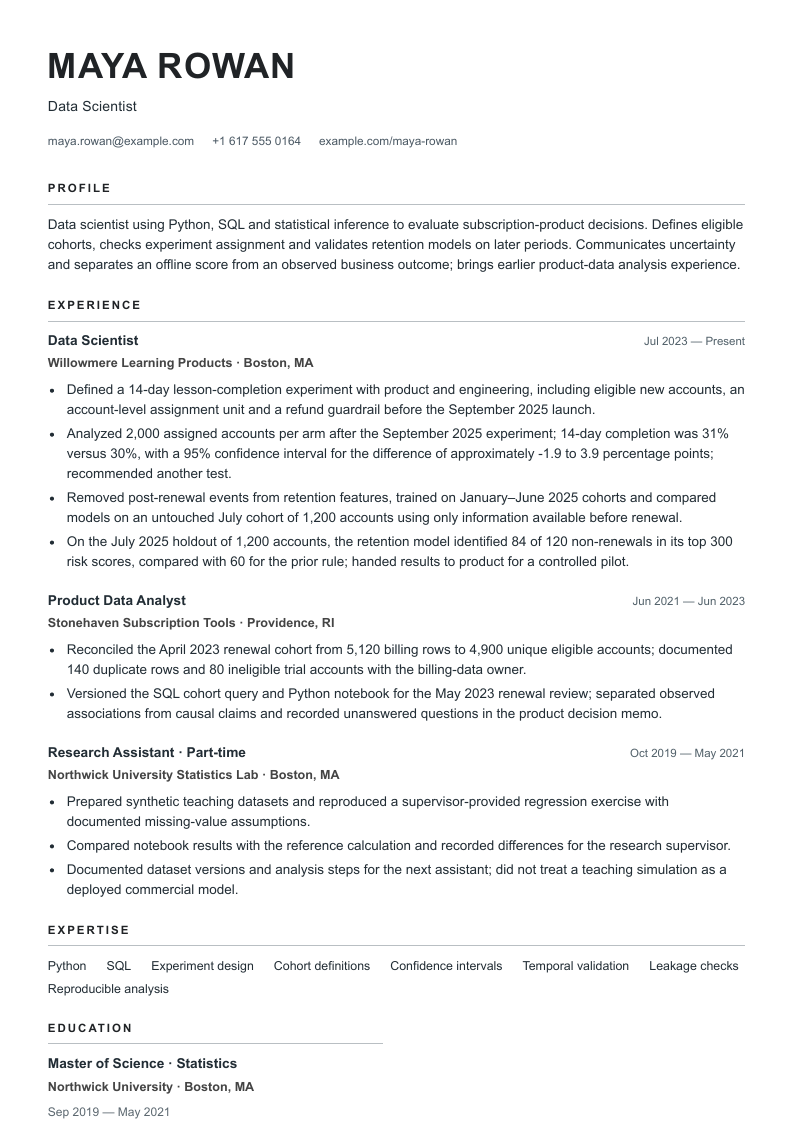
Data scientist using Python, SQL and statistical inference to evaluate subscription-product decisions. Defines eligible cohorts, checks experiment assignment and validates retention models on later periods. Communicates uncertainty and separates an offline score from an observed business outcome; brings earlier product-data analysis experience.
Defined a 14-day lesson-completion experiment with product and engineering, including eligible new accounts, an account-level assignment unit and a refund guardrail before the September 2025 launch.
Analyzed 2,000 assigned accounts per arm after the September 2025 experiment; 14-day completion was 31% versus 30%, with a 95% confidence interval for the difference of approximately -1.9 to 3.9 percentage points; recommended another test.
Removed post-renewal events from retention features, trained on January–June 2025 cohorts and compared models on an untouched July cohort of 1,200 accounts using only information available before renewal.
On the July 2025 holdout of 1,200 accounts, the retention model identified 84 of 120 non-renewals in its top 300 risk scores, compared with 60 for the prior rule; handed results to product for a controlled pilot.
Product Data Analyst
Stonehaven Subscription Tools · Providence, RI
June 2021–June 2023
Reconciled the April 2023 renewal cohort from 5,120 billing rows to 4,900 unique eligible accounts; documented 140 duplicate rows and 80 ineligible trial accounts with the billing-data owner.
Versioned the SQL cohort query and Python notebook for the May 2023 renewal review; separated observed associations from causal claims and recorded unanswered questions in the product decision memo.
Research Assistant · Part-time
Northwick University Statistics Lab · Boston, MA
October 2019–May 2021
Prepared synthetic teaching datasets and reproduced a supervisor-provided regression exercise with documented missing-value assumptions.
Compared notebook results with the reference calculation and recorded differences for the research supervisor.
Documented dataset versions and analysis steps for the next assistant; did not treat a teaching simulation as a deployed commercial model.
Education
Master of Science in Statistics · Northwick University · Boston, MA
September 2019–May 2021
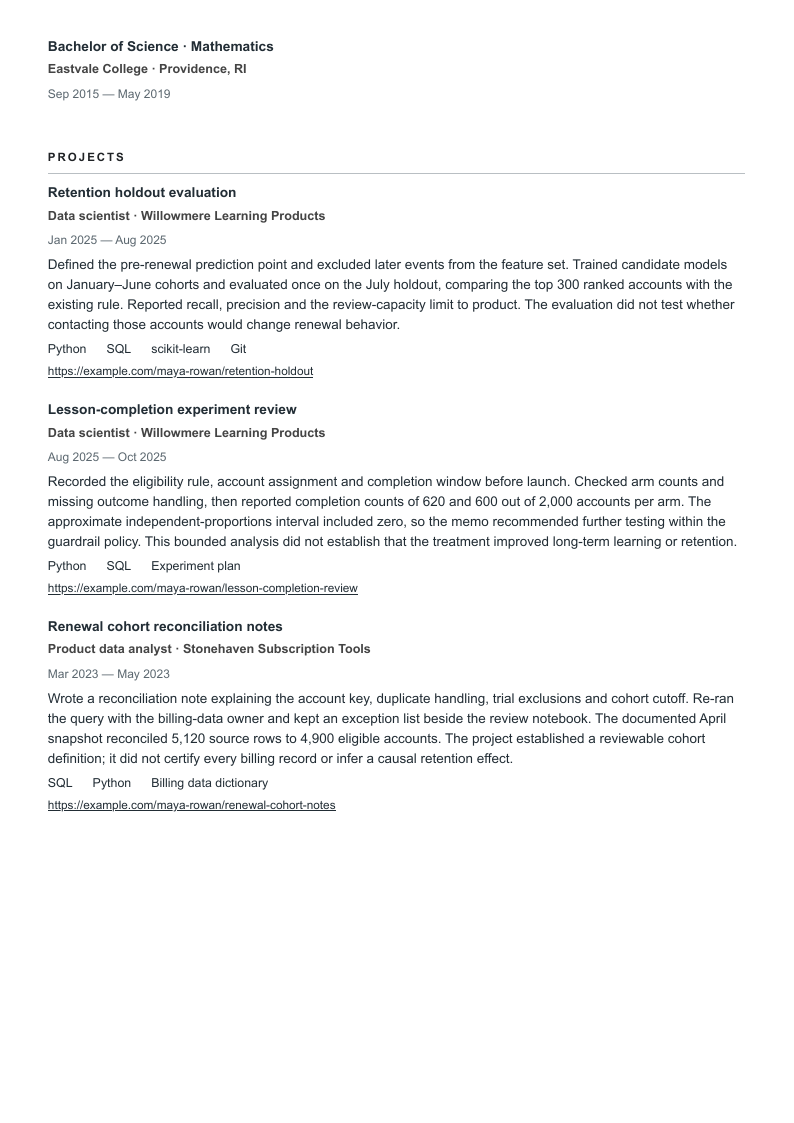
Bachelor of Science in Mathematics · Eastvale College · Providence, RI
September 2015–May 2019
Projects
Retention holdout evaluation
Data scientist · Willowmere Learning Products
January 2025–August 2025
Python · SQL · scikit-learn · Git
Defined the pre-renewal prediction point and excluded later events from the feature set. Trained candidate models on January–June cohorts and evaluated once on the July holdout, comparing the top 300 ranked accounts with the existing rule. Reported recall, precision and the review-capacity limit to product. The evaluation did not test whether contacting those accounts would change renewal behavior.
Recorded the eligibility rule, account assignment and completion window before launch. Checked arm counts and missing outcome handling, then reported completion counts of 620 and 600 out of 2,000 accounts per arm. The approximate independent-proportions interval included zero, so the memo recommended further testing within the guardrail policy. This bounded analysis did not establish that the treatment improved long-term learning or retention.
Product data analyst · Stonehaven Subscription Tools
March 2023–May 2023
SQL · Python · Billing data dictionary
Wrote a reconciliation note explaining the account key, duplicate handling, trial exclusions and cohort cutoff. Re-ran the query with the billing-data owner and kept an exception list beside the review notebook. The documented April snapshot reconciled 5,120 source rows to 4,900 eligible accounts. The project established a reviewable cohort definition; it did not certify every billing record or infer a causal retention effect.
Use additional space when relevant evidence warrants it. Select material for the target role before changing spacing, and review all continuation pages after each substantial edit. A compressed explanation that drops the prediction cutoff or the denominator can make a statistical claim harder to assess.
Review the file that will reach the employer
Read every exported page at normal size. Check the complete contacts, technical terms, minus signs, percentage-point units, dates and final project lines.
Select and copy the text. Confirm that headings, jobs and their bullets read in a usable order. Clarity’s rail precedes the experience column in document order; inspect the copied output for your record.
Test contact and project destinations. Compare visible text with the destination. Replace every example.com placeholder with your own verified address or remove it.
Reconcile the claims. Check cohort counts, baseline, evaluation window, uncertainty, personal ownership and the difference between prediction performance and intervention effects.
Follow the application’s file instructions. After uploading, review parsed titles, dates and contact details. No design guarantees correct parsing in every application system.
Review your resume with the analyzer and compare suggestions with your records and the vacancy. The design buttons open signup with a generic Data Scientist role, selected design and photo preference. They do not insert Maya’s record. Free-plan PDF downloads include a watermark; these examples show paid-plan output.
Questions, answered
Which metrics belong on a data scientist resume?
Use measures that match the task and available evidence. State the cohort, period, baseline, evaluation setup and your contribution. A ranking model may need recall and precision at a defined capacity; an experiment needs an outcome estimate and uncertainty. Do not turn an offline score into a business outcome or claim a universal model accuracy.
Can I include an inconclusive experiment?
Yes, when it shows valid design, careful interpretation and a useful decision. Report the observed estimate and its uncertainty, then explain the recommendation. An interval spanning zero does not prove that the treatment has no effect.
Do all data scientist jobs require a PhD?
Requirements vary by vacancy and level. Read the required qualification and any stated alternatives. A bachelor’s or master’s degree does not establish eligibility for a role requiring a PhD without an applicable alternative, and a certificate does not automatically substitute for that requirement.
How is this different from a data analyst or ML engineer resume?
This example emphasizes experiment design, uncertainty and predictive validation. Analyst and BI roles may emphasize analysis, governed reporting and decision support, while ML engineering may emphasize deployment and operation. Titles overlap; describe the work you actually owned and the target vacancy’s scope.
Should I add a photo?
The examples default to no photo for this US application context. Follow the employer’s instructions and local expectations. The photo toggle is a layout comparison, not evidence that a portrait improves hiring outcomes.
Will signup copy the fictional resume?
No. The Use buttons carry the selected design, photo preference and generic Data Scientist role into signup. The fictional candidate’s career, contacts and portrait are not inserted into your account. A free account is required; free-plan PDF downloads include a watermark.
Compare the data analyst and business intelligence analyst examples when the vacancy centers on analysis, reporting or governed measures. Keep your real title and make your own contribution clear.
Prepared by Resumize with AI-assisted research and drafting for English-language US applications. Three primary employer descriptions and CareerOneStop guidance were checked on October 27, 2026. Application controls were observed as noted below; application completion was not tested. These selected vacancies illustrate growth, experimentation and decision science at different levels. They are not a representative survey or a set of universal requirements. The resume, rewrites and numerical examples are original editorial fiction; the portrait is AI-generated. No employer endorses the examples or promises hiring results.
Checked October 27, 2026: Direct primary page displayed Apply and an application form; New York City, Seattle or San Francisco, no publication date shown. Growth and personalization paths emphasize experiments, guardrails and decisions. The seven-year experience wording is vacancy-specific.
Checked October 27, 2026: Direct primary page displayed Apply; San Francisco Bay Area, no publication date shown. Staff scope centers on experiment methodology, causal inference and education. Its PhD-or-equivalent and experience terms are specific to this staff vacancy.
Checked October 27, 2026: Direct primary page displayed Apply and an application form; San Mateo, California, no publication date shown. Combines statistical/ML methods, hypotheses, SQL and recommendations. Graduate study plus experience is stated, with a BA/BS route considered through additional relevant experience.
Checked October 27, 2026: US Department of Labor-sponsored resume guidance on relevant employment, dates, context and specific contributions. General career guidance; it does not certify these designs or promise application-system compatibility.