A UX researcher resume should explain how you turn a product question into a defensible study and a useful decision. Show why you chose a method, whom you studied, how you interpreted the evidence and what the team did next. This complete example keeps research contribution distinct from interface design and product ownership, with six annotated rewrites and three layouts.
These previews use the same layouts as the builder, with identical example content. Open a full preview to inspect the text and spacing.
Fictional candidate, employers, education and results. The optional portrait is AI-generated. Use your own evidence and photo; the example is not inserted into your resume.
Outcome
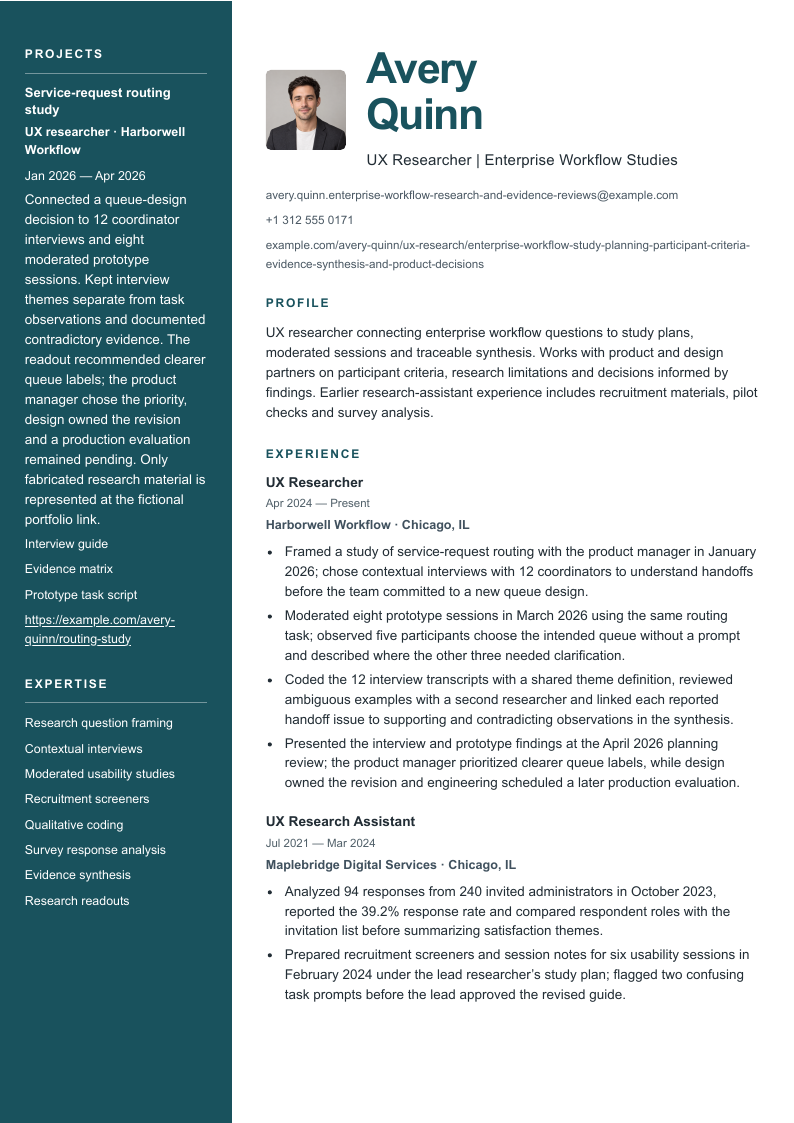
A dark teal left rail presents projects, expertise and education before a white main column with identity, contacts, profile and experience.
Before sending: Research projects are prominent but the narrow rail wraps long explanations. Read the evidence limitations and degree through each continuation, and check copied-text order.
A large serif name and italic profile precede projects and experience, with expertise beside education in a closing two-column block.
Before sending: The project appears before the work history. Keep study scope and decision ownership clear, and inspect the closing qualifications on the final page.
A teal identity band is followed by separate Contact, Profile and Expertise cells; education sits in the left body rail beside experience and projects.
Before sending: The three-cell introduction and narrow education rail change the reading path. Check long contacts, date associations and both columns of the export.
“Use” opens signup with that design and photo preference selected for the builder. A free account is required. Free-plan PDF downloads include a watermark; see current plans for paid options. Photo conventions vary; follow the employer’s instructions and local expectations.
Every design shows the same fictional career record. The default has no photo; all three offer an optional portrait preview. The resume and AI-generated portrait are teaching examples and are not inserted into your account. Use buttons retain the selected design, photo preference and UX Researcher role through signup. A free account is required; free-plan PDF downloads include a watermark.
Outcome gives projects, expertise and education a prominent left rail before the main identity, profile and experience column. Editorial introduces the project before work history and closes with expertise beside education. Studio separates Contact, Profile and Expertise into three cells, then places education beside experience and projects. Compare the actual reading path and complete pages; visual emphasis does not establish parsing quality.
Read the design guides: Outcome · Editorial · Studio. Follow the employer’s file and photo instructions, then inspect your own content in the chosen design.
A complete ux researcher resume example
Avery Quinn and every candidate detail, employer, date, qualification, project and result below are fictional. The example.com links are placeholders, and the optional portrait is AI-generated. This guide uses AI-assisted research and drafting.
UX researcher connecting enterprise workflow questions to study plans, moderated sessions and traceable synthesis. Works with product and design partners on participant criteria, research limitations and decisions informed by findings. Earlier research-assistant experience includes recruitment materials, pilot checks and survey analysis.
Framed a study of service-request routing with the product manager in January 2026; chose contextual interviews with 12 coordinators to understand handoffs before the team committed to a new queue design.
Moderated eight prototype sessions in March 2026 using the same routing task; observed five participants choose the intended queue without a prompt and described where the other three needed clarification.
Coded the 12 interview transcripts with a shared theme definition, reviewed ambiguous examples with a second researcher and linked each reported handoff issue to supporting and contradicting observations in the synthesis.
Presented the interview and prototype findings at the April 2026 planning review; the product manager prioritized clearer queue labels, while design owned the revision and engineering scheduled a later production evaluation.
UX Research Assistant
Maplebridge Digital Services · Chicago, IL
July 2021–March 2024
Analyzed 94 responses from 240 invited administrators in October 2023, reported the 39.2% response rate and compared respondent roles with the invitation list before summarizing satisfaction themes.
Prepared recruitment screeners and session notes for six usability sessions in February 2024 under the lead researcher’s study plan; flagged two confusing task prompts before the lead approved the revised guide.
Education
Bachelor of Arts in Psychology · Northmere College · Chicago, IL
September 2017–May 2021
Coursework in research methods, statistics and human cognition, including a supervised study-design assignment. Fictional degree and institution.
Connected a queue-design decision to 12 coordinator interviews and eight moderated prototype sessions. Kept interview themes separate from task observations and documented contradictory evidence. The readout recommended clearer queue labels; the product manager chose the priority, design owned the revision and a production evaluation remained pending. Only fabricated research material is represented at the fictional portfolio link.
Connect the study question to a real product decision
Lead with the uncertainty that made research useful. Was the team deciding how to route a request, whether an unfamiliar concept was understandable or which task deserved deeper investigation? Avery’s example starts before a queue design is chosen. Contextual interviews explore how coordinators handle work; later prototype sessions examine a particular task. The methods answer related but different questions.
Name the participant group and the selection logic. Twelve coordinators are not twelve random customers, and eight prototype participants do not establish a population-wide completion rate. A short resume can still show the boundary: who participated, what they tried and what you observed. Keep detailed recruitment and moderation decisions in an approved case study, then link only to material you may share.
The employers illustrate different routes and responsibilities. Carrier’s vacancy combines research with operational-workflow and design collaboration. The 6sense description emphasizes evidence quality, focused studies and coaching partners. mthree advertises a graduate hybrid design/research role, not a pure research specification for every employer. Select the work relevant to your own experience instead of collecting every method and tool as keywords.
Six ux researcher experience rewrites with reasoning
Every “after” appears verbatim in the base example. The deliberately weak “before” sentences are not additional career facts. Use the evidence prompts to verify your own contribution rather than borrowing these invented numbers.
1. Start with the decision
Before: Conducted research that transformed the whole product.
After: Framed a study of service-request routing with the product manager in January 2026; chose contextual interviews with 12 coordinators to understand handoffs before the team committed to a new queue design.
Connects a method and participant group to a decision. It does not treat interviews as a representative market survey or claim ownership of the final product strategy.
Evidence to check: The decision brief, participant criteria, interview guide and documented limits; use only approved, de-identified material.
2. Define the observed task
Before: Proved the new design was easy for all users.
After: Moderated eight prototype sessions in March 2026 using the same routing task; observed five participants choose the intended queue without a prompt and described where the other three needed clarification.
Five of eight is a descriptive observation under one task and prototype. It is not a production success rate or a statistically established improvement.
Evidence to check: Task wording, moderation notes, prompt rules and the analysis matrix, with consented records kept in the approved research system.
3. Make synthesis traceable
Before: Discovered what customers really wanted.
After: Coded the 12 interview transcripts with a shared theme definition, reviewed ambiguous examples with a second researcher and linked each reported handoff issue to supporting and contradicting observations in the synthesis.
Shows a disciplined interpretation process and counterevidence. A theme count alone would not establish prevalence, and a second reviewer does not remove every interpretive limitation.
Evidence to check: A permitted codebook excerpt, disagreement log and evidence matrix; do not expose participant identities or verbatim confidential transcripts.
4. Show influence without claiming implementation
Before: My research increased customer retention by 30%.
After: Presented the interview and prototype findings at the April 2026 planning review; the product manager prioritized clearer queue labels, while design owned the revision and engineering scheduled a later production evaluation.
The outcome is a recorded product decision with named owners. It does not attribute a retention or revenue result to research when no production evaluation has occurred.
Evidence to check: The decision record, research recommendation and follow-up measurement question, rather than a fabricated commercial result.
5. Use survey denominators honestly
Before: Surveyed customers and proved everyone loved the service.
After: Analyzed 94 responses from 240 invited administrators in October 2023, reported the 39.2% response rate and compared respondent roles with the invitation list before summarizing satisfaction themes.
94 divided by 240 is approximately 39.2%. Response rate is not satisfaction, and examining role coverage does not eliminate nonresponse bias.
Evidence to check: The invitation cohort, valid-response rules, question wording and role comparison, without sharing personal contact data.
6. State earlier ownership clearly
Before: Led all research and designed the final interface.
After: Prepared recruitment screeners and session notes for six usability sessions in February 2024 under the lead researcher’s study plan; flagged two confusing task prompts before the lead approved the revised guide.
Shows useful research-operations and pilot work in a supporting role. The candidate does not claim the lead’s study design or the product designer’s interface work.
Evidence to check: An approved screener, pilot notes, guide revision and the lead’s decision; distinguish participant selection from research findings.
Show research judgment rather than a list of deliverables
A useful summary names the context, study skills and contribution that the bullets can support. Avery’s enterprise-workflow summary connects planning, moderated sessions and synthesis. It does not claim ownership of a final interface or a commercial result. A candidate with survey or analytics depth should name that actual strength and show the relevant design and analysis choices.
In experience bullets, keep the question, action and consequence together. A report is a deliverable; a planning decision informed by a report shows how it was used. Avery presents evidence and limitations, the product manager chooses a priority, design owns the revision and engineering schedules a later evaluation. That is meaningful influence even though retention has not been measured.
Use quantitative language with defined units. The survey’s 94 valid responses out of 240 invitations produce an approximate 39.2% response rate, not a satisfaction score. Comparing respondent roles with the invitation list helps describe coverage but does not remove nonresponse bias. Likewise, five unaided task completions among eight prototype sessions are an observation, not a measured lift against an absent baseline.
Tie ux researcher skills to a concrete work example
Prioritize the capabilities the vacancy asks for and your record can support. A skills list helps a reader locate them; a dated example explains what you actually did.
UX Researcher skills and supporting evidence
Skill
Evidence to gather
Fictional example
Question framing
The decision, uncertainty and why the chosen method fits.
Twelve coordinator interviews precede a queue-design decision.
Moderated testing
A defined task and prompt/observation rules.
Five of eight participants choose the intended queue unaided.
Synthesis
Evidence links, alternative explanations and review.
Themes retain supporting and contradicting observations.
Research influence
The recommendation and each decision owner.
Product chooses label clarity; design owns the revision.
Survey analysis
Invitation and response cohorts with coverage limits.
94 of 240 invitations produce a 39.2% response rate.
Research operations
Selection criteria, pilot checks and approvals.
Two task-prompt issues flagged before lead approval.
Use education and projects to demonstrate method choices
List your actual degree, field, institution and dates. Avery’s fictional psychology degree includes research methods, statistics and cognition coursework, plus an optional GPA. That background gives context for the work but does not prove mastery of every research method. A course project should show the question, participant or dataset boundary, method and limitations in its own terms.
No certification is claimed in this example. Do not turn attendance at a short course into a professional credential or suggest that every UX research role requires a particular degree. The three employer descriptions differ in experience and educational expectations; use their requirements for the specific application.
Choose a portfolio case that makes your reasoning assessable. In a concise case introduction, explain the question, your part, the evidence and the decision it informed. NN/g’s portfolio guidance supports showing context and constraints; the particular routing scenario here is original fiction. Use only artifacts and excerpts approved for sharing, and never assume that removing a name makes participant data safe to publish.
Make supporting and academic research work count accurately
You can demonstrate useful judgment before owning an entire study. Drafting a screener, testing a task prompt, checking response coverage or maintaining a research repository can show care and collaboration. Keep the lead researcher’s responsibility visible. Avery’s earlier usability work contributes recruitment materials and pilot feedback under a study plan rather than claiming independent study leadership.
For an academic, volunteer or personal project, label the setting and recruitment clearly. An exploratory study with classmates can show question framing and analysis, but it cannot prove what all customers need or how a production design performed. Explain what you would investigate next and why, rather than adding invented business impact.
The expanded record adds a part-time research-methods tutoring role that overlaps the final degree year. It preserves the later assistant and researcher roles unchanged. The work demonstrates teaching and practice-dataset checks, without implying independent ethics-review authority or access to participant records. If your strongest evidence is interface craft or product delivery, compare the separate product-designer and UX/UI-designer guides.
Fictional early-career adaptation
Fictional student adaptation: “Planned an exploratory study of course-registration labels with six volunteer classmates, documented the convenience sample and used the findings to propose a follow-up task study.” This describes a learning project without turning volunteer feedback into a university-wide satisfaction result.
Check long contacts with the optional photo
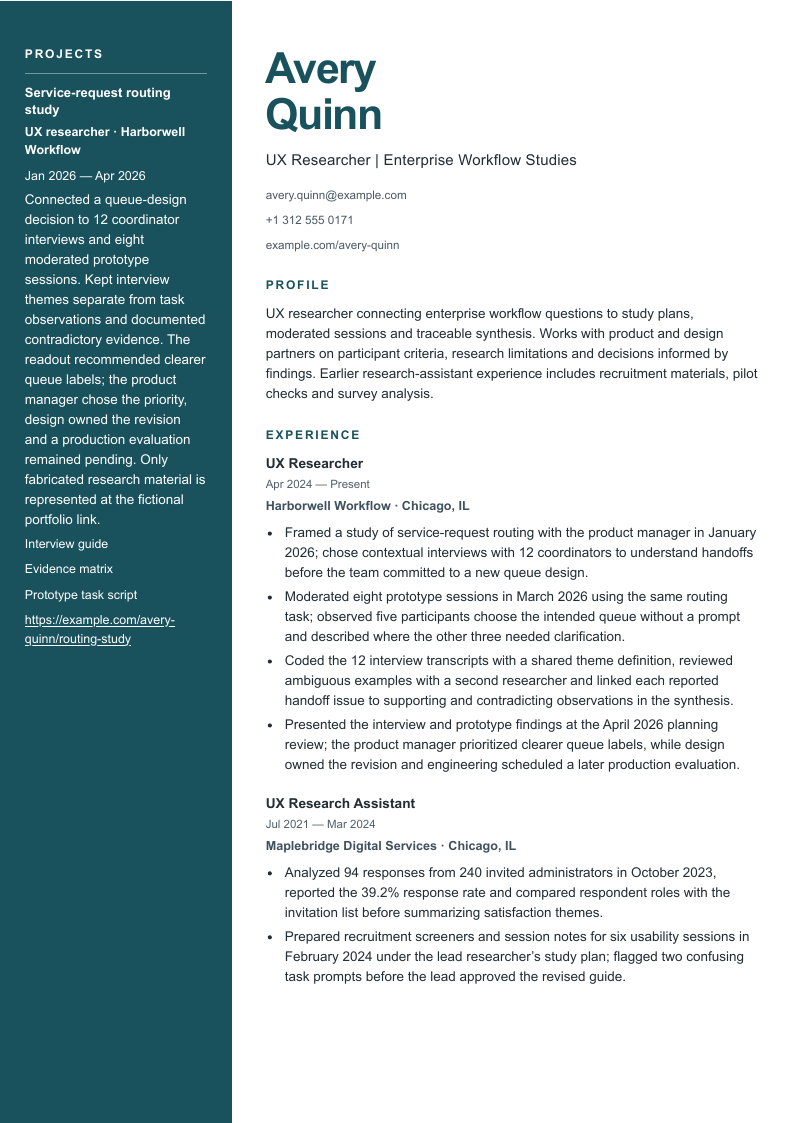
The Outcome long-contact scenario changes only Avery’s resume email and portfolio URL, with the optional portrait on. The account identity, phone, studies, degree, GPA and project remain identical. Check every contact character and the destination of the portfolio link. Then follow the narrow left-rail project and education text through the continuation pages.
UX researcher connecting enterprise workflow questions to study plans, moderated sessions and traceable synthesis. Works with product and design partners on participant criteria, research limitations and decisions informed by findings. Earlier research-assistant experience includes recruitment materials, pilot checks and survey analysis.
Framed a study of service-request routing with the product manager in January 2026; chose contextual interviews with 12 coordinators to understand handoffs before the team committed to a new queue design.
Moderated eight prototype sessions in March 2026 using the same routing task; observed five participants choose the intended queue without a prompt and described where the other three needed clarification.
Coded the 12 interview transcripts with a shared theme definition, reviewed ambiguous examples with a second researcher and linked each reported handoff issue to supporting and contradicting observations in the synthesis.
Presented the interview and prototype findings at the April 2026 planning review; the product manager prioritized clearer queue labels, while design owned the revision and engineering scheduled a later production evaluation.
UX Research Assistant
Maplebridge Digital Services · Chicago, IL
July 2021–March 2024
Analyzed 94 responses from 240 invited administrators in October 2023, reported the 39.2% response rate and compared respondent roles with the invitation list before summarizing satisfaction themes.
Prepared recruitment screeners and session notes for six usability sessions in February 2024 under the lead researcher’s study plan; flagged two confusing task prompts before the lead approved the revised guide.
Education
Bachelor of Arts in Psychology · Northmere College · Chicago, IL
September 2017–May 2021
Coursework in research methods, statistics and human cognition, including a supervised study-design assignment. Fictional degree and institution.
Connected a queue-design decision to 12 coordinator interviews and eight moderated prototype sessions. Kept interview themes separate from task observations and documented contradictory evidence. The readout recommended clearer queue labels; the product manager chose the priority, design owned the revision and a production evaluation remained pending. Only fabricated research material is represented at the fictional portfolio link.
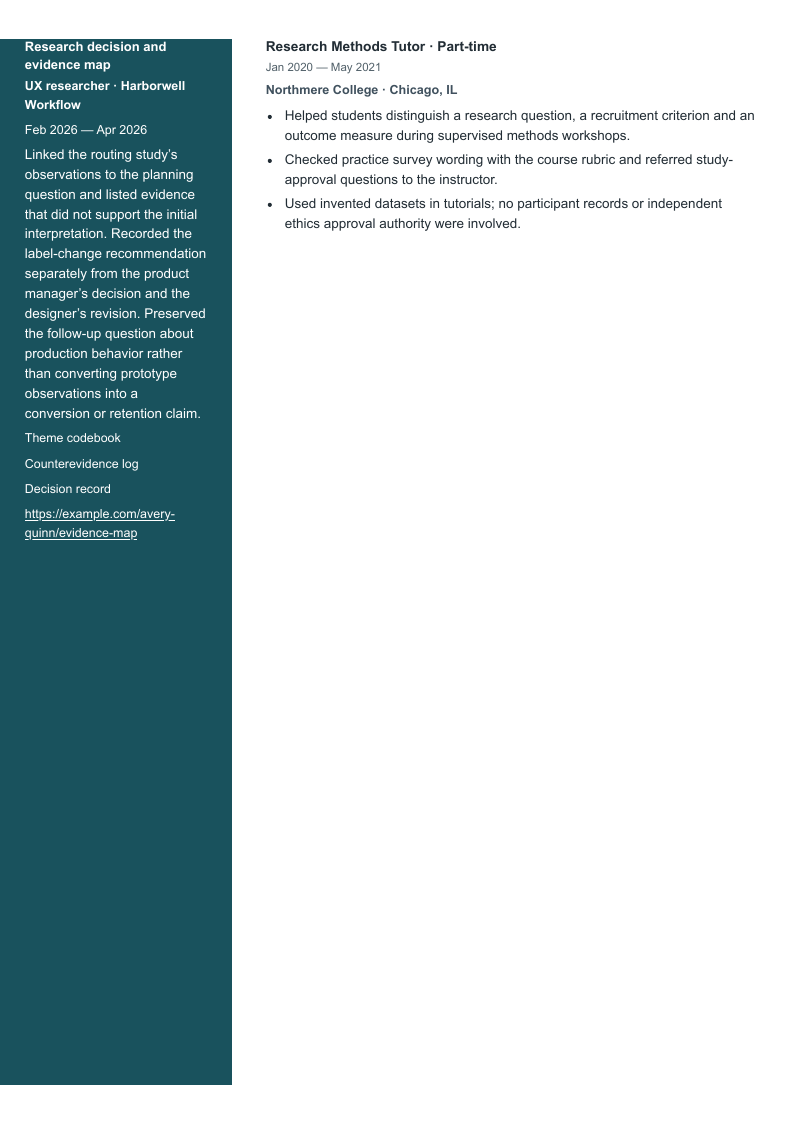
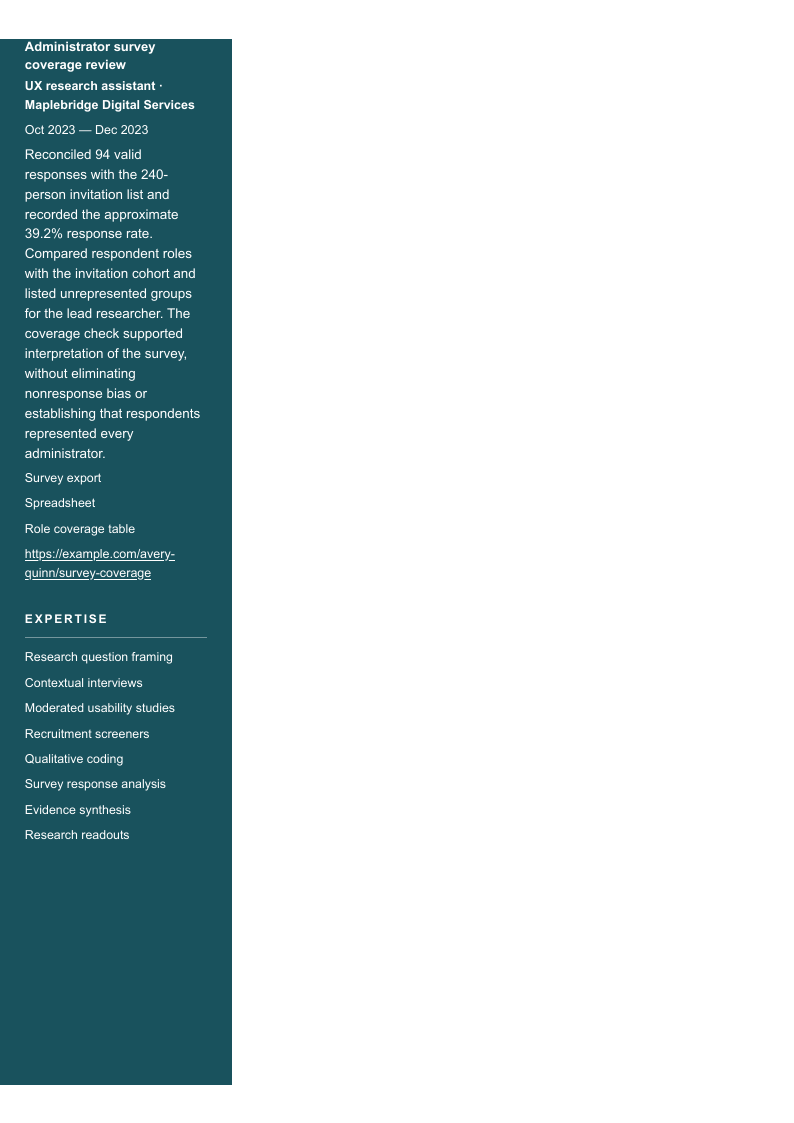
The expanded Outcome record has the photo off. Every base field remains intact; it adds the earlier part-time tutoring job, a research decision/evidence map and a survey coverage review. These additions make ownership and measurement boundaries more explicit. Inspect both columns and their final sentences rather than treating a fixed page count as a requirement.
Open page 1 at full sizeOutcome · Page 1 of 4 · Photo off · Complete paid-plan PDF page, including margins, without a watermark.Open page 2 at full sizeOutcome · Page 2 of 4 · Photo off · Complete paid-plan PDF page, including margins, without a watermark.Open page 3 at full sizeOutcome · Page 3 of 4 · Photo off · Complete paid-plan PDF page, including margins, without a watermark.Open page 4 at full sizeOutcome · Page 4 of 4 · Photo off · Complete paid-plan PDF page, including margins, without a watermark.Use Outcome without a photo
UX researcher connecting enterprise workflow questions to study plans, moderated sessions and traceable synthesis. Works with product and design partners on participant criteria, research limitations and decisions informed by findings. Earlier research-assistant experience includes recruitment materials, pilot checks and survey analysis.
Framed a study of service-request routing with the product manager in January 2026; chose contextual interviews with 12 coordinators to understand handoffs before the team committed to a new queue design.
Moderated eight prototype sessions in March 2026 using the same routing task; observed five participants choose the intended queue without a prompt and described where the other three needed clarification.
Coded the 12 interview transcripts with a shared theme definition, reviewed ambiguous examples with a second researcher and linked each reported handoff issue to supporting and contradicting observations in the synthesis.
Presented the interview and prototype findings at the April 2026 planning review; the product manager prioritized clearer queue labels, while design owned the revision and engineering scheduled a later production evaluation.
UX Research Assistant
Maplebridge Digital Services · Chicago, IL
July 2021–March 2024
Analyzed 94 responses from 240 invited administrators in October 2023, reported the 39.2% response rate and compared respondent roles with the invitation list before summarizing satisfaction themes.
Prepared recruitment screeners and session notes for six usability sessions in February 2024 under the lead researcher’s study plan; flagged two confusing task prompts before the lead approved the revised guide.
Research Methods Tutor · Part-time
Northmere College · Chicago, IL
January 2020–May 2021
Helped students distinguish a research question, a recruitment criterion and an outcome measure during supervised methods workshops.
Checked practice survey wording with the course rubric and referred study-approval questions to the instructor.
Used invented datasets in tutorials; no participant records or independent ethics approval authority were involved.
Education
Bachelor of Arts in Psychology · Northmere College · Chicago, IL
September 2017–May 2021
Coursework in research methods, statistics and human cognition, including a supervised study-design assignment. Fictional degree and institution.
Connected a queue-design decision to 12 coordinator interviews and eight moderated prototype sessions. Kept interview themes separate from task observations and documented contradictory evidence. The readout recommended clearer queue labels; the product manager chose the priority, design owned the revision and a production evaluation remained pending. Only fabricated research material is represented at the fictional portfolio link.
Theme codebook · Counterevidence log · Decision record
Linked the routing study’s observations to the planning question and listed evidence that did not support the initial interpretation. Recorded the label-change recommendation separately from the product manager’s decision and the designer’s revision. Preserved the follow-up question about production behavior rather than converting prototype observations into a conversion or retention claim.
UX research assistant · Maplebridge Digital Services
October 2023–December 2023
Survey export · Spreadsheet · Role coverage table
Reconciled 94 valid responses with the 240-person invitation list and recorded the approximate 39.2% response rate. Compared respondent roles with the invitation cohort and listed unrepresented groups for the lead researcher. The coverage check supported interpretation of the survey, without eliminating nonresponse bias or establishing that respondents represented every administrator.
Read the complete email, portfolio URL, degree, GPA and all final study/project sentences in the actual export. Inspect both Outcome columns and Studio’s three-cell introduction at normal size.
Keep participant counts attached to the right study. Do not combine interviews, prototype tasks and survey responses into one total or turn a response rate into satisfaction.
Check which research activities were yours and who made the product, design and implementation decisions. Keep pending production evaluation distinct from measured impact.
Test approved portfolio links, copy the PDF text and inspect parsed application fields. Follow the requested file type and employer assistance rules. Share only material authorized for a portfolio; leave participant records in approved systems.
These full-page images show paid-plan output without a watermark. Free-plan PDF downloads include a watermark. No design guarantees parsing, ranking or an interview. Check your own saved file and the application fields.
Questions, answered
What makes a UX researcher resume different from a designer resume?
Emphasize research questions, method and participant choices, analysis, limitations and decisions informed by findings. Show design contribution only when it was actually yours; do not use polished screens as a substitute for research reasoning.
Do I need a portfolio?
Check the posting. When case studies are requested or useful, show your contribution, evidence and reasoning using approved material. A concise case can be effective without exposing raw participant data or confidential product plans.
How can I show impact without a revenue metric?
State the decision informed, uncertainty reduced or follow-up work agreed, and identify the other owners. A recorded product priority can be a useful outcome without claiming an unmeasured conversion, retention or revenue effect.
Can I report five of eight users succeeding?
Describe the participants, task and observation honestly. Five of eight prototype participants is a descriptive study result, not proof of a population rate, statistical significance or improvement without a suitable comparison.
Can I use academic or volunteer research?
Yes, when clearly labeled and relevant. Explain recruitment, method, your responsibility and limitations. Do not present a class exercise as production product research or claim commercial outcomes it did not measure.
What do the design buttons carry into signup?
They retain your selected design, photo preference and UX Researcher role. They do not insert Avery’s fictional resume or AI portrait into your account. A free account is required; free-plan PDF downloads include a watermark.
Compare related design roles
Compare the product designer guide for product and interface work and the UX/UI designer guide for combined experience and visual design. Keep your actual title and contribution clear.
Primary sources and editorial scope
Prepared by Resumize with AI-assisted research and drafting for English-language US applications. Three directly retrieved current employer descriptions were checked on October 28, 2026 with full responsibilities and application controls. Carrier, 6sense and mthree illustrate operational workflow research, B2B evidence practice and a graduate hybrid design/research route respectively; they do not define one universal role. NN/g provides limited portfolio context and CareerOneStop provides general experience-writing guidance. Every candidate, employer, study, result, degree and project in the resume is fictional, and the portrait is AI-generated. No employer endorsement, guaranteed parsing, ranking or hiring result is claimed.
Retrieved October 28, 2026. Florida and New York remote locations in the United States; job ID 30217942, posting date October 16, 2026. Full description and Apply link present. Illustrates operational workflow research and collaboration, with domain and design experience specific to this vacancy.
Retrieved October 28, 2026. Austin, Texas, United States; body describes UX Researcher II. Full description, Apply control and application form present; no posting date displayed. Illustrates scoped studies, evidence quality, partner coaching and clear findings in a B2B product environment.
Retrieved October 28, 2026. USA heading and New York tri-state residency requirement in the body. Full description, Apply control and form present; no posting date displayed. A graduate-program hybrid design/research role, used to contrast entry routes rather than define every research job.
Read October 28, 2026; article dated March 10, 2019. Used for concise guidance on context, research contribution and constraints in a portfolio. It does not evaluate these templates or establish current vacancy requirements.
Read October 28, 2026. General advice on relevant experience, employment dates and specific contributions; the fictional study choices and measurements are original editorial examples.