Essential
A plain left header and restrained headings lead into a single-column record with dates in a small gutter.
Before sending: Keep the decision context and dates readable; simple decoration does not establish evidence quality.
Business decisions · Research and assumptions
A Strategy Analyst resume should explain a choice, the evidence behind it and what the decision maker did next. Show how you framed alternatives, tested assumptions and communicated tradeoffs. A model, a recommendation, an approved pilot and a realized result are different achievements; let the reader see which one you delivered.
By Resumize · · AI-assisted research and drafting
Three designs · one example
These previews use the same layouts as the builder, with identical example content. Open a full preview to inspect the text and spacing.
Fictional candidate, employers, education and results. The optional portrait is AI-generated. Use your own evidence and photo; the example is not inserted into your resume.
A plain left header and restrained headings lead into a single-column record with dates in a small gutter.
Before sending: Keep the decision context and dates readable; simple decoration does not establish evidence quality.
A white centered header puts the optional circular portrait above the identity, followed by a restrained single-column record.
Before sending: The centered contact line and portrait use space; inspect long contacts and continuation pages.
A dark supporting rail carries skills and education beside the main career record.
Before sending: Longer projects can continue in the colored rail on another page after the main work history ends. Inspect every page, narrow supporting text and copied reading order.
“Use” opens signup with that design and photo preference selected for the builder. A free account is required. Free-plan PDF downloads include a watermark; see current plans for paid options. Photo conventions vary; follow the employer’s instructions and local expectations.
All three designs show the same fictional career. The default has no photo; the optional portrait is AI-generated. Follow the employer’s instructions and local conventions. Signup retains the exact design, photo preference and Strategy Analyst role. It does not insert the example career or portrait into your account. A free account is required; free-plan PDF downloads include a watermark. These previews show paid-plan output.
Morgan Ellis, employers, education, career, dates, projects and results are original fiction. All example.com links are placeholders and the 555 phone number is fictional. Use the structure with your own supported facts. This record contains two jobs, six work-history bullets, one education entry and one project, with no certification claim.
Strategy Analyst | Market Entry and Planning
morgan.ellis@example.com · +1 312 555 0148
Portfolio: https://example.com/morgan-ellis
Strategy analyst turning market research and operating assumptions into options for business leaders. Builds scenario models, tests evidence gaps with finance and commercial partners, and writes decision memos that distinguish recommendations from approved investments and realized results.
Market and competitor research · Scenario modeling · Excel · Decision memos · Assumption testing · Stakeholder interviews · PowerPoint · Implementation handover
Pinebridge Market Systems · Chicago, IL
May 2023–Present
Birchmere Commercial Research · Evanston, IL
July 2020–April 2023
Bachelor of Arts in Economics · Clearwater College · Illinois
August 2016–May 2020
Coursework in statistics, industrial organization and research methods.
Strategy analyst · Pinebridge Market Systems
January 2026–March 2026
Excel · Source register · Decision memo
Created a register linking the three entry options to dated market sources, demand ranges and capacity assumptions. Recorded the pilot decision separately from forecast outputs so later reviewers could identify what remained untested.
Morgan’s fictional career concerns market entry for a services business. The work combines demand research, capacity assumptions and unit-cost scenarios to compare three options. It is narrower than setting the entire company strategy, buying another company or owning a product launch. Name the business question first so the reader can understand why the analysis mattered.
The employer sample shows why the title needs context. ComparaJá describes a broad, in-person business-management remit in Lisbon; Scangroup’s Nairobi role focuses on consumers, brands and culture; Schonfeld’s London opening requires hands-on AI implementation for investment workflows. Their duties are not interchangeable. This example does not claim to satisfy all three specialties or location requirements.
Each after statement appears exactly in the base work history. The annotations explain evidence and authority boundaries. Replace every invented fact with your own work; a useful example is a structure for reasoning, not permission to borrow a result.
Before: Created winning business strategies.
After: Compared three entry options for a regional service launch, combining demand research, delivery capacity and unit-cost assumptions in a decision memo for the strategy director.
Why it works: Defines the decision and analytical inputs. A recommendation does not establish ownership of the final investment.
Evidence to check: Option definitions, source dates, model inputs and the decision owner.
Before: Forecast revenue with complete accuracy.
After: Built base, lower-demand and higher-cost scenarios for the launch model; showed how customer uptake and support capacity changed the recommendation and reviewed assumptions with finance.
Why it works: Scenario outputs are conditional estimates, not realized revenue or a promise of accuracy.
Evidence to check: Workbook versions, sensitivity ranges, finance review and explicit unresolved assumptions.
Before: Knew everything about our competitors.
After: Reviewed public pricing and service terms for 12 competitors in January 2026; recorded source dates and coverage gaps before grouping the findings into market-entry tradeoffs.
Why it works: The count defines the reviewed sample. Public offers may change and cannot establish the whole market.
Evidence to check: Saved public sources, inclusion rule, comparable offer definitions and missing-data notes.
Before: Delivered millions in growth alone.
After: Presented the option comparison with commercial and operations leads; documented the approved pilot scope, open questions and named owners for the subsequent operating review.
Why it works: Shows follow-through without claiming that a pilot became a profitable rollout.
Evidence to check: Decision record, your presentation role, pilot boundaries and owner handover.
Before: Owned the entire company plan.
After: Prepared sector research and customer-segment summaries for two planning workstreams, checking source definitions with the project lead before incorporating them into client discussion materials.
Why it works: Earlier research supports the later role while preserving review and client decision authority.
Evidence to check: Research brief, evidence register, permitted deliverables and review responsibility.
Before: Built dashboards that transformed the business.
After: Reconciled monthly sales extracts with the data owner and highlighted a regional mix change for the project lead to investigate; separated the observation from proposed explanations.
Why it works: An observed mix shift is a starting point for investigation, not proof of cause or strategy impact.
Evidence to check: Extract dates, reconciliation rule, regional definitions and subsequent investigation.
Lead with the kind of decision you support and two strengths demonstrated below it. Morgan names market research, scenario modeling and decision memos. An early applicant can use a labeled research project; an experienced analyst can explain a workstream and its senior sponsor. A senior record needs real cross-functional influence or complex decision scope, rather than a longer list of frameworks.
A recurring dashboard can supply evidence for strategy, but producing it is not automatically strategic ownership. Explain the question it raised and the investigation or recommendation that followed. Morgan’s earlier sales-mix observation remains a question for the project lead, preserving the difference between reporting a pattern and establishing its cause.
Select relevant skills you can explain through a decision or deliverable. Use truthful vacancy language in context. Repeating terms or listing every tool cannot establish competence or guarantee screening success.
| Skill | Evidence to gather | Fictional example |
|---|---|---|
| Problem framing | Decision, alternatives and owner. | Three regional entry options. |
| Research | Dated sources and comparability. | Twelve public competitor offers. |
| Modeling | Assumptions and sensitivity. | Demand and cost scenarios. |
| Synthesis | Reasoned recommendation and limits. | Decision memo for the strategy director. |
| Collaboration | Input review and decision authority. | Finance and operations assumption review. |
| Handover | Approved scope and unresolved questions. | Pilot owners and operating review. |
A useful model claim identifies the alternatives, input sources, time horizon and assumptions that could change the conclusion. Morgan’s base, lower-demand and higher-cost cases are conditional scenarios. They are not three predictions that all became true. Do not convert a forecast return into revenue generated, or credit yourself with a leader’s investment decision.
Competitor research also has a denominator. The twelve reviewed offers are a dated sample, not the whole market. Check whether geography, contract terms and service scope are comparable. Record missing information rather than silently filling it with a favorable assumption. An estimate can be useful when its uncertainty stays visible.
When implementation follows, name your handover role and the decision owner. A pilot approval can be a defensible outcome without inventing commercial success. Report any later results with their period and population, and acknowledge pricing changes, sales execution and other contributors. Confidential models, customer lists and investment papers do not belong in a public portfolio.
Morgan lists an economics degree and relevant research coursework, without a GPA or certification. Use the qualification you earned and its actual dates. A quantitative assignment can demonstrate a method when clearly labeled as coursework; it should not become client work. The small employer sample cannot establish a universal major or degree requirement.
Choose Excel, presentation software, SQL or research tools only at the level you used them. A checked workbook and clear recommendation can be stronger than unsupported claims of advanced financial modeling. Technical AI strategy, investment strategy and consumer-brand strategy require different evidence. Do not add Python or a postgraduate degree merely because Schonfeld’s specialist opening asks for them.
Choose a public or synthetic problem with a manageable decision, such as comparing three service-area options. Write a one-page brief, cite dated sources, set out assumptions and show which unanswered question would change your recommendation. Label the work self-directed. State that no organization acted on it if that is the case.
A portfolio should let a reader follow the reasoning without opening a private company workbook. A permitted summary can show the question, alternatives, method, recommendation and limitation. Keep the title you actually held when moving from research or operations into strategy. Transferable analysis is useful without relabeling earlier work as executive ownership.
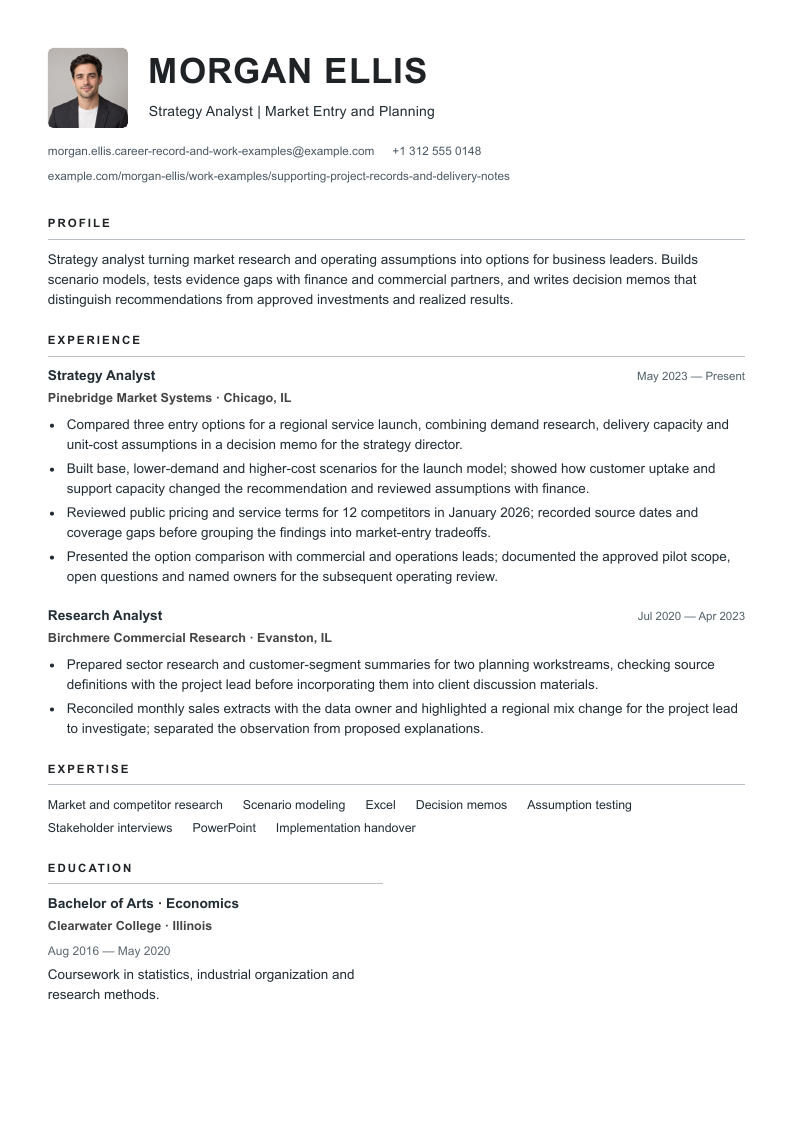
The long-contact Essential example has the photo on and changes only the resume email and portfolio URL. The user identity, phone and career stay identical. Follow both contacts through their final characters and open the link destination. The complete semantic record below includes the full address; a visually tidy label alone does not prove the destination is correct.
 Open page 1 at full size
 Open page 2 at full size
Strategy Analyst | Market Entry and Planning
morgan.ellis.career-record-and-work-examples@example.com · +1 312 555 0148
Portfolio: https://example.com/morgan-ellis/work-examples/supporting-project-records-and-delivery-notes
Strategy analyst turning market research and operating assumptions into options for business leaders. Builds scenario models, tests evidence gaps with finance and commercial partners, and writes decision memos that distinguish recommendations from approved investments and realized results.
Market and competitor research · Scenario modeling · Excel · Decision memos · Assumption testing · Stakeholder interviews · PowerPoint · Implementation handover
Pinebridge Market Systems · Chicago, IL
May 2023–Present
Birchmere Commercial Research · Evanston, IL
July 2020–April 2023
Bachelor of Arts in Economics · Clearwater College · Illinois
August 2016–May 2020
Coursework in statistics, industrial organization and research methods.
Strategy analyst · Pinebridge Market Systems
January 2026–March 2026
Excel · Source register · Decision memo
Created a register linking the three entry options to dated market sources, demand ranges and capacity assumptions. Recorded the pilot decision separately from forecast outputs so later reviewers could identify what remained untested.
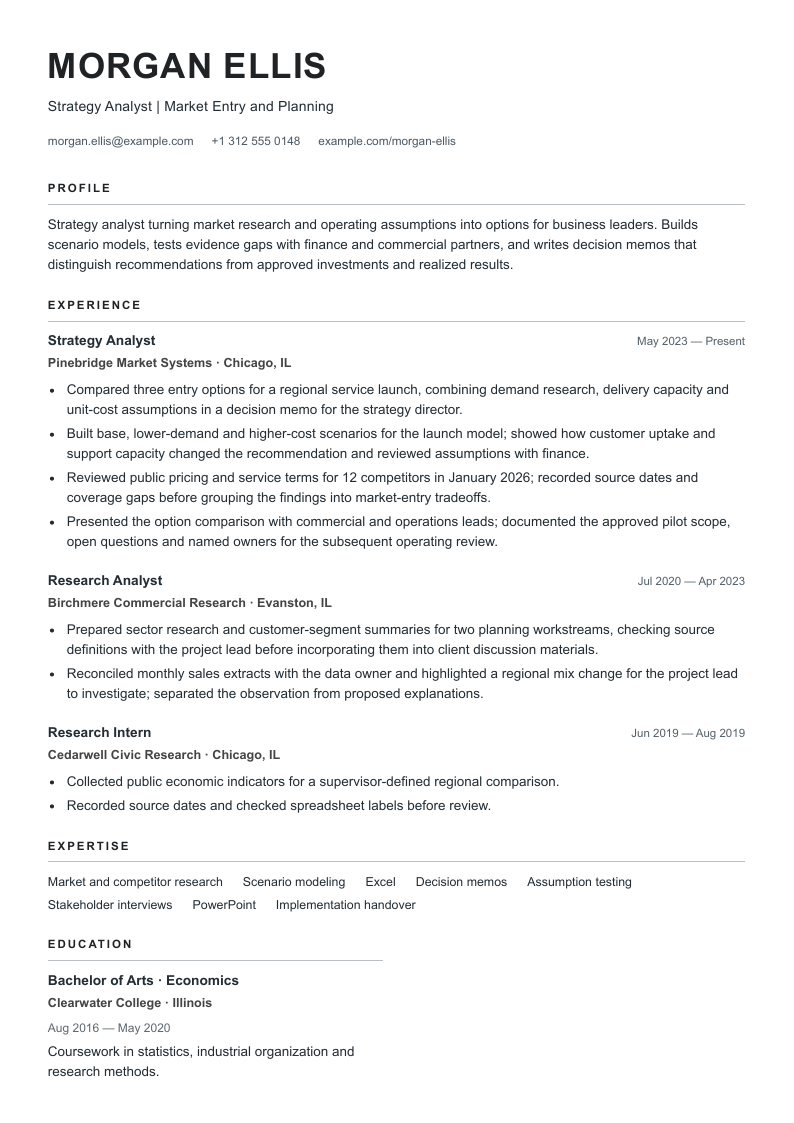
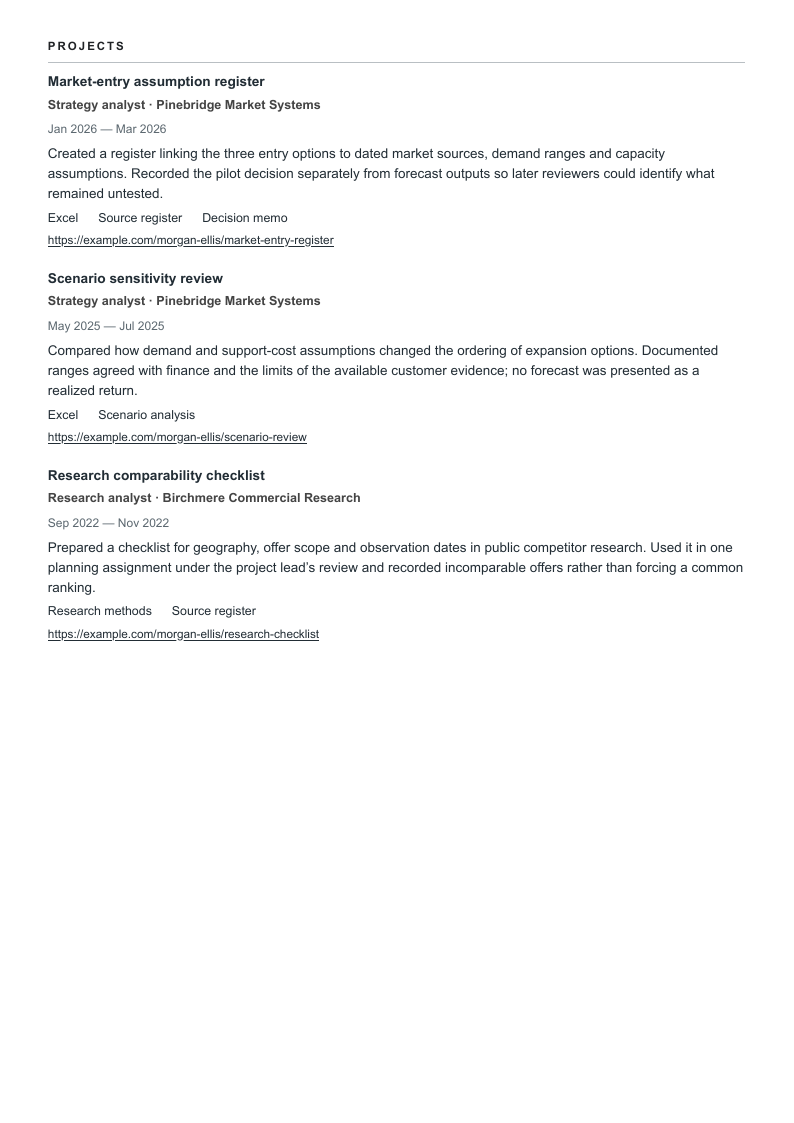
The expanded Essential example has the photo off. It retains every base field and adds an earlier research intern role and two projects. Read each job date and the final project ending, then compare them with the complete text below. Keep assumptions and approval boundaries with the statements they explain.
 Open page 1 at full size
 Open page 2 at full size
Strategy Analyst | Market Entry and Planning
morgan.ellis@example.com · +1 312 555 0148
Portfolio: https://example.com/morgan-ellis
Strategy analyst turning market research and operating assumptions into options for business leaders. Builds scenario models, tests evidence gaps with finance and commercial partners, and writes decision memos that distinguish recommendations from approved investments and realized results.
Market and competitor research · Scenario modeling · Excel · Decision memos · Assumption testing · Stakeholder interviews · PowerPoint · Implementation handover
Pinebridge Market Systems · Chicago, IL
May 2023–Present
Birchmere Commercial Research · Evanston, IL
July 2020–April 2023
Cedarwell Civic Research · Chicago, IL
June 2019–August 2019
Bachelor of Arts in Economics · Clearwater College · Illinois
August 2016–May 2020
Coursework in statistics, industrial organization and research methods.
Strategy analyst · Pinebridge Market Systems
January 2026–March 2026
Excel · Source register · Decision memo
Created a register linking the three entry options to dated market sources, demand ranges and capacity assumptions. Recorded the pilot decision separately from forecast outputs so later reviewers could identify what remained untested.
Strategy analyst · Pinebridge Market Systems
May 2025–July 2025
Excel · Scenario analysis
Compared how demand and support-cost assumptions changed the ordering of expansion options. Documented ranges agreed with finance and the limits of the available customer evidence; no forecast was presented as a realized return.
Research analyst · Birchmere Commercial Research
September 2022–November 2022
Research methods · Source register
Prepared a checklist for geography, offer scope and observation dates in public competitor research. Used it in one planning assignment under the project lead’s review and recorded incomparable offers rather than forcing a common ranking.
Condense repeated duties before removing useful context. Let relevant evidence use another page when needed, then inspect continuations for isolated headings, detached dates and unfinished sentences. Page count alone cannot establish readability.
Read every exported page with your selected photo preference. Check full contacts, job dates, qualifications and project endings. Copy text from the PDF and inspect parsed application fields when available; follow the employer’s requested file type. Use your own evidence and avoid including confidential records.
A free account is required for the builder. Free-plan PDF downloads include a watermark; these previews show paid-plan output. Template buttons retain the exact design, photo preference and Strategy Analyst role. Add your own details and photo after signup.
Use Essential without a photoThe resume analyzer gives advisory feedback. The bullet point generator can help draft from your notes; check every suggestion. No design or wording guarantees parsing, an interview or a hiring outcome.
Explain how evidence informed an alternative, tradeoff or recommendation. A dashboard can support that work, but the resume should identify the decision question and your analytical contribution.
Use supported scope, such as options assessed or research coverage. Keep estimates, approved decisions and realized outcomes separate, with periods and assumptions for any numerical result.
Select truthful problem framing, research, scenario modeling, synthesis and stakeholder communication skills. Tools and specialist domains depend on the opening; a broad keyword inventory cannot prove competence.
Prepared by Resumize with AI-assisted research and drafting for English-language applications. Three primary employer descriptions were directly retrieved with full readable duties, qualifications and application controls on October 29, 2026. Their locations, seniority and decision authority differ. This is a small dated sample, not a representative market survey or proof that the fictional applicant qualifies for each opening. No application was submitted, private employee or client data used, or hiring outcome tested.
Lisbon, Portugal; in-person headquarters role. Broad business-management, team and execution remit, with responsibilities further defined through recruitment. Not a fixed corporate-modeling specification. Full readable employer description and application controls retrieved October 29, 2026 with HTTP200; no posting date displayed.
Nairobi, Kenya; brand and consumer strategy, cultural intelligence, campaign evidence and multidisciplinary collaboration. A different research context from the fictional corporate market-entry analyst. Full duties, qualifications and application controls retrieved October 29, 2026 with HTTP200; no posting date displayed.
London, UK; specialized hands-on AI implementation for macro/fixed-income workflows. Three to five years post-university; technical postgraduate background strongly preferred. Not evidence that every strategy role requires AI engineering. Full duties, qualifications and application controls retrieved October 29, 2026 with HTTP200; no posting date displayed.