Operations Analyst · US service operations applications
Operations analyst resume examples and templates
An operations analyst resume should explain how you turned process data into a decision: which requests you counted, how you defined the measure, where the handoff slowed and what you recommended. This complete fictional example shows service operations analysis with clear limits on what the findings can prove.
These previews use the same layouts as the builder, with identical example content. Open a full preview to inspect the text and spacing.
Fictional candidate, employers, education and results. The optional portrait is AI-generated. Use your own evidence and photo; the example is not inserted into your resume.
Precision
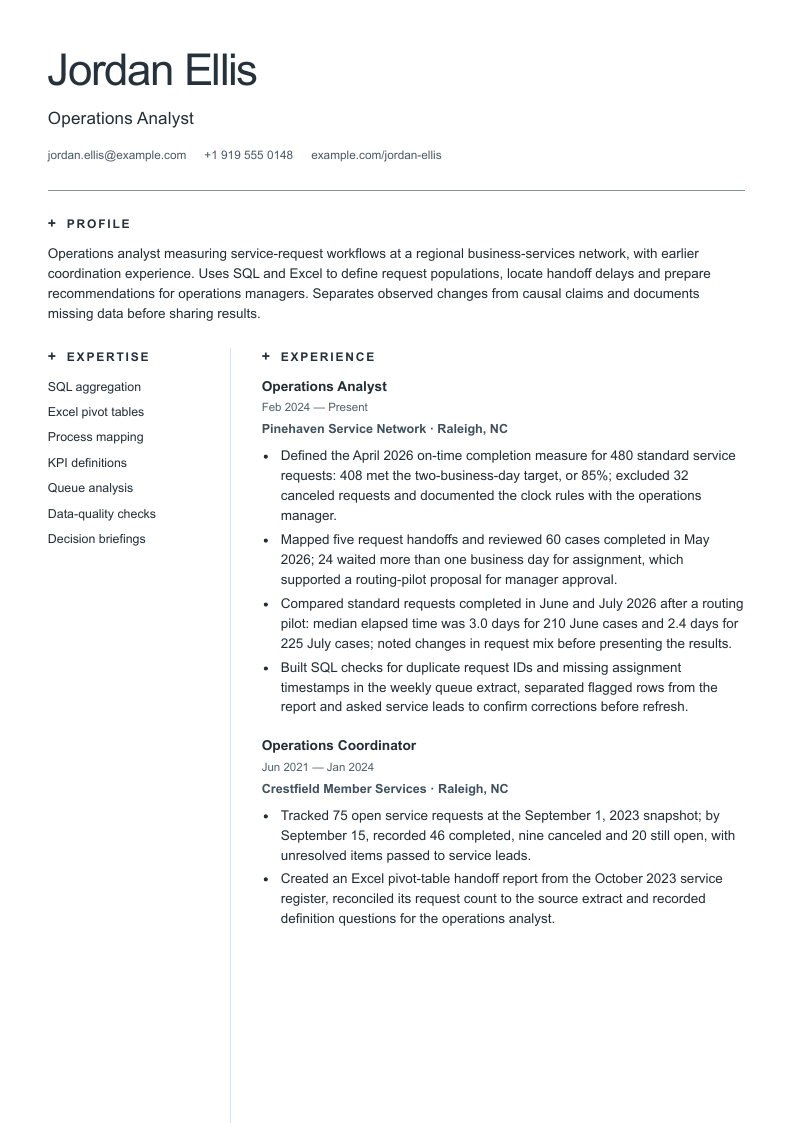
A full-width identity and summary lead to a narrow skills rail beside experience, education and projects, with fine rules.
Before sending: Long analytical bullets wrap within the main column. Check their cohort definitions and final limitations on every continuation page.
“Use” opens signup with that design and photo preference selected for the builder. A free account is required. Free-plan PDF downloads include a watermark; see current plans for paid options. Photo conventions vary; follow the employer’s instructions and local expectations.
Precision, Essential and Signal show Jordan’s identical record. Precision puts skills in a narrow rail while the work history stays in the main column; Essential uses a restrained single-column sequence; Signal adds small square markers and a date gutter. Choose by the readability of the analysis, including its definitions and limitations.
The default is without a photo, with an optional photo preview for every design. The selection buttons carry the chosen template and photo preference into signup for the builder. They do not insert the fictional resume or portrait into your account. Open every exported page before deciding.
Inspect the design details: Precision · Essential · Signal. A layout can organize evidence; it cannot supply missing experience or guarantee screening results.
A complete operations analyst resume example
Jordan Ellis is a fictional operations analyst at a regional business-services network in Raleigh, North Carolina. A prior operations-coordinator job explains the progression from tracking service requests to defining measures and investigating workflows. All people, employers, qualifications and results are invented. The example.com links are fictional placeholders. The portrait is AI-generated, and this guide uses AI-assisted research and drafting.
Operations analyst measuring service-request workflows at a regional business-services network, with earlier coordination experience. Uses SQL and Excel to define request populations, locate handoff delays and prepare recommendations for operations managers. Separates observed changes from causal claims and documents missing data before sharing results.
Defined the April 2026 on-time completion measure for 480 standard service requests: 408 met the two-business-day target, or 85%; excluded 32 canceled requests and documented the clock rules with the operations manager.
Mapped five request handoffs and reviewed 60 cases completed in May 2026; 24 waited more than one business day for assignment, which supported a routing-pilot proposal for manager approval.
Compared standard requests completed in June and July 2026 after a routing pilot: median elapsed time was 3.0 days for 210 June cases and 2.4 days for 225 July cases; noted changes in request mix before presenting the results.
Built SQL checks for duplicate request IDs and missing assignment timestamps in the weekly queue extract, separated flagged rows from the report and asked service leads to confirm corrections before refresh.
Operations Coordinator
Crestfield Member Services · Raleigh, NC
June 2021–January 2024
Tracked 75 open service requests at the September 1, 2023 snapshot; by September 15, recorded 46 completed, nine canceled and 20 still open, with unresolved items passed to service leads.
Created an Excel pivot-table handoff report from the October 2023 service register, reconciled its request count to the source extract and recorded definition questions for the operations analyst.
Education
Bachelor of Science in Business Analytics · Northlake College · Raleigh, NC
September 2017–May 2021
Projects
Routing pilot measurement note
Operations analyst · Pinehaven Service Network
May 2026–August 2026
SQL · Excel · Process map
Documented the five-handoff review and the June–July completed-request comparison for the operations manager. Preserved the 210- and 225-case populations, shared clock rules and request-mix caveat alongside the medians. The manager approved the pilot; Jordan supplied analysis rather than authorizing staffing or system changes. The fictional public note contains no customer records.
Jordan supplies analysis and recommendations; the operations manager approves the routing pilot and retains staffing decisions. That boundary belongs in the resume because a dashboard, an approved process change and a business result are different contributions. The example does not claim that the analyst managed the service team.
Match the kind of operations analysis the employer needs
Operations analyst is a broad title. Start with the work described in the vacancy: what service or transaction moves through the process, who uses the information and which decisions the analyst supports. For this example, the unit is a service request. Its evidence comes from request records, timestamp checks, a process map and a briefing for the operations manager. That is more useful context than saying “data-driven professional” without naming the operation.
The three employer descriptions illustrate the range. Sotheby’s combines operational reporting with process investigation. Magnet Forensics places its analyst in order execution as well as reporting. Vida Health adds contact-center quality and healthcare-specific responsibilities. These selected descriptions support tailoring; they do not establish that every analyst needs the same systems, credentials or authority. A service-process sample cannot stand in for experience in regulated healthcare work.
Before rewriting a bullet, identify the action you performed and the next owner. Did you query a source, check a measure, interview process users, recommend a pilot or implement an approved change? Keep the actual job title and add truthful context in the summary or bullet. Reporting on staffing does not establish that you set headcount, and an analytical recommendation does not establish that you approved the investment.
Make the denominator and clock understandable
Begin with the unit, time window and inclusion rule. Jordan’s April source population contains 512 requests. Removing 32 canceled requests leaves 480 standard requests in the stated measure; 408 met the target, so 408 ÷ 480 = 85%. The manager-reviewed clock rules matter as much as the percentage. A target measured in business days needs a consistent approach to weekends, start events and stop events.
The bottleneck review looks at a different population: 60 cases completed in May, of which 24 waited more than one business day for assignment. The observed share is 40% of reviewed completions. It does not tell a reader the wait distribution of requests that remained open or prove that staffing caused the delay. Keep that sample boundary visible instead of presenting a descriptive review as a complete root-cause investigation.
June and July also contain different completed-case cohorts: 210 and 225 requests. The median fell from 3.0 to 2.4 days, a difference of 0.6 day and a 20% decrease relative to June. That comparison does not isolate the pilot’s effect. Request mix changed, and the measure excludes unfinished cases. A before-and-after observation can be useful evidence when you report what changed and the limitation together.
If you lack a comparable baseline, describe the analysis, check or adopted reporting definition. You can show value through a decision-ready process map, a documented exception or a reconciled report. Do not invent a time saving or extrapolate a small sample into an annual benefit. Prepare enough private evidence to explain your method in an interview, and use only material you are permitted to disclose.
Six annotated operations analyst bullet rewrites
Every after sentence appears verbatim in the base resume above. These are original fictional examples. Use the evidence questions to improve your own wording; do not copy invented numbers or results into an application.
Define the population before the percentage
Before: Improved service levels by 20%.
After: Defined the April 2026 on-time completion measure for 480 standard service requests: 408 met the two-business-day target, or 85%; excluded 32 canceled requests and documented the clock rules with the operations manager.
Why it works: 408 divided by 480 equals 85%. The 32 cancellations are outside that denominator, so the source population contains 512 requests. There is no supported improvement percentage without a baseline.
Evidence to check: Dated request extract, cancellation flags, target definition and manager-reviewed metric notes.
Locate a bottleneck without inventing its cause
Before: Found the root cause of all delays.
After: Mapped five request handoffs and reviewed 60 cases completed in May 2026; 24 waited more than one business day for assignment, which supported a routing-pilot proposal for manager approval.
Why it works: Twenty-four of the 60 reviewed completions had that wait. This descriptive review identifies a point to investigate; it does not represent every request or prove why the wait occurred.
Evidence to check: Five-step process map, case-selection rule, timestamp review and decision brief.
Compare periods and retain the limitation
Before: Cut processing time by 50% through automation.
After: Compared standard requests completed in June and July 2026 after a routing pilot: median elapsed time was 3.0 days for 210 June cases and 2.4 days for 225 July cases; noted changes in request mix before presenting the results.
Why it works: The observed median fell 0.6 day, or 20% relative to June. These are different completed-case cohorts; the comparison cannot isolate the pilot effect or describe still-open cases.
Evidence to check: Same clock definition, both completed-case extracts, mix breakdown and pilot dates.
Show what the SQL check actually did
Before: Built a flawless automated dashboard.
After: Built SQL checks for duplicate request IDs and missing assignment timestamps in the weekly queue extract, separated flagged rows from the report and asked service leads to confirm corrections before refresh.
Why it works: A documented check and review process is stronger than claiming perfect data. A duplicate ID may reflect an export problem; it is not automatically a duplicate service request.
Evidence to check: Query version, flagged-row log, source-owner responses and refresh notes.
Preserve status arithmetic
Before: Cleared the entire customer backlog.
After: Tracked 75 open service requests at the September 1, 2023 snapshot; by September 15, recorded 46 completed, nine canceled and 20 still open, with unresolved items passed to service leads.
Why it works: 46 plus nine plus 20 equals the original 75. Cancellations are not completed work, and new arrivals are outside this fixed starting cohort.
Evidence to check: Both dated cohort snapshots, status history and handoff list.
Demonstrate a practical reporting skill
Before: Used Excel to transform operational efficiency.
After: Created an Excel pivot-table handoff report from the October 2023 service register, reconciled its request count to the source extract and recorded definition questions for the operations analyst.
Why it works: Names the tool, reconciliation and reviewer. Without measured comparable task times, this does not establish a saving or a productivity increase.
Evidence to check: Workbook version, source count and the analyst’s reviewed definition notes.
Write a summary that the experience can support
Lead with the operation and your contribution. Jordan names service-request workflows, SQL and Excel, then explains how managers use the findings. The work history supplies those proof points. A summary promising enterprise transformation, advanced machine learning or executive authority would outrun this record. Add a named platform only when you used it for the work described.
Give the recent role the strongest analytical examples and retain the earlier job’s coordination scope. Jordan’s September status tracking and October pivot report explain the foundation of the current role. The earlier job is not renamed analyst to manufacture a longer analytical tenure. If your title is unfamiliar, explain the service or process in a short phrase while retaining the official title.
Use a compact evidence chain: action, process or population, method, finding or handoff. You do not need all five in every sentence, but the reader should find them across the record. A report created for a service lead becomes stronger when the experience explains what was checked before use. Do not turn every supporting task into a claimed business outcome.
Give operations analyst skills a visible proof point
Choose skills that you can trace to work, then adapt the wording to the vacancy when it remains accurate. SQL on its own says little about query quality; process improvement on its own says little about your authority. The evidence column below gives you questions to answer before adding a claim. Do not add Salesforce because one researched employer uses it if your own work did not.
Operations Analyst skills and supporting evidence
Skill
Evidence to gather
Fictional example
SQL aggregation
Query logic, request key, exclusion rules and source reconciliation.
Weekly duplicate-ID and missing-timestamp checks.
KPI definitions
Numerator, denominator, business-day clock and review owner.
408 of 480 standard requests, with 32 cancellations excluded.
Process mapping
Defined start/end points, handoffs and case-selection method.
Five handoffs and a 60-completion review.
Analysis communication
Recommendation, decision owner and stated limitation.
Routing proposal and a cohort/mix caveat in the results briefing.
Excel
Workbook method and a check against the source.
Pivot-table handoff report reconciled to the extract.
Queue tracking
Dated cohort, separate statuses and treatment of new arrivals.
75 starting items: 46 completed, nine canceled and 20 open.
State education and training accurately
List the degree, field, institution and accurate dates. Jordan’s completed business analytics degree supports the story without substituting for the experience. Employers differ in their education and experience criteria; read the target posting rather than treating this sample as an eligibility checklist. Include a completed relevant course or credential with its issuer and status when it helps explain a method you used.
A course in analytics is not automatically a professional certification, and exposure to a tool is not the same as production proficiency. If study is unfinished, label it in progress and give an expected completion date only when it is defensible. Put education earlier when it is your strongest relevant evidence; keep it below substantial professional experience when that work better answers the vacancy.
Build an early-career version from real responsibilities
A first analyst application can use a coordinator role, internship, volunteer assignment or clearly labeled course project. Show a small, complete analytical task: a source you checked, a definition you wrote, a question you investigated and the person who reviewed it. The goal is a credible contribution, not a larger job title.
Fictional first-role adaptation
Summary: Business analytics graduate with service-desk internship experience reconciling request-register totals and documenting ambiguous categories. Seeking an operations analyst role supporting process measurement and review; brings practice explaining the limits of a small service-data analysis.
Example bullet: Compared two supplied course-project request extracts using a consistent completion rule, documented three records with missing timestamps and presented the unresolved rows separately from the elapsed-time summary.
This graduate summary and course exercise are separate editorial fiction, not additional employment claims for Jordan. In your version, retain the actual project label, dates, data permissions and reviewer. A sanitized or synthetic work sample can explain your method; never publish a customer export to demonstrate SQL.
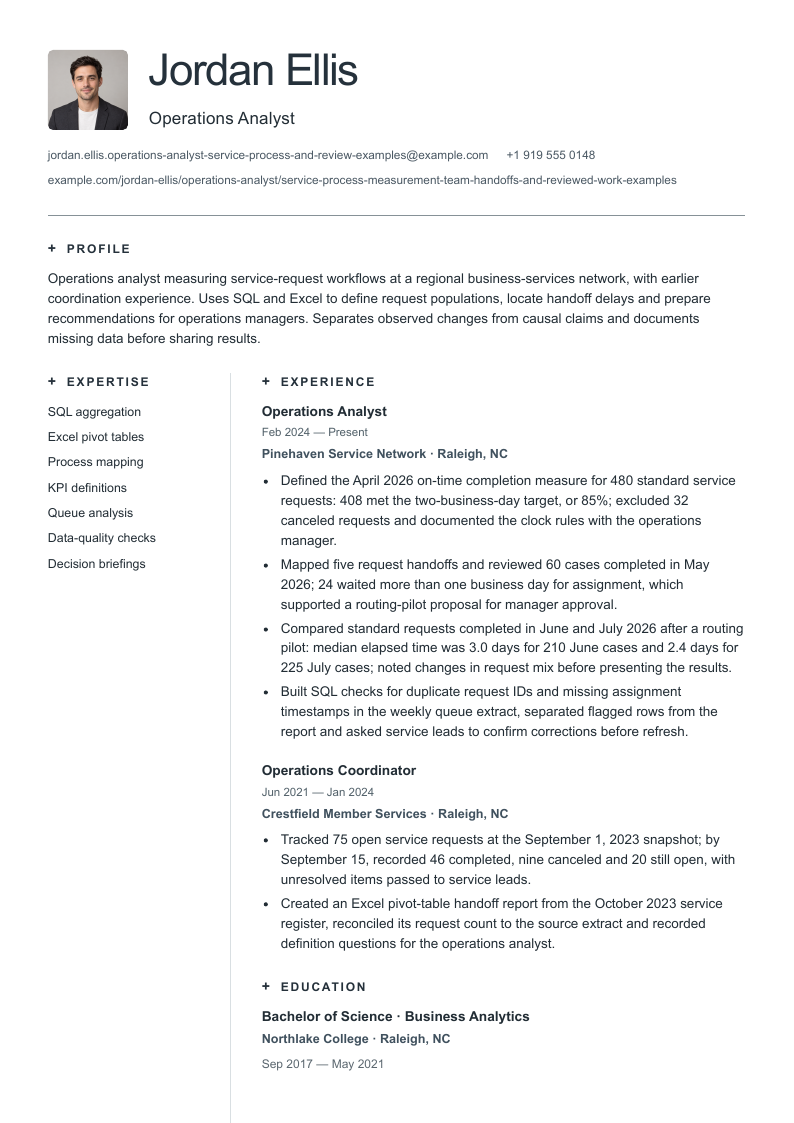
Check long contacts with the optional photo on
This Precision scenario turns the optional photo on and changes only the resume email and portfolio URL. Every job, bullet, date and project matches the base record. Check the whole contact string, then inspect the link destination in the downloaded PDF; a neat display label does not establish that the destination is right.
Operations analyst measuring service-request workflows at a regional business-services network, with earlier coordination experience. Uses SQL and Excel to define request populations, locate handoff delays and prepare recommendations for operations managers. Separates observed changes from causal claims and documents missing data before sharing results.
Defined the April 2026 on-time completion measure for 480 standard service requests: 408 met the two-business-day target, or 85%; excluded 32 canceled requests and documented the clock rules with the operations manager.
Mapped five request handoffs and reviewed 60 cases completed in May 2026; 24 waited more than one business day for assignment, which supported a routing-pilot proposal for manager approval.
Compared standard requests completed in June and July 2026 after a routing pilot: median elapsed time was 3.0 days for 210 June cases and 2.4 days for 225 July cases; noted changes in request mix before presenting the results.
Built SQL checks for duplicate request IDs and missing assignment timestamps in the weekly queue extract, separated flagged rows from the report and asked service leads to confirm corrections before refresh.
Operations Coordinator
Crestfield Member Services · Raleigh, NC
June 2021–January 2024
Tracked 75 open service requests at the September 1, 2023 snapshot; by September 15, recorded 46 completed, nine canceled and 20 still open, with unresolved items passed to service leads.
Created an Excel pivot-table handoff report from the October 2023 service register, reconciled its request count to the source extract and recorded definition questions for the operations analyst.
Education
Bachelor of Science in Business Analytics · Northlake College · Raleigh, NC
September 2017–May 2021
Projects
Routing pilot measurement note
Operations analyst · Pinehaven Service Network
May 2026–August 2026
SQL · Excel · Process map
Documented the five-handoff review and the June–July completed-request comparison for the operations manager. Preserved the 210- and 225-case populations, shared clock rules and request-mix caveat alongside the medians. The manager approved the pilot; Jordan supplied analysis rather than authorizing staffing or system changes. The fictional public note contains no customer records.
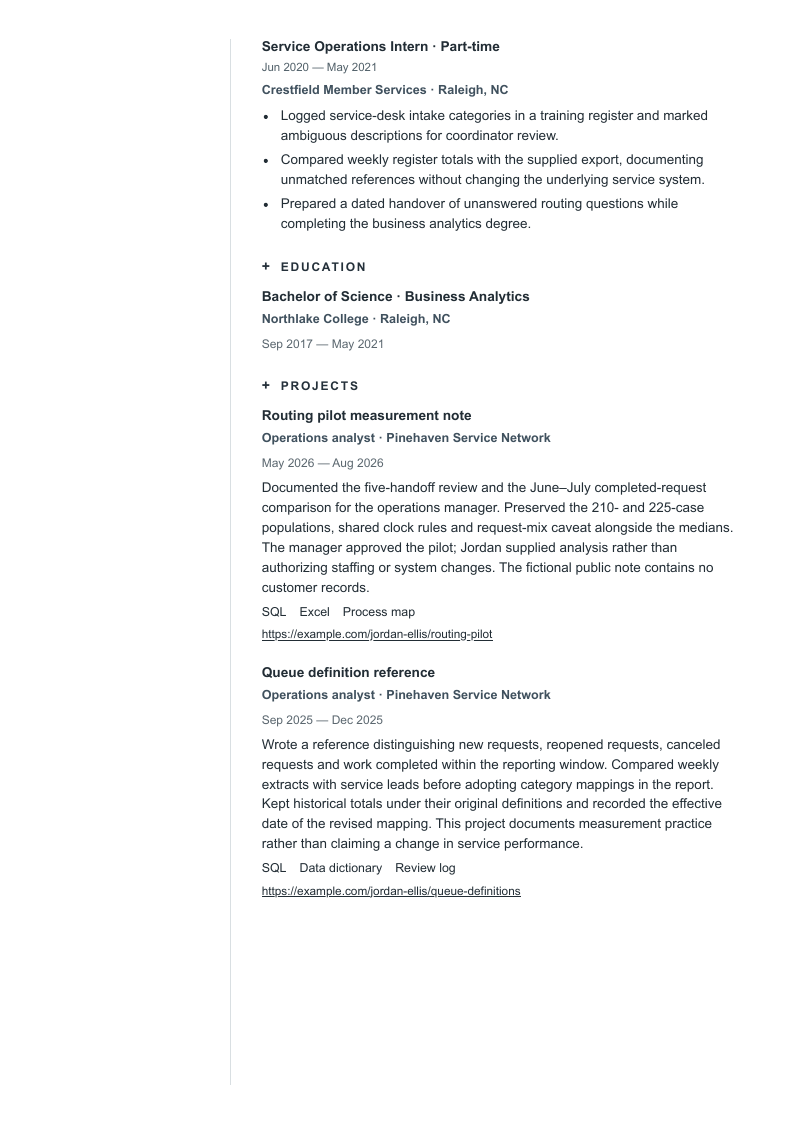
The Precision expanded scenario has the photo off and preserves the base resume. It adds an earlier part-time internship and two projects: a queue-definition reference and a report-validation checklist. The internship overlaps the degree and ends before the full-time coordinator role. Additional content tests page flow without removing the original evidence.
Open page 1 at full sizePrecision · Page 1 of 3 · Photo off · Complete paid-plan PDF page, including margins, without a watermark.Open page 2 at full sizePrecision · Page 2 of 3 · Photo off · Complete paid-plan PDF page, including margins, without a watermark.Open page 3 at full sizePrecision · Page 3 of 3 · Photo off · Complete paid-plan PDF page, including margins, without a watermark.Use Precision without a photo
Operations analyst measuring service-request workflows at a regional business-services network, with earlier coordination experience. Uses SQL and Excel to define request populations, locate handoff delays and prepare recommendations for operations managers. Separates observed changes from causal claims and documents missing data before sharing results.
Defined the April 2026 on-time completion measure for 480 standard service requests: 408 met the two-business-day target, or 85%; excluded 32 canceled requests and documented the clock rules with the operations manager.
Mapped five request handoffs and reviewed 60 cases completed in May 2026; 24 waited more than one business day for assignment, which supported a routing-pilot proposal for manager approval.
Compared standard requests completed in June and July 2026 after a routing pilot: median elapsed time was 3.0 days for 210 June cases and 2.4 days for 225 July cases; noted changes in request mix before presenting the results.
Built SQL checks for duplicate request IDs and missing assignment timestamps in the weekly queue extract, separated flagged rows from the report and asked service leads to confirm corrections before refresh.
Operations Coordinator
Crestfield Member Services · Raleigh, NC
June 2021–January 2024
Tracked 75 open service requests at the September 1, 2023 snapshot; by September 15, recorded 46 completed, nine canceled and 20 still open, with unresolved items passed to service leads.
Created an Excel pivot-table handoff report from the October 2023 service register, reconciled its request count to the source extract and recorded definition questions for the operations analyst.
Service Operations Intern · Part-time
Crestfield Member Services · Raleigh, NC
June 2020–May 2021
Logged service-desk intake categories in a training register and marked ambiguous descriptions for coordinator review.
Compared weekly register totals with the supplied export, documenting unmatched references without changing the underlying service system.
Prepared a dated handover of unanswered routing questions while completing the business analytics degree.
Education
Bachelor of Science in Business Analytics · Northlake College · Raleigh, NC
September 2017–May 2021
Projects
Routing pilot measurement note
Operations analyst · Pinehaven Service Network
May 2026–August 2026
SQL · Excel · Process map
Documented the five-handoff review and the June–July completed-request comparison for the operations manager. Preserved the 210- and 225-case populations, shared clock rules and request-mix caveat alongside the medians. The manager approved the pilot; Jordan supplied analysis rather than authorizing staffing or system changes. The fictional public note contains no customer records.
Wrote a reference distinguishing new requests, reopened requests, canceled requests and work completed within the reporting window. Compared weekly extracts with service leads before adopting category mappings in the report. Kept historical totals under their original definitions and recorded the effective date of the revised mapping. This project documents measurement practice rather than claiming a change in service performance.
Recorded the source-count reconciliation used for the October handoff report and tested the workbook on a training copy containing blank categories and repeated references. Listed checks the analyst needed to review before sharing totals. A passing workbook check did not establish that the original service records were complete. The public placeholder represents an invented project description without employer data.
Read each continuation page in order. In particular, check the end of the routing note, the definition reference and the report-validation project. A missing qualification such as “completed cases” or “manager approval” can change the meaning even when the headline number survives. Use relevant space in your real resume; the expanded teaching record is not a target length.
Check the file you will actually submit
Check the denominator, cancellation treatment, reporting periods and the end of every analytical caveat against your own records.
Read every exported page at normal size. Select and copy the text to check the order of the skills rail and main experience column.
Open the portfolio and project links, read the email through its final character and confirm that contact details remain available with either photo setting.
Follow the employer’s requested file type. After upload, inspect parsed contact, job and date fields; no design guarantees compatibility with every hiring system.
Review your operations analyst resume with the analyzer and assess suggestions against your own evidence. A free account is required to use the builder. Free-plan PDF downloads include a watermark; these examples show paid-plan output.
Questions, answered
What should an operations analyst resume emphasize?
Name the operation, your analytical contribution and how someone used it. Process maps, reconciled reporting, defined KPIs, queue reviews and recommendations are useful when the work history supplies context. Tailor to the actual vacancy; the title can also include order execution or sector-specific quality duties.
Do I need a percentage in every analyst bullet?
No. A documented measure, investigated exception or useful recommendation can demonstrate work without a claimed improvement. Include a percentage only when the population and arithmetic are defensible. Distinguish observed differences from effects you can attribute to your intervention.
Can I use course projects for a first analyst role?
Yes, when clearly labeled. Describe the source, method, finding, limitations and review. Do not present synthetic data as employer results or classroom work as ownership of a live service operation.
Should I include a photo for a US application?
The default here is without a photo. Follow the employer’s instructions and local expectations. The optional preview illustrates layout behavior and does not imply that a portrait is required or improves hiring results.
What do the template buttons carry into signup?
The selected design, photo preference and Operations Analyst role are carried into the builder signup flow. The fictional candidate’s content and portrait are not copied into your account. A free account is required; free-plan PDF downloads include a watermark.
Prepared by Resumize with AI-assisted research and drafting for English-language US private-sector service operations applications. Three primary employer descriptions were checked on October 27, 2026 and displayed application controls; none displayed a publication date. Openings and eligibility restrictions can change. CareerOneStop informs structure. The fictional record and AI-generated portrait are teaching materials, not employer endorsements or verified applicant results.
Checked October 27, 2026. Title: Operations Analyst, Data and Performance; location: New York, United States. Apply control present; no publication date displayed. Reporting requirements, operational KPIs, bottleneck analysis and cross-team communication.
Checked October 27, 2026. Title: Operations Analyst; location: United States; remote. Apply control present; no publication date displayed. Order execution, Salesforce reporting and workflow documentation; this title also covers hands-on fulfillment.
Checked October 27, 2026. Title: Quality Compliance & AI Operations Analyst; location: United States; remote. Apply control present; no publication date displayed. Contact-center quality, process improvement and operational analysis; healthcare-specific duties exceed this general service example.
US Department of Labor-sponsored guidance on relevant work history, visible job context and specific contributions. Used for resume structure, not as evidence of universal role requirements.