Milestone
A narrow colored date rail and timeline markers make progression visible beside a broad content area.
Before sending: Keep the dates and the measured interaction definition readable beside longer technical bullets.
Technology · React product interfaces
A React Developer resume should show how you turn component and state decisions into usable product behavior. Name the interface, its users, the edge cases you handled and the checks you performed. A long list of hooks and packages cannot explain whether you can maintain a production UI.
By Resumize · · Sources and scope
Three designs · one example
These previews use the same layouts as the builder, with identical example content. Open a full preview to inspect the text and spacing.
Fictional candidate, employers, education and results. The optional portrait is AI-generated. Use your own evidence and photo; the example is not inserted into your resume.
A narrow colored date rail and timeline markers make progression visible beside a broad content area.
Before sending: Keep the dates and the measured interaction definition readable beside longer technical bullets.
A dark header introduces the identity above a single-column record with clear section headings.
Before sending: The dark header and optional portrait use space; check long contacts and the first experience entry in the download.
A plain left header and restrained section titles keep the component and testing evidence central, with dates in a small gutter.
Before sending: Minimal decoration still needs clear hierarchy; keep employer names and project endings distinct.
“Use” opens signup with that design and photo preference selected for the builder. A free account is required. Free-plan PDF downloads include a watermark; see current plans for paid options. Photo conventions vary; follow the employer’s instructions and local expectations.
A narrow colored date rail and timeline markers make progression visible beside a broad content area. A dark header introduces the identity above a single-column record with clear section headings. A plain left header and restrained section titles keep the component and testing evidence central, with dates in a small gutter.
Each design shows the same fictional career. The default has no photo; the optional portrait is AI-generated. The buttons retain the exact selected design, photo preference and React Developer role through signup. They do not put the example career or portrait into your account. A free account is required; free-plan PDF downloads include a watermark. These images show paid-plan output.
Alex Rivera, the employers, college, career, dates and results are original fiction. All example.com links are placeholders and the 555 phone number is fictional. Use the structure with your own supported facts.
React Developer | Product Interfaces
alex.rivera@example.com · +1 312 555 0146
Portfolio: https://example.com/alex-rivera
React developer building TypeScript interfaces for workflow software. Designs reusable components, makes loading and error behavior explicit, and tests interactions with product and design colleagues. Brings production UI ownership and earlier experience maintaining browser-based account tools.
React · TypeScript · Component design · State and API integration · Semantic HTML and accessibility · React Testing Library · Playwright · Storybook
Cedarline Workflow Software · Chicago, IL
June 2022–Present
Lindenway Account Tools · Evanston, IL
July 2019–May 2022
Bachelor of Science in Computer Science · Westhaven College · Illinois
August 2015–May 2019
Coursework in software design, human-computer interaction and databases.
React developer · Cedarline Workflow Software
February 2026–May 2026
React · TypeScript · Storybook
Documented component examples for loading, empty, validation and error states used in the renewal flow. Linked each example to an interaction check so design and QA could review the intended behavior before release.
The example focuses on a web product UI built with React and TypeScript. Alex owns form components, draft and fetched state, a renewal dialog and interaction tests. This is more specific than generic responsive web development, and narrower than claiming backend, mobile and infrastructure ownership. React Native experience can matter to another vacancy, but it should keep its own platform label.
The three employer examples show different levels and markets. Ubiquiti asks for senior React work in Sweden, including reusable and interactive visualization components. Xebia’s Poland opening names a particular component, state and testing stack. Verkada’s San Mateo staff role emphasizes a shared design system and adoption across teams. The fictional US product developer is not presented as eligible for every location or as already performing staff-level architecture.
For a component bullet, explain who consumes it and which behavior you helped standardize. For a state bullet, identify the boundary: local editing, server data, navigation or a shared workflow. Official React guidance discusses state structure and sharing; on a resume, the useful evidence is the decision and its effect on the interface, not a code walkthrough.
These examples show how to make scope and evidence assessable. The after statements are exactly the six work-history bullets in the base resume. Replace every invented fact; do not borrow a metric you cannot support.
Before: Built reusable React components.
After: Built and documented 12 React and TypeScript form components for three workflow screens; agreed validation and keyboard behavior with design and reviewed adoption with two product teams.
Why it works: The component count, consumers and decisions give reuse a concrete scope. Twelve components do not imply an entire company design system.
Evidence to check: Component inventory, consuming screens, review notes and your implementation ownership.
Before: Used hooks and Redux everywhere.
After: Separated draft form state from fetched account data in the renewal flow, preserving edits during refresh and showing loading, empty and retry states agreed with the API team.
Why it works: Describes the user problem and the state boundary rather than turning a library list into an accomplishment.
Evidence to check: The original behavior, agreed API contract, review and relevant interaction tests.
Before: Made our app fully accessible.
After: Reworked focus return, field labels and inline error announcements in the renewal dialog; checked keyboard journeys and reviewed screen-reader findings with the accessibility specialist before release.
Why it works: Names the surface and checks. It does not claim complete accessibility or certification of the application.
Evidence to check: Affected dialog, manual checks, specialist review and resolved findings.
Before: Eliminated bugs with automated tests.
After: Added React Testing Library checks for validation and Playwright coverage for eight renewal journeys; all eight passed the May 2026 release check, alongside manual review by QA.
Why it works: The eight journeys define the result and period; a passing check does not establish that a release has no defects.
Evidence to check: Journey inventory, release run, failure handling and QA contribution.
Before: Made the whole platform 80% faster.
After: Profiled an account table and removed repeated row calculations; median interaction time across 20 local runs per version moved from 180 ms to 115 ms in April 2022, with the same dataset and browser settings.
Why it works: A repeatable local comparison is useful without implying a production percentile or backend improvement.
Evidence to check: The interaction definition, fixed dataset, test environment, 20-run samples and code change.
Before: Owned everything from design to deployment.
After: Investigated UI support reports with QA, reproduced account-filter errors and shipped reviewed fixes through the team release process; documented the affected browser behavior and follow-up checks.
Why it works: Explains production work while preserving shared QA and release responsibility.
Evidence to check: Permitted issue summaries, reproduction notes, code review and release responsibility.
Alex’s summary names React, TypeScript, component reuse, state behavior and testing, then the work history supplies examples. An early-career summary can lead with a labeled project and the interactions you implemented. A mid-career developer can name production surfaces and release responsibility. A senior developer should add actual architectural decisions, migration boundaries, mentoring or adoption evidence rather than simply replacing “developer” with “expert.”
Keep UI measurements separate from server and product outcomes. Alex’s account-table result is a local comparison: 20 runs per version, the same dataset and browser settings, and median interaction time. It does not establish customer latency, a production percentile, conversion or revenue. When a backend team or product change also contributed, name that contribution.
Accessibility deserves a defined scope. Focus handling, labels and error announcements in one dialog are useful evidence, but neither a single automated score nor a handful of manual checks proves that an entire application conforms to every requirement. State the surface, review method and your role in resolving findings.
Choose a short, relevant list from work you can explain. Use the vacancy’s wording when accurate, then support it with decisions and outcomes in the history. A keyword list cannot establish competence or guarantee screening success.
| Skill | Evidence to gather | Fictional example |
|---|---|---|
| Component design | A reusable interface and actual consumers. | 12 form components across three screens. |
| State and API integration | Draft behavior, refresh and failure handling. | Edits preserved while account data refreshes. |
| Accessibility | Defined surface and review methods. | Dialog focus, labels and error announcements. |
| Testing | Behavior checked and population of journeys. | Validation checks and eight release journeys. |
| Performance | Environment, sample and interaction definition. | 20 local runs per version on one account table. |
| Production collaboration | Review, QA and release responsibility. | Support reports reproduced and reviewed fixes shipped. |
Alex lists a computer science degree and relevant software and interaction coursework without a GPA. Use your actual degree, training or equivalent experience. Education expectations vary: Verkada lists a related degree for its design-system role, while a different employer may prioritize commercial experience. A course project can demonstrate work; it does not become professional employment.
The example contains no certification. A course completion record is useful only when it supports a real gap in your evidence. Keep its exact issuer, title, date and status; do not present attendance or a bootcamp certificate as an official React professional license. A small portfolio showing interaction and review decisions can be more informative than an unsupported badge list.
If you have no commercial React role, label a personal or coursework project clearly. Choose a realistic flow with inputs, validation, loading, empty and error states. Describe what you built, what you tested and the feedback you used. Do not imply production traffic or paying users when the work used synthetic data.
A portfolio entry can include a permitted screenshot, a component behavior catalogue and a short explanation of a state decision. Link only to work you can share. Remove private customer records, authentication material and internal URLs. Keep React Native, full-stack and design work distinct so the reader can judge the experience relevant to this opening.
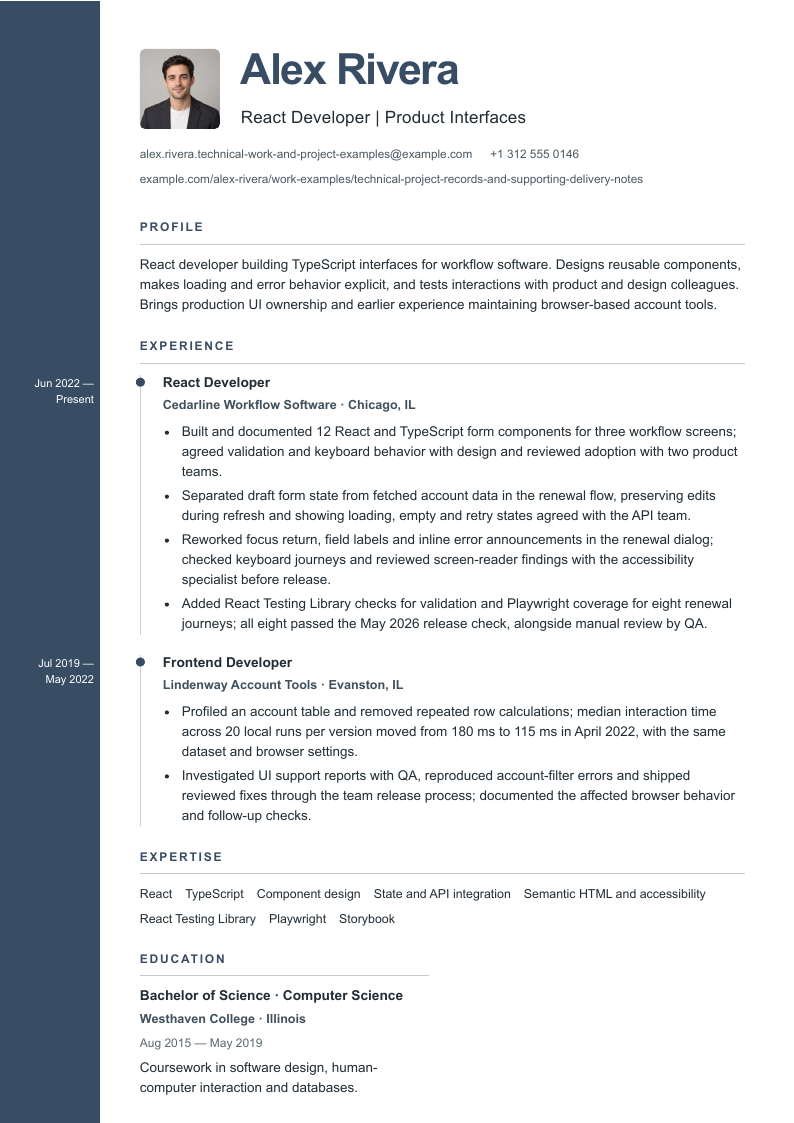
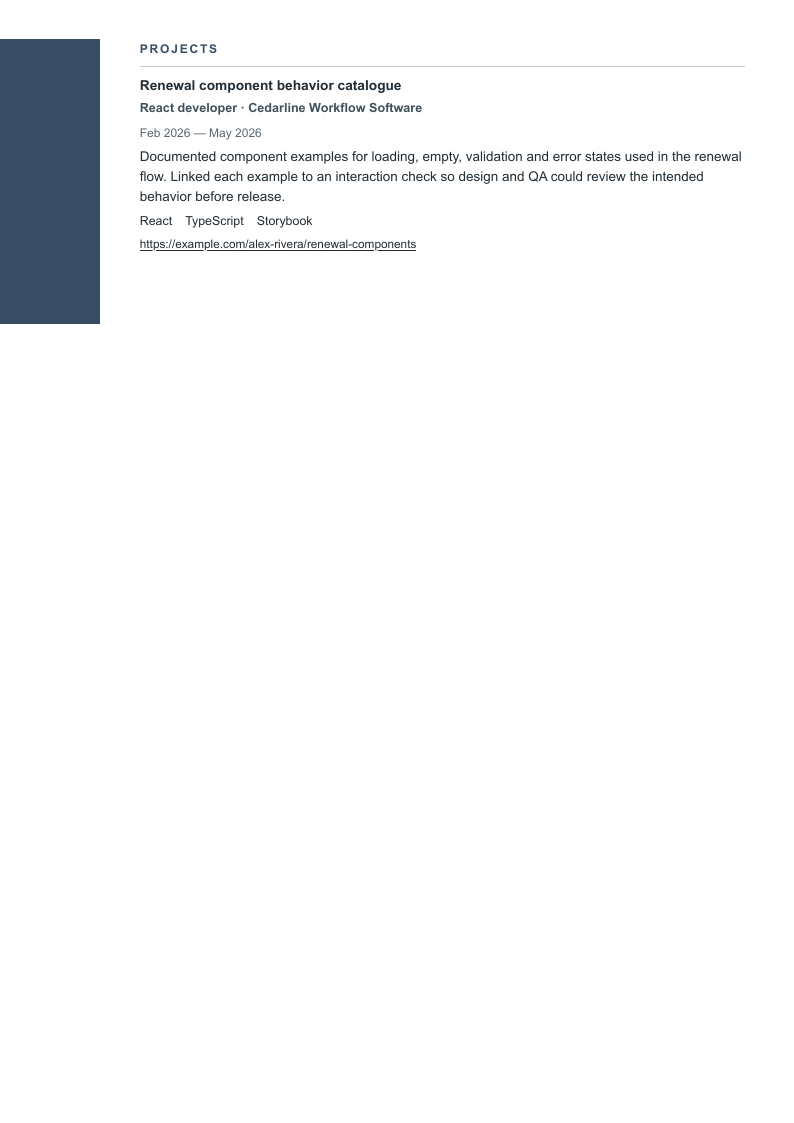
The long-contact Milestone example changes only the resume email and portfolio URL, with the photo on. Alex’s identity, phone, jobs, education and projects remain identical. Follow the email through its final characters and open the full link; check that the date rail does not obscure a wrapped contact.
 Open page 1 at full size
 Open page 2 at full size
React Developer | Product Interfaces
alex.rivera.technical-work-and-project-examples@example.com · +1 312 555 0146
React developer building TypeScript interfaces for workflow software. Designs reusable components, makes loading and error behavior explicit, and tests interactions with product and design colleagues. Brings production UI ownership and earlier experience maintaining browser-based account tools.
React · TypeScript · Component design · State and API integration · Semantic HTML and accessibility · React Testing Library · Playwright · Storybook
Cedarline Workflow Software · Chicago, IL
June 2022–Present
Lindenway Account Tools · Evanston, IL
July 2019–May 2022
Bachelor of Science in Computer Science · Westhaven College · Illinois
August 2015–May 2019
Coursework in software design, human-computer interaction and databases.
React developer · Cedarline Workflow Software
February 2026–May 2026
React · TypeScript · Storybook
Documented component examples for loading, empty, validation and error states used in the renewal flow. Linked each example to an interaction check so design and QA could review the intended behavior before release.
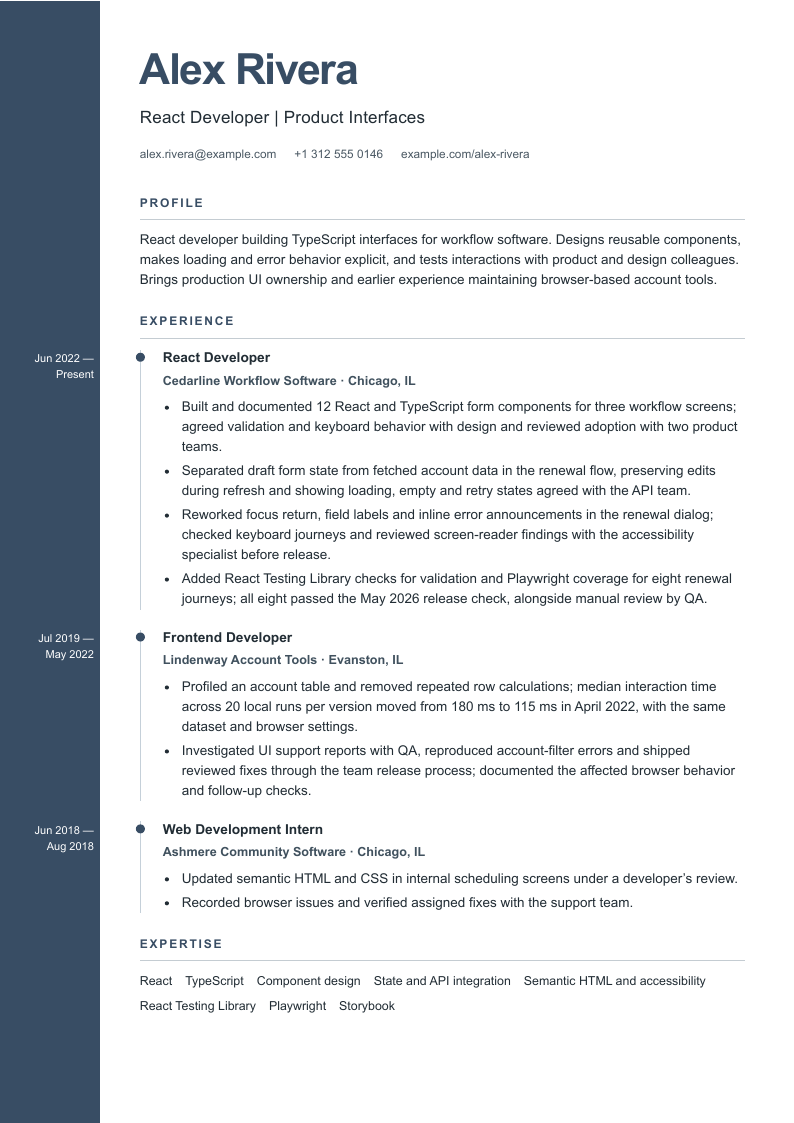
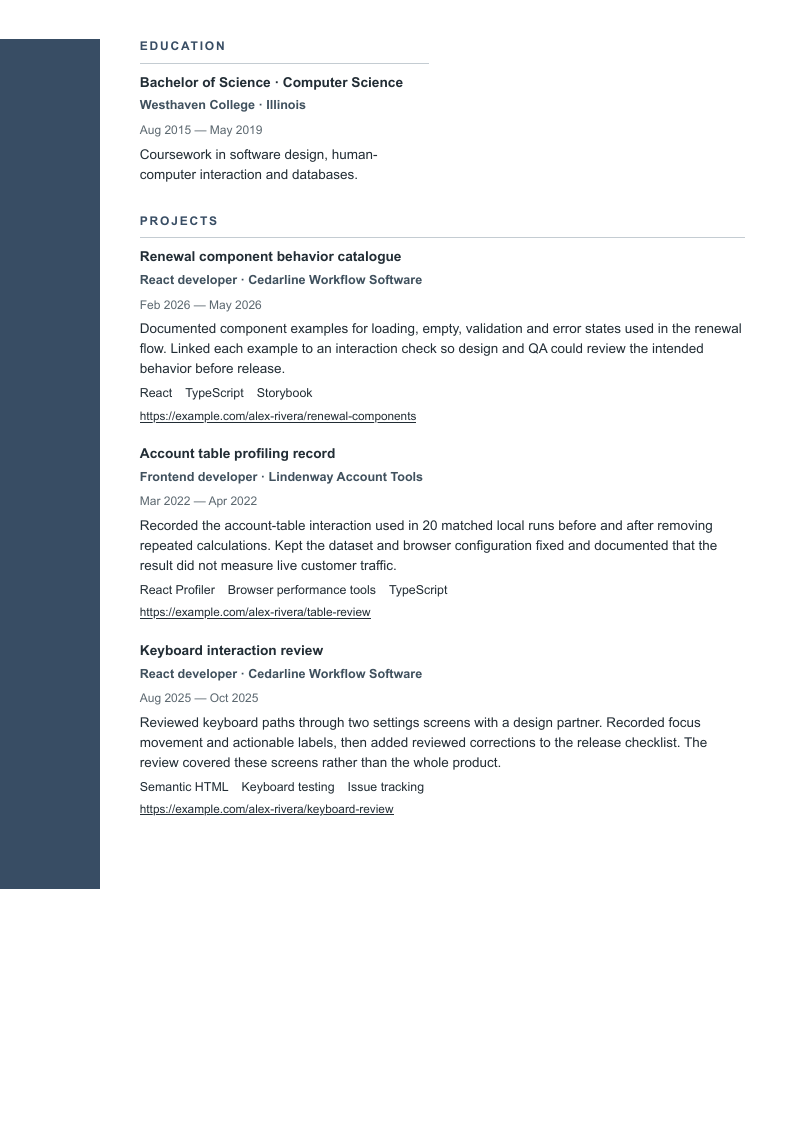
The expanded Milestone example has the photo off and adds an older web internship, an account-table profiling record and a keyboard interaction review. Every base field is retained. Read the last project ending, each employer date and the measurement qualifiers on every page.
 Open page 1 at full size
 Open page 2 at full size
React Developer | Product Interfaces
alex.rivera@example.com · +1 312 555 0146
Portfolio: https://example.com/alex-rivera
React developer building TypeScript interfaces for workflow software. Designs reusable components, makes loading and error behavior explicit, and tests interactions with product and design colleagues. Brings production UI ownership and earlier experience maintaining browser-based account tools.
React · TypeScript · Component design · State and API integration · Semantic HTML and accessibility · React Testing Library · Playwright · Storybook
Cedarline Workflow Software · Chicago, IL
June 2022–Present
Lindenway Account Tools · Evanston, IL
July 2019–May 2022
Ashmere Community Software · Chicago, IL
June 2018–August 2018
Bachelor of Science in Computer Science · Westhaven College · Illinois
August 2015–May 2019
Coursework in software design, human-computer interaction and databases.
React developer · Cedarline Workflow Software
February 2026–May 2026
React · TypeScript · Storybook
Documented component examples for loading, empty, validation and error states used in the renewal flow. Linked each example to an interaction check so design and QA could review the intended behavior before release.
Frontend developer · Lindenway Account Tools
March 2022–April 2022
React Profiler · Browser performance tools · TypeScript
Recorded the account-table interaction used in 20 matched local runs before and after removing repeated calculations. Kept the dataset and browser configuration fixed and documented that the result did not measure live customer traffic.
React developer · Cedarline Workflow Software
August 2025–October 2025
Semantic HTML · Keyboard testing · Issue tracking
Reviewed keyboard paths through two settings screens with a design partner. Recorded focus movement and actionable labels, then added reviewed corrections to the release checklist. The review covered these screens rather than the whole product.
Condense repeated duties before removing the definition behind a result. Use another page when relevant evidence needs it. Check for isolated headings, detached dates and qualifiers separated from metrics; page count alone cannot establish readability.
A free account is required for the builder. Free-plan PDF downloads include a watermark; the previews show paid-plan output. Template buttons retain the exact design, photo preference and React Developer role. Add your own career details and photo after signup.
The resume analyzer gives advisory feedback. For drafting help, use the bullet point generator and check every suggestion against your facts. No design guarantees parsing, interviews or a hiring outcome.
Choose React, TypeScript, component design, state and API integration, accessibility, testing and related tools you can demonstrate. Support the list with specific interface behavior and review evidence.
Name the kind of interface you build and two or three supported strengths. Match the level to your actual ownership; a project, product feature and organization-wide design system are different scopes.
A React-focused record explains component boundaries, state behavior, interaction tests and production UI maintenance. HTML, CSS and browser knowledge still matter, but a framework name alone does not explain the engineering decisions.
Use truthful wording from the opening, such as React, TypeScript, component library, state management or Playwright when accurate. Avoid adding every library in a vacancy or repeating terms to imply unsupported experience.
Use the space needed for relevant, readable evidence. A short early-career record may fit one page; a fuller record can need two. Check every exported page rather than shrinking the type to meet an arbitrary limit.
Signup retains the exact design, photo preference and role. A free account is required. Free-plan PDF downloads include a watermark; these examples show paid-plan output. The fictional career and AI portrait are not inserted into your account.
Prepared by Resumize with AI-assisted research and drafting for English-language applications. The employer descriptions were directly retrieved with readable responsibilities and Apply forms on October 28, 2026. They cover a Sweden-based senior product role, a Poland-based senior consulting role and a California staff design-system role. They inform the work categories; they do not establish universal React requirements or eligibility for this fictional US applicant. Official React documentation supports state terminology. No application was submitted, private account or customer data used, or hiring outcome tested.
Read October 28, 2026. Sweden; Stockholm or Malmö, residence and work permit required. Five-plus years, reusable React components, tests and interactive visualization; senior product scope. Full description and Apply/application form directly retrieved with HTTP 200; no posting date displayed.
Read October 28, 2026. Poland; work from Poland and work permit required. Commercial React/TypeScript, component documentation, state/data tools and testing; this named stack is specific to the vacancy. Full description and Apply/application form directly retrieved with HTTP 200; no posting date displayed.
Read October 28, 2026. San Mateo, California; Staff-level design-system work; React library adoption, accessibility, visual regression and mentoring across product teams. This exceeds the fictional mid-career applicant’s scope. Full description and Apply/application form directly retrieved with HTTP 200; no posting date displayed.
Read October 28, 2026. Official documentation distinguishes state structure, data flow and shared state. Used for terminology, not a claim that using one pattern guarantees performance.