Essential
An uppercase name, quiet section rules and right-aligned employment dates keep the main work history easy to follow.
Before sending: Long URLs and expanded history still need an actual export review.
Software engineering · US applications
A Python developer resume should show a running service or a reproducible automation workflow, the constraints you worked within and the failures you checked. Explain where the code ran and which parts you owned. A framework list is easier to assess when each major skill connects to a concrete change.
By Resumize · · Sources and scope
Three designs · one example
These previews use the same layouts as the builder, with identical example content. Open a full preview to inspect the text and spacing.
Fictional candidate, employers, education and results. The optional portrait is AI-generated. Use your own evidence and photo; the example is not inserted into your resume.
An uppercase name, quiet section rules and right-aligned employment dates keep the main work history easy to follow.
Before sending: Long URLs and expanded history still need an actual export review.
Blue square section markers, a strong header rule and shaded skill labels organize a broad single body with dates beside job titles.
Before sending: Inspect the narrower column for contact wrapping and verify copied reading order.
A dark gray split header, shaded introduction and three-column skills list above a single main column of dated evidence.
Before sending: Review contact contrast and every section after adding a portrait or longer text.
“Use” opens signup with that design and photo preference selected for the builder. A free account is required. Free-plan PDF downloads include a watermark; see current plans for paid options. Photo conventions vary; follow the employer’s instructions and local expectations.
All three designs use the same fictional career. Start without a photo and follow the employer’s instructions and local conventions. The optional portrait is AI-generated. Signup retains the exact design, photo preference and Python Developer role; it does not insert the sample career or portrait into your account.
Sam Parker, the employers, education, dates, projects and metrics are original fiction. The example.com contacts and project links are illustrative placeholders. The optional portrait is AI-generated. Replace every detail with your own shareable evidence; no professional certification is supplied.
Python Developer | Backend Services & Automation
sam.parker@example.com · +1 919 555 0136
Portfolio: https://example.com/sam-parker
Python developer maintaining internal order services and scheduled data imports. Builds FastAPI endpoints, checks PostgreSQL data changes and adds regression tests before reviewed Docker deployments. Brings earlier automation experience and clear documentation of retry behavior, production support and benchmark limits.
Python · FastAPI · PostgreSQL · pytest · Docker · Git · CI checks · Structured logging
Brookvale Operations Software · Raleigh, NC
May 2022–Present
Elmford Business Tools · Durham, NC
July 2019–April 2022
Bachelor of Science in Computer Science · Cedarbank University · Raleigh, NC
August 2015–May 2019
Python Developer · Brookvale Operations Software
February 2026–April 2026
Python · pytest · PostgreSQL
Tested duplicate file submissions and partial-write failures against the import workflow. Recorded the retry limit and operator recovery steps using synthetic files; no customer data or employer source code is published.
A useful Python resume shows what you built with Python, how you checked it and where your responsibility ended. Lead with the kind of work the vacancy needs: a backend service, a data workflow or an automation tool. Then support each important skill with a project or work example you can explain.
Read the posting before choosing your headline and first project. A backend role may need API behavior, database queries and request handling. An automation role may emphasize files, repeatable tasks and failure reporting. A data role may need cleaning, analysis and reproducible outputs. These overlap, but one list of every Python library does not explain your fit.
Make a small evidence map: requested task, where you performed it, and what the reader can inspect or ask about. For example, connect “SQL” to the query you wrote and “testing” to the cases you checked. If a requirement has no supporting example, treat it as a gap rather than placing it in the skills section.
This fictional applicant is targeting a junior automation role. The sample uses a personal project and an internship; neither is a claim about a real person. Replace the identity fields and every experience detail with your own facts. Remove any section or tool you cannot support.
[Name] | [City, State] | [Email] | [Phone] | [Public portfolio URL]
JUNIOR PYTHON DEVELOPER
Computer science graduate who builds Python tools for importing and checking structured data. Experience writing SQL queries, testing input handling and documenting setup through an internship and personal projects.
TECHNICAL SKILLS
Python · SQL · Git · unittest · CSV and JSON processing · SQLite
EXPERIENCE
Software Development Intern — [Employer] | [Month Year–Month Year]
Wrote a Python import script that checked required CSV fields and recorded rejected rows for review.
Added unit tests for missing columns, empty input and repeated records before submitting changes for code review.
Documented the import steps and known input limitations for the operations team.
PROJECTS
Expense-file checker — Personal project | [Date] | [Repository URL]
Built a command-line tool that reads sample expense files, normalizes dates and flags duplicate entries for manual review.
Stored accepted rows in SQLite and wrote queries that group totals by month and expense category.
Included sample input, setup instructions and tests so another person could reproduce the output.
EDUCATION
Bachelor of Science in Computer Science — [Institution] | Awarded [Month Year]
The import bullet names the input, operation and output. It is more useful than “developed innovative Python solutions” because a reviewer can picture the work. The test bullet identifies actual failure cases rather than claiming that the software was bug-free.
The internship remains an internship, and the personal project remains a personal project. A local script is not a production platform. If your project ran only on your laptop, describe that honestly and explain how someone else can run it. Do not turn tutorial completion into employment or imply that practice data represents real customers.
For experienced candidates, put relevant paid work before academic projects. Select a technical decision you made, the scope you owned and the observed outcome. You can describe a reliable process without adding a percentage. The examples below are patterns to adapt only when the work is yours.
Backend: Implemented [endpoint] in [framework], validated [inputs] and added tests for [error cases] before release.
Automation: Replaced [manual step] with a Python script that reads [source], writes [output] and reports [failure condition] to [owner].
Data workflow: Cleaned [dataset] by handling [specific issue], documented the rule and compared the output against [reference check].
Maintenance: Investigated [reported failure], reproduced it with [test input] and added a regression test alongside the fix.
If you report a performance change, keep the old and new timings, workload and test conditions. A smaller input or warmer cache can make two runs incomparable. Distinguish a local benchmark from a production observation. “Reduced import time from [A] to [B] for the same [input]” is clearer than an unexplained “improved efficiency.”
When results belong to a team, name your contribution: implemented the parser, added checks or investigated a bottleneck. Do not claim the entire project outcome as an individual achievement. Exclude confidential customer records, internal URLs and private code from portfolio links.
Group skills by purpose if the list is long: language, backend, data and testing. Include only frameworks and tools you used well enough to discuss. A framework name should connect to an example; star ratings and percentages do not explain what you can do.
For a public project, provide a README with the problem, your contribution, setup steps, sample input, tests and limitations. Python’s official documentation explains virtual environments and the unittest framework; use those references when describing the tools. Do not claim those tools prove software quality on their own.
Before sending, open your exported resume, follow every public link and confirm that the file still reads in a sensible order when copied as plain text. Follow the employer’s requested format. A clear document helps a reader assess evidence, but no format or keyword list guarantees an interview.
Sam’s fictional record identifies an internal order-status service, FastAPI, PostgreSQL, a Docker container and a platform-engineer release partner. This makes the work more useful than “built scalable applications.” It does not claim ownership of cloud infrastructure, a public API, a specific traffic level or a systemwide architecture.
For automation, identify the input, validation rule, accepted output, rejected output and operator response. An idempotent import should have a defined duplicate unit and expected behavior. Bounded retries need a limit and recovery path; they do not make failures disappear. Describe secrets and access controls at a shareable level without publishing employer code or customer data.
The research spans an associate application role at iCapital, mthree’s data-engineering placement and Lab49/ION’s senior microservices work. Those jobs differ in seniority, deployment expectations and domain. Use the actual posting to select evidence; a script that runs locally should not inherit the production or cloud claims of a vacancy.
Read the source descriptions directly: Lab49 / ION: Lead Python Developer, New York; iCapital: Python Engineer and Developer – Associate; mthree: Python Developer. These selected vacancies illustrate scope, not market-wide requirements.
Each after sentence appears verbatim in the base resume. The deliberately weak before statements are teaching examples. Use the evidence prompts to check your own records before adapting a claim.
Before: Built scalable Python apps.
After: Maintain a FastAPI order-status service deployed as a Docker container; implement validated endpoints and coordinate production releases with the platform engineer.
Why it works: Names framework, purpose, deployment and collaboration without implying ownership of all infrastructure.
Evidence to check: Service boundary, permitted change history, release process and actual deployment context.
Before: Made imports 90% faster.
After: Reduced a 50,000-row import from 120 to 78 seconds in a staging benchmark using the same input and database snapshot; production performance was not measured.
Why it works: The 35% reduction is bounded by the same workload and staging conditions.
Evidence to check: Benchmark script, input checksum, repeated timings, database state and environment.
Before: Made jobs error-proof.
After: Added idempotency checks and bounded retries to a scheduled supplier-file import, recording rejected rows and surfacing exhausted retries for operations review.
Why it works: Failure behavior and escalation are more credible than promising no errors.
Evidence to check: Duplicate-case tests, retry settings, rejected-row output and alert ownership.
Before: Wrote lots of tests.
After: Added pytest regression cases for missing fields, duplicate request keys and database rollback after a failed write; required reviewed CI checks before deployment.
Why it works: Specific failure cases show why the tests matter without treating a passing suite as proof of perfect software.
Evidence to check: Test cases, failure reproduction, CI configuration and review rules.
Before: Automated everything.
After: Built Python CSV-validation scripts that wrote accepted rows to PostgreSQL and produced a separate rejection file for the operations team.
Why it works: States input, output and consumer; scripts are not silently presented as a large platform.
Evidence to check: Permitted sample input, validation rules, schema and output contract.
Before: Fixed bugs quickly.
After: Reproduced date-parsing failures with sample files, corrected normalization rules and documented setup and known input limitations for support handovers.
Why it works: Explains a debugging and handover process without an unsupported speed claim.
Evidence to check: Issue example, regression input, change review and documented limitations.
The benchmark reduces 120 seconds to 78 seconds for a 50,000-row staging import. The 42-second reduction is 35% of the original time. The same input and database snapshot support comparison, but cache state, hardware and repeated-run variation still matter. The sample explicitly has no production measurement.
A production latency claim needs its event, percentile, workload and observation period. A local runtime, staging throughput and customer response time are different measures. Preserve comparable conditions and separate your code change from a team’s infrastructure upgrade. Without a defensible comparison, a clear description of batching, validation or query work is still useful evidence.
The regression bullet names missing fields, duplicate keys and rollback after a failed write. Those cases explain risk coverage; they do not establish complete security or reliability. Describe a reproduced defect, why the check fails before the fix and how it joins the release process. Avoid turning a test count or coverage percentage into a guarantee.
Choose the skills the vacancy needs that your record supports. The table links the sample’s tasks to the records needed to substantiate them. Keep confidential documents private; use permitted descriptions or synthetic examples when a public work sample would expose employer information.
| Capability | Evidence to check | Sample wording |
|---|---|---|
| Show the running service | Service boundary, permitted change history, release process and actual deployment context. | Maintain a FastAPI order-status service deployed as a Docker container; implement validated endpoints and coordinate production releases with the platform engineer. |
| Make a benchmark reproducible | Benchmark script, input checksum, repeated timings, database state and environment. | Reduced a 50,000-row import from 120 to 78 seconds in a staging benchmark using the same input and database snapshot; production performance was not measured. |
| Describe failure behavior | Duplicate-case tests, retry settings, rejected-row output and alert ownership. | Added idempotency checks and bounded retries to a scheduled supplier-file import, recording rejected rows and surfacing exhausted retries for operations review. |
| Tie tests to risks | Test cases, failure reproduction, CI configuration and review rules. | Added pytest regression cases for missing fields, duplicate request keys and database rollback after a failed write; required reviewed CI checks before deployment. |
| Name the automation deliverable | Permitted sample input, validation rules, schema and output contract. | Built Python CSV-validation scripts that wrote accepted rows to PostgreSQL and produced a separate rejection file for the operations team. |
| Show maintenance ownership | Issue example, regression input, change review and documented limitations. | Reproduced date-parsing failures with sample files, corrected normalization rules and documented setup and known input limitations for support handovers. |
The fictional computer science degree accompanies employment and projects; no certification is supplied. BLS gives general software-development context, and some cited employers accept equivalent experience. Read the actual required and preferred criteria before deciding how prominently to place education.
The retained Python documentation supports two modest project concepts: virtual environments for isolated setup and unittest for defined test cases. Neither is a deployment credential. State the actual Python version and dependencies in a public project README, use synthetic inputs where appropriate and list cloud certifications only when genuinely held.
An early-career Python resume can lead with one reproducible project and an internship. Keep the project’s purpose small enough to explain: read a CSV, validate required fields, write accepted rows and report rejections. Show setup, test fixtures, expected output and limitations. Label coursework, tutorials and independent changes accurately.
A fictional adaptation could read: “Junior Python developer building local data-validation tools. Writes SQL queries, tests missing and duplicate inputs and documents reproducible setup with synthetic files. Brings supervised internship experience and a personal expense-file checker.” The expanded example retains a local SQLite and unittest project so readers can see how that work differs from production ownership.
Only Sam Parker’s resume email and one portfolio contact URL change in this scenario. Essential is shown with the optional photo on. Compare the full text below with every final character in the export and inspect the linked destination. Long details can wrap, so use the actual output rather than inferring readability from the design name.
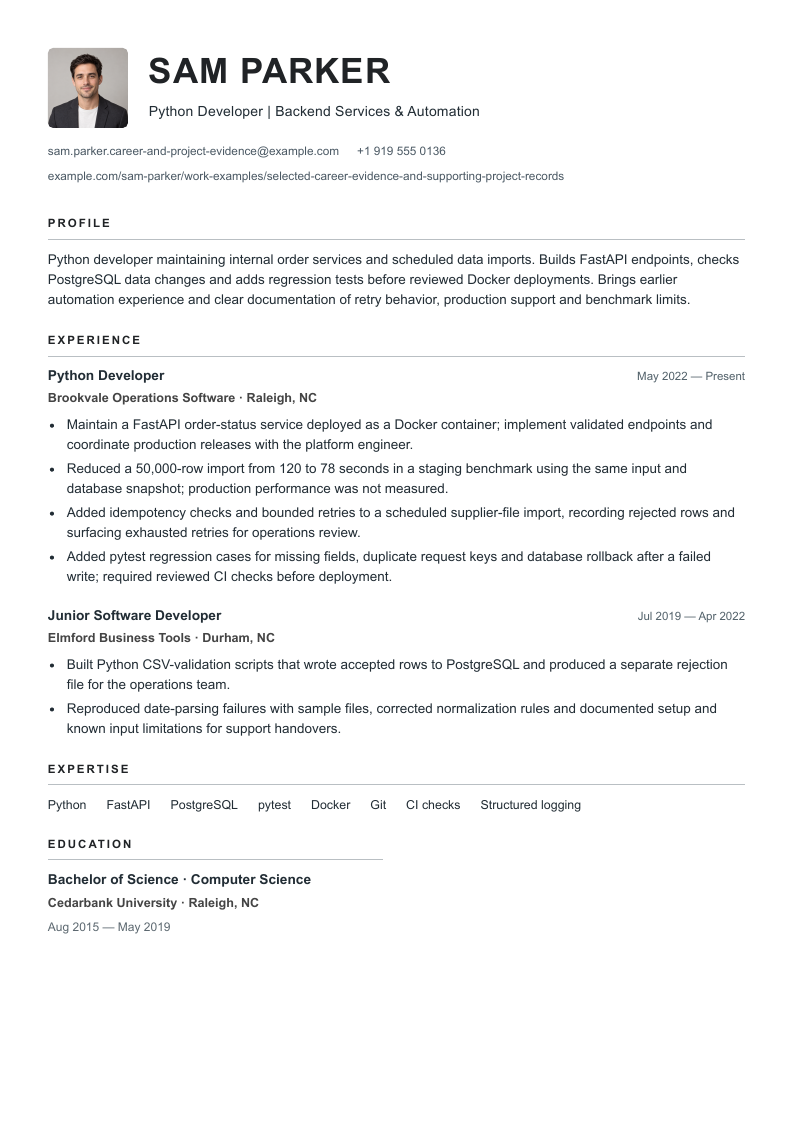 Open page 1 at full size
 Open page 2 at full size
Python Developer | Backend Services & Automation
sam.parker.career-and-project-evidence@example.com · +1 919 555 0136
Portfolio: https://example.com/sam-parker/work-examples/selected-career-evidence-and-supporting-project-records
Python developer maintaining internal order services and scheduled data imports. Builds FastAPI endpoints, checks PostgreSQL data changes and adds regression tests before reviewed Docker deployments. Brings earlier automation experience and clear documentation of retry behavior, production support and benchmark limits.
Python · FastAPI · PostgreSQL · pytest · Docker · Git · CI checks · Structured logging
Brookvale Operations Software · Raleigh, NC
May 2022–Present
Elmford Business Tools · Durham, NC
July 2019–April 2022
Bachelor of Science in Computer Science · Cedarbank University · Raleigh, NC
August 2015–May 2019
Python Developer · Brookvale Operations Software
February 2026–April 2026
Python · pytest · PostgreSQL
Tested duplicate file submissions and partial-write failures against the import workflow. Recorded the retry limit and operator recovery steps using synthetic files; no customer data or employer source code is published.
This Essential scenario has the photo off. It preserves the entire base record and adds one earlier role and two dated projects. Inspect every continuation page, including dates, tools and final limitations. Keep useful supporting evidence when it earns the space; do not remove content solely to force an arbitrary page count.
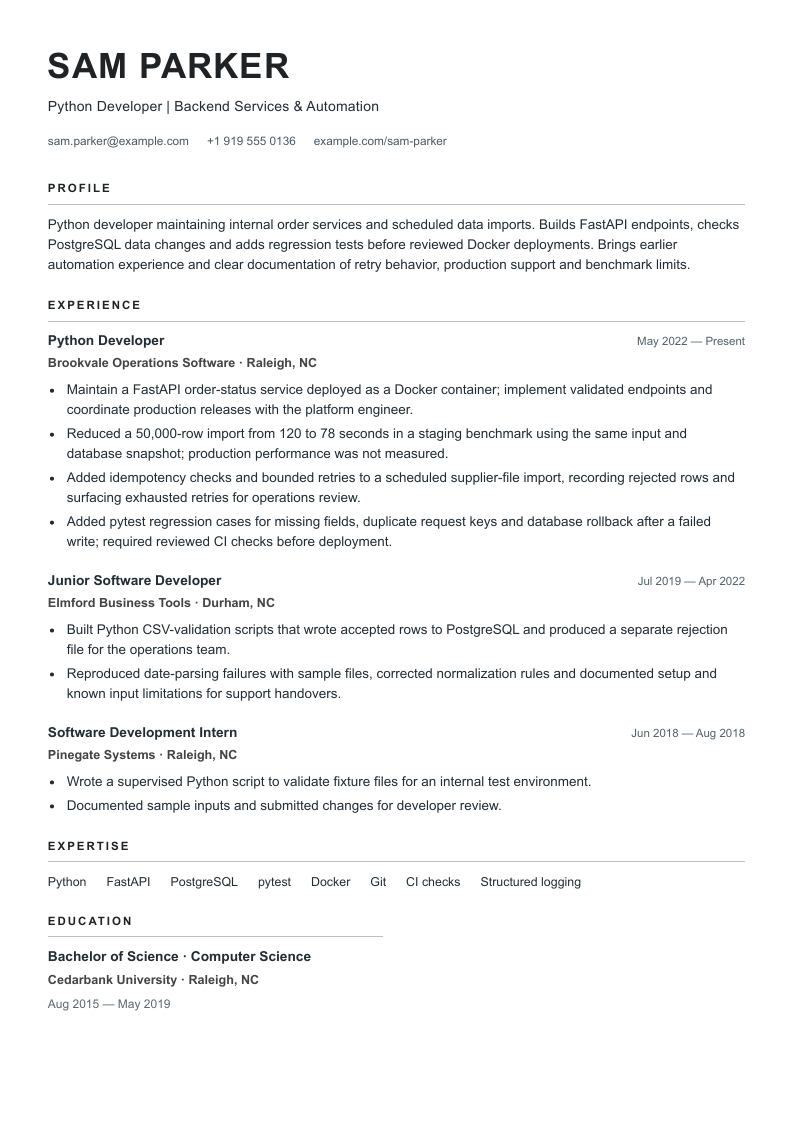 Open page 1 at full size
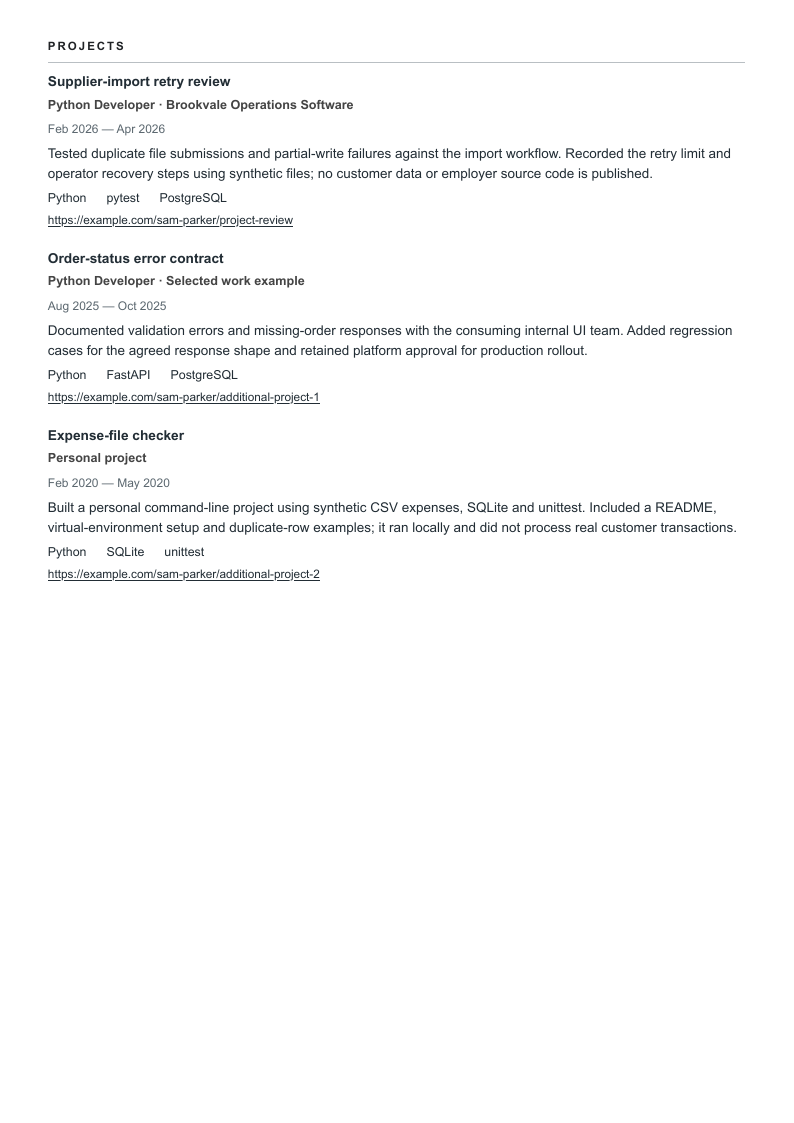 Open page 2 at full size
Python Developer | Backend Services & Automation
sam.parker@example.com · +1 919 555 0136
Portfolio: https://example.com/sam-parker
Python developer maintaining internal order services and scheduled data imports. Builds FastAPI endpoints, checks PostgreSQL data changes and adds regression tests before reviewed Docker deployments. Brings earlier automation experience and clear documentation of retry behavior, production support and benchmark limits.
Python · FastAPI · PostgreSQL · pytest · Docker · Git · CI checks · Structured logging
Brookvale Operations Software · Raleigh, NC
May 2022–Present
Elmford Business Tools · Durham, NC
July 2019–April 2022
Pinegate Systems · Raleigh, NC
June 2018–August 2018
Bachelor of Science in Computer Science · Cedarbank University · Raleigh, NC
August 2015–May 2019
Python Developer · Brookvale Operations Software
February 2026–April 2026
Python · pytest · PostgreSQL
Tested duplicate file submissions and partial-write failures against the import workflow. Recorded the retry limit and operator recovery steps using synthetic files; no customer data or employer source code is published.
Python Developer · Selected work example
August 2025–October 2025
Python · FastAPI · PostgreSQL
Documented validation errors and missing-order responses with the consuming internal UI team. Added regression cases for the agreed response shape and retained platform approval for production rollout.
Personal project
February 2020–May 2020
Python · SQLite · unittest
Built a personal command-line project using synthetic CSV expenses, SQLite and unittest. Included a README, virtual-environment setup and duplicate-row examples; it ran locally and did not process real customer transactions.
Review your resume with the analyzer and check its suggestions against your records. Use buttons open signup with the selected role, exact design and photo preference for the real builder. A free account is required. Free-plan PDF downloads include a watermark; the examples show paid-plan output.
Yes, when you can explain the work. Label the setting as coursework, name the task and describe what you wrote yourself. Do not present a class assignment as commercial development.
No. Select relevant packages you have actually used and can discuss. A short list supported by project evidence is easier to assess than a long inventory of installed dependencies.
A public repository can help when it demonstrates relevant work, but it is not compulsory. Do not publish employer code to create one. You can describe confidential work at an appropriate level without exposing it.
No. State the measured environment, input, baseline and result. Explain comparison limits and keep production observations separate.
The Use buttons retain the exact design, current photo preference and Python Developer role. They do not insert the fictional record or portrait. A free account is required and free-plan PDF downloads include a watermark. Build with your own information and inspect the actual export.
Prepared by Resumize with AI-assisted research and drafting for English-language US applications. Three full primary employer descriptions and the occupational or professional references below were checked on October 29, 2026. Each selected employer page displayed application instructions or an application control; no application was submitted, and availability can change. The candidate records and annotated examples are original editorial fiction. Selected vacancies do not establish universal requirements. No ranking, ATS or hiring-result guarantee is made.
Read October 29, 2026. New York; full description and Apply for this job link retrieved; no posting date displayed. Senior microservices and AWS scope with eight-plus years requested. This illustrates a senior target, not a claim that the sample meets it.
Read October 29, 2026. Stamford, Connecticut; full description and inline application retrieved; no posting date displayed. One to two years of Python experience, APIs, tests and AWS tasks; equivalent relevant experience is an education alternative.
Read October 29, 2026. New York; full description and inline application retrieved; no posting date displayed. Client-facing data-engineering role with pipelines and data-quality work; local-candidate and work-authorization conditions are specific to this opening.
Read October 29, 2026. Official software-development occupational scope. Read through the web reader; direct archive request returned 403. It is not a Python-specific credential standard.
Read October 29, 2026. Retained source for the locally run early-career project and the distinction between individual test cases and broader software quality.
Read October 29, 2026. Retained source for reproducible project setup; a virtual environment is not a deployment or proof of production experience.
Read October 29, 2026. Retained general resume-writing reference; it does not endorse the fictional career or these designs.