Essential
A plain left header and restrained headings lead into a single-column record with dates in a small gutter.
Before sending: Keep dates and evidence context readable across continuations; a simple layout does not prove parsing success.
Java engineering · Services and enterprise integration
A Java Developer resume should show the part of a system you changed, the constraint behind the work and how you verified it. Connect Java and Spring to a request, persistence path, integration or release. Keep tutorial projects, local tests and production ownership identifiable.
By Resumize · · AI-assisted research and drafting
Three designs · one example
These previews use the same layouts as the builder, with identical example content. Open a full preview to inspect the text and spacing.
Fictional candidate, employers, education and results. The optional portrait is AI-generated. Use your own evidence and photo; the example is not inserted into your resume.
A plain left header and restrained headings lead into a single-column record with dates in a small gutter.
Before sending: Keep dates and evidence context readable across continuations; a simple layout does not prove parsing success.
Square section markers, colored headings and a date gutter organize a single-column career record.
Before sending: The date gutter reduces line width. Check item counts, exceptions and dates through every continuation.
A dark gray split header, shaded introduction and three-column skills list above a single main column of dated evidence.
Before sending: The contact header and portrait use space. Read full contact destinations and check dates and project endings in the export.
“Use” opens signup with that design and photo preference selected for the builder. A free account is required. Free-plan PDF downloads include a watermark; see current plans for paid options. Photo conventions vary; follow the employer’s instructions and local expectations.
All three designs show the same fictional career. The default has no photo; the optional portrait is AI-generated. Follow the employer’s instructions and local conventions. Signup retains the exact design, photo preference and Java Developer role. It does not insert the example career or portrait into your account. A free account is required; free-plan PDF downloads include a watermark. These previews show paid-plan output.
Alex Rivera, employers, education, career, dates, projects and results are original fiction. All example.com links are placeholders and the 555 phone number is fictional. Use the structure with your own supported facts. This record contains two jobs, six work-history bullets, one education entry and one personal project, with no certification claim.
Java Developer | JVM Services and Enterprise Integrations
alex.rivera@example.com · +1 312 555 0148
Portfolio: https://example.com/alex-rivera
Java developer maintaining Spring Boot services and enterprise data integrations. Implements bounded API and persistence changes, adds focused regression tests and supports releases with reproducible defect reports, clear compatibility notes and explicit ownership of the components changed.
Java 17 · Spring Boot · PostgreSQL · JUnit · MockMvc · Maven · REST APIs · Git
Briarwell Software · Chicago, IL
May 2023–Present
Elmbridge Systems · Oak Park, IL
July 2020–April 2023
Bachelor of Science in Computer Science · Clearwater College · United States
August 2016–May 2020
Relevant coursework and supervised project work in computer science.
Personal project
January 2026–March 2026
Java 17 · Spring Boot · PostgreSQL · JUnit
Built a personal Spring Boot service with synthetic orders, PostgreSQL persistence and documented request validation. Included controller and repository tests, setup steps and a clear limitation that external payment processing is simulated.
A Java developer resume should connect Java skills to the systems you worked on: the requests a service handled, the data it stored, the tests you wrote and the changes you maintained. Choose examples that match the vacancy, and distinguish classroom work, personal projects and production responsibility.
“Java, Spring Boot, SQL and JUnit” tells a reader which tools you know, but not what you did with them. Pair those tools with an application boundary: an order endpoint, a scheduled batch, a persistence layer or a desktop workflow. Name the part you owned rather than claiming an entire system.
Read the vacancy for its actual emphasis. A team maintaining enterprise services may need debugging and database changes; a graduate role may accept a well-explained project. Move the closest evidence upward. Do not add microservices, messaging or cloud tools just because they appear in other Java resumes.
This original fictional sample illustrates an early-career developer with an internship and a personal Spring project. It is a teaching example, not a real applicant’s record. Replace its claims with work you performed, and use the version and tools you actually used.
[Name] | [City, State] | [Email] | [Phone] | [Portfolio URL]
JAVA DEVELOPER
Developer with internship and project experience building Java services, handling database records and testing HTTP behavior. Uses clear error handling and reproducible tests to make changes easier to review.
TECHNICAL SKILLS
Java · Spring Boot · SQL · PostgreSQL · JUnit · MockMvc · Maven · Git
EXPERIENCE
Software Engineering Intern — [Employer] | [Month Year–Month Year]
Updated a service method that validates submitted records and passes accepted values to the persistence layer.
Added tests for missing fields and invalid values, then resolved feedback from the supervising developer.
Reproduced a reported record-update failure and documented the input and error path for the team.
PROJECTS
Library lending service — Personal project | [Date] | [Repository URL]
Built a Spring Boot service with endpoints for books and loans using PostgreSQL for stored records.
Added validation for loan requests and explicit error responses for unknown books and unavailable copies.
Used JUnit and MockMvc to check controller responses for valid and invalid requests.
Documented the local database setup, sample requests and the current limit that authentication is not implemented.
EDUCATION
Bachelor of Science in [Actual field] — [Institution] | Awarded [Month Year]
The sample separates request validation, persistence and controller tests. Those details give an interviewer concrete follow-up questions. “Created a robust enterprise solution” would hide the same work behind a claim the reader cannot inspect.
The project also states a limitation. A lending demo without authentication should not be described as a secure production service. If your project includes access controls, explain what you implemented and tested; do not substitute the word “secure” for evidence.
Spring’s official testing guide distinguishes loading the application context from testing the web layer with MockMvc. Use similarly precise language on your resume. Do not describe controller tests as end-to-end production verification if they do not exercise that scope.
For paid engineering work, explain the change and why it mattered to the system. Choose examples across delivery and maintenance when both are relevant. Keep team outcomes separate from your own implementation. These patterns are illustrative and require your actual details.
API change: Added [operation] to [service], validated [input] and documented [error response] for the consuming team.
Database change: Updated [query or mapping] to handle [case] and verified behavior using [actual test approach].
Defect investigation: Reproduced [failure] with [conditions], corrected [cause] and added a regression test for that path.
Release support: Prepared [migration or rollout notes], monitored [actual signal] and supported [your responsibility] during release.
Performance: Changed [specific operation] and measured [before/after] under the same [workload and environment].
A junior candidate can show a clear implementation, a test and the feedback they acted on. A more experienced candidate should explain scope: which component they maintained, how they coordinated a change and what decisions they made. Use your actual job title rather than changing it to match the vacancy.
For senior roles, replace a generic “led development” claim with a specific decision or responsibility. Examples include evaluating a migration approach, reviewing API compatibility or coordinating a rollout. Mention mentoring only when you can describe what you did, such as reviewing a new teammate’s first change or maintaining onboarding instructions.
A long list of Java versions is less useful than the version relevant to your work. Do not suggest an upgrade was your achievement if you only used the upgraded service. If you helped with an upgrade, describe your part, such as updating dependencies and checking affected tests.
A public project should have setup instructions, sample requests and a short explanation of the design. Keep credentials out of the repository. Use synthetic records for demonstrations and make it clear whether the application runs locally or has a public deployment.
For confidential work, describe the problem and contribution without exposing internal identifiers or proprietary code. If you cannot share a repository, prepare an explanation of the tradeoff and your verification steps. A portfolio link is optional; an honest account of relevant experience still has value.
Before sending, check contact details, dates, links and the exported layout. Make sure every technology in Skills has a defensible connection to your work. Follow application instructions for the file type rather than assuming a particular format will pass every screening system.
Alex’s fictional career maintains Spring Boot services, database behavior and a supplier import. The work includes implementation, review and release support, with ownership bounded to the changed components. It does not claim the whole enterprise architecture, every deployment platform or a full-stack role without corresponding frontend work.
The employer sample includes a junior mthree placement pathway in Halifax, Ubiquiti’s network-application APIs and firmware integrations in Riga, and Capco’s legacy modernization work in Toronto. Their experience and specialization differ. Use the relevant service work from your own career instead of adding every Java technology these openings mention.
Read the employer descriptions directly: mthree: Junior Java Developer; Ubiquiti: Java Developer; Capco: Java Developer – Application Modernization. This small dated sample illustrates role differences rather than market-wide requirements.
Each after statement appears exactly in the base work history. The annotations explain evidence and authority boundaries. Replace every invented fact with your own work; a useful example is a structure for reasoning, not permission to borrow a result.
Before: Built the entire enterprise platform.
After: Implemented order-status endpoints in a Spring Boot service, adding input validation and documented error responses agreed with the consuming operations application team.
Why it works: Names the endpoints and consumer agreement. It does not claim every part of the platform.
Evidence to check: API contract, validation cases, implementation and review.
Before: Made the database completely reliable.
After: Reproduced a duplicate-update defect using a concurrent-request test, changed the affected persistence path and added regression coverage reviewed by the service maintainer.
Why it works: A reproduced failure and focused regression are concrete; one fix cannot prove universal reliability.
Evidence to check: Concurrent test conditions, transaction behavior and regression scope.
Before: Integrated every supplier seamlessly.
After: Updated a supplier import job to validate required fields and isolate rejected records, preserving retry information and a reviewable error report for operations.
Why it works: Explains accepted/rejected data behavior and retry evidence rather than hiding failure cases.
Evidence to check: Input schema, rejected-record policy, retries and operations handover.
Before: Upgraded all systems with zero downtime.
After: Prepared release and rollback notes for a Java 17 dependency update, checked affected integration tests and monitored agreed error signals with the on-call developer.
Why it works: Names the dependency change and release contribution without claiming every system or unmeasured availability.
Evidence to check: Changed dependencies, test results, rollback plan and release observations.
Before: Achieved perfect test coverage.
After: Added JUnit tests for invoice-mapping rules, covering missing account codes and rounding cases before the senior developer’s review.
Why it works: Specific rule cases are more informative than an unsupported percentage.
Evidence to check: JUnit assertions, edge cases and code-review record.
Before: Architected mission-critical systems.
After: Investigated a reported request failure using synthetic inputs and application logs, documenting the reproduction and implementing the assigned validation fix.
Why it works: A bounded investigation and assigned fix can establish sound engineering habits.
Evidence to check: Reproduction inputs, log evidence, fix scope and reviewer.
Alex’s summary connects APIs, persistence and integrations with tests and release notes. The experience then shows an endpoint change, a duplicate-update defect, an import failure path and an upgrade contribution. That is more assessable than describing all work as scalable, robust or enterprise-grade.
Seniority should follow decisions and responsibility. A junior developer can show a bounded implementation and the review feedback addressed. An experienced developer can describe compatibility choices, failure handling or release coordination. Keep your actual job title, and separate writing an upgrade patch from owning the whole migration program.
Select relevant skills you can explain through a decision or deliverable. Use truthful vacancy language in context. Repeating terms or listing every tool cannot establish competence or guarantee screening success.
| Skill | Evidence to gather | Fictional example |
|---|---|---|
| Java and Spring | Changed component and request behavior. | Order-status endpoints. |
| Persistence | Failure conditions and transaction behavior. | Duplicate-update regression. |
| Integrations | Schema, rejection and retry rules. | Supplier import handling. |
| Testing | Assertions and exercised boundary. | JUnit mapping and integration checks. |
| Release support | Upgrade scope and rollback path. | Java 17 dependency update. |
| Communication | Reproduction and reviewer handover. | Request-failure investigation. |
A JUnit rule test, a MockMvc controller test and an integration test exercise different boundaries. State the behavior checked and the dependencies involved. Spring’s web-layer guide is useful for understanding that distinction; loading an application context or checking an HTTP response alone does not prove a production workflow end to end.
Concurrency and integration claims need failure conditions. Alex’s duplicate-update bullet names a reproduced case and a persistence change, while the import bullet explains rejected records and retry information. Preserve the conditions that made the defect reproducible and explain what the test can and cannot establish.
Performance numbers need a comparable workload and environment. If you cannot support that comparison, describe the change and verification without inventing latency or throughput gains. Release notes, test results and monitored error signals are useful evidence when they match your actual role. Keep proprietary code, credentials and customer records out of public demonstrations.
The example lists a computer science degree and Java 17, with no certification claim. BLS describes software work across user needs, development, maintenance and testing, which supports showing more than feature coding. The broad occupation profile does not require every Java applicant to have the same employer history or toolset.
Include Java, Spring Boot, SQL and test tools only where you can discuss the work behind them. A course or certification can support your record but is not production ownership. Name an actual version when it matters to an upgrade or compatibility decision; a long version list cannot replace evidence of the change you made.
A useful personal project has a small application boundary, synthetic data, setup instructions and tests for both accepted and rejected requests. Alex’s order demo documents persistence and validation, and explicitly says external payment processing is simulated. A reader can understand what it does without mistaking it for a live commerce platform.
Add a short explanation of one design tradeoff and one current limitation. If authentication is missing, say so; if it is present, explain the actual checks instead of calling the whole application secure. Spring’s security tutorial is a starting point for learning, not evidence that a personal demo has been assessed for production security.
The long-contact Essential example has the photo on and changes only the resume email and portfolio URL. The user identity, phone and career stay identical. Follow both contacts through their final characters and open the link destination. The complete semantic record below includes the full address; a visually tidy label alone does not prove the destination is correct.
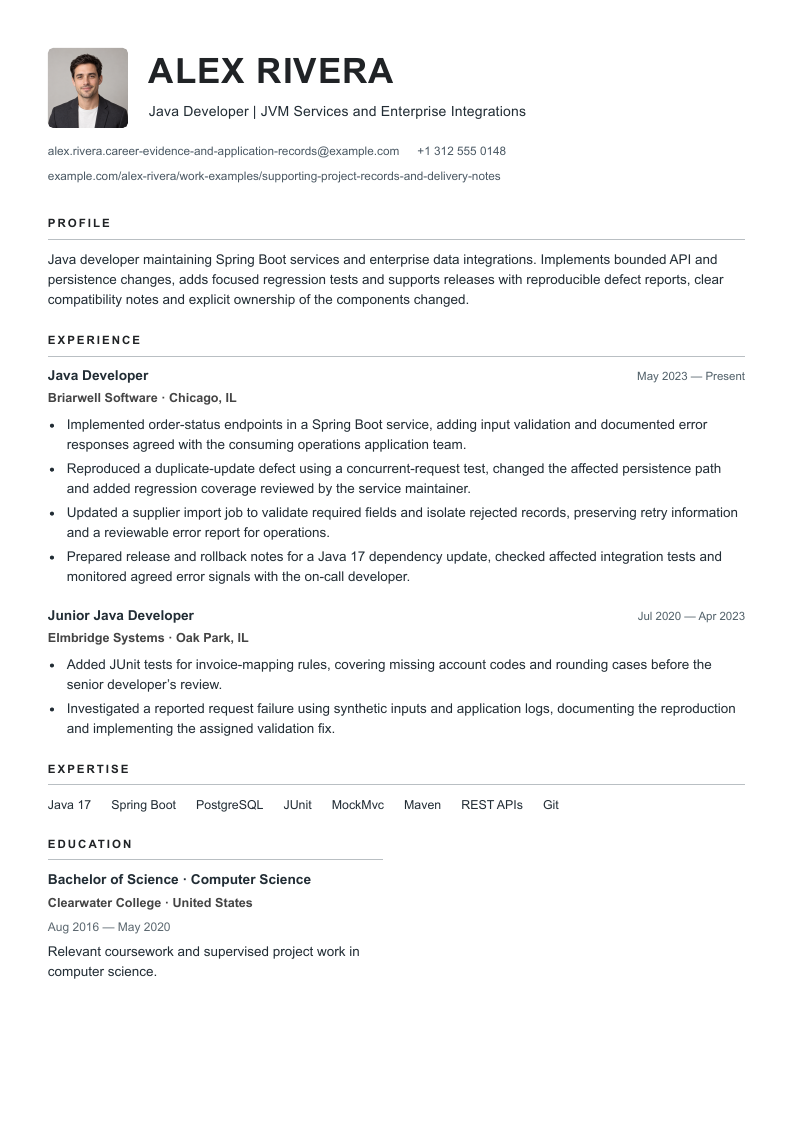 Open page 1 at full size
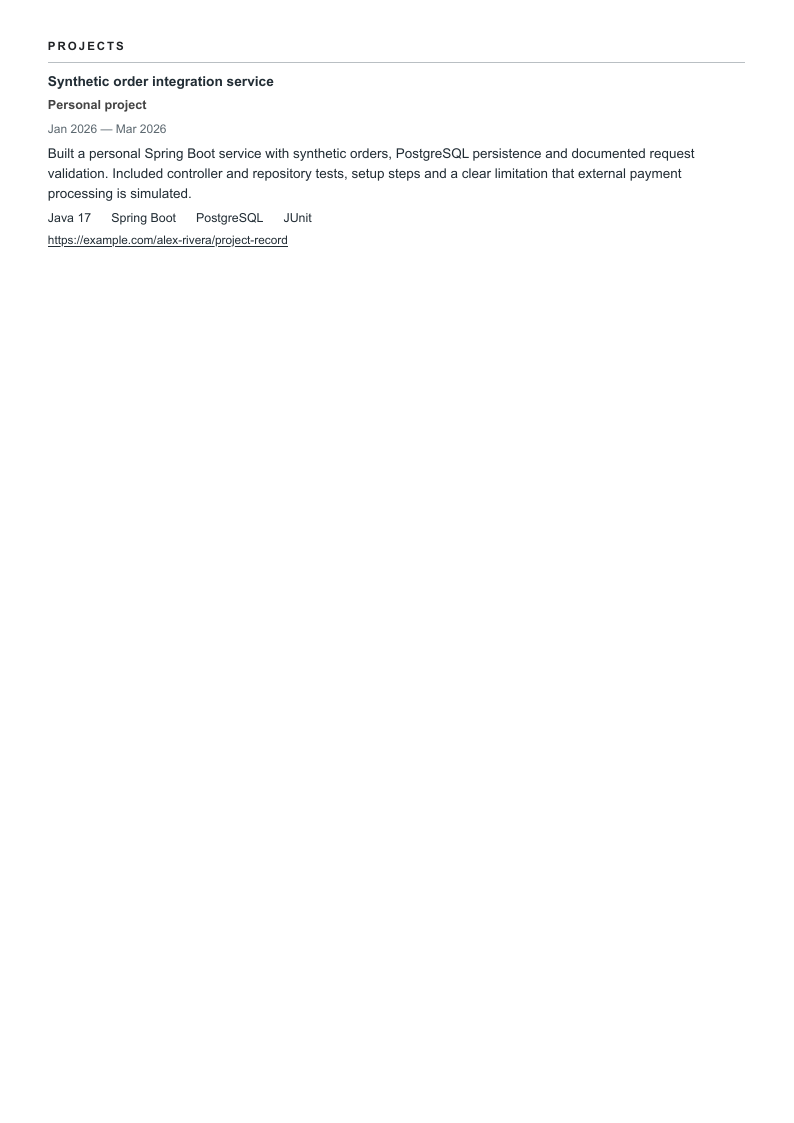 Open page 2 at full size
Java Developer | JVM Services and Enterprise Integrations
alex.rivera.career-evidence-and-application-records@example.com · +1 312 555 0148
Portfolio: https://example.com/alex-rivera/work-examples/supporting-project-records-and-delivery-notes
Java developer maintaining Spring Boot services and enterprise data integrations. Implements bounded API and persistence changes, adds focused regression tests and supports releases with reproducible defect reports, clear compatibility notes and explicit ownership of the components changed.
Java 17 · Spring Boot · PostgreSQL · JUnit · MockMvc · Maven · REST APIs · Git
Briarwell Software · Chicago, IL
May 2023–Present
Elmbridge Systems · Oak Park, IL
July 2020–April 2023
Bachelor of Science in Computer Science · Clearwater College · United States
August 2016–May 2020
Relevant coursework and supervised project work in computer science.
Personal project
January 2026–March 2026
Java 17 · Spring Boot · PostgreSQL · JUnit
Built a personal Spring Boot service with synthetic orders, PostgreSQL persistence and documented request validation. Included controller and repository tests, setup steps and a clear limitation that external payment processing is simulated.
The expanded Essential example has the photo off. It retains every base field and adds an earlier software development intern role and two projects. Read each job date and the final project ending, then compare them with the complete text below. Keep methods, limitations and approval boundaries with the statements they explain.
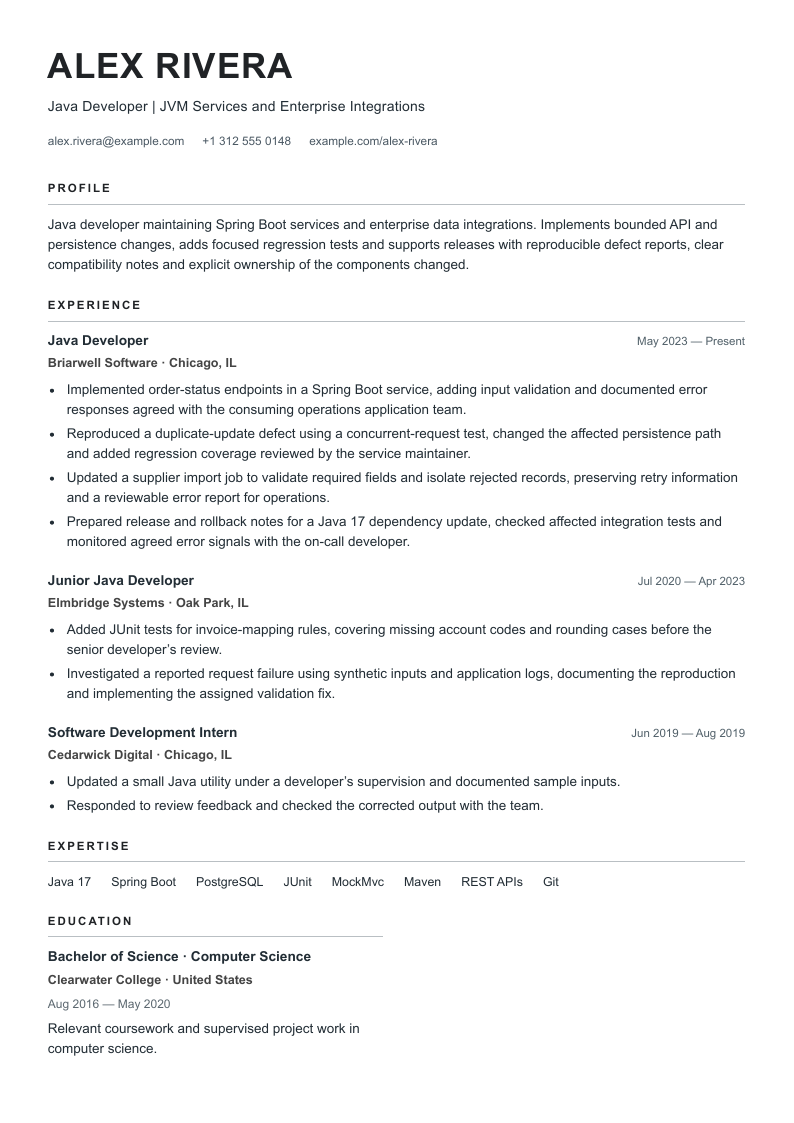 Open page 1 at full size
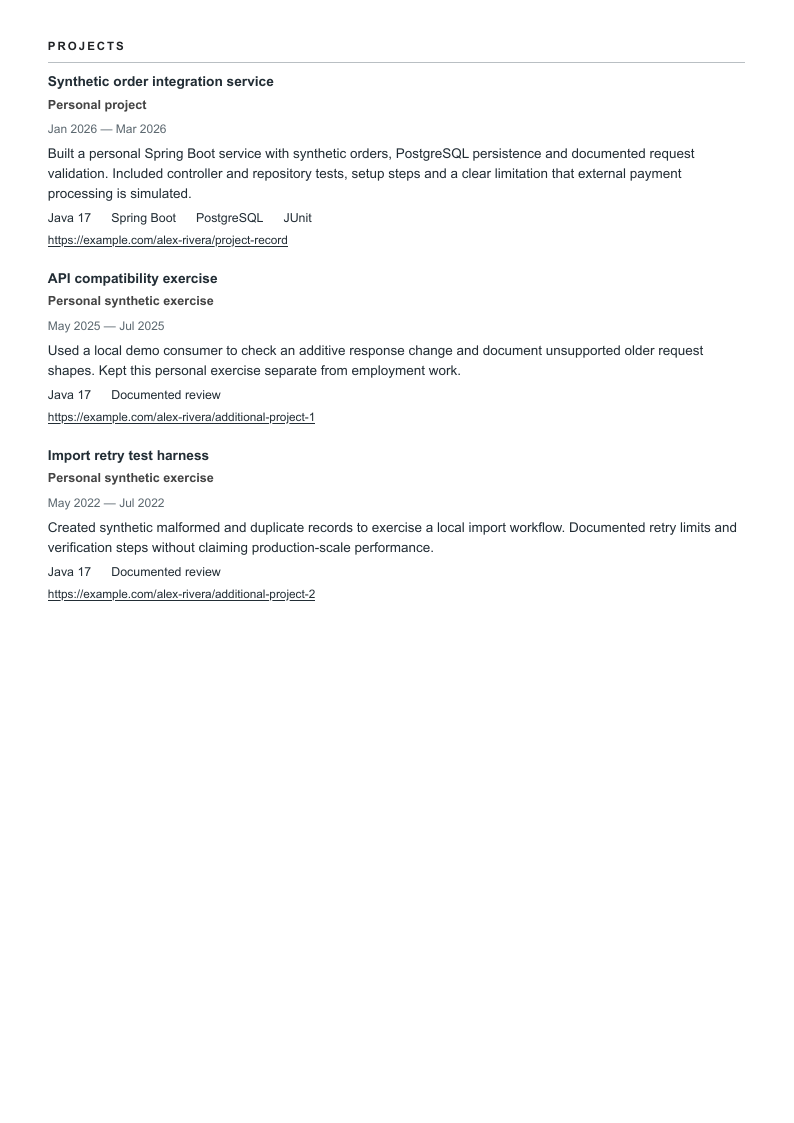 Open page 2 at full size
Java Developer | JVM Services and Enterprise Integrations
alex.rivera@example.com · +1 312 555 0148
Portfolio: https://example.com/alex-rivera
Java developer maintaining Spring Boot services and enterprise data integrations. Implements bounded API and persistence changes, adds focused regression tests and supports releases with reproducible defect reports, clear compatibility notes and explicit ownership of the components changed.
Java 17 · Spring Boot · PostgreSQL · JUnit · MockMvc · Maven · REST APIs · Git
Briarwell Software · Chicago, IL
May 2023–Present
Elmbridge Systems · Oak Park, IL
July 2020–April 2023
Cedarwick Digital · Chicago, IL
June 2019–August 2019
Bachelor of Science in Computer Science · Clearwater College · United States
August 2016–May 2020
Relevant coursework and supervised project work in computer science.
Personal project
January 2026–March 2026
Java 17 · Spring Boot · PostgreSQL · JUnit
Built a personal Spring Boot service with synthetic orders, PostgreSQL persistence and documented request validation. Included controller and repository tests, setup steps and a clear limitation that external payment processing is simulated.
Personal synthetic exercise
May 2025–July 2025
Java 17 · Documented review
Used a local demo consumer to check an additive response change and document unsupported older request shapes. Kept this personal exercise separate from employment work.
Personal synthetic exercise
May 2022–July 2022
Java 17 · Documented review
Created synthetic malformed and duplicate records to exercise a local import workflow. Documented retry limits and verification steps without claiming production-scale performance.
Condense repeated duties before removing useful context. Let relevant evidence use another page when needed, then inspect continuations for isolated headings, detached dates and unfinished sentences. Page count alone cannot establish readability.
Read every exported page with your selected photo preference. Check full contacts, job dates, qualifications and project endings. Copy text from the PDF and inspect parsed application fields when available; follow the employer’s requested file type. Use your own evidence and avoid including confidential records.
A free account is required for the builder. Free-plan PDF downloads include a watermark; these previews show paid-plan output. Template buttons retain the exact design, photo preference and Java Developer role. Add your own details and photo after signup.
Use Essential without a photoThe resume analyzer gives advisory feedback. The bullet point generator can help draft from your notes; check every suggestion. No design or wording guarantees parsing, an interview or a hiring outcome.
Include it when you used it and it is relevant to the vacancy. Show what the application did and your contribution. Completing a tutorial does not establish production experience.
A project can demonstrate skills when paid experience is limited, but label it accurately. Describe the code, tests and limitations instead of presenting it as employment.
Use that description only if your work supports both client-side and server-side development. If your experience is primarily Java services, a clear backend focus is more accurate.
Prepared by Resumize with AI-assisted research and drafting for English-language applications. Three primary employer descriptions were directly retrieved with full readable duties, qualifications and application controls on October 29, 2026. Their locations, seniority and responsibilities differ. Primary occupational guidance supplies broader context; it does not establish an individual applicant’s eligibility. This is a small dated sample, not a representative market survey or proof that the fictional applicant qualifies for each opening. No application was submitted, private employee or client data used, or hiring outcome tested.
Halifax, Nova Scotia, Canada; graduate training and client placement, Java/Spring APIs, tests and database integration. Posting contains inconsistent currency and work-authorization wording; confirm eligibility directly with the employer rather than treating it as authoritative guidance on those points. Full readable employer duties, qualifications and application controls retrieved directly October 29, 2026; availability can change.
Riga, Latvia, hybrid; network-application APIs and firmware integrations; 5+ years Java and English/Latvian fluency. Full readable employer duties, qualifications and application controls retrieved October 29, 2026. This dated observation does not guarantee the vacancy remains open.
Toronto, Canada; legacy Java modernization and enterprise integrations; 5–6 years Java experience. Full readable employer duties, qualifications and application controls retrieved October 29, 2026. This dated observation does not guarantee the vacancy remains open.
Primary US occupational scope reference. Broad occupation guidance does not replace an individual employer’s qualification requirements.
Retained source from the existing guide; distinguishes focused web-layer testing from broader application verification.
Retained official tutorial source; a local demonstration is not evidence of production security.
Retained career guidance source from the existing Java Developer guide.