Nurse Practitioner (NP) resume examples and templates
A nurse practitioner resume should make your population focus, current credentials and clinical contribution easy to understand. This complete fictional family NP example separates advanced practice from earlier RN employment, shows documentation and referral evidence, and keeps state licensure distinct from national certification. Compare three existing designs before choosing your own.
These previews use the same layouts as the builder, with identical example content. Open a full preview to inspect the text and spacing.
Fictional candidate, employers, education and results. The optional portrait is AI-generated. Use your own evidence and photo; the example is not inserted into your resume.
Scholar
A centered serif identity and contacts lead into one column of profile, experience and expertise, followed by education, certifications and projects.
Before sending: The prominent headings and detailed credentials can add pages. Follow every license issue and expiry date through the final project; the name does not imply that a clinical application needs an academic CV.
The original Professional design centers the identity and contacts, then shows summary, skills, experience, education, projects and certifications.
Before sending: Its optional circular portrait sits above the identity. Credentials come after projects, so inspect their complete descriptions and current status as well as shortened social labels and full link destinations.
A muted salmon identity block sits beside contacts, followed by a single content column with section labels in a left gutter: profile, experience, expertise, education, certifications and projects.
Before sending: The contact column and section-label gutter reduce text width. Check the full email and URL, then follow each credential issuer, issue date and expiry through every continuation page.
“Use” opens signup with that design and photo preference selected for the builder. A free account is required. Free-plan PDF downloads include a watermark; see current plans for paid options. Photo conventions vary; follow the employer’s instructions and local expectations.
All three designs contain the same fictional record. Photo is off by default; each offers an optional portrait preview. Use buttons retain the chosen template, photo preference and Nurse Practitioner (NP) role through signup. A free account is required, and free-plan PDF downloads include a watermark. Morgan’s fictional career and AI-generated portrait are teaching material and are not inserted into your account.
Scholar uses centered serif headings and one column, with education and certifications after experience and expertise. Professional uses a centered identity, optional portrait above it, and certifications after projects. Civic places a muted salmon identity block beside contacts, with a single content column and section labels in a left gutter. Check the actual qualification sequence and every continuation page before choosing a design.
Read the design guides: Scholar · Professional · Civic. Follow the employer’s file and photo instructions for your application.
A complete nurse practitioner resume example
Morgan Ellis, the employers, schools, dates, credentials, projects and measures are original editorial fiction. No license or certification exists for this candidate. The example.com links are placeholders and the optional portrait is AI-generated. This guide uses AI-assisted research and drafting; it provides resume guidance, not clinical advice.
Morgan Ellis
Family Nurse Practitioner | Outpatient Assessment and Follow-up
Family nurse practitioner with outpatient assessment, follow-up planning and referral coordination experience in Texas. Holds separate fictional active RN and APRN licenses and ANCC FNP-BC certification. Works within the family population focus and a collaborating physician practice agreement. Earlier ambulatory RN work supports clear EHR documentation, patient communication and accountable handoffs; process measures are kept separate from clinical outcomes.
Provided family nurse practitioner assessment and follow-up in a Texas outpatient clinic, within the family population focus and the practice agreement with the collaborating physician; consulted or referred when needs exceeded the assigned scope.
Reviewed required follow-up-plan fields in 80 assigned encounter notes during June 2026; 72 were complete at first review, and eight were corrected through the clinic’s approved process before the review closed.
Tracked 30 assigned referral handoffs in July–September 2026; confirmed receiving-team acknowledgement for 27 and escalated the three unconfirmed handoffs through the clinic’s follow-up pathway.
Explained the agreed follow-up plan in plain language, used the clinic’s approved teach-back approach and documented questions requiring another clinician’s review in the authorized EHR.
Registered Nurse
Oakridge Ambulatory Group · Austin, TX
June 2017–June 2019
Delivered RN care in an ambulatory clinic while completing the graduate family NP program, recorded nursing assessments and escalated changes to the authorized provider; retained the Registered Nurse title throughout that employment.
Prepared 18 scheduled RN coverage handoffs in January–March 2019 with pending nursing tasks and the receiving clinician identified; used the approved escalation pathway for questions outside the RN assignment.
Education
Master of Science in Nursing in Family Nurse Practitioner · Lakeside Nursing University · Austin, TX
September 2017–May 2019
Fictional completed graduate program with supervised family NP clinical learning; the invented institution is not an accreditation claim.
Bachelor of Science in Nursing · Hillcrest Valley College · Austin, TX
September 2009–May 2013
Fictional completed nursing degree; no GPA or honors claimed.
Licenses and board certification
Registered Nurse license — fictional, nonvalid example
Texas Board of Nursing
Issued July 2013
Expires May 2028
Editorial fiction: initially licensed July 2013; renewed May 2026 and active as of October 2026. The illustrative May 2028 expiry assumes a May birthday in an even birth year. No actual license exists for this candidate.
APRN license: Nurse Practitioner, Family — fictional, nonvalid example
Texas Board of Nursing
Issued August 2019
Expires May 2028
Editorial fiction: initially licensed August 2019; renewed May 2026 and active as of October 2026, aligned with the Texas RN expiry. No actual license exists. This example does not claim prescriptive authority.
Family Nurse Practitioner-Board Certified (FNP-BC) — fictional, nonvalid example
American Nurses Credentialing Center (ANCC)
Issued July 2024
Expires June 2029
Editorial fiction: initially certified July 2019; illustrative renewed five-year certification period July 2024–June 2029, active as of October 2026. No actual certification exists; this is separate from state licensure.
Projects
Referral acknowledgement review
Family NP contributor · Cedarfield Family Clinic
July 2026–September 2026
EHR task queue · Aggregate handoff log · Review checklist
Reviewed 30 assigned referral handoffs with the clinic team, separating 27 acknowledged handoffs from three requiring escalation. Recorded the follow-up owner and review point in the approved system. The exercise measures acknowledgement, not specialist attendance or treatment completion. The portfolio uses invented scenarios and aggregate numbers only, with no patient records or treatment instructions.
Begin with the role you are authorized and prepared to perform. Morgan’s example is a family nurse practitioner in a Texas outpatient clinic. The summary names assessment, follow-up and referral work, while the credentials separate the RN license, APRN license and family NP board certification. “Nurse practitioner” alone does not explain population focus, specialty experience or which procedures you can perform.
The employer sources show why tailoring needs more than a keyword list. RI Primary Care describes outpatient panel work, documentation and referral collaboration in Rhode Island. Tia’s California role combines virtual and in-person primary care with specific women’s-health procedures. Praxis Health’s Oregon posting emphasizes continuity in family practice and states a licensed-NP primary-care experience requirement. These are different jobs in different states; their requirements are not transferred to the Texas example.
Use the target vacancy to decide which truthful evidence deserves space. State your setting, patient population at a suitable general level, collaboration and actual responsibilities. If telehealth or a procedure is requested, describe only work you performed within your training, privileges and authorization. Do not borrow another population-focus credential or imply that NP and PA qualifications are interchangeable because an employer accepts either profession.
Six NP experience rewrites with reasoning
Every “after” appears verbatim in the base example. The weak “before” sentences are not additional career facts. Use the evidence prompts to check your own contribution; do not borrow these invented metrics.
1. State the NP population focus and clinical setting
Before: Provided every kind of medical care independently.
After: Provided family nurse practitioner assessment and follow-up in a Texas outpatient clinic, within the family population focus and the practice agreement with the collaborating physician; consulted or referred when needs exceeded the assigned scope.
Names the NP role, setting and collaboration boundary. A family credential does not establish every acute-care specialty, procedure or independent-practice authority.
Evidence to check: Actual role description, current credentials, approved privileges and supervisor confirmation; exclude patient records.
2. Define a documentation measure
Before: Made all patient records perfect and prevented errors.
After: Reviewed required follow-up-plan fields in 80 assigned encounter notes during June 2026; 72 were complete at first review, and eight were corrected through the clinic’s approved process before the review closed.
The first-review completeness rate is 72 of 80, or 90%. A documentation-field check does not prove clinical accuracy, error prevention or better patient outcomes.
Evidence to check: Employer-permitted aggregate review, field definitions, review dates and correction status, without chart extracts.
3. Make referral follow-up observable
Before: Guaranteed every patient received specialist treatment.
After: Tracked 30 assigned referral handoffs in July–September 2026; confirmed receiving-team acknowledgement for 27 and escalated the three unconfirmed handoffs through the clinic’s follow-up pathway.
The 27 acknowledgements and three escalations account for 30 handoffs. Acknowledgement does not show attendance, treatment completion or an outcome.
Evidence to check: Approved aggregate handoff counts, acknowledgement definition and escalation procedure; no patient identifiers.
4. Describe communication and teaching
Before: Improved compliance for every patient through education.
After: Explained the agreed follow-up plan in plain language, used the clinic’s approved teach-back approach and documented questions requiring another clinician’s review in the authorized EHR.
Shows the communication method and documentation. A completed discussion alone does not establish adherence or a clinical outcome.
Evidence to check: Validated communication competency and approved materials; do not share recorded patient conversations.
5. Keep earlier RN work at its actual level
Before: Worked as an NP before finishing graduate school.
After: Delivered RN care in an ambulatory clinic while completing the graduate family NP program, recorded nursing assessments and escalated changes to the authorized provider; retained the Registered Nurse title throughout that employment.
RN employment and supervised graduate learning are different records. The NP title follows the appropriate education, certification and state authorization.
Evidence to check: Employment title and dates, degree record and relevant authorization dates; no patient chart needed.
6. Show an RN handoff without claiming NP decisions
Before: Diagnosed all telephone concerns as the clinic nurse.
After: Prepared 18 scheduled RN coverage handoffs in January–March 2019 with pending nursing tasks and the receiving clinician identified; used the approved escalation pathway for questions outside the RN assignment.
Describes nursing coordination rather than retroactively assigning NP diagnostic authority. Eighteen handoffs are process events, not 18 distinct patients.
Evidence to check: Permitted aggregate schedule, role boundaries and handoff checklist; omit individual clinical concerns.
Write assessment and follow-up evidence without outcome inflation
A useful summary connects your preparation to the work the employer needs. Morgan’s summary names family NP assessment, referral coordination, documentation and the collaborating-physician practice agreement. The earlier RN job remains an RN job. This is more informative than “highly skilled provider” and more defensible than promising independent practice in every state or every clinical setting.
For a quality measure, define exactly what was reviewed and what the number means. The example reviews required follow-up-plan fields in 80 assigned encounter notes: 72 complete at first review, eight corrected before closure. That supports a 90% first-review completeness measure. It does not establish that the notes were clinically accurate, that every patient improved or that an error was prevented. A real outcome claim needs a defined measure, period, comparison and an honest account of your contribution.
Referral coordination benefits from the same precision. Twenty-seven acknowledged handoffs and three escalations account for 30 assigned events. They do not prove that 30 distinct patients attended appointments or completed treatment. Likewise, documenting teach-back shows a communication process, not guaranteed adherence. Keep the practical contribution while removing causal claims you cannot support with permitted evidence.
Tie NP skills to the work you can support
Use the vacancy’s terminology when it accurately describes your work. Put the setting, preparation and evidence in the experience section; a skills list alone does not establish competence, authority or successful parsing.
Nurse Practitioner skills and supporting evidence
Skill
Evidence to gather
Fictional example
Family NP assessment
Population focus, setting, privileges and collaboration.
Outpatient family NP work within a physician practice agreement.
Clinical documentation
Required fields, review cohort and correction status.
72 of 80 notes complete at first review; eight corrected.
Referral coordination
Handoff definition, receiving owner and escalation.
27 acknowledgements plus three escalations among 30 handoffs.
Patient communication
Validated approach and approved materials.
Plain-language follow-up discussion and teach-back.
Interprofessional work
Your decision and the consultation boundary.
Consultation or referral when needs exceed the assigned scope.
RN care coordination
Actual title, dates and approved nursing assignment.
18 RN handoff events before NP authorization.
Separate graduate education, state licensure and certification
List the awarded degree, program focus, institution and dates accurately. Morgan’s fictional MSN in the family NP program precedes the fictional 2019 certification and APRN authorization; the BS degree precedes RN employment. The invented schools are teaching examples, not claims that a real program is accredited. On your own application, verify the actual program and qualification rather than copying the sample’s institution or dates.
The three credential records serve different purposes. The Texas RN license establishes the example’s RN record, the Texas APRN license names the Nurse Practitioner role and Family population focus, and ANCC’s FNP-BC is the national certification. An MSN or DNP is an academic award, not a substitute for the applicable state authorization. Membership in a professional association is also not board certification.
Morgan’s RN and APRN records use illustrative May 2028 expiries, aligned to a May birthday in an even birth year, and describe a May 2026 renewal. The ANCC example shows a renewed five-year period from July 2024 through June 2029, separately from the original 2019 award. Every credential is explicitly nonvalid editorial fiction. Use the dates and status on your actual current records, and follow the employer’s requested verification process.
Prescriptive authority is a separate issue. The fictional resume makes no prescribing claim and does not include a DEA registration. Texas board guidance distinguishes a practice agreement for medical aspects of care from prescriptive authority requirements. If the vacancy requires prescribing or a registration, supply only your actual current authorization through the appropriate application channel. This article is resume-writing guidance, not legal advice, a licensing checklist or permission to practice.
Show the RN-to-NP transition honestly
A newly qualified NP can use relevant RN experience without relabeling it as advanced practice. Keep the RN title and employment dates, then explain the nursing assessment, communication or handoff work you performed. Graduate clinical placements belong under education or a clearly labeled supervised placement record; they are not independent NP employment. Separate completed qualifications from exams, applications or authorizations still pending.
Morgan’s base record pairs the later family NP role with an earlier ambulatory RN role during graduate study. The expanded version adds an older RN job from August 2013 through May 2017 and two projects; it does not alter the base jobs or invent earlier NP authority. This makes the progression clear even when the longer document continues onto another page.
A fictional early-career adaptation could say: “Registered nurse transitioning to family NP practice after completed graduate preparation; seeking a role that matches the current population-focus credentials and employer onboarding requirements.” Replace that with your exact awarded qualifications and current status. Never describe yourself as licensed, certified or board eligible merely because you plan to apply; use the issuer’s and employer’s accurate terminology.
Check long contacts alongside the optional photo
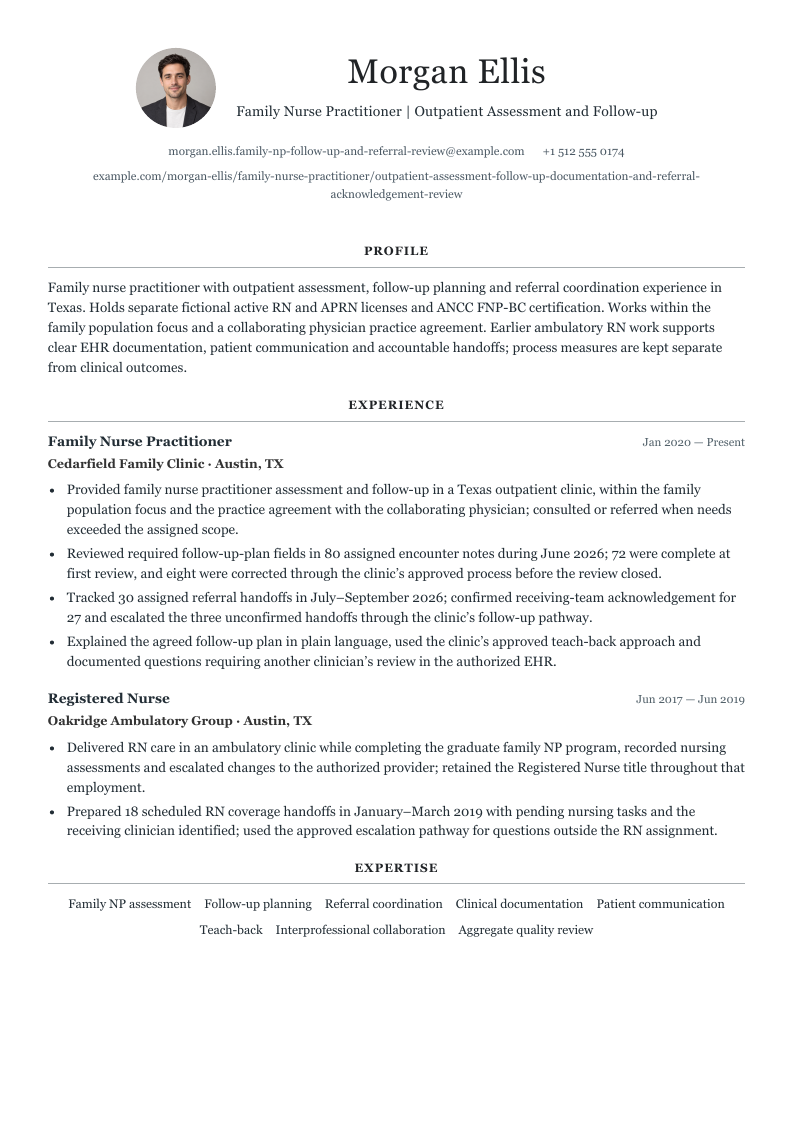
The Scholar long-contact preview changes only Morgan’s resume email and portfolio URL and turns the optional portrait on. User identity, phone, jobs, education, credentials and project remain unchanged. Inspect the full email ending and final URL segment, then follow all three qualification records and their dates through the complete export.
Family nurse practitioner with outpatient assessment, follow-up planning and referral coordination experience in Texas. Holds separate fictional active RN and APRN licenses and ANCC FNP-BC certification. Works within the family population focus and a collaborating physician practice agreement. Earlier ambulatory RN work supports clear EHR documentation, patient communication and accountable handoffs; process measures are kept separate from clinical outcomes.
Provided family nurse practitioner assessment and follow-up in a Texas outpatient clinic, within the family population focus and the practice agreement with the collaborating physician; consulted or referred when needs exceeded the assigned scope.
Reviewed required follow-up-plan fields in 80 assigned encounter notes during June 2026; 72 were complete at first review, and eight were corrected through the clinic’s approved process before the review closed.
Tracked 30 assigned referral handoffs in July–September 2026; confirmed receiving-team acknowledgement for 27 and escalated the three unconfirmed handoffs through the clinic’s follow-up pathway.
Explained the agreed follow-up plan in plain language, used the clinic’s approved teach-back approach and documented questions requiring another clinician’s review in the authorized EHR.
Registered Nurse
Oakridge Ambulatory Group · Austin, TX
June 2017–June 2019
Delivered RN care in an ambulatory clinic while completing the graduate family NP program, recorded nursing assessments and escalated changes to the authorized provider; retained the Registered Nurse title throughout that employment.
Prepared 18 scheduled RN coverage handoffs in January–March 2019 with pending nursing tasks and the receiving clinician identified; used the approved escalation pathway for questions outside the RN assignment.
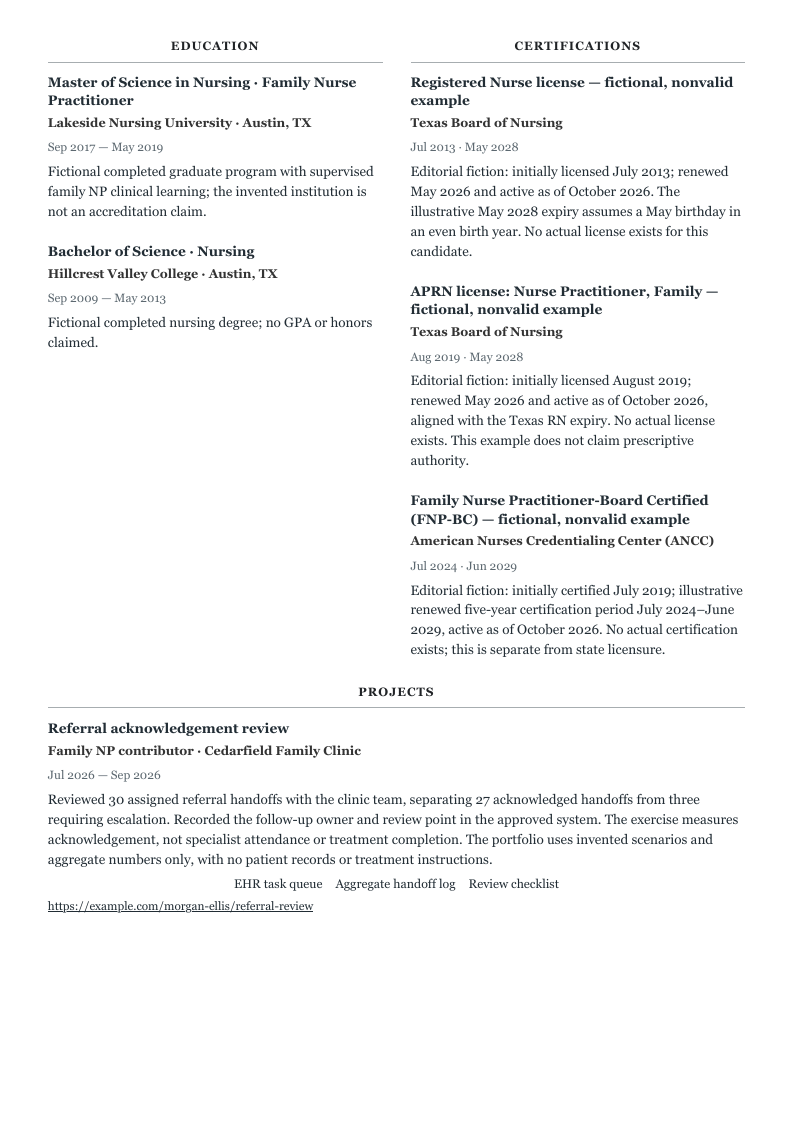
Education
Master of Science in Nursing in Family Nurse Practitioner · Lakeside Nursing University · Austin, TX
September 2017–May 2019
Fictional completed graduate program with supervised family NP clinical learning; the invented institution is not an accreditation claim.
Bachelor of Science in Nursing · Hillcrest Valley College · Austin, TX
September 2009–May 2013
Fictional completed nursing degree; no GPA or honors claimed.
Licenses and board certification
Registered Nurse license — fictional, nonvalid example
Texas Board of Nursing
Issued July 2013
Expires May 2028
Editorial fiction: initially licensed July 2013; renewed May 2026 and active as of October 2026. The illustrative May 2028 expiry assumes a May birthday in an even birth year. No actual license exists for this candidate.
APRN license: Nurse Practitioner, Family — fictional, nonvalid example
Texas Board of Nursing
Issued August 2019
Expires May 2028
Editorial fiction: initially licensed August 2019; renewed May 2026 and active as of October 2026, aligned with the Texas RN expiry. No actual license exists. This example does not claim prescriptive authority.
Family Nurse Practitioner-Board Certified (FNP-BC) — fictional, nonvalid example
American Nurses Credentialing Center (ANCC)
Issued July 2024
Expires June 2029
Editorial fiction: initially certified July 2019; illustrative renewed five-year certification period July 2024–June 2029, active as of October 2026. No actual certification exists; this is separate from state licensure.
Projects
Referral acknowledgement review
Family NP contributor · Cedarfield Family Clinic
July 2026–September 2026
EHR task queue · Aggregate handoff log · Review checklist
Reviewed 30 assigned referral handoffs with the clinic team, separating 27 acknowledged handoffs from three requiring escalation. Recorded the follow-up owner and review point in the approved system. The exercise measures acknowledgement, not specialist attendance or treatment completion. The portfolio uses invented scenarios and aggregate numbers only, with no patient records or treatment instructions.
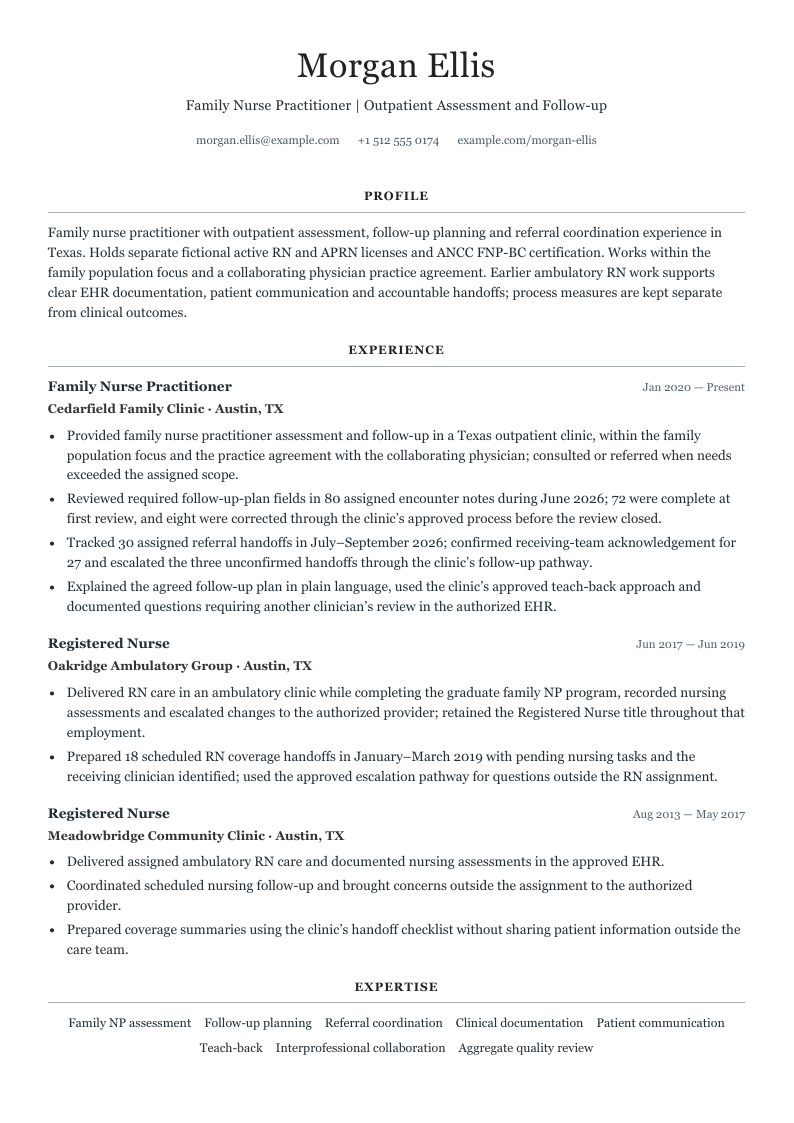
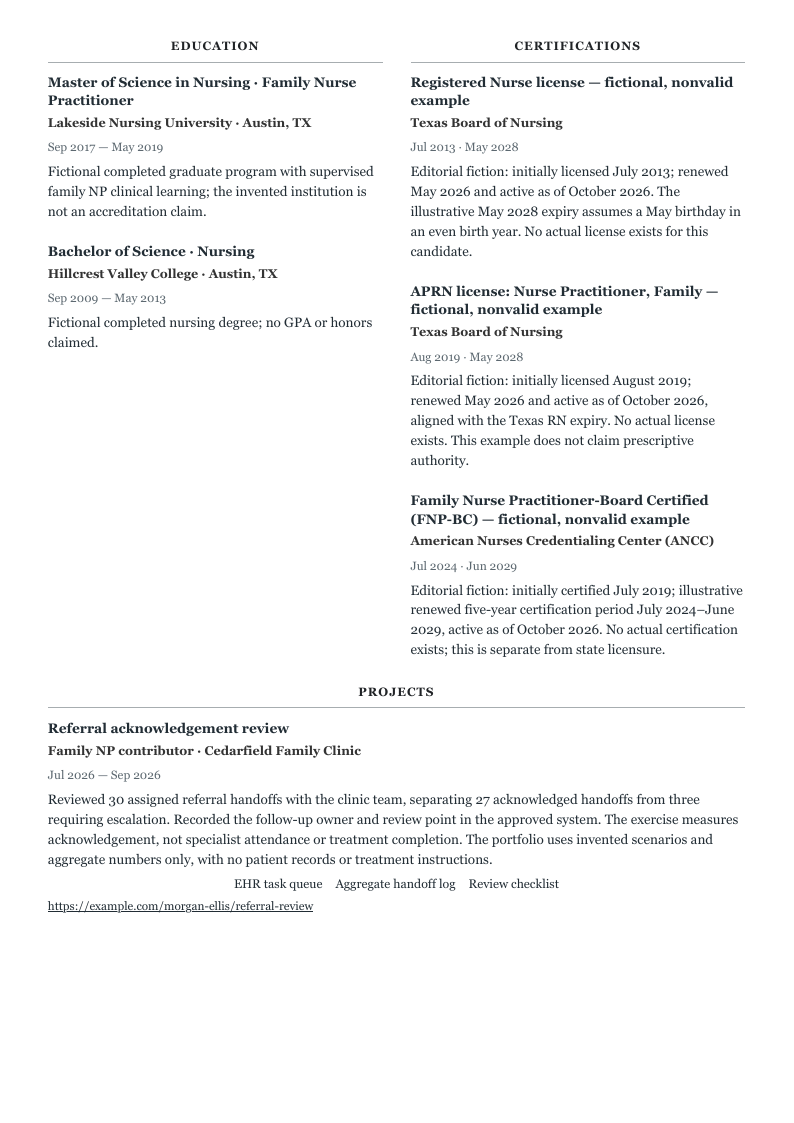
The expanded Scholar example has photo off and preserves every base field. It adds the earlier RN employment plus documentation-review and RN handoff projects. Keep those project dates attached to their own records, and keep both RN roles distinct from later family NP practice. Do not remove an issuer, qualification description or final sentence merely to force the document onto a particular page count.
Open page 1 at full sizeScholar · Page 1 of 3 · Photo off · Complete paid-plan PDF page, including margins, without a watermark.Open page 2 at full sizeScholar · Page 2 of 3 · Photo off · Complete paid-plan PDF page, including margins, without a watermark.Open page 3 at full sizeScholar · Page 3 of 3 · Photo off · Complete paid-plan PDF page, including margins, without a watermark.Use Scholar without a photo
Morgan Ellis
Family Nurse Practitioner | Outpatient Assessment and Follow-up
Family nurse practitioner with outpatient assessment, follow-up planning and referral coordination experience in Texas. Holds separate fictional active RN and APRN licenses and ANCC FNP-BC certification. Works within the family population focus and a collaborating physician practice agreement. Earlier ambulatory RN work supports clear EHR documentation, patient communication and accountable handoffs; process measures are kept separate from clinical outcomes.
Provided family nurse practitioner assessment and follow-up in a Texas outpatient clinic, within the family population focus and the practice agreement with the collaborating physician; consulted or referred when needs exceeded the assigned scope.
Reviewed required follow-up-plan fields in 80 assigned encounter notes during June 2026; 72 were complete at first review, and eight were corrected through the clinic’s approved process before the review closed.
Tracked 30 assigned referral handoffs in July–September 2026; confirmed receiving-team acknowledgement for 27 and escalated the three unconfirmed handoffs through the clinic’s follow-up pathway.
Explained the agreed follow-up plan in plain language, used the clinic’s approved teach-back approach and documented questions requiring another clinician’s review in the authorized EHR.
Registered Nurse
Oakridge Ambulatory Group · Austin, TX
June 2017–June 2019
Delivered RN care in an ambulatory clinic while completing the graduate family NP program, recorded nursing assessments and escalated changes to the authorized provider; retained the Registered Nurse title throughout that employment.
Prepared 18 scheduled RN coverage handoffs in January–March 2019 with pending nursing tasks and the receiving clinician identified; used the approved escalation pathway for questions outside the RN assignment.
Registered Nurse
Meadowbridge Community Clinic · Austin, TX
August 2013–May 2017
Delivered assigned ambulatory RN care and documented nursing assessments in the approved EHR.
Coordinated scheduled nursing follow-up and brought concerns outside the assignment to the authorized provider.
Prepared coverage summaries using the clinic’s handoff checklist without sharing patient information outside the care team.
Education
Master of Science in Nursing in Family Nurse Practitioner · Lakeside Nursing University · Austin, TX
September 2017–May 2019
Fictional completed graduate program with supervised family NP clinical learning; the invented institution is not an accreditation claim.
Bachelor of Science in Nursing · Hillcrest Valley College · Austin, TX
September 2009–May 2013
Fictional completed nursing degree; no GPA or honors claimed.
Licenses and board certification
Registered Nurse license — fictional, nonvalid example
Texas Board of Nursing
Issued July 2013
Expires May 2028
Editorial fiction: initially licensed July 2013; renewed May 2026 and active as of October 2026. The illustrative May 2028 expiry assumes a May birthday in an even birth year. No actual license exists for this candidate.
APRN license: Nurse Practitioner, Family — fictional, nonvalid example
Texas Board of Nursing
Issued August 2019
Expires May 2028
Editorial fiction: initially licensed August 2019; renewed May 2026 and active as of October 2026, aligned with the Texas RN expiry. No actual license exists. This example does not claim prescriptive authority.
Family Nurse Practitioner-Board Certified (FNP-BC) — fictional, nonvalid example
American Nurses Credentialing Center (ANCC)
Issued July 2024
Expires June 2029
Editorial fiction: initially certified July 2019; illustrative renewed five-year certification period July 2024–June 2029, active as of October 2026. No actual certification exists; this is separate from state licensure.
Projects
Referral acknowledgement review
Family NP contributor · Cedarfield Family Clinic
July 2026–September 2026
EHR task queue · Aggregate handoff log · Review checklist
Reviewed 30 assigned referral handoffs with the clinic team, separating 27 acknowledged handoffs from three requiring escalation. Recorded the follow-up owner and review point in the approved system. The exercise measures acknowledgement, not specialist attendance or treatment completion. The portfolio uses invented scenarios and aggregate numbers only, with no patient records or treatment instructions.
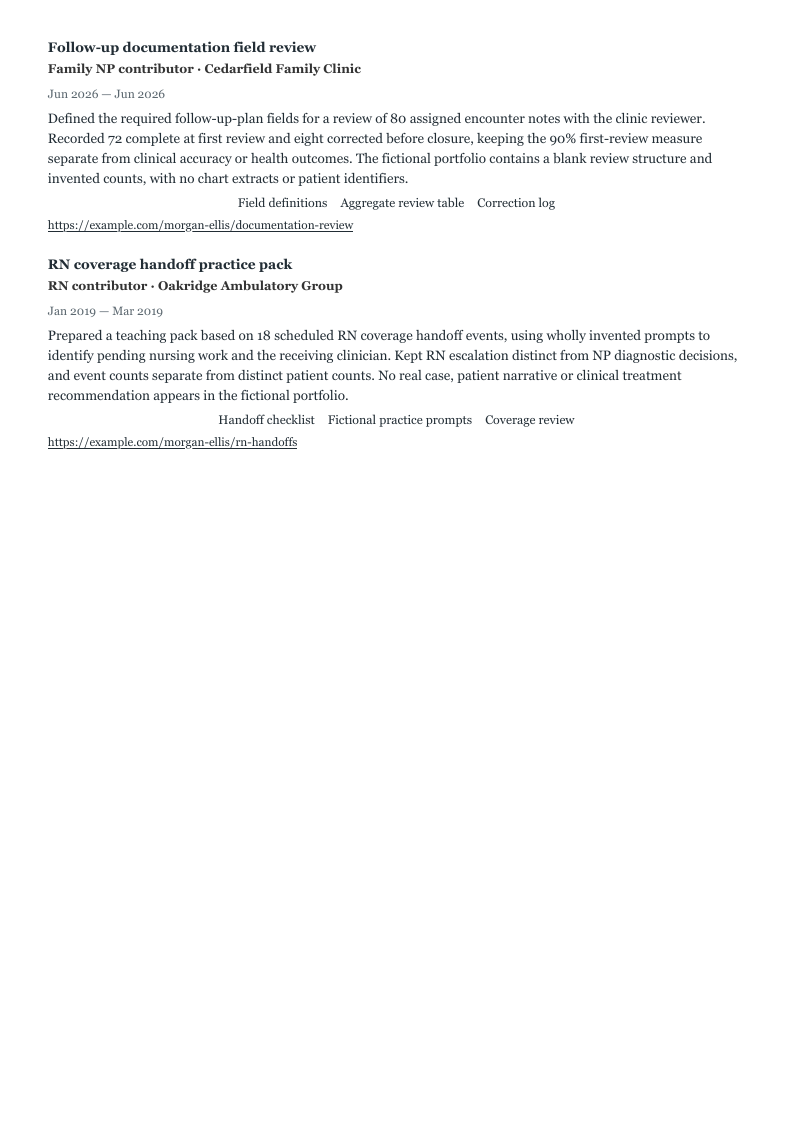
Field definitions · Aggregate review table · Correction log
Defined the required follow-up-plan fields for a review of 80 assigned encounter notes with the clinic reviewer. Recorded 72 complete at first review and eight corrected before closure, keeping the 90% first-review measure separate from clinical accuracy or health outcomes. The fictional portfolio contains a blank review structure and invented counts, with no chart extracts or patient identifiers.
Handoff checklist · Fictional practice prompts · Coverage review
Prepared a teaching pack based on 18 scheduled RN coverage handoff events, using wholly invented prompts to identify pending nursing work and the receiving clinician. Kept RN escalation distinct from NP diagnostic decisions, and event counts separate from distinct patient counts. No real case, patient narrative or clinical treatment recommendation appears in the fictional portfolio.
Check qualifications and content in the exported file
Read the complete email and portfolio destination, then check every job, degree, license and certification date against the correct record. In Civic, check the contact column and section-label gutter through every continuation.
Confirm the actual role and population focus, current credential status, state, employer privileges and collaboration boundaries. Add prescribing authority or registrations only when actually held and relevant; an NP title alone does not supply them.
Keep note counts, handoff events and distinct patients separate. Reconcile each numerator with its denominator and do not turn documentation completeness or acknowledgement into a clinical-outcome claim.
Copy the exported PDF text and inspect parsed application fields. Follow the requested file type and any assistance rules. Keep patient identifiers, chart extracts, case narratives, screenshots and proprietary clinical protocols outside your resume and portfolio.
These complete page images show paid-plan output without a watermark. Free-plan PDF downloads include a watermark. No design guarantees ATS parsing, ranking or an interview. Check your own saved file and application fields; do not use a real or lightly anonymized patient case as a public portfolio example.
Questions, answered
How does an NP resume differ from an RN resume?
Show your actual graduate preparation, NP role and population focus, current state authorization and national certification where applicable. Retain earlier RN titles and dates. RN nursing experience does not retroactively become NP employment or establish advanced-practice authority.
Is FNP-BC the same as an APRN license?
No. FNP-BC is the American Nurses Credentialing Center’s family nurse practitioner board-certification credential. State licensure is a separate record. The fictional example lists its Texas RN license, Texas APRN Family NP license and ANCC certification separately, with distinct issuers and dates.
Should every NP list prescriptive authority or DEA registration?
List only authorizations you actually hold and that are relevant to the vacancy. Requirements vary with jurisdiction and role. The fictional example does not claim prescribing authority or a DEA registration; its credentials do not establish eligibility for every job cited in the research.
Can I claim a clinical improvement from a documentation audit?
A field-completeness check does not establish a patient outcome. Define the cohort, dates and review measure, then describe your correction or follow-up work. A clinical-outcome claim requires separate permitted evidence and an accurate explanation of your contribution.
Can I include patient cases in a portfolio?
Do not publish patient records, screenshots, identifiers or lightly anonymized case narratives. The example portfolio uses wholly invented scenarios and aggregate teaching numbers. Follow employer permissions and applicable privacy requirements for any material you use.
Must my NP resume fit one page?
Use the length needed for relevant, readable evidence and complete qualifications, following the employer’s instructions. Inspect every exported page and remove repetition. Do not hide a license status or qualification description to satisfy a fixed page-count rule.
What do the template buttons carry into signup?
Your selected template, photo preference and Nurse Practitioner (NP) role. Morgan’s fictional resume and AI-generated portrait are not inserted into your account. A free account is required; free-plan PDF downloads include a watermark.
Prepared by Resumize with AI-assisted research and drafting for English-language US applications. Three current primary employer descriptions with Apply controls were checked on October 28, 2026: Rhode Island outpatient primary care, a California hybrid primary-care and women’s-health role accepting NPs or PAs, and Oregon family practice. These postings illustrate variation; they do not establish universal NP requirements or Texas eligibility. Texas board material was available through official indexed text while direct retrieval returned errors; ANCC’s certification page was directly readable. All resume identities, institutions, employers, credentials, dates and measures are fictional. No clinical treatment guidance, legal advice, credential verification, employer endorsement or guaranteed result is provided.
Retrieved October 28, 2026. Rhode Island outpatient role; full description, Apply control and application form present; no publication date displayed. Illustrates population focus, documentation, physician collaboration and referral work. Its Rhode Island license, DEA and CSR requirements are vacancy-specific, not a grant of Texas authority.
Retrieved October 28, 2026. Los Angeles/Pasadena, California; full hybrid role description, Apply control and form present; no publication date displayed. Illustrates coordinated documentation and in-person/virtual work, with procedure-specific qualifications. NP and PA credentials remain distinct; the shared vacancy does not make them interchangeable.
Retrieved October 28, 2026. Albany, Oregon; full description, Apply control and application form present; no publication date displayed. Illustrates continuity, outpatient family practice and a stated minimum of one year licensed NP primary-care experience. These requirements do not define every NP vacancy.
Checked October 28, 2026 through the official indexed text; direct-page retrieval returned an error. Distinguishes RN privilege, role/population-focus graduate preparation, national certification and optional prescriptive authority. The guide does not provide a licensing checklist or verify any sample credential.
Checked October 28, 2026 through the official indexed text; direct-page retrieval returned an error. Describes Texas RN/APRN expiry alignment and birth-month/birth-year renewal conventions. The fictional records assume a May birthday in an even birth year; their dates are illustrative, not actual board records.
Checked October 28, 2026 through the official indexed text; direct PDF retrieval returned an error. Explains that medical aspects of care require a collaborating physician relationship and practice agreement even when a role does not prescribe. No universal independent-practice or prescribing permission is inferred.
Read October 28, 2026. Official FNP-BC credential title and five-year validity/renewal context; certification is separate from state licensure. The fictional renewal is July 2024–June 2029 and is not a verified credential.