A physician assistant resume should make your clinical setting, authorized responsibilities and consultation practices easy to understand. Use this complete fictional example to connect evaluation, documentation and follow-up to evidence, while separating state licensure from NCCPA certification.
These previews use the same layouts as the builder, with identical example content. Open a full preview to inspect the text and spacing.
Fictional candidate, employers, education and results. The optional portrait is AI-generated. Use your own evidence and photo; the example is not inserted into your resume.
Classic
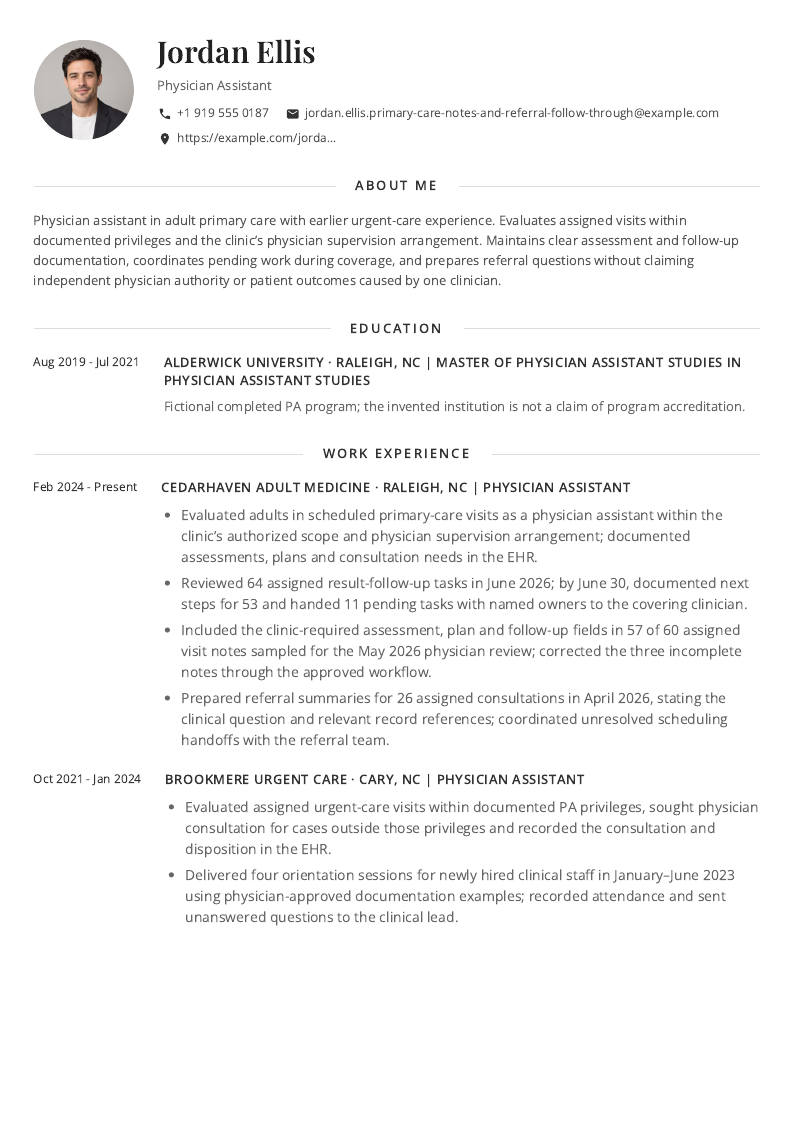
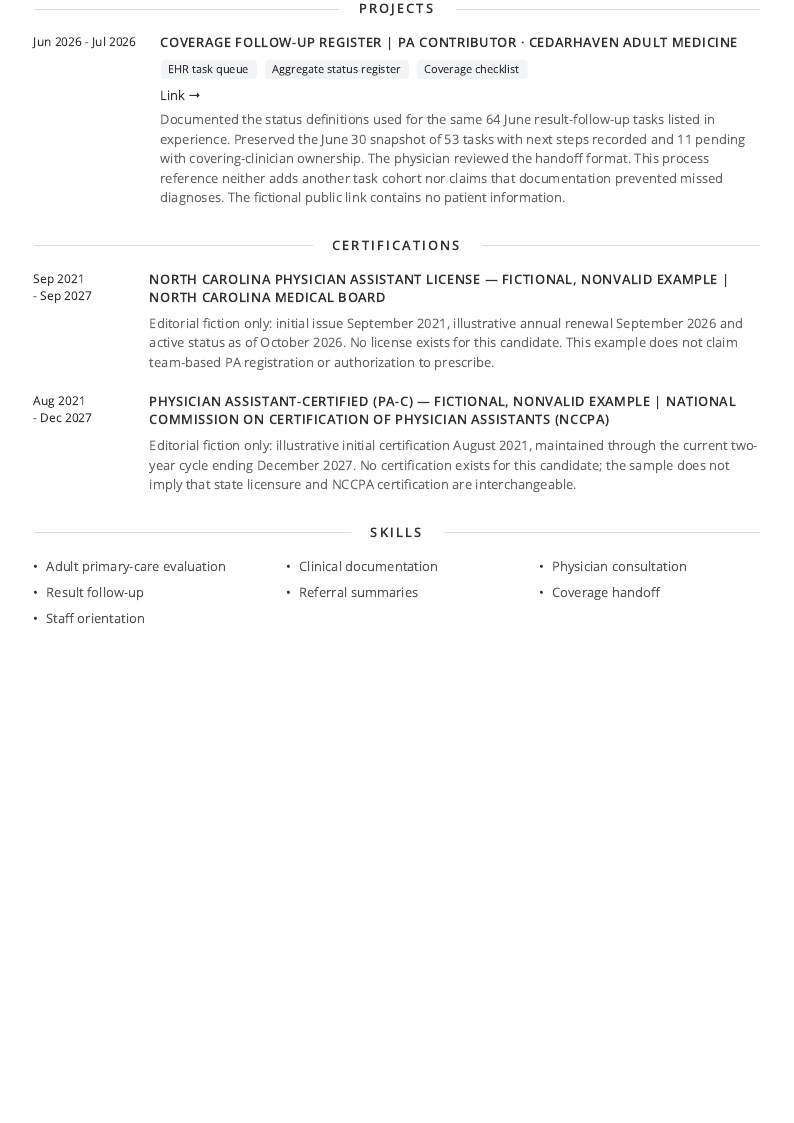
The native Classic design uses a serif name, optional circular photo, wrapped contacts and a date gutter. About Me is followed by education, work experience, projects, certifications and skills.
Before sending: Education precedes clinical employment and skills come last. Check whether the actual chronology and credential status remain easy to locate, including continuation pages.
Native Professional centers the identity and optional portrait above contacts, then places summary and skills before experience, education, projects and certifications.
Before sending: Its section sequence differs from Classic. Inspect the full credential descriptions after projects and check every contact destination.
A plain left header and restrained single-column sections make the same career record easy to scan.
Before sending: Long clinical bullets still need review for intact consultation boundaries and task definitions; design cannot validate clinical scope.
“Use” opens signup with that design and photo preference selected for the builder. A free account is required. Free-plan PDF downloads include a watermark; see current plans for paid options. Photo conventions vary; follow the employer’s instructions and local expectations.
Classic is the native design with a serif name, optional circular photo and date gutter. It puts About Me before education, work experience, projects, certifications and finally skills. Professional brings summary and skills ahead of experience, while Essential uses a plain left header and one main column. The same record appears in all three. Read the continuation pages before choosing; a section order can change where credentials and clinical experience first appear.
The candidate, employers, education, credentials and results are editorial fiction. The portrait is AI-generated. The default is without a photo for this US example; use an optional portrait only when it fits the application instructions and local expectations. The buttons carry your chosen design, photo setting and role into signup. They do not put the fictional record or portrait into your account.
A complete fictional Physician Assistant resume
Jordan Ellis is an invented North Carolina physician assistant in adult primary care after an urgent-care role. The sample includes two jobs, one completed PA education record, one project and separate fictional state-license and NCCPA entries. Clinical employment begins after the illustrative credentials.
Physician assistant in adult primary care with earlier urgent-care experience. Evaluates assigned visits within documented privileges and the clinic’s physician supervision arrangement. Maintains clear assessment and follow-up documentation, coordinates pending work during coverage, and prepares referral questions without claiming independent physician authority or patient outcomes caused by one clinician.
Evaluated adults in scheduled primary-care visits as a physician assistant within the clinic’s authorized scope and physician supervision arrangement; documented assessments, plans and consultation needs in the EHR.
Reviewed 64 assigned result-follow-up tasks in June 2026; by June 30, documented next steps for 53 and handed 11 pending tasks with named owners to the covering clinician.
Included the clinic-required assessment, plan and follow-up fields in 57 of 60 assigned visit notes sampled for the May 2026 physician review; corrected the three incomplete notes through the approved workflow.
Prepared referral summaries for 26 assigned consultations in April 2026, stating the clinical question and relevant record references; coordinated unresolved scheduling handoffs with the referral team.
Physician Assistant
Brookmere Urgent Care · Cary, NC
October 2021–January 2024
Evaluated assigned urgent-care visits within documented PA privileges, sought physician consultation for cases outside those privileges and recorded the consultation and disposition in the EHR.
Delivered four orientation sessions for newly hired clinical staff in January–June 2023 using physician-approved documentation examples; recorded attendance and sent unanswered questions to the clinical lead.
Education
Master of Physician Assistant Studies in Physician Assistant Studies · Alderwick University · Raleigh, NC
August 2019–July 2021
Fictional completed PA program; the invented institution is not a claim of program accreditation.
Projects
Coverage follow-up register
PA contributor · Cedarhaven Adult Medicine
June 2026–July 2026
EHR task queue · Aggregate status register · Coverage checklist
Documented the status definitions used for the same 64 June result-follow-up tasks listed in experience. Preserved the June 30 snapshot of 53 tasks with next steps recorded and 11 pending with covering-clinician ownership. The physician reviewed the handoff format. This process reference neither adds another task cohort nor claims that documentation prevented missed diagnoses. The fictional public link contains no patient information.
North Carolina Physician Assistant license — fictional, nonvalid example
North Carolina Medical Board
Issued September 2021 · Expires September 2027
Editorial fiction only: initial issue September 2021, illustrative annual renewal September 2026 and active status as of October 2026. No license exists for this candidate. This example does not claim team-based PA registration or authorization to prescribe.
Physician Assistant-Certified (PA-C) — fictional, nonvalid example
National Commission on Certification of Physician Assistants (NCCPA)
Issued August 2021 · Expires December 2027
Editorial fiction only: illustrative initial certification August 2021, maintained through the current two-year cycle ending December 2027. No certification exists for this candidate; the sample does not imply that state licensure and NCCPA certification are interchangeable.
The example.com addresses are reserved placeholders. The public project link contains no real work samples. Each credential explicitly says fictional and nonvalid: the named board or certifying organization is real, but it has issued nothing to this invented candidate.
Make PA clinical judgment and consultation visible
A physician assistant resume needs more than a list of rooming, scheduling and paperwork tasks. Jordan’s record shows clinical evaluation, assessment-and-plan documentation, referral questions and result follow-up, with the physician supervision arrangement and documented privileges made explicit. It does not claim that a PA is a physician, nurse practitioner, RN or medical assistant. Keep your actual profession and job title readable even when an employer advertises a combined NP/PA opening.
This fictional North Carolina candidate uses a physician supervision arrangement. Current NC Medical Board licensing guidance distinguishes registered team-based PA status from existing supervision requirements. The record makes no team-based registration claim. Other jurisdictions and practice models differ; describe your own authorized work without asserting that all PAs practice independently or that a job title grants unrestricted prescribing or procedure authority.
The current employer sources show why tailoring matters. Duke’s outpatient neurosurgery vacancy emphasizes physician collaboration and specialty experience. Mayo’s community internal-medicine role uses a shared-panel model for adult and geriatric care and requests experienced APPs. Tia’s California opening combines in-person and virtual primary care with women’s health requirements. The fictional adult-primary-care record does not establish every specialty, procedure or registration those employers request.
Clinical credibility comes from selecting evidence that fits the actual setting. If you performed a procedure, identify your true role, training and privileges where relevant. Do not add a procedure to imitate a posting, and do not publish a patient story to demonstrate complexity. An approved aggregate measure or an accurately described consultation can support a useful bullet without revealing a case.
Six annotated resume bullet rewrites
Every after sentence below appears verbatim in the complete base resume. Apply the evidence questions to your own work; do not copy the invented numbers, duties or credentials into an application.
Clinical work with an explicit team context
Before: Worked as an independent physician and managed every condition.
After: Evaluated adults in scheduled primary-care visits as a physician assistant within the clinic’s authorized scope and physician supervision arrangement; documented assessments, plans and consultation needs in the EHR.
Why it works: Makes genuine PA clinical evaluation visible without claiming physician status or a practice model that applies in every jurisdiction.
Evidence to check: Role description, documented practice arrangement, privileges and supervisor confirmation; no clinical records.
A result-review queue with a cutoff
Before: Closed every test result and prevented missed diagnoses.
After: Reviewed 64 assigned result-follow-up tasks in June 2026; by June 30, documented next steps for 53 and handed 11 pending tasks with named owners to the covering clinician.
Why it works: The 53 completed next-step entries and 11 pending tasks reconcile to 64. Documentation is not proof of diagnostic accuracy, completed treatment or prevented harm.
Evidence to check: Approved aggregate work-queue report, task definition, cutoff and coverage handoff.
A defined documentation review
Before: Achieved 100% quality and patient satisfaction.
After: Included the clinic-required assessment, plan and follow-up fields in 57 of 60 assigned visit notes sampled for the May 2026 physician review; corrected the three incomplete notes through the approved workflow.
Why it works: Measures required-field completeness in one defined sample: 95%. It does not measure patient satisfaction or independently establish the clinical quality of a plan.
Evidence to check: Physician-approved aggregate review, sampling method, required-field list and correction status.
Referral communication with responsibility intact
Before: Guaranteed specialist access and improved patient outcomes.
After: Prepared referral summaries for 26 assigned consultations in April 2026, stating the clinical question and relevant record references; coordinated unresolved scheduling handoffs with the referral team.
Why it works: Names a clinical communication task and an administrative partner. A prepared referral is not a completed specialist visit or an outcome attributable to one clinician.
Evidence to check: Aggregate referral assignment list, summary checklist and team handoff confirmation.
An earlier clinical role without procedure inflation
Before: Expert in every urgent-care procedure from day one.
After: Evaluated assigned urgent-care visits within documented PA privileges, sought physician consultation for cases outside those privileges and recorded the consultation and disposition in the EHR.
Why it works: Shows clinical responsibility and its boundary without inventing procedures, prescribing rights or unrestricted autonomy.
Evidence to check: Contemporaneous privilege list, orientation sign-offs and supervisor confirmation.
Teaching with verified material and a review stage
Before: Trained the entire team and eliminated clinical errors.
After: Delivered four orientation sessions for newly hired clinical staff in January–June 2023 using physician-approved documentation examples; recorded attendance and sent unanswered questions to the clinical lead.
Why it works: Counts delivered sessions rather than implying all staff were trained or that attendance reduced clinical errors.
Evidence to check: Session dates, approved materials, role-based attendance totals and question log; no staff identities.
Tie the summary to a defined clinical record
Lead with specialty or setting, relevant progression and two or three strengths shown in experience. Jordan’s summary names adult primary care, earlier urgent care, consultation and follow-up ownership. It does not promise that every result was closed, advertise physician status or introduce a procedure absent from the work history. If your credential is current, its exact verified designation can help; a summary cannot substitute for the full credential record.
Keep each employer, location, title and date range visible. The earlier urgent-care role adds a different setting, but the bullet stays within documented privileges and consultation. The four orientation sessions demonstrate staff preparation rather than proof that all staff became competent or that errors fell. Keep facilitation separate from approval and competency sign-off.
Use comparable units when quantifying work. The 64 June tasks are not 64 patients, and 53 recorded next steps do not mean 53 completed treatments. The 60-note May sample is a separate cohort: 57 complete plus three corrected. A referral summary count is not an appointment-completion rate. Include period, cutoff and definition, then state only the conclusion the evidence supports. Never convert an operational measure into a causal patient-outcome claim.
Connect each skill to evidence
Start from work the target vacancy needs, then pair each skill with experience evidence. Jordan’s generic EHR experience does not establish a named product certification. Add procedures, prescribing registrations or specialty credentials only when your record supports their exact scope and current status.
Physician Assistant skills and supporting evidence
Skill
Evidence to check
Fictional proof point
Clinical evaluation
Setting, privileges and consultation arrangement.
Adult visits within authorized PA scope.
Result follow-up
Assigned tasks, cutoff and next owner.
64 tasks: 53 next steps recorded, 11 pending.
Documentation
Field definition and physician-reviewed cohort.
57 of 60 complete; three corrected.
Referral communication
Clinical question and team handoff.
26 assigned consultation summaries.
Orientation
Delivered sessions and material approval.
Four sessions using approved examples.
Make licensure and certification separate, current entries
List the completed PA qualification, institution and dates accurately. A student rotation is supervised education, not a prior staff PA job. Jordan’s invented program ends before the illustrative certification and state license, and the first PA job begins afterward. The invented university is not a claim of accreditation; check your actual program and employer requirements rather than treating this fiction as an eligibility pathway.
NCCPA certification and a state license are different credentials. Use PA-C only when it truthfully reflects current NCCPA certification. NCCPA describes maintenance in two-year cycles within a longer recertification process; a distant recertification milestone should not be presented as the current certificate’s expiration. Check the actual record rather than calculating a date from a generic example.
For state licensure, identify the jurisdiction, current status and relevant dates from the issuing board. Jordan’s fictional NC license entry includes initial issue, illustrative annual renewal and expiry, while the NCCPA entry has its own issuer and cycle end. Both entries say nonvalid and contain no registry identifiers. Neither implies team-based registration, DEA registration or specific prescribing authority. Add other credentials only when they are real, current and relevant to the vacancy.
If an application requires a license number or credential verification, provide your actual information through the employer’s requested process. A public resume need not display a copied registry record or imply verification through a placeholder link. A pending application, expired credential or scheduled examination must retain its true status; never describe it as issued or current for keyword matching.
Use rotations as education, not invented employment
For a first PA role, make completed education, current credential status and supervised clinical rotations easy to find. Identify each rotation’s setting, dates and preceptor or supervision context at an appropriate level. Explain the work you actually performed, observed or presented. Do not turn student exposure into independent management, completed employment or unrestricted procedure competency.
A separate fictional new-graduate summary could read: Recent PA-program graduate with supervised adult primary-care and urgent-care rotations. Prepared assessment-and-plan presentations for preceptor review and maintained a rotation feedback log. NCCPA examination scheduled; state license application pending. This teaching example cannot use PA-C or claim an issued license, and it does not change Jordan’s fictional credentials.
A rotation bullet could read: Presented an assessment and proposed plan to the preceptor during supervised primary-care encounters, incorporated feedback and documented the approved work in the training workflow. Replace it with your actual contribution and permission to document. The selected Duke, Mayo and Tia openings request experience or specialty preparation; look for positions whose entry requirements fit your actual status rather than using this sample to imply eligibility.
Check the long-contact version with a photo
This Classic scenario changes only the resume email and portfolio URL. The phone, candidate, career content and credentials match the base record. Read the full email to its last character. A template may shorten a website label while preserving the complete destination, so check the visible text and the actual PDF link separately.
Physician assistant in adult primary care with earlier urgent-care experience. Evaluates assigned visits within documented privileges and the clinic’s physician supervision arrangement. Maintains clear assessment and follow-up documentation, coordinates pending work during coverage, and prepares referral questions without claiming independent physician authority or patient outcomes caused by one clinician.
Evaluated adults in scheduled primary-care visits as a physician assistant within the clinic’s authorized scope and physician supervision arrangement; documented assessments, plans and consultation needs in the EHR.
Reviewed 64 assigned result-follow-up tasks in June 2026; by June 30, documented next steps for 53 and handed 11 pending tasks with named owners to the covering clinician.
Included the clinic-required assessment, plan and follow-up fields in 57 of 60 assigned visit notes sampled for the May 2026 physician review; corrected the three incomplete notes through the approved workflow.
Prepared referral summaries for 26 assigned consultations in April 2026, stating the clinical question and relevant record references; coordinated unresolved scheduling handoffs with the referral team.
Physician Assistant
Brookmere Urgent Care · Cary, NC
October 2021–January 2024
Evaluated assigned urgent-care visits within documented PA privileges, sought physician consultation for cases outside those privileges and recorded the consultation and disposition in the EHR.
Delivered four orientation sessions for newly hired clinical staff in January–June 2023 using physician-approved documentation examples; recorded attendance and sent unanswered questions to the clinical lead.
Education
Master of Physician Assistant Studies in Physician Assistant Studies · Alderwick University · Raleigh, NC
August 2019–July 2021
Fictional completed PA program; the invented institution is not a claim of program accreditation.
Projects
Coverage follow-up register
PA contributor · Cedarhaven Adult Medicine
June 2026–July 2026
EHR task queue · Aggregate status register · Coverage checklist
Documented the status definitions used for the same 64 June result-follow-up tasks listed in experience. Preserved the June 30 snapshot of 53 tasks with next steps recorded and 11 pending with covering-clinician ownership. The physician reviewed the handoff format. This process reference neither adds another task cohort nor claims that documentation prevented missed diagnoses. The fictional public link contains no patient information.
North Carolina Physician Assistant license — fictional, nonvalid example
North Carolina Medical Board
Issued September 2021 · Expires September 2027
Editorial fiction only: initial issue September 2021, illustrative annual renewal September 2026 and active status as of October 2026. No license exists for this candidate. This example does not claim team-based PA registration or authorization to prescribe.
Physician Assistant-Certified (PA-C) — fictional, nonvalid example
National Commission on Certification of Physician Assistants (NCCPA)
Issued August 2021 · Expires December 2027
Editorial fiction only: illustrative initial certification August 2021, maintained through the current two-year cycle ending December 2027. No certification exists for this candidate; the sample does not imply that state licensure and NCCPA certification are interchangeable.
Read the expanded record on every page
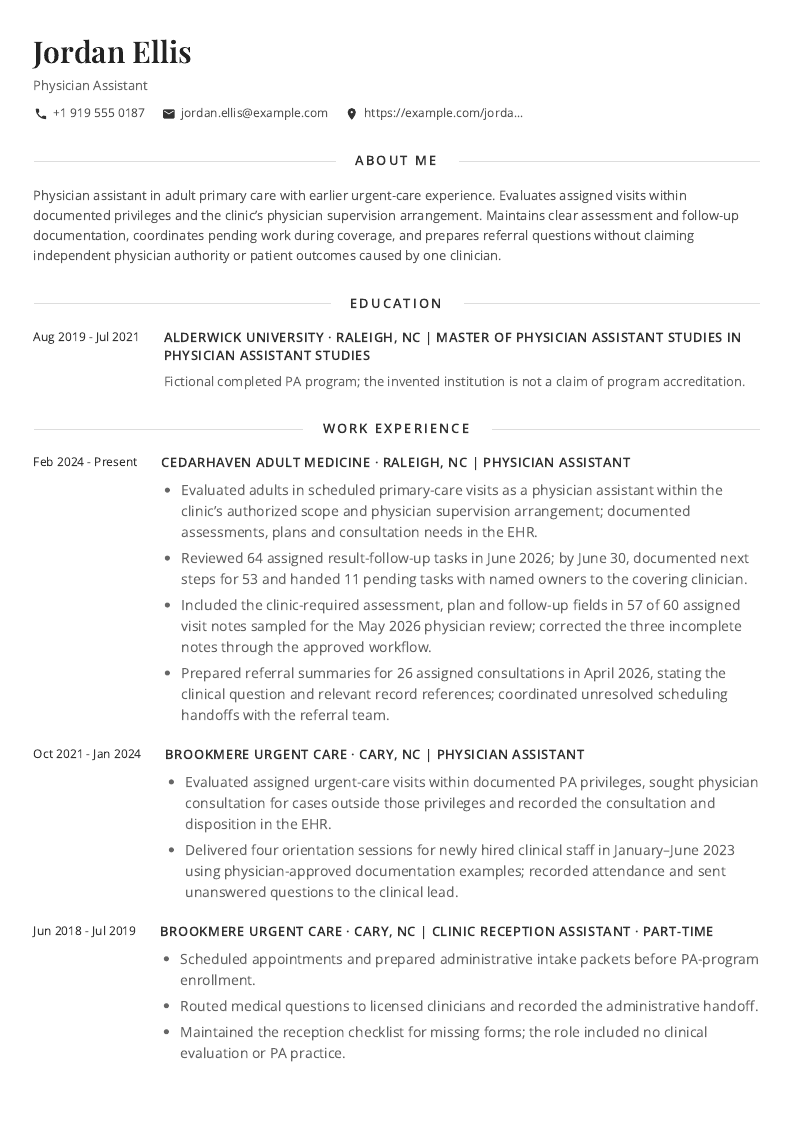
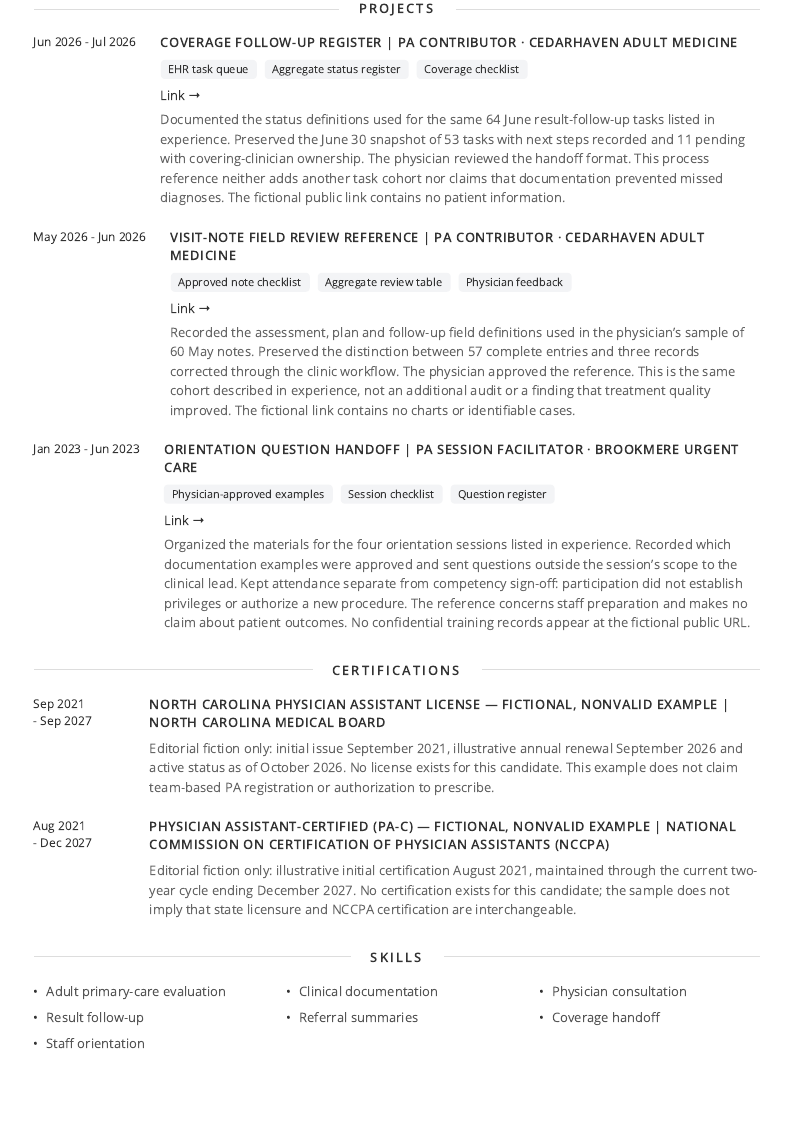
The expanded Classic version keeps the photo off and retains all base content. It adds one earlier, explicitly nonclinical job before the candidate’s professional training and two projects explaining existing work. Those projects do not create extra encounters, handoffs or accomplishments from the same cohort.
Use every continuation page to check date ranges, job headings, project endings and full credential descriptions. Compare the complete text below with the image pages. A license disclaimer, scope limitation or unresolved-task count belongs to the record even when it falls near a page break. Relevance should decide what goes into a real application; the expanded record demonstrates layout stress rather than a required resume length.
Physician assistant in adult primary care with earlier urgent-care experience. Evaluates assigned visits within documented privileges and the clinic’s physician supervision arrangement. Maintains clear assessment and follow-up documentation, coordinates pending work during coverage, and prepares referral questions without claiming independent physician authority or patient outcomes caused by one clinician.
Evaluated adults in scheduled primary-care visits as a physician assistant within the clinic’s authorized scope and physician supervision arrangement; documented assessments, plans and consultation needs in the EHR.
Reviewed 64 assigned result-follow-up tasks in June 2026; by June 30, documented next steps for 53 and handed 11 pending tasks with named owners to the covering clinician.
Included the clinic-required assessment, plan and follow-up fields in 57 of 60 assigned visit notes sampled for the May 2026 physician review; corrected the three incomplete notes through the approved workflow.
Prepared referral summaries for 26 assigned consultations in April 2026, stating the clinical question and relevant record references; coordinated unresolved scheduling handoffs with the referral team.
Physician Assistant
Brookmere Urgent Care · Cary, NC
October 2021–January 2024
Evaluated assigned urgent-care visits within documented PA privileges, sought physician consultation for cases outside those privileges and recorded the consultation and disposition in the EHR.
Delivered four orientation sessions for newly hired clinical staff in January–June 2023 using physician-approved documentation examples; recorded attendance and sent unanswered questions to the clinical lead.
Clinic Reception Assistant · Part-time
Brookmere Urgent Care · Cary, NC
June 2018–July 2019
Scheduled appointments and prepared administrative intake packets before PA-program enrollment.
Routed medical questions to licensed clinicians and recorded the administrative handoff.
Maintained the reception checklist for missing forms; the role included no clinical evaluation or PA practice.
Education
Master of Physician Assistant Studies in Physician Assistant Studies · Alderwick University · Raleigh, NC
August 2019–July 2021
Fictional completed PA program; the invented institution is not a claim of program accreditation.
Projects
Coverage follow-up register
PA contributor · Cedarhaven Adult Medicine
June 2026–July 2026
EHR task queue · Aggregate status register · Coverage checklist
Documented the status definitions used for the same 64 June result-follow-up tasks listed in experience. Preserved the June 30 snapshot of 53 tasks with next steps recorded and 11 pending with covering-clinician ownership. The physician reviewed the handoff format. This process reference neither adds another task cohort nor claims that documentation prevented missed diagnoses. The fictional public link contains no patient information.
Recorded the assessment, plan and follow-up field definitions used in the physician’s sample of 60 May notes. Preserved the distinction between 57 complete entries and three records corrected through the clinic workflow. The physician approved the reference. This is the same cohort described in experience, not an additional audit or a finding that treatment quality improved. The fictional link contains no charts or identifiable cases.
Organized the materials for the four orientation sessions listed in experience. Recorded which documentation examples were approved and sent questions outside the session’s scope to the clinical lead. Kept attendance separate from competency sign-off: participation did not establish privileges or authorize a new procedure. The reference concerns staff preparation and makes no claim about patient outcomes. No confidential training records appear at the fictional public URL.
North Carolina Physician Assistant license — fictional, nonvalid example
North Carolina Medical Board
Issued September 2021 · Expires September 2027
Editorial fiction only: initial issue September 2021, illustrative annual renewal September 2026 and active status as of October 2026. No license exists for this candidate. This example does not claim team-based PA registration or authorization to prescribe.
Physician Assistant-Certified (PA-C) — fictional, nonvalid example
National Commission on Certification of Physician Assistants (NCCPA)
Issued August 2021 · Expires December 2027
Editorial fiction only: illustrative initial certification August 2021, maintained through the current two-year cycle ending December 2027. No certification exists for this candidate; the sample does not imply that state licensure and NCCPA certification are interchangeable.
Check the file you will submit
Read every exported page at normal size. Confirm employers, dates, counts, the end of each project and the full credential status. Keep all scope and supervision qualifications attached to the claims they limit.
Select and copy the PDF text. Check the reading order and complete contact fields, then test each portfolio and project link. Open the file after downloading rather than relying only on an editor preview.
Use the file type requested by the employer. After upload, inspect parsed job titles, employers, dates and contact details when the application provides a review screen. No design guarantees an ATS pass or ranking.
Reconcile every statement with evidence you are permitted to disclose. Remove patient identifiers, private charts, incident reports, staff identities and employer-only documents from public materials.
A free account is required to use the builder. Free-plan PDF downloads include a watermark; the complete preview pages here show paid-plan output. Choose the design and photo option you want, then replace all sample material with your own verified information.
Questions, answered
Is a physician assistant resume the same as a medical assistant resume?
No. Describe the actual profession, education, credentials and work. This PA example includes clinical evaluation and assessment-and-plan documentation within authorized scope and a physician supervision arrangement. A medical assistant support role does not establish PA preparation or authority.
Can I use PA-C if I completed a PA program?
Use PA-C only when you hold the current NCCPA credential. Program completion, a scheduled examination, NCCPA certification and state licensure are distinct facts. The sample license and certification are clearly fictional and nonvalid.
Should I describe myself as an independent provider?
Describe the actual jurisdiction, privileges and practice arrangement rather than making a universal independence claim. This fictional North Carolina record states physician supervision and does not claim registered team-based PA status or unrestricted prescribing authority.
How can I quantify clinical work without claiming patient outcomes?
Define an approved aggregate workload or process measure, including period, denominator and cutoff. Jordan’s 53 recorded next steps plus 11 pending tasks account for 64 assigned June tasks; this is not a measure of completed treatment or prevented diagnoses.
What do the template buttons preserve?
Signup carries the chosen design, photo preference and Physician Assistant role. It does not insert the fictional resume or portrait into your account. A free account is required; free-plan PDF downloads include a watermark.
Prepared by Resumize with AI-assisted research and drafting for English-language US applications. Three primary employer job descriptions per role were directly opened on October 28, 2026 and displayed application controls. Vacancies may close; their duties and entry criteria are specific to each employer. CareerOneStop informs resume structure. The linked boards supply jurisdictional or certification context, not permission for this fictional candidate to practice.
This is original resume-writing guidance, not clinical, treatment or legal advice. It contains no patient cases, treatment instructions or promise of clinical or hiring outcomes. All candidate information and results are invented, and the portrait is AI-generated. Check your actual board record, employer requirements and practice arrangement before representing a credential or scope.
Checked October 28, 2026. Exact title as linked; location field Durham, NC, US, 27710, with Raleigh and Wake County practice sites in the body. Displayed date October 5, 2026; Apply now present. Describes physician collaboration, clinical documentation and specialty experience; requests 2+ years of NP or PA experience.
Checked October 28, 2026. Exact title as linked; Rochester, MN; posted September 2, 2026; Apply Now present. Describes adult and geriatric primary care in a shared-panel team and requests 2+ years of APP experience. Requirements are specific to this vacancy.
Checked October 28, 2026. Title as linked; Los Angeles, California, United States; Pasadena, California, United States. Apply control present; no posting date displayed. Hybrid outpatient role names documentation, team collaboration and practice-specific qualifications. A shared NP/PA vacancy does not make their credentials interchangeable.
Checked October 28, 2026. Primary certification-board guidance on the PA-C designation. Use an actual current credential; the sample’s nonvalid fictional certification cannot be verified.
Checked October 28, 2026. Primary guidance describes maintenance within two-year cycles and the longer recertification process. These are distinct from state license renewal.
Checked October 28, 2026. Primary state-board guidance distinguishes team-based PA registration from existing supervision requirements. The fictional candidate claims a physician supervision arrangement, not registered team-based status.
Checked October 28, 2026. State-specific license renewal guidance. Check actual jurisdiction, status and dates separately from NCCPA certification; the sample’s license is fictional and nonvalid.
Checked October 28, 2026. US Department of Labor-sponsored guidance supports relevant work history, visible employers and dates, and specific context. Used for resume writing, not clinical scope.