Precision
An open two-column body, compact icons and fine rules separate career evidence from supporting information.
Before sending: Check the narrower supporting column, full qualification lines and copied text order after export.
Engineering · Design basis and operating constraints
A chemical engineer resume should explain the process question, the calculations or operating evidence you used and the review that followed. Keep design assumptions, modeled opportunities, approved changes and plant results distinct. A clear engineering contribution is more convincing than an unexplained claim of optimization.
By Resumize · · AI-assisted research and drafting
Three designs · one example
These previews use the same layouts as the builder, with identical example content. Open a full preview to inspect the text and spacing.
Fictional candidate, employers, education and results. The optional portrait is AI-generated. Use your own evidence and photo; the example is not inserted into your resume.
An open two-column body, compact icons and fine rules separate career evidence from supporting information.
Before sending: Check the narrower supporting column, full qualification lines and copied text order after export.
A centered identity and optional circular portrait lead into a restrained single-column career record.
Before sending: The portrait and centered contacts use vertical space. Inspect complete contacts and all credential and project endings.
A large sans-serif name, green slash separators and subtle zigzag rules organize a single-column record.
Before sending: Keep complete dates, training details and the final project visible after adding a photo or more content.
“Use” opens signup with that design and photo preference selected for the builder. A free account is required. Free-plan PDF downloads include a watermark; see current plans for paid options. Photo conventions vary; follow the employer’s instructions and local expectations.
All three designs use the same complete fictional career. The default has no photo; the optional portrait is AI-generated. Follow the employer's instructions and local conventions. Signup retains the exact template, photo preference and Chemical Engineer role. It does not insert the example career or portrait into your account. A free account is required; free-plan PDF downloads include a watermark. These previews show paid-plan output.
Morgan Chen, employers, education, dates, projects and results are original fiction. The example.com links are placeholders and the 555 phone number is fictional. This base record contains two jobs, six work-history bullets, 1 education entry and no certification or license claim, plus one project. Use the structure with your own supported facts.
Chemical Engineer | Process Design and Improvement
morgan.chen.process@example.com · +1 713 555 0168
Portfolio: https://example.com/morgan-chen-process
Chemical engineer supporting batch-process design and manufacturing improvement through material balances, equipment checks and operating-data analysis. Documents assumptions, works with operators and reviewers, and separates modeled opportunities from approved changes and verified plant results.
Material and energy balances · Process troubleshooting · PFD and P&ID review · Equipment sizing support · Operating-data analysis · Management of Change support · Excel · Operator collaboration
Cedarline Specialty Materials · Houston, TX
March 2022–Present
Northmere Process Solutions · Pasadena, TX
July 2019–February 2022
Bachelor of Science in Chemical Engineering · Gulfhaven University · Texas
August 2015–May 2019
Coursework in transport phenomena, thermodynamics, process control and a supervised design capstone.
Chemical process engineer · Cedarline Specialty Materials
January 2026–April 2026
Material and energy balances · Excel · P&ID markups
Linked three operating cases to inlet assumptions, equipment limits and the approved change reference. Kept modeled utility demand separate from any later plant trial or financial result, and linked 12 drawing markups to reviewer comments.
Morgan's fictional record concerns batch-process manufacturing in Texas. A cooling-loop comparison, equipment limits, drawing revisions and operator data provide the technical context. The record does not claim to design an entire plant, approve every hazard review or hold a PE license.
BLS describes chemical engineering work across process development, equipment design, testing, troubleshooting and evaluation. Your resume needs a narrower view: the unit operation or manufacturing setting, the problem, the assumptions and your deliverables. Include enough technical language for a reviewer to understand the work without publishing a confidential design basis.
The employer sample ranges from Hexion's senior resin and formaldehyde expertise to Nouryon's capital-project and plant-improvement role and General Matter's nuclear-fuel process work. The latter has specialized high-hazard and clearance requirements. These descriptions help identify context; they do not mean every chemical engineer needs the same sector experience or that this applicant satisfies each role.
Each after statement appears exactly in the base work history. The notes explain the evidence that makes it useful and the limits of the claim. Replace invented details with your own work.
Before: Optimized all plant processes.
After: Compared three cooling-loop operating cases for a batch line using a material-and-energy balance, documenting inlet assumptions and the equipment limits for senior engineer review.
Why it works: A defined process question and review boundary explain the engineering contribution.
Evidence to check: Case definitions, assumptions, calculation checks and reviewer.
Before: Saved $500,000 with a spreadsheet.
After: Estimated utility demand for the three cases in Excel and presented a sensitivity range to operations; labeled the figures as modeled opportunities pending an approved trial.
Why it works: An estimate is useful without becoming booked savings or proven plant performance.
Evidence to check: Model version, input basis, sensitivity bounds and approval status.
Before: Owned every plant drawing.
After: Updated 12 P&ID markups for an approved cooling-loop change, resolving reviewer comments with instrumentation and operations before document control issued the revision.
Why it works: Defines the document inventory and cross-functional review without claiming final issue authority.
Evidence to check: Markup list, change reference, reviewer comments and issued revision.
Before: Certified the process as completely safe.
After: Prepared process data and tracked eight assigned actions for a multidisciplinary hazard review, routing completion evidence to the process safety lead.
Why it works: Supports hazard-review work without claiming a safety guarantee or independent approval.
Evidence to check: Assigned action register, evidence attachments, responsible lead and closure decisions.
Before: Fixed production problems instantly.
After: Reconciled batch temperature trends with operator logs for a recurring cycle-time variation and drafted two testable explanations for the project engineer's review.
Why it works: Separates observation and hypotheses from an established root cause.
Evidence to check: Trend period, log references, operating conditions and test plan.
Before: Designed and commissioned a plant alone.
After: Prepared equipment datasheet inputs and checked line-list references under a project engineer, recording unresolved vendor questions before the design review.
Why it works: Earlier engineering support is concrete without invented lead or commissioning authority.
Evidence to check: Deliverable scope, supervisor review and question register.
Start with the process environment and the methods you can discuss in detail. Morgan names material balances, equipment checks and operating-data analysis. The work history then shows a three-case cooling-loop comparison and a reviewed drawing package. Software belongs alongside the engineering task it enabled.
A calculation bullet should identify its purpose, key input basis and review point. You do not need to publish values that are confidential or operationally sensitive. A concise description of the constraints and check can show judgment more clearly than a tool list or a claim that every calculation was flawless.
Separate your deliverable from final authority. Preparing datasheet inputs, updating markups and resolving comments can be substantial work while a project engineer or document-control process owns approval and issue. If you led a package, say what you coordinated and which decisions were yours.
Choose relevant skills you can explain through actual work. Use truthful vacancy language in context, then point the reader to the example that supports it.
| Skill | Evidence to gather | Fictional example |
|---|---|---|
| Material and energy balances | Purpose, input basis and calculation check. | Three cooling-loop operating cases. |
| Data analysis | Period, conditions and missing data. | Batch trends reconciled with operator logs. |
| Drawing coordination | Revision, comments and issue owner. | 12 P&ID markups. |
| Process safety support | Assigned work and closure responsibility. | Eight hazard-review actions. |
| Equipment documentation | Inputs, unknowns and reviewer. | Datasheet and line-list checks. |
| Technical communication | Recommendation, status and next decision. | Modeled utility opportunities for review. |
Morgan's utility-demand figures are modeled opportunities, pending an approved trial. They are not booked savings. If you later report a plant result, specify the comparison period, production basis, operating conditions and how the result was checked. A yield or energy improvement can change with product mix and throughput.
The approved cooling-loop change in the sample supports a drawing revision; it does not mean every modeled operating case was authorized for plant use. The 12 P&ID markups are a document inventory. Keep the change reference and reviewer comments with them so the reader can understand the stage reached.
Troubleshooting also has stages. A trend and operator log may suggest two explanations, but neither is a verified root cause until the work supports it. Describe your investigation and next test without turning correlation into certainty. Hazard-review action tracking shows follow-through; it is not a personal guarantee that a process is safe.
The fictional record lists a chemical engineering bachelor's degree with relevant coursework and no professional license. BLS notes that entry-level chemical engineering licensure is not required, while experienced engineers may pursue PE licensure. Do not use that occupational overview to assume you can sign work or provide a regulated service in any jurisdiction.
If you hold an EIT or PE designation, use the issuing jurisdiction and actual status. Passing an exam, being eligible to apply and holding a license are different facts. A training course in a hazard-review method is also different from being assigned or qualified to facilitate a review.
List process simulation, spreadsheet or drawing software you have used, at a level the record can support. Morgan uses Excel rather than claiming a full simulation stack. Where a vacancy requests a tool you have only studied, label a coursework example or training project accurately.
A graduate can show a defined capstone problem, a balance, a constraint comparison and the review feedback received. Label academic work as academic and simulated results as simulated. Do not present a design exercise as a commissioned operating plant or an assumed cost reduction as a business saving.
Co-op and associate work can demonstrate disciplined engineering practice: checking timestamps, recording unknown values, preparing datasheet inputs and following comments through revision. Those activities show how you made a calculation or package reviewable. Retain the supervisor's role where it helps explain your scope.
The expanded record adds a supervised co-op, a trend investigation and a vendor-question register. Each adds a distinct form of evidence. A public portfolio should use a synthetic problem or a permitted summary, with proprietary drawings, process conditions and internal reports excluded.
The long-contact Precision version has the photo on and changes only the resume email and portfolio URL. The identity, phone and career stay identical. Follow each contact through its final character, then check the full link destination. The complete text below preserves the full address, including any part shortened by the visual label.
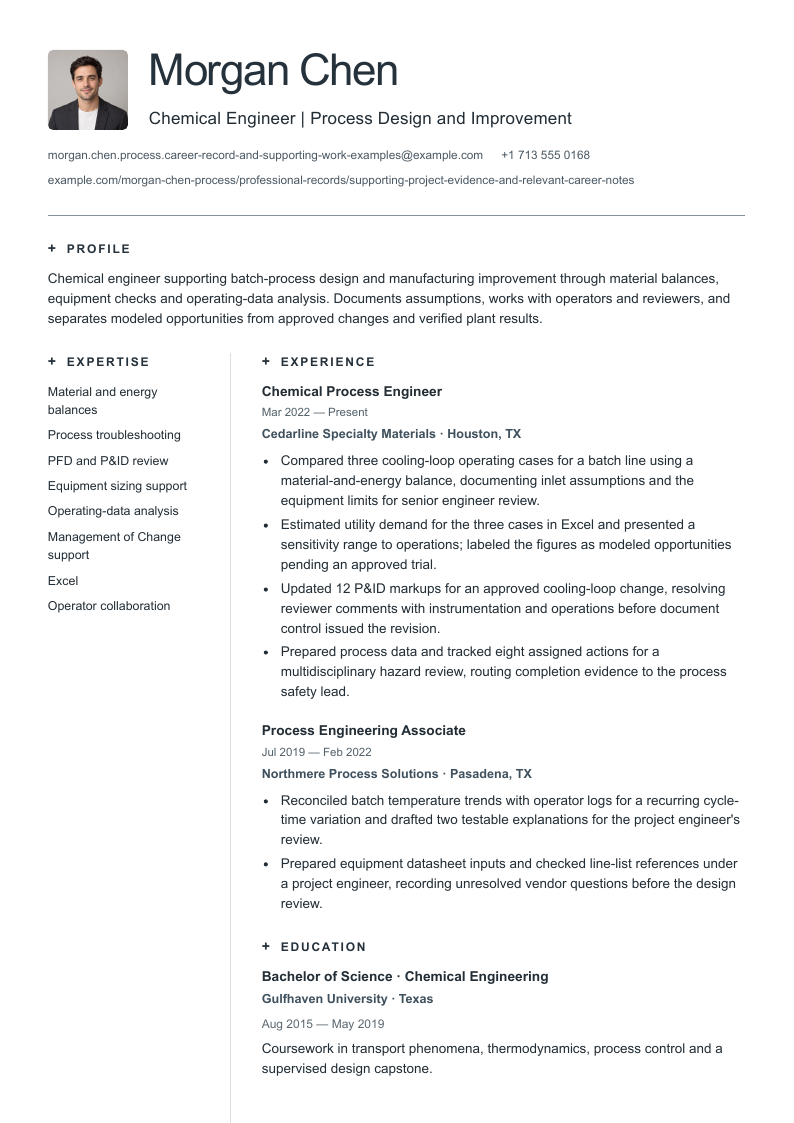 Open page 1 at full size
 Open page 2 at full size
Chemical Engineer | Process Design and Improvement
morgan.chen.process.career-record-and-supporting-work-examples@example.com · +1 713 555 0168
Chemical engineer supporting batch-process design and manufacturing improvement through material balances, equipment checks and operating-data analysis. Documents assumptions, works with operators and reviewers, and separates modeled opportunities from approved changes and verified plant results.
Material and energy balances · Process troubleshooting · PFD and P&ID review · Equipment sizing support · Operating-data analysis · Management of Change support · Excel · Operator collaboration
Cedarline Specialty Materials · Houston, TX
March 2022–Present
Northmere Process Solutions · Pasadena, TX
July 2019–February 2022
Bachelor of Science in Chemical Engineering · Gulfhaven University · Texas
August 2015–May 2019
Coursework in transport phenomena, thermodynamics, process control and a supervised design capstone.
Chemical process engineer · Cedarline Specialty Materials
January 2026–April 2026
Material and energy balances · Excel · P&ID markups
Linked three operating cases to inlet assumptions, equipment limits and the approved change reference. Kept modeled utility demand separate from any later plant trial or financial result, and linked 12 drawing markups to reviewer comments.
The expanded Precision version has the photo off. It keeps every base career field and adds an earlier chemical engineering co-op — supervised role plus two projects. Compare the complete text with every preview page, including the last job date, qualification detail and final project ending.
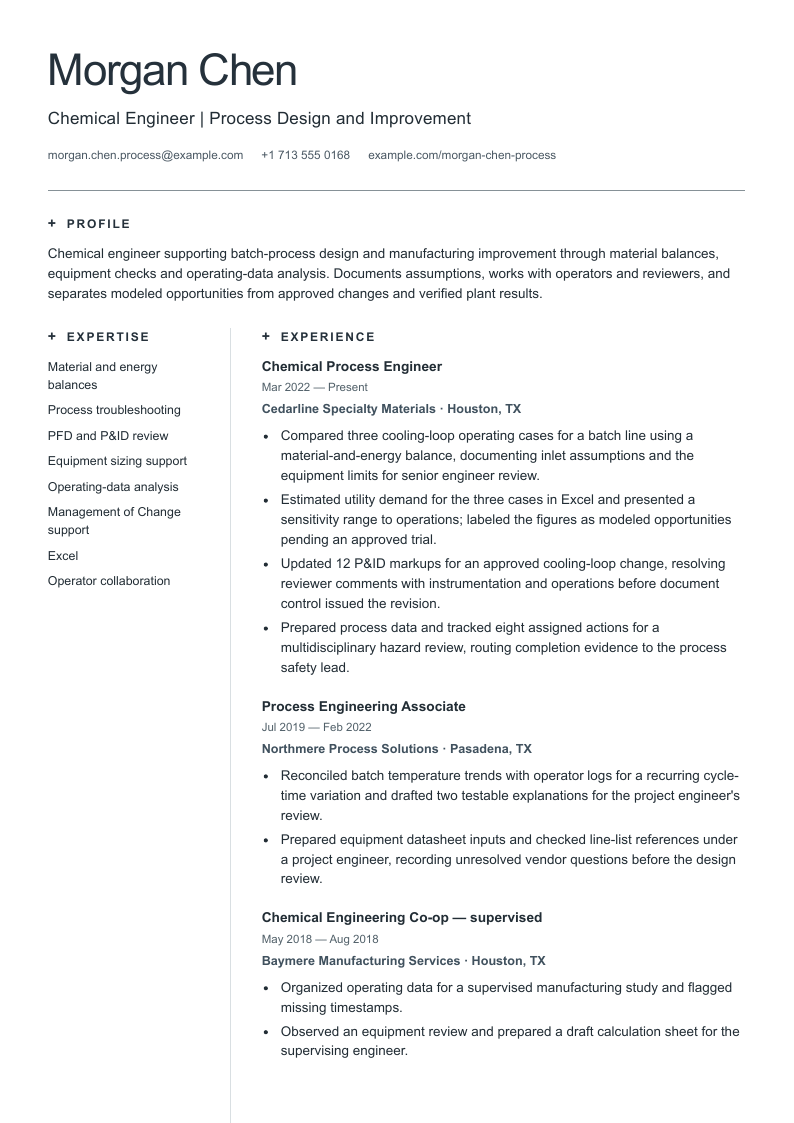 Open page 1 at full size
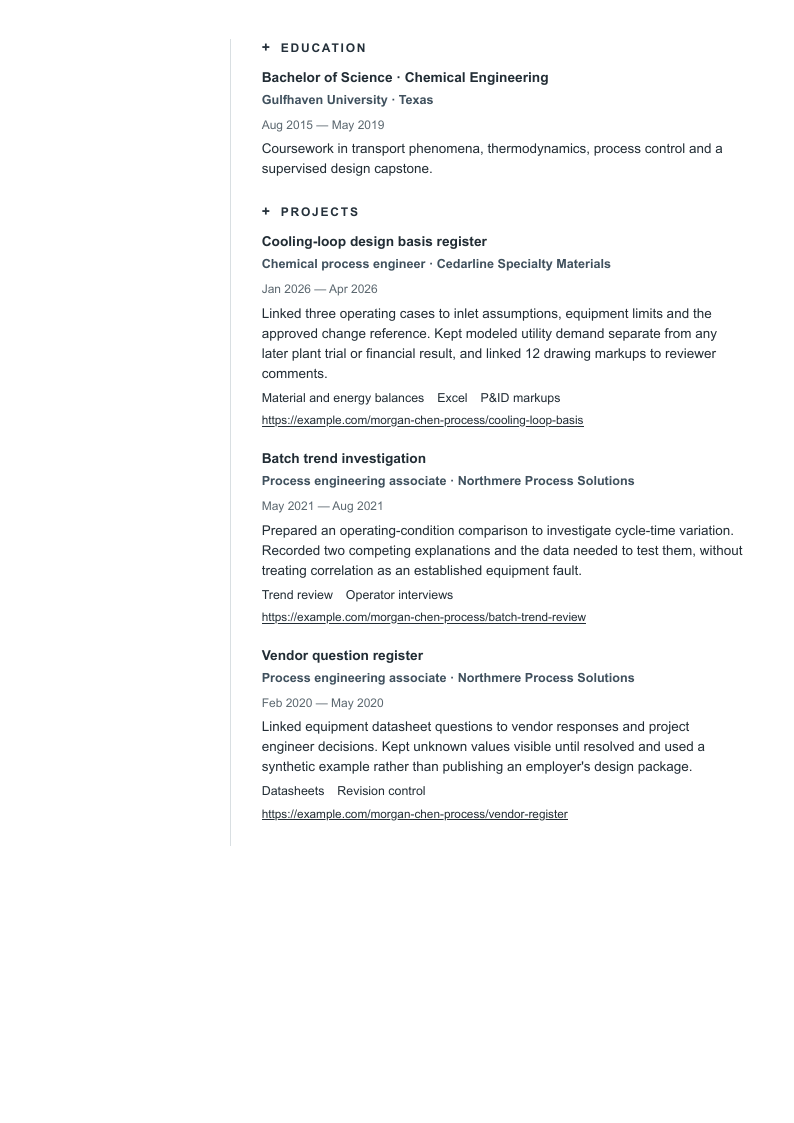 Open page 2 at full size
Chemical Engineer | Process Design and Improvement
morgan.chen.process@example.com · +1 713 555 0168
Portfolio: https://example.com/morgan-chen-process
Chemical engineer supporting batch-process design and manufacturing improvement through material balances, equipment checks and operating-data analysis. Documents assumptions, works with operators and reviewers, and separates modeled opportunities from approved changes and verified plant results.
Material and energy balances · Process troubleshooting · PFD and P&ID review · Equipment sizing support · Operating-data analysis · Management of Change support · Excel · Operator collaboration
Cedarline Specialty Materials · Houston, TX
March 2022–Present
Northmere Process Solutions · Pasadena, TX
July 2019–February 2022
Baymere Manufacturing Services · Houston, TX
May 2018–August 2018
Bachelor of Science in Chemical Engineering · Gulfhaven University · Texas
August 2015–May 2019
Coursework in transport phenomena, thermodynamics, process control and a supervised design capstone.
Chemical process engineer · Cedarline Specialty Materials
January 2026–April 2026
Material and energy balances · Excel · P&ID markups
Linked three operating cases to inlet assumptions, equipment limits and the approved change reference. Kept modeled utility demand separate from any later plant trial or financial result, and linked 12 drawing markups to reviewer comments.
Process engineering associate · Northmere Process Solutions
May 2021–August 2021
Trend review · Operator interviews
Prepared an operating-condition comparison to investigate cycle-time variation. Recorded two competing explanations and the data needed to test them, without treating correlation as an established equipment fault.
Process engineering associate · Northmere Process Solutions
February 2020–May 2020
Datasheets · Revision control
Linked equipment datasheet questions to vendor responses and project engineer decisions. Kept unknown values visible until resolved and used a synthetic example rather than publishing an employer's design package.
Condense repeated duties before removing useful context. Let relevant evidence use another page when needed, then inspect continuations for isolated headings, detached dates and unfinished sentences. A page count alone cannot establish readability.
Read every exported page with your chosen photo preference. Check complete contacts, dates, qualifications and project endings. Copy text from the PDF and inspect parsed application fields when available; follow the employer's requested file type. Use your own evidence and keep confidential information out of the document.
A free account is required for the builder. Free-plan PDF downloads include a watermark; the previews show paid-plan output. Template buttons retain the exact template, photo preference and Chemical Engineer role. Add your own details and photo after signup.
Use Precision without a photoThe resume analyzer gives advisory feedback. The bullet point generator can help draft from your notes; check every suggestion. No design or wording guarantees parsing, an interview or a hiring outcome.
Distinguish modeled estimates, approved business cases and verified operating or financial results. State the basis and period, explain your contribution and avoid treating a simulation output as realized savings.
List tools you actually used and connect them to a task. A named balance, model or design review is more useful than unsupported proficiency across a software inventory.
Use a synthetic exercise or an employer-permitted high-level summary. A resume should not expose proprietary drawings, operating conditions or internal hazard-review records.
Only claim a license you hold and follow the vacancy and jurisdiction. The sample lists no PE credential; the occupational source does not establish permission to sign engineering work.
Use enough space for relevant evidence at a readable size. A shorter record may fit one page; a fuller career may need more. Inspect all exported pages, including contacts, qualifications and final entries.
Signup retains the exact template, photo preference and role. A free account is required. The fictional career and portrait are not inserted into your account. Free-plan PDF downloads include a watermark; the example previews show paid-plan output.
Prepared by Resumize with AI-assisted research and drafting for English-language applications. Three directly readable primary employer descriptions were reviewed on October 29, 2026, alongside the occupational or professional authorities below. Undated postings are identified as undated; a readable Apply control does not establish that a vacancy remains unfilled. This is a small sample with different specialties, settings and requirements, not a market survey or proof that the fictional applicant qualifies for every opening. No application was submitted or hiring outcome tested.
Houston, Texas with travel; senior resin/formaldehyde process work, design review, hazard analysis, commissioning and relief modeling. BS Chemical/Process Engineering and five-plus years relevant experience specified. Direct page date October 13, 2026; full duties, requirements and Apply control read October 29, 2026. Specialist senior remit exceeds the fictional candidate's scope.
Houston, Texas; medium/long-term process design and capital projects through commissioning, operator collaboration, MOC/PSSR and hazard studies. Chemical Engineering bachelor's and five-plus years in PSM-regulated manufacturing. Open until further notice; full description and Apply control read October 29, 2026; no posting date shown.
Los Angeles, California; nuclear-fuel unit operations, pilot tests, modeling and engineering documentation. Relevant engineering bachelor's, two-plus years in a high-hazard setting and technical communication. Full duties, qualifications and application controls read October 29, 2026; no posting date shown. Application also specifies US citizenship/Q-clearance eligibility; not a general chemical-engineering requirement or a claim the fictional applicant qualifies.
Occupational scope includes process design, testing, troubleshooting, safety/environmental evaluation and cost estimation. Bachelor's preparation is typical; entry-level licensure is not required. This does not authorize an individual to sign engineering work or establish universal job requirements. Read October 29, 2026.