A chemist resume should explain what you measured, the records that support it and how uncertain or exceptional results reached the right reviewer. This original analytical laboratory example uses specific workloads and documented decisions, with six annotated rewrites, a complete fictional record and three designs.
These previews use the same layouts as the builder, with identical example content. Open a full preview to inspect the text and spacing.
Fictional candidate, employers, education and results. The optional portrait is AI-generated. Use your own evidence and photo; the example is not inserted into your resume.
Scholar
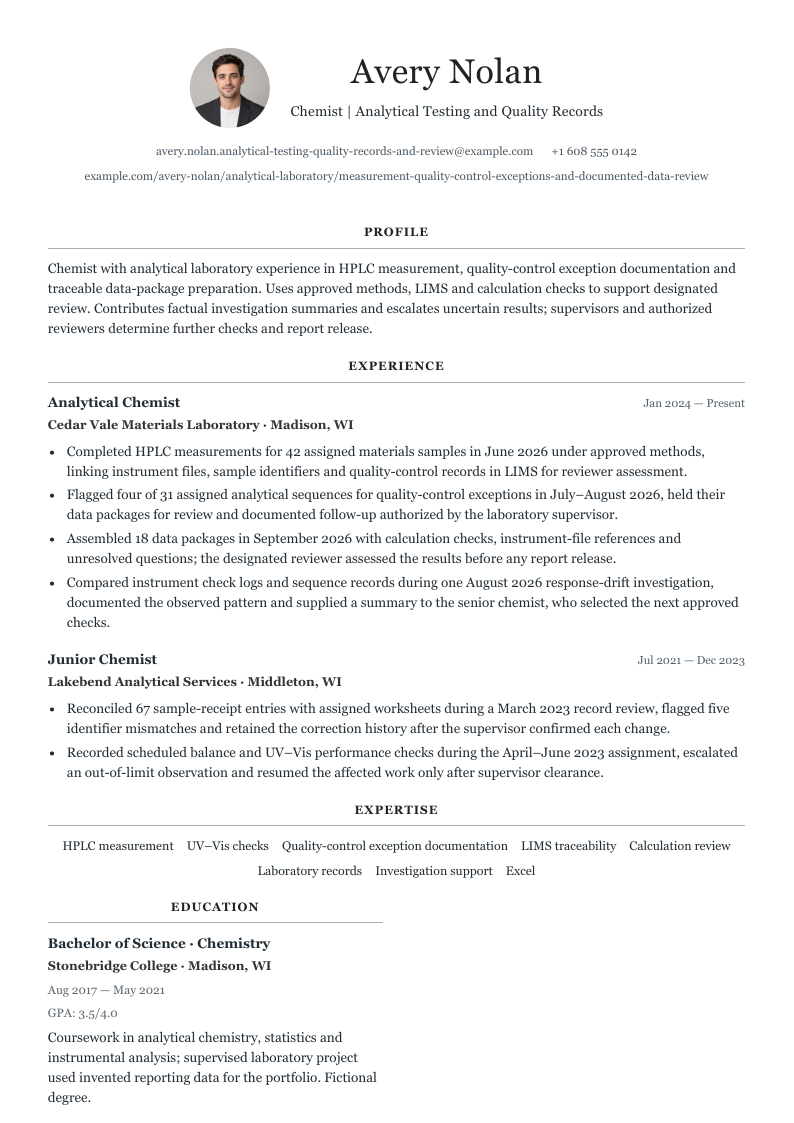
A centered serif identity and ruled headings present Profile, Experience, Expertise, Education, Certifications and Projects in one column.
Before sending: Experience leads the evidence; longer investigation descriptions and project details may continue onto another page. Read every page together.
A large sans-serif name, green separators and subtle zigzag rules organize Profile, Experience, Expertise, Education, Certifications and Projects.
Before sending: Decorative separators do not explain scientific scope. Keep sample counts, quality-control exceptions and reviewer ownership readable in the text.
The original Professional design uses a bold sans-serif name, a separate contact bar and blue accents. Professional Summary and Skills precede Experience, Education, Projects and Certifications.
Before sending: Skills appear before experience, and any certification entry would follow projects. Its optional circular portrait sits above the centered identity block; inspect shortened social labels and their actual destinations.
“Use” opens signup with that design and photo preference selected for the builder. A free account is required. Free-plan PDF downloads include a watermark; see current plans for paid options. Photo conventions vary; follow the employer’s instructions and local expectations.
Scholar, Fieldnote and Professional show Avery’s same analytical laboratory record. The default has no photo, and each design has an optional portrait preview. The buttons retain your design, photo choice and Chemist role through signup. Avery’s fictional details and the AI portrait are not copied into your account.
Scholar uses a centered serif identity and ruled headings. Fieldnote uses a large sans-serif name, green separators and subtle zigzag rules. Both order the record as Profile, Experience, Expertise, Education, Certifications when supplied, and Projects. The original Professional design has a separate contact bar and blue accents; Professional Summary and Skills precede Experience, Education, Projects and any Certifications. Read the measurement evidence in each design before choosing.
A complete analytical chemist resume example
Avery Nolan is an invented chemist in a Wisconsin materials laboratory, with an earlier junior laboratory role. Every employer, person, degree, count, date and project is fictional. The example.com links are placeholders. The AI-generated portrait and AI-assisted research and drafting are disclosed teaching aids. No real customer sample, proprietary method or result is reproduced.
Chemist with analytical laboratory experience in HPLC measurement, quality-control exception documentation and traceable data-package preparation. Uses approved methods, LIMS and calculation checks to support designated review. Contributes factual investigation summaries and escalates uncertain results; supervisors and authorized reviewers determine further checks and report release.
Completed HPLC measurements for 42 assigned materials samples in June 2026 under approved methods, linking instrument files, sample identifiers and quality-control records in LIMS for reviewer assessment.
Flagged four of 31 assigned analytical sequences for quality-control exceptions in July–August 2026, held their data packages for review and documented follow-up authorized by the laboratory supervisor.
Assembled 18 data packages in September 2026 with calculation checks, instrument-file references and unresolved questions; the designated reviewer assessed the results before any report release.
Compared instrument check logs and sequence records during one August 2026 response-drift investigation, documented the observed pattern and supplied a summary to the senior chemist, who selected the next approved checks.
Junior Chemist
Lakebend Analytical Services · Middleton, WI
July 2021–December 2023
Reconciled 67 sample-receipt entries with assigned worksheets during a March 2023 record review, flagged five identifier mismatches and retained the correction history after the supervisor confirmed each change.
Recorded scheduled balance and UV–Vis performance checks during the April–June 2023 assignment, escalated an out-of-limit observation and resumed the affected work only after supervisor clearance.
Education
Bachelor of Science in Chemistry · Stonebridge College · Madison, WI
August 2017–May 2021
Coursework in analytical chemistry, statistics and instrumental analysis; supervised laboratory project used invented reporting data for the portfolio. Fictional degree.
GPA: 3.5/4.0
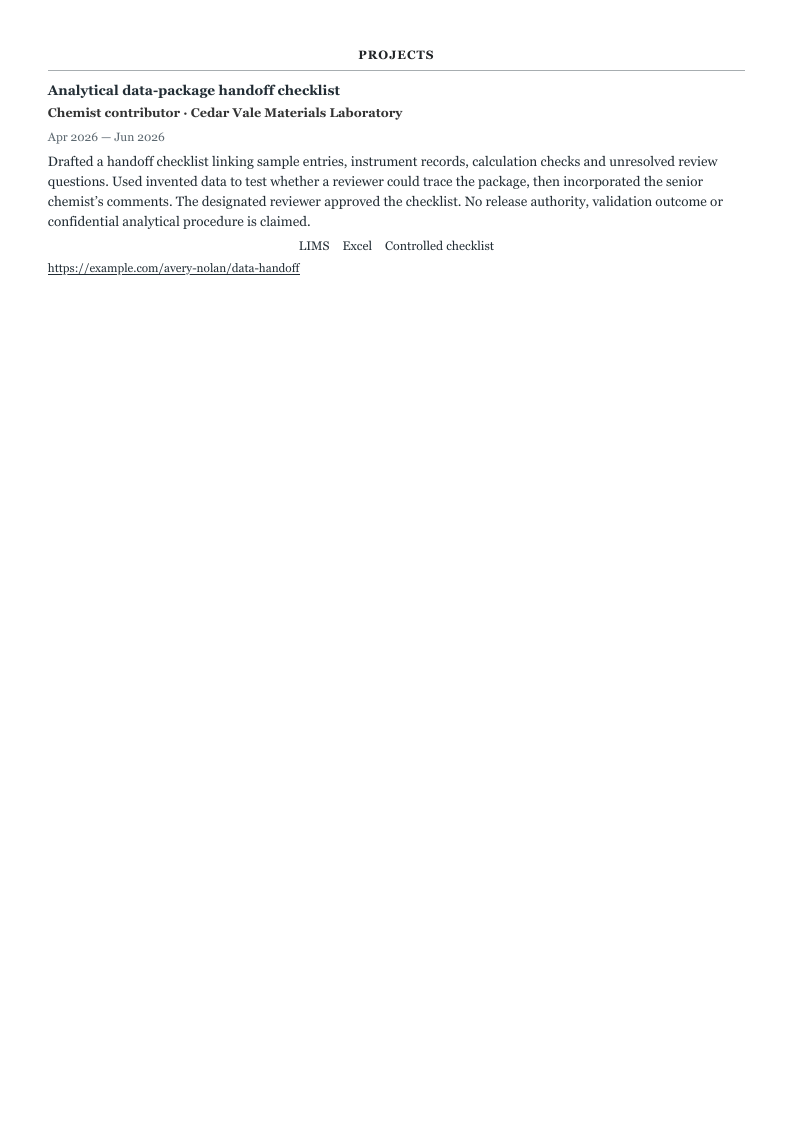
Projects
Analytical data-package handoff checklist
Chemist contributor · Cedar Vale Materials Laboratory
April 2026–June 2026
LIMS · Excel · Controlled checklist
Drafted a handoff checklist linking sample entries, instrument records, calculation checks and unresolved review questions. Used invented data to test whether a reviewer could trace the package, then incorporated the senior chemist’s comments. The designated reviewer approved the checklist. No release authority, validation outcome or confidential analytical procedure is claimed.
The record emphasizes measurements, quality-control exceptions and review-ready documentation. It claims neither chemical synthesis expertise nor clinical interpretation. The fictional degree and optional GPA appear in full; no professional certification, laboratory accreditation or independent release authority is asserted.
Connect the measurement to its quality record
“Performed analysis” leaves the reader guessing about the laboratory setting, instrument, documentation and next decision. A stronger example names the analytical work and explains how another authorized person could trace it. Avery links measurements to instrument records and quality-control information, holds exceptions for review and preserves uncertainty in the investigation summary.
The three employer descriptions illustrate this emphasis at different levels. Eurofins Chemist I combines directed testing with records and quality-control monitoring. Its Entry Level Chemist- TASC role connects approved procedures, instrumental analysis and documented work, accepting relevant academic or early-career exposure. SGS Chemist I describes equipment and quality records, nonconformities and changes approved by a supervisor. They do not establish that every chemist uses the same instrument or has the same review authority.
Use the target posting to select the relevant part of your background. This guide concentrates on analytical laboratory measurement and quality documentation. The existing environmental and computational chemistry guides address different work. A list of instruments does not prove method development, validation ownership or experience with every sample type. Describe the scope you can explain without publishing operating procedures.
Six chemist bullet rewrites with defensible limits
All six “after” sentences appear verbatim in the base experience. The exaggerated “before” versions illustrate claims to avoid; they are not extra facts. The evidence prompts are for checking your account within authorized systems, not for attaching instrument files, private sample records or confidential methods to a public application.
1. Define the measurement workload
Before: Tested thousands of samples with perfect accuracy.
After: Completed HPLC measurements for 42 assigned materials samples in June 2026 under approved methods, linking instrument files, sample identifiers and quality-control records in LIMS for reviewer assessment.
Forty-two is one month’s assigned sample count, not a measure of accuracy or a count of released reports. The named method and traceable records define the work without exposing an operating procedure.
Evidence to check: An authorized aggregate workload record, training scope and a blank data-package checklist; keep sample identifiers and proprietary methods private.
2. Explain the response to failed quality control
Before: Fixed all failed tests and made every batch pass.
After: Flagged four of 31 assigned analytical sequences for quality-control exceptions in July–August 2026, held their data packages for review and documented follow-up authorized by the laboratory supervisor.
Four of 31 refers to sequences, not samples or failed products. It describes detection and a review hold; it does not imply that the remaining sequences were released or that repeat testing erased the original record.
Evidence to check: The approved exception workflow and a permitted aggregate count; never replace or conceal original instrument records.
3. Keep review authority visible
Before: Approved all chemistry results for customers.
After: Assembled 18 data packages in September 2026 with calculation checks, instrument-file references and unresolved questions; the designated reviewer assessed the results before any report release.
Eighteen counts prepared packages in one month. Assembly and checks support review but do not make the analyst the authorized release decision-maker.
Evidence to check: A blank package checklist and your authorized review responsibilities; no customer results or signatures.
4. Describe investigation without inventing a cause
Before: Solved instrument failures and eliminated downtime.
After: Compared instrument check logs and sequence records during one August 2026 response-drift investigation, documented the observed pattern and supplied a summary to the senior chemist, who selected the next approved checks.
One investigation is a bounded contribution. An observed pattern is not proof of root cause; the senior chemist owns the next-step decision and no downtime improvement is claimed.
Evidence to check: A sanitized investigation outline approved for disclosure, with method parameters, customer data and confidential findings removed.
5. Make record reconciliation specific
Before: Managed LIMS and guaranteed data integrity.
After: Reconciled 67 sample-receipt entries with assigned worksheets during a March 2023 record review, flagged five identifier mismatches and retained the correction history after the supervisor confirmed each change.
Sixty-seven is the review population and five is the mismatch count within it. An audit trail and confirmed correction demonstrate handling of a defined issue, without a claim that all laboratory data were error-free.
Evidence to check: A permitted aggregate reconciliation record and blank correction procedure; exclude real sample identifiers and access details.
6. Distinguish an equipment check from method development
Before: Validated every instrument and developed new methods.
After: Recorded scheduled balance and UV–Vis performance checks during the April–June 2023 assignment, escalated an out-of-limit observation and resumed the affected work only after supervisor clearance.
The dates define the assignment. Routine performance checks and an escalation do not establish method validation, instrument qualification ownership or a guarantee of future performance.
Evidence to check: Your training authorization, blank check log and escalation policy; do not publish acceptance limits or procedural instructions.
Keep samples, sequences and release decisions distinct
Avery’s summary names HPLC measurement, quality-control documentation, LIMS and calculation checks. Those statements match the experience. It does not expand routine approved-method work into method validation or claim that preparing a data package is the same as approving a customer report. Write the technique, setting and level of responsibility you actually held.
The numbers have different units. Forty-two samples in June describes a monthly assignment. Four of 31 analytical sequences in July–August describes exceptions in a separate cohort. It is about 12.9% of those sequences, but the count is clearer here and is not a sample failure rate, product defect rate or release rate. Eighteen September packages measure preparation volume; none of these figures establishes accuracy, precision or a turnaround improvement.
Document an investigation as observations, your contribution and the next authorized decision. A response-drift pattern does not prove a cause. An escalated out-of-limit observation does not establish that the issue disappeared or that every result was valid. If you report precision or recovery in your own resume, identify the statistic, unit, study population and approved context, and distinguish repeatability from accuracy. Include only figures you can defend and are permitted to disclose.
Avoid promising that retesting made a result acceptable. The original record, reason for follow-up and reviewer decision matter. The sample’s supervisor and designated reviewer retain the next-check and report-release decisions. Your actual role may differ; describe the authorization you held rather than borrowing a title’s assumed authority.
Back analytical skills with scope and a record
Match a short skills list to the work history. HPLC means more when the bullet identifies approved measurement work and traceable files. UV–Vis performance checks do not establish method-development expertise. LIMS use does not establish system administration or validation ownership. Add software, instrumentation and quality terminology only when the posting needs them and your record supports them.
Chemist skills and supporting evidence
Skill
Evidence to gather
Fictional example
HPLC measurement
Assigned analytical scope and traceable records.
42 June samples linked to files and quality records.
Quality-control documentation
Exception unit, review hold and authorized follow-up.
Four of 31 sequences flagged; data held for review.
Data-package preparation
Calculation checks, file references and reviewer handoff.
18 packages assembled for designated assessment.
Investigation support
Observation summary and decision ownership.
Response-drift pattern supplied to the senior chemist.
LIMS traceability
Defined reconciliation and retained correction history.
Five mismatches in 67 receipt entries reviewed.
Performance checks
Training scope, escalation and clearance.
Out-of-limit observation escalated before work resumed.
Use education and training claims at their actual level
List the awarded degree, field, institution and dates. Avery’s fictional chemistry degree names analytical coursework, statistics and a supervised project. The GPA is optional and may be useful early in a career. Scholar and Fieldnote place education after experience and expertise; Professional places it after experience. Confirm any GPA you include remains visible and correct in your export.
Relevant training can be described when it helps establish the scope of work, but a course, employer authorization and an external professional certification are different facts. This example does not invent a credential to fill a section. If a target role requires a specific credential, verify it with the issuer and employer, then state your actual award, dates and status. Do not describe a planned course or expired credential as current.
ISO describes ISO/IEC 17025 in relation to testing and calibration laboratories. Working in a laboratory, completing internal training or knowing a quality system does not make an individual an “ISO 17025 accredited chemist.” If laboratory accreditation is relevant, check the organization’s actual status and scope before mentioning your work within it. Avery’s fictional laboratories make no accreditation claim.
Show supervised laboratory work in a first application
A new graduate can describe a placement, campus laboratory role or course project, provided the setting and supervision are clear. Identify the measurement or data task, your recordkeeping and how feedback changed the work. Academic exposure to an instrument should not become an assertion of independent industrial method ownership.
Fictional adaptation for Avery’s June 2021 application
Summary: Chemistry graduate with analytical coursework and a supervised campus laboratory role. Organizes measurement data with clear units and missing-value notes, maintains assigned log fields and incorporates instructor feedback. Seeking an entry-level laboratory position with method-specific training and review.
Evidence bullet: Organized invented measurement data for a statistics exercise and documented units and missing values before instructor review.
This historical adaptation belongs to the imagined first application, before the July 2021 junior chemist role. The campus role appears in the expanded record and overlaps the final degree year. A small, clearly labeled exercise can demonstrate reasoning without inventing commercial testing, confidential results or a credential.
Read the long contacts with the Scholar photo enabled
Only the resume email and portfolio URL change in this scenario. Avery’s user identity and all career content remain the same. The photo-enabled Scholar header must still leave the contact details readable. Compare every character with the full text below and test the actual PDF link destination. A photo is optional; follow the employer’s application instructions.
Chemist with analytical laboratory experience in HPLC measurement, quality-control exception documentation and traceable data-package preparation. Uses approved methods, LIMS and calculation checks to support designated review. Contributes factual investigation summaries and escalates uncertain results; supervisors and authorized reviewers determine further checks and report release.
Completed HPLC measurements for 42 assigned materials samples in June 2026 under approved methods, linking instrument files, sample identifiers and quality-control records in LIMS for reviewer assessment.
Flagged four of 31 assigned analytical sequences for quality-control exceptions in July–August 2026, held their data packages for review and documented follow-up authorized by the laboratory supervisor.
Assembled 18 data packages in September 2026 with calculation checks, instrument-file references and unresolved questions; the designated reviewer assessed the results before any report release.
Compared instrument check logs and sequence records during one August 2026 response-drift investigation, documented the observed pattern and supplied a summary to the senior chemist, who selected the next approved checks.
Junior Chemist
Lakebend Analytical Services · Middleton, WI
July 2021–December 2023
Reconciled 67 sample-receipt entries with assigned worksheets during a March 2023 record review, flagged five identifier mismatches and retained the correction history after the supervisor confirmed each change.
Recorded scheduled balance and UV–Vis performance checks during the April–June 2023 assignment, escalated an out-of-limit observation and resumed the affected work only after supervisor clearance.
Education
Bachelor of Science in Chemistry · Stonebridge College · Madison, WI
August 2017–May 2021
Coursework in analytical chemistry, statistics and instrumental analysis; supervised laboratory project used invented reporting data for the portfolio. Fictional degree.
GPA: 3.5/4.0
Projects
Analytical data-package handoff checklist
Chemist contributor · Cedar Vale Materials Laboratory
April 2026–June 2026
LIMS · Excel · Controlled checklist
Drafted a handoff checklist linking sample entries, instrument records, calculation checks and unresolved review questions. Used invented data to test whether a reviewer could trace the package, then incorporated the senior chemist’s comments. The designated reviewer approved the checklist. No release authority, validation outcome or confidential analytical procedure is claimed.
Inspect the expanded analytical record across pages
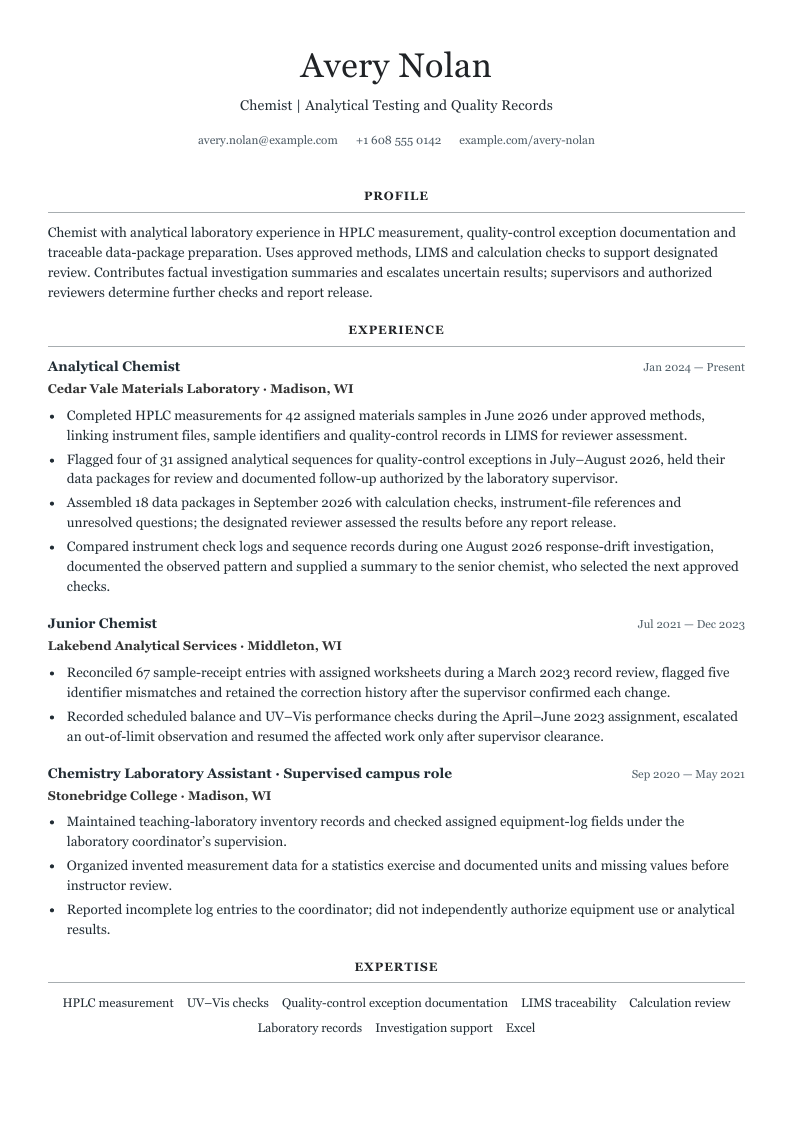
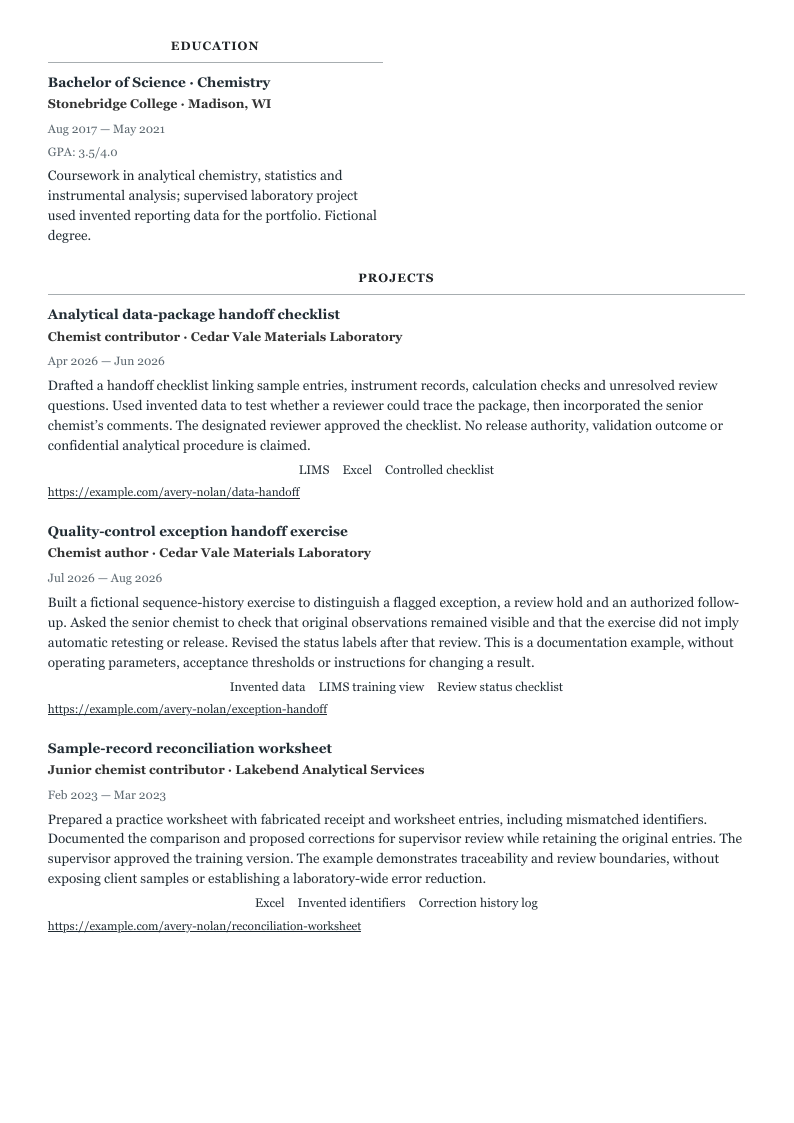
The expanded Scholar example has the photo off. It retains the full base record, including GPA and the handoff checklist project, then adds a September 2020–May 2021 supervised campus role and two projects. The extra projects use invented data for exception handoff and record reconciliation. They demonstrate documentation, preserve original observations and identify supervisor review without adding laboratory-wide performance gains.
Chemist with analytical laboratory experience in HPLC measurement, quality-control exception documentation and traceable data-package preparation. Uses approved methods, LIMS and calculation checks to support designated review. Contributes factual investigation summaries and escalates uncertain results; supervisors and authorized reviewers determine further checks and report release.
Completed HPLC measurements for 42 assigned materials samples in June 2026 under approved methods, linking instrument files, sample identifiers and quality-control records in LIMS for reviewer assessment.
Flagged four of 31 assigned analytical sequences for quality-control exceptions in July–August 2026, held their data packages for review and documented follow-up authorized by the laboratory supervisor.
Assembled 18 data packages in September 2026 with calculation checks, instrument-file references and unresolved questions; the designated reviewer assessed the results before any report release.
Compared instrument check logs and sequence records during one August 2026 response-drift investigation, documented the observed pattern and supplied a summary to the senior chemist, who selected the next approved checks.
Junior Chemist
Lakebend Analytical Services · Middleton, WI
July 2021–December 2023
Reconciled 67 sample-receipt entries with assigned worksheets during a March 2023 record review, flagged five identifier mismatches and retained the correction history after the supervisor confirmed each change.
Recorded scheduled balance and UV–Vis performance checks during the April–June 2023 assignment, escalated an out-of-limit observation and resumed the affected work only after supervisor clearance.
Chemistry Laboratory Assistant · Supervised campus role
Stonebridge College · Madison, WI
September 2020–May 2021
Maintained teaching-laboratory inventory records and checked assigned equipment-log fields under the laboratory coordinator’s supervision.
Organized invented measurement data for a statistics exercise and documented units and missing values before instructor review.
Reported incomplete log entries to the coordinator; did not independently authorize equipment use or analytical results.
Education
Bachelor of Science in Chemistry · Stonebridge College · Madison, WI
August 2017–May 2021
Coursework in analytical chemistry, statistics and instrumental analysis; supervised laboratory project used invented reporting data for the portfolio. Fictional degree.
GPA: 3.5/4.0
Projects
Analytical data-package handoff checklist
Chemist contributor · Cedar Vale Materials Laboratory
April 2026–June 2026
LIMS · Excel · Controlled checklist
Drafted a handoff checklist linking sample entries, instrument records, calculation checks and unresolved review questions. Used invented data to test whether a reviewer could trace the package, then incorporated the senior chemist’s comments. The designated reviewer approved the checklist. No release authority, validation outcome or confidential analytical procedure is claimed.
Invented data · LIMS training view · Review status checklist
Built a fictional sequence-history exercise to distinguish a flagged exception, a review hold and an authorized follow-up. Asked the senior chemist to check that original observations remained visible and that the exercise did not imply automatic retesting or release. Revised the status labels after that review. This is a documentation example, without operating parameters, acceptance thresholds or instructions for changing a result.
Excel · Invented identifiers · Correction history log
Prepared a practice worksheet with fabricated receipt and worksheet entries, including mismatched identifiers. Documented the comparison and proposed corrections for supervisor review while retaining the original entries. The supervisor approved the training version. The example demonstrates traceability and review boundaries, without exposing client samples or establishing a laboratory-wide error reduction.
Follow the final sentence of each experience and project through continuation pages. Check that a quality-control exception remains connected to its review hold and that the reviewer’s responsibility is not stranded or omitted. Choose relevant evidence in your own application instead of padding the record or removing necessary limits to meet an arbitrary page count.
Check the file and the scientific meaning before submission
Read every page at normal size. Confirm sample and sequence units, periods, degree, GPA, dates and project descriptions, including the last line on a continuation page.
Select and copy the PDF text. Check the reading order, full contacts and instrument names. Open each portfolio and project link and compare its destination with the full text.
Use the employer’s requested file type and inspect imported contact, title and date fields. These designs do not guarantee application-system parsing, ranking or hiring outcomes.
Compare claims with authorized evidence. Remove customer identifiers, proprietary method parameters, unsupported validation claims and wording that turns a flagged observation into a proven cause or approved result.
A free account is required for the builder. Free-plan PDF downloads include a watermark; the preview images show paid-plan output. Browse all resume templates to compare another design with your actual content.
Match the laboratory setting and target role. For analytical work, describe the measurement technique, sample or sequence scope, quality-control documentation, traceable records and appropriate review decisions. Do not treat every chemistry specialty as the same job.
Should I list every instrument from the posting?
List instruments you have used and can discuss at the stated level. Academic exposure, routine approved-method work, troubleshooting and method validation are different experience. Support the most relevant entries in your work history or projects.
Can I say I am ISO 17025 accredited?
Do not infer an individual credential from laboratory work or training. ISO/IEC 17025 concerns testing and calibration laboratories. Confirm the organization’s actual accreditation and scope if relevant, and describe your contribution accurately.
Do the sample counts show analytical accuracy?
No. Forty-two samples, 31 sequences and 18 packages describe different workloads and periods. The four flagged sequences are not a sample failure or product defect rate. Accuracy or precision needs its own defined study, units and permitted evidence.
How can a new graduate show laboratory experience?
Label coursework, supervised campus work and placements accurately. Describe a defined data or measurement task, documentation and instructor or supervisor review. Do not turn a class exercise into commercial testing or independent method authority.
Which design and details carry into signup?
The selected Scholar, Fieldnote or Professional design, photo choice and Chemist role carry through. Scholar without a photo is the default. The fictional resume and AI portrait stay out of your account; free-plan PDF downloads include a watermark.
Sources and editorial scope
Prepared by Resumize with AI-assisted research and drafting for English-language US analytical laboratory applications. Three direct vacancy descriptions were retrieved October 28, 2026 with full responsibilities and application controls: two Eurofins roles and one SGS role. This small sample informs the writing examples, not every chemistry specialty. ISO supplies the laboratory-standard context; CareerOneStop supplies resume-writing guidance. No chemical procedure, credential verification, product release decision or clinical advice is provided. The candidate, laboratory organizations, degree, figures and AI-generated portrait are fictional teaching material, without employer endorsement or a guarantee about screening or employment.
Retrieved October 28, 2026. Full description and I’m interested application control present. No location or posting date in the visible page body retrieved, so none is inferred from search metadata. Describes directed testing, LIMS records, quality-control monitoring and equipment checks; bachelor’s in chemistry or a related field listed.
Retrieved October 28, 2026. Full description and I’m interested application control present. Body names Eurofins BPT-Columbia; no displayed posting date or separate location field retrieved. Supports approved procedures, analytical records, HPLC/GC exposure and supervised early-career laboratory experience.
Retrieved October 28, 2026. Full description and I’m interested application control present. No location or posting date in the retrieved visible body. Describes method-based analysis, equipment records, nonconformity documentation and supervisor-approved changes; lists degree or commercial laboratory experience and three years of related work.
Retrieved October 28, 2026. ISO describes the standard in relation to testing and calibration laboratories. It does not establish an individual chemist accreditation; the sample makes no certification or accreditation claim.
Retrieved October 28, 2026. US Department of Labor-sponsored resume advice on relevant experience, employment dates and specific actions with context. Used for writing structure, without promising application-system compatibility or hiring results.