Cross-functional business planning · US applications
Business operations manager resume examples and templates
A business operations manager resume should show how you help an organization make and execute better decisions. Name the planning question, the analysis, the people who decide and the follow-through you own. This complete example centers on cross-team planning and governance, with six annotated rewrites that keep recommendations, approvals and measured results distinct.
Choose a business operations manager resume design
These previews use the same layouts as the builder, with identical example content. Open a full preview to inspect the text and spacing.
Fictional candidate, employers, education and results. The optional portrait is AI-generated. Use your own evidence and photo; the example is not inserted into your resume.
Balance
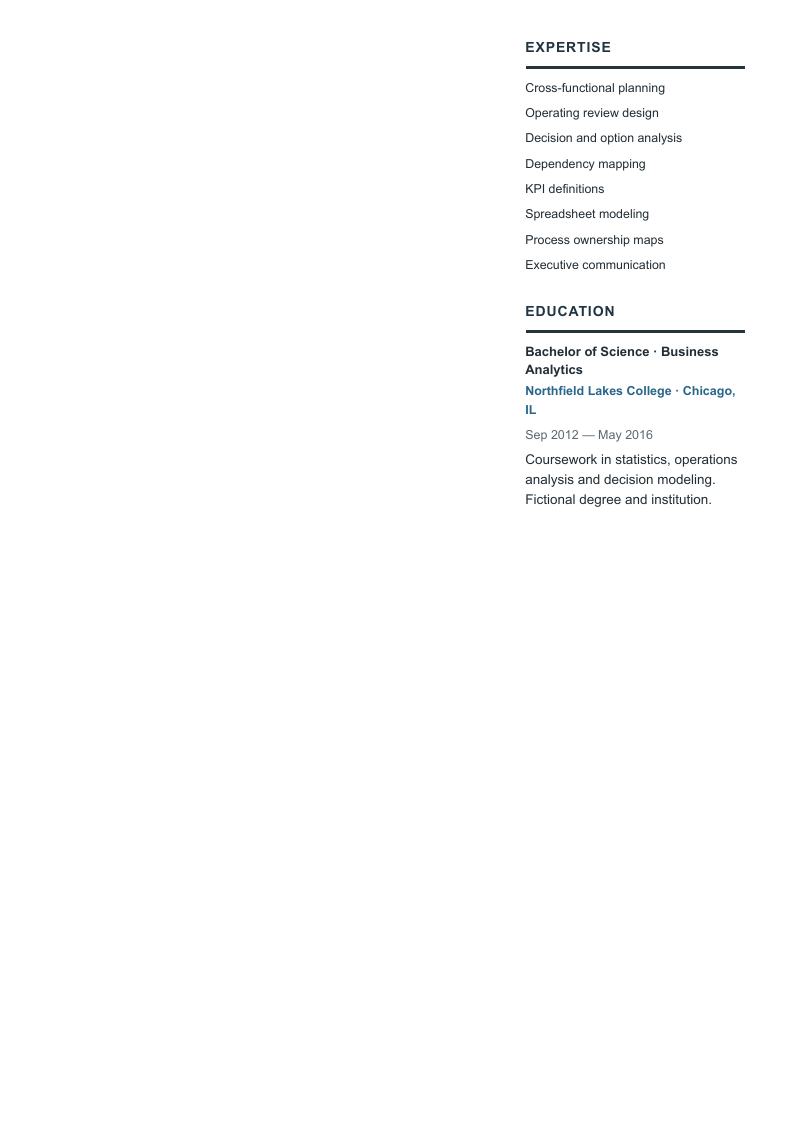
An open header leads into a broad main column for Profile and Experience, with Projects, Expertise and Education in a narrower right rail.
Before sending: The project and degree wrap in the rail and may continue beyond the work history. Inspect both columns through their last sentences, including the planning-status definitions.
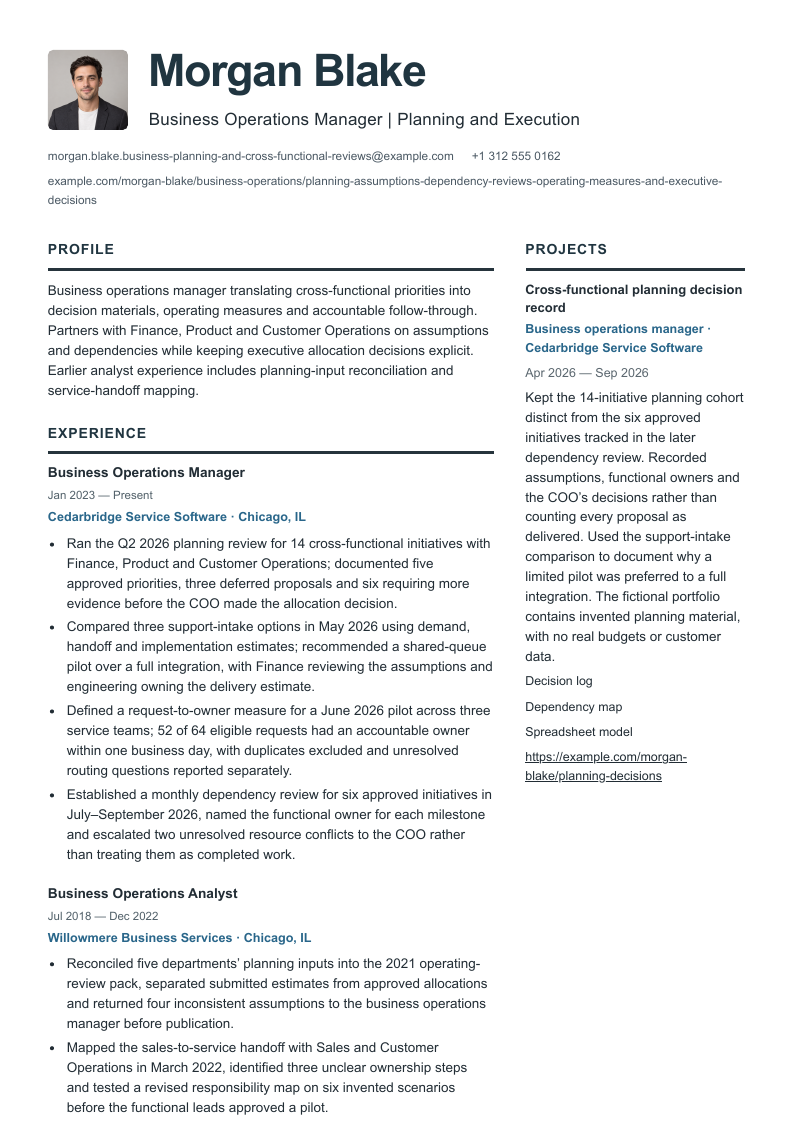
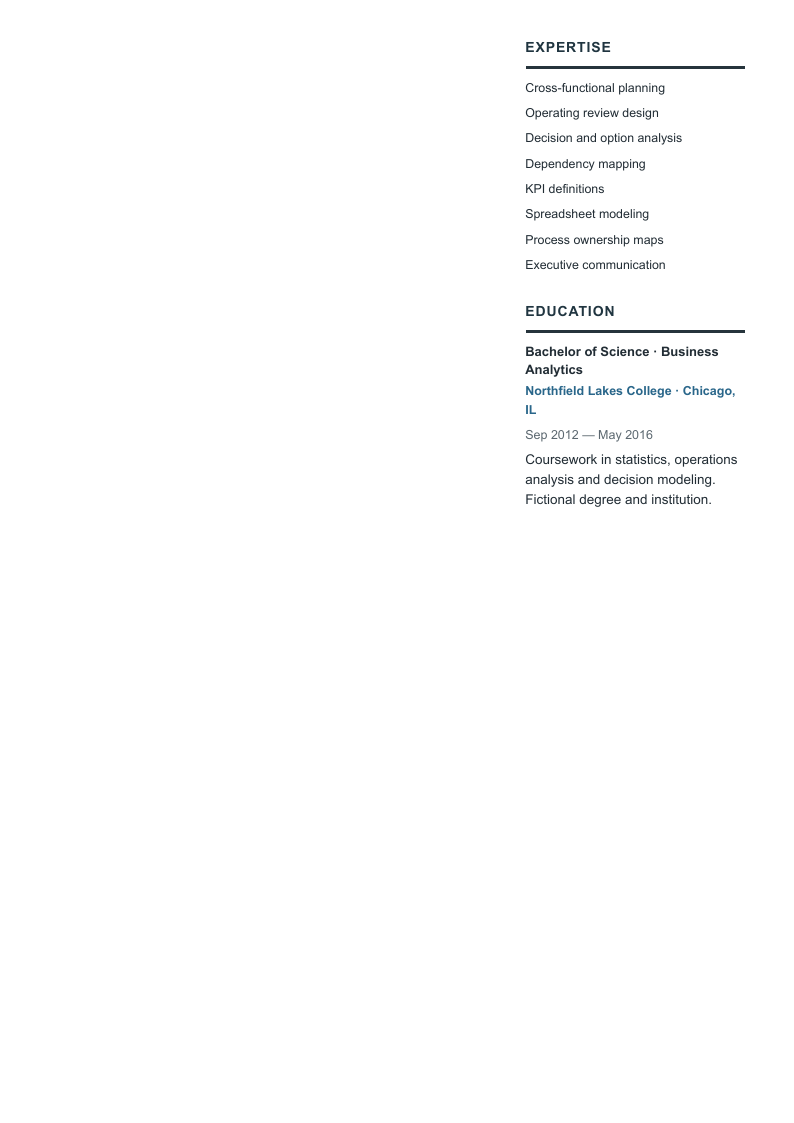
A centered header and profile precede a left rail of education and projects beside a wider column of expertise and experience. Its optional square portrait is intentionally grayscale.
Before sending: The rail comes before the work column in document order. Compare the project’s decision ownership with the dated job evidence and check the full degree description.
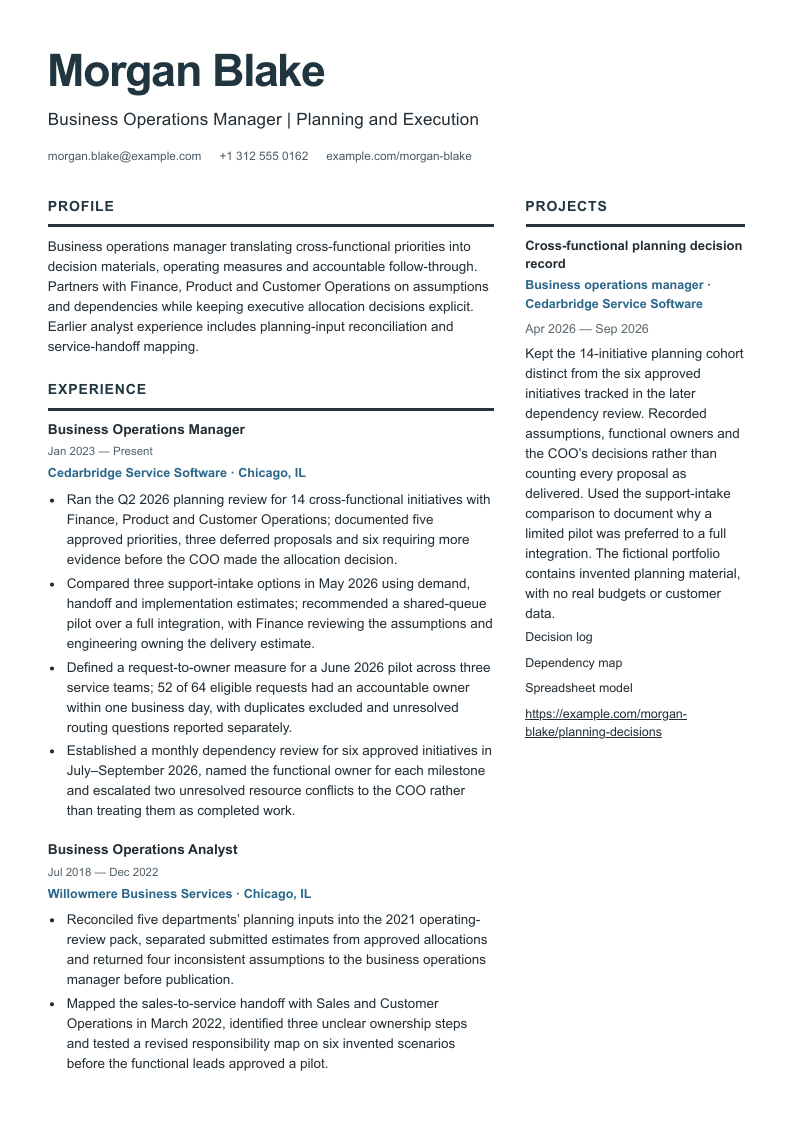
A plain left-aligned header and restrained headings present Profile, Experience, Expertise, Education and Projects in one column.
Before sending: The quiet layout makes the wording carry the argument. Keep the allocation decision, pilot limits and unresolved conflicts visible rather than trimming them to fit.
“Use” opens signup with that design and photo preference selected for the builder. A free account is required. Free-plan PDF downloads include a watermark; see current plans for paid options. Photo conventions vary; follow the employer’s instructions and local expectations.
Every design shows the same fictional career record. The default has no photo; all three offer an optional portrait preview. The resume and AI-generated portrait are teaching examples and are not inserted into your account. Use buttons retain the selected design, photo preference and Business Operations Manager role through signup. A free account is required; free-plan PDF downloads include a watermark.
Balance gives Profile and Experience the broad main column while Projects, Expertise and Education sit in the narrower right rail. Competency puts education and projects in a left rail before expertise and experience in the wider column; its optional portrait is intentionally grayscale. Essential presents the same record in one restrained column. Compare the complete exported pages and their reading order; none of these layouts establishes application-system compatibility.
Read the design guides: Balance · Competency · Essential. Follow the employer’s file and photo instructions, then inspect your own content in the chosen design.
A complete business operations manager resume example
Morgan Blake and every resume detail, employer, date, qualification, project and result below are fictional. The example.com links are placeholders, and the optional portrait is AI-generated. This guide uses AI-assisted research and drafting.
Morgan Blake
Business Operations Manager | Planning and Execution
Business operations manager translating cross-functional priorities into decision materials, operating measures and accountable follow-through. Partners with Finance, Product and Customer Operations on assumptions and dependencies while keeping executive allocation decisions explicit. Earlier analyst experience includes planning-input reconciliation and service-handoff mapping.
Skills
Cross-functional planning · Operating review design · Decision and option analysis · Dependency mapping · KPI definitions · Spreadsheet modeling · Process ownership maps · Executive communication
Experience
Business Operations Manager
Cedarbridge Service Software · Chicago, IL
January 2023–Present
Ran the Q2 2026 planning review for 14 cross-functional initiatives with Finance, Product and Customer Operations; documented five approved priorities, three deferred proposals and six requiring more evidence before the COO made the allocation decision.
Compared three support-intake options in May 2026 using demand, handoff and implementation estimates; recommended a shared-queue pilot over a full integration, with Finance reviewing the assumptions and engineering owning the delivery estimate.
Defined a request-to-owner measure for a June 2026 pilot across three service teams; 52 of 64 eligible requests had an accountable owner within one business day, with duplicates excluded and unresolved routing questions reported separately.
Established a monthly dependency review for six approved initiatives in July–September 2026, named the functional owner for each milestone and escalated two unresolved resource conflicts to the COO rather than treating them as completed work.
Business Operations Analyst
Willowmere Business Services · Chicago, IL
July 2018–December 2022
Reconciled five departments’ planning inputs into the 2021 operating-review pack, separated submitted estimates from approved allocations and returned four inconsistent assumptions to the business operations manager before publication.
Mapped the sales-to-service handoff with Sales and Customer Operations in March 2022, identified three unclear ownership steps and tested a revised responsibility map on six invented scenarios before the functional leads approved a pilot.
Education
Bachelor of Science in Business Analytics · Northfield Lakes College · Chicago, IL
September 2012–May 2016
Coursework in statistics, operations analysis and decision modeling. Fictional degree and institution.
Projects
Cross-functional planning decision record
Business operations manager · Cedarbridge Service Software
April 2026–September 2026
Decision log · Dependency map · Spreadsheet model
Kept the 14-initiative planning cohort distinct from the six approved initiatives tracked in the later dependency review. Recorded assumptions, functional owners and the COO’s decisions rather than counting every proposal as delivered. Used the support-intake comparison to document why a limited pilot was preferred to a full integration. The fictional portfolio contains invented planning material, with no real budgets or customer data.
Show the business question and the decision system
Business operations often works between functions rather than running one delivery team. A useful bullet explains the decision that required coordination: which initiatives to prioritize, how to evaluate competing options, what an operating measure means or when a dependency needs an executive decision. The job title alone does not tell a reader whether you supervise a service team, lead a planning process or act as an individual contributor.
Morgan’s example owns a planning review and its evidence, then keeps functional owners accountable for agreed milestones. The COO decides allocations. Finance reviews assumptions and engineering estimates delivery effort. Those boundaries make the contribution assessable without weakening it: the business operations manager can lead the process and recommendation while another leader holds approval authority.
The employer sources show why context matters. SpaceX describes analytical business decisions in hardware cost improvement. Deploy emphasizes executive partnership, metrics and cross-functional projects. The Pokémon Company International combines planning and business performance with direct-to-consumer execution and explicitly marks the vacancy as not a people-manager role. These are different domains, not one combined specification to copy into a resume.
Six business operations manager experience rewrites with reasoning
Every “after” appears verbatim in the base example. The deliberately weak “before” sentences are not additional career facts. Use the evidence prompts to verify your own contribution rather than borrowing these invented numbers.
1. Show a planning decision, not a meeting schedule
Before: Drove company strategy and delivered all business priorities.
After: Ran the Q2 2026 planning review for 14 cross-functional initiatives with Finance, Product and Customer Operations; documented five approved priorities, three deferred proposals and six requiring more evidence before the COO made the allocation decision.
The 14 initiatives reconcile to distinct planning statuses. The candidate owns the review and decision materials; the COO retains allocation authority. Approval is not delivery.
Evidence to check: The planning cohort, criteria, options brief and dated allocation record, using only material approved for an application.
2. Connect analysis to a concrete recommendation
Before: Used data to generate millions in savings.
After: Compared three support-intake options in May 2026 using demand, handoff and implementation estimates; recommended a shared-queue pilot over a full integration, with Finance reviewing the assumptions and engineering owning the delivery estimate.
Names the alternatives and the recommendation without turning a model into realized savings. Cross-functional review makes ownership clearer than a vague strategy claim.
Evidence to check: The option model, assumptions, sensitivity notes and decision log; distinguish estimates from realized costs.
3. Define a cross-team operating measure
Before: Improved business efficiency by 40%.
After: Defined a request-to-owner measure for a June 2026 pilot across three service teams; 52 of 64 eligible requests had an accountable owner within one business day, with duplicates excluded and unresolved routing questions reported separately.
52 of 64 is 81.25%, a bounded pilot observation. It is neither a before-and-after improvement nor an end-to-end resolution measure.
Evidence to check: Eligibility rules, deduplication method, business-day calendar, assignment timestamps and the complete pilot cohort.
4. Keep follow-through distinct from executive authority
Before: Managed every department and guaranteed project completion.
After: Established a monthly dependency review for six approved initiatives in July–September 2026, named the functional owner for each milestone and escalated two unresolved resource conflicts to the COO rather than treating them as completed work.
Cross-functional coordination does not make the other departments direct reports. The two unresolved conflicts remain visible, and milestones do not become business outcomes automatically.
Evidence to check: The dependency map, owner acceptance, cutoff snapshot and escalation decision; no confidential staffing or customer details.
5. Explain the earlier analytical contribution
Before: Owned the budget and transformed forecasting.
After: Reconciled five departments’ planning inputs into the 2021 operating-review pack, separated submitted estimates from approved allocations and returned four inconsistent assumptions to the business operations manager before publication.
The analyst consolidates and checks inputs rather than approving departmental budgets. Four assumptions are a review finding, not a savings figure.
Evidence to check: A clean demonstration of the input template, validation rules and manager sign-off, without real budget data.
6. Make process improvement assessable
Before: Streamlined all processes and removed every bottleneck.
After: Mapped the sales-to-service handoff with Sales and Customer Operations in March 2022, identified three unclear ownership steps and tested a revised responsibility map on six invented scenarios before the functional leads approved a pilot.
Shows the process, the specific ambiguity and a test. A successful scenario exercise does not prove production cycle-time or customer-retention gains.
Evidence to check: The before-and-after map, scenario criteria and pilot decision, using invented examples rather than customer records.
Connect planning, analysis and follow-through in the summary
Open with the operating context and the contribution your experience can substantiate. Morgan’s summary names decision materials, operating measures and dependencies in service software. It does not claim to run every function, own a company profit-and-loss statement or have produced a savings result that the supplied record never measured. A strong summary can be specific without a large financial number.
Use units consistently. The Q2 planning review contains 14 initiatives: five approved, three deferred and six requiring more evidence. The later July–September dependency review tracks a separate set of six approved initiatives. Do not equate the five approvals in the earlier snapshot with the later six-workstream set, or count every proposal as a delivered project. Dates and status definitions make the distinction visible.
An option model supports a recommendation; it is not realized savings. A pilot with 52 of 64 requests assigned within one business day measures owner assignment for its eligible cohort, not resolution time or overall company efficiency. Include a comparison when you actually have one, explain material changes between periods and preserve unresolved questions rather than hiding them behind a percentage.
Tie business operations manager skills to concrete evidence
Prioritize the capabilities the vacancy asks for and your record can support. A skills list helps the reader locate them; a dated example explains the contribution, decision and scope.
Business Operations Manager skills and supporting evidence
Skill
Evidence to gather
Fictional example
Planning reviews
The initiative cohort, criteria, options and actual allocation owner.
14 proposals reconcile to five approvals, three deferrals and six evidence gaps.
Option analysis
Assumptions, alternatives and who reviewed the estimates.
A shared-queue pilot is recommended over full integration.
KPI definitions
Eligible units, event timestamps and observation rules.
52 of 64 pilot requests receive an owner within one business day.
Dependency management
Functional owners, milestones, risks and escalation decisions.
Two unresolved resource conflicts remain open at the review cutoff.
Input reconciliation
Submitted estimates distinguished from approved decisions.
Five departments’ inputs are checked before publication.
Process governance
A responsibility map tested against concrete cases.
Six invented handoff scenarios support a later pilot decision.
Use qualifications and projects to explain your reasoning
List the degree, field, institution and dates accurately. Morgan’s fictional business-analytics degree gives context for the modeling and measurement work. GPA is omitted because the established work record carries the argument; use a verified GPA when it helps your own application. A qualification does not substitute for showing how you framed a decision or checked an assumption.
No certification is claimed in this example. If a vacancy values a credential you hold, use its awarded title, issuer and current status. Do not turn a course, a planned exam or a project-management task into an awarded professional certification. The cited employers differ in education and background expectations, so use the specific posting rather than treating one route as mandatory.
A useful project provides enough context to examine a work product. The planning decision record shows how proposals, assumptions, functional responsibilities and executive decisions remain separate. A clean invented model can illustrate your method without exposing an employer’s budgets, commercial plans, customer records or staffing discussions. A portfolio link should lead only to material approved for sharing.
Make the transition from analyst or coordinator visible
Keep your actual titles and show where your responsibility expanded. An analyst might reconcile inputs, test assumptions and propose options. A coordinator might maintain the review calendar and obtain updates. A manager’s broader scope can include designing the operating rhythm, resolving ownership ambiguity and presenting a recommendation for an allocation decision. Do not rewrite earlier work as executive authority.
If you are moving from operations delivery, explain the bridge with a concrete cross-functional decision. A coverage schedule by itself does not show company planning; a capacity analysis that supports an agreed initiative choice may. If your strongest evidence is direct team supervision and recurring service delivery, the separate operations manager guide may fit better. Employers can combine both responsibilities, so the right description depends on the work.
The expanded example adds Morgan’s earlier coordinator role, which begins after the degree and ends before the analyst job. It preserves every base field and adds two connected projects: pilot measurement and a handoff responsibility map. These additions show progression and reasoning, not a rule that a manager resume needs every task or a particular page count.
Fictional career-progression adaptation
Fictional analyst adaptation: “Compared three options for a shared intake process, documented the assumptions and presented a limited pilot recommendation to the business operations manager.” This shows decision support without claiming that the analyst approved funding or delivered a measured saving.
Check long contacts with the optional photo
The Balance long-contact scenario changes only Morgan’s resume email and portfolio URL, with the optional photo on. User identity, phone, work history, education and project facts remain identical. Compare the complete contact ending against the text below and test the link destination, then inspect the narrow project rail through each continuation.
Business operations manager translating cross-functional priorities into decision materials, operating measures and accountable follow-through. Partners with Finance, Product and Customer Operations on assumptions and dependencies while keeping executive allocation decisions explicit. Earlier analyst experience includes planning-input reconciliation and service-handoff mapping.
Skills
Cross-functional planning · Operating review design · Decision and option analysis · Dependency mapping · KPI definitions · Spreadsheet modeling · Process ownership maps · Executive communication
Experience
Business Operations Manager
Cedarbridge Service Software · Chicago, IL
January 2023–Present
Ran the Q2 2026 planning review for 14 cross-functional initiatives with Finance, Product and Customer Operations; documented five approved priorities, three deferred proposals and six requiring more evidence before the COO made the allocation decision.
Compared three support-intake options in May 2026 using demand, handoff and implementation estimates; recommended a shared-queue pilot over a full integration, with Finance reviewing the assumptions and engineering owning the delivery estimate.
Defined a request-to-owner measure for a June 2026 pilot across three service teams; 52 of 64 eligible requests had an accountable owner within one business day, with duplicates excluded and unresolved routing questions reported separately.
Established a monthly dependency review for six approved initiatives in July–September 2026, named the functional owner for each milestone and escalated two unresolved resource conflicts to the COO rather than treating them as completed work.
Business Operations Analyst
Willowmere Business Services · Chicago, IL
July 2018–December 2022
Reconciled five departments’ planning inputs into the 2021 operating-review pack, separated submitted estimates from approved allocations and returned four inconsistent assumptions to the business operations manager before publication.
Mapped the sales-to-service handoff with Sales and Customer Operations in March 2022, identified three unclear ownership steps and tested a revised responsibility map on six invented scenarios before the functional leads approved a pilot.
Education
Bachelor of Science in Business Analytics · Northfield Lakes College · Chicago, IL
September 2012–May 2016
Coursework in statistics, operations analysis and decision modeling. Fictional degree and institution.
Projects
Cross-functional planning decision record
Business operations manager · Cedarbridge Service Software
April 2026–September 2026
Decision log · Dependency map · Spreadsheet model
Kept the 14-initiative planning cohort distinct from the six approved initiatives tracked in the later dependency review. Recorded assumptions, functional owners and the COO’s decisions rather than counting every proposal as delivered. Used the support-intake comparison to document why a limited pilot was preferred to a full integration. The fictional portfolio contains invented planning material, with no real budgets or customer data.
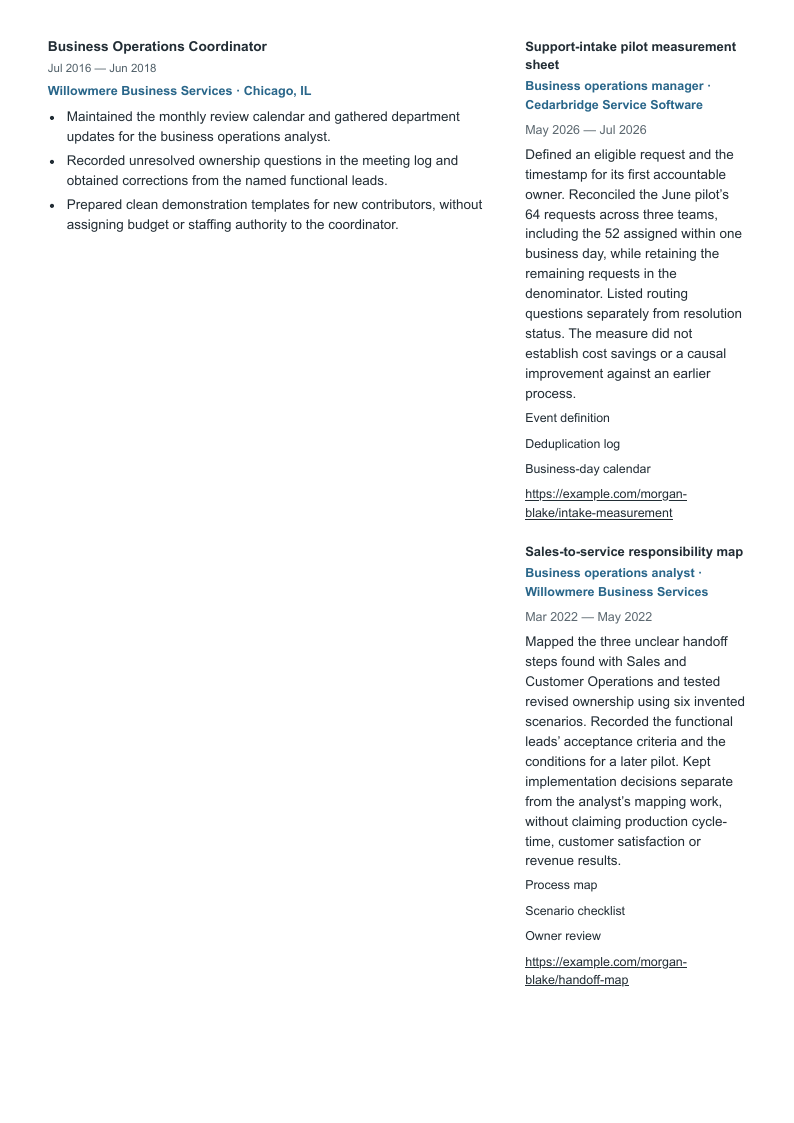
This expanded Balance record has the photo off and preserves every base field. It adds the earlier coordinator job, a pilot measurement sheet and the sales-to-service responsibility map. Follow both columns to their final sentences and retain the distinction between the 14-proposal Q2 cohort and the later six approved workstreams. The added content tests completeness rather than prescribing a resume length.
Open page 1 at full sizeBalance · Page 1 of 3 · Photo off · Complete paid-plan PDF page, including margins, without a watermark.Open page 2 at full sizeBalance · Page 2 of 3 · Photo off · Complete paid-plan PDF page, including margins, without a watermark.Open page 3 at full sizeBalance · Page 3 of 3 · Photo off · Complete paid-plan PDF page, including margins, without a watermark.Use Balance without a photo
Morgan Blake
Business Operations Manager | Planning and Execution
Business operations manager translating cross-functional priorities into decision materials, operating measures and accountable follow-through. Partners with Finance, Product and Customer Operations on assumptions and dependencies while keeping executive allocation decisions explicit. Earlier analyst experience includes planning-input reconciliation and service-handoff mapping.
Skills
Cross-functional planning · Operating review design · Decision and option analysis · Dependency mapping · KPI definitions · Spreadsheet modeling · Process ownership maps · Executive communication
Experience
Business Operations Manager
Cedarbridge Service Software · Chicago, IL
January 2023–Present
Ran the Q2 2026 planning review for 14 cross-functional initiatives with Finance, Product and Customer Operations; documented five approved priorities, three deferred proposals and six requiring more evidence before the COO made the allocation decision.
Compared three support-intake options in May 2026 using demand, handoff and implementation estimates; recommended a shared-queue pilot over a full integration, with Finance reviewing the assumptions and engineering owning the delivery estimate.
Defined a request-to-owner measure for a June 2026 pilot across three service teams; 52 of 64 eligible requests had an accountable owner within one business day, with duplicates excluded and unresolved routing questions reported separately.
Established a monthly dependency review for six approved initiatives in July–September 2026, named the functional owner for each milestone and escalated two unresolved resource conflicts to the COO rather than treating them as completed work.
Business Operations Analyst
Willowmere Business Services · Chicago, IL
July 2018–December 2022
Reconciled five departments’ planning inputs into the 2021 operating-review pack, separated submitted estimates from approved allocations and returned four inconsistent assumptions to the business operations manager before publication.
Mapped the sales-to-service handoff with Sales and Customer Operations in March 2022, identified three unclear ownership steps and tested a revised responsibility map on six invented scenarios before the functional leads approved a pilot.
Business Operations Coordinator
Willowmere Business Services · Chicago, IL
July 2016–June 2018
Maintained the monthly review calendar and gathered department updates for the business operations analyst.
Recorded unresolved ownership questions in the meeting log and obtained corrections from the named functional leads.
Prepared clean demonstration templates for new contributors, without assigning budget or staffing authority to the coordinator.
Education
Bachelor of Science in Business Analytics · Northfield Lakes College · Chicago, IL
September 2012–May 2016
Coursework in statistics, operations analysis and decision modeling. Fictional degree and institution.
Projects
Cross-functional planning decision record
Business operations manager · Cedarbridge Service Software
April 2026–September 2026
Decision log · Dependency map · Spreadsheet model
Kept the 14-initiative planning cohort distinct from the six approved initiatives tracked in the later dependency review. Recorded assumptions, functional owners and the COO’s decisions rather than counting every proposal as delivered. Used the support-intake comparison to document why a limited pilot was preferred to a full integration. The fictional portfolio contains invented planning material, with no real budgets or customer data.
Defined an eligible request and the timestamp for its first accountable owner. Reconciled the June pilot’s 64 requests across three teams, including the 52 assigned within one business day, while retaining the remaining requests in the denominator. Listed routing questions separately from resolution status. The measure did not establish cost savings or a causal improvement against an earlier process.
Business operations analyst · Willowmere Business Services
March 2022–May 2022
Process map · Scenario checklist · Owner review
Mapped the three unclear handoff steps found with Sales and Customer Operations and tested revised ownership using six invented scenarios. Recorded the functional leads’ acceptance criteria and the conditions for a later pilot. Kept implementation decisions separate from the analyst’s mapping work, without claiming production cycle-time, customer satisfaction or revenue results.
Read the contact ending, degree dates, job scope and final project sentence on every exported page. In Balance and Competency, inspect both columns and their continuation pages.
Keep estimates, recommendations, approvals, implementation and realized outcomes distinct. Identify the actual allocation and functional owners.
Reconcile initiatives, requests, departments and scenarios as different units. Preserve the pilot denominator, event definition and unresolved statuses.
Test approved portfolio links, copy the PDF text and inspect the application’s parsed fields. Follow the vacancy’s file and assistance instructions; do not publish internal budgets, customer information or commercial plans.
These full-page images show paid-plan output without a watermark. Free-plan PDF downloads include a watermark. No design guarantees parsing, ranking or an interview. Check your own saved file and the application fields.
Questions, answered
How does business operations differ from operations management?
This guide focuses on cross-functional planning, decision analysis, operating measures and governance. The separate operations manager example centers on team supervision and recurring delivery. Employers may combine those scopes; explain your actual work rather than relying on the title.
Does a business operations manager need direct reports?
The title alone does not establish people management. The cited Pokémon vacancy explicitly lists People Manager: No. State any direct reports separately from functional partners or workstreams coordinated.
Can I put projected savings on my resume?
When accurate and permitted, clearly label a model’s assumptions and projected result. Do not present an option estimate or an approved proposal as a realized saving. This fictional example makes a recommendation without claiming savings.
What metrics belong in business operations bullets?
Use measures relevant to the decision: defined initiative statuses, a pilot cohort, an assignment event or a documented assumption check. Explain the unit, period and denominator; do not turn owner assignment into resolution or approval into delivery.
How can an analyst show readiness for a manager role?
Keep the real title and demonstrate broader responsibility through framing options, checking assumptions, establishing ownership or presenting a recommendation. Show which decision remained with the manager or executive.
What do the template buttons retain?
They carry the chosen design, photo preference and Business Operations Manager role into signup. They do not insert Morgan’s fictional resume or AI portrait into your account. A free account is required; free-plan PDF downloads include a watermark.
Compare related scope and prepare your application
Prepared by Resumize with AI-assisted research and drafting for English-language US applications. Three current primary employer descriptions were retrieved on October 28, 2026 with full responsibilities and application controls. They illustrate hardware decision support, technology-company operations and direct-to-consumer business planning; their domain requirements are not universal. CareerOneStop supplies general experience-writing guidance. Every candidate, employer, degree, project, count and result in the resume is original fiction; the optional portrait is AI-generated. No employer endorsement, guaranteed parsing, search ranking or hiring result is claimed.
Retrieved October 28, 2026. Bastrop, Texas; full description, Apply control and application form present. No publication date displayed. Describes business decision support, models and cross-functional implementation in hardware cost improvement; domain and authorization requirements are specific to that vacancy.
Retrieved October 28, 2026. San Francisco; onsite. Full description and Apply for this job link present, with a separate application page; no publication date displayed. Illustrates executive partnership, systems, metrics and cross-functional project execution in a technology company.
Retrieved October 28, 2026. Bellevue, Washington, United States. Full description, Apply control and form present; no publication date displayed. Combines planning, business performance and cross-functional execution in direct-to-consumer channels. Explicitly lists People Manager: No, illustrating why the title alone does not prove direct reports.
Read October 28, 2026. US Department of Labor-sponsored guidance on relevant experience, dates and specific contributions. The planning decisions, pilot counts and rewrites here are original fiction.