A backend developer resume should make service behavior visible: the request you handled, data that had to stay consistent, failure case you tested and release responsibility you actually held. Use this complete order-service example to explain technical decisions without turning a test result into a production guarantee.
These previews use the same layouts as the builder, with identical example content. Open a full preview to inspect the text and spacing.
Fictional candidate, employers, education and results. The optional portrait is AI-generated. Use your own evidence and photo; the example is not inserted into your resume.
Signal
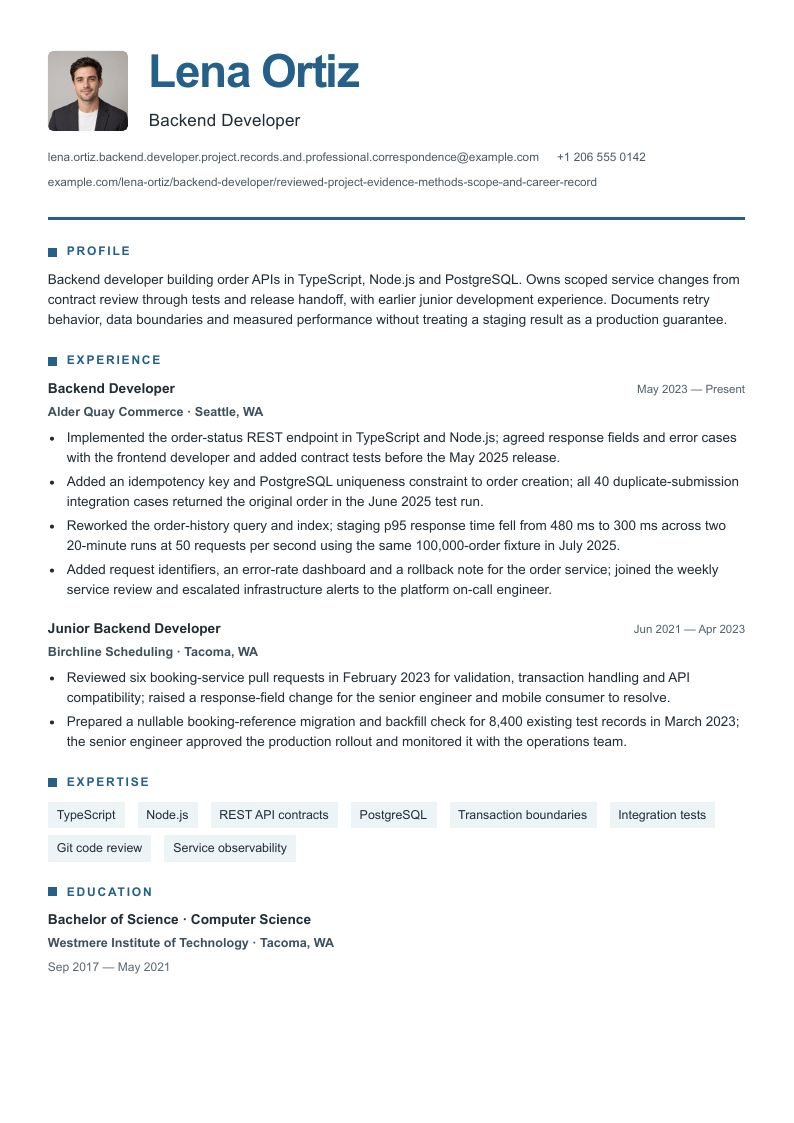
A single body column uses square section markers, colored headings and a date gutter; profile and experience precede skills, education and projects.
Before sending: Dated evidence reads in a broad column, but long bullets still continue across pages. Keep the measurement period and limitation with the result when checking the export.
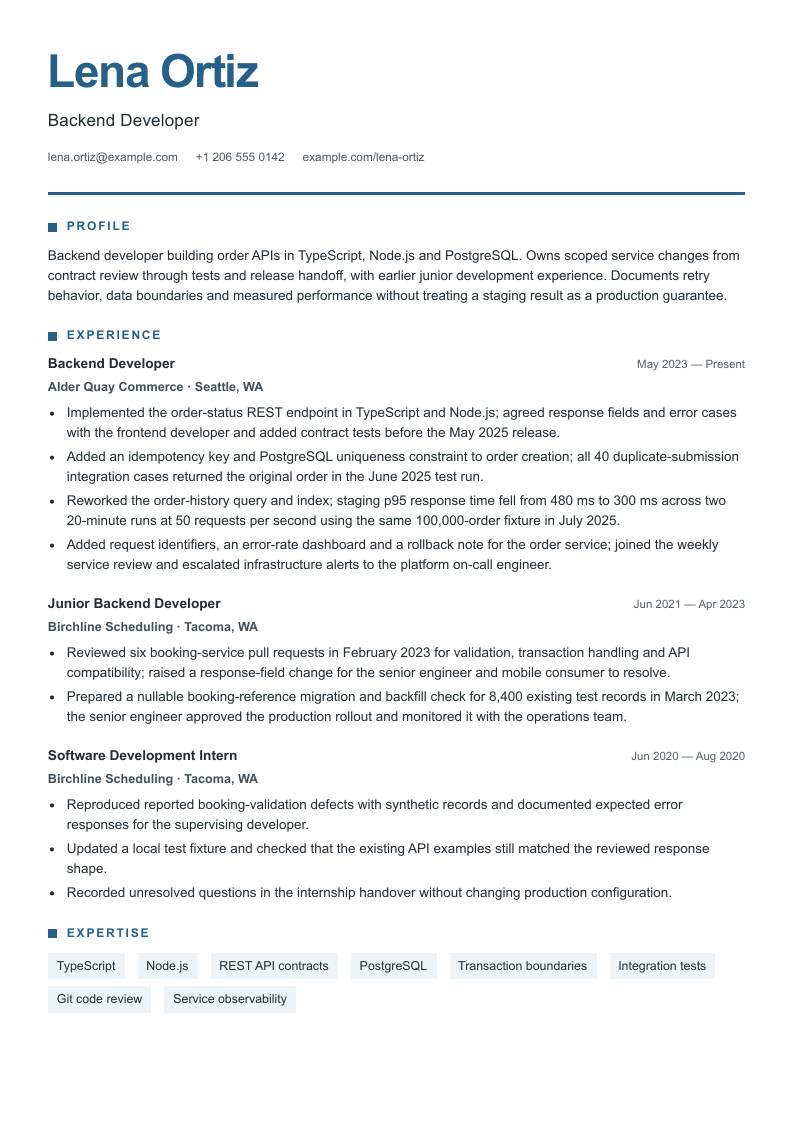
A plain left header and restrained section titles lead into a single-column profile, experience, skills, education and projects sequence.
Before sending: The understated layout leaves the evidence to carry the application. Inspect long technical terms, URLs and continuation pages; plain styling does not guarantee correct parsing.
An open header and full-width profile sit above an expertise rail and a broader column for experience, education and projects.
Before sending: The expertise rail narrows the work column. Check that API conditions, comparison workloads and final project lines remain readable across every exported page.
“Use” opens signup with that design and photo preference selected for the builder. A free account is required. Free-plan PDF downloads include a watermark; see current plans for paid options. Photo conventions vary; follow the employer’s instructions and local expectations.
Signal, Essential, Precision show the identical fictional record. Open each complete preview and compare the optional photo. All designs default to no photo. Follow the employer’s instructions for your application; the portrait is an AI-generated fictional fixture, and the candidate record is not inserted into your account.
Read the design details: Signal, Essential, Precision. Choose by the readability of your own record across every exported page, including contact details and the final project lines.
A complete backend developer resume example
Lena Ortiz is a fictional backend developer working on order APIs in Seattle, with earlier booking-service development experience. Every person, employer, qualification and result is invented. The example.com links are illustrative placeholders, not working candidate repositories. Use your own records and respect your employer’s rules for sharing implementation details.
Backend developer building order APIs in TypeScript, Node.js and PostgreSQL. Owns scoped service changes from contract review through tests and release handoff, with earlier junior development experience. Documents retry behavior, data boundaries and measured performance without treating a staging result as a production guarantee.
Implemented the order-status REST endpoint in TypeScript and Node.js; agreed response fields and error cases with the frontend developer and added contract tests before the May 2025 release.
Added an idempotency key and PostgreSQL uniqueness constraint to order creation; all 40 duplicate-submission integration cases returned the original order in the June 2025 test run.
Reworked the order-history query and index; staging p95 response time fell from 480 ms to 300 ms across two 20-minute runs at 50 requests per second using the same 100,000-order fixture in July 2025.
Added request identifiers, an error-rate dashboard and a rollback note for the order service; joined the weekly service review and escalated infrastructure alerts to the platform on-call engineer.
Junior Backend Developer
Birchline Scheduling · Tacoma, WA
June 2021–April 2023
Reviewed six booking-service pull requests in February 2023 for validation, transaction handling and API compatibility; raised a response-field change for the senior engineer and mobile consumer to resolve.
Prepared a nullable booking-reference migration and backfill check for 8,400 existing test records in March 2023; the senior engineer approved the production rollout and monitored it with the operations team.
Education
Bachelor of Science in Computer Science · Westmere Institute of Technology · Tacoma, WA
Documented which order fields are fixed on a retry and how conflicting submissions are reported. Built repeat-submission fixtures, reviewed transaction boundaries with the senior engineer and shared response examples with the frontend consumer. The 40-case test run covered specified duplicate submissions; it did not simulate every network failure or prove that production orders could never be duplicated.
Begin with the business operation and its consumers. “Order creation API” is more informative than “scalable microservices” when the latter has no supporting scope. Name the language, data store, contract and behavior you changed. If an endpoint is used by a web client and mobile app, describe the compatibility question and review, rather than implying you also built both interfaces.
Correctness can be a stronger contribution than another speed claim. Explain how retries, partial failure, validation, concurrent updates or schema evolution affected the operation. Lena’s idempotency example specifies 40 integration cases and their expected result. That is evidence of tested behavior under defined inputs. It does not establish that all duplicates were eliminated, every failure mode was simulated or a whole distributed system was formally verified.
For performance, keep the workload visible. The fictional comparison uses two 20-minute staging runs at 50 requests per second with the same 100,000-order fixture. A p95 change from 480 ms to 300 ms is a 180 ms, or 37.5%, reduction in that statistic. It is not an average, a throughput increase or a measurement for every customer. Changes in cache state, concurrency, errors or hardware can make a comparison misleading; retain those details in your supporting notes.
Backend ownership often includes production troubleshooting, but the boundary varies. Say whether you implemented instrumentation, joined an on-call rotation, approved a release or handed an infrastructure incident to a platform team. Application code ownership does not automatically mean responsibility for organization-wide availability, cloud architecture or every incident. Keep the real title even when a vacancy uses “backend engineer” instead of “backend developer”.
The employer examples show different boundaries. Ketryx pairs API and PostgreSQL work with testing, monitoring and some frontend contribution. GitLab’s senior/staff database-automation vacancy has a much broader platform remit in Go. Alma’s France-based senior payment role includes APIs and incident response. These are three vacancy examples, not a single universal stack or seniority threshold. Match the actual job description while keeping your experience accurate.
Six annotated resume bullet rewrites
Every after version appears in the complete base resume. Use the reasoning with evidence from your own work; the fictional figures and outcomes are teaching examples, not claims to copy.
A service contract with real boundaries
Before: Built robust APIs for the entire platform.
After: Implemented the order-status REST endpoint in TypeScript and Node.js; agreed response fields and error cases with the frontend developer and added contract tests before the May 2025 release.
Why it works: Names the endpoint and collaboration boundary. Contract tests cover agreed behavior; they do not establish that every platform API is robust.
Evidence to gather: Reviewed API contract, merged change, consumer feedback and release record.
Retry behavior and data consistency
Before: Eliminated all duplicate orders.
After: Added an idempotency key and PostgreSQL uniqueness constraint to order creation; all 40 duplicate-submission integration cases returned the original order in the June 2025 test run.
Why it works: Forty defined test cases are the denominator. Passing them supports retry behavior under those inputs, not a claim that duplicates are impossible in production.
Evidence to gather: Test inputs, transaction review, uniqueness migration and test-run output.
A performance result with a comparable workload
Before: Made the API 60% faster for every customer.
After: Reworked the order-history query and index; staging p95 response time fell from 480 ms to 300 ms across two 20-minute runs at 50 requests per second using the same 100,000-order fixture in July 2025.
Why it works: The 180 ms change is a 37.5% reduction in this measured p95, with workload, fixture and environment held constant. It does not measure production customer latency or isolate every source of variation.
Evidence to gather: Query plans, test script, fixture version, run timestamps and latency distribution.
Operability within a shared on-call model
Before: Owned 24/7 reliability and prevented outages.
After: Added request identifiers, an error-rate dashboard and a rollback note for the order service; joined the weekly service review and escalated infrastructure alerts to the platform on-call engineer.
Why it works: Shows instrumentation and response boundaries. A weekly review is not sole round-the-clock ownership, and no prevented-outage count is inferred.
Evidence to gather: Dashboard definition, logging review, rollback note and escalation policy.
Review that protects consumers
Before: Led architecture for all engineering teams.
After: Reviewed six booking-service pull requests in February 2023 for validation, transaction handling and API compatibility; raised a response-field change for the senior engineer and mobile consumer to resolve.
Why it works: The work is a scoped review contribution with a named decision handoff. A review count alone does not prove better quality or architectural authority.
Evidence to gather: Pull request discussions, compatibility concern and recorded resolution.
A schema change with verification
Before: Migrated the database with zero risk.
After: Prepared a nullable booking-reference migration and backfill check for 8,400 existing test records in March 2023; the senior engineer approved the production rollout and monitored it with the operations team.
Why it works: The record count belongs to the test verification. Approval and production monitoring belong to the stated owners; the resume does not convert a test run into a zero-risk guarantee.
Evidence to gather: Migration review, fixture count, backfill reconciliation and rollout approval.
Connect the summary, experience and project
Use the summary to establish your current kind of backend work, main tools and scope of ownership. Lena’s summary names order services, contract review, release handoff and data boundaries. It does not add “expert”, “architect” or an unsupported years-of-experience total. Your summary can be shorter when the job history already makes the connection clear.
In the most relevant job, lead with a service change that the hiring team can understand. Follow it with correctness, measurement or operational evidence, choosing the dimensions the vacancy actually needs. A database-heavy role may value schema review and query analysis more than a list of every framework you have tried. Keep the earlier junior role’s review contribution and approval boundary intact.
A project should explain the missing reasoning: what could go wrong, which assumptions were tested, what the candidate did and who accepted the next step. The retry-contract project adds test scope and consumer agreement to the experience bullets. A project link should lead to material you are allowed to share. If the work is private, describe a sanitized method without exposing real schemas, customer records, credentials or access endpoints.
Choose skills that have evidence behind them
List tools and methods you can explain, then connect the most relevant ones to a decision, artifact or verified action. Do not add a keyword because it appears in a vacancy if you have not used it. Keep technical scope and decision authority separate.
Backend Developer skills, evidence and the fictional example
Skill
Evidence to gather
Where it appears in this sample
API design
A defined operation, input/output contract and consumer review.
Order-status fields and error cases reviewed with the frontend developer.
Data consistency
The transaction boundary, retry expectation and verification.
Idempotency and a uniqueness constraint checked in 40 integration cases.
PostgreSQL performance
A query plan and comparison with workload, environment and errors.
Two staging runs with the same fixture; p95 is reported as a percentile.
Code review
A specific concern raised and how it was resolved.
A changed response field escalated to a senior engineer and mobile consumer.
Operability
Instrumentation, release notes and the response owner.
Request identifiers, error-rate dashboard and platform escalation.
Schema evolution
Compatibility, reconciliation and approval evidence.
Nullable reference and backfill check; production rollout approved separately.
Education and credentials: use the actual qualification
List your actual degree or training, field, institution and dates. Lena has one fictional computer-science bachelor’s degree and no certifications. This is an example of one route into the work. The cited employers describe different seniority and technology needs; the example is not an eligibility checklist.
For a course, bootcamp or cloud credential, state the real provider and completion status. A course project can support a technical discussion but does not become paid production experience. Mark education in progress as expected or in progress, and do not imply that a certification confers access, architecture authority or proof of incident-handling ability. Do not include secret access material or private credential identifiers.
Adapt the evidence for an early-career application
For a first backend role, use a clearly labeled course, personal or supervised project with a reproducible operation. Describe a small API, its data model, validation and a testable failure case. “Added a duplicate-submission test and documented the expected response” is useful even when no real customers used it. State that the environment is a local lab or test service.
Keep internship and support titles accurate. Lena’s older internship involved synthetic booking records, reviewed fixtures and a handover. It did not include independent production administration. If you move from frontend or full-stack work, select the server-side decisions you actually owned and show the collaboration boundary instead of rewriting the job title.
Fictional early-career summary: Computer-science graduate with a supervised booking-API project in TypeScript and PostgreSQL. Writes validation tests, records expected error responses and uses code review to resolve contract questions. Seeking a first backend developer role; project testing has used synthetic data rather than live customer traffic.
Fictional project bullet: Built a local booking endpoint with a documented request schema, added validation tests for missing fields and asked a supervising developer to review the response examples before completing the handover. This describes a learning artifact and makes no claim of production scale.
Inspect long contacts with the photo on
Only Lena’s resume email and portfolio contact URL change in this scenario. Signal is shown with the optional photo on. All career facts, dates, bullets and projects match the base record. Read the complete contact text below and compare its final characters with the export; test the full destination even when a visible link omits the protocol.
Backend developer building order APIs in TypeScript, Node.js and PostgreSQL. Owns scoped service changes from contract review through tests and release handoff, with earlier junior development experience. Documents retry behavior, data boundaries and measured performance without treating a staging result as a production guarantee.
Implemented the order-status REST endpoint in TypeScript and Node.js; agreed response fields and error cases with the frontend developer and added contract tests before the May 2025 release.
Added an idempotency key and PostgreSQL uniqueness constraint to order creation; all 40 duplicate-submission integration cases returned the original order in the June 2025 test run.
Reworked the order-history query and index; staging p95 response time fell from 480 ms to 300 ms across two 20-minute runs at 50 requests per second using the same 100,000-order fixture in July 2025.
Added request identifiers, an error-rate dashboard and a rollback note for the order service; joined the weekly service review and escalated infrastructure alerts to the platform on-call engineer.
Junior Backend Developer
Birchline Scheduling · Tacoma, WA
June 2021–April 2023
Reviewed six booking-service pull requests in February 2023 for validation, transaction handling and API compatibility; raised a response-field change for the senior engineer and mobile consumer to resolve.
Prepared a nullable booking-reference migration and backfill check for 8,400 existing test records in March 2023; the senior engineer approved the production rollout and monitored it with the operations team.
Education
Bachelor of Science in Computer Science · Westmere Institute of Technology · Tacoma, WA
Documented which order fields are fixed on a retry and how conflicting submissions are reported. Built repeat-submission fixtures, reviewed transaction boundaries with the senior engineer and shared response examples with the frontend consumer. The 40-case test run covered specified duplicate submissions; it did not simulate every network failure or prove that production orders could never be duplicated.
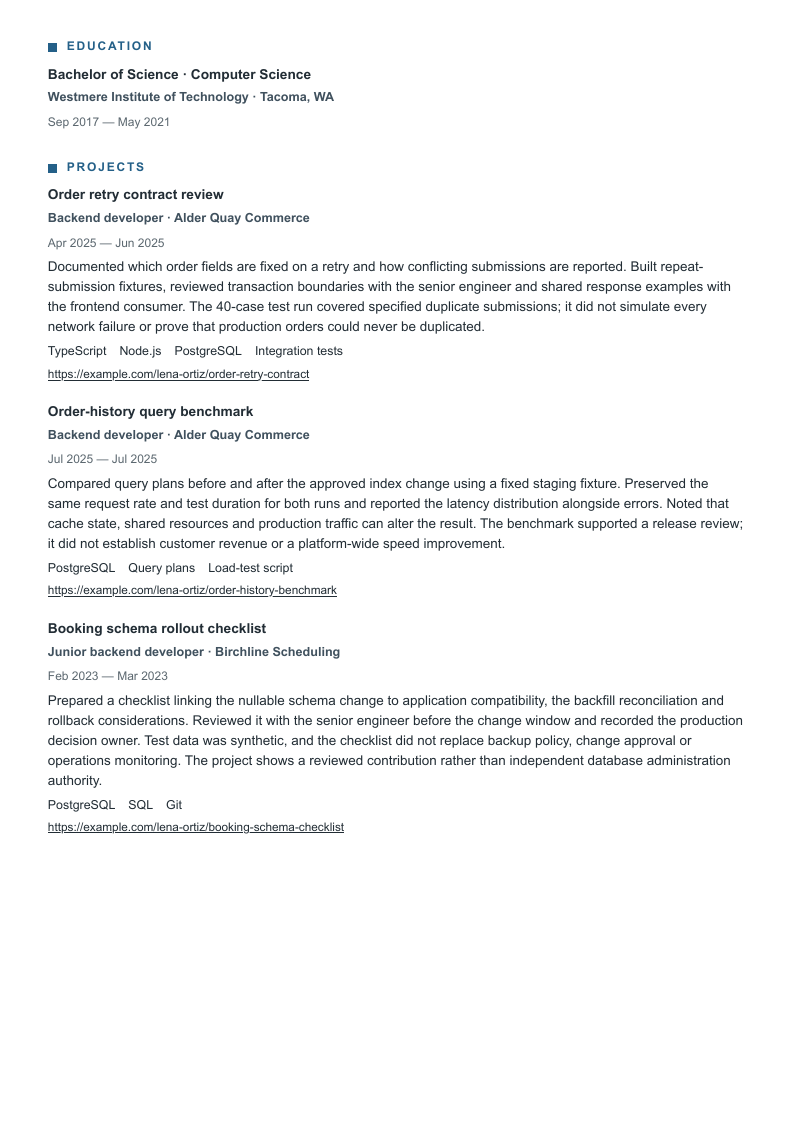
The expanded Signal record has the photo off and preserves the entire base resume. It adds the earlier summer internship and two dated projects covering the query benchmark and schema-rollout checklist. Read every continuation page, including the last sentence of each project and the oldest job. Additional pages are a layout test, not a reason to add irrelevant work to an application.
Backend developer building order APIs in TypeScript, Node.js and PostgreSQL. Owns scoped service changes from contract review through tests and release handoff, with earlier junior development experience. Documents retry behavior, data boundaries and measured performance without treating a staging result as a production guarantee.
Implemented the order-status REST endpoint in TypeScript and Node.js; agreed response fields and error cases with the frontend developer and added contract tests before the May 2025 release.
Added an idempotency key and PostgreSQL uniqueness constraint to order creation; all 40 duplicate-submission integration cases returned the original order in the June 2025 test run.
Reworked the order-history query and index; staging p95 response time fell from 480 ms to 300 ms across two 20-minute runs at 50 requests per second using the same 100,000-order fixture in July 2025.
Added request identifiers, an error-rate dashboard and a rollback note for the order service; joined the weekly service review and escalated infrastructure alerts to the platform on-call engineer.
Junior Backend Developer
Birchline Scheduling · Tacoma, WA
June 2021–April 2023
Reviewed six booking-service pull requests in February 2023 for validation, transaction handling and API compatibility; raised a response-field change for the senior engineer and mobile consumer to resolve.
Prepared a nullable booking-reference migration and backfill check for 8,400 existing test records in March 2023; the senior engineer approved the production rollout and monitored it with the operations team.
Software Development Intern
Birchline Scheduling · Tacoma, WA
June 2020–August 2020
Reproduced reported booking-validation defects with synthetic records and documented expected error responses for the supervising developer.
Updated a local test fixture and checked that the existing API examples still matched the reviewed response shape.
Recorded unresolved questions in the internship handover without changing production configuration.
Education
Bachelor of Science in Computer Science · Westmere Institute of Technology · Tacoma, WA
Documented which order fields are fixed on a retry and how conflicting submissions are reported. Built repeat-submission fixtures, reviewed transaction boundaries with the senior engineer and shared response examples with the frontend consumer. The 40-case test run covered specified duplicate submissions; it did not simulate every network failure or prove that production orders could never be duplicated.
Compared query plans before and after the approved index change using a fixed staging fixture. Preserved the same request rate and test duration for both runs and reported the latency distribution alongside errors. Noted that cache state, shared resources and production traffic can alter the result. The benchmark supported a release review; it did not establish customer revenue or a platform-wide speed improvement.
Prepared a checklist linking the nullable schema change to application compatibility, the backfill reconciliation and rollback considerations. Reviewed it with the senior engineer before the change window and recorded the production decision owner. Test data was synthetic, and the checklist did not replace backup policy, change approval or operations monitoring. The project shows a reviewed contribution rather than independent database administration authority.
Read every page at normal size. Check that API names, date ranges, workload units and the final lines of each project remain visible. Compare the exported content with the complete public record.
Select and copy the PDF text. Check section order, bullet boundaries and whether a performance number remains connected to its environment and measurement period. Open email, portfolio and project links.
Follow the employer’s requested file type. Review parsed titles, dates and contacts after upload. A design choice does not guarantee compatibility with every application system.
Audit the technical claim. Keep staging and production distinct, state personal contribution, and retain a comparison workload or test scope when citing a number. Use shareable records rather than private implementation details.
Review your resume with the analyzer and check suggestions against your records. The design buttons open signup with the selected template and photo preference. A free account is required; free-plan PDF downloads include a watermark. These previews show paid-plan output.
Questions, answered
What belongs on a backend developer resume?
Name the services or APIs you changed, the language and data layer, a concrete correctness or performance concern and how the change was reviewed or verified. Add release and operational responsibilities only within the scope you actually held. A stack list becomes useful when the experience explains how you used it.
Can I include projects that never served real users?
Yes. Label personal, academic or lab projects accurately and explain the operation, test data, decisions and limits. A synthetic load test does not establish production scale, and an offline demo is not a customer deployment.
Should I rename my full-stack job to backend developer?
Keep the real title. Emphasize the server-side portion of that role with specific service, database and review evidence. If the target vacancy includes frontend work, include the relevant collaboration or interface work you actually did.
Do I need a latency improvement in every bullet?
No. A well-defined contract, migration verification, compatibility review or useful operational handoff can be strong evidence. Use numbers when the denominator, environment and time window are known; avoid invented improvements.
Should this US resume include a photo?
The example defaults to no photo and offers an optional comparison. Follow the employer’s instructions and local expectations. The fictional AI-generated portrait is a layout fixture and does not establish that a photo improves hiring outcomes.
What happens when I choose a design?
The button opens signup with the selected design, current photo preference and Backend Developer role. The fictional candidate record and portrait are not inserted. A free account is required; free-plan PDF downloads include a watermark, while these examples show paid-plan output.
Prepared by Resumize with AI-assisted research and drafting for English-language US applications. We checked the three direct primary employer descriptions and CareerOneStop guidance below on October 27, 2026. Application controls were present; no application was submitted, and availability can change. Requirements belong to each vacancy. Search research informed the questions addressed here without access to private query data, search volumes or ranking forecasts.
The fictional record, annotated rewrites, measurement critique and design comparisons are original editorial examples. All people, employers, qualifications and outcomes in the resume are invented; the portrait is AI-generated. Sources do not endorse Resumize, these designs or any hiring outcome. The page is intended to help a reader prepare an accurate application, with no guarantee of ATS compatibility or interview results.
Checked October 27, 2026: Direct primary page displayed Apply and an application form; no publication date shown. Hybrid Boston role covers TypeScript, PostgreSQL schemas, API logic, testing and monitoring, with some frontend contribution. Its experience and work-authorization terms belong to this vacancy.
Checked October 27, 2026: Direct primary page displayed Apply; remote Canada and United States, no publication date shown. Senior/staff scope includes Go, PostgreSQL lifecycle automation, production operation and peer review. This specialized platform role is a comparator, not a requirement for every backend developer.
Checked October 27, 2026: Direct primary page displayed Apply; Paris or remote from France, no publication date shown. Payment APIs, Python/PostgreSQL and incident response illustrate service ownership. Its eight-year experience requirement and French location apply to this senior vacancy, not the US fictional candidate.
Checked October 27, 2026: US Department of Labor-sponsored resume guidance on relevant employment, dates, context and specific contributions. General career guidance; it does not certify these designs or promise application-system compatibility.