Associate product manager resume examples and templates
An associate product manager resume should show how you learn from users, reason about a small product decision and work with design and engineering to deliver it. Use this complete example to make bounded ownership, senior-PM guidance and honest product measurement clear without claiming responsibility for the whole roadmap.
These previews use the same layouts as the builder, with identical example content. Open a full preview to inspect the text and spacing.
Fictional candidate, employers, education and results. The optional portrait is AI-generated. Use your own evidence and photo; the example is not inserted into your resume.
Signal
Small square section markers, colored headings and a date gutter create a clear single-column sequence from summary to experience.
Before sending: The acceptance-scenario and cohort bullets are detailed. Check the dates in the gutter and each continuation rather than compressing the scope limits to fit one page.
A light full-width header sits above a narrow left column of projects, expertise and education, with summary and experience on the right.
Before sending: The cohort project is in the narrower column and precedes experience in document order. Check the denominator and cut-off sentence in the export and in copied text.
A plain left header with restrained headings presents the same record in a single-column flow with a small date gutter.
Before sending: Projects follow experience, expertise and education. If the cohort explanation continues later, read it with the matching adoption bullet before deciding which details your application needs.
“Use” opens signup with that design and photo preference selected for the builder. A free account is required. Free-plan PDF downloads include a watermark; see current plans for paid options. Photo conventions vary; follow the employer’s instructions and local expectations.
All three designs use the identical fictional record. Open each full preview to inspect every exported page and compare the optional photo. The default is without a photo. The optional portrait is AI-generated; the sample content and portrait are teaching examples and are not inserted into your account.
Signal uses square section markers, colored headings and a date gutter. Clarity places projects, expertise and education in a narrower left column beside summary and experience. Essential offers a restrained single-column alternative. Compare how the same discovery and adoption evidence reads, especially the scope limits that can wrap onto later pages.
A complete associate product manager resume example
Riley Chen is an invented associate product manager at a B2B scheduling-software company after a product-operations coordinator role. The first degree ends in May 2024, product operations begins that September, and the associate role starts in July 2025. This is one early-career progression, not a promise of eligibility for a graduate hiring program. All names, employers, schools, counts and results are fictional; example.com links are placeholders.
Early-career associate product manager for B2B scheduling software, with prior product-operations experience. Turns scoped administrator research into feature recommendations, acceptance scenarios and launch-monitoring questions with senior-PM guidance. Reports defined adoption cohorts and distinguishes observed use from retention or causal impact.
Interviewed eight scheduling administrators in March–April 2026 with a senior PM’s discussion guide; coded recurring saved-filter problems and documented that the convenience sample did not represent all customer segments.
Recommended a saved-view feature after comparing three workflow options with design and engineering; the senior PM approved its priority and scope for the July 2026 release.
Wrote six acceptance scenarios for saved-view permissions and empty states, reviewed them with design and engineering, and tracked two unresolved questions until the July 2026 release owner confirmed the decisions.
Reported that 124 of 180 customer workspaces enabled for saved views in July 2026 had saved at least one view by August 30; labeled the 68.9% cohort adoption snapshot and made no retention or causal-lift claim.
Product Operations Coordinator
Westlake Workflow Systems · Austin, TX
September 2024–June 2025
Grouped 42 support requests about scheduling filters in February–April 2025 into issue themes; the PM accepted five for discovery, deferred 12 and left 25 in the support queue at the April 30 review.
Checked a saved-filter event definition against 20 anonymized test sessions in May 2025; logged three mismatches for engineering and reran the checks after the event owner confirmed the update.
Education
Bachelor of Science in Information Systems · Lakeshore State University
Joined the enabled-workspace list to the saved-view event records and excluded internal workspaces before the review. Checked distinct workspace identifiers rather than summing repeated actions. Documented the July cohort, August 30 observation cut-off and missing segment comparisons. Shared the snapshot with the senior PM as one input to follow-up research, not as evidence of retention improvement or an experiment result.
The story runs from eight administrator interviews to a three-option recommendation, six acceptance scenarios and one adoption snapshot. The senior PM approves scope and priority. Riley writes requirements and checks the measurement; engineering builds the feature. This gives a hiring reader concrete work to discuss without inventing executive authority or a retention result.
Explain what an associate product manager actually owned
An APM title does not identify one standard experience level. Some employers run mentored graduate rotations; others hire people with domain experience or strong technical backgrounds. Read the target vacancy’s eligibility, dates, location and responsibilities before choosing evidence. Keep your real title and show the product area you worked on rather than using “Product Manager” to imply a broader remit.
Roblox’s cited 2027 program describes a 21-month rotation with mentorship and senior-PM partnership. FourKites expects logistics expertise alongside SQL, discovery and adoption work. Volexity combines growing product skills with technical deployment, Python and customer troubleshooting. These different roles explain why a recent graduate, a support-to-product applicant and an early-career engineer should not send identical evidence.
Bounded ownership still involves judgment. Riley compares three saved-view options with design and engineering, recommends one and documents that the senior PM approves priority and scope. In your own record, say which decisions you recommended or made, what constraints you considered and who approved tradeoffs. Do not imply ownership of pricing, a full product strategy or a business-unit result when your remit was one feature.
Use product metrics only when their definition survives scrutiny. Here, 124 distinct customer workspaces from a 180-workspace enabled cohort saved at least one view by a stated cut-off. That is 68.9% observed cohort adoption. It does not measure individual users, sustained use, customer retention or causal improvement. There was no randomized comparison, so “increased retention by 69%” would be a different and unsupported claim.
Six annotated associate product manager bullet rewrites
Each after version appears in the complete resume above. The rewrites demonstrate reasoning, not achievements to borrow. Replace every fictional number, date and result with evidence that you are permitted to describe.
Discovery with a visible sampling limit
Before: Discovered exactly what all customers wanted.
After: Interviewed eight scheduling administrators in March–April 2026 with a senior PM’s discussion guide; coded recurring saved-filter problems and documented that the convenience sample did not represent all customer segments.
Why it works: Eight interviews can support a discovery question without measuring prevalence across the customer base. The guide and coding work show contribution; they do not establish that every user wants the proposed feature.
Evidence to check: Participant selection notes, interview consent and approved summaries, coding scheme and the stated sample limits.
A bounded feature decision
Before: Owned the entire product strategy and roadmap.
After: Recommended a saved-view feature after comparing three workflow options with design and engineering; the senior PM approved its priority and scope for the July 2026 release.
Why it works: Identifies an options decision, cross-functional input and the approval boundary. Recommending a feature is credible early-career ownership without claiming company-level strategy or control of the entire roadmap.
Evidence to check: Option brief, constraints, design and engineering feedback and the senior PM’s prioritization decision.
Specification and release responsibilities
Before: Built and launched a complex product single-handedly.
After: Wrote six acceptance scenarios for saved-view permissions and empty states, reviewed them with design and engineering, and tracked two unresolved questions until the July 2026 release owner confirmed the decisions.
Why it works: The associate owns the requirements contribution and question tracking. Engineering built the feature and the release owner controlled readiness; six acceptance scenarios do not prove that all behavior was tested.
Evidence to check: Versioned specification, scenario review comments, decision log and release handoff.
Adoption without causal attribution
Before: Increased customer retention by 69% through my feature.
After: Reported that 124 of 180 customer workspaces enabled for saved views in July 2026 had saved at least one view by August 30; labeled the 68.9% cohort adoption snapshot and made no retention or causal-lift claim.
Why it works: The numerator is unique workspaces with an observed action; the denominator is the defined enabled cohort. This is not individual-user adoption, repeated engagement, retention, an experiment or proof that the associate caused the behavior.
Evidence to check: Enablement cohort, deduplicated event query, event definition, cut-off date and checks excluding internal workspaces.
Product operations with status reconciliation
Before: Solved every customer problem and cut churn.
After: Grouped 42 support requests about scheduling filters in February–April 2025 into issue themes; the PM accepted five for discovery, deferred 12 and left 25 in the support queue at the April 30 review.
Why it works: The statuses reconcile to 42 requests, not necessarily 42 unique customers or defects. Acceptance for discovery is not a shipped fix or evidence of churn reduction.
Evidence to check: Dated request cohort, deduplication rules, theme notes and PM-approved disposition snapshot.
Analytics contribution with engineering ownership
Before: Owned analytics and made the data completely accurate.
After: Checked a saved-filter event definition against 20 anonymized test sessions in May 2025; logged three mismatches for engineering and reran the checks after the event owner confirmed the update.
Why it works: States the actual check and handoff. A 20-session validation cannot establish perfect production instrumentation, and the engineering owner retains implementation responsibility.
Evidence to check: Approved test-session set, expected and observed event records, mismatch log and confirmation of the update.
Build an early-career story from decisions and handoffs
Riley’s summary identifies a B2B scheduling context, prior product operations and a clear set of contributions: interview synthesis, feature recommendations, acceptance scenarios and measurement questions. It does not call a two-person project a product organization or describe an early-career role as a head-of-product position. A reader should be able to find each summary claim in the experience.
For a feature example, show the problem evidence, options, recommendation and boundary of delivery. The acceptance scenarios cover permissions and empty states because those are concrete behaviors a team can review. Tracking two open questions is useful coordination; it is not proof of exhaustive testing, and the release owner remains responsible for the final decisions.
The previous operations role adds relevant evidence without being retitled as product management. Forty-two support requests are grouped for a PM review and reconciled by discovery status. A separate event-definition check identifies three mismatches in a bounded test set. These examples show readiness to reason about product evidence while preserving the difference between support requests, customer counts, implemented fixes and business outcomes.
Pair product skills with an artifact or decision
Choose relevant skills you can explain through your actual record. A tool or keyword is useful when the surrounding work makes its meaning clear. The table separates evidence to check from the invented example.
Associate Product Manager skills, evidence to gather and fictional examples
Skill
Evidence to gather
Where it appears in this sample
User discovery
Participant selection, synthesis and limits of inference.
Eight administrator interviews form a convenience sample.
Prioritization
Options, constraints and decision authority.
Three workflow options precede the senior PM’s approved scope.
Requirements
Specific acceptance behavior and unresolved questions.
Six scenarios include permissions and empty states.
Product analytics
The event, eligible cohort, unit and observation cut-off.
124 of 180 workspaces have one saved-view action.
SQL and data checks
The records joined, exclusions and deduplication.
The project counts distinct customer workspaces and excludes internal ones.
Delivery collaboration
Your handoff and the other discipline’s responsibility.
Engineering builds; the release owner confirms decisions.
Present education and projects at their actual stage
List the real degree, field, institution and completion or expected dates. Riley’s information-systems degree supports one route into the chosen role, but the cited employers describe different backgrounds. A graduate rotation may have cohort-specific eligibility that a general APM title does not convey. Verify the current posting rather than assuming a course or certificate makes you eligible.
For a student or independent project, identify whether you conducted a class exercise, tested a prototype or shipped something people could actually use. State your contribution and collaborators. A clickable prototype is not a launched commercial product; a handful of volunteer test sessions is not a customer growth metric. An incomplete course should remain clearly marked as in progress.
Use relevant tools where they explain work. The sample’s SQL belongs to a defined cohort review, not a broad claim of data-science expertise. A course in analytics can be useful preparation, but it does not prove production-query ownership, experiment design or a causal impact. Do not add the technical deployment tools in Volexity’s vacancy unless they are part of your own experience.
Adapt for a first APM application or a move from operations
If you have no product title yet, keep your actual support, research, analyst, engineering or student role. Choose evidence that shows you understood a user problem, compared options, documented an acceptance condition or made a careful measurement. A first APM application can demonstrate useful judgment before it demonstrates broad ownership.
For example, a coordinator can describe grouping a dated support-request cohort and documenting the PM’s decisions. A student can explain prototype research and its volunteer sample. Riley’s expanded record labels the campus role as part-time student research and explicitly says there was no deployed product or commercial growth. Those boundaries make the experience easier to assess.
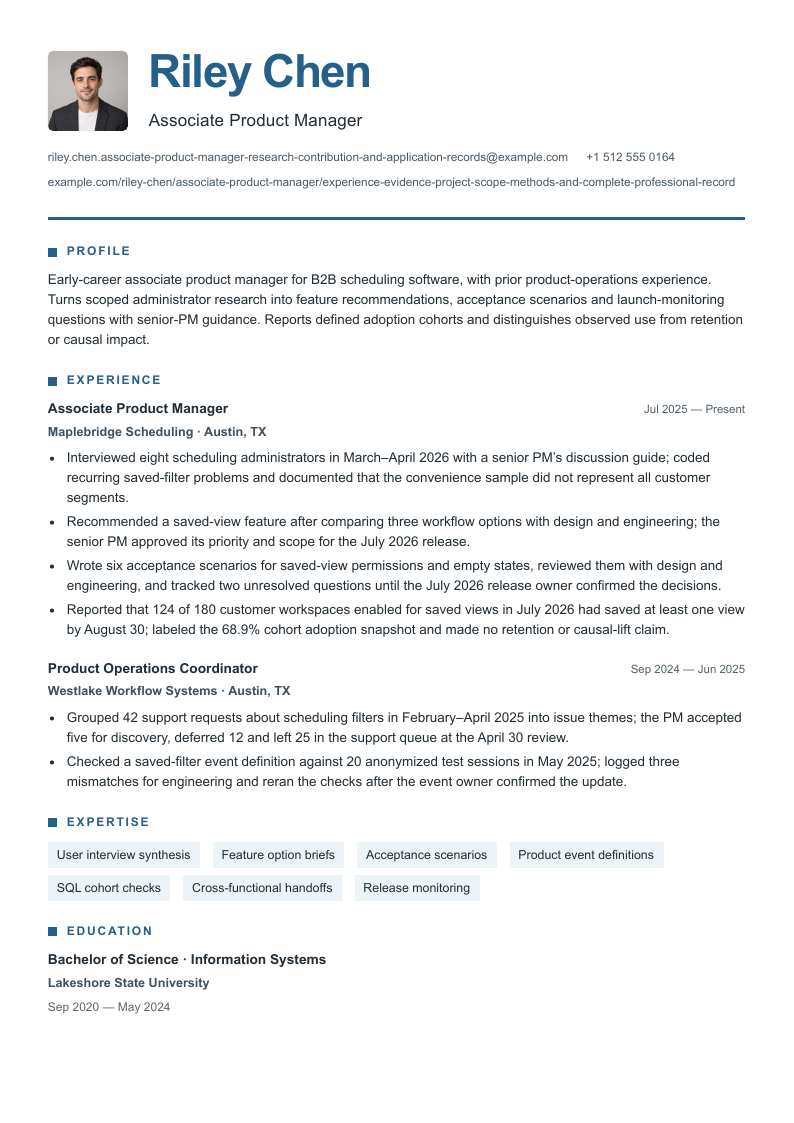
Inspect long contact details with the photo on
Only the resume email and portfolio URL change in this contact check. Signal is shown with the optional photo on. All jobs, acceptance scenarios, dates and project descriptions remain the same. Compare the complete contact strings with the final characters in the export and test the link destination. This US example defaults to no photo; follow the employer’s instructions.
Early-career associate product manager for B2B scheduling software, with prior product-operations experience. Turns scoped administrator research into feature recommendations, acceptance scenarios and launch-monitoring questions with senior-PM guidance. Reports defined adoption cohorts and distinguishes observed use from retention or causal impact.
Interviewed eight scheduling administrators in March–April 2026 with a senior PM’s discussion guide; coded recurring saved-filter problems and documented that the convenience sample did not represent all customer segments.
Recommended a saved-view feature after comparing three workflow options with design and engineering; the senior PM approved its priority and scope for the July 2026 release.
Wrote six acceptance scenarios for saved-view permissions and empty states, reviewed them with design and engineering, and tracked two unresolved questions until the July 2026 release owner confirmed the decisions.
Reported that 124 of 180 customer workspaces enabled for saved views in July 2026 had saved at least one view by August 30; labeled the 68.9% cohort adoption snapshot and made no retention or causal-lift claim.
Product Operations Coordinator
Westlake Workflow Systems · Austin, TX
September 2024–June 2025
Grouped 42 support requests about scheduling filters in February–April 2025 into issue themes; the PM accepted five for discovery, deferred 12 and left 25 in the support queue at the April 30 review.
Checked a saved-filter event definition against 20 anonymized test sessions in May 2025; logged three mismatches for engineering and reran the checks after the event owner confirmed the update.
Education
Bachelor of Science in Information Systems · Lakeshore State University
Joined the enabled-workspace list to the saved-view event records and excluded internal workspaces before the review. Checked distinct workspace identifiers rather than summing repeated actions. Documented the July cohort, August 30 observation cut-off and missing segment comparisons. Shared the snapshot with the senior PM as one input to follow-up research, not as evidence of retention improvement or an experiment result.
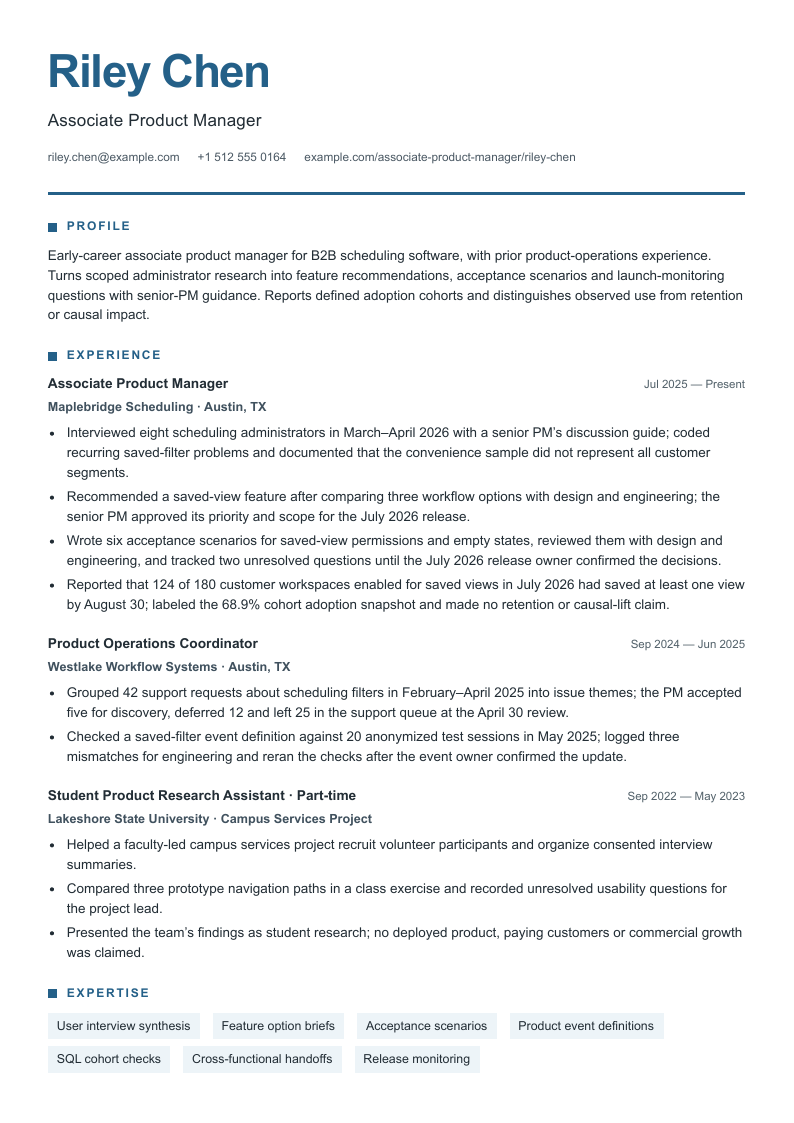
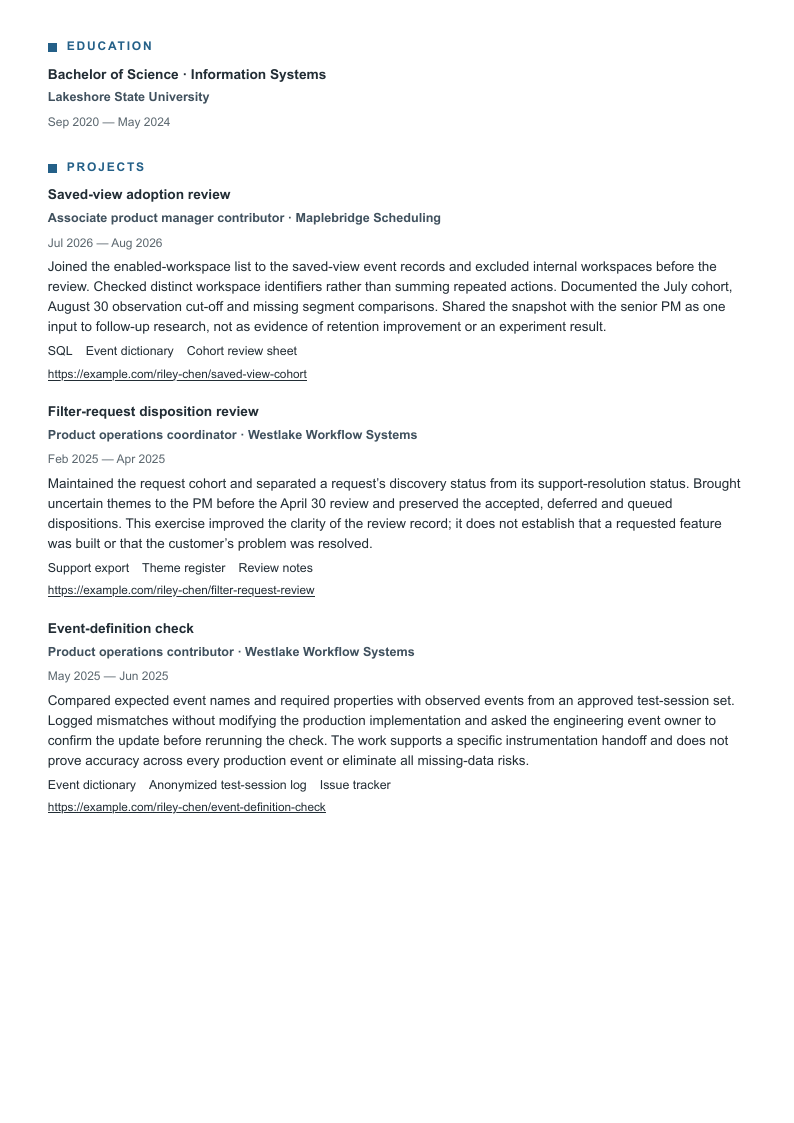
This Signal export has the photo off. It preserves the entire base record and adds the earlier part-time campus role and two dated product-operations projects. Read all continuation pages, including the final event-definition limitations. The longer record is a completeness check; for an application, select relevant evidence before adjusting spacing or adding more content.
Early-career associate product manager for B2B scheduling software, with prior product-operations experience. Turns scoped administrator research into feature recommendations, acceptance scenarios and launch-monitoring questions with senior-PM guidance. Reports defined adoption cohorts and distinguishes observed use from retention or causal impact.
Interviewed eight scheduling administrators in March–April 2026 with a senior PM’s discussion guide; coded recurring saved-filter problems and documented that the convenience sample did not represent all customer segments.
Recommended a saved-view feature after comparing three workflow options with design and engineering; the senior PM approved its priority and scope for the July 2026 release.
Wrote six acceptance scenarios for saved-view permissions and empty states, reviewed them with design and engineering, and tracked two unresolved questions until the July 2026 release owner confirmed the decisions.
Reported that 124 of 180 customer workspaces enabled for saved views in July 2026 had saved at least one view by August 30; labeled the 68.9% cohort adoption snapshot and made no retention or causal-lift claim.
Product Operations Coordinator
Westlake Workflow Systems · Austin, TX
September 2024–June 2025
Grouped 42 support requests about scheduling filters in February–April 2025 into issue themes; the PM accepted five for discovery, deferred 12 and left 25 in the support queue at the April 30 review.
Checked a saved-filter event definition against 20 anonymized test sessions in May 2025; logged three mismatches for engineering and reran the checks after the event owner confirmed the update.
Student Product Research Assistant · Part-time
Lakeshore State University · Campus Services Project
September 2022–May 2023
Helped a faculty-led campus services project recruit volunteer participants and organize consented interview summaries.
Compared three prototype navigation paths in a class exercise and recorded unresolved usability questions for the project lead.
Presented the team’s findings as student research; no deployed product, paying customers or commercial growth was claimed.
Education
Bachelor of Science in Information Systems · Lakeshore State University
Joined the enabled-workspace list to the saved-view event records and excluded internal workspaces before the review. Checked distinct workspace identifiers rather than summing repeated actions. Documented the July cohort, August 30 observation cut-off and missing segment comparisons. Shared the snapshot with the senior PM as one input to follow-up research, not as evidence of retention improvement or an experiment result.
Product operations coordinator · Westlake Workflow Systems
February 2025–April 2025
Support export · Theme register · Review notes
Maintained the request cohort and separated a request’s discovery status from its support-resolution status. Brought uncertain themes to the PM before the April 30 review and preserved the accepted, deferred and queued dispositions. This exercise improved the clarity of the review record; it does not establish that a requested feature was built or that the customer’s problem was resolved.
Compared expected event names and required properties with observed events from an approved test-session set. Logged mismatches without modifying the production implementation and asked the engineering event owner to confirm the update before rerunning the check. The work supports a specific instrumentation handoff and does not prove accuracy across every production event or eliminate all missing-data risks.
Verify the ownership boundary. Keep recommendations, approvals, implementation and release decisions distinct. Do not promote an internship, coordinator role or bounded feature assignment into company-wide strategy ownership.
Reconcile the measurement. Check unique workspace versus user counts, enablement criteria, event definition and the observation date. An adoption snapshot is not retention or causal lift.
Read every export page and link. Inspect contacts, gutter dates, project endings and any narrow-column text. Copy the PDF text and open destinations using only shareable work; keep customer information and internal analytics private.
Check the actual vacancy. Confirm cohort eligibility and the requested file type, then review parsed fields after upload. No visual design guarantees application-system compatibility, an interview or acceptance into a program.
Review your resume with the analyzer and check suggestions against your records. The design buttons open signup with the selected template and photo preference. Free-plan PDF downloads include a watermark; these examples show paid-plan output.
Questions, answered
Is an APM resume the same as a product manager resume?
Some skills overlap, but the scope and decision authority can differ. Keep your actual title and show the feature, research or workstream you owned. State senior-PM mentorship or approval where it mattered instead of claiming full product strategy.
Can I apply with product operations or customer support experience?
Some roles value adjacent experience, while others specify graduation cohorts, technical skills or domain experience. Show your actual contribution to user evidence, requirements, prioritization or measurement and check the individual vacancy’s requirements. Do not retitle an operations job as product management.
What if I have no shipped feature?
Use a clearly labeled project, research task, requirements contribution or prototype evaluation. Explain its stage and limits. Do not turn an unshipped recommendation into a launch or present volunteer testing as paying-customer adoption.
Should I claim the team’s product metric?
You can describe a relevant team observation when accurate and shareable, but distinguish your contribution, the unit, cohort and time window. A before-and-after change alone does not prove your feature caused it. This sample reports an adoption snapshot and explicitly makes no retention or causal-lift claim.
Do all APM jobs accept new graduates?
No. The selected primary descriptions illustrate a mentored rotation, a logistics-experienced role and a technical product route. Read current eligibility and timing for the exact vacancy; a title alone does not establish that a new graduate qualifies.
Will the builder keep my selected design and photo preference?
The Use buttons open signup with that design and the selected photo preference for the builder. A free account is required. The fictional candidate record and AI-generated portrait are not inserted into your resume; free-plan PDF downloads include a watermark.
Prepared by Resumize with AI-assisted research and drafting for English-language US applications. The three primary employer descriptions and career guidance below were checked on October 27, 2026. Employer pages displayed application controls or forms as noted; that observation is not proof of a completed application or a guarantee the vacancy remains available. These selected descriptions illustrate different scopes rather than universal hiring requirements. The complete records, rewrites and design comparisons are original editorial examples, not employer endorsements, search-ranking forecasts or promises of hiring results.
Checked October 27, 2026: San Mateo primary page showed Apply Now and job ID 41298. It says applications close October 30 at 5 PM PST and describes a 21-month mentored rotation. No publication date shown. The year names a future cohort, not a requirement that every APM be a 2027 graduate. Application completion was not tested.
Checked October 27, 2026: Chicago or US remote primary page displayed Apply and an application form; no publication date shown. Describes usage analysis, SQL, customer discovery and roadmap support, while requiring 3+ years of relevant logistics expertise. This is a domain-experienced route, not evidence that all APM roles accept new graduates.
Checked October 27, 2026: Silver Spring preferred or US remote considered; primary page displayed Apply, Submit application and a separate required supplemental-form link. No publication date shown. The role emphasizes Python, deployment support, customer issues and growing product skills. That technical scope differs from this scheduling-workflow example; supplemental submission was not tested.
Read October 27, 2026. General guidance on relevant experience, specific contributions and employment dates. The product cohorts, handoff examples and critique here are original editorial work.
Read October 27, 2026. General guidance on readable presentation and consistent formatting. It does not rank these layouts or guarantee compatibility with every application system.