Precision
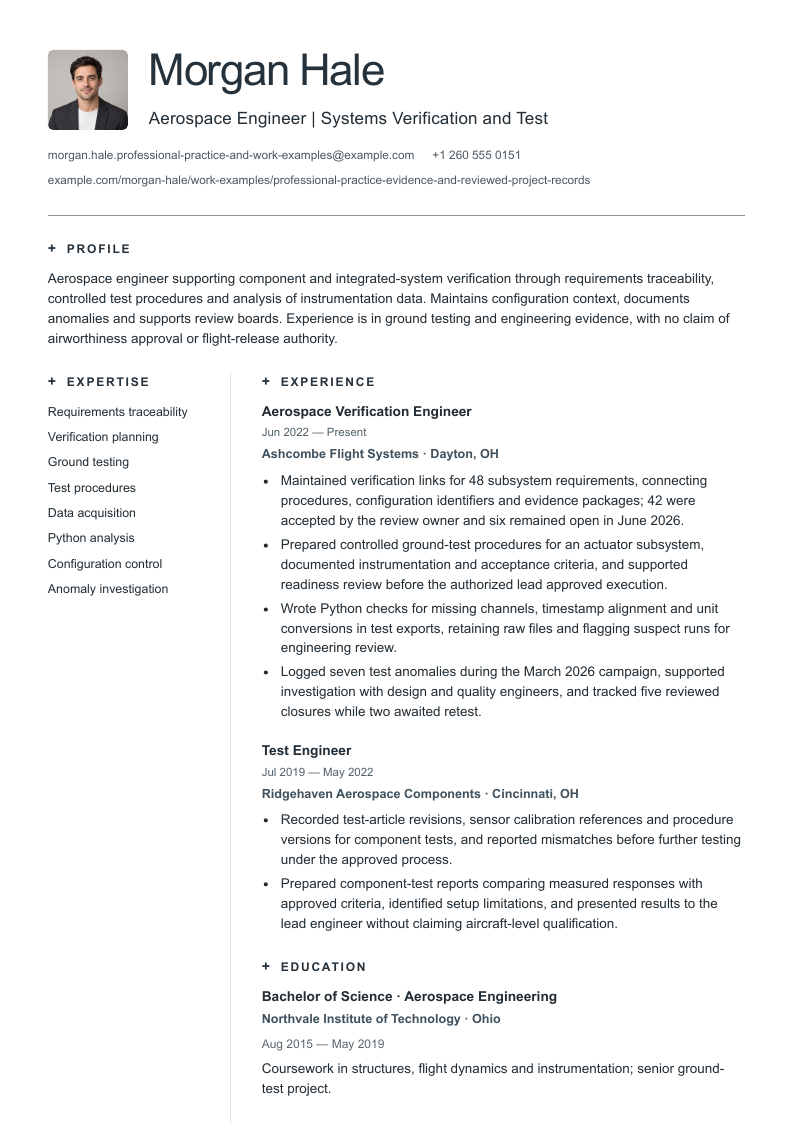
An expertise rail separates test tools from the broader verification work record.
Before sending: Check the six open requirements and the limits on ground-test evidence remain readable.
Engineering · Aerospace verification and test evidence
An Aerospace Engineer resume should make the requirement, test or analysis, configuration and review decision traceable. Name the subsystem and environment you worked on, then show your own contribution to verification evidence and anomaly follow-up. Keep engineering preparation, acceptance ownership, airworthiness decisions and security status precise.
By Resumize · · Sources and scope
Three designs · one example
These previews use the same layouts as the builder, with identical example content. Open a full preview to inspect the text and spacing.
Fictional candidate, employers, education and results. The optional portrait is AI-generated. Use your own evidence and photo; the example is not inserted into your resume.
An expertise rail separates test tools from the broader verification work record.
Before sending: Check the six open requirements and the limits on ground-test evidence remain readable.
A centered header and sequential history keep test responsibilities and review authority easy to follow.
Before sending: Retain configuration identifiers and distinguish report preparation from approval.
A practical technical hierarchy supports procedures, test evidence and project context.
Before sending: Read the final anomaly status and project ending instead of judging fit from the first page.
“Use” opens signup with that design and photo preference selected for the builder. A free account is required. Free-plan PDF downloads include a watermark; see current plans for paid options. Photo conventions vary; follow the employer’s instructions and local expectations.
Precision places an Expertise rail beside the broader work record. Professional uses a centered identity header and single-column history. Fieldnote uses a large sans name, green separators and subtle zigzag rules. Compare the same verification career across all three, including open requirement status and the last project limitation.
The default has no photo. Every design uses the same fictional career, and its button keeps the exact design, photo preference and Aerospace Engineer role through signup. The example career and portrait are not added to your account. A free account is required; free-plan PDF downloads include a watermark. These images show paid-plan output. Follow the employer’s photo and file-format instructions.
Morgan Hale, the companies, college, technical projects and all measures are original fiction. No real program identifiers, proprietary test limits or controlled engineering data appear. The example.com links and 555 number are placeholders, and the optional portrait is AI-generated. This record does not claim a clearance, PE license or airworthiness authority.
Aerospace Engineer | Systems Verification and Test
morgan.hale@example.com · +1 260 555 0151
Work examples: https://example.com/morgan-hale
Aerospace engineer supporting component and integrated-system verification through requirements traceability, controlled test procedures and analysis of instrumentation data. Maintains configuration context, documents anomalies and supports review boards. Experience is in ground testing and engineering evidence, with no claim of airworthiness approval or flight-release authority.
Requirements traceability · Verification planning · Ground testing · Test procedures · Data acquisition · Python analysis · Configuration control · Anomaly investigation
Ashcombe Flight Systems · Dayton, OH
June 2022–Present
Ridgehaven Aerospace Components · Cincinnati, OH
July 2019–May 2022
Bachelor of Science in Aerospace Engineering · Northvale Institute of Technology · Ohio
August 2015–May 2019
Coursework in structures, flight dynamics and instrumentation; senior ground-test project.
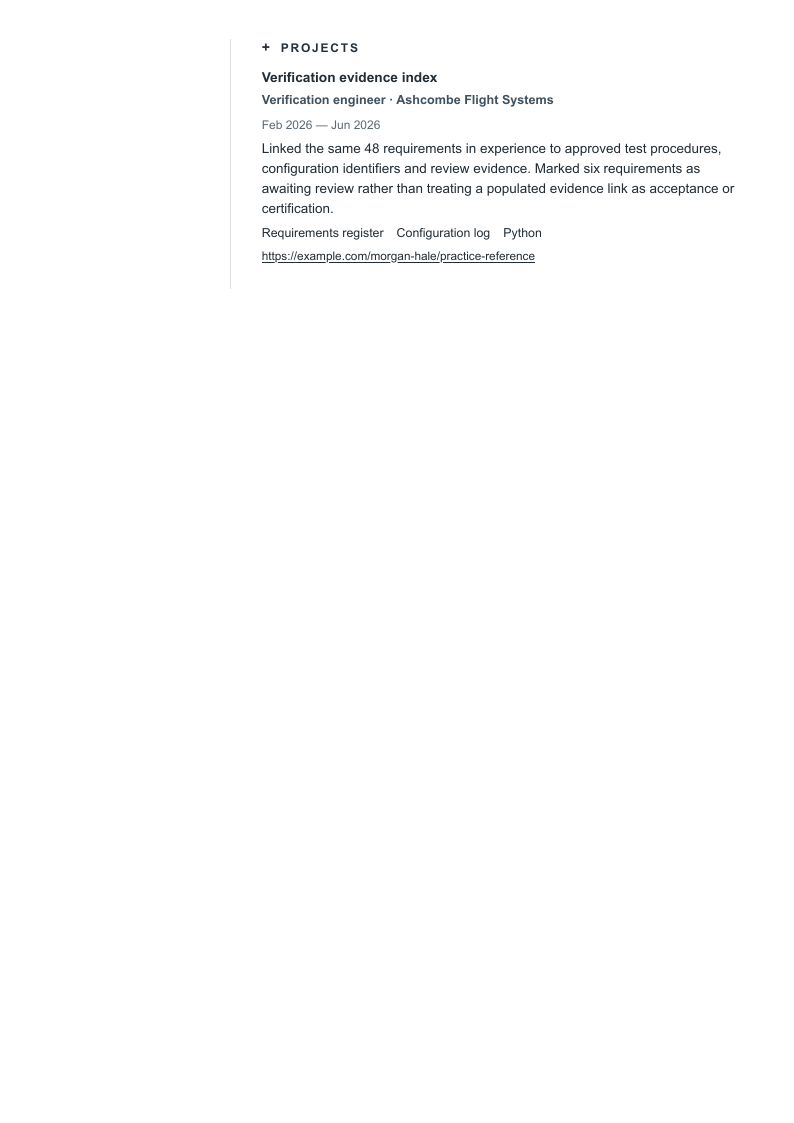
Verification engineer · Ashcombe Flight Systems
February 2026–June 2026
Requirements register · Configuration log · Python
Linked the same 48 requirements in experience to approved test procedures, configuration identifiers and review evidence. Marked six requirements as awaiting review rather than treating a populated evidence link as acceptance or certification.
Morgan works in systems verification and ground testing. Aerospace engineering also includes structures, aerodynamics, propulsion, controls and other specialties. A reader needs the hardware, environment and responsibility before a software list. State whether you developed an analysis method, prepared a procedure, executed a test, reviewed evidence or held approval authority; those activities have different meanings.
The current employer examples span several settings. SpaceX’s Falcon Test opening covers rocket hardware and test-stand work. KH Aerospace describes interconnected aircraft electrical and embedded systems. True Anomaly’s Test Engineer I/II opening includes test planning, execution and documentation across several engineering domains. The sample uses bounded ground-test responsibilities; it does not import the most senior authorization in any advertisement.
Separate verification against a stated requirement from broader validation of intended use. Explain what the test can establish at the actual configuration and conditions. A component result or a populated traceability row does not by itself establish aircraft-level qualification, flight release or regulatory approval. Keep the authorized acceptance owner visible.
Each after statement is exactly one of the six bullets in the base work history. All facts and numbers are fictional. Use the structure to explain your own contribution and evidence, replacing every invented detail.
Before: Certified the aircraft was ready to fly.
After: Maintained verification links for 48 subsystem requirements, connecting procedures, configuration identifiers and evidence packages; 42 were accepted by the review owner and six remained open in June 2026.
Why it works: A traceability population with acceptance ownership is credible; it does not grant certification authority.
Evidence to check: Approved requirement set, configuration baseline, review date and acceptance register.
Before: Tested all aircraft systems in every condition.
After: Prepared controlled ground-test procedures for an actuator subsystem, documented instrumentation and acceptance criteria, and supported readiness review before the authorized lead approved execution.
Why it works: Identifies hardware, environment and approval boundary.
Evidence to check: Approved procedure revision, instrumentation list and readiness-review responsibilities.
Before: Automated all engineering decisions with Python.
After: Wrote Python checks for missing channels, timestamp alignment and unit conversions in test exports, retaining raw files and flagging suspect runs for engineering review.
Why it works: Shows repeatable data checks without delegating engineering acceptance to a script.
Evidence to check: Versioned script, sample inputs, expected checks and reviewed exception handling.
Before: Resolved every flight risk.
After: Logged seven test anomalies during the March 2026 campaign, supported investigation with design and quality engineers, and tracked five reviewed closures while two awaited retest.
Why it works: Five closures plus two open items accounts for the campaign without claiming flight safety.
Evidence to check: Campaign issue register, review authority, closure evidence and retest status.
Before: Owned all aerospace design changes.
After: Recorded test-article revisions, sensor calibration references and procedure versions for component tests, and reported mismatches before further testing under the approved process.
Why it works: Concrete configuration details demonstrate discipline without claiming design ownership.
Evidence to check: Configuration log, calibration references and mismatch escalation process.
Before: Guaranteed flight performance from laboratory results.
After: Prepared component-test reports comparing measured responses with approved criteria, identified setup limitations, and presented results to the lead engineer without claiming aircraft-level qualification.
Why it works: Separates measured component behavior from broader vehicle claims.
Evidence to check: Report revision, approved criteria, test setup limits and reviewer records.
Morgan’s summary introduces controlled test procedures, configuration context, data checks and review support. An analyst can instead foreground the model, boundary conditions, correlation or design decision they supported. A design engineer should explain constraints and tradeoffs rather than borrow this test-oriented summary. Use tools as part of a task, such as Python checks on test exports, rather than as an unexplained inventory.
The sample links 48 subsystem requirements to evidence, with 42 accepted by the review owner and six open in June. Acceptance belongs to that reviewer and requirement set. The seven-anomaly campaign has five reviewed closures and two items awaiting retest. Neither measure proves flight safety, a defect-free product or universal test coverage. Do not remove unresolved status to create a cleaner success percentage.
| Skill | Evidence to gather | Fictional example |
|---|---|---|
| Requirements traceability | Defined population, baseline and acceptance owner. | 48 requirements: 42 accepted and six open. |
| Test preparation | Hardware, environment, criteria and approval. | Actuator ground-test procedure and readiness review. |
| Data analysis | Repeatable checks and retained raw evidence. | Python flags timestamps, units and missing channels. |
| Anomaly investigation | Reviewed closures and unresolved retest status. | Seven anomalies: five closed and two awaiting retest. |
| Configuration control | Article, sensor and procedure revisions. | Mismatches escalated before further testing. |
| Technical reporting | Measured comparison and limits of inference. | Component report avoids aircraft-level qualification claims. |
Use the employer’s terminology only where your history supports it. Explain a tool, method or credential in context; a keyword list cannot replace the work it describes.
List the exact engineering degree and relevant study or project work. The BLS overview describes a related engineering bachelor’s degree as typical preparation and notes that licensure is not required for entry-level aerospace engineer positions. That occupational overview is different from the requirements of a particular job, state professional practice or approval role. The fictional sample has no PE license.
Clearance, export-control eligibility and citizenship conditions vary by program and employer. True Anomaly’s posting includes its own citizenship and clearance-related conditions; those do not justify adding a clearance to your resume. State only verified current facts that you are authorized to disclose, and answer application screening questions accurately. Do not publish classified or export-controlled technical content as evidence of experience.
A graduate can show a university project, internship or laboratory campaign with the team size, assigned subsystem and contribution labeled accurately. SpaceX’s opening explicitly considers qualifying hands-on extracurricular experience, and True Anomaly distinguishes its I and II experience bands. Those examples show why a well-described student project can matter; they do not promise eligibility for every aerospace job.
Describe a requirement, the measurement approach, a setup limitation and the review outcome. A synthetic data notebook can demonstrate missing-channel checks and reproducibility. Keep a student lab separate from a flight-qualified system and a simulated result separate from a physical test. Show who approved the procedure or reviewed the conclusion, and share only material permitted by the university or employer.
The long-contact Precision example changes Morgan’s email and work-examples URL with the photo on. The phone, requirements, anomaly counts and engineering history remain the same. Inspect the entire URL and email in the contact area and confirm the start of the work record remains readable.
 Open page 1 at full size
 Open page 2 at full size
Aerospace Engineer | Systems Verification and Test
morgan.hale.professional-practice-and-work-examples@example.com · +1 260 555 0151
Work examples: https://example.com/morgan-hale/work-examples/professional-practice-evidence-and-reviewed-project-records
Aerospace engineer supporting component and integrated-system verification through requirements traceability, controlled test procedures and analysis of instrumentation data. Maintains configuration context, documents anomalies and supports review boards. Experience is in ground testing and engineering evidence, with no claim of airworthiness approval or flight-release authority.
Requirements traceability · Verification planning · Ground testing · Test procedures · Data acquisition · Python analysis · Configuration control · Anomaly investigation
Ashcombe Flight Systems · Dayton, OH
June 2022–Present
Ridgehaven Aerospace Components · Cincinnati, OH
July 2019–May 2022
Bachelor of Science in Aerospace Engineering · Northvale Institute of Technology · Ohio
August 2015–May 2019
Coursework in structures, flight dynamics and instrumentation; senior ground-test project.
Verification engineer · Ashcombe Flight Systems
February 2026–June 2026
Requirements register · Configuration log · Python
Linked the same 48 requirements in experience to approved test procedures, configuration identifiers and review evidence. Marked six requirements as awaiting review rather than treating a populated evidence link as acceptance or certification.
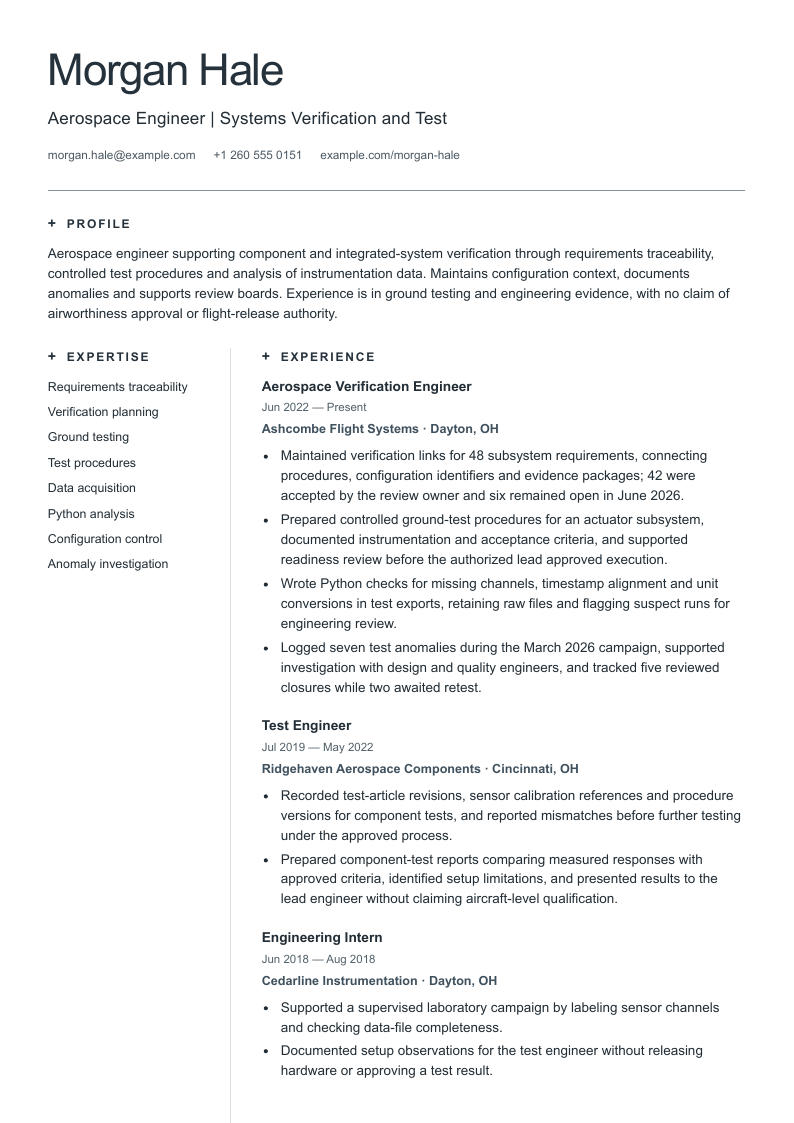
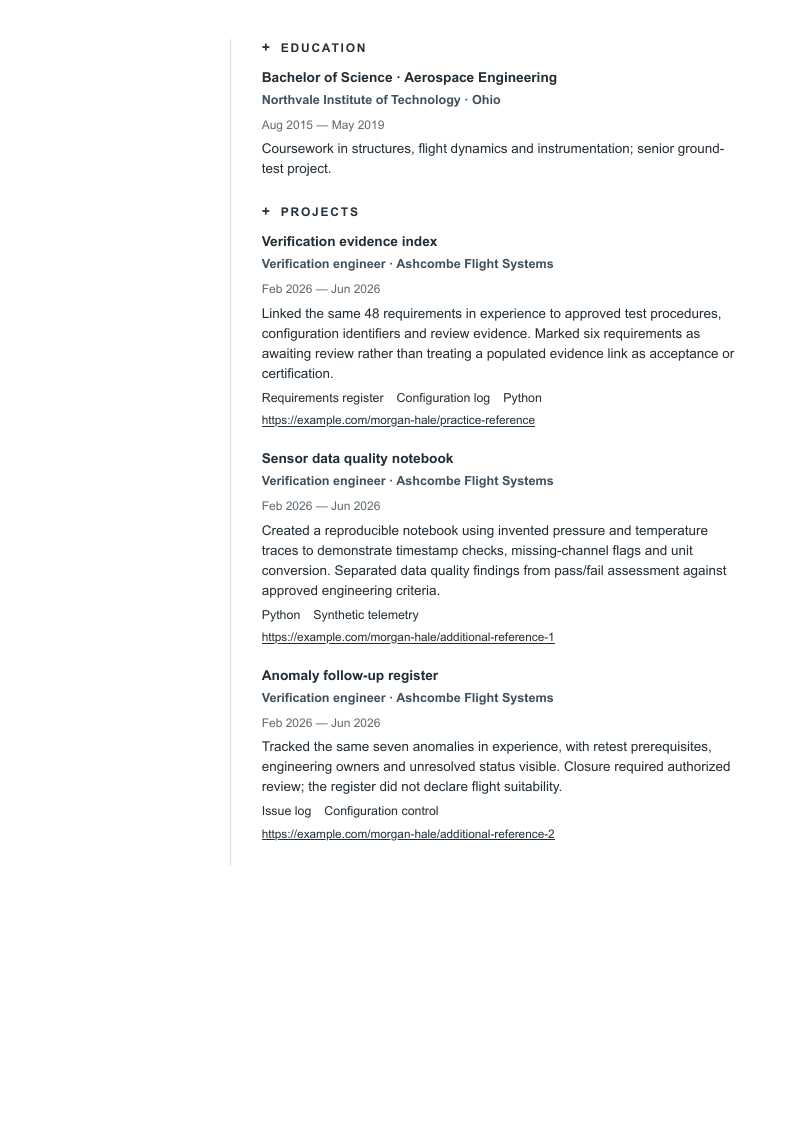
The expanded Precision record retains the base career and adds a supervised engineering internship, a synthetic sensor-data notebook and an anomaly follow-up register. These projects explain data quality and review status, without introducing a second test campaign or flight approval. Read every page through the last sentence about authorized anomaly closure.
 Open page 1 at full size
 Open page 2 at full size
Aerospace Engineer | Systems Verification and Test
morgan.hale@example.com · +1 260 555 0151
Work examples: https://example.com/morgan-hale
Aerospace engineer supporting component and integrated-system verification through requirements traceability, controlled test procedures and analysis of instrumentation data. Maintains configuration context, documents anomalies and supports review boards. Experience is in ground testing and engineering evidence, with no claim of airworthiness approval or flight-release authority.
Requirements traceability · Verification planning · Ground testing · Test procedures · Data acquisition · Python analysis · Configuration control · Anomaly investigation
Ashcombe Flight Systems · Dayton, OH
June 2022–Present
Ridgehaven Aerospace Components · Cincinnati, OH
July 2019–May 2022
Cedarline Instrumentation · Dayton, OH
June 2018–August 2018
Bachelor of Science in Aerospace Engineering · Northvale Institute of Technology · Ohio
August 2015–May 2019
Coursework in structures, flight dynamics and instrumentation; senior ground-test project.
Verification engineer · Ashcombe Flight Systems
February 2026–June 2026
Requirements register · Configuration log · Python
Linked the same 48 requirements in experience to approved test procedures, configuration identifiers and review evidence. Marked six requirements as awaiting review rather than treating a populated evidence link as acceptance or certification.
Verification engineer · Ashcombe Flight Systems
February 2026–June 2026
Python · Synthetic telemetry
Created a reproducible notebook using invented pressure and temperature traces to demonstrate timestamp checks, missing-channel flags and unit conversion. Separated data quality findings from pass/fail assessment against approved engineering criteria.
Verification engineer · Ashcombe Flight Systems
February 2026–June 2026
Issue log · Configuration control
Tracked the same seven anomalies in experience, with retest prerequisites, engineering owners and unresolved status visible. Closure required authorized review; the register did not declare flight suitability.
Use enough space to keep relevant evidence readable. Condense repetition before removing a measure’s definition or your responsibility boundary. An isolated heading, detached date or lost final qualifier needs attention regardless of page count.
The resume analyzer offers advisory feedback. Use the bullet point generator for drafting, then verify each suggestion. Follow the employer’s requested format and review text copied from your PDF. A design cannot guarantee parsing, interviews or an offer.
Show your discipline, hardware or system, constraints and assigned contribution. Connect analysis or testing to configuration, requirements and the reviewer’s decision.
A link alone does not establish acceptance. State the evidence status, review owner and unresolved items; reserve accepted or verified for the actual approved decision.
The BLS overview says licensure is not required for entry-level aerospace engineer positions. Specific jobs and practice responsibilities may differ. List only credentials actually held and check the intended role.
Use a clearly labeled project or internship with your assigned work, measurement method and limitations. Distinguish simulation, laboratory testing and flight-qualified work.
Keep relevant evidence readable and follow the employer’s instructions. Condense repeated duties before removing dates, credential scope or a result’s definition. Read every page of the exported PDF rather than judging length from a thumbnail.
Signup retains the exact design, photo preference and Aerospace Engineer role. A free account is required. Free-plan PDF downloads include a watermark; these example images show paid-plan output. The fictional career and portrait are not inserted into your account.
Prepared by Resumize with AI-assisted research and drafting. Three complete employer descriptions were read on October 29, 2026: SpaceX Falcon Test, KH Aerospace Systems/Electrical and True Anomaly Test Engineer I/II. The BLS occupational overview supports the broad scope and entry-level licensure distinction. These test-oriented openings are a small sample of aerospace work, not a survey of every specialty or a statement of program eligibility. No real test results, controlled information, applications or hiring outcomes were used. Openings and credential guidance can change; check the current primary source for your own application.
Read October 29, 2026. McGregor, Texas; test requirements, instrumentation, data review and hazard-aware test operations. Lists relevant engineering degrees and accepts qualifying hands-on extracurricular experience. Direct full description and application form read.
Read October 29, 2026. Hayward, California; integrated unmanned-aircraft electrical systems, test procedures, stressed-condition evaluation and traceable anomalies. Direct full description and application form read; the systems remit is broader than one component lab.
Read October 29, 2026. Colorado; test plans, configuration control, readiness review and failure investigations across mechanical, electrical and environmental work. Specifies different experience bands and role-specific citizenship requirements. Direct full description and application entry read.
Read October 29, 2026. Primary occupational overview covers design and testing, typical education and licensure. Entry-level aerospace engineering positions do not generally require licensure; this is distinct from approval authority, a security clearance or a particular program’s hiring conditions.