A structural engineer resume should connect analysis assumptions, calculation packages and drawings to the building work you actually performed. Show your review responsibility and coordination with other disciplines. This Texas EIT example demonstrates supervised structural contributions without claiming a PE or SE license or independent design approval.
These previews use the same layouts as the builder, with identical example content. Open a full preview to inspect the text and spacing.
Fictional candidate, employers, education and results. The optional portrait is AI-generated. Use your own evidence and photo; the example is not inserted into your resume.
Keystone
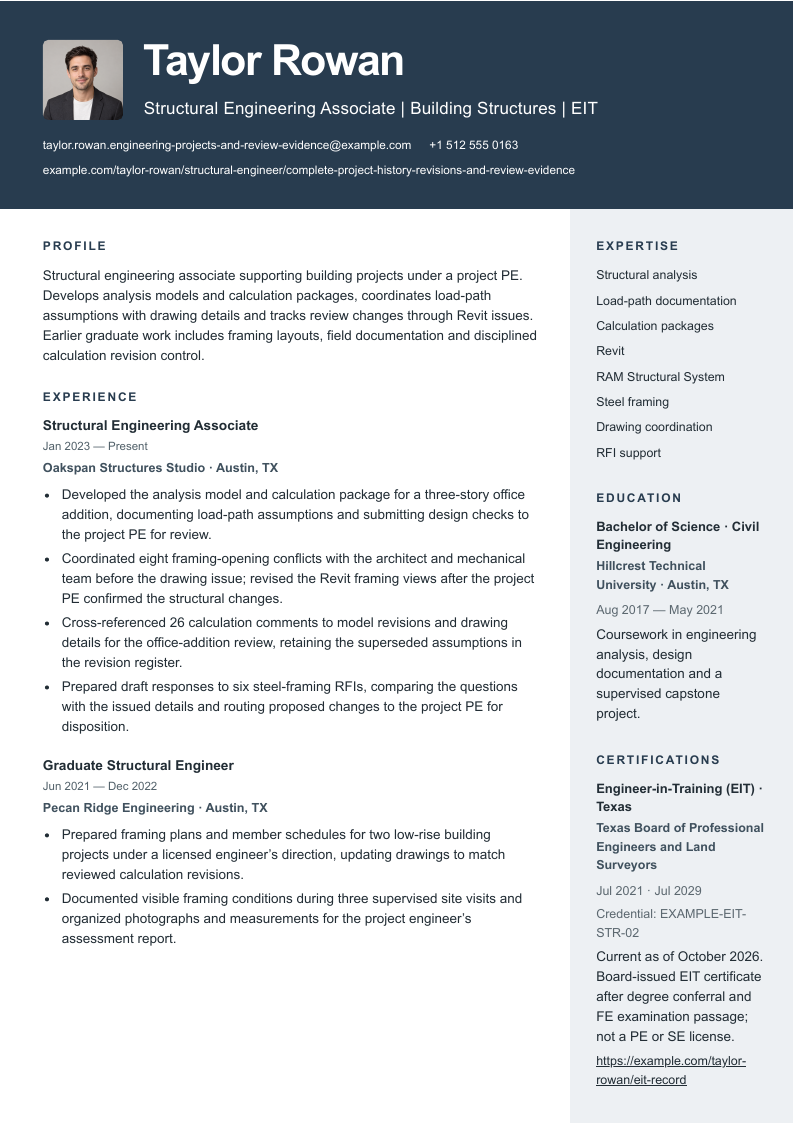
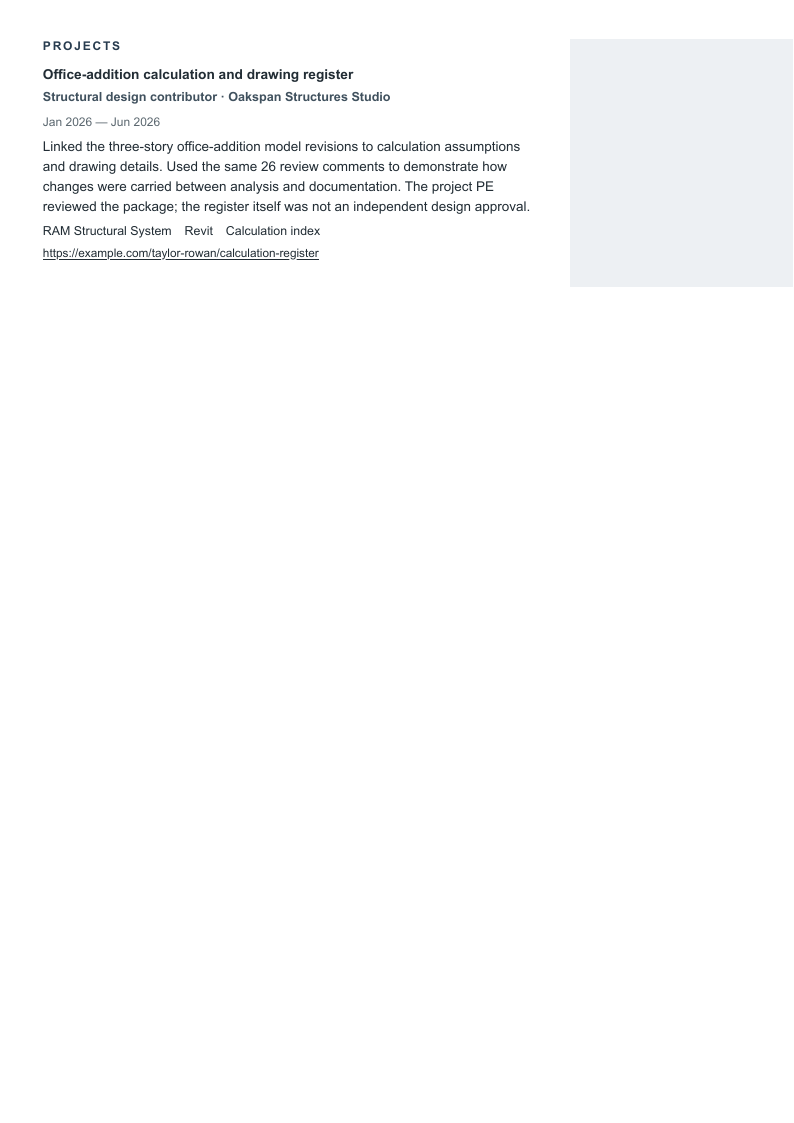
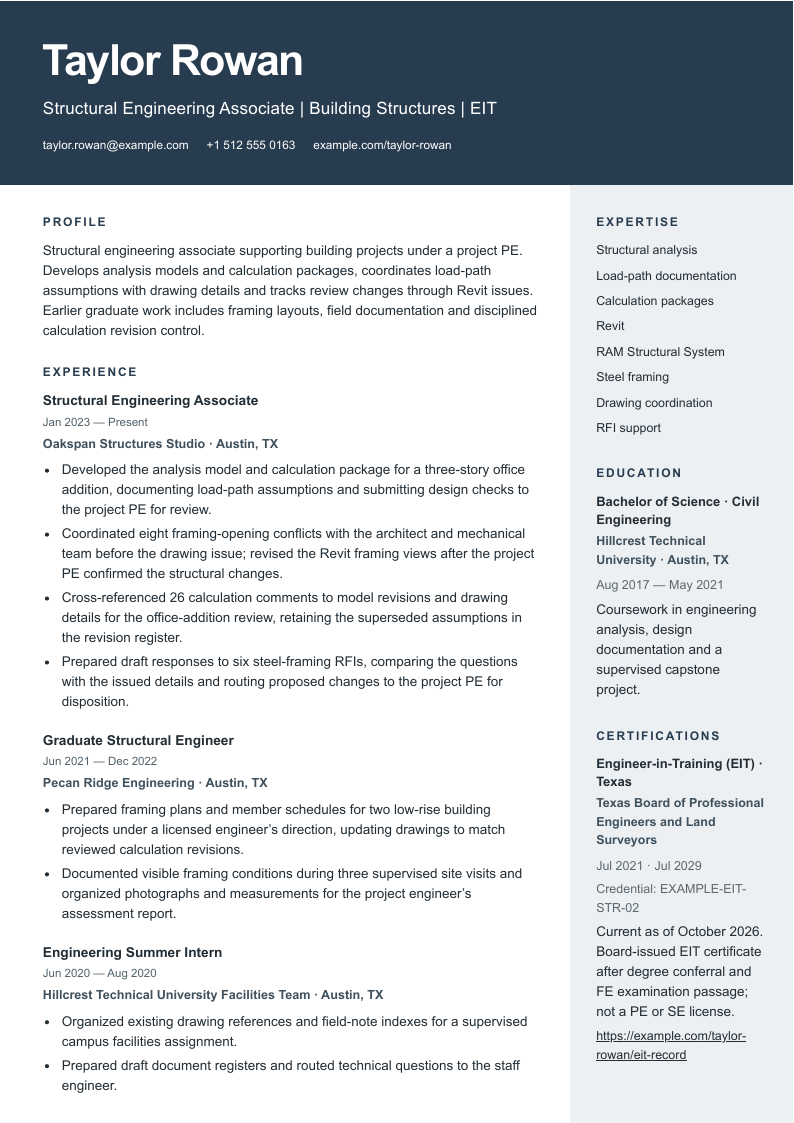
A colored masthead spans the page. Profile, Experience and Projects occupy the main column; a pale right rail contains Expertise, Education and Certifications.
Before sending: Read both columns to the end. The EIT record sits in the narrower rail, so inspect its issuer and expiry alongside the final calculation-project text.
Original Professional centers the identity and contact details on white, with an optional circular portrait above them. The summary leads into Skills, Experience, Education, Projects and Certifications in one column.
Before sending: Its social label can shorten a displayed URL. Verify the complete destination and the EIT record after projects, including all continuation pages.
Small square section markers, colored headings and a date gutter organize Profile, Experience, Expertise, Education, Certifications and Projects in one main column.
Before sending: The date gutter reduces line width. Check model and drawing revision descriptions and the complete issuer name rather than forcing a one-page target.
“Use” opens signup with that design and photo preference selected for the builder. A free account is required. Free-plan PDF downloads include a watermark; see current plans for paid options. Photo conventions vary; follow the employer’s instructions and local expectations.
All three designs show the same fictional career. The default is without a photo; the optional portrait is AI-generated. Template buttons retain the exact design, photo preference and Structural Engineer role through signup. They do not place the fictional career record or portrait in your account.
Taylor Rowan is a fictional Texas engineering associate working under a project PE. Every person, employer, university, date, credential, project and result in these examples is invented. No real board credential exists for this candidate; the invented university is not an accreditation claim. The example.com links are placeholders, and the optional portrait is AI-generated. The sample illustrates resume writing and does not establish permission to practice engineering.
Taylor Rowan
Structural Engineering Associate | Building Structures | EIT
Structural engineering associate supporting building projects under a project PE. Develops analysis models and calculation packages, coordinates load-path assumptions with drawing details and tracks review changes through Revit issues. Earlier graduate work includes framing layouts, field documentation and disciplined calculation revision control.
Developed the analysis model and calculation package for a three-story office addition, documenting load-path assumptions and submitting design checks to the project PE for review.
Coordinated eight framing-opening conflicts with the architect and mechanical team before the drawing issue; revised the Revit framing views after the project PE confirmed the structural changes.
Cross-referenced 26 calculation comments to model revisions and drawing details for the office-addition review, retaining the superseded assumptions in the revision register.
Prepared draft responses to six steel-framing RFIs, comparing the questions with the issued details and routing proposed changes to the project PE for disposition.
Graduate Structural Engineer
Pecan Ridge Engineering · Austin, TX
June 2021–December 2022
Prepared framing plans and member schedules for two low-rise building projects under a licensed engineer’s direction, updating drawings to match reviewed calculation revisions.
Documented visible framing conditions during three supervised site visits and organized photographs and measurements for the project engineer’s assessment report.
Education
Bachelor of Science in Civil Engineering · Hillcrest Technical University · Austin, TX
August 2017–May 2021
Coursework in engineering analysis, design documentation and a supervised capstone project.
EIT certification
Engineer-in-Training (EIT) · Texas
Texas Board of Professional Engineers and Land Surveyors
Issued July 2021
Expires July 2029
Credential ID: EXAMPLE-EIT-STR-02
Current as of October 2026. Board-issued EIT certificate after degree conferral and FE examination passage; not a PE or SE license.
Structural design contributor · Oakspan Structures Studio
January 2026–June 2026
RAM Structural System · Revit · Calculation index
Linked the three-story office-addition model revisions to calculation assumptions and drawing details. Used the same 26 review comments to demonstrate how changes were carried between analysis and documentation. The project PE reviewed the package; the register itself was not an independent design approval.
The base record contains two jobs and six experience bullets, one degree, one Texas EIT record and one supporting project. Each experience bullet appears verbatim in the rewrites below. The EIT certificate has its own issuer, issue date, expiry and status; it is not labeled as a PE or SE license.
Show the structure, analysis scope and review responsibility
Name the structural context: building type, new work or alteration, material systems and your actual analysis or documentation assignment. Taylor’s sample concerns a three-story office addition and earlier low-rise buildings. It does not imply bridge, industrial crane, high-rise seismic or existing-building specialist experience merely because those markets also hire structural engineers.
BRPH’s current EI/EIT opening explicitly describes calculations, construction documents and field support under PE supervision. DLR Group’s Charlotte opening asks for two to seven years of building work and lists FE passage as preferred. HDR’s Denver opening is a senior leadership comparison requiring a jurisdiction-recognized PE. Taylor’s EIT record does not meet HDR’s PE requirement.
A useful structural bullet shows how analysis and documentation connect. The office-addition model is paired with a calculation package and documented load-path assumptions. The Revit coordination bullet identifies framing openings, the other disciplines and the PE review point. That is more informative than “used engineering software” or an unsupported guarantee that the building is safe.
Keep construction support precise. Drafting an RFI response, comparing a shop drawing with issued details and approving a design change are different responsibilities. Use the verb that describes your part. Observing visible framing on a site visit does not establish hidden conditions, continuous inspection or authority to certify a structure.
Six structural engineer rewrites with reasoning
Each after sentence is part of the base resume. The deliberately weak before statements are teaching examples, not extra career facts. Check the evidence prompts against your own work and replace every fictional number with an accurate, permitted description.
1. Connect a model to an actual package
Before: Designed safe buildings with advanced software.
After: Developed the analysis model and calculation package for a three-story office addition, documenting load-path assumptions and submitting design checks to the project PE for review.
Why it works: Names the structure, deliverable and review boundary. Software use does not prove building safety or make the associate the engineer of record.
Evidence to check: Approved project description, calculation index, model revision and review responsibilities.
2. Show drawing coordination
Before: Eliminated all design clashes.
After: Coordinated eight framing-opening conflicts with the architect and mechanical team before the drawing issue; revised the Revit framing views after the project PE confirmed the structural changes.
Why it works: Eight specific coordination items are stronger than an unsupported zero-clash claim. The sentence distinguishes coordination from design approval.
Evidence to check: Coordination log, revised views and the PE review trail.
3. Make the technical review traceable
Before: Automated calculations and guaranteed accuracy.
After: Cross-referenced 26 calculation comments to model revisions and drawing details for the office-addition review, retaining the superseded assumptions in the revision register.
Why it works: The count describes review scope. Traceability supports checking; it does not establish that all calculations were error-free.
Evidence to check: Calculation comment record, dated revisions and drawing cross-references.
4. Keep construction support bounded
Before: Approved every contractor substitution.
After: Prepared draft responses to six steel-framing RFIs, comparing the questions with the issued details and routing proposed changes to the project PE for disposition.
Why it works: Preparation and comparison describe the associate’s contribution. The PE retains disposition of proposed design changes.
Evidence to check: RFI dates, issued-detail references, draft response and final reviewer.
5. Use precise graduate experience
Before: Led structural design for major buildings.
After: Prepared framing plans and member schedules for two low-rise building projects under a licensed engineer’s direction, updating drawings to match reviewed calculation revisions.
Why it works: Two defined projects and linked deliverables make graduate work legible without upgrading it to independent project leadership.
Evidence to check: Assigned sheet list, reviewed calculation versions and drawing revisions.
6. Describe observations without certification
Before: Certified all existing structures as sound.
After: Documented visible framing conditions during three supervised site visits and organized photographs and measurements for the project engineer’s assessment report.
Why it works: Reports observed conditions and documentation. It does not diagnose concealed conditions or claim a structural certification.
Evidence to check: Visit scope, approved observation notes and report contribution; omit client photographs from a public sample.
Make technical judgment legible without a calculation recipe
Taylor’s summary connects analysis models, load-path assumptions, calculation packages, Revit issues and review changes. The employment bullets support each point with a defined building and document set. Choose the technical strengths that matter to the opening and that your actual experience can demonstrate; a list of every analysis program is not a substitute for project evidence.
The three-story office addition provides context, not a design instruction. The resume describes deliverables and review ownership without publishing loading values, member sizes or steps someone could use to design a building. A hiring team can assess the candidate’s contribution from the scope and process before requesting permitted work samples.
The 26 calculation comments measure a review assignment. Retaining superseded assumptions in a register demonstrates traceability; it does not prove an error-free analysis. Likewise, resolving eight framing-opening conflicts before an issue is a bounded coordination result, not proof that all possible clashes were eliminated.
Use a genuine technical or delivery result only with a clear basis: the affected package, revision period, comparison and your contribution. If a team shortened a review cycle, distinguish your indexing or coordination task from the team’s final result. Do not claim a material saving, resilience improvement or safety outcome without appropriate evidence and permission to share it.
Connect selected skills to project evidence
Use vacancy language when it accurately describes work you have performed. Name the deliverable, project context and review responsibility behind a tool or method. Software proficiency does not by itself establish design approval authority or guarantee accurate application parsing.
Structural Engineer skills and supporting evidence
Skill
Evidence to gather
Fictional example
Structural analysis
Project type, model responsibility and reviewer.
Office-addition model and design checks for PE review.
Load-path documentation
Assumption register and calculation references.
Documented assumptions in the calculation package.
Revit coordination
Affected views, disciplines and review point.
Eight framing-opening conflicts before drawing issue.
Calculation revision control
Comment trail, versions and drawing links.
26 comments linked to model and detail revisions.
RFI support
Issued detail, draft response and final disposition.
Six steel-framing RFIs routed to the PE.
Field documentation
Observed scope and assessment owner.
Three supervised visits supporting an engineer’s report.
Separate the degree, FE result, EIT certificate and PE license
List the degree, field, institution and dates exactly as earned. Taylor Rowan completed the fictional civil engineering degree in May 2021 before the July EIT issue date. Include a GPA only if accurate and useful for the opening; do not add an accreditation claim for an invented institution or turn coursework into a professional credential.
Texas distinguishes FE passage from its board-issued EIT certificate and PE licensure. Its EIT certificate lasts eight years; this fictional record runs from July 2021 to July 2029 and is current in October 2026. It supplies no PE practice authority. Use the actual board record for your own issuer, status and dates.
An exam pass is not an issued license. If you hold a PE or SE credential, identify its actual jurisdiction and current status. Requirements vary by project, jurisdiction and vacancy; do not infer a nationwide SE rule. Where a posting requires an active PE, an EIT example does not satisfy that condition. Never add signing, sealing or engineer-of-record responsibility you did not hold.
Show graduate design work without overstating independence
Use a supervised design project, internship or graduate role to show how you approach drawings and calculations. Label academic work and placements accurately, name the deliverable and explain the review received. A university model is not a constructed building, and a graduate design contribution is not an engineer-of-record appointment.
Taylor’s graduate role includes framing plans, schedules and reviewed calculation revisions for two low-rise projects. The expanded record adds a summer 2020 facilities internship before the May 2021 degree. The internship describes document organization and question routing; it does not retrospectively become licensed structural design.
The base project explains the register behind the same 26 calculation comments. The expanded coordination project explains the same eight framing-opening conflicts. Reusing a work example can add useful detail, but make the shared scope explicit rather than presenting the projects as additional building commissions or doubling the results.
Keep proprietary drawings, model files, client names, photographs and internal calculation packages out of public portfolios unless disclosure is expressly permitted. A concise approved project narrative can show your role and methods. All example.com links here are invented placeholders; they contain no engineering designs or credential verification.
Inspect long contact details with the optional photo
The Keystone long-contact scenario turns the photo on and changes only the resume email and portfolio URL. Taylor’s user record, phone, job history, degree, EIT record and projects remain unchanged. Inspect the contact endings in the masthead and the full link target. Original Professional may shorten a displayed social label.
Structural engineering associate supporting building projects under a project PE. Develops analysis models and calculation packages, coordinates load-path assumptions with drawing details and tracks review changes through Revit issues. Earlier graduate work includes framing layouts, field documentation and disciplined calculation revision control.
Developed the analysis model and calculation package for a three-story office addition, documenting load-path assumptions and submitting design checks to the project PE for review.
Coordinated eight framing-opening conflicts with the architect and mechanical team before the drawing issue; revised the Revit framing views after the project PE confirmed the structural changes.
Cross-referenced 26 calculation comments to model revisions and drawing details for the office-addition review, retaining the superseded assumptions in the revision register.
Prepared draft responses to six steel-framing RFIs, comparing the questions with the issued details and routing proposed changes to the project PE for disposition.
Graduate Structural Engineer
Pecan Ridge Engineering · Austin, TX
June 2021–December 2022
Prepared framing plans and member schedules for two low-rise building projects under a licensed engineer’s direction, updating drawings to match reviewed calculation revisions.
Documented visible framing conditions during three supervised site visits and organized photographs and measurements for the project engineer’s assessment report.
Education
Bachelor of Science in Civil Engineering · Hillcrest Technical University · Austin, TX
August 2017–May 2021
Coursework in engineering analysis, design documentation and a supervised capstone project.
EIT certification
Engineer-in-Training (EIT) · Texas
Texas Board of Professional Engineers and Land Surveyors
Issued July 2021
Expires July 2029
Credential ID: EXAMPLE-EIT-STR-02
Current as of October 2026. Board-issued EIT certificate after degree conferral and FE examination passage; not a PE or SE license.
Structural design contributor · Oakspan Structures Studio
January 2026–June 2026
RAM Structural System · Revit · Calculation index
Linked the three-story office-addition model revisions to calculation assumptions and drawing details. Used the same 26 review comments to demonstrate how changes were carried between analysis and documentation. The project PE reviewed the package; the register itself was not an independent design approval.
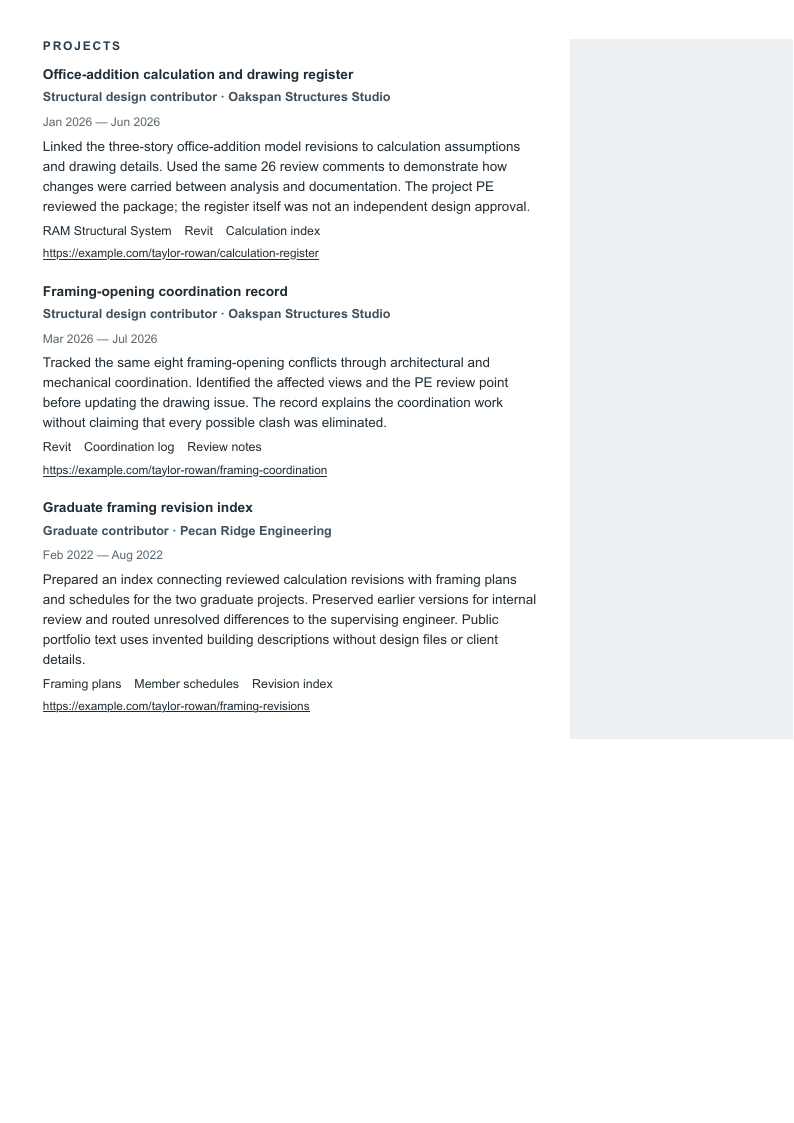
The expanded Keystone scenario turns the photo off and adds one earlier internship plus two projects to the unchanged base record. Follow Profile, Experience and all three Projects in the main column, then inspect Expertise, Education and the complete EIT record in the right rail. A continuation page must preserve the end of each field.
Structural engineering associate supporting building projects under a project PE. Develops analysis models and calculation packages, coordinates load-path assumptions with drawing details and tracks review changes through Revit issues. Earlier graduate work includes framing layouts, field documentation and disciplined calculation revision control.
Developed the analysis model and calculation package for a three-story office addition, documenting load-path assumptions and submitting design checks to the project PE for review.
Coordinated eight framing-opening conflicts with the architect and mechanical team before the drawing issue; revised the Revit framing views after the project PE confirmed the structural changes.
Cross-referenced 26 calculation comments to model revisions and drawing details for the office-addition review, retaining the superseded assumptions in the revision register.
Prepared draft responses to six steel-framing RFIs, comparing the questions with the issued details and routing proposed changes to the project PE for disposition.
Graduate Structural Engineer
Pecan Ridge Engineering · Austin, TX
June 2021–December 2022
Prepared framing plans and member schedules for two low-rise building projects under a licensed engineer’s direction, updating drawings to match reviewed calculation revisions.
Documented visible framing conditions during three supervised site visits and organized photographs and measurements for the project engineer’s assessment report.
Engineering Summer Intern
Hillcrest Technical University Facilities Team · Austin, TX
June 2020–August 2020
Organized existing drawing references and field-note indexes for a supervised campus facilities assignment.
Prepared draft document registers and routed technical questions to the staff engineer.
Education
Bachelor of Science in Civil Engineering · Hillcrest Technical University · Austin, TX
August 2017–May 2021
Coursework in engineering analysis, design documentation and a supervised capstone project.
EIT certification
Engineer-in-Training (EIT) · Texas
Texas Board of Professional Engineers and Land Surveyors
Issued July 2021
Expires July 2029
Credential ID: EXAMPLE-EIT-STR-02
Current as of October 2026. Board-issued EIT certificate after degree conferral and FE examination passage; not a PE or SE license.
Structural design contributor · Oakspan Structures Studio
January 2026–June 2026
RAM Structural System · Revit · Calculation index
Linked the three-story office-addition model revisions to calculation assumptions and drawing details. Used the same 26 review comments to demonstrate how changes were carried between analysis and documentation. The project PE reviewed the package; the register itself was not an independent design approval.
Structural design contributor · Oakspan Structures Studio
March 2026–July 2026
Revit · Coordination log · Review notes
Tracked the same eight framing-opening conflicts through architectural and mechanical coordination. Identified the affected views and the PE review point before updating the drawing issue. The record explains the coordination work without claiming that every possible clash was eliminated.
Prepared an index connecting reviewed calculation revisions with framing plans and schedules for the two graduate projects. Preserved earlier versions for internal review and routed unresolved differences to the supervising engineer. Public portfolio text uses invented building descriptions without design files or client details.
Keystone divides the career narrative and projects from the right-hand qualifications rail. Signal uses one main column with a date gutter. Original Professional places Skills before Experience and the certificate after Projects. Visual order, copied PDF text and parsed application fields can differ, so check the file you will actually submit.
Check the resume file you will submit
Verify responsibility. Keep your actual title, review role and approval boundary intact in the summary, bullets and projects.
Check qualifications. Confirm the degree and current credential from your own records. Label examination milestones, certificates and licenses separately.
Read every page. Inspect contact endings, job dates, credential dates, project URLs and the final sentence. Check copied PDF text and parsed application fields.
Follow the opening. Use the requested file type, relevant specialty and permitted project evidence. A template does not guarantee parsing, licensing eligibility, an interview or a job.
A free account is required for the builder. Free-plan PDF downloads include a watermark; these previews show paid-plan output. Use buttons retain the selected design, photo preference and Structural Engineer role without copying the fictional content or portrait.
Questions, answered
What should a structural engineer resume show?
Name the building or structural context, your analysis and drawing scope, the calculation or review deliverable, and the person responsible for approval. Support selected software skills with specific project contributions.
Can I list structural experience without a PE or SE?
Describe genuine supervised work using your actual title and responsibility. Do not imply independent practice, stamping, sealing or engineer-of-record authority. A job requiring a current license still requires the actual credential.
Should I publish calculations or drawings with my resume?
Use only material you are permitted to disclose. An approved project narrative can explain your contribution without proprietary drawings, model files, client details or a building-design recipe.
Is passing the FE or PE exam a state license?
No. An examination result, a board-issued EIT certificate and an issued PE license are distinct records. Identify the credential you actually hold and check the relevant jurisdiction.
Does every structural job require an SE license?
Requirements depend on the jurisdiction, project and vacancy. Do not infer a nationwide rule from one advertisement, add an SE title you do not hold or assume a PE license supplies every additional authorization.
What does selecting a template preserve?
Signup retains the selected design, photo preference and exact Structural Engineer role. It does not copy the fictional career or portrait. A free account is required; free-plan PDF downloads include a watermark.
Prepared by Resumize with AI-assisted research and drafting for English-language US applications. Current BRPH, DLR Group and HDR descriptions were retrieved with full responsibilities and Apply controls on October 28, 2026. BRPH and DLR provide supervised or emerging-professional comparisons; HDR shows a senior PE-required role. Official Texas board and NCEES guidance support the limited credential distinctions. Three postings do not establish universal structural duties, PE/SE requirements or this candidate’s eligibility. This is resume guidance, not structural design instruction, a building safety assessment or a licensing decision. No application was submitted.
Retrieved October 28, 2026: Orlando, Florida; full responsibilities and inline Apply form available; no posting date displayed. Explicit PE supervision, calculations, Revit documents, coordination and construction support; EI/EIT required and one to three years preferred. The Texas certificate sample does not establish Florida eligibility.
Retrieved October 28, 2026: Charlotte, North Carolina; full description and inline Apply form available; no posting date shown. Two to seven years of building structural work; calculations, layouts, reports and discipline coordination. FE passage, Revit and structural software are preferences in this vacancy.
Retrieved October 28, 2026: Denver, Colorado; posted June 30, 2026; full description and Apply for Job control available, no closed-position notice. Senior building-team leadership with a jurisdiction-recognized PE license required and ten years preferred. An EIT sample does not meet that license requirement or establish engineer-of-record authority.
Read October 28, 2026. Texas EIT certification requires the degree, FE passage and a board application; the certificate expires eight years after issuance. The board explicitly distinguishes EIT certification from permission to practice as a PE. The fictional July 2021–July 2029 certificate follows that convention; it is not a real board record.
Read October 28, 2026. Official Texas guidance separates education, examinations, experience and board licensing documentation. An FE or PE exam result is not itself a currently issued PE license. Check the actual jurisdiction and vacancy.
Read October 28, 2026. Describes a common education, experience and examination path while directing candidates to their state or territory for the requirements that apply. No nationwide PE or SE requirement is inferred here.