Essential
A quiet single-column hierarchy keeps the evidence prominent.
Before sending: Expanded histories still need review of the complete export.
Typed application development · US resume context
A TypeScript Developer resume should show the typed boundaries, migration choices and runtime behavior you maintained. Connect interfaces to actual application responsibilities. Keep compile-time checking separate from input validation and production correctness.
By Resumize · · AI-assisted research and drafting
Three designs · one example
These previews use the same layouts as the builder, with identical example content. Open a full preview to inspect the text and spacing.
Fictional candidate, employers, education and results. The optional portrait is AI-generated. Use your own evidence and photo; the example is not inserted into your resume.
A quiet single-column hierarchy keeps the evidence prominent.
Before sending: Expanded histories still need review of the complete export.
A bold identity band and supporting column separate practical skills from work history.
Before sending: Inspect narrow contact and supporting sections and the copied PDF reading order.
A dark header and clear section rhythm organize identity and work evidence.
Before sending: Inspect contact contrast and the header after changing photo or contact length.
“Use” opens signup with that design and photo preference selected for the builder. A free account is required. Free-plan PDF downloads include a watermark; see current plans for paid options. Photo conventions vary; follow the employer’s instructions and local expectations.
The three designs use the same fictional career. The default has no photo. Follow the employer’s instructions and local conventions; the optional portrait is AI-generated. Signup retains the exact design, supported photo preference and TypeScript Developer role. It does not insert the example career or portrait into your account. A free account is required, and free-plan PDF downloads include a watermark. These previews show paid-plan output.
Alex Mercer, the employers, qualifications, dates, projects and results are original editorial fiction. The example.com addresses and links and the 555 phone number are illustrative placeholders. Replace every field with your own facts. The optional portrait is AI-generated, and all qualifications and any license or registration dates are fictional and contain no valid identifiers. The base record has two jobs, six experience bullets, one education record and one project.
TypeScript Developer | Type safety and migration outcomes across a codebase
alex.mercer@example.com · +1 614 555 0115
Portfolio: https://example.com/alex-mercer
TypeScript developer maintaining typed application modules and service interfaces for internal operations tools. Plans incremental migrations, validates runtime inputs and adds regression cases with reviewed releases. Brings JavaScript-development experience with clear separation between compile-time checks and runtime behavior.
TypeScript · JavaScript migration · Typed interfaces · Runtime input validation · Regression testing · Code review
Birchgate Software Services · Austin, TX
April 2022–Present
Cedarfield Digital · Austin, TX
June 2019–March 2022
Bachelor of Science in Computer Science · Maplecrest University · Austin, TX
August 2015–May 2019
TypeScript Developer · Birchgate Software Services
June 2026–July 2026
Module inventory · TypeScript checks · Regression cases
Reviewed the 120-module migration scope with 90 through agreed checks and 30 pending. Kept compile-time results separate from runtime validation and did not treat conversion completion as proof of defect elimination.
https://example.com/alex-mercer/incremental-conversion-review
Alex’s fictional remit maintains typed modules for internal order tools and shared request/response interfaces. Application and service owners review changes. Earlier JavaScript work remains accurately named rather than being retroactively presented as TypeScript ownership.
The reviewed descriptions below include TypeScript-specific and adjacent full-stack work. Framework, backend and DevOps expectations vary. A Python/React or full-stack opening is an explicit comparison, not proof that this sample has every listed technology.
Explain an interface boundary, migration risk and verification rather than claiming a codebase became perfectly safe. Official TypeScript documentation distinguishes static checking from runtime behavior. External data still needs the validation your application actually implements.
Read the employer descriptions directly: Maania Consultancy Services TypeScript Developer; Talan Full Stack Developer Python-React; Ten Mile Square Technologies Senior Full Stack TypeScript Developer with DevOps. This selected dated sample illustrates differences in scope and requirements, rather than a representative labor-market survey.
Each after sentence appears in the base career record. The weak before statements are teaching examples. Use the evidence prompts to check the population, decisions and limitations behind your own wording.
Before: Made the whole platform type-safe.
After: Maintain TypeScript modules for internal order tools, define shared request and response interfaces and review changes with application and service owners.
Why it works: Module and interface scope are explicit rather than a universal codebase claim.
Evidence to check: Module ownership, interface contracts and review.
Before: Migrated everything without bugs.
After: Tracked 120 modules in the agreed migration scope in June 2026; 90 had passed the specified conversion and review checks and 30 remained pending.
Why it works: The 75% conversion share concerns this scope and checklist, not all runtime correctness.
Evidence to check: Frozen scope, conversion criteria, reviewed modules and pending work.
Before: TypeScript prevented every invalid input.
After: Validate external request data at runtime before using typed application interfaces, retain failure responses and document malformed-input cases for review.
Why it works: Static types do not establish that untrusted runtime data has been validated.
Evidence to check: Input rules, failure behavior and test examples.
Before: Deleted tests because types were enough.
After: Add regression cases for optional fields, changed response shapes and failed writes during migration, and retain reviewed release checks.
Why it works: Defined runtime cases complement compile-time checking without promising zero defects.
Evidence to check: Migration risks, regression cases and release review.
Before: Architected every typed system.
After: Maintained JavaScript form and request behavior, reproduced failures with synthetic inputs and submitted fixes for developer review.
Why it works: Earlier JavaScript work supports the progression without retroactively claiming TypeScript ownership.
Evidence to check: Assigned behavior, reproduction and review.
Before: Made maintenance effortless.
After: Documented setup, interface assumptions and known limitations for the next developer, linking unresolved questions to the team’s issue records.
Why it works: A useful handover does not establish a measured maintenance saving.
Evidence to check: Setup notes, assumptions and issues.
The agreed migration scope has 120 modules, with 90 through the conversion/review checklist and 30 pending, or 75%. The count is not proof that every runtime failure disappeared or every module in the organization was converted.
Keep conversion scope, review criteria and runtime regression cases visible. Tests for optional fields, changed response shapes and failed writes explain practical risk coverage without claiming exhaustive correctness.
Use relevant capabilities that your experience or projects demonstrate. The table connects the sample’s claims to records a candidate should check. A skill keyword is not a substitute for an example, and a private employer record should stay private unless sharing is permitted.
| Capability in context | Evidence to check | Sample work |
|---|---|---|
| Define the typed boundary | Module ownership, interface contracts and review. | Maintain TypeScript modules for internal order tools, define shared request and response interfaces and review changes with application and service owners. |
| Keep migration status visible | Frozen scope, conversion criteria, reviewed modules and pending work. | Tracked 120 modules in the agreed migration scope in June 2026; 90 had passed the specified conversion and review checks and 30 remained pending. |
| Preserve runtime checks | Input rules, failure behavior and test examples. | Validate external request data at runtime before using typed application interfaces, retain failure responses and document malformed-input cases for review. |
| Tie testing to migration risks | Migration risks, regression cases and release review. | Add regression cases for optional fields, changed response shapes and failed writes during migration, and retain reviewed release checks. |
| Preserve JavaScript experience | Assigned behavior, reproduction and review. | Maintained JavaScript form and request behavior, reproduced failures with synthetic inputs and submitted fixes for developer review. |
| Explain documentation | Setup notes, assumptions and issues. | Documented setup, interface assumptions and known limitations for the next developer, linking unresolved questions to the team’s issue records. |
Alex’s computer-science degree and employers are fictional and no certification is supplied. Use genuine qualifications and projects. TypeScript documentation is language guidance, not a professional credential or a substitute for work evidence.
A JavaScript developer can show incremental typed interfaces and runtime checks while preserving the official job title. Label coursework and personal migrations accurately.
The expanded record retains Alex’s supervised internship and two dated projects under held roles. A reproducible synthetic example should explain setup, malformed inputs and limitations rather than invent production outcomes.
Only Alex Mercer’s resume email and one portfolio contact URL change in this scenario. Identity, phone, employment, qualifications and projects stay identical. Essential uses the optional photo-on view here. Read every final character of the email and URL, and check the link destination against the complete record below.
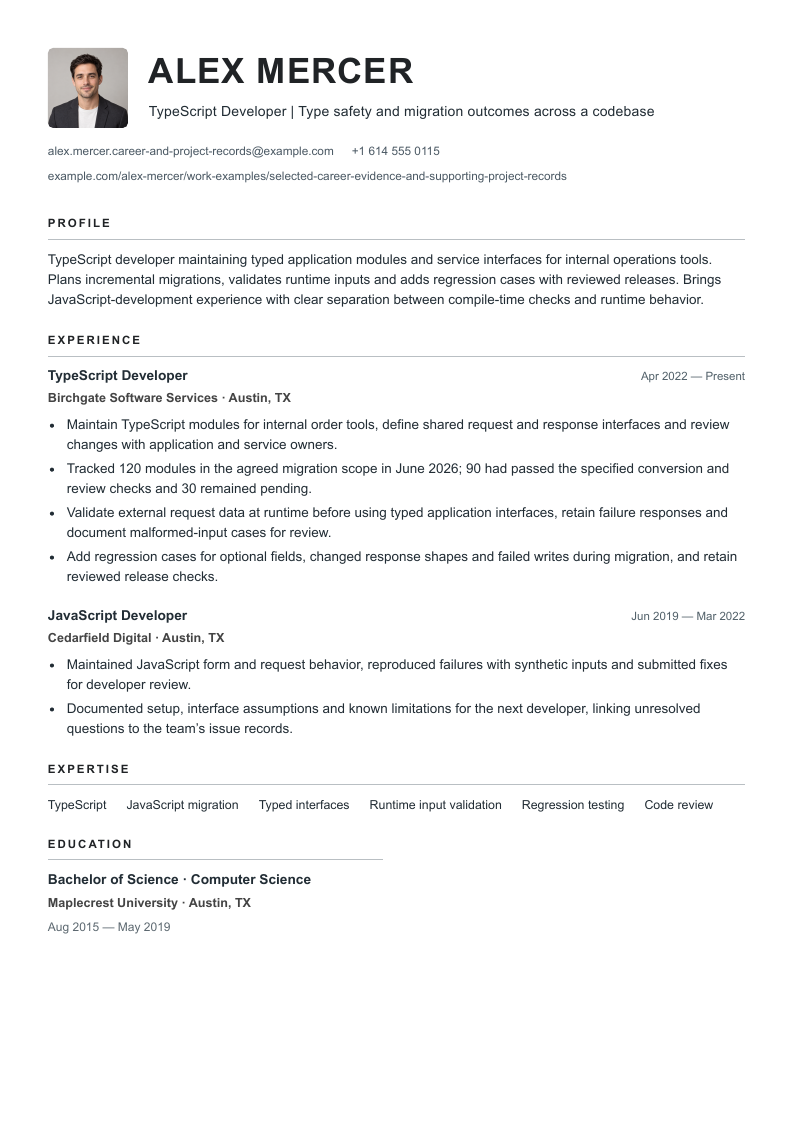 Open page 1 at full size
 Open page 2 at full size
TypeScript Developer | Type safety and migration outcomes across a codebase
alex.mercer.career-and-project-records@example.com · +1 614 555 0115
TypeScript developer maintaining typed application modules and service interfaces for internal operations tools. Plans incremental migrations, validates runtime inputs and adds regression cases with reviewed releases. Brings JavaScript-development experience with clear separation between compile-time checks and runtime behavior.
TypeScript · JavaScript migration · Typed interfaces · Runtime input validation · Regression testing · Code review
Birchgate Software Services · Austin, TX
April 2022–Present
Cedarfield Digital · Austin, TX
June 2019–March 2022
Bachelor of Science in Computer Science · Maplecrest University · Austin, TX
August 2015–May 2019
TypeScript Developer · Birchgate Software Services
June 2026–July 2026
Module inventory · TypeScript checks · Regression cases
Reviewed the 120-module migration scope with 90 through agreed checks and 30 pending. Kept compile-time results separate from runtime validation and did not treat conversion completion as proof of defect elimination.
https://example.com/alex-mercer/incremental-conversion-review
The expanded Essential scenario keeps the photo off. It preserves every base field and adds one earlier job and two projects. Project titles and employers reflect the job actually held during their dates, and method lists describe the work in that project. Read the full record, including the final project and its limits.
Condense repeated responsibilities before removing information a reader needs to understand a claim. Review headings, dates and continuation pages after your own changes; the design name alone cannot establish how an expanded career will read.
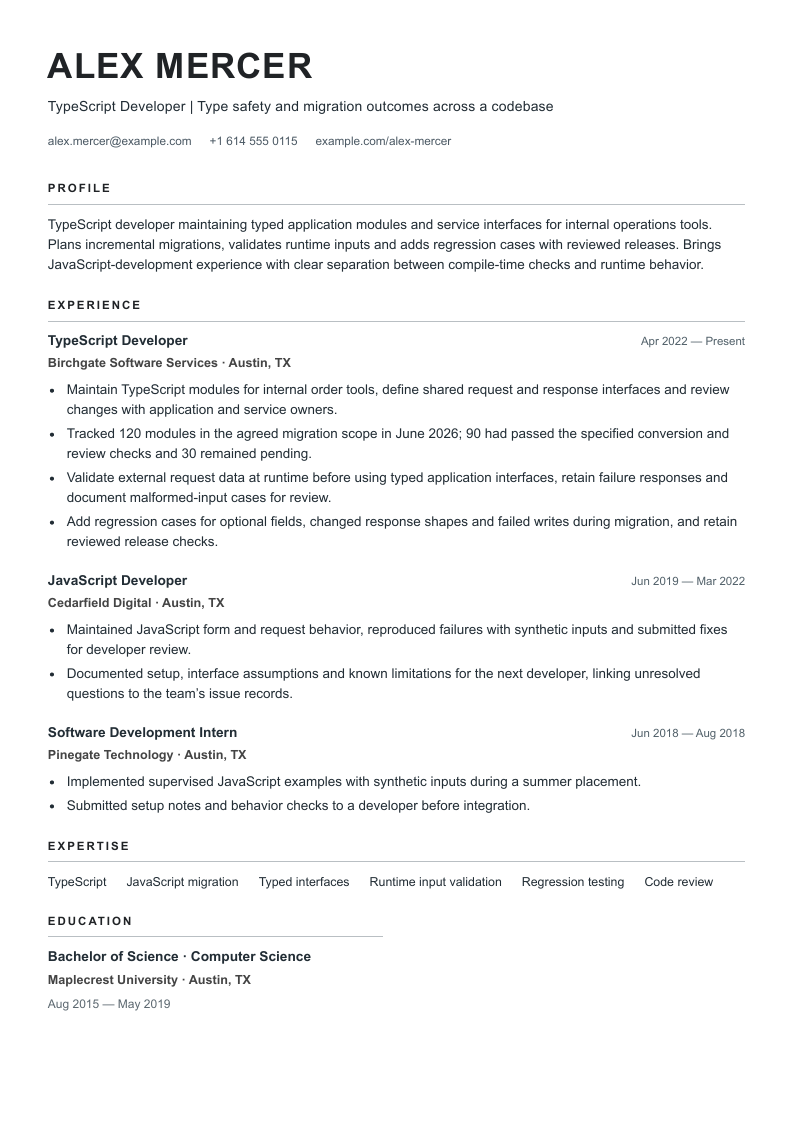 Open page 1 at full size
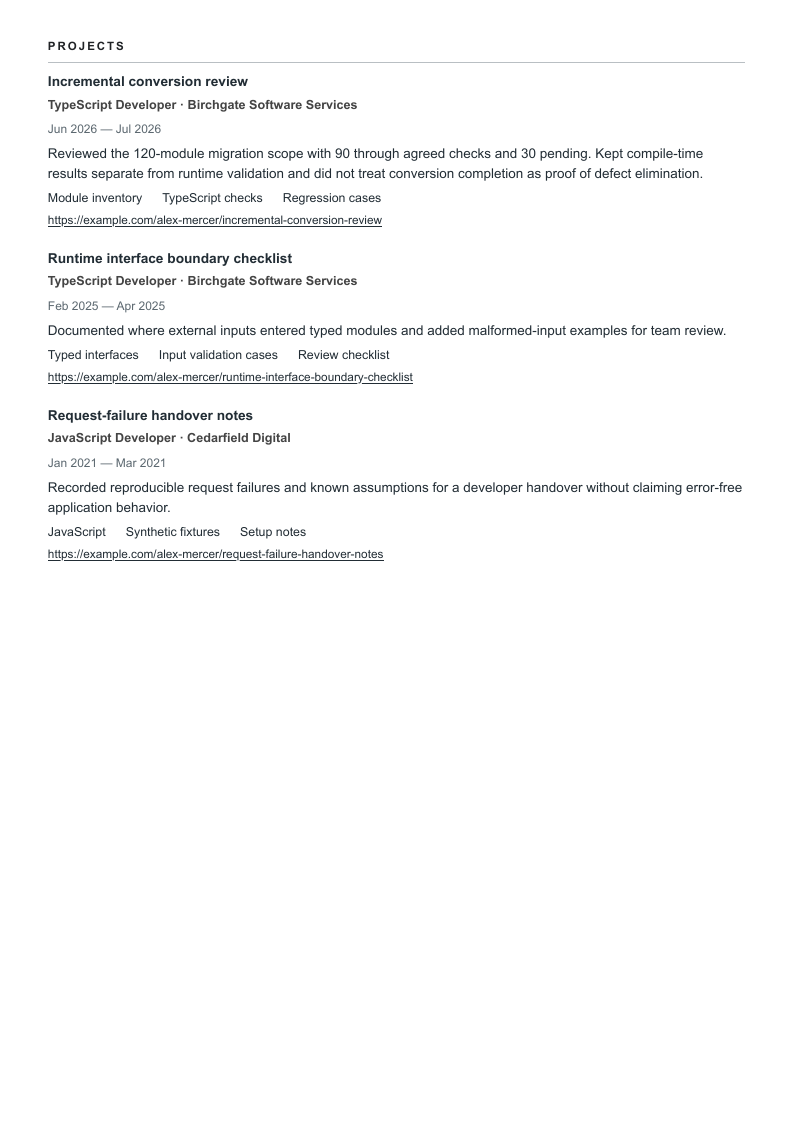 Open page 2 at full size
TypeScript Developer | Type safety and migration outcomes across a codebase
alex.mercer@example.com · +1 614 555 0115
Portfolio: https://example.com/alex-mercer
TypeScript developer maintaining typed application modules and service interfaces for internal operations tools. Plans incremental migrations, validates runtime inputs and adds regression cases with reviewed releases. Brings JavaScript-development experience with clear separation between compile-time checks and runtime behavior.
TypeScript · JavaScript migration · Typed interfaces · Runtime input validation · Regression testing · Code review
Birchgate Software Services · Austin, TX
April 2022–Present
Cedarfield Digital · Austin, TX
June 2019–March 2022
Pinegate Technology · Austin, TX
June 2018–August 2018
Bachelor of Science in Computer Science · Maplecrest University · Austin, TX
August 2015–May 2019
TypeScript Developer · Birchgate Software Services
June 2026–July 2026
Module inventory · TypeScript checks · Regression cases
Reviewed the 120-module migration scope with 90 through agreed checks and 30 pending. Kept compile-time results separate from runtime validation and did not treat conversion completion as proof of defect elimination.
https://example.com/alex-mercer/incremental-conversion-review
TypeScript Developer · Birchgate Software Services
February 2025–April 2025
Typed interfaces · Input validation cases · Review checklist
Documented where external inputs entered typed modules and added malformed-input examples for team review.
https://example.com/alex-mercer/runtime-interface-boundary-checklist
JavaScript Developer · Cedarfield Digital
January 2021–March 2021
JavaScript · Synthetic fixtures · Setup notes
Recorded reproducible request failures and known assumptions for a developer handover without claiming error-free application behavior.
https://example.com/alex-mercer/request-failure-handover-notes
Review your resume with the analyzer and check every suggestion against your records. No template guarantees parsing, ranking, an interview or a hiring outcome. A free account is required for the builder; free-plan PDF downloads include a watermark. The examples show paid-plan output.
Static types do not establish that runtime inputs match an interface. Describe actual validation and failure behavior.
No. State scope and criteria and use separate evidence for runtime defects.
List relevant tools you actually used and connect them to implementation responsibilities you can explain.
Signup retains the exact design, the supported photo setting and TypeScript Developer role. Compact stays photo-free. The fictional career and portrait are not inserted into your account. A free account is required and free-plan PDF downloads include a watermark.
Prepared by Resumize with AI-assisted research and drafting for English-language US resume context. Employer descriptions from other markets are identified in the discussion and notes. Full employer bodies were checked October 30, 2026; availability, location eligibility and engagement conditions vary and can change. The original fictional records are teaching material, not verified applicants or evidence that this candidate meets every opening. No application was submitted or hiring outcome tested.
Official occupational and credential guidance was reviewed through direct, web-access or indexed text as stated in each note. Retrieval failures remain disclosed. The source notes distinguish these limits from full direct employer retrieval.
Read October 30, 2026. Maania Consultancy Services, Philadelphia, US; brief complete TypeScript-developer description on the staffing employer’s board. An anonymous client description is not treated as direct evidence about every employer. Complete role body retrieved. Application controls were present; availability may change.
Read October 30, 2026. Talan, Edinburgh, UK; Full Stack Developer Python-React, used as an adjacent full-stack comparison rather than an identical TypeScript-only role. Complete role body retrieved. Application controls were present; availability may change.
Read October 30, 2026. Ten Mile Square Technologies, Arlington, US; senior full-stack TypeScript with DevOps. Seniority and extra technologies are not automatically assigned to the sample. Complete role body retrieved. Application controls were present; availability may change.
Official page body reviewed October 30, 2026. Used for the stated static/runtime distinction.