Supply Chain Manager resume examples and templates
A supply chain manager resume becomes useful when it explains the planning decisions behind the numbers: which items and sites you owned, the constraints you weighed, the team you led and how service and cost were measured. Use this complete industrial assembly example to make those tradeoffs readable.
These previews use the same layouts as the builder, with identical example content. Open a full preview to inspect the text and spacing.
Fictional candidate, employers, education and results. The optional portrait is AI-generated. Use your own evidence and photo; the example is not inserted into your resume.
Ledger
A centered serif identity, gold contact rule and single-column sections keep planning scope, dates and financial assumptions together.
Before sending: The centered header uses room and long modeled-savings bullets need careful wrapping. A polished number still needs its cost basis and status.
Restrained headings and an uppercase left identity put the same management progression on a straightforward chronological path.
Before sending: The spare styling relies on the content to distinguish inventory decisions from routine expediting. Check the full project description after export.
A dark left identity rail holds contact details, skills and education beside a white column for summary, experience and projects.
Before sending: Supporting details use the narrow rail. Inspect long contacts, date ranges and continuation pages; the main-column width makes dense metric definitions wrap.
“Use” opens signup with that design and photo preference selected for the builder. A free account is required. Free-plan PDF downloads include a watermark; see current plans for paid options. Photo conventions vary; follow the employer’s instructions and local expectations.
Ledger, Essential and Harbor use the identical fictional record. Compare every exported page with both photo states. The default is no photo; follow the employer’s instructions and local application context. The AI-generated portrait is a fictional teaching asset, and the candidate content is not added to your account.
Inspect the layouts in Ledger, Essential, Harbor. Use section placement and readability with your actual record to choose; no design guarantees ATS compatibility, interviews or a hiring outcome.
A complete supply chain manager resume example
Adrian Mercer is a fictional manager for one industrial assembly plant, following a materials-planning role. All sample people, candidate employers, qualifications and results are invented. The example.com links are placeholders. The optional portrait is AI-generated, and the sample record and portrait are not inserted into your account.
Supply chain manager for one industrial assembly plant, leading four planners and two buyers. Connects a 13-week supply plan with supplier commitments, inventory policy and operations decisions. Reports inventory at a consistent cost basis and keeps material readiness, supplier delivery and modeled savings as separate measures.
Led four planners and two buyers across one assembly plant; average month-end raw-material inventory at constant standard cost fell from $5.0 million in January–March 2025 to $4.3 million in October–December, while material-availability checks met the scheduled-start date for 91% and 93% of eligible work orders respectively.
Chaired a weekly 13-week supply review for 340 active purchased components; compared demand changes, supplier commitments and capacity limits, then assigned shortage actions while operations approved production-sequence changes.
Reviewed 400 purchase-order lines due from 12 assigned suppliers in April–June 2026; 352 arrived by the original confirmed date, an 88% line-level on-time rate, and agreed recovery actions for late lines with purchasing and supplier contacts.
Compared two packaging-supply offers on a fixed annual basket; finance approved $72,000 of modeled price reduction less $18,000 of added freight, for $54,000 net annualized opportunity before implementation, with quality retaining supplier approval.
Materials Planner
Redfern Industrial Components · Akron, OH
June 2020–December 2023
Reconciled lead times and order multiples for 180 purchased components against supplier confirmations in July–August 2022; submitted 34 proposed ERP parameter changes for planner approval and recorded the effective dates.
Prepared a December 2023 review of 65 no-demand component lines valued at $250,000 at standard cost; separated proposed reuse, supplier-return enquiries and write-off candidates for engineering, purchasing and finance decisions.
Education
Bachelor of Science in Operations and Supply Chain Management · Great Lakes Vale University
September 2016–May 2020
Projects
Packaging supplier comparison
Supply chain manager · Ashcombe Assembly Products
February 2026–April 2026
Excel scenario model · Supplier quotations · Finance review
Compared supplier offers against a fixed annual quantity basket and separated unit-price opportunity from added freight. Finance reviewed a $72,000 price reduction and $18,000 freight offset, yielding $54,000 modeled net annualized opportunity before implementation. Quality retained qualification approval; the model did not establish realized savings, service equivalence or final supplier approval.
Identify product or material scope, sites, planning horizon and your place in the decision chain. Adrian covers 340 active purchased components at one plant, leads four planners and two buyers, and chairs a weekly 13-week supply review. Operations retains production-sequence approval; quality retains supplier qualification. This is meaningful management scope without claiming ownership of every factory, shipment or commercial forecast.
Connect a demand change to a supply decision. What did the team know about supplier dates, order multiples, capacity or lead time? Which options did you compare: expedite, defer, substitute after approval, alter a release or hold additional stock? Then say who made the final decision and what happened. “Managed end-to-end supply chain” gives less usable information than a bounded decision with constraints.
Planning, procurement, warehouse operations and logistics overlap, but they are not interchangeable. A freight coordination bullet should explain the transport work you owned; a planning bullet should expose horizon and supply constraints. Do not rename a warehouse-supervisor history as supply chain management or add a procurement saving to a logistics saving when they describe the same benefit.
Every after version appears in the complete resume above. Apply the reasoning to facts you can verify; do not borrow the fictional counts, results or responsibilities.
Inventory change with a service countermeasure
Before: Slashed inventory 20% without affecting customers.
After: Led four planners and two buyers across one assembly plant; average month-end raw-material inventory at constant standard cost fell from $5.0 million in January–March 2025 to $4.3 million in October–December, while material-availability checks met the scheduled-start date for 91% and 93% of eligible work orders respectively.
Why it works: The inventory reduction is 14%, using comparable three-month averages and a fixed cost basis. The service measure is material readiness at scheduled start, not customer OTIF. The two trends do not prove sole causation.
Evidence to check: Finance-approved fixed-cost inventory series, both work-order denominators and the readiness definition.
Planning decisions that acknowledge a constraint
Before: Optimized the end-to-end supply chain and solved all shortages.
After: Chaired a weekly 13-week supply review for 340 active purchased components; compared demand changes, supplier commitments and capacity limits, then assigned shortage actions while operations approved production-sequence changes.
Why it works: Gives horizon, scope, inputs and decision rights. A weekly meeting is useful when it produces decisions; do not relabel one plant as the entire global supply chain.
Evidence to check: Item scope, dated constrained-supply plan, action owners and operations approvals.
Supplier delivery with consistent endpoints
Before: Improved supplier performance to 98% on time.
After: Reviewed 400 purchase-order lines due from 12 assigned suppliers in April–June 2026; 352 arrived by the original confirmed date, an 88% line-level on-time rate, and agreed recovery actions for late lines with purchasing and supplier contacts.
Why it works: Names the denominator, cohort and original-date rule. It does not claim improvement without a comparable baseline. A line-level receipt metric is not order-level OTIF, quality acceptance or complete delivery.
Evidence to check: Original supplier confirmations, receipts, partial-line rule, exclusions and quarter cut-off.
Negotiation savings that survive cost review
Before: Saved $300K through strategic negotiations.
After: Compared two packaging-supply offers on a fixed annual basket; finance approved $72,000 of modeled price reduction less $18,000 of added freight, for $54,000 net annualized opportunity before implementation, with quality retaining supplier approval.
Why it works: An approved model is prospective, not realized P&L savings. States the freight offset, fixed basket and approval boundary; actual volumes and implementation costs could change the result.
Evidence to check: Versioned offers, fixed quantities, freight assumptions, finance review and quality approval status.
Parameter maintenance with bounded ownership
Before: Built an AI forecast that eliminated shortages.
After: Reconciled lead times and order multiples for 180 purchased components against supplier confirmations in July–August 2022; submitted 34 proposed ERP parameter changes for planner approval and recorded the effective dates.
Why it works: Shows master-data work and approver without inventing AI or an unmeasured shortage outcome. Proposed changes are not automatically approved changes.
Evidence to check: Source confirmations, 180-item scope, proposed-change log and approved effective dates.
Excess review without treating stock as cash
Before: Recovered $250K in obsolete inventory savings.
After: Prepared a December 2023 review of 65 no-demand component lines valued at $250,000 at standard cost; separated proposed reuse, supplier-return enquiries and write-off candidates for engineering, purchasing and finance decisions.
Why it works: The $250,000 is reviewed stock value, not recovered cash or realized savings. A no-demand line is not automatically obsolete, and the analyst does not approve disposition alone.
Evidence to check: Aging cut-off, demand horizon, valuation basis, disposition status and decision owners.
Make management scope visible in the summary and history
Adrian’s summary states one assembly plant and six direct reports before describing planning and supplier work. The experience then explains how the weekly review produces actions. Use your real reporting arrangement: direct reports, a matrix team, contractors and supplier contacts are different relationships. A manager title alone does not establish people-management responsibility.
For each role, select a few decisions with a clear ownership boundary. A shortage review might include operations, sales and purchasing; say which analysis you prepared, which action you approved and which decision belonged elsewhere. If you inherited a policy or implemented a recommendation led by another team, name your implementation role rather than claiming the whole transformation.
System names should follow actual use. This sample says ERP because it does not establish SAP, Oracle or another named product. If you used a named planning module, describe the inputs or controls you maintained and the decision it supported. A list of systems without supporting work does not show that you can run MRP, design inventory policy or lead a planning team.
Keep inventory, service and savings measures separate
The sample compares $5.0 million with $4.3 million of average month-end raw-material inventory, a $0.7 million or 14% reduction. Both are three-month averages at constant standard cost, so a price revaluation is not silently reported as less stock. This is a balance measure; it is not annual purchasing spend, cash released or a realized cost saving.
The companion 91% and 93% figures are material-readiness checks against scheduled production starts. They are not customer on-time-in-full delivery. An honest comparison needs each period’s eligible work-order count, exclusions and the same readiness rule. Inventory mix, demand, supplier conditions and operations decisions can influence both series; the sample does not claim that the manager alone caused the change.
The supplier baseline counts 352 of 400 due purchase-order lines by the original confirmed date, or 88%. Preserve that original date when a supplier later promises recovery. State how partial receipts and cancelled lines are handled. Order-level OTIF, receipt-line on-time performance, quality acceptance and requested-date delivery answer different questions; do not substitute one label for another.
The sourcing model subtracts $18,000 of additional freight from $72,000 of price opportunity, leaving $54,000 net annualized opportunity on a fixed basket. Before calling it realized savings, reconcile actual quantities, implementation and qualification costs, timing and the finance-approved baseline. A quote comparison is still useful resume evidence when labeled as a recommendation rather than booked benefit.
Connect skills to work a reader can inspect
Choose skills relevant to the vacancy that your experience or clearly labeled training supports. Use this table to gather evidence before writing a keyword list.
Role skills, evidence to gather and the fictional sample
Skill
Evidence to gather
Where it appears in the sample
Constrained supply planning
A horizon, item/site scope, supply inputs and resulting decision.
The weekly 13-week review assigns shortages while operations approves sequence changes.
Inventory policy
Comparable balances plus a service countermeasure.
Constant-cost averages are reviewed alongside production material readiness.
Supplier performance
Original commitment, eligible cohort and counting rule.
352 of 400 due lines gives an 88% baseline for one quarter.
Commercial judgment
Comparable basket, offsets, approval and implementation status.
$54,000 is modeled annualized opportunity before implementation.
ERP parameter control
Source confirmation, change ownership and effective date.
34 proposed parameter changes are submitted for approval, not assumed implemented.
People leadership
Actual reporting relationships and team decisions.
Four planners and two buyers have defined action ownership in the review.
List education and credentials without treating them as authority
Give the completed degree, field, institution and dates. Adrian’s fictional bachelor’s degree accompanies progression from planning to management. The record supplies no professional certification. Do not add CPIM, CSCP, a Lean belt or a project-management credential because a vacancy mentions it; list only what you hold with its real issuer and status.
Education and experience expectations vary with the job. Grainger’s cited analytics manager requires a related bachelor’s degree and emphasizes analytical work; Verizon’s cited role allows a bachelor’s degree or specified work experience and identifies additional preferred qualifications. Read the actual required and preferred criteria before deciding which evidence deserves prominence.
Training in inventory planning or a software module can support your application, but course attendance does not establish supplier-contract authority or financial savings. If you are changing sectors, explain the relevant decision process and acknowledge unfamiliar product, regulatory or planning requirements rather than implying that all supply chains have the same constraints.
Adapt a planner or analyst record for a first management role
If you have not had direct reports, do not invent a team. Show how you coordinated decisions: prepared a shortage view, reviewed assumptions with operations, assigned follow-up by agreement or maintained a parameter-change process. Distinguish leading a meeting from having hiring, appraisal or budget responsibility.
A fictional transition summary could read: “Materials planner seeking a first supply chain management role. Maintains supplier commitments and ERP planning inputs, prepares constrained-supply reviews and coordinates action owners across purchasing and operations. Brings experience checking assumptions and explaining unresolved shortages.” That is a direction statement, not a promotion of the previous title.
For a project, state the period, item or supplier scope, deliverable and approval boundary. A university inventory simulation belongs under projects with its simulated data labeled. An analyst’s reviewed inventory value is not a recovered saving, and team outcomes should retain the contribution you can substantiate.
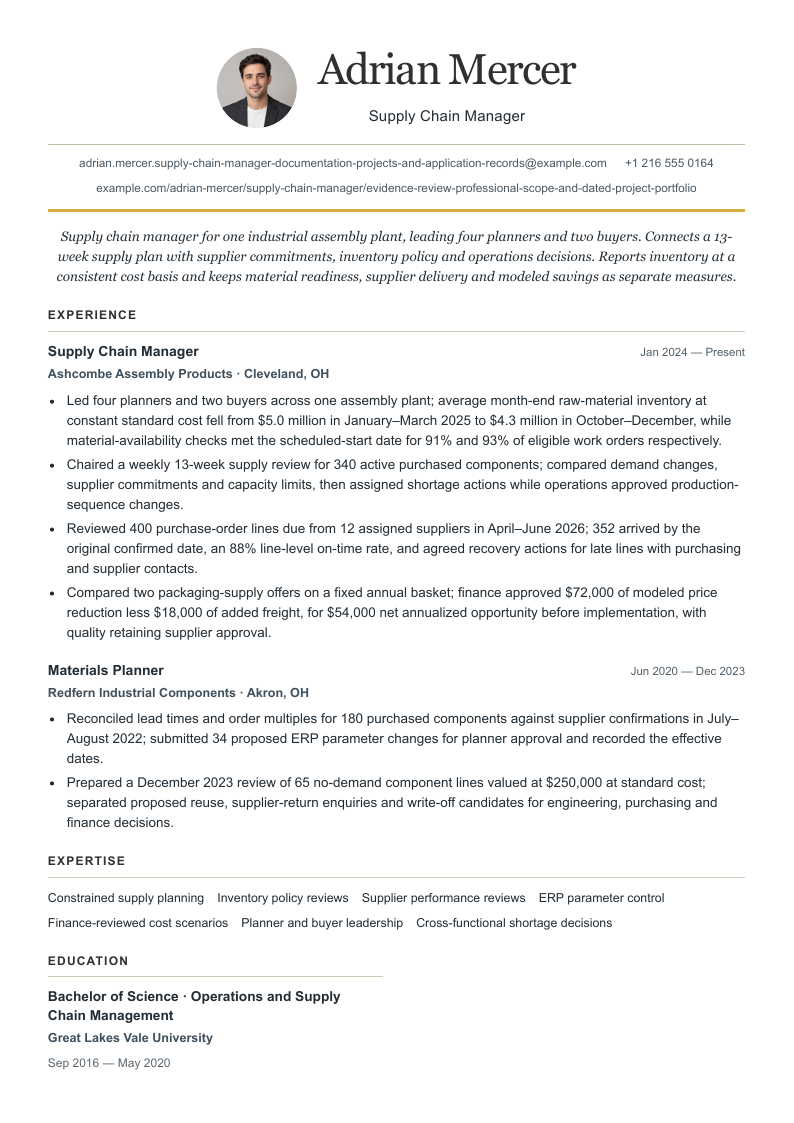
Inspect long contacts with the photo on
Only Adrian’s resume email and portfolio contact URL change here. Ledger is shown with its optional photo on. Compare the full text below against the final characters in the export and test the linked destination. A long URL can wrap even when the label looks tidy; inspect the actual PDF rather than inferring readability from the template name.
Supply chain manager for one industrial assembly plant, leading four planners and two buyers. Connects a 13-week supply plan with supplier commitments, inventory policy and operations decisions. Reports inventory at a consistent cost basis and keeps material readiness, supplier delivery and modeled savings as separate measures.
Led four planners and two buyers across one assembly plant; average month-end raw-material inventory at constant standard cost fell from $5.0 million in January–March 2025 to $4.3 million in October–December, while material-availability checks met the scheduled-start date for 91% and 93% of eligible work orders respectively.
Chaired a weekly 13-week supply review for 340 active purchased components; compared demand changes, supplier commitments and capacity limits, then assigned shortage actions while operations approved production-sequence changes.
Reviewed 400 purchase-order lines due from 12 assigned suppliers in April–June 2026; 352 arrived by the original confirmed date, an 88% line-level on-time rate, and agreed recovery actions for late lines with purchasing and supplier contacts.
Compared two packaging-supply offers on a fixed annual basket; finance approved $72,000 of modeled price reduction less $18,000 of added freight, for $54,000 net annualized opportunity before implementation, with quality retaining supplier approval.
Materials Planner
Redfern Industrial Components · Akron, OH
June 2020–December 2023
Reconciled lead times and order multiples for 180 purchased components against supplier confirmations in July–August 2022; submitted 34 proposed ERP parameter changes for planner approval and recorded the effective dates.
Prepared a December 2023 review of 65 no-demand component lines valued at $250,000 at standard cost; separated proposed reuse, supplier-return enquiries and write-off candidates for engineering, purchasing and finance decisions.
Education
Bachelor of Science in Operations and Supply Chain Management · Great Lakes Vale University
September 2016–May 2020
Projects
Packaging supplier comparison
Supply chain manager · Ashcombe Assembly Products
February 2026–April 2026
Excel scenario model · Supplier quotations · Finance review
Compared supplier offers against a fixed annual quantity basket and separated unit-price opportunity from added freight. Finance reviewed a $72,000 price reduction and $18,000 freight offset, yielding $54,000 modeled net annualized opportunity before implementation. Quality retained qualification approval; the model did not establish realized savings, service equivalence or final supplier approval.
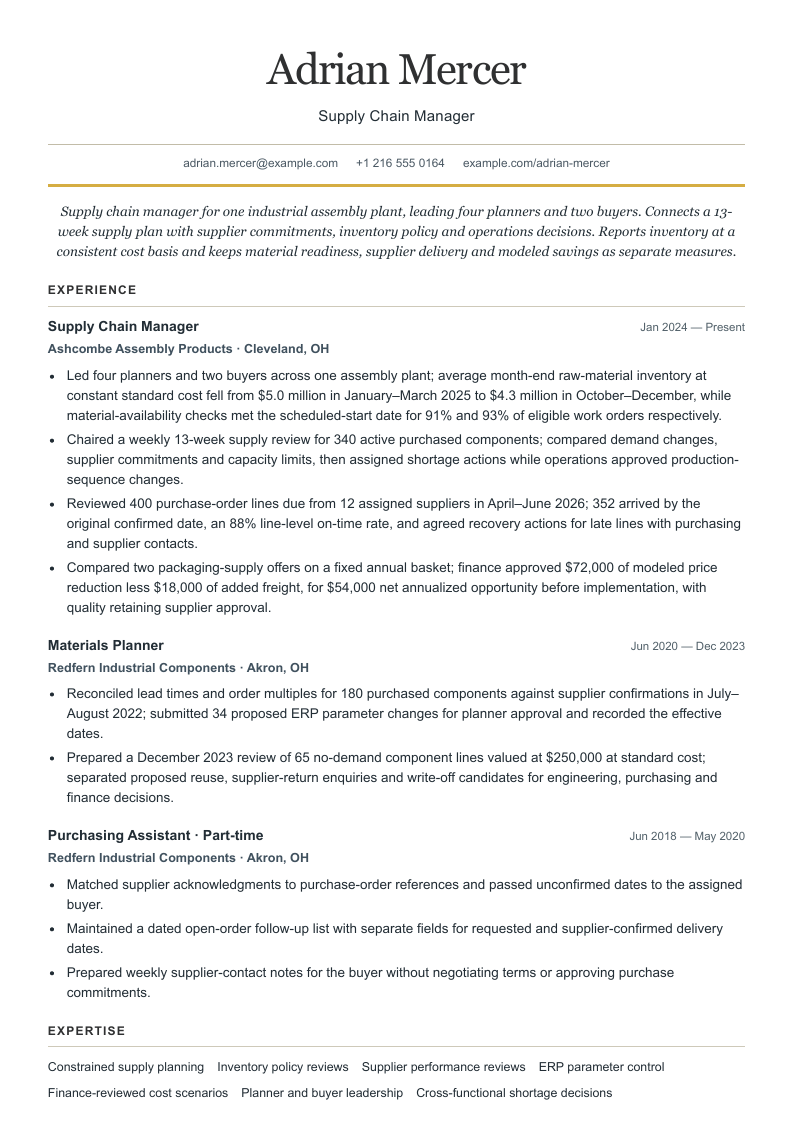
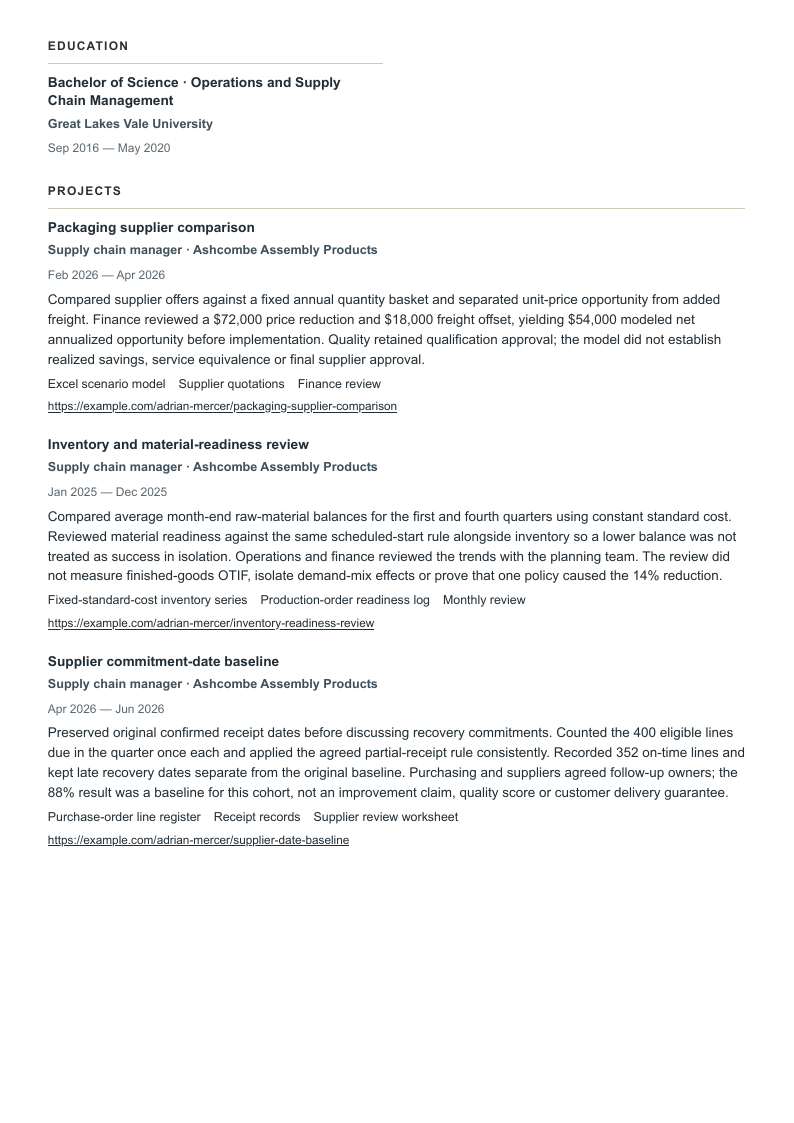
This Ledger example has the photo off. It retains the entire base record and adds Adrian’s earlier part-time purchasing role and two dated projects. Read every continuation page, including the original supplier-date rule and the final limitations in the inventory review. Additional evidence can justify length; the record is not shortened to force a page count.
Supply chain manager for one industrial assembly plant, leading four planners and two buyers. Connects a 13-week supply plan with supplier commitments, inventory policy and operations decisions. Reports inventory at a consistent cost basis and keeps material readiness, supplier delivery and modeled savings as separate measures.
Led four planners and two buyers across one assembly plant; average month-end raw-material inventory at constant standard cost fell from $5.0 million in January–March 2025 to $4.3 million in October–December, while material-availability checks met the scheduled-start date for 91% and 93% of eligible work orders respectively.
Chaired a weekly 13-week supply review for 340 active purchased components; compared demand changes, supplier commitments and capacity limits, then assigned shortage actions while operations approved production-sequence changes.
Reviewed 400 purchase-order lines due from 12 assigned suppliers in April–June 2026; 352 arrived by the original confirmed date, an 88% line-level on-time rate, and agreed recovery actions for late lines with purchasing and supplier contacts.
Compared two packaging-supply offers on a fixed annual basket; finance approved $72,000 of modeled price reduction less $18,000 of added freight, for $54,000 net annualized opportunity before implementation, with quality retaining supplier approval.
Materials Planner
Redfern Industrial Components · Akron, OH
June 2020–December 2023
Reconciled lead times and order multiples for 180 purchased components against supplier confirmations in July–August 2022; submitted 34 proposed ERP parameter changes for planner approval and recorded the effective dates.
Prepared a December 2023 review of 65 no-demand component lines valued at $250,000 at standard cost; separated proposed reuse, supplier-return enquiries and write-off candidates for engineering, purchasing and finance decisions.
Purchasing Assistant · Part-time
Redfern Industrial Components · Akron, OH
June 2018–May 2020
Matched supplier acknowledgments to purchase-order references and passed unconfirmed dates to the assigned buyer.
Maintained a dated open-order follow-up list with separate fields for requested and supplier-confirmed delivery dates.
Prepared weekly supplier-contact notes for the buyer without negotiating terms or approving purchase commitments.
Education
Bachelor of Science in Operations and Supply Chain Management · Great Lakes Vale University
September 2016–May 2020
Projects
Packaging supplier comparison
Supply chain manager · Ashcombe Assembly Products
February 2026–April 2026
Excel scenario model · Supplier quotations · Finance review
Compared supplier offers against a fixed annual quantity basket and separated unit-price opportunity from added freight. Finance reviewed a $72,000 price reduction and $18,000 freight offset, yielding $54,000 modeled net annualized opportunity before implementation. Quality retained qualification approval; the model did not establish realized savings, service equivalence or final supplier approval.
Fixed-standard-cost inventory series · Production-order readiness log · Monthly review
Compared average month-end raw-material balances for the first and fourth quarters using constant standard cost. Reviewed material readiness against the same scheduled-start rule alongside inventory so a lower balance was not treated as success in isolation. Operations and finance reviewed the trends with the planning team. The review did not measure finished-goods OTIF, isolate demand-mix effects or prove that one policy caused the 14% reduction.
Purchase-order line register · Receipt records · Supplier review worksheet
Preserved original confirmed receipt dates before discussing recovery commitments. Counted the 400 eligible lines due in the quarter once each and applied the agreed partial-receipt rule consistently. Recorded 352 on-time lines and kept late recovery dates separate from the original baseline. Purchasing and suppliers agreed follow-up owners; the 88% result was a baseline for this cohort, not an improvement claim, quality score or customer delivery guarantee.
Read every exported page. Check contacts, dates, amounts, education and the final lines of each project. Compare both photo states and read continuation pages at normal size.
Select and copy the text. Inspect reading order and confirm that periods, denominators and responsibility limits stay with the claims they explain. Test the full social and project destinations.
Follow the application instructions. Use the requested file type and review parsed titles, contacts and dates after upload. No layout can guarantee how every application system handles a file.
Reconcile the wording. Replace all fictional details with your own verifiable, shareable experience. Check scope, current credentials, metric definitions and which approvals belonged to others.
Review your resume with the analyzer and verify suggestions against your records. The Use buttons open signup with your selected role, design and photo preference for the real resume builder; the fictional record and portrait are not inserted. A free account is required. Free-plan PDF downloads include a watermark; these examples show paid-plan output.
Questions, answered
How is this different from a logistics manager resume?
A logistics record can focus on transport, warehousing or 3PL execution. This sample centers on supply planning, purchased-component inventory and supplier decisions at an assembly plant. The titles overlap across employers; use your real title and describe the scope rather than assuming every supply chain manager owns every function.
Should a supply chain manager always show direct reports?
State the actual arrangement. The fictional example leads six people, but Verizon’s cited manager role explicitly operates as an individual contributor. Matrix coordination, supplier oversight and direct people management should be described accurately.
Can inventory reduction be called savings?
Inventory balance, cash flow and expense savings are different measures. State the stock type, valuation basis, period and service effect. Confirm realized financial benefit with finance before calling a balance reduction a saving, and avoid counting the same benefit under multiple initiatives.
What should I include for supplier on-time delivery?
State the eligible cohort, measurement period, original date basis and unit of counting. Explain partial receipts or exclusions when material. Do not replace original commitments with recovery dates or label a receipt-line on-time measure customer OTIF.
Should I name every ERP in the job advertisement?
Use only systems you actually used and describe the relevant planning, master-data or reporting work. Training and workplace ownership are different. The generic ERP wording in this sample does not imply experience in a named system.
Will the builder keep the selected template and photo preference?
The Use buttons open signup with the exact selected design and current photo preference for this role. They do not insert the fictional sample or portrait. Build with your own information, then inspect the actual export. A free account is required, and free-plan PDF downloads include a watermark.
Compare the without-photo collection for another presentation choice, and use the design pages above to inspect section placement with the same record.
Sources and editorial scope
Prepared by Resumize with AI-assisted research and drafting for English-language US applications. Three primary employer descriptions and the authoritative occupational source below were checked on October 27, 2026. Each employer page displayed an application control; no application was submitted, and availability can change. These selected vacancies illustrate scope differences, not market-wide requirements or endorsements. The candidate records, annotated rewrites and metric analysis are original editorial fiction. No search-volume, ranking, ATS or hiring-result guarantee is made.
Checked October 27, 2026: primary page displayed Apply now, requisition 333700 and October 9, 2026 (the search snippet showed an earlier date). Describes inventory-positioning models, analytical processes and partnership with operations and finance. It is a specialized analytics role, not a universal supply chain manager specification. Application completion was not tested.
Checked October 27, 2026: employer page displayed Apply now, requisition 138696 and October 24, 2026. Joint design/manufacturing example connects sourcing, supplier and component selection, qualification and materials cost work. Those electronics and customer-design requirements are specific to this vacancy. Application completion was not tested.
Checked October 27, 2026: primary page displayed Apply Now, job R-1101556 and an October 30, 2026 application end date; no publication date is asserted. Explicitly describes an individual contributor overseeing 3PL performance, contracts and reverse logistics. Demonstrates that manager in the title does not always mean direct reports. Application completion was not tested.
Checked October 27, 2026. Occupational task overview covers planning, purchasing, inventory, supplier performance and coordination across functions. Used as scope context, not a requirement that one person owns every listed function; no salary statistic is taken from its broader occupational grouping.