Scholar
An academic hierarchy separates methods, research experience and education.
Before sending: Read dense method names and education details at normal size.
Secondary science learning · US resume context
A Science Teacher resume should show the subjects, grades and inquiry work you taught. Explain how assessment and student reasoning informed the next lesson. Keep practical-learning preparation within the school’s approved process and use learning measures with clear limits.
By Resumize · · AI-assisted research and drafting
Three designs · one example
These previews use the same layouts as the builder, with identical example content. Open a full preview to inspect the text and spacing.
Fictional candidate, employers, education and results. The optional portrait is AI-generated. Use your own evidence and photo; the example is not inserted into your resume.
An academic hierarchy separates methods, research experience and education.
Before sending: Read dense method names and education details at normal size.
A traditional centered header and simple rules emphasize the written record.
Before sending: Long contacts and the optional portrait can change header spacing.
Formal labels and restrained blue accents suit document-led careers.
Before sending: Check long terms and dates in the exported reading order.
“Use” opens signup with that design and photo preference selected for the builder. A free account is required. Free-plan PDF downloads include a watermark; see current plans for paid options. Photo conventions vary; follow the employer’s instructions and local expectations.
The three designs use the same fictional career. The default has no photo. Follow the employer’s instructions and local conventions; the optional portrait is AI-generated. Signup retains the exact design, supported photo preference and Science Teacher role. It does not insert the example career or portrait into your account. A free account is required, and free-plan PDF downloads include a watermark. These previews show paid-plan output.
Alex Linden, the employers, qualifications, dates, projects and results are original editorial fiction. The example.com addresses and links and the 555 phone number are illustrative placeholders. Replace every field with your own facts. The optional portrait is AI-generated, and all qualifications and any license or registration dates are fictional and contain no valid identifiers. The base record has two jobs, six experience bullets, one education record and one project.
Science Teacher | Scientific inquiry and laboratory learning
alex.linden@example.com · +1 614 555 0117
Portfolio: https://example.com/alex-linden
Science teacher planning secondary biology and physical-science lessons with supervised laboratory learning. Uses inquiry questions, assessment responses and student explanations to identify misconceptions and plan follow-up. Brings earlier classroom teaching and supervised placement experience with careful handling of learning evidence.
Science lesson planning · Scientific inquiry · Laboratory learning preparation · Formative assessment · Misconception analysis · Student feedback
Cedarbank High School · Columbus, OH
August 2022–Present
Birchfield Secondary School · Newark, OH
August 2019–July 2022
Bachelor of Science in Education in Integrated Science Education · Maplecrest University · Columbus, OH
August 2015–May 2019
State Board of Education of Ohio
Issued July 2023
Expires June 2028
Professional license for the stated field and grade band; no educator identifier displayed.
Science Teacher · Cedarbank High School
May 2026–June 2026
Common assessment · Student-response themes · Lesson sequence
Reviewed 80 completed checks with 60 meeting the criterion and 20 needing follow-up. Used nonidentifying response themes for lesson planning without treating one assessment as overall attainment or teacher causality.
https://example.com/alex-linden/science-reasoning-misconception-review
Alex’s fictional timetable covers biology and physical science for grades 9–10. Inquiry questions, demonstrations and supervised practical work are tied to the school curriculum. The record describes classroom contribution and collaboration without claiming national curriculum or every laboratory specialization.
The reviewed employer descriptions below span secondary teaching in Pakistan and US school networks. Their degree, subject and school-setting requirements differ from the Ohio example. Do not turn a foreign degree preference or one school’s criteria into a universal teaching-license rule.
A useful example names a scientific misconception, the evidence and the change in teaching. Keep student information private and avoid publishing identifying work. A classroom demonstration or checklist does not justify claiming practical activities are free of risk.
Read the employer descriptions directly: Al Huda International School Female Science Teacher (Secondary Section); KIPP SY 26/27 High School Science Teacher; Uncommon Schools Middle School Science Teacher. This selected dated sample illustrates differences in scope and requirements, rather than a representative labor-market survey.
Each after sentence appears in the base career record. The weak before statements are teaching examples. Use the evidence prompts to check the population, decisions and limitations behind your own wording.
Before: Taught all sciences at every level.
After: Plan biology and physical-science lessons for grades 9–10, linking inquiry questions, demonstrations and supervised laboratory learning to the school’s curriculum.
Why it works: Subjects, grades and activities define classroom scope without claiming every specialization.
Evidence to check: Teaching allocation, curriculum and lesson examples.
Before: Made every student a scientist.
After: Reviewed a common science-reasoning check completed by 80 students in May 2026; 60 met the defined criterion and 20 needed follow-up on interpreting experimental evidence.
Why it works: The 75% share concerns this check and completion group, not every aspect of scientific attainment.
Evidence to check: Criterion, completion population and follow-up analysis.
Before: Used data to guarantee improvement.
After: Group recurring misconceptions from student explanations and revise the next lesson sequence with alternative examples and short checks before assigning further practice.
Why it works: A responsive teaching decision is visible without an invented attainment gain.
Evidence to check: Response themes, revised sequence and follow-up checks.
Before: Ran risk-free experiments.
After: Prepare supervised practical activities through the school’s approved risk-assessment and equipment-check process, coordinating support and escalation with responsible colleagues.
Why it works: Preparation follows the local process rather than guaranteeing no laboratory risk or supplying operating instructions.
Evidence to check: Approved activity plan, checks and colleague responsibilities.
Before: Directed all science curriculum nationally.
After: Taught assigned secondary science classes and prepared shared assessment items with department colleagues through the school’s review process.
Why it works: Classroom and collaborative work remain distinct from broad curriculum authority.
Evidence to check: Class allocation, assessment items and review.
Before: Gave perfect individual instruction.
After: Provided feedback on scientific reasoning and discussed learning priorities with students and families through approved school channels.
Why it works: Feedback practice does not establish universal personalization or satisfaction.
Evidence to check: Feedback examples and nonidentifying communication process.
The common check has 80 completed responses: 60 meet the criterion and 20 need follow-up, a 75% share. It is not the whole enrolled population, an external examination result or proof that one teacher caused overall attainment.
The follow-up decision groups misconceptions and revises examples before checking again. That process can show professional judgment without an invented attainment increase. Keep assessment purpose, criterion and missing responses visible.
Use relevant capabilities that your experience or projects demonstrate. The table connects the sample’s claims to records a candidate should check. A skill keyword is not a substitute for an example, and a private employer record should stay private unless sharing is permitted.
| Capability in context | Evidence to check | Sample work |
|---|---|---|
| Define subjects and grades | Teaching allocation, curriculum and lesson examples. | Plan biology and physical-science lessons for grades 9–10, linking inquiry questions, demonstrations and supervised laboratory learning to the school’s curriculum. |
| Keep the learning population | Criterion, completion population and follow-up analysis. | Reviewed a common science-reasoning check completed by 80 students in May 2026; 60 met the defined criterion and 20 needed follow-up on interpreting experimental evidence. |
| Show the teaching response | Response themes, revised sequence and follow-up checks. | Group recurring misconceptions from student explanations and revise the next lesson sequence with alternative examples and short checks before assigning further practice. |
| Describe laboratory preparation | Approved activity plan, checks and colleague responsibilities. | Prepare supervised practical activities through the school’s approved risk-assessment and equipment-check process, coordinating support and escalation with responsible colleagues. |
| Preserve prior classroom scope | Class allocation, assessment items and review. | Taught assigned secondary science classes and prepared shared assessment items with department colleagues through the school’s review process. |
| Make feedback specific | Feedback examples and nonidentifying communication process. | Provided feedback on scientific reasoning and discussed learning priorities with students and families through approved school channels. |
Alex’s degree and Ohio Integrated Science (7–12) professional license are fictional, with no valid educator identifier. The illustrative five-year term is July 2023 through June 2028. The Ohio professional-license and subject-field guidance was reviewed previously and is reused with its dated evidence.
A degree alone does not establish current authorization. Use your actual jurisdiction, subject, grade band and status and read the employer’s requirements. School and country contexts can differ substantially.
A new science teacher can use supervised placement, tutoring or a clearly labeled curriculum project. State the subject, age group and mentor’s role rather than imply independent classroom responsibility.
The expanded record keeps Alex’s student placement separate from employed teaching and two correctly dated projects. A synthetic practical-learning plan should retain the school or course review boundary and avoid operating instructions outside your authority.
Only Alex Linden’s resume email and one portfolio contact URL change in this scenario. Identity, phone, employment, qualifications and projects stay identical. Scholar uses the optional photo-on view here. Read every final character of the email and URL, and check the link destination against the complete record below.
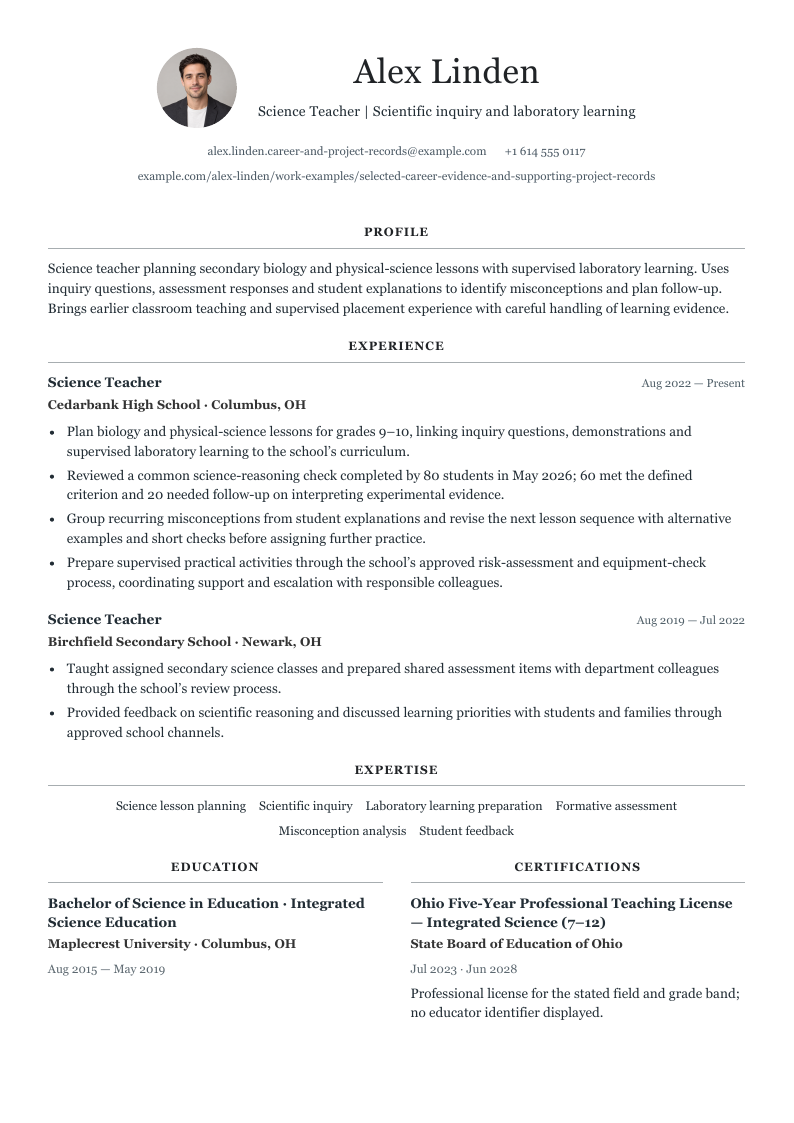 Open page 1 at full size
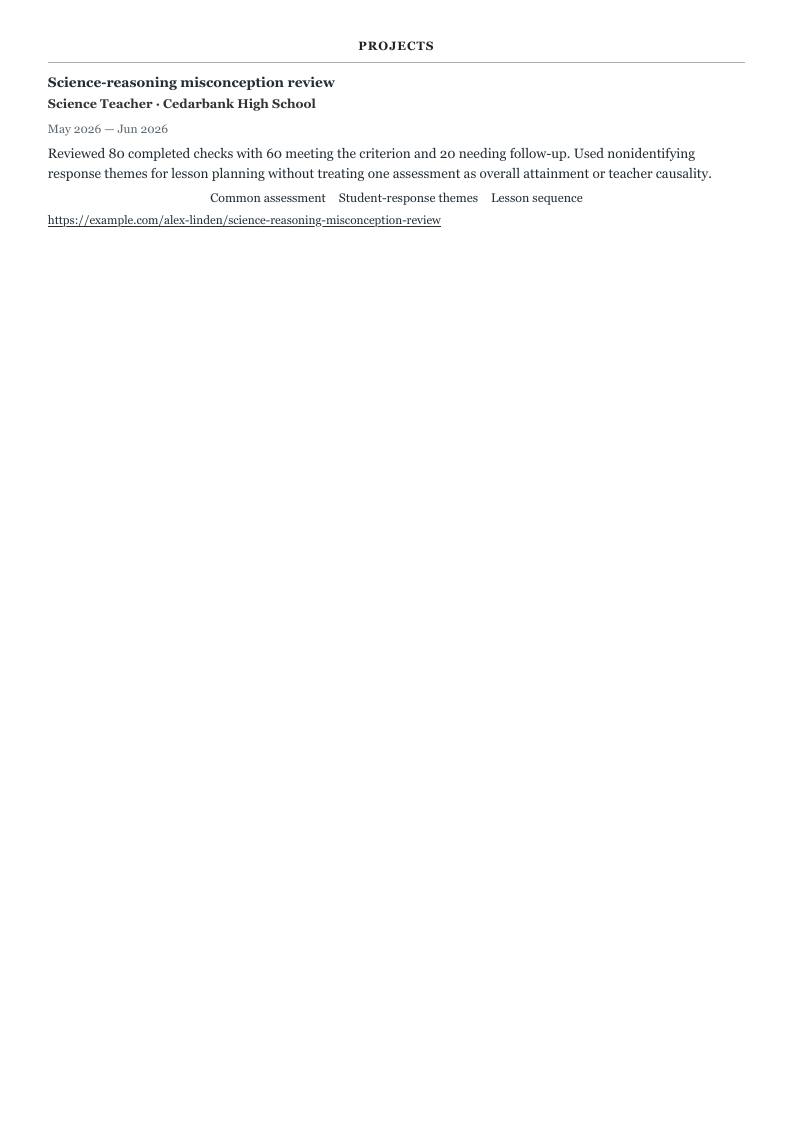 Open page 2 at full size
Science Teacher | Scientific inquiry and laboratory learning
alex.linden.career-and-project-records@example.com · +1 614 555 0117
Science teacher planning secondary biology and physical-science lessons with supervised laboratory learning. Uses inquiry questions, assessment responses and student explanations to identify misconceptions and plan follow-up. Brings earlier classroom teaching and supervised placement experience with careful handling of learning evidence.
Science lesson planning · Scientific inquiry · Laboratory learning preparation · Formative assessment · Misconception analysis · Student feedback
Cedarbank High School · Columbus, OH
August 2022–Present
Birchfield Secondary School · Newark, OH
August 2019–July 2022
Bachelor of Science in Education in Integrated Science Education · Maplecrest University · Columbus, OH
August 2015–May 2019
State Board of Education of Ohio
Issued July 2023
Expires June 2028
Professional license for the stated field and grade band; no educator identifier displayed.
Science Teacher · Cedarbank High School
May 2026–June 2026
Common assessment · Student-response themes · Lesson sequence
Reviewed 80 completed checks with 60 meeting the criterion and 20 needing follow-up. Used nonidentifying response themes for lesson planning without treating one assessment as overall attainment or teacher causality.
https://example.com/alex-linden/science-reasoning-misconception-review
The expanded Scholar scenario keeps the photo off. It preserves every base field and adds one earlier job and two projects. Project titles and employers reflect the job actually held during their dates, and method lists describe the work in that project. Read the full record, including the final project and its limits.
Condense repeated responsibilities before removing information a reader needs to understand a claim. Review headings, dates and continuation pages after your own changes; the design name alone cannot establish how an expanded career will read.
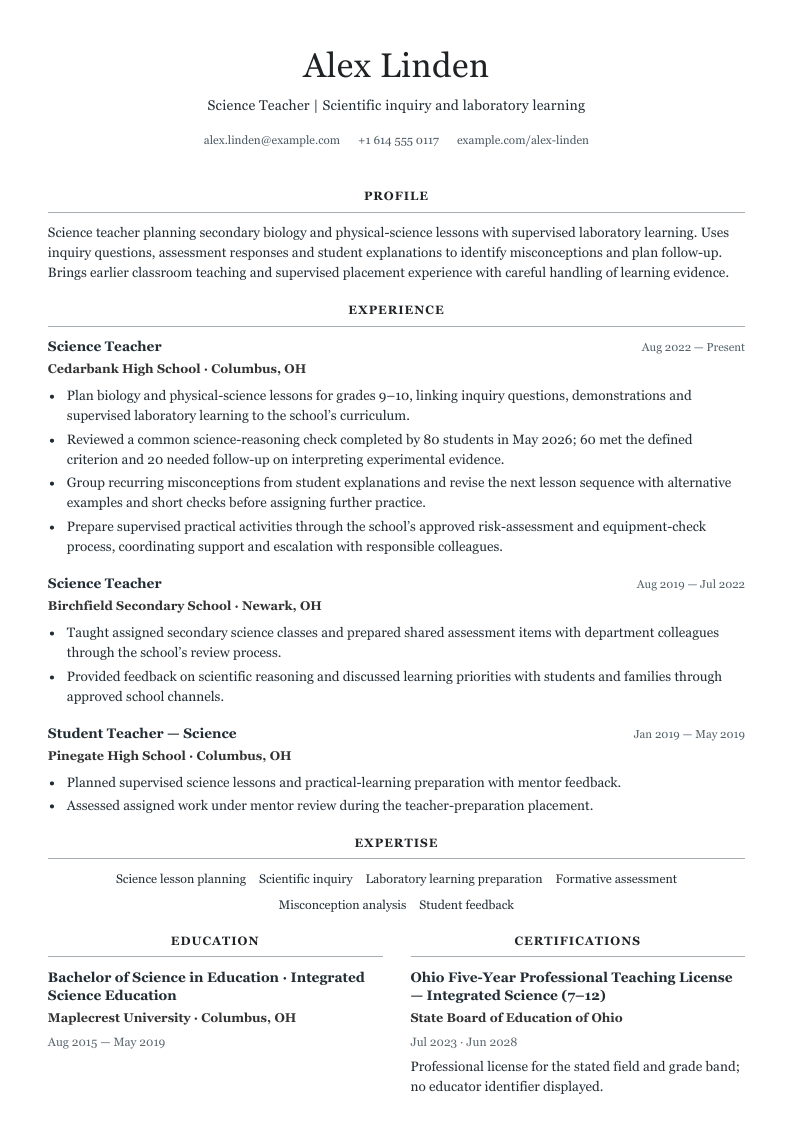 Open page 1 at full size
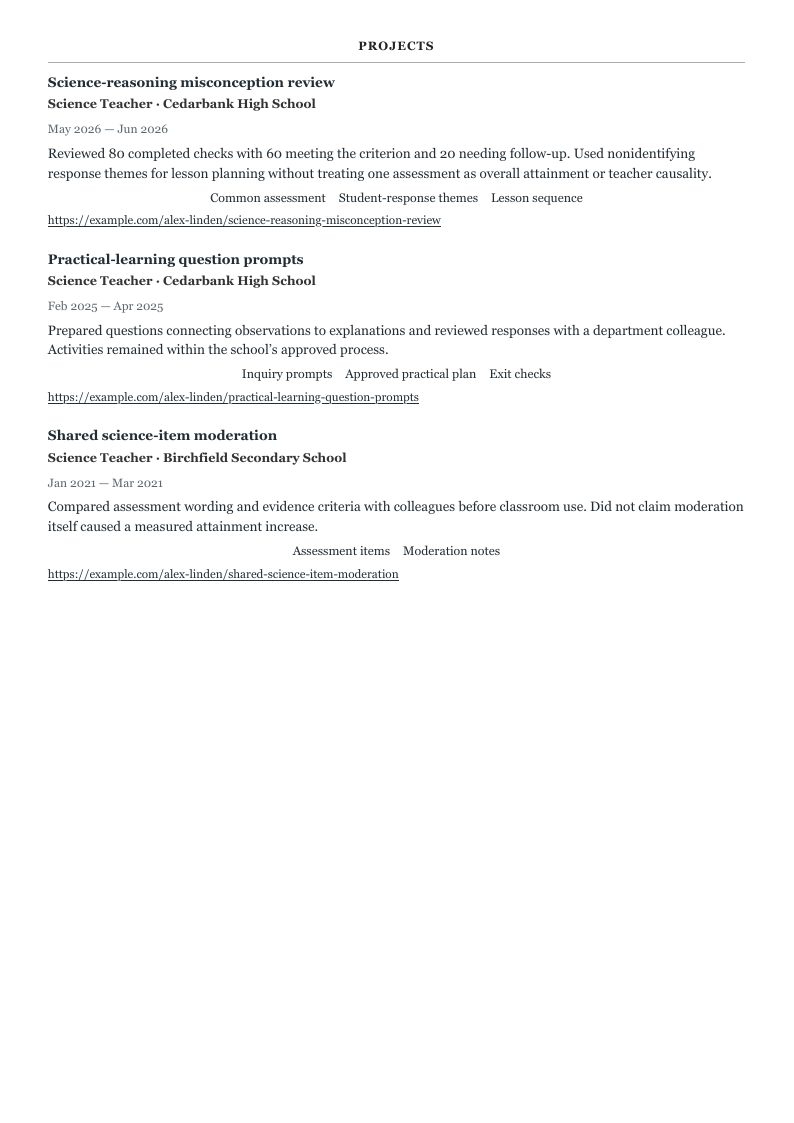 Open page 2 at full size
Science Teacher | Scientific inquiry and laboratory learning
alex.linden@example.com · +1 614 555 0117
Portfolio: https://example.com/alex-linden
Science teacher planning secondary biology and physical-science lessons with supervised laboratory learning. Uses inquiry questions, assessment responses and student explanations to identify misconceptions and plan follow-up. Brings earlier classroom teaching and supervised placement experience with careful handling of learning evidence.
Science lesson planning · Scientific inquiry · Laboratory learning preparation · Formative assessment · Misconception analysis · Student feedback
Cedarbank High School · Columbus, OH
August 2022–Present
Birchfield Secondary School · Newark, OH
August 2019–July 2022
Pinegate High School · Columbus, OH
January 2019–May 2019
Bachelor of Science in Education in Integrated Science Education · Maplecrest University · Columbus, OH
August 2015–May 2019
State Board of Education of Ohio
Issued July 2023
Expires June 2028
Professional license for the stated field and grade band; no educator identifier displayed.
Science Teacher · Cedarbank High School
May 2026–June 2026
Common assessment · Student-response themes · Lesson sequence
Reviewed 80 completed checks with 60 meeting the criterion and 20 needing follow-up. Used nonidentifying response themes for lesson planning without treating one assessment as overall attainment or teacher causality.
https://example.com/alex-linden/science-reasoning-misconception-review
Science Teacher · Cedarbank High School
February 2025–April 2025
Inquiry prompts · Approved practical plan · Exit checks
Prepared questions connecting observations to explanations and reviewed responses with a department colleague. Activities remained within the school’s approved process.
https://example.com/alex-linden/practical-learning-question-prompts
Science Teacher · Birchfield Secondary School
January 2021–March 2021
Assessment items · Moderation notes
Compared assessment wording and evidence criteria with colleagues before classroom use. Did not claim moderation itself caused a measured attainment increase.
https://example.com/alex-linden/shared-science-item-moderation
Review your resume with the analyzer and check every suggestion against your records. No template guarantees parsing, ranking, an interview or a hiring outcome. A free account is required for the builder; free-plan PDF downloads include a watermark. The examples show paid-plan output.
Yes. Biology, physical science and other specialties help explain fit when they reflect your actual teaching and authorization.
Describe the criterion and population. A single result does not establish broad attainment or causality.
Explain planning, supervision and the approved school process without claiming risk-free practical work or qualifications you do not hold.
Signup retains the exact design, the supported photo setting and Science Teacher role. Compact stays photo-free. The fictional career and portrait are not inserted into your account. A free account is required and free-plan PDF downloads include a watermark.
Prepared by Resumize with AI-assisted research and drafting for English-language US resume context. Employer descriptions from other markets are identified in the discussion and notes. Full employer bodies were checked October 30, 2026; availability, location eligibility and engagement conditions vary and can change. The original fictional records are teaching material, not verified applicants or evidence that this candidate meets every opening. No application was submitted or hiring outcome tested.
Official occupational and credential guidance was reviewed through direct, web-access or indexed text as stated in each note. Retrieval failures remain disclosed. The source notes distinguish these limits from full direct employer retrieval.
Read October 30, 2026. Al Huda International School, Karachi, Pakistan; secondary science role whose title specifies female applicants and whose brief description requests a science master’s degree. These conditions are not Ohio licensing rules. Complete employer role description retrieved. Application controls were present; continuing availability is not guaranteed.
Read October 30, 2026. KIPP, Kansas City, US; high-school science for school year 2026/27. Complete employer role description retrieved. Application controls were present; continuing availability is not guaranteed.
Read October 30, 2026. Uncommon Schools, Camden, New Jersey; middle-school science. Subject and grade settings differ from the Ohio example. Complete employer role description retrieved. Application controls were present; continuing availability is not guaranteed.
Official indexed guidance reviewed October 29, 2026 and reused; direct/web-open requests returned 404. The sample’s five-year license is fictional and contains no valid educator identifier.
Official indexed subject/grade-band table reviewed October 29, 2026 and reused for Integrated Science (7–12); direct/web-open access returned 404. No real applicant eligibility is established.