A Retail Buyer resume should connect the range you selected to the customer need, commercial constraint and supplier work behind it. Show category and store scope, how you evaluated a buy and what you did after the order. Separate a proposed range, an approved purchase and an observed sales result.
These previews use the same layouts as the builder, with identical example content. Open a full preview to inspect the text and spacing.
Fictional candidate, employers, education and results. The optional portrait is AI-generated. Use your own evidence and photo; the example is not inserted into your resume.
Modern
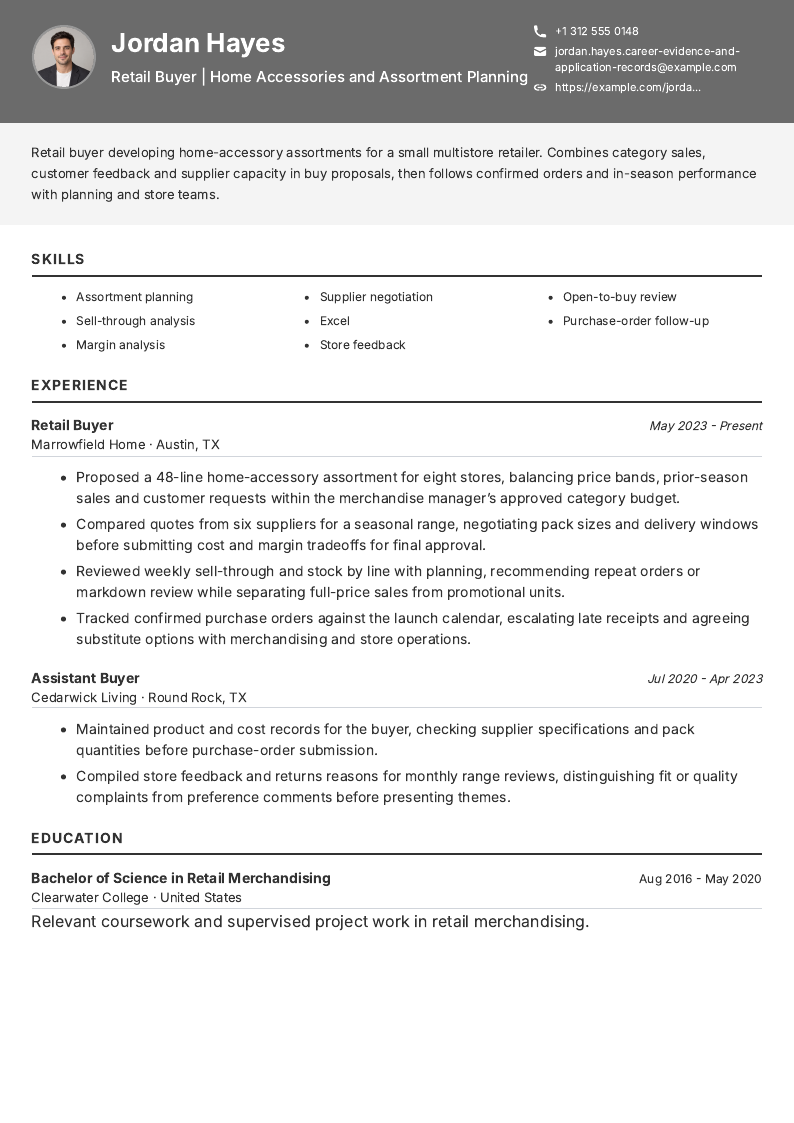
A dark gray split header, shaded introduction and three-column skills list above a single main column of dated evidence.
Before sending: The contact header and portrait use space. Read full contact destinations and check dates and project endings in the export.
Mint role band and small mint section markers, with Expertise and qualifications in a narrow left column and Profile, Experience and Projects in the wider right column.
Before sending: Supporting-column text can wrap tightly. Inspect copied reading order, full contacts and every page at normal size.
“Use” opens signup with that design and photo preference selected for the builder. A free account is required. Free-plan PDF downloads include a watermark; see current plans for paid options. Photo conventions vary; follow the employer’s instructions and local expectations.
All three designs show the same fictional career. The default has no photo; the optional portrait is AI-generated. Follow the employer’s instructions and local conventions. Signup retains the exact design, photo preference and Retail Buyer role. It does not insert the example career or portrait into your account. A free account is required; free-plan PDF downloads include a watermark. These previews show paid-plan output.
Jordan Hayes, employers, education, career, dates, projects and results are original fiction. All example.com links are placeholders and the 555 phone number is fictional. Use the structure with your own supported facts. This record contains two jobs, six work-history bullets, one education entry and one project, with no certification claim.
Jordan Hayes
Retail Buyer | Home Accessories and Assortment Planning
Retail buyer developing home-accessory assortments for a small multistore retailer. Combines category sales, customer feedback and supplier capacity in buy proposals, then follows confirmed orders and in-season performance with planning and store teams.
Proposed a 48-line home-accessory assortment for eight stores, balancing price bands, prior-season sales and customer requests within the merchandise manager’s approved category budget.
Compared quotes from six suppliers for a seasonal range, negotiating pack sizes and delivery windows before submitting cost and margin tradeoffs for final approval.
Reviewed weekly sell-through and stock by line with planning, recommending repeat orders or markdown review while separating full-price sales from promotional units.
Tracked confirmed purchase orders against the launch calendar, escalating late receipts and agreeing substitute options with merchandising and store operations.
Assistant Buyer
Cedarwick Living · Round Rock, TX
July 2020–April 2023
Maintained product and cost records for the buyer, checking supplier specifications and pack quantities before purchase-order submission.
Compiled store feedback and returns reasons for monthly range reviews, distinguishing fit or quality complaints from preference comments before presenting themes.
Education
Bachelor of Science in Retail Merchandising · Clearwater College · United States
August 2016–May 2020
Relevant coursework and supervised project work in retail merchandising.
Projects
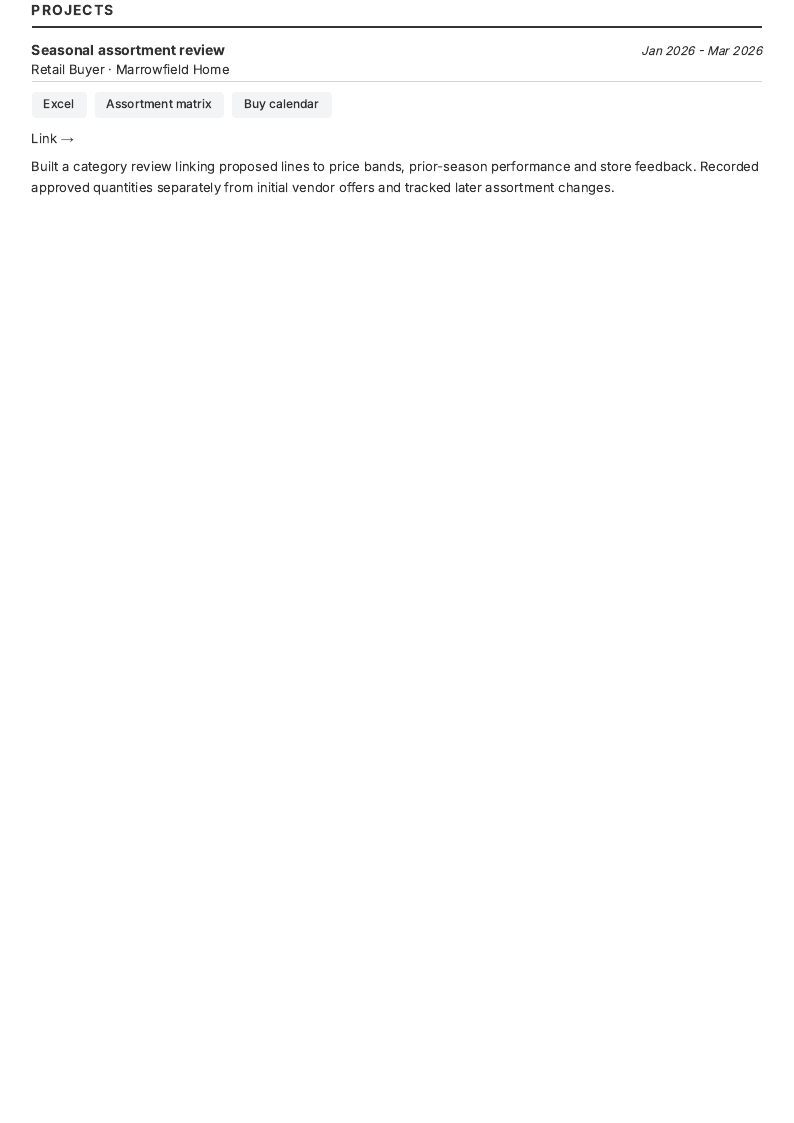
Seasonal assortment review
Retail Buyer · Marrowfield Home
January 2026–March 2026
Excel · Assortment matrix · Buy calendar
Built a category review linking proposed lines to price bands, prior-season performance and store feedback. Recorded approved quantities separately from initial vendor offers and tracked later assortment changes.
Jordan’s fictional example buys home accessories for eight stores within a merchandise manager’s approved category budget. It shows assortment proposals, vendor terms and in-season reviews. Buying is connected to planning and store execution, while final budget and markdown decisions stay with the appropriate owner.
Current descriptions show the title’s range. SHEIN focuses on fashion trends, repeats and recolors; Fanatics describes licensed soccer merchandise and category financial management; takealot.com combines cosmetics buying with e-commerce trading. These categories require different product knowledge. A home-accessory example can teach evidence structure without implying qualification for every specialty.
Each after statement appears exactly in the base work history. The annotations explain evidence and authority boundaries. Replace every invented fact with your own work; a useful example is a structure for reasoning, not permission to borrow a result.
1. Define the buying scope
Before: Owned the entire retail business.
After: Proposed a 48-line home-accessory assortment for eight stores, balancing price bands, prior-season sales and customer requests within the merchandise manager’s approved category budget.
Why it works: Names category, stores and budget authority so a reader can assess actual buying responsibility.
Evidence to check: Assortment matrix, store scope and approved budget.
2. Show a commercial tradeoff
Before: Negotiated unbeatable prices.
After: Compared quotes from six suppliers for a seasonal range, negotiating pack sizes and delivery windows before submitting cost and margin tradeoffs for final approval.
Why it works: Supplier terms include packs and timing as well as price. Approval remains with the named decision maker.
Evidence to check: Comparable quotes, terms, landed-cost basis and approval.
3. Put sales in context
Before: Doubled sales with great products.
After: Reviewed weekly sell-through and stock by line with planning, recommending repeat orders or markdown review while separating full-price sales from promotional units.
Why it works: Sell-through needs a period and receipt basis; promotions can change the interpretation.
Evidence to check: Sales/receipt window, returns treatment and markdown record.
4. Follow execution
Before: Ensured flawless launches.
After: Tracked confirmed purchase orders against the launch calendar, escalating late receipts and agreeing substitute options with merchandising and store operations.
Why it works: A late order remains a risk even when escalated. Show the response without promising all launches succeeded.
Evidence to check: Confirmed delivery dates, escalation and approved substitute.
5. Demonstrate order discipline
Before: Did buying administration.
After: Maintained product and cost records for the buyer, checking supplier specifications and pack quantities before purchase-order submission.
Why it works: Accurate product records support reliable orders without implying ownership of the range strategy.
Evidence to check: Specifications, pack definitions, cost and PO review.
6. Explain customer evidence
Before: Knew exactly what customers wanted.
After: Compiled store feedback and returns reasons for monthly range reviews, distinguishing fit or quality complaints from preference comments before presenting themes.
Why it works: Feedback is a sample. Distinguishing complaint categories makes the review more useful.
Evidence to check: Feedback sources, returns reasons and review period.
Show commercial judgment before listing products
A useful summary states your category and how you make decisions. Jordan connects customer feedback and sales history to assortment proposals, then follows confirmed orders and performance with planning. A list of brands does less work unless it explains your actual buying scope or a relevant product specialty.
Experienced buyers can identify the budget, channel and decisions they owned, using figures they are permitted to disclose. Assistant buyers can show clean cost records, order follow-up and range-review analysis. Keep the title you held; preparing materials for a range review does not make you the category’s final decision maker.
Connect Retail Buyer skills to evidence
Select relevant skills you can explain through a decision or deliverable. Use truthful vacancy language in context. Repeating terms or listing every tool cannot establish competence or guarantee screening success.
Skill
Evidence to gather
Fictional example
Assortment selection
Customer, price bands and budget.
Forty-eight-line proposal.
Negotiation
Comparable offers and approval.
Six supplier quotes.
Trading analysis
Period, receipts and returns.
Weekly line review with planning.
Order execution
Confirmed dates and escalation.
Launch calendar follow-up.
Product records
Cost, specification and pack checks.
Assistant buyer’s order preparation.
Customer insight
Source and complaint category.
Store feedback and returns review.
Give sales, margin and sell-through a basis
A range with more lines is not automatically a better assortment. Explain the customer need, price architecture and constraint behind the selection. Jordan’s 48 lines describe a proposal, while eight stores describe coverage. Neither number proves sales growth or customer satisfaction.
When reporting sell-through, identify the period and receipt basis, and explain returns and transfers where they affect the comparison. Separate full-price and promotional sales. A margin statement should use the firm’s agreed basis and distinguish initial margin from a later realized result after markdowns, freight or returns.
Negotiation evidence should compare like terms: unit cost, pack size, delivery timing, payment terms and any other relevant commitments. A lower unit quote can create excess stock if the minimum order rises. Describe your recommendation and approval boundary, and disclose no confidential supplier prices or private customer data in a public portfolio.
Use qualifications to support category knowledge
The example lists a retail merchandising degree and no certification. O*NET describes retail buying as selecting merchandise for resale using price, quality, sales and customer evidence; its scope also includes assistant buyers. List the qualification you earned and relevant work you can explain, rather than presenting one employer’s preference as a universal rule.
Tools support the commercial story. A checked assortment matrix or open-to-buy review can demonstrate useful Excel work, but a software name alone cannot establish planning authority. If your background is in stores, use real product and customer observations and describe how they informed buying discussions. Do not relabel sales-floor work as purchase approval.
Build a small range proposal with an explicit limit
Choose a manageable category and create a self-directed assortment brief with synthetic costs and demand assumptions. Define the customer, store or channel, price bands and a budget. Compare a small set of products and show the tradeoff between breadth, depth and minimum order quantities.
Add a simple in-season review using a labeled synthetic sales table. Identify a line you would repeat, retain or review for markdown, and explain what further evidence you need. Include a sample supplier follow-up with no real negotiation claim. This demonstrates reasoning while keeping coursework, personal work and paid buying experience distinct.
Check long contacts at full size
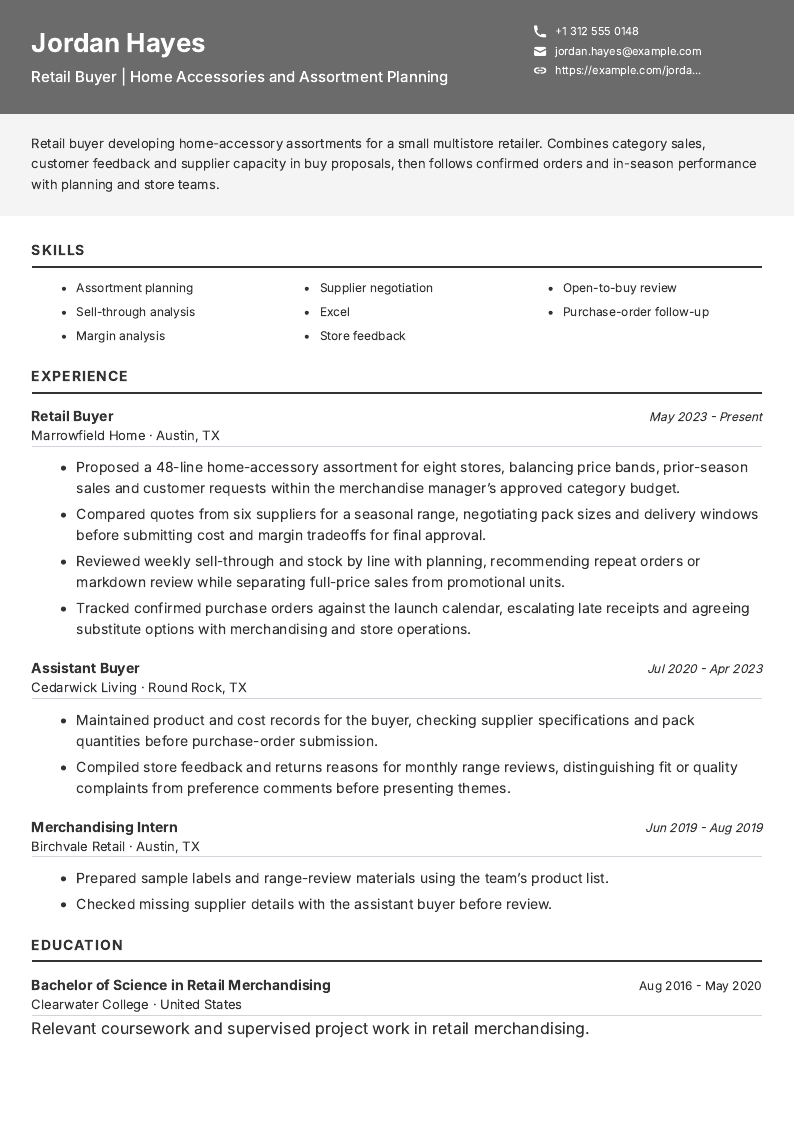
The long-contact Modern example has the photo on and changes only the resume email and portfolio URL. The user identity, phone and career stay identical. Follow both contacts through their final characters and open the link destination. The complete semantic record below includes the full address; a visually tidy label alone does not prove the destination is correct.
Retail buyer developing home-accessory assortments for a small multistore retailer. Combines category sales, customer feedback and supplier capacity in buy proposals, then follows confirmed orders and in-season performance with planning and store teams.
Proposed a 48-line home-accessory assortment for eight stores, balancing price bands, prior-season sales and customer requests within the merchandise manager’s approved category budget.
Compared quotes from six suppliers for a seasonal range, negotiating pack sizes and delivery windows before submitting cost and margin tradeoffs for final approval.
Reviewed weekly sell-through and stock by line with planning, recommending repeat orders or markdown review while separating full-price sales from promotional units.
Tracked confirmed purchase orders against the launch calendar, escalating late receipts and agreeing substitute options with merchandising and store operations.
Assistant Buyer
Cedarwick Living · Round Rock, TX
July 2020–April 2023
Maintained product and cost records for the buyer, checking supplier specifications and pack quantities before purchase-order submission.
Compiled store feedback and returns reasons for monthly range reviews, distinguishing fit or quality complaints from preference comments before presenting themes.
Education
Bachelor of Science in Retail Merchandising · Clearwater College · United States
August 2016–May 2020
Relevant coursework and supervised project work in retail merchandising.
Projects
Seasonal assortment review
Retail Buyer · Marrowfield Home
January 2026–March 2026
Excel · Assortment matrix · Buy calendar
Built a category review linking proposed lines to price bands, prior-season performance and store feedback. Recorded approved quantities separately from initial vendor offers and tracked later assortment changes.
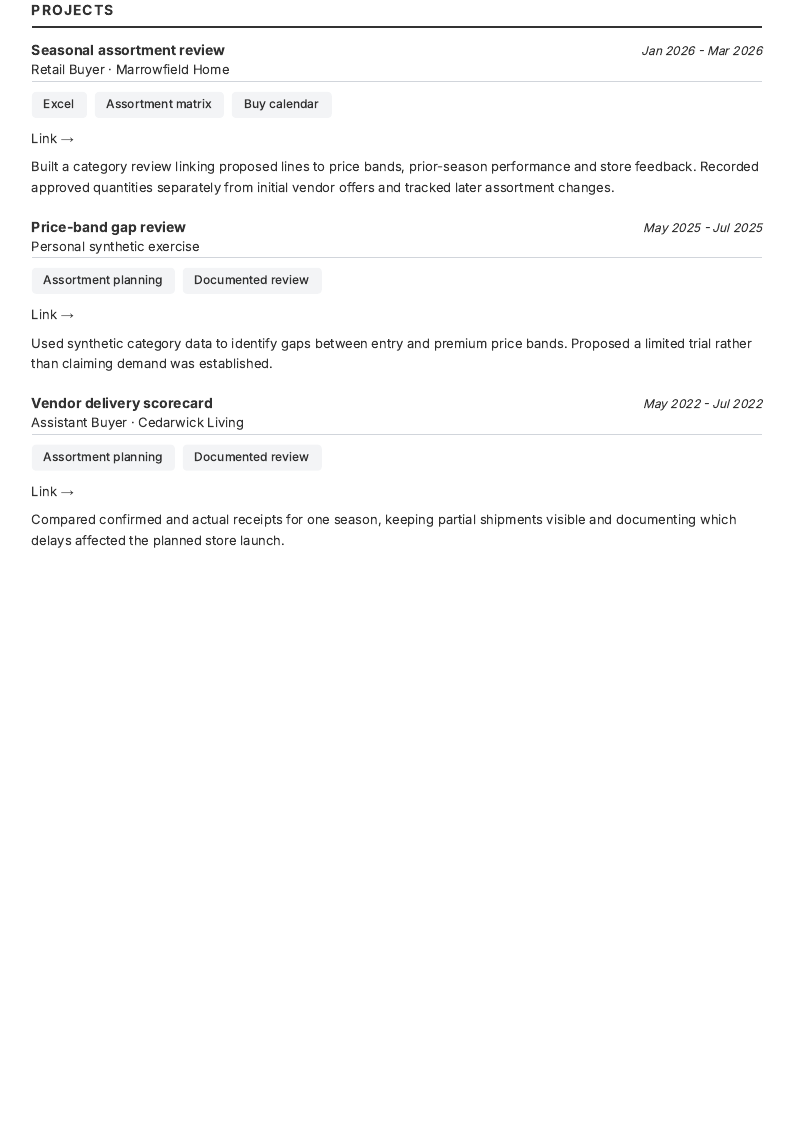
The expanded Modern example has the photo off. It retains every base field and adds an earlier merchandising intern role and two projects. Read each job date and the final project ending, then compare them with the complete text below. Keep methods, limitations and approval boundaries with the statements they explain.
Retail buyer developing home-accessory assortments for a small multistore retailer. Combines category sales, customer feedback and supplier capacity in buy proposals, then follows confirmed orders and in-season performance with planning and store teams.
Proposed a 48-line home-accessory assortment for eight stores, balancing price bands, prior-season sales and customer requests within the merchandise manager’s approved category budget.
Compared quotes from six suppliers for a seasonal range, negotiating pack sizes and delivery windows before submitting cost and margin tradeoffs for final approval.
Reviewed weekly sell-through and stock by line with planning, recommending repeat orders or markdown review while separating full-price sales from promotional units.
Tracked confirmed purchase orders against the launch calendar, escalating late receipts and agreeing substitute options with merchandising and store operations.
Assistant Buyer
Cedarwick Living · Round Rock, TX
July 2020–April 2023
Maintained product and cost records for the buyer, checking supplier specifications and pack quantities before purchase-order submission.
Compiled store feedback and returns reasons for monthly range reviews, distinguishing fit or quality complaints from preference comments before presenting themes.
Merchandising Intern
Birchvale Retail · Austin, TX
June 2019–August 2019
Prepared sample labels and range-review materials using the team’s product list.
Checked missing supplier details with the assistant buyer before review.
Education
Bachelor of Science in Retail Merchandising · Clearwater College · United States
August 2016–May 2020
Relevant coursework and supervised project work in retail merchandising.
Projects
Seasonal assortment review
Retail Buyer · Marrowfield Home
January 2026–March 2026
Excel · Assortment matrix · Buy calendar
Built a category review linking proposed lines to price bands, prior-season performance and store feedback. Recorded approved quantities separately from initial vendor offers and tracked later assortment changes.
Used synthetic category data to identify gaps between entry and premium price bands. Proposed a limited trial rather than claiming demand was established.
Compared confirmed and actual receipts for one season, keeping partial shipments visible and documenting which delays affected the planned store launch.
Condense repeated duties before removing useful context. Let relevant evidence use another page when needed, then inspect continuations for isolated headings, detached dates and unfinished sentences. Page count alone cannot establish readability.
Inspect the download before applying
Read every exported page with your selected photo preference. Check full contacts, job dates, qualifications and project endings. Copy text from the PDF and inspect parsed application fields when available; follow the employer’s requested file type. Use your own evidence and avoid including confidential records.
A free account is required for the builder. Free-plan PDF downloads include a watermark; these previews show paid-plan output. Compact has no portrait option; its preview remains photo-free. Template buttons retain the exact design, photo preference and Retail Buyer role. Add your own details and photo after signup.
The resume analyzer gives advisory feedback. The bullet point generator can help draft from your notes; check every suggestion. No design or wording guarantees parsing, an interview or a hiring outcome.
Questions, answered
What should a Retail Buyer resume include?
Name your category, channel or store scope, buying responsibility and the evidence behind assortment and supplier decisions. Follow the story through order execution and in-season review where that was your work.
Can I claim the whole category’s sales growth?
Describe your contribution and use an approved comparison period and metric basis. Pricing, promotions, availability and other teams can affect sales; a proposed buy is not itself a realized result.
What can an assistant buyer show?
Product and cost accuracy, supplier follow-up, sales analysis and range-review support are useful when tied to specific records and decisions. Keep final buying and budget authority clear.
Prepared by Resumize with AI-assisted research and drafting for English-language applications. Three primary employer descriptions were directly retrieved with full readable duties, qualifications and application controls on October 29, 2026. Their locations, seniority and responsibilities differ. Primary occupational guidance supplies broader context; it does not establish an individual applicant’s eligibility. This is a small dated sample, not a representative market survey or proof that the fictional applicant qualifies for each opening. No application was submitted, private employee or client data used, or hiring outcome tested.
Los Angeles; women’s fashion trend, repeat and recolor decisions; 3–5 years relevant experience. Full readable employer duties, qualifications and application controls retrieved October 29, 2026. This dated observation does not guarantee the vacancy remains open.
Jacksonville, Florida or New York, New York; hybrid three days in office. Soccer category assortment, supplier partnerships and in-season financial management; 4+ years relevant experience. Full readable employer duties, qualifications and application controls retrieved directly October 29, 2026; availability can change.
Cape Town, South Africa; cosmetics e-commerce category buying, digital trading and supplier negotiation; 4–7+ years relevant experience. Direct HTML includes full duties and qualifications; cached search-browser body omits them. Distinct from the fictional US home-accessory role. Full readable employer duties, qualifications and application controls retrieved directly October 29, 2026; availability can change.