Impact
A strong identity block and prominent work history emphasize leadership decisions.
Before sending: Keep metric definitions beside results and inspect dense leadership bullets.
Product backlog decisions · US resume context
A Product Owner resume should show the product, priorities and decisions you actually owned. Explain user needs and acceptance examples alongside the backlog. Keep delivery activity separate from evidence that a change created value.
By Resumize · · AI-assisted research and drafting
Three designs · one example
These previews use the same layouts as the builder, with identical example content. Open a full preview to inspect the text and spacing.
Fictional candidate, employers, education and results. The optional portrait is AI-generated. Use your own evidence and photo; the example is not inserted into your resume.
A strong identity block and prominent work history emphasize leadership decisions.
Before sending: Keep metric definitions beside results and inspect dense leadership bullets.
A centered identity block and restrained section rules provide a formal presentation.
Before sending: The optional portrait and long contacts can increase header depth.
Open spacing and clear headings distinguish evidence from supporting details.
Before sending: Long records can need continuation pages; inspect the complete export.
“Use” opens signup with that design and photo preference selected for the builder. A free account is required. Free-plan PDF downloads include a watermark; see current plans for paid options. Photo conventions vary; follow the employer’s instructions and local expectations.
The three designs use the same fictional career. The default has no photo. Follow the employer’s instructions and local conventions; the optional portrait is AI-generated. Signup retains the exact design, supported photo preference and Product Owner role. It does not insert the example career or portrait into your account. A free account is required, and free-plan PDF downloads include a watermark. These previews show paid-plan output.
Casey Ellis, the employers, qualifications, dates, projects and results are original editorial fiction. The example.com addresses and links and the 555 phone number are illustrative placeholders. Replace every field with your own facts. The optional portrait is AI-generated, and all qualifications and any license or registration dates are fictional and contain no valid identifiers. The base record has two jobs, six experience bullets, one education record and one project.
Product Owner | Backlog decisions and acceptance criteria in a delivery team
casey.ellis@example.com · +1 614 555 0114
Portfolio: https://example.com/casey-ellis
Product owner maintaining the backlog for an internal order-management product. Clarifies user needs, agrees acceptance criteria with the delivery team and makes scope choices with business stakeholders. Brings business-analyst experience in workflow mapping, requirements and test preparation.
Backlog prioritization · Acceptance criteria · User-story refinement · Stakeholder decisions · Workflow analysis · Release goal tracking
Birchgate Operations Software · Raleigh, NC
April 2022–Present
Cedarfield Digital Services · Raleigh, NC
June 2019–March 2022
Bachelor of Science in Information Systems · Maplecrest University · Raleigh, NC
August 2015–May 2019
Product Owner · Birchgate Operations Software
June 2026–July 2026
Backlog export · Acceptance criteria · Decision log
Reconciled 30 planned items to 24 accepted by the review date and six carried forward. Retained reasons and criteria, and kept release acceptance separate from evidence of business benefit.
A product owner resume should show how you made product decisions, clarified work and checked whether a change helped its users. Explain the product and your authority before listing delivery tools. Writing tickets or attending meetings alone does not establish ownership of product value.
The Scrum Guide describes the Product Owner’s accountability for maximizing product value and effective Product Backlog management. Employers may use the title differently, so read the vacancy and explain your actual remit. State whether you owned a product area, supported another owner or worked in a different role with transferable responsibilities.
Name the user and problem at a suitable level: an internal scheduling tool, a customer account workflow or a reporting product. Avoid confidential roadmap details. A reader should understand what you prioritized and who depended on the decisions.
This fictional sample describes responsibility for an internal service-request product. It illustrates the structure of an application, not a verified career. Adapt it to your actual product, authority, dates and evidence.
[Name] | [City, State] | [Email] | [Phone]
PRODUCT OWNER
Product owner experienced in clarifying user problems, ordering backlog work and reviewing outcomes with stakeholders. Translates operational feedback into explicit decisions and testable requirements for an internal product team.
RELEVANT SKILLS
Backlog ordering · Stakeholder discussions · Requirements clarification · Outcome review · [Actual planning and analytics tools]
EXPERIENCE
Product Owner — [Employer] | [Month Year–Present]
Own the backlog for [actual product area], making priorities visible against the agreed product goal.
Review support feedback and user discussions to distinguish recurring problems from isolated feature requests.
Clarify expected behavior and acceptance examples with developers before work is selected for implementation.
Review delivered changes with users and stakeholders, recording follow-up decisions and unresolved assumptions.
Business Analyst — [Employer] | [Month Year–Month Year]
Mapped the service-request workflow and documented conflicting requirements for the product owner to resolve.
Prepared examples of incomplete submissions and checked proposed behavior with operations colleagues.
EDUCATION AND TRAINING
[Actual qualification] — [Institution] | [Date]
[Completed relevant training or credential] — [Provider], [Date/status]
The strongest example often explains a tradeoff. What competing needs existed? What evidence did you examine? What did you decide, and what remained uncertain? This gives more information than “managed the backlog using Agile.”
In a fictional service-request project, users want faster status visibility while managers want another dashboard. The owner reviews support questions and prioritizes a simple status view first. That is a decision story; it becomes a result story only when there is evidence of what happened after release.
Decision: Prioritized request-status visibility after reviewing recurring support questions; documented why an additional management dashboard was deferred.
Verification: Compared [actual post-release measure] with [defined baseline] and reviewed user feedback before deciding the next improvement.
Story count, completed tickets and release frequency describe activity. They do not automatically establish customer satisfaction, revenue or retention. If your contribution was clarifying requirements or reducing unresolved decisions, describe that directly.
For an outcome claim, keep the measure, time window and attribution clear. A change after launch may have several causes. State what the team observed and what you contributed rather than assigning every movement to your backlog decision.
Do not turn a team estimate or a planned target into an achieved result. If measurement was limited, explain the feedback you reviewed and the next decision it supported. That can still demonstrate thoughtful product work.
Business analysis, operations and project work can supply relevant examples of problem clarification and stakeholder communication. Keep the original job title and describe the responsibility accurately. Supporting a product owner is not the same as holding the accountability yourself.
If you made a portfolio case study, label it as a proposal or personal exercise. Explain the assumptions and how you would validate them; do not claim invented customers or launch results. A course or certification is training evidence, not proof of product ownership.
Before sending, check that your summary, experience and interview stories describe the same authority. Remove tool names that are unsupported and select the examples most relevant to the employer’s product problems.
Casey’s fictional product is an internal order-management tool. Operations stakeholders and the delivery team help clarify priorities and behavior, while the owner records scope decisions. The prior business-analyst role contributes workflow and requirement evidence without being retitled as ownership.
The current employer descriptions below use Product Owner in different technical and business settings. The Scrum Guide provides a specific accountability model, while organizations may organize work differently. State your own product boundary and decision rights rather than assuming a ticketing tool establishes ownership.
A strong prioritization story includes competing needs, user evidence, capacity constraints and what was deferred. Clarifying an acceptance criterion can be valuable work without a revenue claim. Keep technical implementation decisions with the people responsible for them.
Read the employer descriptions directly: Nimbyx Philippines, Inc. Product Owner; Madiff Polska Product Owner; Endava Product Owner. This selected dated sample illustrates differences in scope and requirements, rather than a representative labor-market survey.
Each after sentence appears in the base career record. The weak before statements are teaching examples. Use the evidence prompts to check the population, decisions and limitations behind your own wording.
Before: Owned all company strategy.
After: Maintain the backlog for an internal order-management product, agree priorities with operations stakeholders and explain scope tradeoffs to the delivery team.
Why it works: A defined product and stakeholders distinguish backlog responsibility from enterprise product strategy.
Evidence to check: Product boundary, priority decisions and stakeholder roles.
Before: Delivered every feature on time.
After: Reviewed 30 backlog items planned for the June 2026 release; 24 met the agreed acceptance criteria by the review date and six carried forward with reasons recorded.
Why it works: The 80% accepted-item share is not a measure of customer value, story points or every team’s delivery performance.
Evidence to check: Release item list, criteria, cutoff and carry-forward decisions.
Before: Wrote perfect requirements.
After: Refine user stories with operations and developers, specifying observable acceptance criteria for order status, permissions and exception handling before implementation.
Why it works: Concrete behavior is clearer than asserting requirements are perfect.
Evidence to check: Story versions, criteria and refinement decisions.
Before: Said yes to every stakeholder.
After: Defer low-priority reporting changes when order-exception work needs capacity, document the business rationale and confirm the revised release scope with stakeholders.
Why it works: Prioritization includes decisions and foregone work rather than a larger backlog alone.
Evidence to check: Priority rationale, capacity discussion and scope confirmation.
Before: Architected the whole platform.
After: Mapped order-processing workflows and clarified requirement questions with users, preparing decision notes for the product owner and technical leads.
Why it works: Analysis support does not establish platform architecture authority.
Evidence to check: Workflow map, user input and decision notes.
Before: Guaranteed error-free releases.
After: Prepared user-acceptance scenarios from agreed requirements and tracked unresolved issues for business review before release decisions.
Why it works: Test preparation and issue visibility do not guarantee a defect-free release.
Evidence to check: Scenarios, issue register and release decision owners.
The June review includes 30 planned backlog items, with 24 meeting agreed criteria by the cutoff and six carried forward. The 80% accepted-item share is not customer satisfaction, revenue or a comparison of team productivity. Item counts and story points are also different units.
Delivery acceptance and user value need separate observations. A change can satisfy the stated criteria and still require learning after release. Casey’s summary therefore emphasizes scope, requirements and decisions rather than claiming unmeasured product outcomes.
Use relevant capabilities that your experience or projects demonstrate. The table connects the sample’s claims to records a candidate should check. A skill keyword is not a substitute for an example, and a private employer record should stay private unless sharing is permitted.
| Capability in context | Evidence to check | Sample work |
|---|---|---|
| Define the product boundary | Product boundary, priority decisions and stakeholder roles. | Maintain the backlog for an internal order-management product, agree priorities with operations stakeholders and explain scope tradeoffs to the delivery team. |
| Keep delivery counts bounded | Release item list, criteria, cutoff and carry-forward decisions. | Reviewed 30 backlog items planned for the June 2026 release; 24 met the agreed acceptance criteria by the review date and six carried forward with reasons recorded. |
| Make acceptance testable | Story versions, criteria and refinement decisions. | Refine user stories with operations and developers, specifying observable acceptance criteria for order status, permissions and exception handling before implementation. |
| Show a genuine tradeoff | Priority rationale, capacity discussion and scope confirmation. | Defer low-priority reporting changes when order-exception work needs capacity, document the business rationale and confirm the revised release scope with stakeholders. |
| Preserve analyst contribution | Workflow map, user input and decision notes. | Mapped order-processing workflows and clarified requirement questions with users, preparing decision notes for the product owner and technical leads. |
| Describe testing support | Scenarios, issue register and release decision owners. | Prepared user-acceptance scenarios from agreed requirements and tracked unresolved issues for business review before release decisions. |
Casey’s information-systems degree is fictional and no Scrum or other certification is supplied. Use actual qualifications and completed training with accurate status. The Scrum Guide describes Product Owner accountability; a course or tool alone is not proof you held that accountability in employment.
A business analyst can demonstrate user discussions, requirement conflicts, workflow mapping and acceptance scenarios. Preserve the official title and identify who resolved priorities. Supporting another owner does not mean you owned every decision.
A personal product case should be labeled as a proposal or exercise. Explain assumptions and how you would validate them rather than invent customers or launch results. The expanded example retains Casey’s internship and two dated work projects under held titles.
Only Casey Ellis’s resume email and one portfolio contact URL change in this scenario. Identity, phone, employment, qualifications and projects stay identical. Impact uses the optional photo-on view here. Read every final character of the email and URL, and check the link destination against the complete record below.
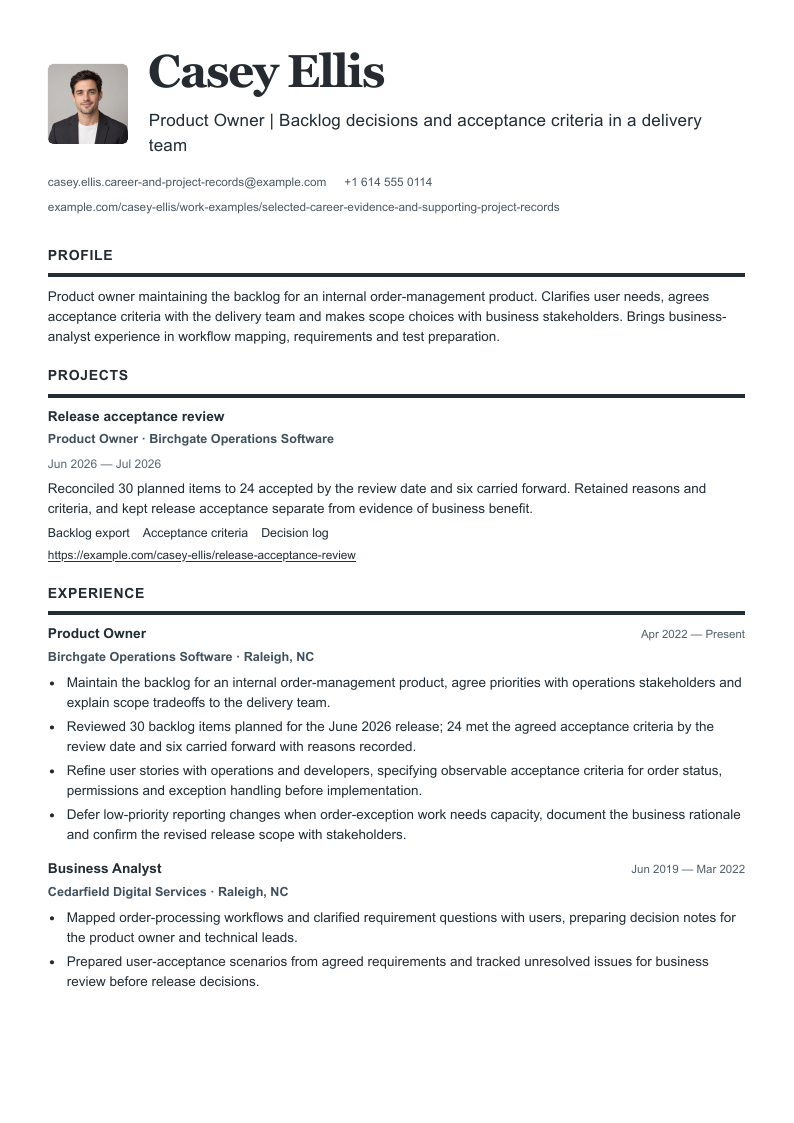 Open page 1 at full size
 Open page 2 at full size
Product Owner | Backlog decisions and acceptance criteria in a delivery team
casey.ellis.career-and-project-records@example.com · +1 614 555 0114
Product owner maintaining the backlog for an internal order-management product. Clarifies user needs, agrees acceptance criteria with the delivery team and makes scope choices with business stakeholders. Brings business-analyst experience in workflow mapping, requirements and test preparation.
Backlog prioritization · Acceptance criteria · User-story refinement · Stakeholder decisions · Workflow analysis · Release goal tracking
Birchgate Operations Software · Raleigh, NC
April 2022–Present
Cedarfield Digital Services · Raleigh, NC
June 2019–March 2022
Bachelor of Science in Information Systems · Maplecrest University · Raleigh, NC
August 2015–May 2019
Product Owner · Birchgate Operations Software
June 2026–July 2026
Backlog export · Acceptance criteria · Decision log
Reconciled 30 planned items to 24 accepted by the review date and six carried forward. Retained reasons and criteria, and kept release acceptance separate from evidence of business benefit.
The expanded Impact scenario keeps the photo off. It preserves every base field and adds one earlier job and two projects. Project titles and employers reflect the job actually held during their dates, and method lists describe the work in that project. Read the full record, including the final project and its limits.
Condense repeated responsibilities before removing information a reader needs to understand a claim. Review headings, dates and continuation pages after your own changes; the design name alone cannot establish how an expanded career will read.
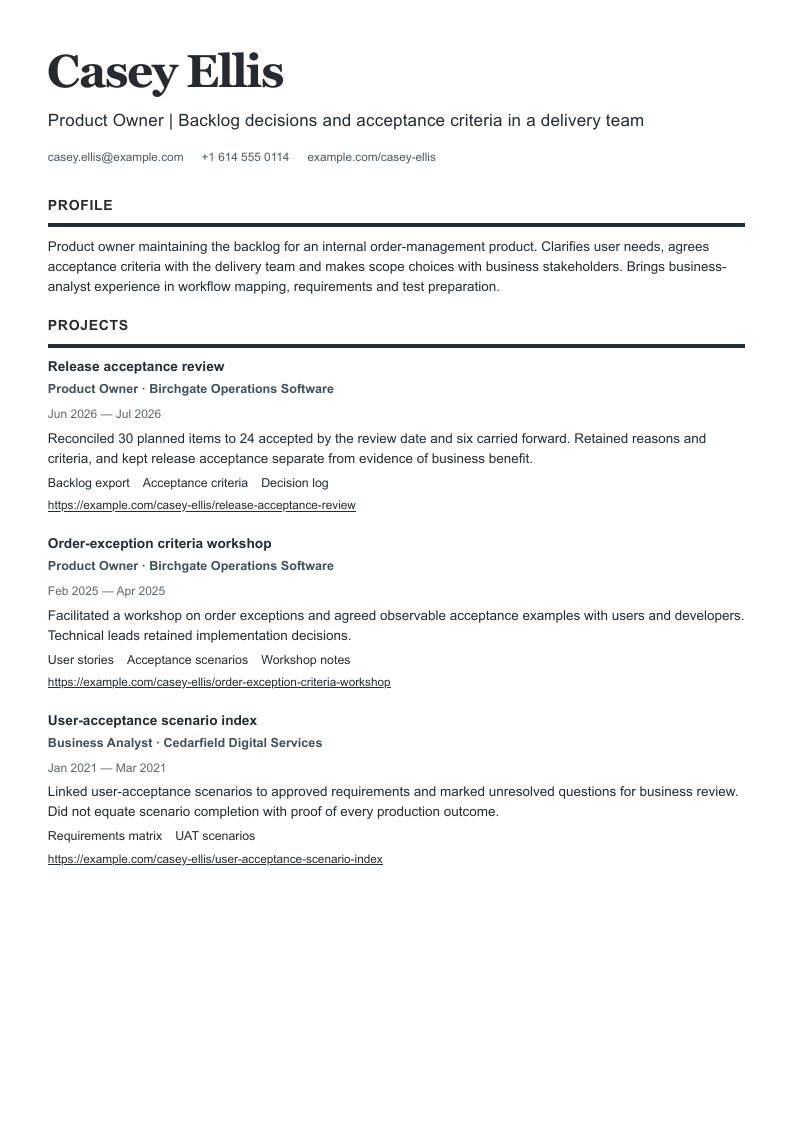 Open page 1 at full size
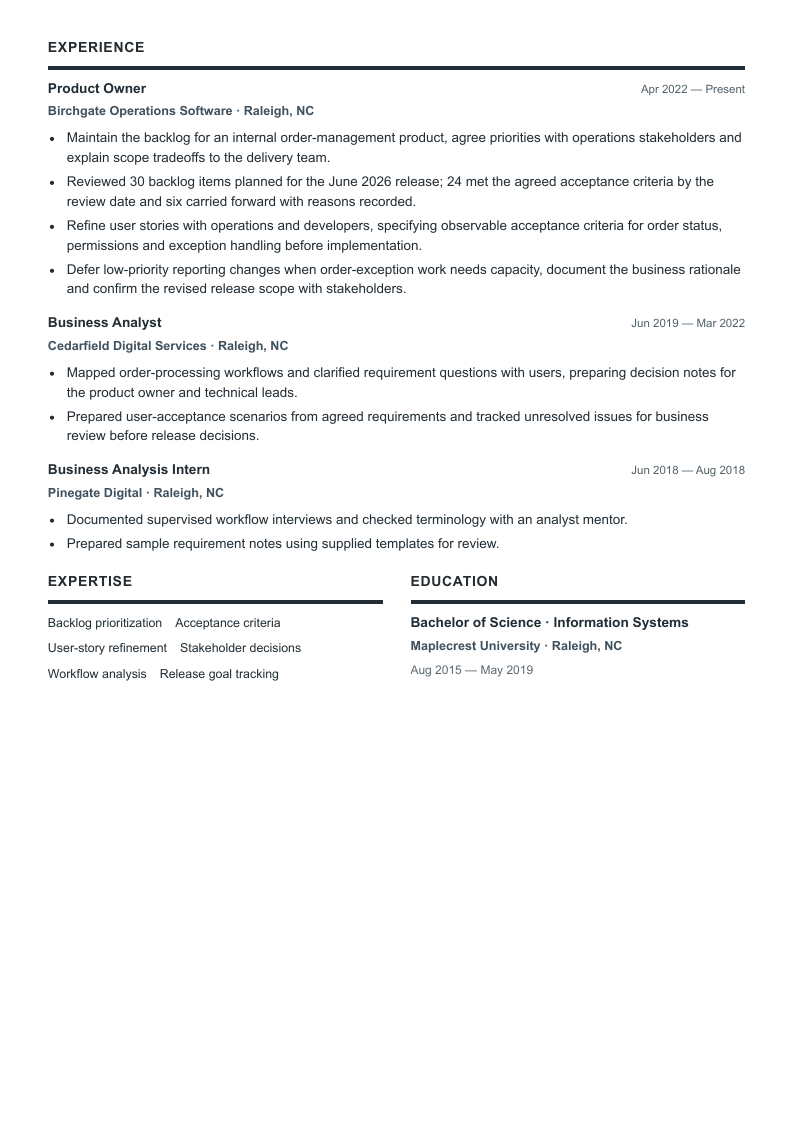 Open page 2 at full size
Product Owner | Backlog decisions and acceptance criteria in a delivery team
casey.ellis@example.com · +1 614 555 0114
Portfolio: https://example.com/casey-ellis
Product owner maintaining the backlog for an internal order-management product. Clarifies user needs, agrees acceptance criteria with the delivery team and makes scope choices with business stakeholders. Brings business-analyst experience in workflow mapping, requirements and test preparation.
Backlog prioritization · Acceptance criteria · User-story refinement · Stakeholder decisions · Workflow analysis · Release goal tracking
Birchgate Operations Software · Raleigh, NC
April 2022–Present
Cedarfield Digital Services · Raleigh, NC
June 2019–March 2022
Pinegate Digital · Raleigh, NC
June 2018–August 2018
Bachelor of Science in Information Systems · Maplecrest University · Raleigh, NC
August 2015–May 2019
Product Owner · Birchgate Operations Software
June 2026–July 2026
Backlog export · Acceptance criteria · Decision log
Reconciled 30 planned items to 24 accepted by the review date and six carried forward. Retained reasons and criteria, and kept release acceptance separate from evidence of business benefit.
Product Owner · Birchgate Operations Software
February 2025–April 2025
User stories · Acceptance scenarios · Workshop notes
Facilitated a workshop on order exceptions and agreed observable acceptance examples with users and developers. Technical leads retained implementation decisions.
https://example.com/casey-ellis/order-exception-criteria-workshop
Business Analyst · Cedarfield Digital Services
January 2021–March 2021
Requirements matrix · UAT scenarios
Linked user-acceptance scenarios to approved requirements and marked unresolved questions for business review. Did not equate scenario completion with proof of every production outcome.
https://example.com/casey-ellis/user-acceptance-scenario-index
Review your resume with the analyzer and check every suggestion against your records. No template guarantees parsing, ranking, an interview or a hiring outcome. A free account is required for the builder; free-plan PDF downloads include a watermark. The examples show paid-plan output.
List tools you used when relevant, but support them with decisions and work. Using a ticketing system does not by itself demonstrate product ownership.
Explain relevant requirements, user and stakeholder work while preserving your actual title. Be clear about decisions you owned and those made by the product owner.
No. A specific tradeoff, clarified requirement or decision process can be useful evidence. Use numbers only when you can explain the measure and source.
List tools you actually used when relevant, supported by decisions and work. The tool alone does not establish ownership.
State them as delivery measures. Business benefit needs a defined user or commercial outcome and accurate attribution.
Show transferable evidence while preserving your actual title and distinguishing the decisions you owned from those made by the product owner.
Signup retains the exact design, the supported photo setting and Product Owner role. Compact stays photo-free. The fictional career and portrait are not inserted into your account. A free account is required and free-plan PDF downloads include a watermark.
Prepared by Resumize with AI-assisted research and drafting for English-language US resume context. Employer descriptions from other markets are identified in the discussion and notes. Full employer bodies were checked October 30, 2026; availability, location eligibility and engagement conditions vary and can change. The original fictional records are teaching material, not verified applicants or evidence that this candidate meets every opening. No application was submitted or hiring outcome tested.
Official occupational and credential guidance was reviewed through direct, web-access or indexed text as stated in each note. Retrieval failures remain disclosed. The source notes distinguish these limits from full direct employer retrieval.
Read October 30, 2026. Nimbyx, Makati City, Philippines; Product Owner in a technology/business setting. Full employer description retrieved. Application controls were present at review; availability can change.
Read October 30, 2026. Madiff Polska, Warsaw, Poland; Product Owner in a technology-services setting. Full employer description retrieved. Application controls were present at review; availability can change.
Read October 30, 2026. Endava, Bengaluru, India; Product Owner with its own client/delivery requirements. Full employer description retrieved. Application controls were present at review; availability can change.
Reviewed October 30, 2026. Official context for the role or the stated practice; not a credential or proof that the fictional candidate meets every requirement.