A paralegal resume should make legal support work concrete: the matters you tracked, information you checked, documents you prepared and questions you brought to the responsible attorney. This original example shows factual traceability and review boundaries alongside a complete fictional resume, six annotated rewrites and three designs.
These previews use the same layouts as the builder, with identical example content. Open a full preview to inspect the text and spacing.
Fictional candidate, employers, education and results. The optional portrait is AI-generated. Use your own evidence and photo; the example is not inserted into your resume.
Classic
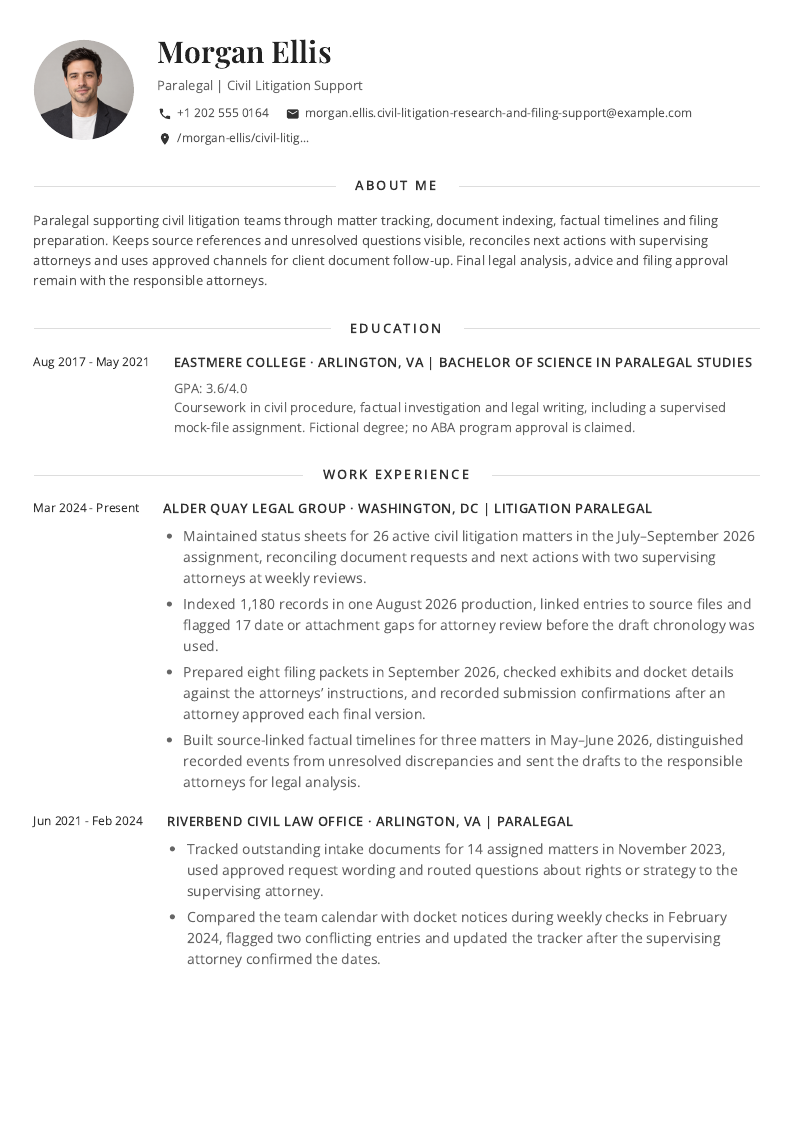
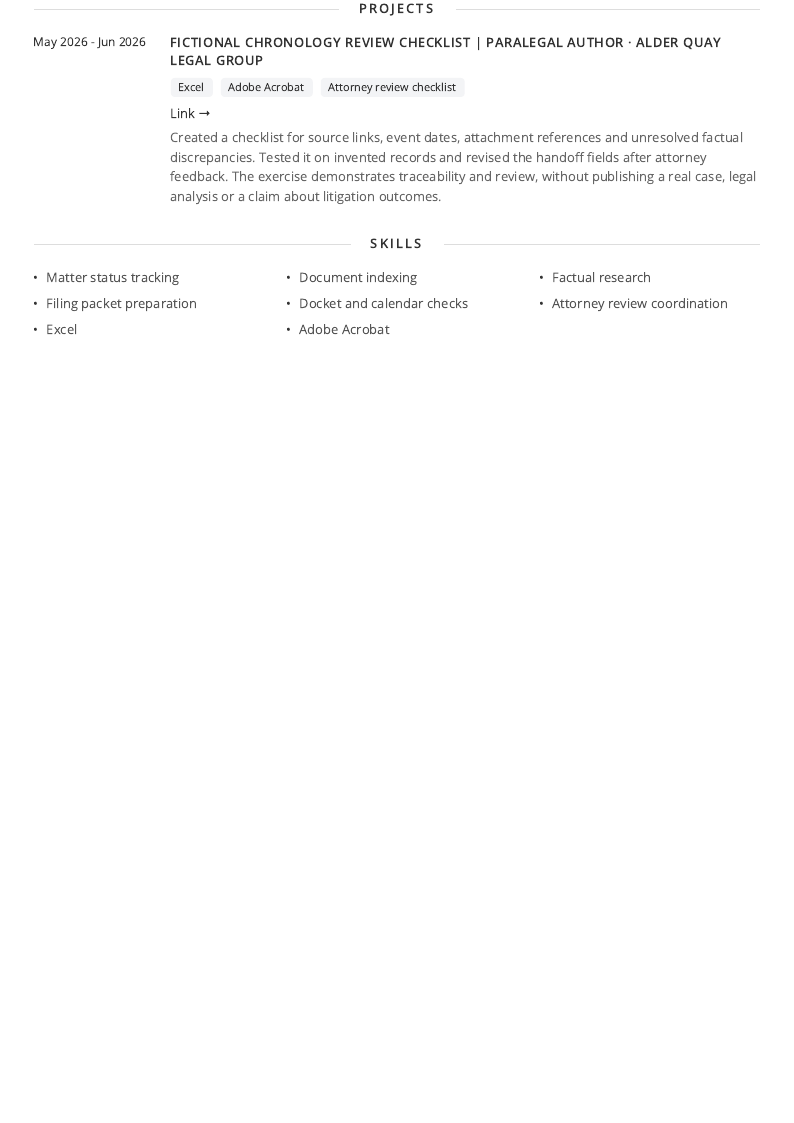
A serif name and centered section labels lead into About Me, Education, Work Experience, Projects, Certifications and Skills. Dates occupy a separate left column.
Before sending: Education appears before experience. The date gutter narrows the narrative; the optional circular portrait shares the header with contacts. Social labels may shorten, so inspect the link destination.
A coral identity block sits beside contacts, followed by Profile, Experience, Expertise, Education, Certifications and Projects, with a left section-label gutter.
Before sending: Experience comes before education, but the label gutter reduces text width. Keep the attorney approval clause connected to the filing example across pages.
A plain left header and restrained headings present Profile, Experience, Expertise, Education, Certifications and Projects in one column.
Before sending: The quiet style gives the words more responsibility. Review date alignment, long source-linked descriptions and the full education description in the export.
“Use” opens signup with that design and photo preference selected for the builder. A free account is required. Free-plan PDF downloads include a watermark; see current plans for paid options. Photo conventions vary; follow the employer’s instructions and local expectations.
Classic, Civic and Essential show Morgan’s identical record. The default has no photo; the optional portrait demonstrates the other header state. The buttons retain the selected design, photo preference and Paralegal role through signup. Morgan’s name, career history and portrait are teaching examples and are not inserted into your account.
Classic uses a serif identity, centered section labels and a left date column. Its actual order is About Me, Education, Work Experience, Projects, Certifications when supplied, then Skills. It is a separate design from Scholar. Civic puts a coral name block beside contacts and labels sections in a left gutter. Essential has a plain left header and restrained headings. Both put experience before education. Choose by the readability of the work and its review boundaries; a design does not guarantee a screening result.
A complete paralegal resume example
Morgan Ellis is an invented civil-litigation paralegal in Washington, DC, with an earlier Arlington role. Every person, employer, matter count, document count, date, degree and project is fictional. No real case or client is described. The example.com links are placeholders and the portrait is AI-generated. This guide uses AI-assisted research and drafting.
Paralegal supporting civil litigation teams through matter tracking, document indexing, factual timelines and filing preparation. Keeps source references and unresolved questions visible, reconciles next actions with supervising attorneys and uses approved channels for client document follow-up. Final legal analysis, advice and filing approval remain with the responsible attorneys.
Skills
Matter status tracking · Document indexing · Factual research · Filing packet preparation · Docket and calendar checks · Attorney review coordination · Excel · Adobe Acrobat
Experience
Litigation Paralegal
Alder Quay Legal Group · Washington, DC
March 2024–Present
Maintained status sheets for 26 active civil litigation matters in the July–September 2026 assignment, reconciling document requests and next actions with two supervising attorneys at weekly reviews.
Indexed 1,180 records in one August 2026 production, linked entries to source files and flagged 17 date or attachment gaps for attorney review before the draft chronology was used.
Prepared eight filing packets in September 2026, checked exhibits and docket details against the attorneys’ instructions, and recorded submission confirmations after an attorney approved each final version.
Built source-linked factual timelines for three matters in May–June 2026, distinguished recorded events from unresolved discrepancies and sent the drafts to the responsible attorneys for legal analysis.
Paralegal
Riverbend Civil Law Office · Arlington, VA
June 2021–February 2024
Tracked outstanding intake documents for 14 assigned matters in November 2023, used approved request wording and routed questions about rights or strategy to the supervising attorney.
Compared the team calendar with docket notices during weekly checks in February 2024, flagged two conflicting entries and updated the tracker after the supervising attorney confirmed the dates.
Education
Bachelor of Science in Paralegal Studies · Eastmere College · Arlington, VA
August 2017–May 2021
Coursework in civil procedure, factual investigation and legal writing, including a supervised mock-file assignment. Fictional degree; no ABA program approval is claimed.
GPA: 3.6/4.0
Projects
Fictional chronology review checklist
Paralegal author · Alder Quay Legal Group
May 2026–June 2026
Excel · Adobe Acrobat · Attorney review checklist
Created a checklist for source links, event dates, attachment references and unresolved factual discrepancies. Tested it on invented records and revised the handoff fields after attorney feedback. The exercise demonstrates traceability and review, without publishing a real case, legal analysis or a claim about litigation outcomes.
The six experience bullets establish a workload, the task performed and the attorney’s review or decision. They do not claim legal advice, a privilege determination or a favorable ruling. The education record is included in full, with an optional fictional GPA; no certification or state paralegal license is claimed.
Show how a matter stays ready for attorney review
A useful paralegal bullet lets a reader reconstruct the handoff: what information arrived, how you organized or checked it, what remained unresolved and who reviewed the next step. Morgan’s chronology has source links and unresolved factual gaps. The filing example separates preparation, attorney approval and recorded confirmation. That sequence explains reliable support more clearly than calling yourself a case strategist.
The employer sources illustrate different applications. Wilson Elser describes litigation documents, factual retrieval and attorney-reviewed drafting. Mission Lane emphasizes corporate records and diligence coordination. Legal Services NYC describes intake, document gathering and litigation support in a specific advocacy program. A litigation applicant should select relevant evidence from the first example without borrowing corporate governance or benefits representation duties they have not performed.
The ABA’s definition connects paralegal work to delegated substantive tasks for which a lawyer is responsible. Keep that responsibility visible in your writing. Preparing a document, spotting a discrepancy or gathering an answer does not by itself establish independent authority to advise a client. Check the target employer, jurisdiction and practice rules; this guide does not turn one vacancy’s duties into permission for another setting.
Six paralegal experience rewrites with reasoning
Each “after” sentence appears verbatim in the base resume. The “before” versions are deliberately weak overclaims, not additional facts about Morgan. Use the evidence prompts to verify your own account. A permitted aggregate or an invented demonstration is often enough to explain your process; a resume is not a place to publish case files or attorney work product.
1. Define the matter workload
Before: Handled hundreds of cases and never missed anything.
After: Maintained status sheets for 26 active civil litigation matters in the July–September 2026 assignment, reconciling document requests and next actions with two supervising attorneys at weekly reviews.
The 26 is a concurrent assigned matter count during one quarter, not a career total or a promise of flawless performance. Weekly reconciliation describes a process the candidate can explain.
Evidence to check: A permitted aggregate workload report, dated review checklist and role description; exclude matter names and client identifiers.
2. Distinguish document organization from legal review
Before: Completed discovery and decided which documents were privileged.
After: Indexed 1,180 records in one August 2026 production, linked entries to source files and flagged 17 date or attachment gaps for attorney review before the draft chronology was used.
The 1,180 is one production; the 17 are gaps flagged within it, not 17 legal findings. Indexing and factual flags do not establish authority over privilege, relevance or production strategy.
Evidence to check: Your indexing procedure and an invented demonstration chronology; retain actual productions and attorney comments in the approved system.
3. State who approves the filing
Before: Independently filed motions and won every deadline.
After: Prepared eight filing packets in September 2026, checked exhibits and docket details against the attorneys’ instructions, and recorded submission confirmations after an attorney approved each final version.
Eight measures packet volume for a named month. Approval precedes submission; a confirmation is not a ruling, acceptance guarantee or evidence of winning a matter.
Evidence to check: A permitted aggregate task log and blank packet checklist; no pleadings, docket numbers or live filing credentials.
4. Make factual research traceable
Before: Researched complex legal issues and advised clients.
After: Built source-linked factual timelines for three matters in May–June 2026, distinguished recorded events from unresolved discrepancies and sent the drafts to the responsible attorneys for legal analysis.
The contribution is factual research with source references and visible uncertainty. Attorneys own legal analysis and advice; a timeline does not determine the merits of a case.
Evidence to check: A clean fictional timeline and your source-checking method; do not share private evidence or attorney work product.
5. Explain the follow-up boundary
Before: Resolved client issues and handled legal questions.
After: Tracked outstanding intake documents for 14 assigned matters in November 2023, used approved request wording and routed questions about rights or strategy to the supervising attorney.
Fourteen is the assigned follow-up set, not a count of resolved legal issues. Approved communication and escalation show judgment while keeping advice with the attorney.
Evidence to check: Approved blank request wording and a permitted task summary; omit client messages, contact details and case circumstances.
6. Describe a deadline discrepancy without claiming a legal ruling
Before: Guaranteed all court deadlines were accurate.
After: Compared the team calendar with docket notices during weekly checks in February 2024, flagged two conflicting entries and updated the tracker after the supervising attorney confirmed the dates.
Two is a discrepancy count in a specified month. The candidate notices and reconciles records; the attorney confirms legal deadlines. No error-free or future compliance claim follows.
Evidence to check: The calendar-check procedure and a fictional discrepancy example; do not reproduce real notices or docket identifiers.
Use practice context and precise ownership in the summary
Open with your actual practice setting and the work you can substantiate. Morgan’s civil-litigation summary names tracking, indexing, timelines and filing preparation. It does not claim courtroom advocacy or contract negotiation. If your background is in corporate, immigration or legal-aid support, replace the setting and evidence with your own rather than adding every practice as a keyword.
Counts need a defined unit and period. The 26 active matters describe one quarter’s concurrent assignment. The 1,180 records belong to one production, while 17 describes gaps within that production. Eight filing packets in September are neither eight wins nor a measure of court acceptance. These figures should not be combined into a productivity rate because they describe different work and periods.
Use verbs that preserve decision ownership: indexed, linked, flagged, prepared, reconciled and recorded. Explain who confirmed a date or approved a final document. If you have a defensible improvement measure, state the baseline, comparison period and scope, and distinguish your contribution from attorneys, other paralegals and system changes. A clear review process is useful evidence without an invented percentage.
Tie paralegal skills to a work product
Choose skills that the posting asks for and your experience supports. Name a research platform, case system or filing portal only if you used it in the stated role. Morgan’s Excel and Adobe Acrobat entries relate to indexing and document work; they do not establish expertise in every e-discovery platform. Separate a software skill from legal judgment about the content.
Paralegal skills and supporting evidence
Skill
Evidence to gather
Fictional example
Matter tracking
Assigned scope, review period and next-action process.
26 active matters reconciled at weekly attorney reviews.
Document indexing
Source references and a stated gap-handling process.
1,180 records indexed; 17 gaps sent for review.
Filing preparation
Packet checks, final approval and confirmation stages.
Eight prepared packets approved before submission.
Factual research
A source-linked product that separates uncertainty.
Three factual timelines sent for legal analysis.
Client document follow-up
Approved wording and a clear escalation point.
Rights or strategy questions routed to the attorney.
Calendar checks
How conflicting entries are confirmed and corrected.
Two February discrepancies updated after confirmation.
Separate the degree, a certificate and a certification
List the degree, field, institution and dates as awarded. Morgan’s fictional bachelor’s degree includes relevant coursework and a GPA. GPA is optional; keep it when useful to the application. Classic places Education before Work Experience and displays the included grade, so check whether that emphasis suits your strongest evidence. No ABA approval is asserted for the invented college or program.
An educational certificate and a professional certification are different records. NALA explains that distinction and describes its optional CP credential and five-year renewal process. Morgan claims neither. If you hold a relevant certification, use the issuer’s exact title, dates and current status. A planned exam or membership does not establish an awarded credential.
There is no universal state paralegal license asserted here. Requirements can depend on jurisdiction, employer, practice area and the particular duties. ABA educational guidance describes different routes and jurisdiction-specific rules. Confirm the applicable authority and the vacancy’s requirements rather than treating this degree or a voluntary certification as permission to practice law independently.
Build a first application from supervised work
A first paralegal application can use a placement, records role or clearly labeled mock-file project. Identify the supervised setting and show a useful product: a source index, invented chronology or reviewed document checklist. Administrative accuracy can support the application without relabeling a records assistant as an independent paralegal.
Fictional adaptation for Morgan’s June 2021 application
Summary: Paralegal studies graduate with a supervised legal-records role and a mock-file writing assignment. Checks file inventories, organizes source references and refers missing-item questions to assigned staff. Seeking a first paralegal position supporting attorney-reviewed work.
Evidence bullet: Checked file inventories against the office index during the final degree year and referred missing-item questions to the assigned paralegal.
This is a historical first-application adaptation, not an extra claim about Morgan’s current seniority. The records role appears in the expanded record and overlaps the final college year. Keep the true title and dates and use invented portfolio material; permission to handle a record at work does not establish permission to publish it.
Check long contacts with the Classic photo option
This scenario changes only the resume email and portfolio URL. The user identity and complete career record stay the same. With the photo enabled, Classic’s circular portrait shares the header with contacts. Read the email through its final character. A displayed social label can shorten, so open the actual PDF link and compare it with the full URL below. Follow the employer’s photo instructions; the portrait is optional.
Paralegal supporting civil litigation teams through matter tracking, document indexing, factual timelines and filing preparation. Keeps source references and unresolved questions visible, reconciles next actions with supervising attorneys and uses approved channels for client document follow-up. Final legal analysis, advice and filing approval remain with the responsible attorneys.
Skills
Matter status tracking · Document indexing · Factual research · Filing packet preparation · Docket and calendar checks · Attorney review coordination · Excel · Adobe Acrobat
Experience
Litigation Paralegal
Alder Quay Legal Group · Washington, DC
March 2024–Present
Maintained status sheets for 26 active civil litigation matters in the July–September 2026 assignment, reconciling document requests and next actions with two supervising attorneys at weekly reviews.
Indexed 1,180 records in one August 2026 production, linked entries to source files and flagged 17 date or attachment gaps for attorney review before the draft chronology was used.
Prepared eight filing packets in September 2026, checked exhibits and docket details against the attorneys’ instructions, and recorded submission confirmations after an attorney approved each final version.
Built source-linked factual timelines for three matters in May–June 2026, distinguished recorded events from unresolved discrepancies and sent the drafts to the responsible attorneys for legal analysis.
Paralegal
Riverbend Civil Law Office · Arlington, VA
June 2021–February 2024
Tracked outstanding intake documents for 14 assigned matters in November 2023, used approved request wording and routed questions about rights or strategy to the supervising attorney.
Compared the team calendar with docket notices during weekly checks in February 2024, flagged two conflicting entries and updated the tracker after the supervising attorney confirmed the dates.
Education
Bachelor of Science in Paralegal Studies · Eastmere College · Arlington, VA
August 2017–May 2021
Coursework in civil procedure, factual investigation and legal writing, including a supervised mock-file assignment. Fictional degree; no ABA program approval is claimed.
GPA: 3.6/4.0
Projects
Fictional chronology review checklist
Paralegal author · Alder Quay Legal Group
May 2026–June 2026
Excel · Adobe Acrobat · Attorney review checklist
Created a checklist for source links, event dates, attachment references and unresolved factual discrepancies. Tested it on invented records and revised the handoff fields after attorney feedback. The exercise demonstrates traceability and review, without publishing a real case, legal analysis or a claim about litigation outcomes.
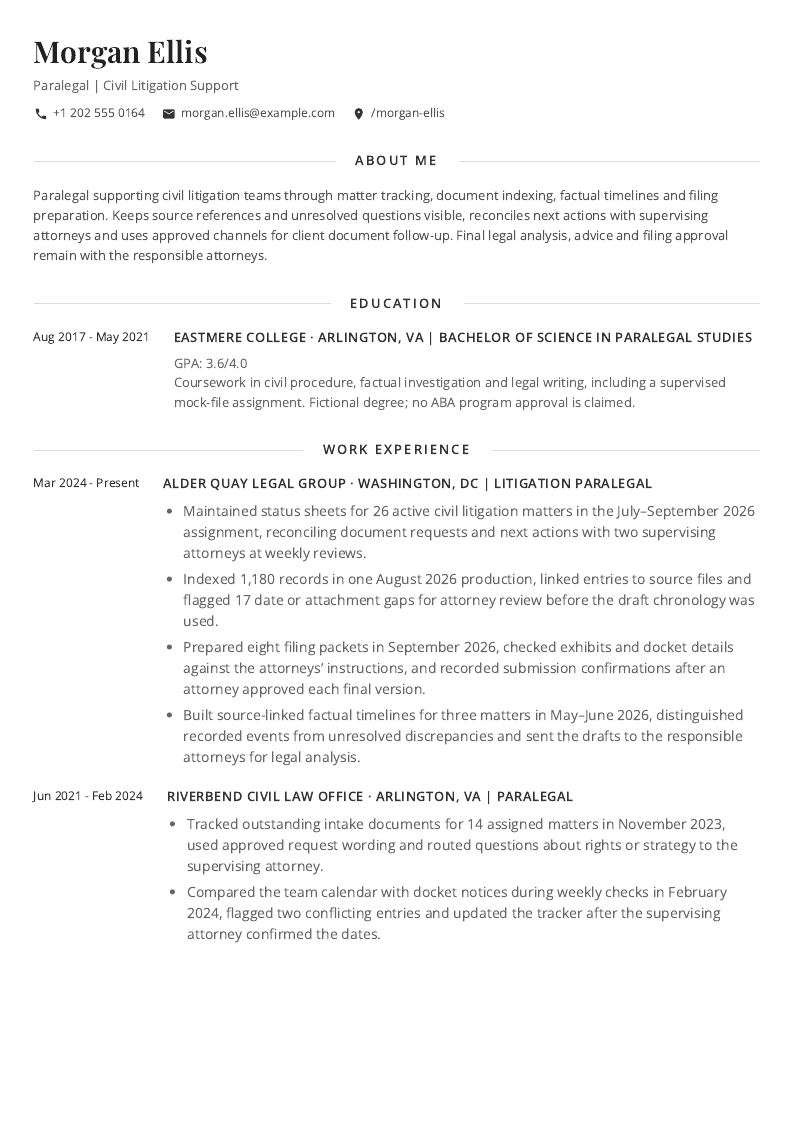
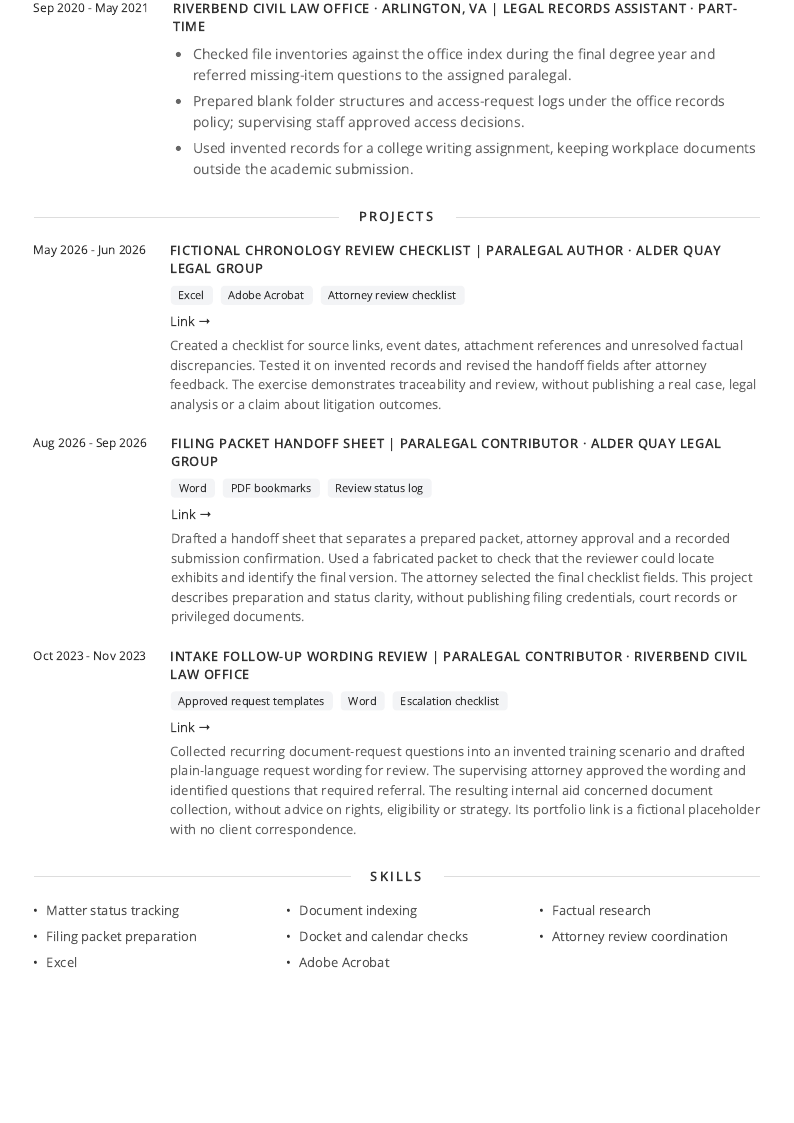
The expanded Classic example has the photo off. It preserves the base record, including the degree, GPA and chronology project, then adds the September 2020–May 2021 part-time records role and two later projects. The earlier role overlaps the final degree year and ends before the June 2021 paralegal role begins. The extra projects describe filing handoff and reviewed intake wording without adding case outcomes.
Paralegal supporting civil litigation teams through matter tracking, document indexing, factual timelines and filing preparation. Keeps source references and unresolved questions visible, reconciles next actions with supervising attorneys and uses approved channels for client document follow-up. Final legal analysis, advice and filing approval remain with the responsible attorneys.
Skills
Matter status tracking · Document indexing · Factual research · Filing packet preparation · Docket and calendar checks · Attorney review coordination · Excel · Adobe Acrobat
Experience
Litigation Paralegal
Alder Quay Legal Group · Washington, DC
March 2024–Present
Maintained status sheets for 26 active civil litigation matters in the July–September 2026 assignment, reconciling document requests and next actions with two supervising attorneys at weekly reviews.
Indexed 1,180 records in one August 2026 production, linked entries to source files and flagged 17 date or attachment gaps for attorney review before the draft chronology was used.
Prepared eight filing packets in September 2026, checked exhibits and docket details against the attorneys’ instructions, and recorded submission confirmations after an attorney approved each final version.
Built source-linked factual timelines for three matters in May–June 2026, distinguished recorded events from unresolved discrepancies and sent the drafts to the responsible attorneys for legal analysis.
Paralegal
Riverbend Civil Law Office · Arlington, VA
June 2021–February 2024
Tracked outstanding intake documents for 14 assigned matters in November 2023, used approved request wording and routed questions about rights or strategy to the supervising attorney.
Compared the team calendar with docket notices during weekly checks in February 2024, flagged two conflicting entries and updated the tracker after the supervising attorney confirmed the dates.
Legal Records Assistant · Part-time
Riverbend Civil Law Office · Arlington, VA
September 2020–May 2021
Checked file inventories against the office index during the final degree year and referred missing-item questions to the assigned paralegal.
Prepared blank folder structures and access-request logs under the office records policy; supervising staff approved access decisions.
Used invented records for a college writing assignment, keeping workplace documents outside the academic submission.
Education
Bachelor of Science in Paralegal Studies · Eastmere College · Arlington, VA
August 2017–May 2021
Coursework in civil procedure, factual investigation and legal writing, including a supervised mock-file assignment. Fictional degree; no ABA program approval is claimed.
GPA: 3.6/4.0
Projects
Fictional chronology review checklist
Paralegal author · Alder Quay Legal Group
May 2026–June 2026
Excel · Adobe Acrobat · Attorney review checklist
Created a checklist for source links, event dates, attachment references and unresolved factual discrepancies. Tested it on invented records and revised the handoff fields after attorney feedback. The exercise demonstrates traceability and review, without publishing a real case, legal analysis or a claim about litigation outcomes.
Drafted a handoff sheet that separates a prepared packet, attorney approval and a recorded submission confirmation. Used a fabricated packet to check that the reviewer could locate exhibits and identify the final version. The attorney selected the final checklist fields. This project describes preparation and status clarity, without publishing filing credentials, court records or privileged documents.
Paralegal contributor · Riverbend Civil Law Office
October 2023–November 2023
Approved request templates · Word · Escalation checklist
Collected recurring document-request questions into an invented training scenario and drafted plain-language request wording for review. The supervising attorney approved the wording and identified questions that required referral. The resulting internal aid concerned document collection, without advice on rights, eligibility or strategy. Its portfolio link is a fictional placeholder with no client correspondence.
Check dates against the correct job, then follow every sentence across page transitions. Keep the attorney approval and escalation clauses intact when editing. Select relevant material for your own vacancy rather than padding to a page count or removing review boundaries to squeeze the record onto one page.
Check the application file and its claims
Read all exported pages at normal size, including the degree and GPA, date column, final bullet and project links. Confirm that preparation and attorney approval remain connected.
Select and copy the PDF text. Check the reading order and full contact details, then test every portfolio and project link. Shortened display labels should retain the intended destination.
Follow the employer’s file instructions and inspect the contact fields, dates and job titles after upload. No design guarantees parsing, ranking or an interview.
Verify counts and periods against records you may use. Remove client identifiers, docket numbers, privileged content, confidential methods and unsupported claims about advice or results.
A free account is required for the builder. Free-plan PDF downloads include a watermark; these images show paid-plan output. Browse the wider template selection if another design makes your evidence easier to read.
State the practice setting, your actual title and dates, then show matter organization, factual research, document preparation and deadline checks with the appropriate attorney review. Select duties that match your own experience and the vacancy.
Can I say I managed cases independently?
Describe the tasks you owned precisely. Matter tracking or document follow-up can show initiative, while legal analysis, advice and approvals need their actual decision owner. Do not use independent case management as shorthand for authority you did not hold.
Do I need a paralegal certification?
Check the employer and applicable jurisdiction. A degree, educational certificate and voluntary professional certification are different records. The example includes a degree and makes no certification claim; it does not establish eligibility for every role.
Can I include real case names or a writing sample?
Use only material you are authorized to disclose. A clean invented chronology can illustrate your process. Do not assume a public filing or a document you handled is approved for a portfolio; follow the employer’s permitted review and submission process.
Which design is the default?
Classic, without a photo. Education precedes Work Experience; Civic and Essential place experience first. The optional photo changes header space, so inspect the actual export and follow the employer’s instructions.
What do the template buttons carry into signup?
They retain the chosen design, photo setting and Paralegal role. They do not put Morgan’s fictional resume or AI portrait into your account. A free account is required; free-plan PDF downloads include a watermark.
Sources and editorial scope
Prepared by Resumize with AI-assisted research and drafting for English-language US paralegal applications. Three direct employer descriptions were retrieved on October 28, 2026 with full responsibilities and application controls: Wilson Elser, Mission Lane and Legal Services NYC. They cover different practices and are a small source sample, not a universal job specification. ABA and NALA sources help distinguish delegated work, education and optional certification. This guide does not verify anyone’s credentials, determine legal eligibility or provide legal advice. All resume facts and the AI-generated portrait are fictional teaching material, without employer endorsement or a promise of interviews, screening results or case outcomes.
Retrieved October 28, 2026. Washington, DC; full description, Apply control and application form present. No posting date displayed. Supports document organization, factual retrieval, calendar monitoring and drafting for attorney approval. Its bachelor’s requirement and preferred certificate are specific to this vacancy.
Retrieved October 28, 2026. Remote, United States; full description, Apply control and application form present. No posting date displayed. Corporate legal operations example covering diligence requests, entity records, filings and work with attorneys; distinct from the sample’s litigation practice.
Retrieved October 28, 2026. Location field says Manhattan Legal Services; body describes work throughout Manhattan. Full description, Apply control and form present; no posting date displayed. Illustrates intake, file tracking, document gathering and attorney litigation support, with program-specific duties.
Retrieved October 28, 2026. Defines the role through qualifications and delegated substantive work for which a lawyer is responsible. Used for the supervision boundary, without claiming a uniform state license.
Retrieved October 28, 2026; page dated September 8, 2026. Describes education routes and jurisdiction-specific regulation. Check the target jurisdiction and employer; a degree, certificate or voluntary certification is not interchangeable with authority to practice law.
Retrieved October 28, 2026. Distinguishes an educational certificate from a professional certification and describes the CP credential. The example omits certification; a degree is not presented as a CP credential.
Retrieved October 28, 2026. Describes the five-year CP period and current renewal requirements. Check your actual issuer record and status before describing a credential as current.
Retrieved October 28, 2026. US Department of Labor-sponsored resume advice on relevant experience, employment dates and specific actions with context. Used for writing structure, without promising application-system compatibility or hiring results.