Occupational Therapist (OT) resume examples and templates
An occupational therapist resume should make the connection between meaningful daily activities, evaluation, intervention and follow-through easy to see. Name the population and setting, describe your own decisions and keep state licensure separate from national certification. This guide includes six annotated rewrites and the same complete fictional record in Fieldnote, Essential and Botanical.
Choose an occupational therapist (ot) resume design
These previews use the same layouts as the builder, with identical example content. Open a full preview to inspect the text and spacing.
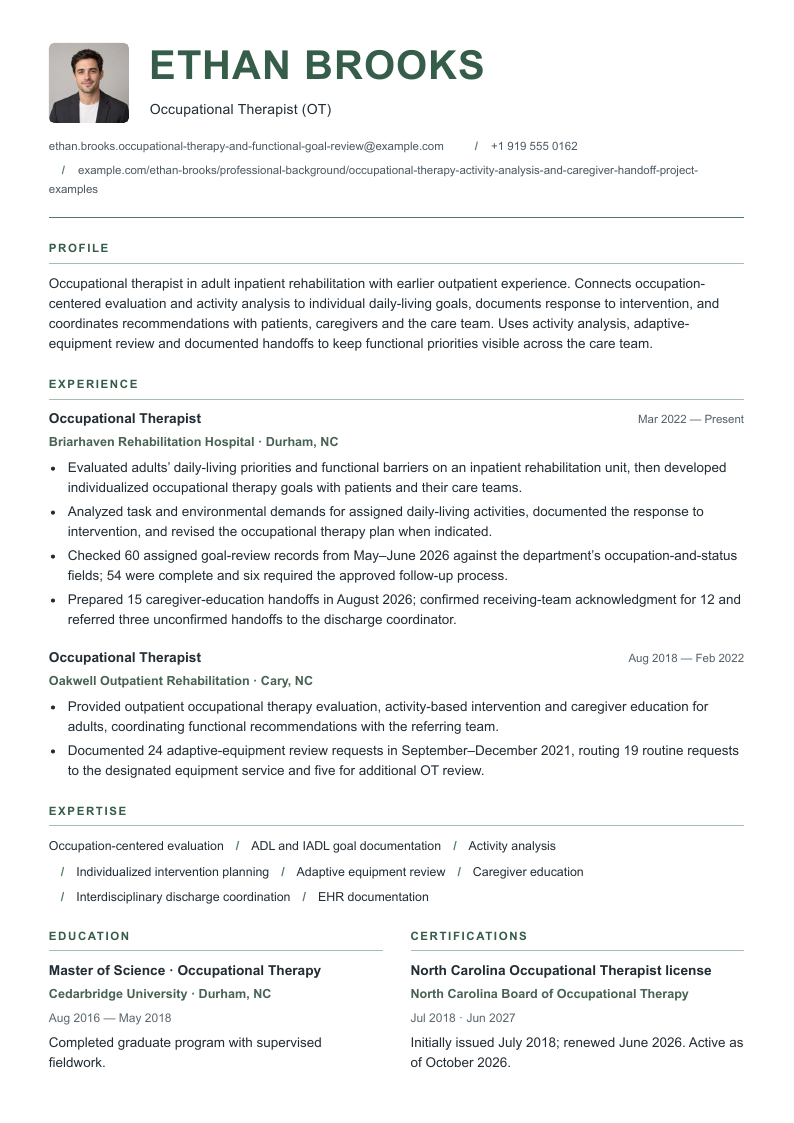
Fictional candidate, employers, education and results. The optional portrait is AI-generated. Use your own evidence and photo; the example is not inserted into your resume.
Fieldnote
A large sans-serif name, green slash separators and subtle section rules introduce a single-column body.
Before sending: Experience comes before skills, and projects follow qualifications. Read both the state license and separate NBCOT record across the full export.
A plain left header and restrained headings keep profile, experience, skills, education, credentials and projects in one main sequence.
Before sending: Quiet styling leaves clinical context to the wording. Retain the activity, setting and unresolved handoff status instead of shortening them to a skill list.
A mint rounded role band sits above a skills-and-education rail beside the main profile, experience and projects column. The optional circular portrait has a mint border.
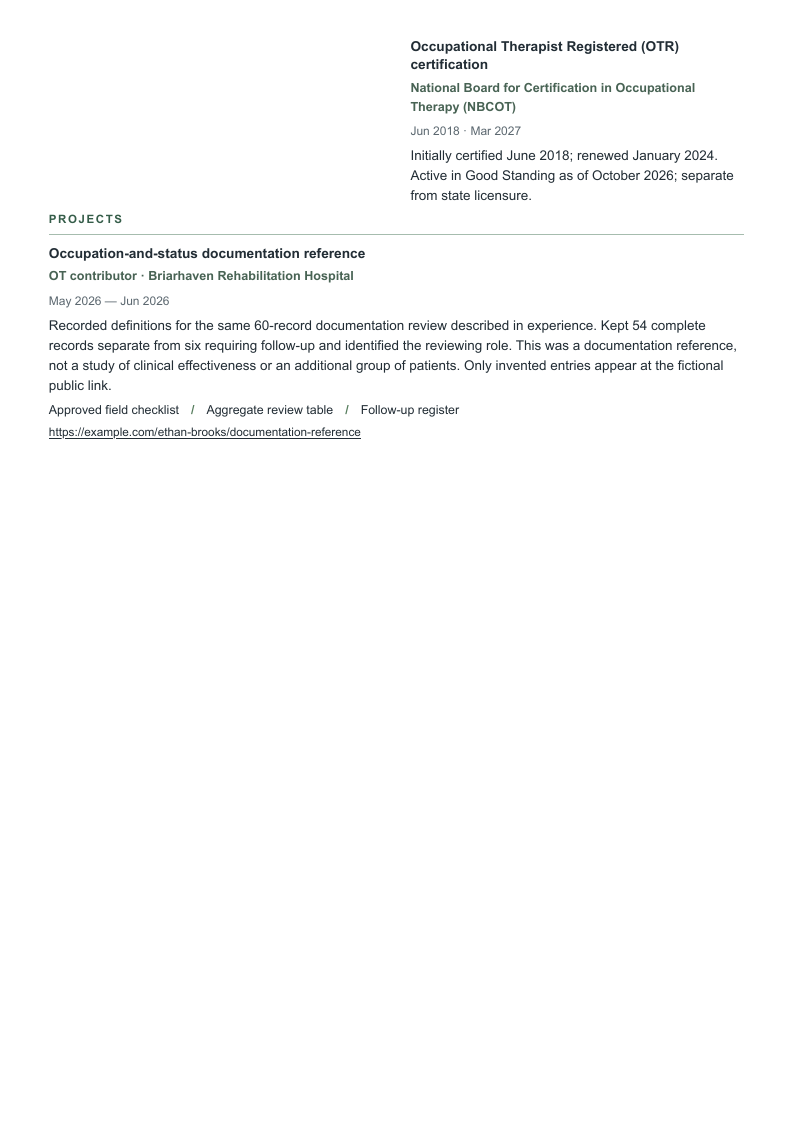
Before sending: The narrow qualifications rail wraps the two credential records. Follow both columns and verify that each issuer and expiry date stays attached to the correct credential.
“Use” opens signup with that design and photo preference selected for the builder. A free account is required. Free-plan PDF downloads include a watermark; see current plans for paid options. Photo conventions vary; follow the employer’s instructions and local expectations.
All three designs show the same fictional record. The default is without a photo; the optional portrait is AI-generated. Compare every page before choosing. Template buttons retain the exact design, photo preference and Occupational Therapist (OT) role through signup. They do not insert the fictional career record or portrait into your account.
Ethan Brooks is a fictional North Carolina occupational therapist with adult inpatient and earlier outpatient experience. Every person, employer, institution, credential, date, number and result in the examples is invented. Neither the state license nor NBCOT certification exists for this candidate, and the invented university is not an accreditation claim. All example.com links are placeholders and the optional portrait is AI-generated. These are resume-writing examples, not treatment recommendations or verified practitioner records.
Occupational therapist in adult inpatient rehabilitation with earlier outpatient experience. Connects occupation-centered evaluation and activity analysis to individual daily-living goals, documents response to intervention, and coordinates recommendations with patients, caregivers and the care team. Uses activity analysis, adaptive-equipment review and documented handoffs to keep functional priorities visible across the care team.
Evaluated adults’ daily-living priorities and functional barriers on an inpatient rehabilitation unit, then developed individualized occupational therapy goals with patients and their care teams.
Analyzed task and environmental demands for assigned daily-living activities, documented the response to intervention, and revised the occupational therapy plan when indicated.
Checked 60 assigned goal-review records from May–June 2026 against the department’s occupation-and-status fields; 54 were complete and six required the approved follow-up process.
Prepared 15 caregiver-education handoffs in August 2026; confirmed receiving-team acknowledgment for 12 and referred three unconfirmed handoffs to the discharge coordinator.
Occupational Therapist
Oakwell Outpatient Rehabilitation · Cary, NC
August 2018–February 2022
Provided outpatient occupational therapy evaluation, activity-based intervention and caregiver education for adults, coordinating functional recommendations with the referring team.
Documented 24 adaptive-equipment review requests in September–December 2021, routing 19 routine requests to the designated equipment service and five for additional OT review.
Education
Master of Science in Occupational Therapy · Cedarbridge University · Durham, NC
August 2016–May 2018
Completed graduate program with supervised fieldwork.
Licensure and certifications
North Carolina Occupational Therapist license
North Carolina Board of Occupational Therapy
Issued July 2018
Expires June 2027
Initially issued July 2018; renewed June 2026. Active as of October 2026.
National Board for Certification in Occupational Therapy (NBCOT)
Issued June 2018
Expires March 2027
Initially certified June 2018; renewed January 2024. Active in Good Standing as of October 2026; separate from state licensure.
Projects
Occupation-and-status documentation reference
OT contributor · Briarhaven Rehabilitation Hospital
May 2026–June 2026
Approved field checklist · Aggregate review table · Follow-up register
Recorded definitions for the same 60-record documentation review described in experience. Kept 54 complete records separate from six requiring follow-up and identified the reviewing role. This was a documentation reference, not a study of clinical effectiveness or an additional group of patients. Only invented entries appear at the fictional public link.
The current role connects daily-living priorities, activity analysis, goal-review documentation and caregiver handoffs. The earlier job shows adult outpatient work and adaptive-equipment review routing. The state license and OTR certification remain separate complete records. The project explains the same 60-record documentation sample from experience rather than presenting it as another group of patients.
Show the occupation, context and level of responsibility
Identify the actual occupations and setting relevant to your application: adult self-care after hospitalization, home routines, school participation, work tasks, mental-health services or another area you know. Explain how your evaluation and activity analysis informed an individualized plan. An undifferentiated exercise list loses the purpose of OT and does not show the decisions you made.
The researched vacancies serve different populations. Duke’s inpatient rehabilitation role emphasizes meaningful daily occupations, plans, education and care-team communication. Mayo’s mental-health opening includes inpatient and outpatient work and program contributions. Michigan Medicine’s pediatric role concerns children’s rehabilitation in a multidisciplinary clinic. Ethan’s fictional adult record does not claim the pediatric or mental-health expertise of those other openings.
Name supervisory or leadership responsibilities precisely. Coordinating recommendations with a care team is not the same as managing that team. An occupational therapist assistant, student, aide and occupational therapist can have different responsibilities. Keep the title and supervision context accurate, and verify the applicable board and employer expectations rather than assigning all team members the same evaluation authority.
Use the job advertisement to select evidence you actually have. If a posting names a pediatric assessment tool or a specialist area, do not add it merely as a keyword. Describe your genuine training or supervised exposure separately from competence you have demonstrated in employment. A relevant narrower example is more informative than an unsupported claim to every population, setting and technique.
Six occupational therapist rewrites with reasoning
Each after sentence appears verbatim in the base resume. The before statements are deliberately weak or overstated examples, not additional facts. Use the evidence prompts to check your own record and replace invented sample numbers with information you can substantiate and share.
1. Start with the occupation
Before: Improved every patient’s life with therapy.
After: Evaluated adults’ daily-living priorities and functional barriers on an inpatient rehabilitation unit, then developed individualized occupational therapy goals with patients and their care teams.
Why it works: Names the setting and occupation-centered contribution without assigning a universal outcome to every person.
Evidence to check: Actual assignment and competency records plus supervisor confirmation; no charts or identifiers.
2. Activity analysis and plan review
Before: Used exercises that guaranteed independence.
After: Analyzed task and environmental demands for assigned daily-living activities, documented the response to intervention, and revised the occupational therapy plan when indicated.
Why it works: Connects intervention to meaningful activities and reassessment without offering a treatment recipe or guaranteeing independence.
Evidence to check: Approved description of responsibilities and clinical review process, without patient-level material.
3. Documentation with a defined denominator
Before: Reached 100% clinical accuracy in all records.
After: Checked 60 assigned goal-review records from May–June 2026 against the department’s occupation-and-status fields; 54 were complete and six required the approved follow-up process.
Why it works: Fifty-four plus six accounts for 60 records. Field completeness is a process measure, not clinical accuracy, better daily function or proof of care quality.
Evidence to check: Employer-approved aggregate audit, field definitions, review dates and correction ownership.
4. Caregiver handoff and outstanding work
Before: Solved all family discharge concerns immediately.
After: Prepared 15 caregiver-education handoffs in August 2026; confirmed receiving-team acknowledgment for 12 and referred three unconfirmed handoffs to the discharge coordinator.
Why it works: The count separates acknowledgment from unresolved follow-up. It does not prove caregiver competence, equipment availability or discharge readiness.
Evidence to check: Aggregate handoff log, acknowledgment definition and coordinator escalation record.
5. Earlier outpatient scope
Before: Led every rehabilitation service at the clinic.
After: Provided outpatient occupational therapy evaluation, activity-based intervention and caregiver education for adults, coordinating functional recommendations with the referring team.
Why it works: Keeps the earlier OT job distinct from management and from claiming ownership of other professions’ services.
Evidence to check: Employment record, population and setting confirmation, and competency review.
6. Equipment review without a purchase claim
Before: Bought equipment that eliminated home safety risks.
After: Documented 24 adaptive-equipment review requests in September–December 2021, routing 19 routine requests to the designated equipment service and five for additional OT review.
Why it works: The 24 requests are divided by routing status. Neither referral nor a recommendation proves purchase, delivery, fit or elimination of risk.
Evidence to check: Approved aggregate request list, routing criteria and receiving-owner record.
Explain evidence without turning a process count into independence
Ethan’s summary names adult rehabilitation, occupation-centered evaluation, activity analysis and handoffs. The experience supplies examples of those contributions. Your own summary should do the same: a short introduction to your strongest relevant evidence, with the population and setting visible. Avoid a claim to improve every person’s independence unless the record can actually support the statement.
The goal-review check covers 60 assigned records from May–June 2026. Fifty-four contain the required occupation-and-status fields and six need follow-up. That is a 90% documentation-completeness result for the defined sample. It is not a 90% independence rate, a clinical-accuracy measure, proof of treatment effectiveness or a percentage improvement. Keep the denominator and the six outstanding records attached to the result.
If you have an approved functional result, identify the measure, starting point, follow-up period, paired cohort and your contribution. Different instruments and populations are not interchangeable. Record completion, caregiver acknowledgment and a change in an activity score answer different questions. Do not join them into a single outcome or attribute all multidisciplinary progress to one person.
The caregiver handoff example preserves 12 acknowledgments and three unconfirmed handoffs from August’s 15. Acknowledgment means the receiving team confirmed receipt; it is not proof of caregiver skill, equipment delivery or discharge readiness. The equipment bullet likewise distinguishes requests from orders. Status can make a modest process contribution credible without claiming that all risks were eliminated.
Connect selected skills to evidence
Choose terms from the actual vacancy only when your experience supports them. Spell out an unfamiliar abbreviation at first use and describe the task, setting and result behind it. A skills list helps a reader locate relevant work; it cannot establish a credential or guarantee screening success.
Occupational Therapist (OT) skills and supporting evidence
Skill
Evidence to gather
Fictional example
Occupation-centered evaluation
Population, daily priority and evaluation contribution.
Adult daily-living priorities in inpatient rehabilitation.
Activity analysis
Task and environment considered in the plan.
Demands linked to assigned daily-living activities.
Goal documentation
Defined fields, cohort and follow-up status.
54 complete plus six follow-ups among 60 records.
Caregiver communication
Material, receiving team and acknowledgment.
12 acknowledged plus three unconfirmed handoffs.
Adaptive equipment review
Recommendation, route and responsible service.
19 routine routes plus five additional OT reviews.
Team coordination
Your recommendation and the next decision owner.
Discharge coordinator receives open handoffs.
Keep the degree, state license and OTR status distinct
List the exact degree, field, institution and dates rather than treating the degree title as a license. Ethan’s fictional Master of Science in Occupational Therapy ran from August 2016 to May 2018 and included supervised fieldwork. NBCOT certification begins in June 2018 and the North Carolina license in July 2018, before the first August OT job. The invented record demonstrates a readable chronology; it does not verify eligibility at an actual school or board.
North Carolina’s board explains that licensure must be issued before practice begins and describes annual June 30 expiry. Ethan’s separate fictional state record shows initial issue, June 2026 renewal, active status as of October and June 2027 expiry. A candidate awaiting approval should describe the pending step accurately rather than displaying a license or active status they do not hold.
NBCOT certification is a separate record. Its guidance distinguishes Active in Good Standing status and use of OTR from expired certification, and describes a three-year renewal cycle. Ethan’s invented certification shows initial June 2018 certification, January 2024 renewal and March 2027 expiry. No real certification number is supplied. Use your actual current issuer record when deciding whether and how to display a credential.
The North Carolina board says continuing NBCOT certification is not required for state license renewal, while using OTR depends on maintaining the certification. Mayo separately requires continuing OTR certification for its researched employment opening. State renewal rules and employer criteria therefore should not be collapsed into one national rule. Verify your own jurisdiction and vacancy; membership in a professional association is not a substitute for either record.
Label fieldwork, projects and earlier work honestly
If you are entering OT, supervised fieldwork can show occupation-centered assessment, documentation, communication and reflection on a defined assignment. Identify it as fieldwork and name the setting, population, supervision and dates. A student placement or university simulation should not be presented as independent licensed work. Use invented or expressly approved blank material for a public example; do not publish clinical notes, recognizable patient stories or home assessments.
Ethan’s expanded record adds a part-time student-services assistant job from June 2015 to July 2016, before graduate study. Scheduling and routing accessibility-service questions show administrative communication. They do not demonstrate clinical eligibility decisions, OT evaluation or NBCOT status at that earlier date. Keep that boundary visible when translating transferable skills.
A project should add context to a genuine contribution. The occupation-and-status reference explains the fields behind the existing 60-record check. The caregiver reference explains acknowledgment definitions for the same 15 handoffs. The equipment index preserves 19 routine routes and five additional reviews among the same 24 requests. These are overlapping descriptions of existing work, not new clinical cohorts or an additive total.
Inspect long contacts with the optional photo
The Fieldnote long-contact export has the photo on and changes only Ethan’s resume email and portfolio URL. The user identity, phone, jobs, education, state license, OTR certification and projects are identical. Inspect the complete contact endings and the actual URL destination. The optional portrait changes header space, so a photo-off view is not sufficient to check its wrapping.
Occupational therapist in adult inpatient rehabilitation with earlier outpatient experience. Connects occupation-centered evaluation and activity analysis to individual daily-living goals, documents response to intervention, and coordinates recommendations with patients, caregivers and the care team. Uses activity analysis, adaptive-equipment review and documented handoffs to keep functional priorities visible across the care team.
Evaluated adults’ daily-living priorities and functional barriers on an inpatient rehabilitation unit, then developed individualized occupational therapy goals with patients and their care teams.
Analyzed task and environmental demands for assigned daily-living activities, documented the response to intervention, and revised the occupational therapy plan when indicated.
Checked 60 assigned goal-review records from May–June 2026 against the department’s occupation-and-status fields; 54 were complete and six required the approved follow-up process.
Prepared 15 caregiver-education handoffs in August 2026; confirmed receiving-team acknowledgment for 12 and referred three unconfirmed handoffs to the discharge coordinator.
Occupational Therapist
Oakwell Outpatient Rehabilitation · Cary, NC
August 2018–February 2022
Provided outpatient occupational therapy evaluation, activity-based intervention and caregiver education for adults, coordinating functional recommendations with the referring team.
Documented 24 adaptive-equipment review requests in September–December 2021, routing 19 routine requests to the designated equipment service and five for additional OT review.
Education
Master of Science in Occupational Therapy · Cedarbridge University · Durham, NC
August 2016–May 2018
Completed graduate program with supervised fieldwork.
Licensure and certifications
North Carolina Occupational Therapist license
North Carolina Board of Occupational Therapy
Issued July 2018
Expires June 2027
Initially issued July 2018; renewed June 2026. Active as of October 2026.
National Board for Certification in Occupational Therapy (NBCOT)
Issued June 2018
Expires March 2027
Initially certified June 2018; renewed January 2024. Active in Good Standing as of October 2026; separate from state licensure.
Projects
Occupation-and-status documentation reference
OT contributor · Briarhaven Rehabilitation Hospital
May 2026–June 2026
Approved field checklist · Aggregate review table · Follow-up register
Recorded definitions for the same 60-record documentation review described in experience. Kept 54 complete records separate from six requiring follow-up and identified the reviewing role. This was a documentation reference, not a study of clinical effectiveness or an additional group of patients. Only invented entries appear at the fictional public link.
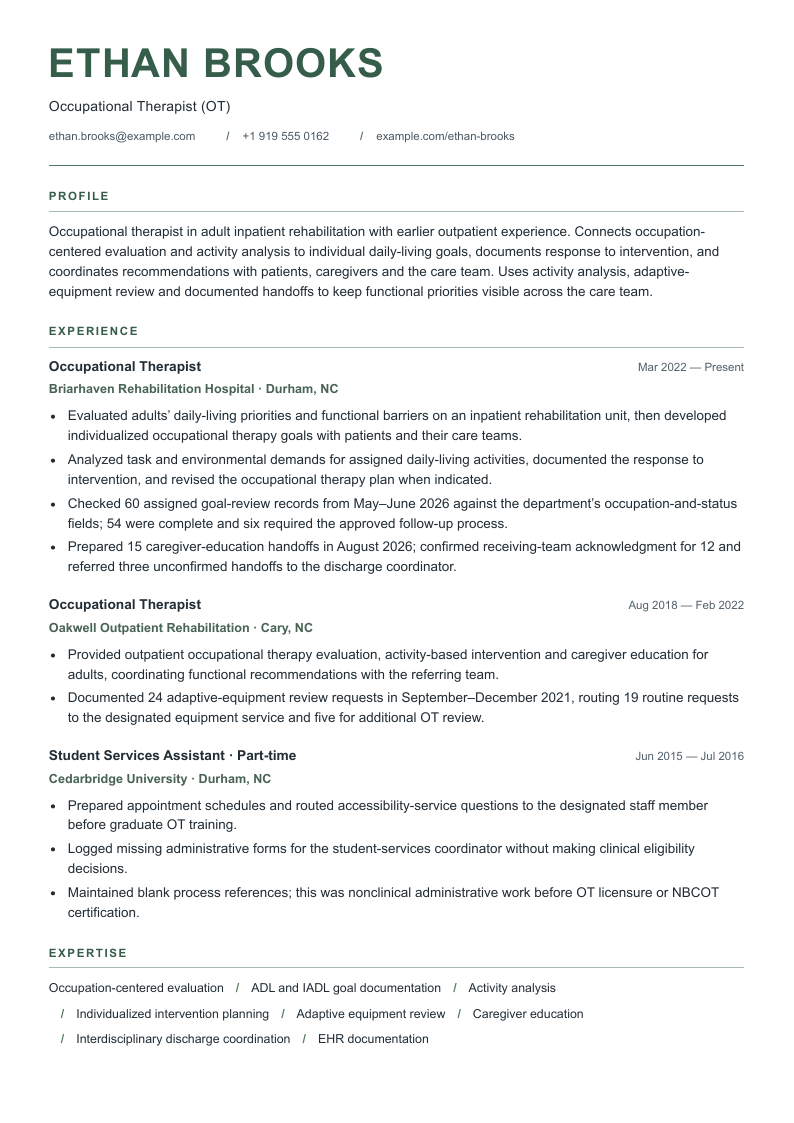
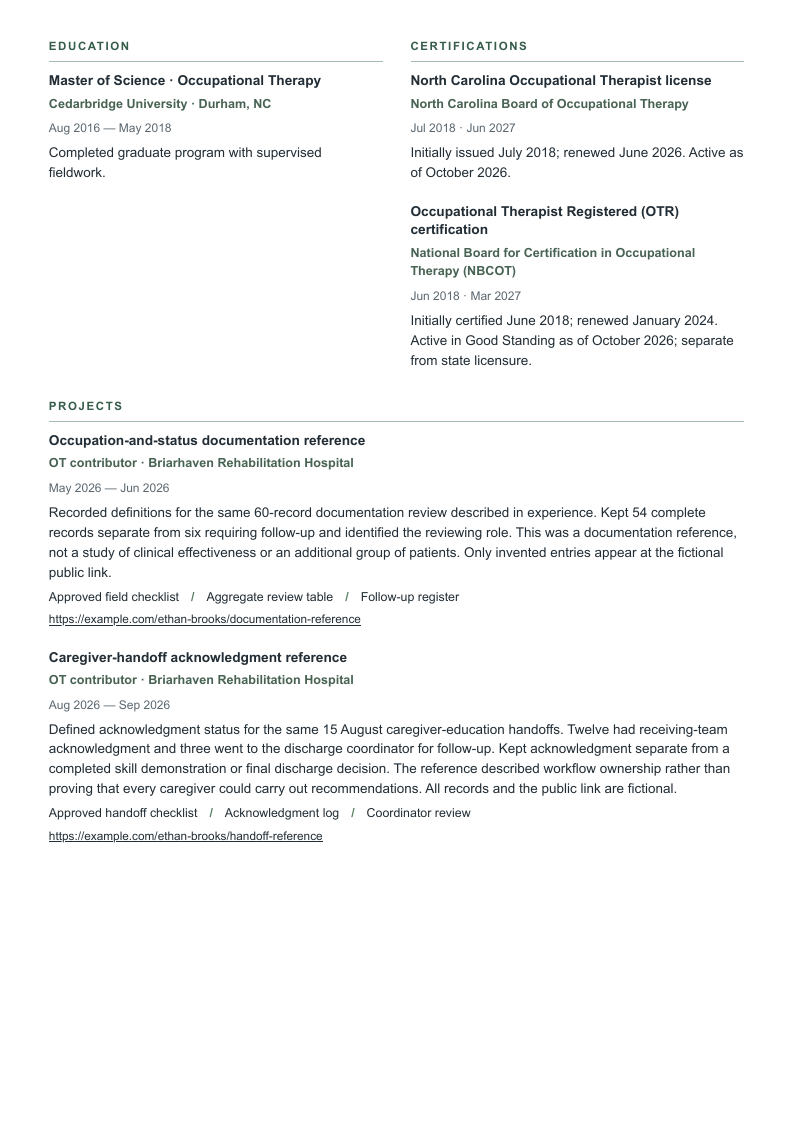
The expanded Fieldnote export has the photo off. It retains the entire base record and adds the earlier nonclinical student-services job, a caregiver-handoff reference and an adaptive-equipment review index. Follow both credential records and their separate issue and expiry dates before continuing through all three projects. The additional records are a layout test, not a claim that every OT application needs the same length.
Open page 1 at full sizeFieldnote · Page 1 of 3 · Photo off · Complete paid-plan PDF page, including margins, without a watermark.Open page 2 at full sizeFieldnote · Page 2 of 3 · Photo off · Complete paid-plan PDF page, including margins, without a watermark.Open page 3 at full sizeFieldnote · Page 3 of 3 · Photo off · Complete paid-plan PDF page, including margins, without a watermark.Use Fieldnote without a photo
Occupational therapist in adult inpatient rehabilitation with earlier outpatient experience. Connects occupation-centered evaluation and activity analysis to individual daily-living goals, documents response to intervention, and coordinates recommendations with patients, caregivers and the care team. Uses activity analysis, adaptive-equipment review and documented handoffs to keep functional priorities visible across the care team.
Evaluated adults’ daily-living priorities and functional barriers on an inpatient rehabilitation unit, then developed individualized occupational therapy goals with patients and their care teams.
Analyzed task and environmental demands for assigned daily-living activities, documented the response to intervention, and revised the occupational therapy plan when indicated.
Checked 60 assigned goal-review records from May–June 2026 against the department’s occupation-and-status fields; 54 were complete and six required the approved follow-up process.
Prepared 15 caregiver-education handoffs in August 2026; confirmed receiving-team acknowledgment for 12 and referred three unconfirmed handoffs to the discharge coordinator.
Occupational Therapist
Oakwell Outpatient Rehabilitation · Cary, NC
August 2018–February 2022
Provided outpatient occupational therapy evaluation, activity-based intervention and caregiver education for adults, coordinating functional recommendations with the referring team.
Documented 24 adaptive-equipment review requests in September–December 2021, routing 19 routine requests to the designated equipment service and five for additional OT review.
Student Services Assistant · Part-time
Cedarbridge University · Durham, NC
June 2015–July 2016
Prepared appointment schedules and routed accessibility-service questions to the designated staff member before graduate OT training.
Logged missing administrative forms for the student-services coordinator without making clinical eligibility decisions.
Maintained blank process references; this was nonclinical administrative work before OT licensure or NBCOT certification.
Education
Master of Science in Occupational Therapy · Cedarbridge University · Durham, NC
August 2016–May 2018
Completed graduate program with supervised fieldwork.
Licensure and certifications
North Carolina Occupational Therapist license
North Carolina Board of Occupational Therapy
Issued July 2018
Expires June 2027
Initially issued July 2018; renewed June 2026. Active as of October 2026.
National Board for Certification in Occupational Therapy (NBCOT)
Issued June 2018
Expires March 2027
Initially certified June 2018; renewed January 2024. Active in Good Standing as of October 2026; separate from state licensure.
Projects
Occupation-and-status documentation reference
OT contributor · Briarhaven Rehabilitation Hospital
May 2026–June 2026
Approved field checklist · Aggregate review table · Follow-up register
Recorded definitions for the same 60-record documentation review described in experience. Kept 54 complete records separate from six requiring follow-up and identified the reviewing role. This was a documentation reference, not a study of clinical effectiveness or an additional group of patients. Only invented entries appear at the fictional public link.
Defined acknowledgment status for the same 15 August caregiver-education handoffs. Twelve had receiving-team acknowledgment and three went to the discharge coordinator for follow-up. Kept acknowledgment separate from a completed skill demonstration or final discharge decision. The reference described workflow ownership rather than proving that every caregiver could carry out recommendations. All records and the public link are fictional.
OT contributor · Oakwell Outpatient Rehabilitation
September 2021–December 2021
Approved request form · Routing matrix · Review register
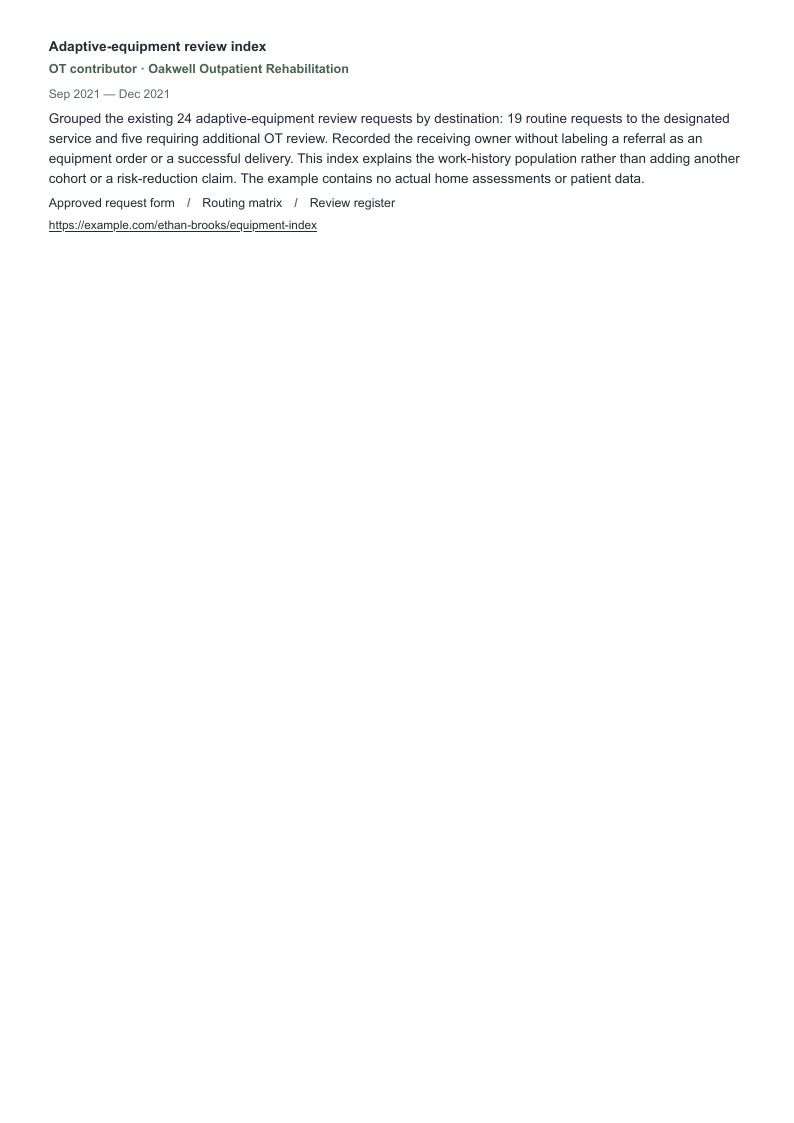
Grouped the existing 24 adaptive-equipment review requests by destination: 19 routine requests to the designated service and five requiring additional OT review. Recorded the receiving owner without labeling a referral as an equipment order or a successful delivery. This index explains the work-history population rather than adding another cohort or a risk-reduction claim. The example contains no actual home assessments or patient data.
Fieldnote and Essential present one main sequence, with different heading and date treatments. Botanical puts skills and qualifications in a narrower rail beside the main career column. Check that the North Carolina license and NBCOT certification keep their own issuer and dates, and read both columns to the final project sentence.
Check the file you will submit
Verify your qualifications. Check the exact degree, issuer, jurisdiction and current credential status against your own records. Keep pending or expired qualifications accurately labeled.
Keep the measurement intact. Retain the population, date range, definition and unresolved follow-up. A documentation check or acknowledged handoff is not a clinical outcome.
Inspect every page. Read contact endings, job dates, credential dates, project details and the final sentence. Open permitted links and confirm the actual destination.
Follow employer instructions. Check the requested file type, copied PDF text and parsed fields. A design cannot guarantee accurate parsing, licensure, an interview or a job offer.
A free account is required for the builder. Free-plan PDF downloads include a watermark; these preview images show paid-plan output. Use buttons carry the chosen design, photo preference and Occupational Therapist (OT) role into signup without copying the fictional career record or AI portrait.
What should an occupational therapist resume emphasize?
Show how evaluation and activity analysis relate to meaningful occupations for the population and setting you served. Support intervention planning, documentation, education and coordination with actual examples, and show accurate current qualifications.
Are state licensure and OTR certification the same thing?
They are separate records. North Carolina’s board distinguishes its license renewal from NBCOT certification and use of OTR. An employer may add its own current certification requirement. Check both your jurisdiction and the vacancy.
Can I call a documentation score an independence rate?
No. In this fictional sample, 54 of 60 records have complete required fields. That describes field completeness, not functional independence, clinical accuracy or a treatment effect. Keep the measurement definition and missing records visible.
How should an entry-level OT describe fieldwork?
Label supervised fieldwork accurately with dates, setting, population and your contribution. Keep it separate from independently licensed employment and describe pending qualifications honestly.
Can I publish case notes to prove my experience?
Use invented examples or approved blank process structures rather than charts, home assessments or recognizable patient narratives. A resume should explain your contribution without exposing protected or confidential information.
What does choosing a template preserve?
The signup button retains the exact Fieldnote, Essential, Botanical design, photo preference and Occupational Therapist (OT) role. It does not copy the fictional career record or AI portrait. A free account is required, and free-plan PDF downloads include a watermark.
Prepared by Resumize with AI-assisted research and drafting for English-language US applications. Duke, Mayo and Michigan Medicine descriptions were retrieved directly with full duties and application controls on October 28, 2026. The sources cover inpatient adult rehabilitation, mental-health services and pediatric care; they do not define one universal OT remit. Current North Carolina board and NBCOT materials support the limited license/certification distinctions. All career facts, credentials, counts and rewrites are original fiction, with placeholder links and an AI-generated optional portrait. This is resume guidance, not a clinical intervention, patient-specific recommendation or licensing determination. No application was submitted and no treatment, parsing or hiring outcome is guaranteed.
Checked October 28, 2026 by direct HTTP 200 retrieval. Exact current displayed title is Inpatient Rehab - PRN despite the older Acute-Care URL wording. Durham, NC, US, 27710; posted October 20, 2026; requisition 274950. Full responsibilities and Apply now present. Occupation-centered goals, documentation, education and team coordination inform this guide; it requires a North Carolina OT license.
Checked October 28, 2026 by direct HTTP 200 retrieval. Rochester, Minnesota; posted May 20, 2026; job 383046. Full inpatient/outpatient mental-health description and Apply Now present. This employer explicitly requires Minnesota licensure and ongoing NBCOT OTR certification; those employment criteria do not establish every state’s renewal rules.
Checked October 28, 2026 by direct HTTP 200 retrieval. Exact title as linked; Michigan Medicine - Ann Arbor, MI; opening 284227; posting period October 15–November 12, 2026. Full duties, required and desired qualifications and Apply Now present. Pediatric and multidisciplinary experience illustrates a different population from the fictional adult sample; desired tools are not universal OT requirements.
Checked October 28, 2026 through readable primary-page retrieval. Explains annual June 30 license expiry and separates state renewal from NBCOT certification and use of OTR. Direct requests timed out; the saved web retrieval provides the board’s actual text. The fictional sample does not verify a real practitioner.
Checked October 28, 2026 through readable primary-page retrieval. Distinguishes completion of education/examination from issuance of a North Carolina license before practice. Used for the fictional chronology; this is not a licensing application or universal US rule.
Checked October 28, 2026 by direct HTTP 200 retrieval. Describes the three-year renewal period and January–March renewal season; certification is separate from state licensure.
Checked October 28, 2026; current PDF retrieved directly. Explains Active in Good Standing status, use of OTR, three-year renewal and the scheduled renewal deadline. Fictional initial, renewal and expiry dates demonstrate a record structure, not actual certification.
Checked October 28, 2026. Official renewal application documents March 31 as the online renewal deadline in its displayed renewal year. Used only to check the month-end convention in the fictional March 2027 record; candidates must inspect their own current credential record.