California commercial litigation \u00b7 US private practice
Lawyer resume examples and templates for commercial litigation
A lawyer resume should tell a hiring partner where you are admitted, what kind of legal work you do and which parts of a matter you personally handled. This guide uses a California commercial litigation associate to show research, drafting, discovery and reporting without disclosing client matters or taking credit for a team\u2019s result.
These previews use the same layouts as the builder, with identical example content. Open a full preview to inspect the text and spacing.
Fictional candidate, employers, education and results. The optional portrait is AI-generated. Use your own evidence and photo; the example is not inserted into your resume.
Essential
A plain left-aligned header and restrained headings keep the summary and dated experience in a single main sequence.
Before sending: Admissions appear in the summary and the later certification block. Confirm both remain visible and match; the design does not move bar status into a dedicated top admission line.
Centered serif identity and section headings with thin rules give the same experience record a traditional single-column presentation.
Before sending: Its visual name does not turn this employment resume into an academic CV. Education, admission and the writing exercise follow experience and expertise; inspect their continuation pages.
A warm ivory background, large centered serif name and italic summary emphasize the practice-area introduction.
Before sending: The centered italic introduction changes emphasis and wrapping. Keep California admission status legible and check long contacts instead of assuming the more decorative header adds credibility.
“Use” opens signup with that design and photo preference selected for the builder. A free account is required. Free-plan PDF downloads include a watermark; see current plans for paid options. Photo conventions vary; follow the employer’s instructions and local expectations.
All three designs use the identical fictional record. Open each full preview to inspect every exported page and compare the optional photo. The default is without a photo. The optional portrait is AI-generated; the sample content and portrait are teaching examples and are not inserted into your account.
Essential offers a restrained left-aligned introduction, Scholar uses centered serif headings, and Heritage places a centered italic summary on a warm ivory page. All three preserve the same record. None creates a separate top-of-page admissions section automatically, so the fictional admission is explicit in the summary and its complete credential entry remains below. If the employer or your career office specifies a different section order, follow that instruction.
Alex Morgan is an invented California commercial litigation associate working on business contract disputes. The move between two fictional firms follows a December 2020 admission and a 2020 Juris Doctor. The later writing project is a synthetic exercise, separate from client work. Every candidate, employer, school, qualification and result is fictional; no real attorney holds the admission described here. Example.com links are placeholders, not a public client file or a sample to submit as your own.
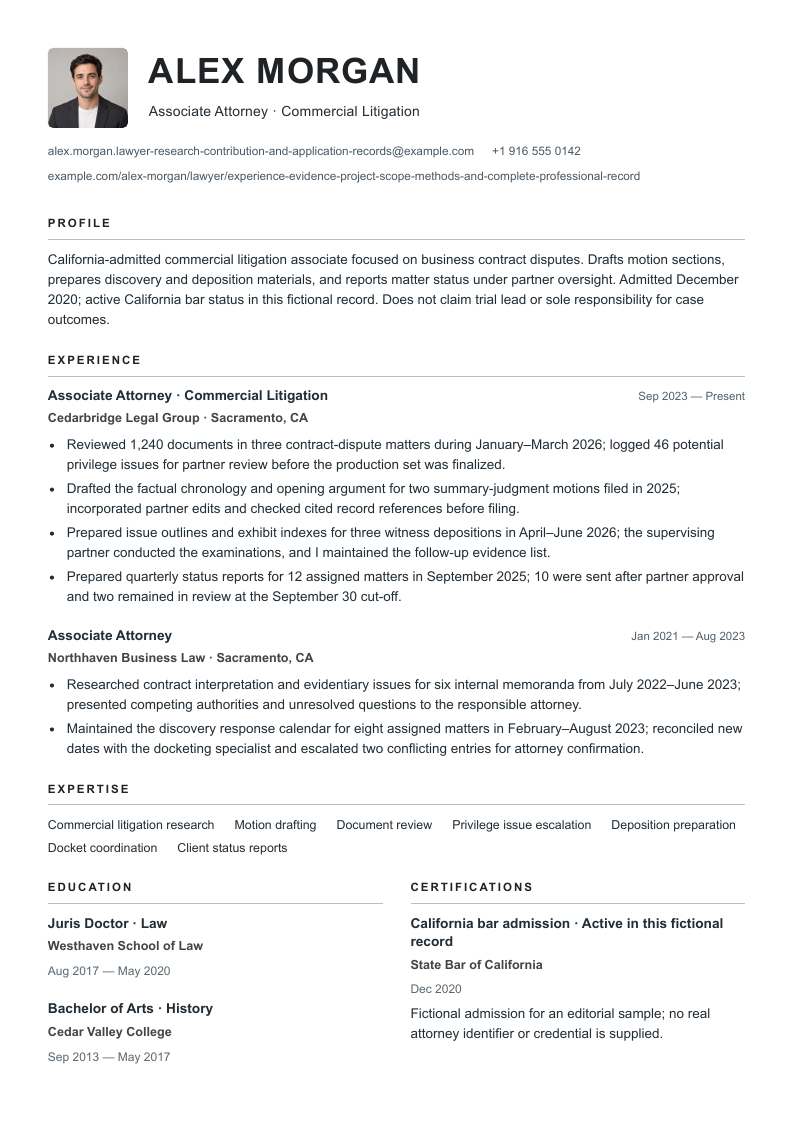
California-admitted commercial litigation associate focused on business contract disputes. Drafts motion sections, prepares discovery and deposition materials, and reports matter status under partner oversight. Admitted December 2020; active California bar status in this fictional record. Does not claim trial lead or sole responsibility for case outcomes.
Reviewed 1,240 documents in three contract-dispute matters during January–March 2026; logged 46 potential privilege issues for partner review before the production set was finalized.
Drafted the factual chronology and opening argument for two summary-judgment motions filed in 2025; incorporated partner edits and checked cited record references before filing.
Prepared issue outlines and exhibit indexes for three witness depositions in April–June 2026; the supervising partner conducted the examinations, and I maintained the follow-up evidence list.
Prepared quarterly status reports for 12 assigned matters in September 2025; 10 were sent after partner approval and two remained in review at the September 30 cut-off.
Associate Attorney
Northhaven Business Law · Sacramento, CA
January 2021–August 2023
Researched contract interpretation and evidentiary issues for six internal memoranda from July 2022–June 2023; presented competing authorities and unresolved questions to the responsible attorney.
Maintained the discovery response calendar for eight assigned matters in February–August 2023; reconciled new dates with the docketing specialist and escalated two conflicting entries for attorney confirmation.
Education
Juris Doctor in Law · Westhaven School of Law
August 2017–May 2020
Bachelor of Arts in History · Cedar Valley College
September 2013–May 2017
Admissions and Credentials
California bar admission · Active in this fictional record
State Bar of California
Issued December 2020
Fictional admission for an editorial sample; no real attorney identifier or credential is supplied.
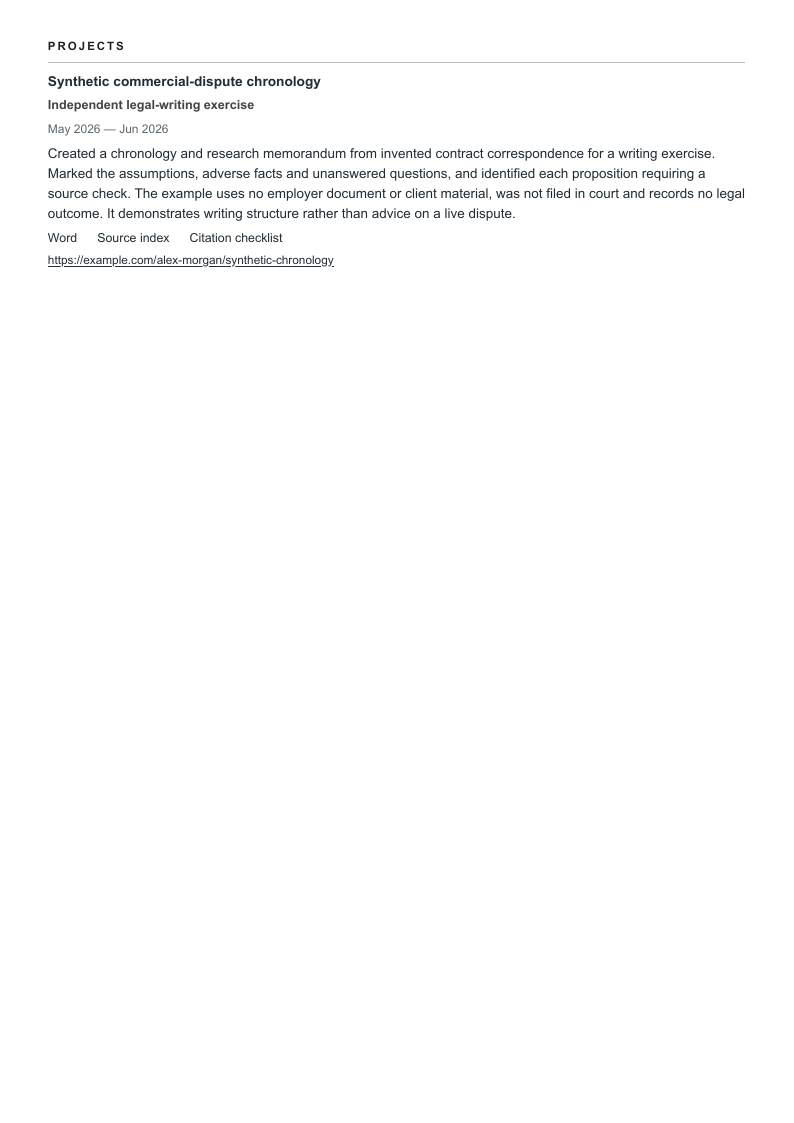
Projects
Synthetic commercial-dispute chronology
Independent legal-writing exercise
May 2026–June 2026
Word · Source index · Citation checklist
Created a chronology and research memorandum from invented contract correspondence for a writing exercise. Marked the assumptions, adverse facts and unanswered questions, and identified each proposition requiring a source check. The example uses no employer document or client material, was not filed in court and records no legal outcome. It demonstrates writing structure rather than advice on a live dispute.
The six experience bullets make the associate’s work visible without implying that Alex argued the motions, examined the witnesses or decided what could be produced. The project adds a writing-process example without publishing a client document. The admission entry states the chosen jurisdiction; it is not evidence of admission to any particular federal court.
Name the practice area, jurisdiction and level of responsibility
“Lawyer” is a broad search term. A private-practice commercial litigator, transactional associate, public defender and in-house counsel have different work to demonstrate. Keep your actual title and add a truthful practice-area descriptor if it helps the reader. This sample concerns California business disputes; it is not a model of the qualifications or procedure for every jurisdiction.
Use matter descriptions that convey your contribution without identifying a client: for example, a contract-dispute research memorandum, discovery response assignment or deposition-preparation task. State whether you drafted, reviewed, prepared, argued, examined or supervised. “Prepared for three depositions” means something different from “took three depositions.” Partner review is part of the work’s context, not a reason to replace a precise contribution with “assisted.”
The cited Wilson Elser role describes commercial litigation, motion practice and depositions. Downey Brand emphasizes business disputes, discovery and senior-attorney collaboration; its heading and body give different experience ranges, so read the current vacancy carefully. GRSM requests California admission and treats trial experience as preferred. These are selected employer descriptions, not universal experience thresholds or a reason to add trial work you have not performed.
Case outcomes require context. A motion drafted by an associate, revised by a partner and argued by another lawyer is team work. If a result can be shared, explain your part and the kind of disposition without implying a guarantee or sole causation. A win percentage without a period, denominator, definition of “win” and eligible matters can mislead. A settlement amount can also reveal private information; a numerical result is optional when it cannot be shared responsibly.
Six annotated lawyer bullet rewrites
Each after version appears in the complete resume above. The rewrites demonstrate reasoning, not achievements to borrow. Replace every fictional number, date and result with evidence that you are permitted to describe.
Discovery scope and review authority
Before: Managed all discovery with perfect accuracy.
After: Reviewed 1,240 documents in three contract-dispute matters during January–March 2026; logged 46 potential privilege issues for partner review before the production set was finalized.
Why it works: The document count covers a dated review set; flagged issues are not established privilege determinations. The partner retained the final decision. Neither volume nor an issue log proves that every document was reviewed without error.
Evidence to check: Dated review assignment, deduplicated document IDs, issue log and partner disposition; retain these internally rather than publishing the source documents.
Motion work without borrowing the ruling
Before: Won every motion and saved clients millions.
After: Drafted the factual chronology and opening argument for two summary-judgment motions filed in 2025; incorporated partner edits and checked cited record references before filing.
Why it works: Names the actual drafting contribution and the filing period. It does not imply sole authorship, oral argument, a favorable ruling or a client savings estimate. If a ruling is shareable and relevant, distinguish the team result from your own work.
Evidence to check: Version history, assignment notes, filed versions and the associate’s identifiable drafting scope.
Deposition preparation rather than examination
Before: Led high-stakes depositions independently.
After: Prepared issue outlines and exhibit indexes for three witness depositions in April–June 2026; the supervising partner conducted the examinations, and I maintained the follow-up evidence list.
Why it works: Three depositions describe a preparation cohort, not three examinations conducted. The outline and follow-up work are useful evidence even without stand-up experience.
Evidence to check: Deposition calendar, outline versions, exhibit index and documented division of responsibilities.
Client reporting with a reconciled status
Before: Always kept every client fully informed.
After: Prepared quarterly status reports for 12 assigned matters in September 2025; 10 were sent after partner approval and two remained in review at the September 30 cut-off.
Why it works: The 10 sent plus two pending reconcile to the 12-matter assignment. A report snapshot does not establish client satisfaction or prove that all client communication was timely. No client or case identifier belongs in the public example.
Evidence to check: Assigned-matter list, approval dates and the dated report tracker with confidential identifiers removed from any permitted summary.
Research that supports a decision
Before: Advised clients on all commercial law issues.
After: Researched contract interpretation and evidentiary issues for six internal memoranda from July 2022–June 2023; presented competing authorities and unresolved questions to the responsible attorney.
Why it works: Shows a bounded research practice without claiming universal subject expertise or final client-advice authority. Six memoranda are six work products, not six successful matters.
Evidence to check: Research assignments, memorandum dates, source-check records and responsible-attorney feedback.
Deadline work with a second check
Before: Guaranteed zero missed court deadlines.
After: Maintained the discovery response calendar for eight assigned matters in February–August 2023; reconciled new dates with the docketing specialist and escalated two conflicting entries for attorney confirmation.
Why it works: Describes the control and escalation rather than an unsupported guarantee. An eight-matter calendar is not the entire firm docket, and the attorney confirmation remains visible.
Evidence to check: Matter assignment window, calendar updates, docketing cross-checks and resolution of the two conflicting entries.
Choose a concise introduction and matter-based experience
Alex’s introduction states commercial litigation, California admission and the work performed under partner oversight. It does not use “expert in all commercial law” or claim a record of winning cases. A brief summary can help a lateral reader locate a specialty, but legal-resume conventions differ. If a recruiter requests a traditional resume with admissions, education and experience and no summary, adapt the order and omit the summary rather than repeating it elsewhere.
Under each employer, give the real title, location and dates before selecting the most relevant assignments. For a litigation vacancy, distinguish factual investigation, research, drafting, discovery management, witness preparation and actual advocacy. A transactional applicant should instead show relevant deal stages and responsibility; do not translate drafting a dispute chronology into negotiating a transaction.
The six rewrites below show how counts can establish scope without turning a resume into a billing report. Alex’s 1,240-document review has a quarter and a defined review set. The 12-report example states what was sent and what remained in review at one cut-off. Neither number implies a favorable legal result or measures client satisfaction. If even a matter count is sensitive, use an approved qualitative description.
Tie legal skills to work the reader can discuss
Choose relevant skills you can explain through your actual record. A tool or keyword is useful when the surrounding work makes its meaning clear. The table separates evidence to check from the invented example.
Lawyer skills, evidence to gather and fictional examples
Skill
Evidence to gather
Where it appears in this sample
Legal research
A defined question, relevant sources and a responsible-attorney review.
Six internal memoranda identify competing authorities and unanswered issues.
Motion drafting
The specific sections drafted, editing boundary and filing status.
Two filed motions include Alex’s factual chronology and opening argument.
Discovery review
The review set, issue flags and the final decision owner.
The partner reviews the 46 potential privilege issues.
Deposition preparation
Outlines, exhibits and the person who examined the witness.
The supervising partner conducts the three examinations.
Client reporting
The assignment cohort, approval stage and cut-off.
Ten of 12 reports are sent; two remain in review.
Deadline coordination
The check performed and how uncertain dates are escalated.
The docketing specialist and responsible attorney resolve conflicts.
Keep admissions distinct from education and membership
A Juris Doctor is an educational qualification. Bar admission and current status are separate facts. The sample supplies both the degree and an explicitly fictional California admission dated December 2020. For your own resume, give the jurisdiction and truthful current status requested by the employer. Passing an exam, awaiting admission, association membership and admission to a specific court should not be collapsed into one “licensed everywhere” statement.
List real degrees, institutions and completion or expected dates. Include honors, journals or a rank only when accurate and useful for the target application. An experienced associate may devote more space to practice than to school activities; a new graduate may emphasize relevant study and supervised clinical work. The cited career offices offer audience-specific section-order advice rather than a universal template rule.
Writing samples need their own care. Yale’s guidance advises obtaining permission for employer documents, preserving confidentiality and explaining edits or excerpts. Follow the employer’s requested length and format. A public docket entry does not by itself make the underlying work appropriate for unrestricted reuse. This sample uses invented source material and does not offer legal advice or a document for a live matter.
Adapt for a new lawyer without inventing admitted practice
If your relevant work is a summer position, law-school clinic, research assignment or judicial internship, keep that title and supervision visible. Explain the research question, draft or preparation task you completed. Do not change a student role into “Associate Attorney,” call exam eligibility an admission or imply that a simulated advocacy exercise was a court appearance.
A useful early-career description could say that you prepared a research summary and revised it after attorney feedback. If a clinical project involved real clients, use the confidentiality and description rules applicable to that work. Alex’s expanded record labels the summer role as temporary and the synthetic chronology as an independent writing exercise, preserving the distinction between training, practice and a portfolio demonstration.
Inspect long contact details with the photo on
Only the resume email and portfolio URL change in this contact stress check. Essential is shown with the optional photo on. Read the complete address and link below, then compare their final characters in the export. The photo is an optional layout comparison; this US example defaults to no photo and makes no claim that a portrait helps a legal application.
California-admitted commercial litigation associate focused on business contract disputes. Drafts motion sections, prepares discovery and deposition materials, and reports matter status under partner oversight. Admitted December 2020; active California bar status in this fictional record. Does not claim trial lead or sole responsibility for case outcomes.
Reviewed 1,240 documents in three contract-dispute matters during January–March 2026; logged 46 potential privilege issues for partner review before the production set was finalized.
Drafted the factual chronology and opening argument for two summary-judgment motions filed in 2025; incorporated partner edits and checked cited record references before filing.
Prepared issue outlines and exhibit indexes for three witness depositions in April–June 2026; the supervising partner conducted the examinations, and I maintained the follow-up evidence list.
Prepared quarterly status reports for 12 assigned matters in September 2025; 10 were sent after partner approval and two remained in review at the September 30 cut-off.
Associate Attorney
Northhaven Business Law · Sacramento, CA
January 2021–August 2023
Researched contract interpretation and evidentiary issues for six internal memoranda from July 2022–June 2023; presented competing authorities and unresolved questions to the responsible attorney.
Maintained the discovery response calendar for eight assigned matters in February–August 2023; reconciled new dates with the docketing specialist and escalated two conflicting entries for attorney confirmation.
Education
Juris Doctor in Law · Westhaven School of Law
August 2017–May 2020
Bachelor of Arts in History · Cedar Valley College
September 2013–May 2017
Admissions and Credentials
California bar admission · Active in this fictional record
State Bar of California
Issued December 2020
Fictional admission for an editorial sample; no real attorney identifier or credential is supplied.
Projects
Synthetic commercial-dispute chronology
Independent legal-writing exercise
May 2026–June 2026
Word · Source index · Citation checklist
Created a chronology and research memorandum from invented contract correspondence for a writing exercise. Marked the assumptions, adverse facts and unanswered questions, and identified each proposition requiring a source check. The example uses no employer document or client material, was not filed in court and records no legal outcome. It demonstrates writing structure rather than advice on a live dispute.
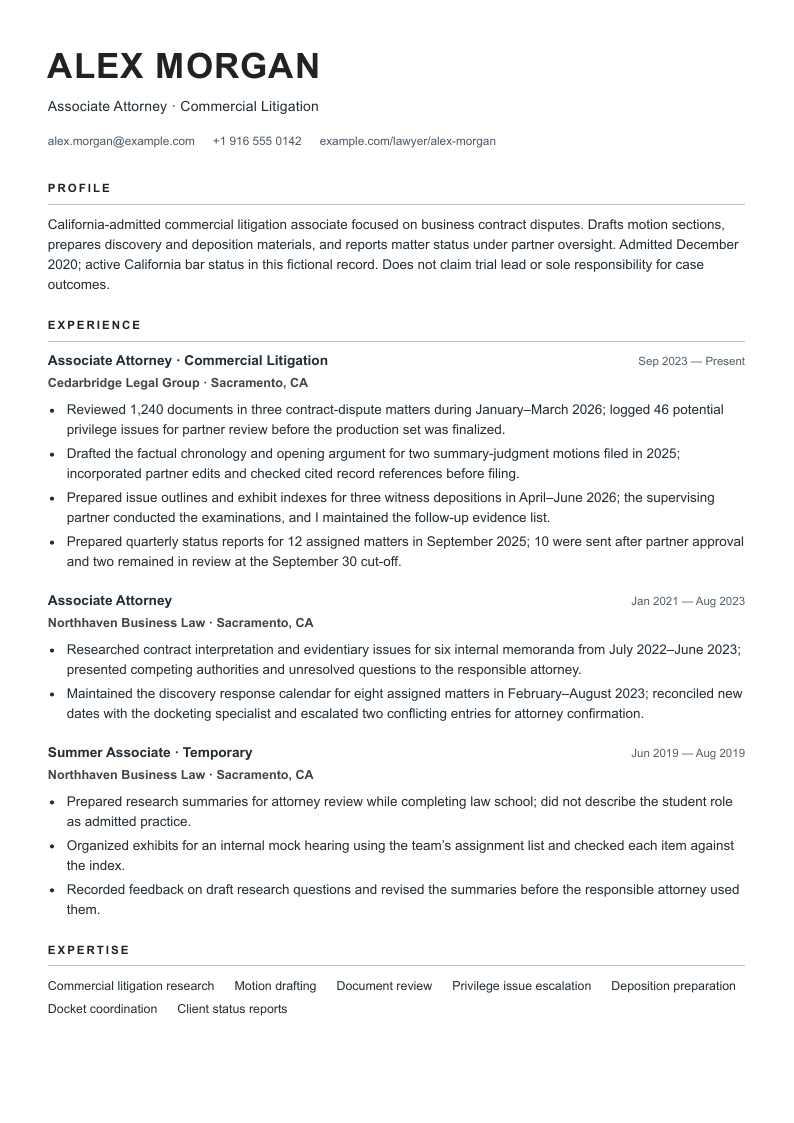
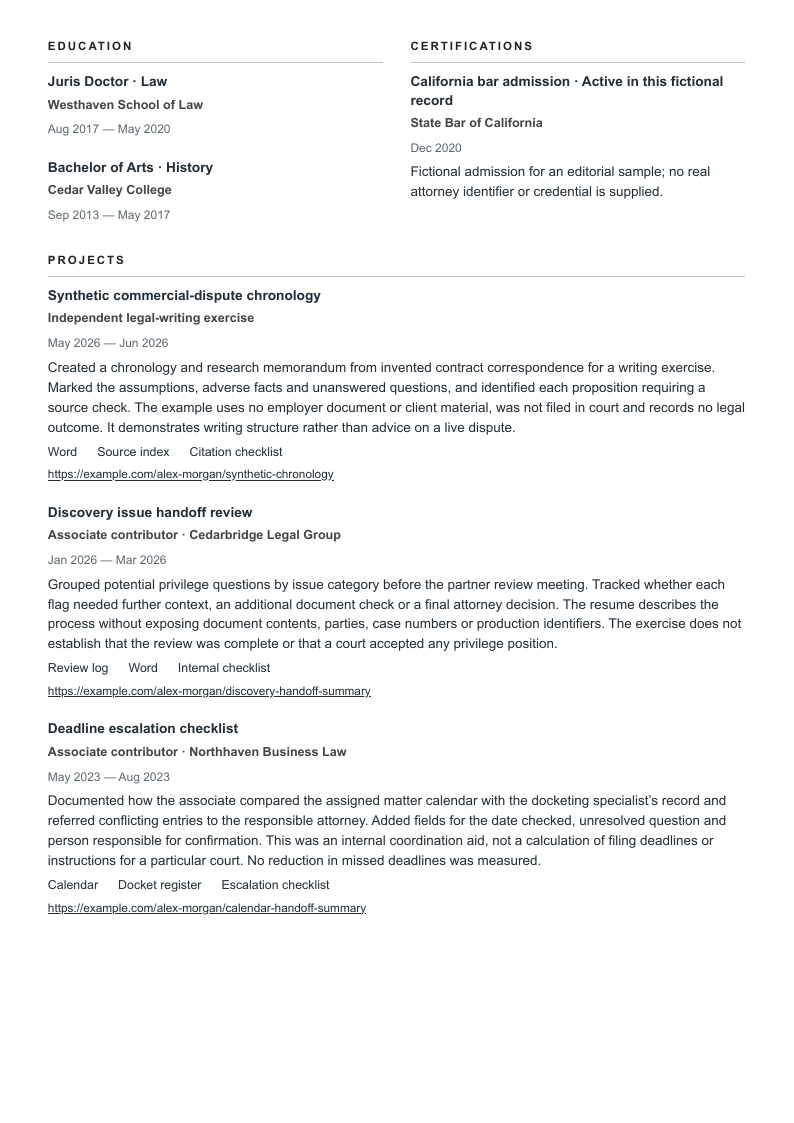
This Essential export has the photo off. It retains both associate roles, both degrees, the admission entry and the original writing project, then adds the temporary summer role and two dated process projects. Check that the earlier role, admission description and final project sentences remain visible on all continuation pages. Additional pages are a layout check, not a recommendation to send every item to every firm.
California-admitted commercial litigation associate focused on business contract disputes. Drafts motion sections, prepares discovery and deposition materials, and reports matter status under partner oversight. Admitted December 2020; active California bar status in this fictional record. Does not claim trial lead or sole responsibility for case outcomes.
Reviewed 1,240 documents in three contract-dispute matters during January–March 2026; logged 46 potential privilege issues for partner review before the production set was finalized.
Drafted the factual chronology and opening argument for two summary-judgment motions filed in 2025; incorporated partner edits and checked cited record references before filing.
Prepared issue outlines and exhibit indexes for three witness depositions in April–June 2026; the supervising partner conducted the examinations, and I maintained the follow-up evidence list.
Prepared quarterly status reports for 12 assigned matters in September 2025; 10 were sent after partner approval and two remained in review at the September 30 cut-off.
Associate Attorney
Northhaven Business Law · Sacramento, CA
January 2021–August 2023
Researched contract interpretation and evidentiary issues for six internal memoranda from July 2022–June 2023; presented competing authorities and unresolved questions to the responsible attorney.
Maintained the discovery response calendar for eight assigned matters in February–August 2023; reconciled new dates with the docketing specialist and escalated two conflicting entries for attorney confirmation.
Summer Associate · Temporary
Northhaven Business Law · Sacramento, CA
June 2019–August 2019
Prepared research summaries for attorney review while completing law school; did not describe the student role as admitted practice.
Organized exhibits for an internal mock hearing using the team’s assignment list and checked each item against the index.
Recorded feedback on draft research questions and revised the summaries before the responsible attorney used them.
Education
Juris Doctor in Law · Westhaven School of Law
August 2017–May 2020
Bachelor of Arts in History · Cedar Valley College
September 2013–May 2017
Admissions and Credentials
California bar admission · Active in this fictional record
State Bar of California
Issued December 2020
Fictional admission for an editorial sample; no real attorney identifier or credential is supplied.
Projects
Synthetic commercial-dispute chronology
Independent legal-writing exercise
May 2026–June 2026
Word · Source index · Citation checklist
Created a chronology and research memorandum from invented contract correspondence for a writing exercise. Marked the assumptions, adverse facts and unanswered questions, and identified each proposition requiring a source check. The example uses no employer document or client material, was not filed in court and records no legal outcome. It demonstrates writing structure rather than advice on a live dispute.
Grouped potential privilege questions by issue category before the partner review meeting. Tracked whether each flag needed further context, an additional document check or a final attorney decision. The resume describes the process without exposing document contents, parties, case numbers or production identifiers. The exercise does not establish that the review was complete or that a court accepted any privilege position.
Documented how the associate compared the assigned matter calendar with the docketing specialist’s record and referred conflicting entries to the responsible attorney. Added fields for the date checked, unresolved question and person responsible for confirmation. This was an internal coordination aid, not a calculation of filing deadlines or instructions for a particular court. No reduction in missed deadlines was measured.
Confirm jurisdiction and status. Check admissions separately from degrees and association memberships. Match any jurisdiction-specific application instructions and do not infer a court admission from a state admission.
Read the actual exported pages. Check drafting scopes, review owners, date ranges, long contacts and every project ending. Do not hide the partner’s role or the pending status to fit a page.
Inspect text and links. Copy text from the PDF and check the reading order. Open portfolio destinations and confirm that a public link contains only material you are permitted to share.
Follow the vacancy instructions. Use its requested file type and writing-sample requirements. Review parsed fields after upload; no design guarantees correct parsing or a hiring outcome.
Review your resume with the analyzer and check suggestions against your records. The design buttons open signup with the selected template and photo preference. Free-plan PDF downloads include a watermark; these examples show paid-plan output.
Questions, answered
Should I write lawyer or attorney on my resume?
Keep the title you actually held and add a truthful practice-area descriptor when useful. This page uses lawyer for broad search intent and Associate Attorney for the fictional California employment record. Do not imply admission or a title you do not hold.
Should I list a bar number?
Follow the employer’s instructions and the conventions relevant to your jurisdiction. State truthful admission and current status. This fictional example deliberately supplies no real attorney number and makes no claim that one is universally required on a resume.
Can I include a case win or settlement?
Use only shareable, accurate information, distinguish your contribution from the team result and avoid unsupported causal credit. A meaningful drafting or research description can stand without a win rate or confidential settlement amount.
Can a writing sample use client material?
Follow the employer’s instructions and obtain the required permission before using employer documents. Yale’s cited career guidance addresses confidentiality, redactions and explaining editing. This guide uses synthetic material and is resume-writing guidance, not legal advice.
Does Scholar mean I should submit an academic CV?
No. Scholar is a visual design with centered serif headings. The example is an employment resume. Follow the vacancy’s requested document and include relevant publications only when you can describe their authorship and status accurately.
Will the builder keep my selected design and photo preference?
The Use buttons open signup with that design and the selected photo preference for the builder. A free account is required. The fictional candidate record and AI-generated portrait are not inserted into your resume; free-plan PDF downloads include a watermark.
Prepared by Resumize with AI-assisted research and drafting for English-language US applications. The three primary employer descriptions and career guidance below were checked on October 27, 2026. Employer pages displayed application controls or forms as noted; that observation is not proof of a completed application or a guarantee the vacancy remains available. These selected descriptions illustrate different scopes rather than universal hiring requirements. The complete records, rewrites and design comparisons are original editorial examples, not employer endorsements, search-ranking forecasts or promises of hiring results.
Checked October 27, 2026: San Diego primary description displayed Apply and an application form with Submit application; no publication date shown. Requires California admission and describes commercial disputes, motion practice, depositions and client reports. Requirements belong to this vacancy; no application was submitted.
Checked October 27, 2026: current openings page dated this Sacramento listing October 9, 2026 and displayed Submit Resume linking to FloRecruit. The heading says 4–8 years while the requirements text says 3–6, so do not infer a precise experience cutoff from this guide. Describes discovery, motions, depositions and senior-attorney collaboration; application completion was not tested.
Checked October 27, 2026: Los Angeles posting ID 2026-2420 displayed Apply and requested a cover letter, resume and writing sample; no publication date shown. The page also warned that cookies must be enabled for application features. California admission is specified; trial experience is preferred, not required. Application completion was not tested.
Read October 27, 2026. Career guidance on accurate legal experience, admissions, education and clear presentation. Its student-oriented advice and section-order preferences do not certify these layouts or set requirements for all experienced-lawyer applications.
Read October 27, 2026. Advises following requested writing-sample instructions, obtaining employer permission for employer documents, preserving confidentiality and explaining edits or excerpts. This guide gives resume-writing guidance, not legal advice.