Scholar
Centered serif identity and section headings with thin rules above a mostly single-column sequence of work, skills, qualifications and projects.
Before sending: Check dense method descriptions and education details at normal reading size.
Science and laboratory operations · US applications
A laboratory technician resume should make the sample, procedure and record trail visible. State which work you were trained to perform, how you recorded it and when you referred an exception. A credible laboratory record separates preparation and quality checks from independent analysis, interpretation and report authorization.
By Resumize · · Sources and scope
Three designs · one example
These previews use the same layouts as the builder, with identical example content. Open a full preview to inspect the text and spacing.
Fictional candidate, employers, education and results. The optional portrait is AI-generated. Use your own evidence and photo; the example is not inserted into your resume.
Centered serif identity and section headings with thin rules above a mostly single-column sequence of work, skills, qualifications and projects.
Before sending: Check dense method descriptions and education details at normal reading size.
Large uppercase sans-serif name, green contact and skill separators, a ruled header and single-column work history.
Before sending: Read long procedure names and continuation pages rather than judging only the first page.
A centered name and contact block above a single-column body, uppercase headings and restrained gray rules.
Before sending: Long contact lines and the optional portrait can change the header depth.
“Use” opens signup with that design and photo preference selected for the builder. A free account is required. Free-plan PDF downloads include a watermark; see current plans for paid options. Photo conventions vary; follow the employer’s instructions and local expectations.
All three designs use the same fictional career. Start without a photo and follow the employer’s instructions and local conventions. The optional portrait is AI-generated. Signup retains the exact design, photo preference and Laboratory Technician role; it does not insert the sample career or portrait into your account.
Jamie Foster, the employers, education, dates, projects and metrics are original fiction. The example.com contacts and project links are illustrative placeholders. The optional portrait is AI-generated. Replace every detail with your own shareable evidence; no professional certification is supplied.
Laboratory Technician | Environmental Testing
jamie.foster@example.com · +1 614 555 0189
Portfolio: https://example.com/jamie-foster
Laboratory technician preparing environmental water samples under approved methods and analyst supervision. Maintains sample identity, equipment checks and LIMS records, and refers quality-control exceptions before release. Brings laboratory-assistant experience and an associate degree in laboratory science; does not perform clinical diagnosis or authorize final reports.
Sample preparation · LIMS data entry · Sample traceability · Routine equipment checks · QC recordkeeping · SOP documentation · Laboratory housekeeping
Alderbrook Environmental Testing · Columbus, OH
April 2022–Present
Pinegate Water Services · Hilliard, OH
June 2019–March 2022
Associate of Applied Science in Laboratory Science · Maplebridge Community College · Columbus, OH
August 2017–May 2019
Laboratory Technician · Alderbrook Environmental Testing
June 2026–July 2026
LIMS export · Receipt checklist · Excel
Reviewed the eight incomplete first-review records with accessioning staff and grouped the missing-field types. Proposed checklist wording for supervisor approval; the review did not establish analytical accuracy or a later improvement rate.
Jamie’s fictional environmental water-testing career centers on sample identity, preparation, routine measurements and documented checks. It is a nonclinical example. It does not establish clinical laboratory licensure, patient testing authority or competence on every instrument used elsewhere in the laboratory.
Write the sample type, approved method or SOP context and your actual task. Preparation, instrument operation, method development and final result approval are distinct contributions. If an analyst performed the instrument analysis, say how your aliquot, identity and bench records supported that handover. A technique used once in a class should retain its training setting.
The selected descriptions show the range within the title. Eurofins’ Barberton opening concerns environmental samples under supervision. SGS chemistry involves consumer-product preparation and equipment checks, while SGS Harrisburg emphasizes trained supervised testing and quality records. These differences matter more than filling the skills section with every laboratory acronym.
Read the source descriptions directly: Eurofins: Laboratory Technician, Barberton; SGS: Laboratory Technician – Chemistry; SGS: Laboratory Technician, Harrisburg. These selected vacancies illustrate scope, not market-wide requirements.
Each after sentence appears verbatim in the base resume. The deliberately weak before statements are teaching examples. Use the evidence prompts to check your own records before adapting a claim.
Before: Performed every laboratory test.
After: Prepare water-sample aliquots and routine measurements under approved SOPs, recording method versions and referring instrument-analysis work to authorized analysts.
Why it works: States sample type, procedural control and role boundary without inventing advanced instrument competence.
Evidence to check: Training authorization, method version, bench records and task assignment.
Before: Achieved 100% lab accuracy.
After: Checked 240 sample records received in June 2026; 232 had complete receipt fields on first review and referred eight incomplete records to the accessioning lead.
Why it works: The 96.7% first-review completeness rate concerns documentation, not analytical accuracy.
Evidence to check: Receipt cohort, required fields, first-review log and exceptions.
Before: Guaranteed reliable results.
After: Recorded blank and duplicate checks with each assigned batch and flagged results outside SOP limits to the analyst before further processing or report review.
Why it works: QC action is specific without claiming the technician independently validates every result.
Evidence to check: QC worksheets, acceptance limits, exception records and analyst review.
Before: Calibrated every machine.
After: Completed assigned balance and pH-meter verification logs, recorded out-of-range checks and withheld affected equipment pending supervisor assessment.
Why it works: Verification and calibration are different activities; the claim names what was actually done.
Evidence to check: Equipment IDs, verification records, acceptance criteria and escalation.
Before: Managed all laboratory operations.
After: Logged incoming water samples, matched container identifiers to submission records and referred labeling or condition discrepancies before preparation.
Why it works: Receipt control is useful assistant evidence without claiming responsibility for the entire laboratory.
Evidence to check: Receipt procedure, identifier checks and discrepancy disposition.
Before: Kept the lab spotless.
After: Prepared glassware and stocked designated consumables using laboratory procedures, maintaining lot records and reporting damaged or depleted supplies to the lead technician.
Why it works: Identifies controlled support work rather than a vague cleanliness claim.
Evidence to check: Support-task training, lot records and supply follow-up.
The June receipt check covers 240 records, with 232 complete at first review and eight referred for correction. That is approximately 96.7% first-review completeness for this cohort. It is not an analytical recovery rate, measurement uncertainty, sample acceptance rate or claim that all laboratory records were accurate.
Blank and duplicate checks support a batch review according to the laboratory method and limits. The fictional bullet describes recording and escalation; it supplies no results from which to infer method performance. Avoid calling every equipment check calibration. The sample says verification and retains supervisor assessment for out-of-range equipment.
For throughput evidence, identify whether you count samples, aliquots, tests or reports and state the period. Repeats and QC material can change those counts. For improvement claims, retain comparable work and the effect on quality or rework. A high preparation count should not imply authority to release data or expertise in unfamiliar methods.
Choose the skills the vacancy needs that your record supports. The table links the sample’s tasks to the records needed to substantiate them. Keep confidential documents private; use permitted descriptions or synthetic examples when a public work sample would expose employer information.
| Capability | Evidence to check | Sample wording |
|---|---|---|
| Name the method boundary | Training authorization, method version, bench records and task assignment. | Prepare water-sample aliquots and routine measurements under approved SOPs, recording method versions and referring instrument-analysis work to authorized analysts. |
| Count traceability rather than accuracy | Receipt cohort, required fields, first-review log and exceptions. | Checked 240 sample records received in June 2026; 232 had complete receipt fields on first review and referred eight incomplete records to the accessioning lead. |
| Show QC escalation | QC worksheets, acceptance limits, exception records and analyst review. | Recorded blank and duplicate checks with each assigned batch and flagged results outside SOP limits to the analyst before further processing or report review. |
| Describe equipment checks | Equipment IDs, verification records, acceptance criteria and escalation. | Completed assigned balance and pH-meter verification logs, recorded out-of-range checks and withheld affected equipment pending supervisor assessment. |
| Keep sample custody clear | Receipt procedure, identifier checks and discrepancy disposition. | Logged incoming water samples, matched container identifiers to submission records and referred labeling or condition discrepancies before preparation. |
| Explain support work | Support-task training, lot records and supply follow-up. | Prepared glassware and stocked designated consumables using laboratory procedures, maintaining lot records and reporting damaged or depleted supplies to the lead technician. |
The sample has an associate degree and no professional certification. BLS offers occupational context for chemical-technician work, while the cited vacancies vary in education and experience. A credential required for a clinical role should not be borrowed into this nonclinical environmental example.
List only techniques and equipment for which you can explain your training and actual use. Internal competency sign-off, laboratory accreditation and a personal credential are different. Do not list the employer’s laboratory accreditation as your own certification. State completed education and genuine training status without inventing authorization.
For an entry-level application, keep supervised academic or student-aide work clearly labeled. Record a real method, sample type, notebook practice and result-review process from your training. A teaching-laboratory exercise can show care and documentation without becoming commercial testing or independent research.
A fictional adaptation could read: “Laboratory science graduate seeking a technician role. Prepares labeled teaching samples under instructor procedures, maintains bench records and reports discrepancies for review. Brings coursework and supervised experience in sample handling and routine measurements.” Use only techniques actually performed, and explain the limits of simulated or teaching samples.
Only Jamie Foster’s resume email and one portfolio contact URL change in this scenario. Scholar is shown with the optional photo on. Compare the full text below with every final character in the export and inspect the linked destination. Long details can wrap, so use the actual output rather than inferring readability from the design name.
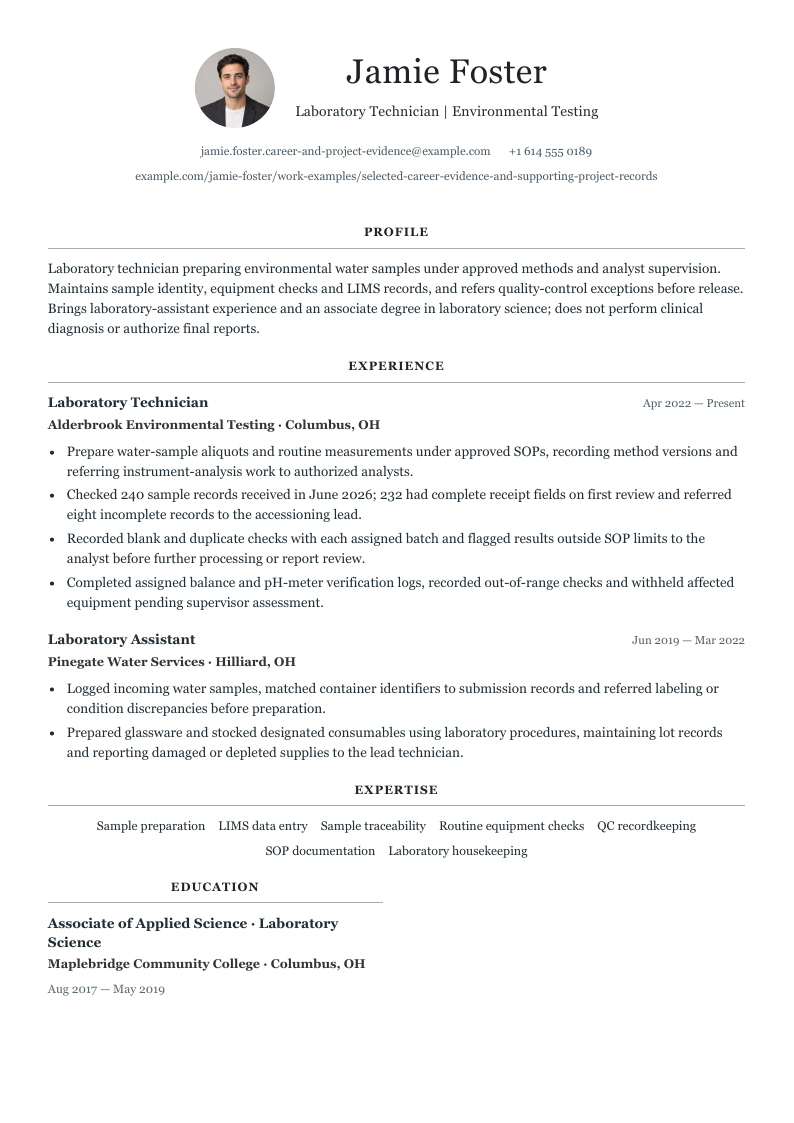 Open page 1 at full size
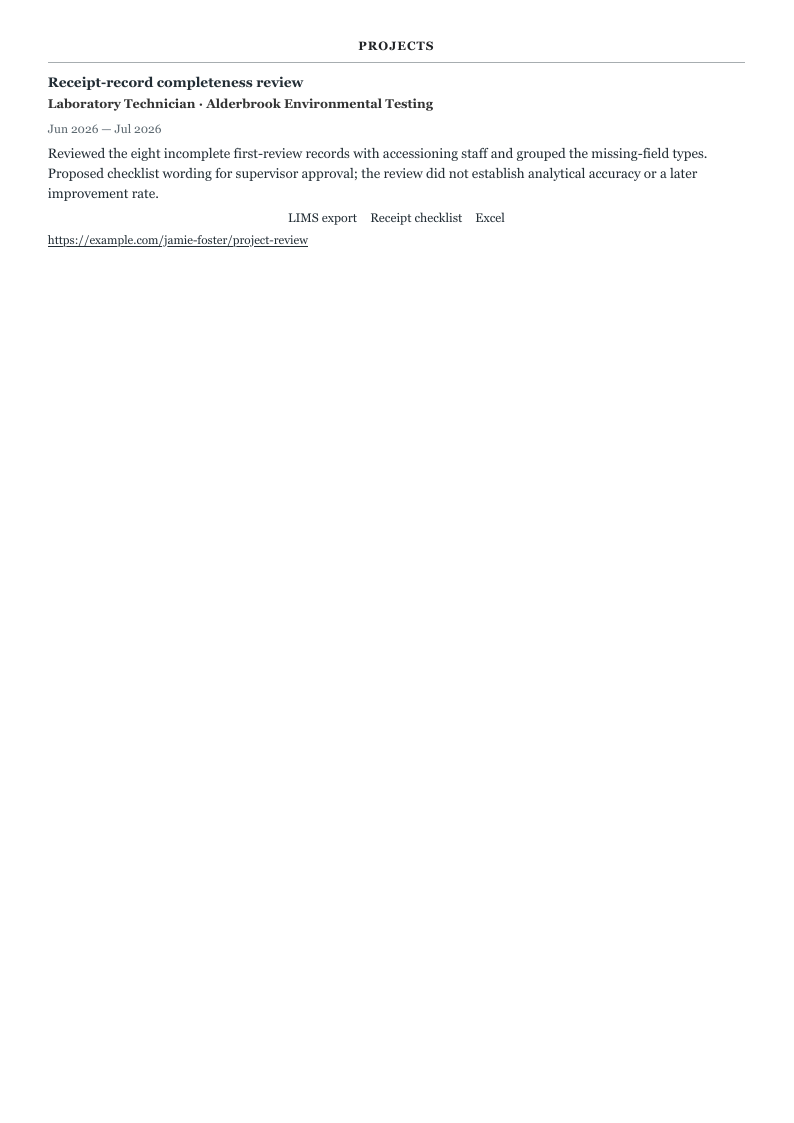 Open page 2 at full size
Laboratory Technician | Environmental Testing
jamie.foster.career-and-project-evidence@example.com · +1 614 555 0189
Laboratory technician preparing environmental water samples under approved methods and analyst supervision. Maintains sample identity, equipment checks and LIMS records, and refers quality-control exceptions before release. Brings laboratory-assistant experience and an associate degree in laboratory science; does not perform clinical diagnosis or authorize final reports.
Sample preparation · LIMS data entry · Sample traceability · Routine equipment checks · QC recordkeeping · SOP documentation · Laboratory housekeeping
Alderbrook Environmental Testing · Columbus, OH
April 2022–Present
Pinegate Water Services · Hilliard, OH
June 2019–March 2022
Associate of Applied Science in Laboratory Science · Maplebridge Community College · Columbus, OH
August 2017–May 2019
Laboratory Technician · Alderbrook Environmental Testing
June 2026–July 2026
LIMS export · Receipt checklist · Excel
Reviewed the eight incomplete first-review records with accessioning staff and grouped the missing-field types. Proposed checklist wording for supervisor approval; the review did not establish analytical accuracy or a later improvement rate.
This Scholar scenario has the photo off. It preserves the entire base record and adds one earlier role and two dated projects. Inspect every continuation page, including dates, tools and final limitations. Keep useful supporting evidence when it earns the space; do not remove content solely to force an arbitrary page count.
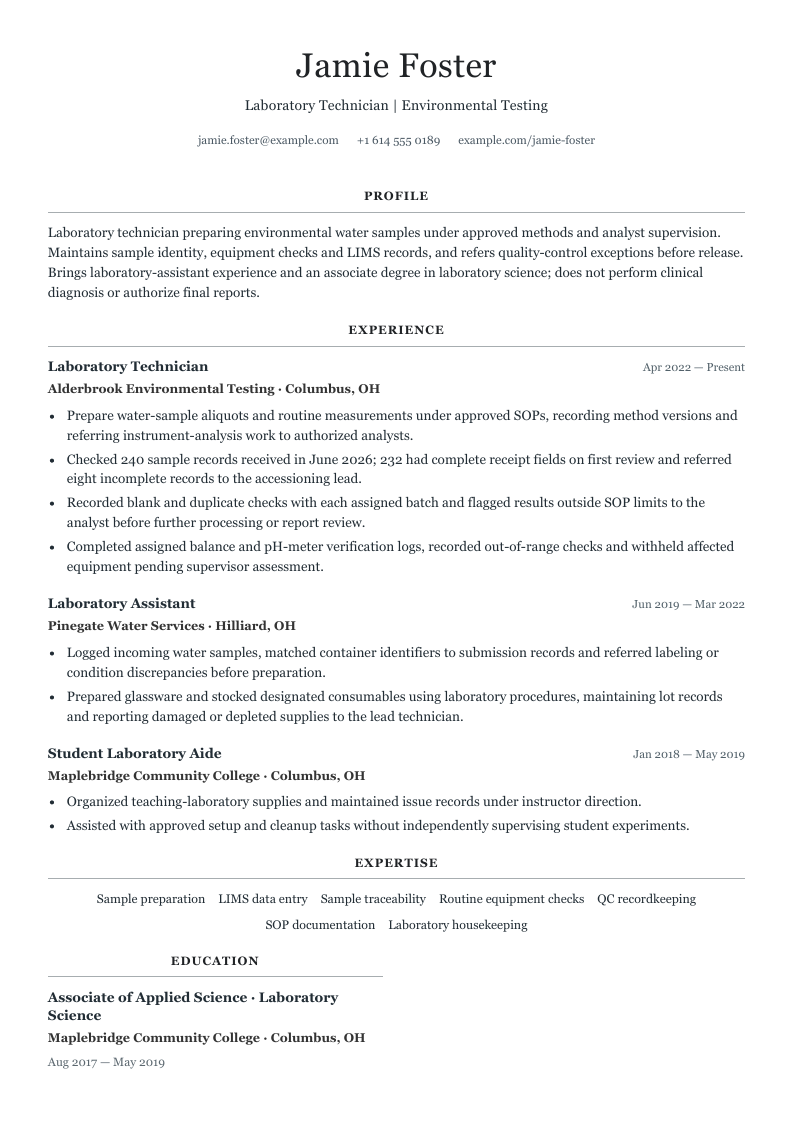 Open page 1 at full size
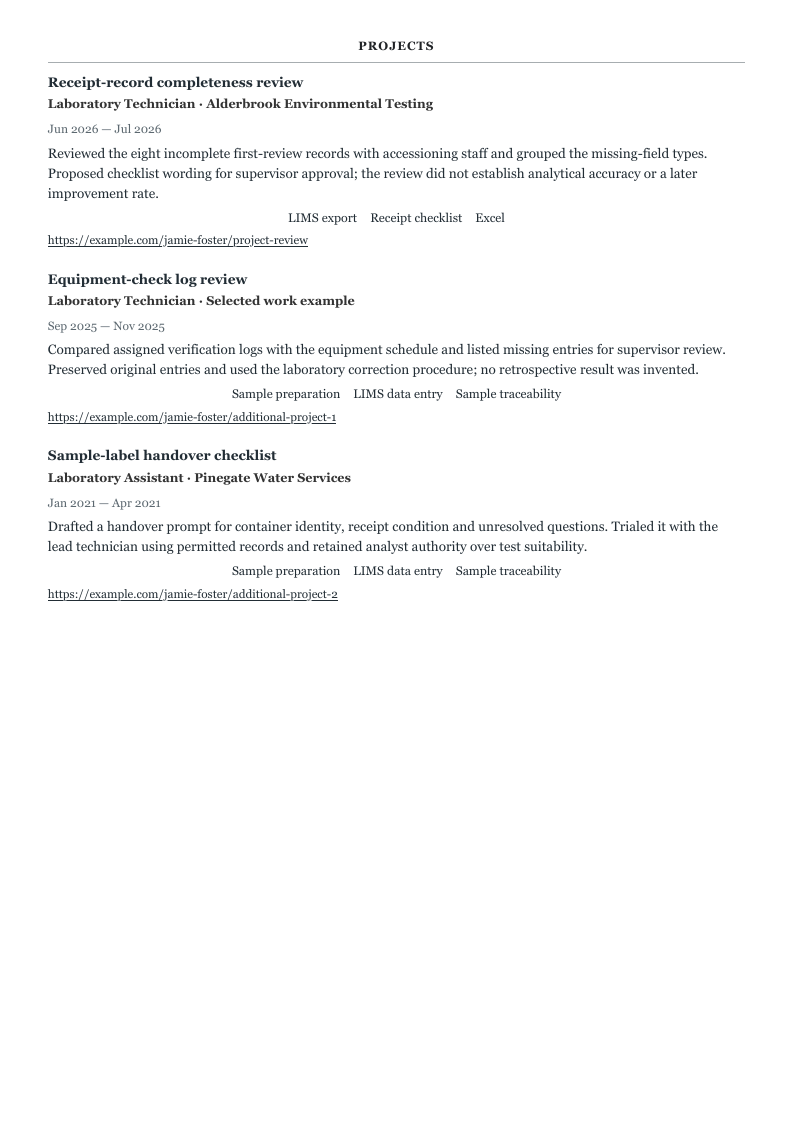 Open page 2 at full size
Laboratory Technician | Environmental Testing
jamie.foster@example.com · +1 614 555 0189
Portfolio: https://example.com/jamie-foster
Laboratory technician preparing environmental water samples under approved methods and analyst supervision. Maintains sample identity, equipment checks and LIMS records, and refers quality-control exceptions before release. Brings laboratory-assistant experience and an associate degree in laboratory science; does not perform clinical diagnosis or authorize final reports.
Sample preparation · LIMS data entry · Sample traceability · Routine equipment checks · QC recordkeeping · SOP documentation · Laboratory housekeeping
Alderbrook Environmental Testing · Columbus, OH
April 2022–Present
Pinegate Water Services · Hilliard, OH
June 2019–March 2022
Maplebridge Community College · Columbus, OH
January 2018–May 2019
Associate of Applied Science in Laboratory Science · Maplebridge Community College · Columbus, OH
August 2017–May 2019
Laboratory Technician · Alderbrook Environmental Testing
June 2026–July 2026
LIMS export · Receipt checklist · Excel
Reviewed the eight incomplete first-review records with accessioning staff and grouped the missing-field types. Proposed checklist wording for supervisor approval; the review did not establish analytical accuracy or a later improvement rate.
Laboratory Technician · Selected work example
September 2025–November 2025
Sample preparation · LIMS data entry · Sample traceability
Compared assigned verification logs with the equipment schedule and listed missing entries for supervisor review. Preserved original entries and used the laboratory correction procedure; no retrospective result was invented.
Laboratory Assistant · Pinegate Water Services
January 2021–April 2021
Sample preparation · LIMS data entry · Sample traceability
Drafted a handover prompt for container identity, receipt condition and unresolved questions. Trialed it with the lead technician using permitted records and retained analyst authority over test suitability.
Review your resume with the analyzer and check its suggestions against your records. Use buttons open signup with the selected role, exact design and photo preference for the real builder. A free account is required. Free-plan PDF downloads include a watermark; the examples show paid-plan output.
No. It is an environmental testing support example. Clinical roles may have different education, credential and jurisdiction requirements; use the actual vacancy and verified qualifications for that setting.
Describe the workplace context accurately if relevant, but do not present an organization’s accreditation as your personal certification. State your actual training, authorization and task scope.
Name the measure. Complete receipt fields, duplicate agreement and analytical recovery answer different questions. Keep the population, method and review criteria attached to the result.
Include only equipment you actually used, with the relevant task and proficiency context. Observing a demonstration or preparing samples for an analyst does not establish independent instrument competence.
The Use buttons retain the exact design, current photo preference and Laboratory Technician role. They do not insert the fictional record or portrait. A free account is required and free-plan PDF downloads include a watermark. Build with your own information and inspect the actual export.
Prepared by Resumize with AI-assisted research and drafting for English-language US applications. Three full primary employer descriptions and the occupational or professional references below were checked on October 29, 2026. Each selected employer page displayed application instructions or an application control; no application was submitted, and availability can change. The candidate records and annotated examples are original editorial fiction. Selected vacancies do not establish universal requirements. No ranking, ATS or hiring-result guarantee is made.
Read October 29, 2026. Barberton, Ohio; full description and I’m interested application control retrieved; no posting date displayed. Environmental sample preparation under close supervision; chemistry-related degree preferred and prior laboratory exposure requested.
Read October 29, 2026. Fairfield, New Jersey; full consumer-product chemistry description and application control retrieved; anticipated close November 30, 2026. Preparation, equipment checks and documentation differ from the sample water-testing scope.
Read October 29, 2026. Harrisburg, Pennsylvania; full description and application control retrieved; no posting date displayed. Sample homogenization, supervised proficiency training and quality records; high school diploma or equivalent required.
Read October 29, 2026. Official occupational context for nonclinical laboratory support, technical training and records. Read through the web reader; direct archive request returned 403. Clinical credentials are outside this sample.