An HVAC Technician resume should make the equipment, service setting and your actual contribution easy to identify. Show how you diagnose faults, complete maintenance, document work and communicate repair recommendations. Keep certification type precise and separate your contribution from team results. This guide pairs a complete fictional career record with six annotated rewrites and three existing designs.
These previews use the same layouts as the builder, with identical example content. Open a full preview to inspect the text and spacing.
Fictional candidate, employers, education and results. The optional portrait is AI-generated. Use your own evidence and photo; the example is not inserted into your resume.
Essential
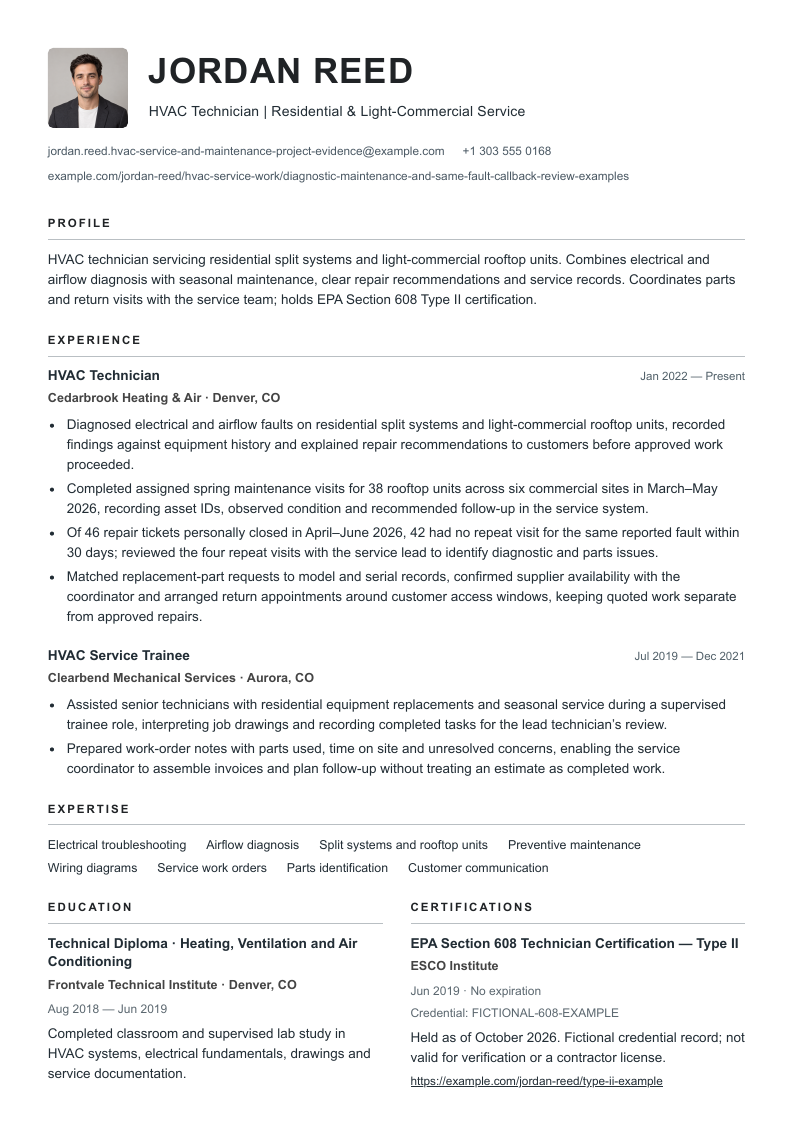
A plain left header and restrained headings organize Profile, Experience, Expertise, Education, Certifications and Projects in one column, with dates in a small gutter.
Before sending: Its quiet layout relies on precise writing. Keep equipment scope, callback observation window and Type II designation readable instead of shortening them to broad claims.
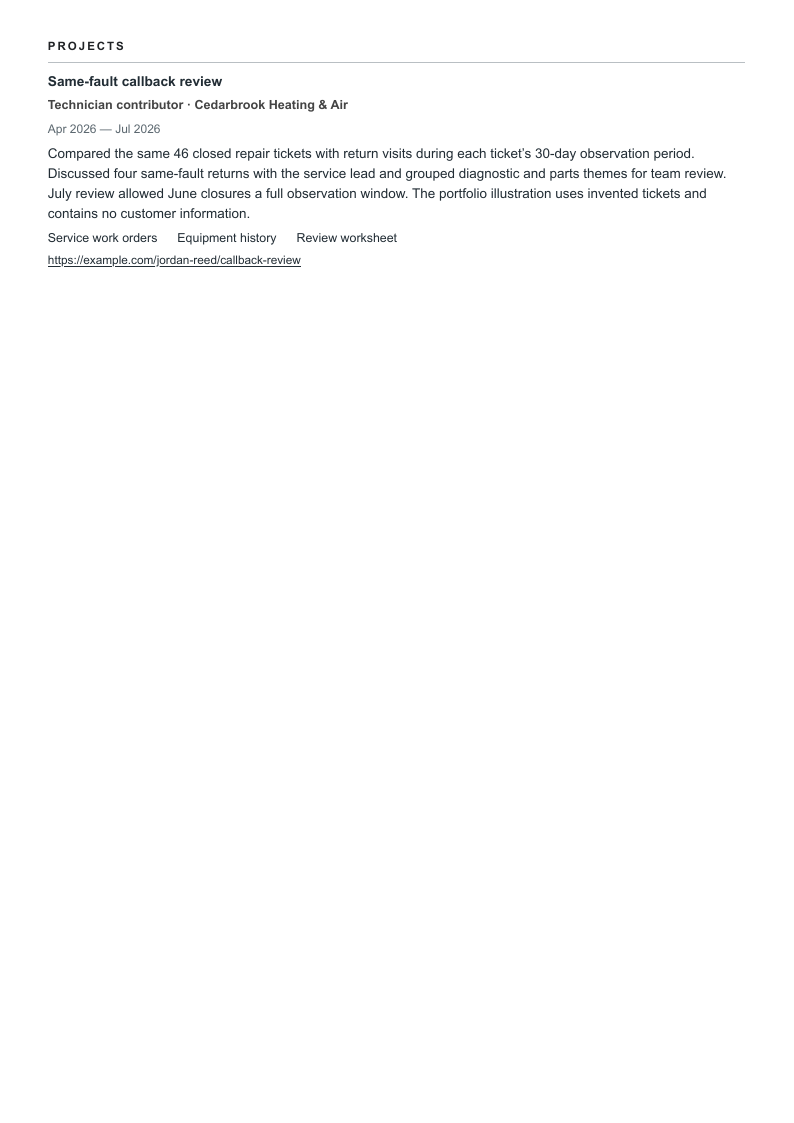
Original Modern has a dark identity and contact header, an unheaded summary, then Skills, Experience, Education, Projects and Certifications in one column.
Before sending: Credentials follow projects. Check the Type II record through every exported page and inspect the complete email and URL destination behind a shortened social label.
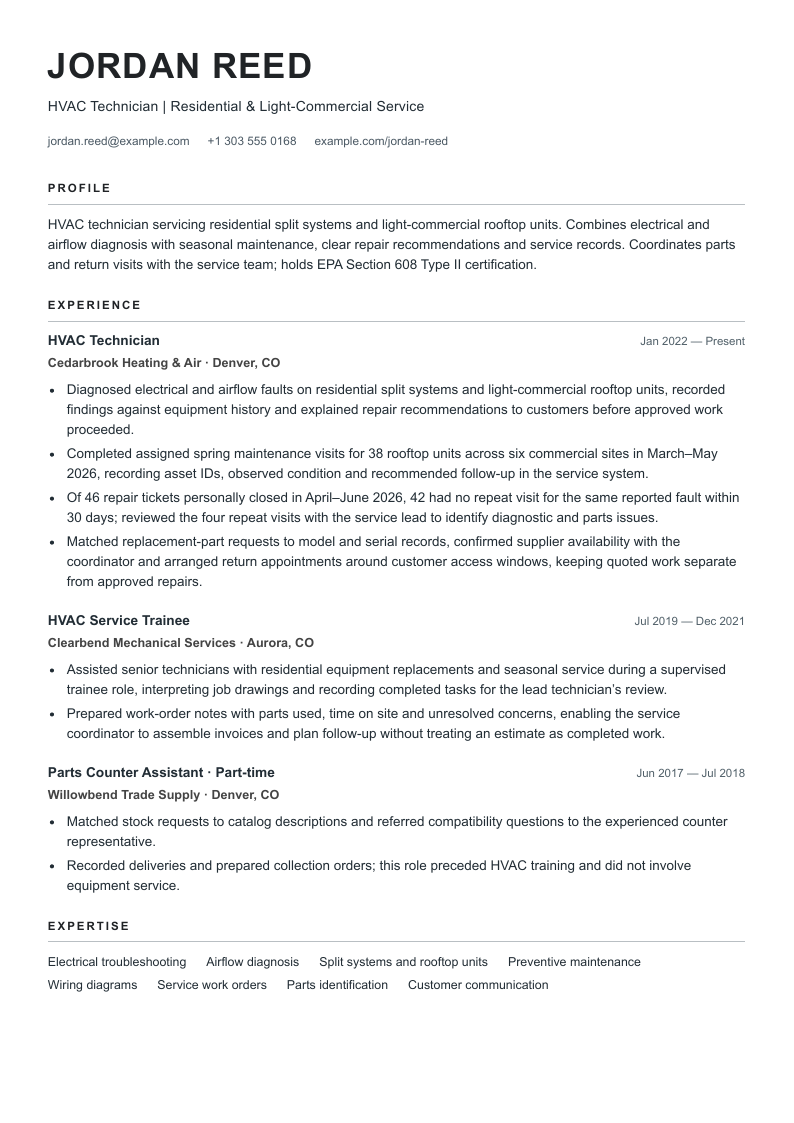
A narrow colored date rail and timeline markers sit beside broad content; Profile, Experience, Expertise, Education, Certifications and Projects follow the header.
Before sending: The date rail takes space from the narrative. Inspect long diagnostic bullets, certification details and all continuation pages with and without the optional portrait.
“Use” opens signup with that design and photo preference selected for the builder. A free account is required. Free-plan PDF downloads include a watermark; see current plans for paid options. Photo conventions vary; follow the employer’s instructions and local expectations.
All three designs use the same career record. The default has no photo; the optional portrait is AI-generated. Design buttons retain the exact template, photo preference and HVAC Technician role through signup. They do not insert Jordan’s fictional career record or portrait into your account.
Jordan Reed, both employers, the technical institute, work history, dates, counts and results are invented. ESCO Institute is a real certifier on EPA’s approved-program list, but this candidate’s credential holding, issue date, example ID and example.com URL are entirely fictional and cannot verify a certification. All portfolio links are placeholders and the optional portrait is AI-generated. These examples teach resume writing; they do not authorize work or provide repair instructions.
Jordan Reed
HVAC Technician | Residential & Light-Commercial Service
HVAC technician servicing residential split systems and light-commercial rooftop units. Combines electrical and airflow diagnosis with seasonal maintenance, clear repair recommendations and service records. Coordinates parts and return visits with the service team; holds EPA Section 608 Type II certification.
Skills
Electrical troubleshooting · Airflow diagnosis · Split systems and rooftop units · Preventive maintenance · Wiring diagrams · Service work orders · Parts identification · Customer communication
Experience
HVAC Technician
Cedarbrook Heating & Air · Denver, CO
January 2022–Present
Diagnosed electrical and airflow faults on residential split systems and light-commercial rooftop units, recorded findings against equipment history and explained repair recommendations to customers before approved work proceeded.
Completed assigned spring maintenance visits for 38 rooftop units across six commercial sites in March–May 2026, recording asset IDs, observed condition and recommended follow-up in the service system.
Of 46 repair tickets personally closed in April–June 2026, 42 had no repeat visit for the same reported fault within 30 days; reviewed the four repeat visits with the service lead to identify diagnostic and parts issues.
Matched replacement-part requests to model and serial records, confirmed supplier availability with the coordinator and arranged return appointments around customer access windows, keeping quoted work separate from approved repairs.
HVAC Service Trainee
Clearbend Mechanical Services · Aurora, CO
July 2019–December 2021
Assisted senior technicians with residential equipment replacements and seasonal service during a supervised trainee role, interpreting job drawings and recording completed tasks for the lead technician’s review.
Prepared work-order notes with parts used, time on site and unresolved concerns, enabling the service coordinator to assemble invoices and plan follow-up without treating an estimate as completed work.
Education
Technical Diploma in Heating, Ventilation and Air Conditioning · Frontvale Technical Institute · Denver, CO
August 2018–June 2019
Completed classroom and supervised lab study in HVAC systems, electrical fundamentals, drawings and service documentation.
Training and certifications
EPA Section 608 Technician Certification — Type II
ESCO Institute
Issued June 2019
Does not expire
Credential ID: FICTIONAL-608-EXAMPLE
Held as of October 2026. Fictional credential record; not valid for verification or a contractor license.
Service work orders · Equipment history · Review worksheet
Compared the same 46 closed repair tickets with return visits during each ticket’s 30-day observation period. Discussed four same-fault returns with the service lead and grouped diagnostic and parts themes for team review. July review allowed June closures a full observation window. The portfolio illustration uses invented tickets and contains no customer information.
The current role covers diagnosis, a seasonal maintenance assignment, a defined callback review and parts coordination. The earlier trainee role preserves supervision and shows documentation. The project explains the same 46-ticket review rather than adding another set of repairs. The diploma is separate from the Type II certification.
Start with the equipment and service setting
Residential service, light-commercial maintenance, large chiller work, building controls and in-house facilities jobs need different evidence. State your actual equipment categories and assignment. Jordan’s split-system and rooftop-unit experience does not establish chiller expertise, independent engineering design, boiler credentials or contractor ownership.
The current employer sample shows that variation. CFM’s Denver senior commercial vacancy emphasizes service records, equipment training and substantial relevant experience. Spring Oak’s Bedford in-house role centers its own properties and considerate work around residents. Johnson Controls’ Austin controls-service opening adds controller and commissioning documentation. These three experienced US openings are a small sample, not a national requirement list or an apprenticeship survey.
Within your own work, distinguish installation assistance, repair diagnosis, preventive maintenance and commissioning responsibilities. If you supported a replacement, explain the tasks you performed and who reviewed completion. If you used building automation systems (BAS), name the platform and level of responsibility only when true. Viewing a status screen does not by itself establish controller programming or ownership of a whole building integration.
Describe technical judgment as work evidence: the equipment involved, the source of the service request, the finding documented and the approved next action. Keep wiring instructions, refrigerant quantities, access codes and site-specific operating procedures out of the resume. Safety and code awareness belong in an accurate description of training and work responsibilities, without an unsupported claim that you personally certified every installation’s compliance.
Six HVAC Technician rewrites with evidence prompts
Every after sentence appears verbatim in the base resume. The before statements deliberately overstate or obscure the work. Replace the fictional details with your own supported facts, and describe scope when no reliable result measure exists.
1. Make diagnostic work visible
Before: Fixed every HVAC issue immediately.
After: Diagnosed electrical and airflow faults on residential split systems and light-commercial rooftop units, recorded findings against equipment history and explained repair recommendations to customers before approved work proceeded.
Why it works: Names equipment, reasoning and communication without claiming every fault was resolved or describing a repair procedure.
Evidence to check: Approved service summaries, equipment categories and your actual diagnostic responsibility; exclude client names, access details and proprietary readings.
2. Define the maintenance assignment
Before: Maintained thousands of units with zero breakdowns.
After: Completed assigned spring maintenance visits for 38 rooftop units across six commercial sites in March–May 2026, recording asset IDs, observed condition and recommended follow-up in the service system.
Why it works: The count is 38 units across six sites during a season. Completed visits do not prove that equipment cannot fail later.
Evidence to check: Permitted aggregate asset count, visit dates and maintenance assignment; keep customer asset identifiers out of the public resume.
3. Measure a defined callback result
Before: Eliminated callbacks and saved every customer money.
After: Of 46 repair tickets personally closed in April–June 2026, 42 had no repeat visit for the same reported fault within 30 days; reviewed the four repeat visits with the service lead to identify diagnostic and parts issues.
Why it works: Shows the ticket population, same-fault definition and observation window. It does not claim permanent fixes, energy savings or sole responsibility for team performance.
Evidence to check: Ticket selection, closure dates, repeat-fault definition, follow-up cutoff and service-lead review.
4. Show customer and parts coordination
Before: Ran all projects and guaranteed instant parts delivery.
After: Matched replacement-part requests to model and serial records, confirmed supplier availability with the coordinator and arranged return appointments around customer access windows, keeping quoted work separate from approved repairs.
Why it works: A technician can contribute to scheduling and accurate requests without owning supplier lead times or approving every quote.
Evidence to check: Your role in parts requests, quote approval and return scheduling; use a generic description instead of private customer documents.
5. Keep supervised experience accurate
Before: Independently commissioned every type of commercial system as an apprentice.
After: Assisted senior technicians with residential equipment replacements and seasonal service during a supervised trainee role, interpreting job drawings and recording completed tasks for the lead technician’s review.
Why it works: Preserves the trainee title and supervision. Participation in a replacement does not establish independent commissioning or competence on chillers.
Evidence to check: Training assignment, supervisor confirmation and task records that distinguish assistance from independent sign-off.
6. Explain useful service documentation
Before: Improved billing accuracy by 100% using paperwork.
After: Prepared work-order notes with parts used, time on site and unresolved concerns, enabling the service coordinator to assemble invoices and plan follow-up without treating an estimate as completed work.
Why it works: Describes a concrete contribution without inventing a billing improvement or taking credit for the coordinator’s final invoice.
Evidence to check: Approved work-order fields, actual documentation duties and who reviewed billing and follow-up.
Write the summary from the work history
Use two or three sentences to identify your service setting, equipment and strongest supported contributions. Jordan’s summary names residential and light-commercial service, diagnosis, maintenance and coordination. The bullets then demonstrate each point. Avoid adding ten years of experience, a senior title or an energy-saving percentage simply because an example or advertisement uses it.
For an entry-level summary, identify the completed technical program or supervised training and the tasks you can demonstrate. An experienced technician can prioritize the equipment and service work closest to the vacancy. A senior applicant should substantiate any commissioning ownership, mentoring, complex-system responsibility or commercial project leadership in the experience section. Keep earlier roles and dates accurate at every level.
The fictional callback measure covers 46 personally closed tickets from April–June 2026, with a full 30-day observation period for each closure. Forty-two had no repeat visit for the same reported fault and four did. The project review ends in July so late-June closures can receive that follow-up. This is a defined service-ticket result, not a lifetime failure rate or proof that the technician alone caused the result.
Maintenance volume is another kind of evidence: 38 units across six sites describes an assignment. It is not 38 sites, a count of unique customers or proof of avoided breakdowns. If you claim lower downtime or callbacks, define the comparison, period and same-event rule. For genuine energy or cost claims, identify the measurement basis, comparable operating conditions and team contribution. A tune-up alone does not support a promised bill reduction or a change to a system’s rated efficiency.
Use only information you are allowed to share. An aggregate ticket count can demonstrate scope without publishing customer locations, equipment serial numbers, invoices or proprietary controls files. For writing support, use the bullet point generator and check every suggested fact before it reaches an application.
Choose skills you can demonstrate
Read the actual vacancy before selecting terms. Refrigeration, electrical troubleshooting, rooftop units, airflow analysis, preventive maintenance, drawings, service reports and customer communication may fit different roles. Include chillers, BAS integration, commissioning, specialized test equipment or a particular service platform only when your work supports the term. Spell out computerized maintenance management system (CMMS) if it is relevant to your actual records work.
HVAC Technician skills and supporting evidence
Skill
Evidence to gather
Fictional example
Electrical and airflow diagnosis
Equipment type, your diagnostic responsibility and recorded finding.
Split systems and light-commercial rooftop units.
Preventive maintenance
Assigned assets, service period and follow-up recommendations.
38 rooftop units across six sites in spring 2026.
Wiring diagrams and equipment history
How drawings or prior records informed your work.
Findings linked to equipment history; supervised drawing interpretation.
Work-order documentation
Work performed, parts, time and unresolved issues.
Service coordinator uses notes for invoices and follow-up.
Parts and customer coordination
Your part in identification, approval and return scheduling.
Model and serial records, supplier availability and access windows.
Callback review
Ticket selection, same-fault definition and observation window.
46 closed tickets; 42 without a same-fault return within 30 days.
Place useful vacancy language naturally in the summary, skills and relevant bullets. A credential belongs in a credential record with its exact type and issuer, not just in a keyword list. Repeating every advertised term cannot establish experience or guarantee an applicant tracking system result, interview or offer.
Separate training, Section 608 certification and licensing
List your actual technical diploma, apprenticeship or other relevant education with the institution, field and dates. Jordan’s invented diploma includes supervised labs and predates the trainee role. A college GPA is unnecessary here. Label an unfinished program, employer course or manufacturer training by its true status; attendance does not automatically establish a certification or completed apprenticeship.
EPA’s Section 608 requirements distinguish Type I for small appliances, Type II for high- and very-high-pressure appliances except small appliances and motor vehicle air conditioners, Type III for low-pressure appliances, and Universal for all equipment types covered by the program. Certification requirements concern covered refrigerant work; Universal is not a requirement for every HVAC task. Use your exact earned designation. Section 608 credentials do not expire.
The fictional record shows Type II, the named certifier, June 2019 issue date, held status as of October 2026 and no expiry. Its ID and URL are explicit examples. EPA’s approved-program list includes the real ESCO Institute. This does not mean ESCO certified Jordan or endorses this guide. In your own resume, use your actual certifying organization and verified details rather than an invented issuer or a government agency named as the card issuer.
A federal refrigerant certification is separate from a state or local HVAC contractor license, employment authorization and employer training. This guide makes no state licensing determination and Jordan claims no contractor license. Check the authority and vacancy relevant to your work location before making a license claim. If you hold NATE or another specialty certification, list its exact credential, issuer and current dates separately; this sample does not claim one.
Build an early-career record around supervised work
Use genuine lab work, a supervised placement or a trainee assignment when it demonstrates a relevant skill. Identify the setting and supervisor’s role. A class project can show interpretation of drawings, organized service notes or a maintenance-planning exercise, while remaining clearly labeled as training. Do not present a simulated repair as a paid customer job.
Transferable parts-counter or customer-service work can explain accurate orders, listening and follow-through. The expanded sample labels Jordan’s older counter role as part-time and keeps it before technical training. It does not turn that work into HVAC servicing. Preserve the boundary between observing, assisting, performing and signing off a task.
Check the full email and portfolio destination
This Essential export turns the photo on and changes only the resume email and portfolio URL. Identity, phone, career, credentials and projects are identical to the base record. Read the final characters of both long contacts and open the link destination. A shortened displayed social label in Modern can still point to the full URL.
HVAC technician servicing residential split systems and light-commercial rooftop units. Combines electrical and airflow diagnosis with seasonal maintenance, clear repair recommendations and service records. Coordinates parts and return visits with the service team; holds EPA Section 608 Type II certification.
Skills
Electrical troubleshooting · Airflow diagnosis · Split systems and rooftop units · Preventive maintenance · Wiring diagrams · Service work orders · Parts identification · Customer communication
Experience
HVAC Technician
Cedarbrook Heating & Air · Denver, CO
January 2022–Present
Diagnosed electrical and airflow faults on residential split systems and light-commercial rooftop units, recorded findings against equipment history and explained repair recommendations to customers before approved work proceeded.
Completed assigned spring maintenance visits for 38 rooftop units across six commercial sites in March–May 2026, recording asset IDs, observed condition and recommended follow-up in the service system.
Of 46 repair tickets personally closed in April–June 2026, 42 had no repeat visit for the same reported fault within 30 days; reviewed the four repeat visits with the service lead to identify diagnostic and parts issues.
Matched replacement-part requests to model and serial records, confirmed supplier availability with the coordinator and arranged return appointments around customer access windows, keeping quoted work separate from approved repairs.
HVAC Service Trainee
Clearbend Mechanical Services · Aurora, CO
July 2019–December 2021
Assisted senior technicians with residential equipment replacements and seasonal service during a supervised trainee role, interpreting job drawings and recording completed tasks for the lead technician’s review.
Prepared work-order notes with parts used, time on site and unresolved concerns, enabling the service coordinator to assemble invoices and plan follow-up without treating an estimate as completed work.
Education
Technical Diploma in Heating, Ventilation and Air Conditioning · Frontvale Technical Institute · Denver, CO
August 2018–June 2019
Completed classroom and supervised lab study in HVAC systems, electrical fundamentals, drawings and service documentation.
Training and certifications
EPA Section 608 Technician Certification — Type II
ESCO Institute
Issued June 2019
Does not expire
Credential ID: FICTIONAL-608-EXAMPLE
Held as of October 2026. Fictional credential record; not valid for verification or a contractor license.
Service work orders · Equipment history · Review worksheet
Compared the same 46 closed repair tickets with return visits during each ticket’s 30-day observation period. Discussed four same-fault returns with the service lead and grouped diagnostic and parts themes for team review. July review allowed June closures a full observation window. The portfolio illustration uses invented tickets and contains no customer information.
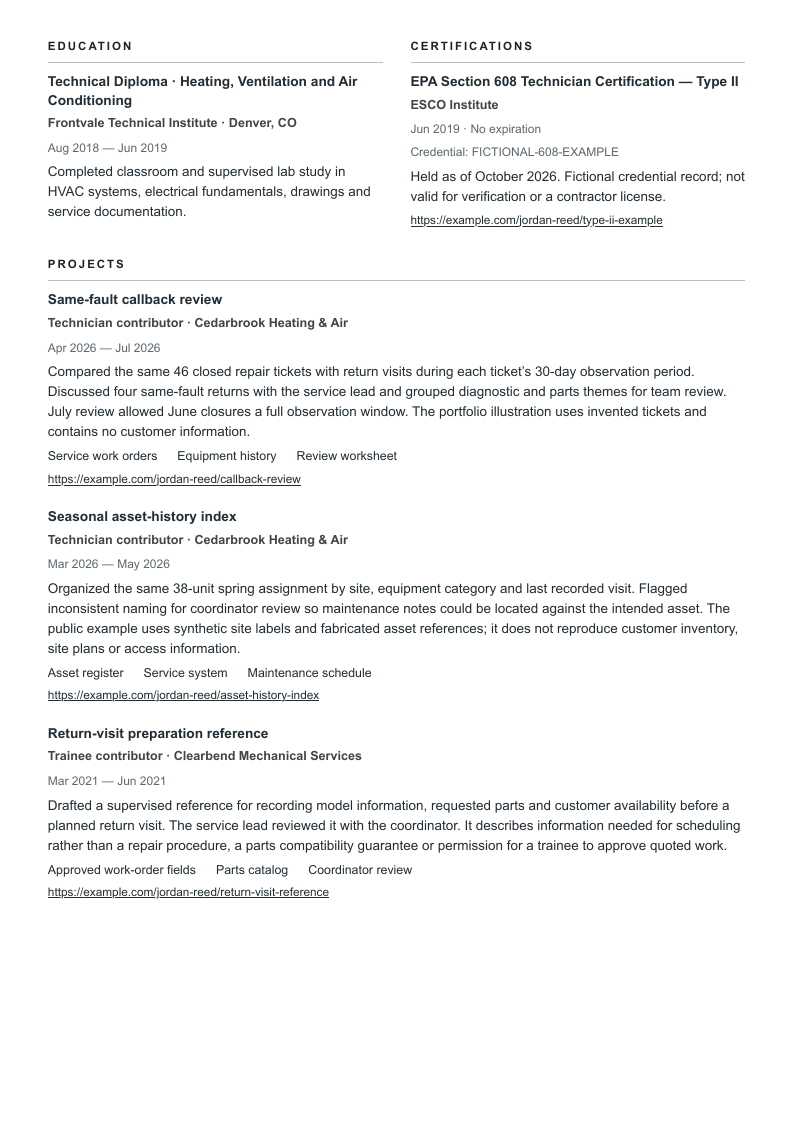
The expanded Essential example has the photo off. It preserves the complete base record and adds one older parts-counter job and two projects. The maintenance index explains the same 38-unit assignment; the return-visit reference describes supervised information preparation. Neither adds invented savings or gives a repair procedure. Compare all pages with the complete text below.
HVAC technician servicing residential split systems and light-commercial rooftop units. Combines electrical and airflow diagnosis with seasonal maintenance, clear repair recommendations and service records. Coordinates parts and return visits with the service team; holds EPA Section 608 Type II certification.
Skills
Electrical troubleshooting · Airflow diagnosis · Split systems and rooftop units · Preventive maintenance · Wiring diagrams · Service work orders · Parts identification · Customer communication
Experience
HVAC Technician
Cedarbrook Heating & Air · Denver, CO
January 2022–Present
Diagnosed electrical and airflow faults on residential split systems and light-commercial rooftop units, recorded findings against equipment history and explained repair recommendations to customers before approved work proceeded.
Completed assigned spring maintenance visits for 38 rooftop units across six commercial sites in March–May 2026, recording asset IDs, observed condition and recommended follow-up in the service system.
Of 46 repair tickets personally closed in April–June 2026, 42 had no repeat visit for the same reported fault within 30 days; reviewed the four repeat visits with the service lead to identify diagnostic and parts issues.
Matched replacement-part requests to model and serial records, confirmed supplier availability with the coordinator and arranged return appointments around customer access windows, keeping quoted work separate from approved repairs.
HVAC Service Trainee
Clearbend Mechanical Services · Aurora, CO
July 2019–December 2021
Assisted senior technicians with residential equipment replacements and seasonal service during a supervised trainee role, interpreting job drawings and recording completed tasks for the lead technician’s review.
Prepared work-order notes with parts used, time on site and unresolved concerns, enabling the service coordinator to assemble invoices and plan follow-up without treating an estimate as completed work.
Parts Counter Assistant · Part-time
Willowbend Trade Supply · Denver, CO
June 2017–July 2018
Matched stock requests to catalog descriptions and referred compatibility questions to the experienced counter representative.
Recorded deliveries and prepared collection orders; this role preceded HVAC training and did not involve equipment service.
Education
Technical Diploma in Heating, Ventilation and Air Conditioning · Frontvale Technical Institute · Denver, CO
August 2018–June 2019
Completed classroom and supervised lab study in HVAC systems, electrical fundamentals, drawings and service documentation.
Training and certifications
EPA Section 608 Technician Certification — Type II
ESCO Institute
Issued June 2019
Does not expire
Credential ID: FICTIONAL-608-EXAMPLE
Held as of October 2026. Fictional credential record; not valid for verification or a contractor license.
Service work orders · Equipment history · Review worksheet
Compared the same 46 closed repair tickets with return visits during each ticket’s 30-day observation period. Discussed four same-fault returns with the service lead and grouped diagnostic and parts themes for team review. July review allowed June closures a full observation window. The portfolio illustration uses invented tickets and contains no customer information.
Asset register · Service system · Maintenance schedule
Organized the same 38-unit spring assignment by site, equipment category and last recorded visit. Flagged inconsistent naming for coordinator review so maintenance notes could be located against the intended asset. The public example uses synthetic site labels and fabricated asset references; it does not reproduce customer inventory, site plans or access information.
Approved work-order fields · Parts catalog · Coordinator review
Drafted a supervised reference for recording model information, requested parts and customer availability before a planned return visit. The service lead reviewed it with the coordinator. It describes information needed for scheduling rather than a repair procedure, a parts compatibility guarantee or permission for a trainee to approve quoted work.
Let relevant evidence determine length. Condense repeated duties before removing the certification type, observation window or supervision qualifier. A second page can be appropriate when it preserves useful experience. Check that a date, project ending or credential detail has not become isolated or disappeared at a page break.
Inspect the exported resume before applying
Read every exported page, including the final project, certification type, issuer and nonexpiry statement.
Check the complete email, phone and link destination, especially after adding a photo or longer contact text.
Confirm job titles, dates, supervision and equipment categories match your own experience.
Keep the ticket population and 30-day callback definition together; inspect how the sentence continues across pages.
Copy text from the PDF and inspect the application’s parsed fields when available. Follow the employer’s requested file type.
A free account is required for the builder. Free-plan PDF downloads include a watermark; the preview images show paid-plan output. Template choices retain Essential, Modern or Milestone, the photo setting and HVAC Technician role through signup. They do not copy the fictional resume or AI portrait.
The resume analyzer gives advisory feedback; review its suggestions against your own facts. No layout or tool promises universal parsing, screening success or a hiring outcome.
Questions, answered
What skills should an HVAC Technician include on a resume?
Prioritize equipment and tasks relevant to the vacancy that you can demonstrate: diagnosis, preventive maintenance, drawings, service documentation and customer communication. Add controls, chillers or commissioning only when your own work supports them.
How do I write an HVAC Technician resume summary?
Name your service setting, equipment and two or three supported contributions. An early-career applicant can identify technical training and supervised work. An experienced applicant should connect claimed strengths to the work history rather than copying sample percentages.
What are the key responsibilities of an HVAC Technician?
Depending on the assignment, responsibilities can include diagnosis, service, maintenance, installation support, records and customer coordination. Keep equipment, supervision and approval boundaries clear; the title alone does not imply every specialty or contractor authority.
How long should an HVAC Technician resume be?
Use the space needed for relevant, readable evidence. A concise early-career record may fit one page, while a fuller record may need two. Inspect every export instead of deleting important credential details or qualifiers to hit a page target.
What makes an HVAC Technician resume stand out?
Specific equipment experience, accurate credentials and clear work examples help a reader assess fit. Define the period and population behind callback or maintenance figures, and identify your contribution without promising energy savings or permanent fault elimination.
What ATS keywords should an HVAC Technician use?
Use truthful terms from the actual opening, such as rooftop units, electrical troubleshooting, preventive maintenance or service reports. Put the exact earned credential type in its record. Keyword repetition cannot establish competence or guarantee screening success.
Is EPA 608 certification a contractor license?
No. Section 608 certification and its equipment types concern covered refrigerant work. A contractor license and employer training are separate records. Check the rules for the actual location and assignment; Universal is not required for every HVAC task.
What happens when I choose a design?
Signup retains the exact Essential, Modern or Milestone design, photo preference and HVAC Technician role. It does not insert Jordan’s fictional career record or portrait. A free account is required and free-plan PDF downloads include a watermark.
Prepared by Resumize with AI-assisted research and drafting for English-language US applications. Three directly retrieved current employer descriptions had full responsibilities and application controls on October 28, 2026: Colorado commercial service, Virginia in-house maintenance and Texas controls service. This small experienced-role sample does not define every market or entry route. Official EPA sources support credential terminology; no state credential determination is made. All career facts and rewrites are original fiction; the real certifier’s name is used only to illustrate an invented credential record. No application was submitted, proprietary client material used or hiring outcome tested.
Read October 28, 2026. Denver, CO; full description and inline application form available. No posting date displayed; applications accepted on an ongoing basis. Senior commercial role specifies five years of relevant experience, daily service records and equipment training; its qualifications are vacancy-specific.
Read October 28, 2026. Bedford, VA; full description and Apply for this job link available; no posting date displayed. Experienced in-house facilities role includes diagnosis, maintenance records and communication around residents. It is not a traveling customer-service assignment.
Read October 28, 2026. Austin, TX; job WD30278857; full description and Apply now link available; no posting date displayed. Controls-focused service, commissioning records and customer communication illustrate a different specialty. The sample does not claim proprietary controller programming or qualify automatically for this role.
Read October 28, 2026; page updated July 15, 2026. Describes the certification scope, equipment-specific Types I, II and III and Universal, approved testing and the nonexpiring credential convention. Used for resume credential terminology, not operational instructions.
Read October 28, 2026. Official approved-program list includes ESCO Institute, approved December 28, 1993. ESCO is real; Jordan’s claimed holding, dates, ID and URL are fictional. Listing a certifier does not establish a real credential or EPA endorsement of preparatory training.