A graphic designer resume can show how a brief became a coherent set of deliverables and what made those files ready for the next person. Pair the portfolio link with audience, design rationale, production checks and approval boundaries. This fictional US example follows exhibition and community-program work from typographic directions to print proof and digital handover.
These previews use the same layouts as the builder, with identical example content. Open a full preview to inspect the text and spacing.
Fictional candidate, employers, education and results. The optional portrait is AI-generated. Use your own evidence and photo; the example is not inserted into your resume.
Studio
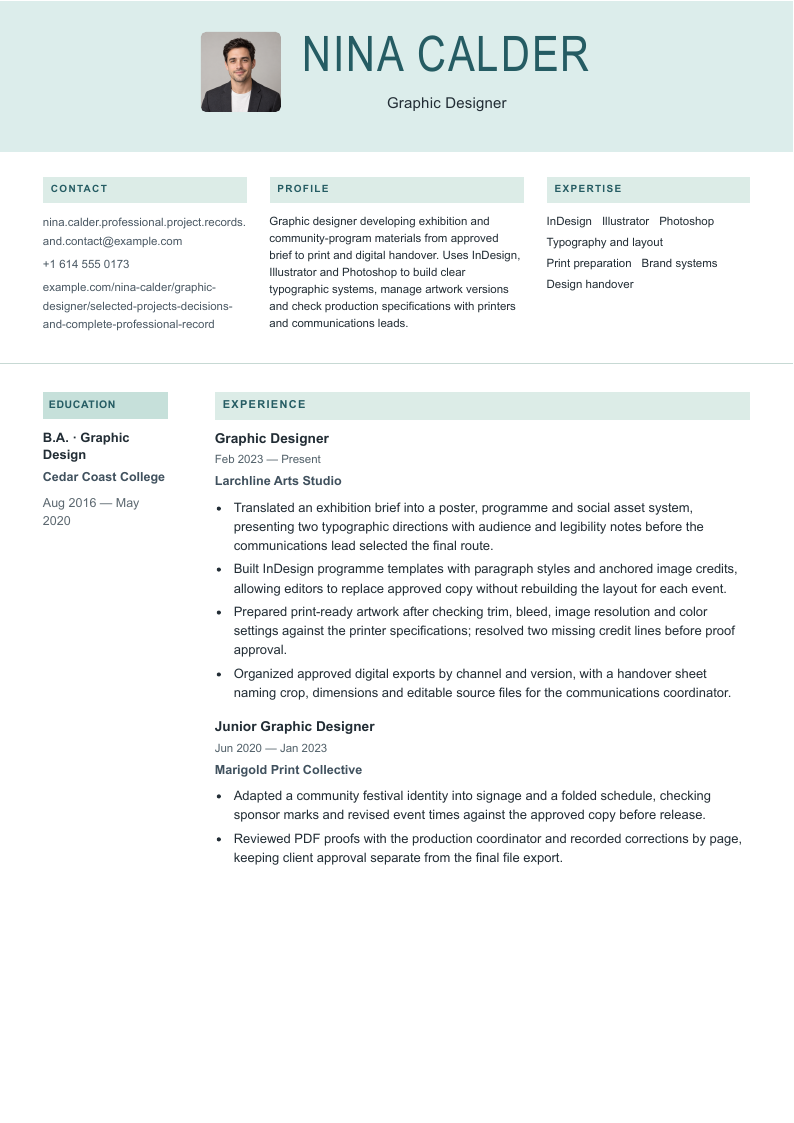
A centered mint header leads into separate Contact, Profile and Expertise areas, then education beside work history.
Before sending: The introductory areas and education sidebar are narrow. Check contact wrapping and longer work-history pages.
“Use” opens signup with that design and photo preference selected for the builder. A free account is required. Free-plan PDF downloads include a watermark; see current plans for paid options. Photo conventions vary; follow the employer’s instructions and local expectations.
Studio, Editorial and Modern show the same Nina Calder record. Compare every page with the optional photo on and off. No photo is selected by default. The fictional portrait demonstrates placement and is not added to your resume.
Choose the design after deciding which evidence matters. The previews are layout examples, not a parsing guarantee or a promise of interviews. Follow the employer’s requested file format and check the exported document with your own content.
Complete fictional graphic designer resume
All names, employers, qualifications, projects and results in this example are original editorial fiction. The two jobs contain the same six after-bullets explained below: four in the current role and two in the earlier role. The degree and selected project provide proportionate context. Replace the entire record with your own evidence.
Graphic designer developing exhibition and community-program materials from approved brief to print and digital handover. Uses InDesign, Illustrator and Photoshop to build clear typographic systems, manage artwork versions and check production specifications with printers and communications leads.
Skills
InDesign · Illustrator · Photoshop · Typography and layout · Print preparation · Brand systems · Design handover
Experience
Graphic Designer
Larchline Arts Studio
February 2023–Present
Translated an exhibition brief into a poster, programme and social asset system, presenting two typographic directions with audience and legibility notes before the communications lead selected the final route.
Built InDesign programme templates with paragraph styles and anchored image credits, allowing editors to replace approved copy without rebuilding the layout for each event.
Prepared print-ready artwork after checking trim, bleed, image resolution and color settings against the printer specifications; resolved two missing credit lines before proof approval.
Organized approved digital exports by channel and version, with a handover sheet naming crop, dimensions and editable source files for the communications coordinator.
Junior Graphic Designer
Marigold Print Collective
June 2020–January 2023
Adapted a community festival identity into signage and a folded schedule, checking sponsor marks and revised event times against the approved copy before release.
Reviewed PDF proofs with the production coordinator and recorded corrections by page, keeping client approval separate from the final file export.
Education
B.A. in Graphic Design · Cedar Coast College
August 2016–May 2020
Projects
Exhibition programme design system
Graphic Designer · Larchline Arts Studio
July 2025–September 2025
InDesign · Illustrator · PDF proofing
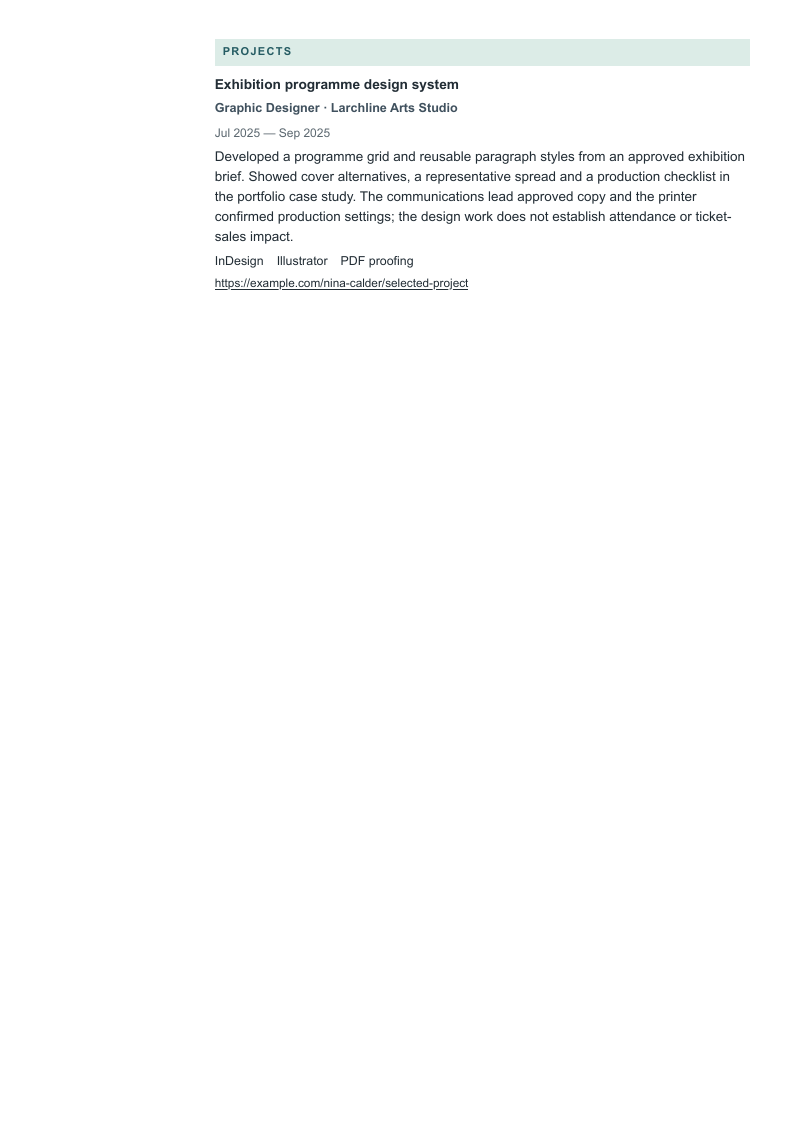
Developed a programme grid and reusable paragraph styles from an approved exhibition brief. Showed cover alternatives, a representative spread and a production checklist in the portfolio case study. The communications lead approved copy and the printer confirmed production settings; the design work does not establish attendance or ticket-sales impact.
Begin with the assignment and the audience, then name a design choice. A poster, programme and social crop can share a visual language while solving different viewing conditions. Nina presents two typographic directions with audience and legibility notes before a communications lead selects one. That is more useful than describing the work as beautiful or innovative without showing a decision.
Use the portfolio to connect the brief, alternatives, selected outcome and personal contribution. Include a representative spread or channel adaptation rather than a gallery of unexplained final images. State whether you developed the identity, adapted an existing system or prepared production files. Copy approval, photography, illustration and printing may belong to other people; credit them accurately.
Production is specific work. Describe trim, bleed, image resolution, color settings, credits and proof versions against the printer’s actual specifications. A corrected proof is evidence of a review process, not a claim of error-free manufacturing. For digital delivery, explain export dimensions, source-file naming and replacement instructions. A finished asset does not by itself show engagement, attendance or revenue.
Six annotated before-and-after bullets
These are teaching rewrites, not claims about real work. Preserve the setting, decision and ownership when adapting the pattern. If you cannot substantiate a number, explain an observed check or deliverable instead.
Explain a design choice
Before: Created stunning designs.
After: Translated an exhibition brief into a poster, programme and social asset system, presenting two typographic directions with audience and legibility notes before the communications lead selected the final route.
Connects typography to an audience and a brief, giving a portfolio reviewer a decision to investigate.
Evidence to retain: Brief, alternatives and rationale.
Name the system
Before: Improved design efficiency.
After: Built InDesign programme templates with paragraph styles and anchored image credits, allowing editors to replace approved copy without rebuilding the layout for each event.
Describes reusable styles without inventing a time-saving percentage.
Evidence to retain: Template, paragraph styles and edit instructions.
Make production concrete
Before: Delivered perfect print files.
After: Prepared print-ready artwork after checking trim, bleed, image resolution and color settings against the printer specifications; resolved two missing credit lines before proof approval.
Lists checks and a resolved issue. A checklist is stronger than a claim of perfection.
Evidence to retain: Printer specifications, preflight output and approved proof.
Show the handover
Before: Designed social graphics.
After: Organized approved digital exports by channel and version, with a handover sheet naming crop, dimensions and editable source files for the communications coordinator.
Identifies versions and channel constraints rather than equating asset delivery with engagement.
Evidence to retain: Asset manifest, source files and export settings.
Respect copy ownership
Before: Led festival branding.
After: Adapted a community festival identity into signage and a folded schedule, checking sponsor marks and revised event times against the approved copy before release.
Keeps adaptation and verification visible without implying ownership of the original identity.
Evidence to retain: Identity guide, approved copy and revised schedule.
Separate approval from export
Before: Managed the entire production.
After: Reviewed PDF proofs with the production coordinator and recorded corrections by page, keeping client approval separate from the final file export.
Shows proof corrections and who approved them; the designer does not claim the printer’s work.
Evidence to retain: Annotated proof, correction log and approval record.
Connect skills to inspectable work
Skill evidence in the fictional graphic designer record
Skill
Evidence to name
Sample connection
Typography and layout
Audience, hierarchy and an explainable choice.
Two exhibition directions precede the approved route.
Printer specifications, preflight and proof version.
Trim, bleed, resolution and color are checked before release.
Digital adaptation
Crop, dimensions and consistent approved information.
A channel manifest links exports to source versions.
Collaboration
Your contribution and the approval owner.
Communications approves copy; production checks the proof.
Allied Maker emphasizes typography, editorial judgment and a strong portfolio, including early-career work. Authentic Brands Group describes multi-medium campaign systems and brand materials. The Pokémon Company International highlights long-format editorial systems, InDesign and prepress. Together they support explaining the brief and handover, but they do not imply that every graphic designer must cover all three industries or hold a management title.
Explain the design work before listing the software
Nina’s summary identifies exhibition and community-program materials, typographic systems and production handover. The experience then connects InDesign styles, Illustrator assets and Photoshop crops to those assignments. A long list of tools without a project can obscure whether the role involved brand identity, editorial layout, motion or interface design.
Keep your actual title and level. Adapting a festival identity is useful work without claiming ownership of the original brand. A junior designer’s proof corrections show craft and collaboration; they do not need an invented creative-director label. Where a project was freelance, contract or voluntary, say so and use the real dates. Link only to work you are permitted to share.
Show a student brief as a complete design decision
Illustrative early-career adaptation
Summary: Graphic-design graduate with a student exhibition identity project covering typography, programme layout and print preparation. Explains audience, iterations and production assumptions in a labeled portfolio case study.
Project bullet: Developed two typographic directions for a fictional exhibition brief, tested a folded schedule with classmates, and revised the type size and panel order before preparing an annotated print proof.
Boundary: The brief, audience test and print assumptions belong to a student project. They demonstrate a design process, not a real client commission, a production print run or measured visitor growth.
Keep employment under its actual title and distinguish supervised work, independent projects and paid responsibility. A small, well-explained contribution is useful without adding an invented promotion or employer outcome.
List education and credentials with their actual status
Report the actual degree, institution and dates; add relevant training when it explains a skill used in a project. The employer descriptions vary: Allied Maker invites exceptional early-career portfolios, while the Pokémon role expects substantial expertise and specifically has no people-manager responsibility. Nina’s degree is an illustrative background. Software-course completion should not be labeled professional certification or substituted for a portfolio of your contribution.
Check long contacts in Studio with a photo
Only the contact email and one profile URL change in this version. The email uses a valid local part of at most 64 characters on example.com; the work, user identity, dates and projects match the base example. Compare the final characters with the complete text below and open the exported link. The longer strings test wrapping, not a recommended contact style.
Graphic designer developing exhibition and community-program materials from approved brief to print and digital handover. Uses InDesign, Illustrator and Photoshop to build clear typographic systems, manage artwork versions and check production specifications with printers and communications leads.
Skills
InDesign · Illustrator · Photoshop · Typography and layout · Print preparation · Brand systems · Design handover
Experience
Graphic Designer
Larchline Arts Studio
February 2023–Present
Translated an exhibition brief into a poster, programme and social asset system, presenting two typographic directions with audience and legibility notes before the communications lead selected the final route.
Built InDesign programme templates with paragraph styles and anchored image credits, allowing editors to replace approved copy without rebuilding the layout for each event.
Prepared print-ready artwork after checking trim, bleed, image resolution and color settings against the printer specifications; resolved two missing credit lines before proof approval.
Organized approved digital exports by channel and version, with a handover sheet naming crop, dimensions and editable source files for the communications coordinator.
Junior Graphic Designer
Marigold Print Collective
June 2020–January 2023
Adapted a community festival identity into signage and a folded schedule, checking sponsor marks and revised event times against the approved copy before release.
Reviewed PDF proofs with the production coordinator and recorded corrections by page, keeping client approval separate from the final file export.
Education
B.A. in Graphic Design · Cedar Coast College
August 2016–May 2020
Projects
Exhibition programme design system
Graphic Designer · Larchline Arts Studio
July 2025–September 2025
InDesign · Illustrator · PDF proofing
Developed a programme grid and reusable paragraph styles from an approved exhibition brief. Showed cover alternatives, a representative spread and a production checklist in the portfolio case study. The communications lead approved copy and the printer confirmed production settings; the design work does not establish attendance or ticket-sales impact.
Read every page of the expanded graphic designer record
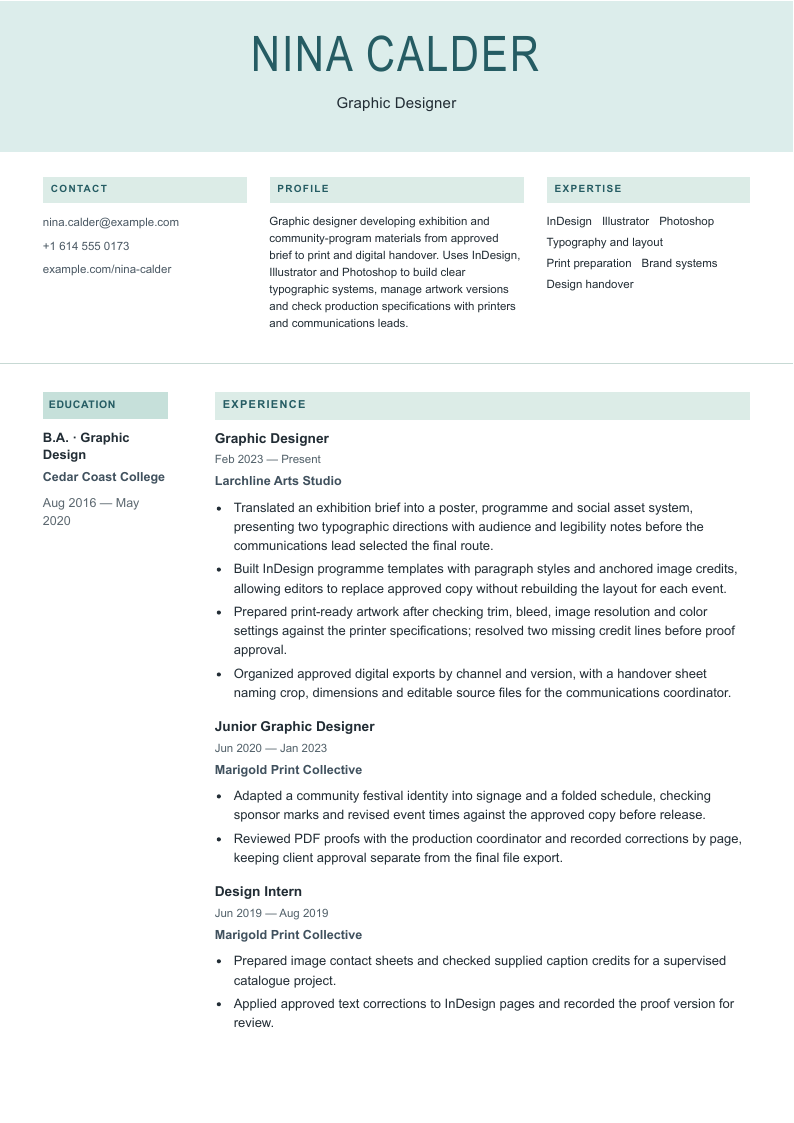
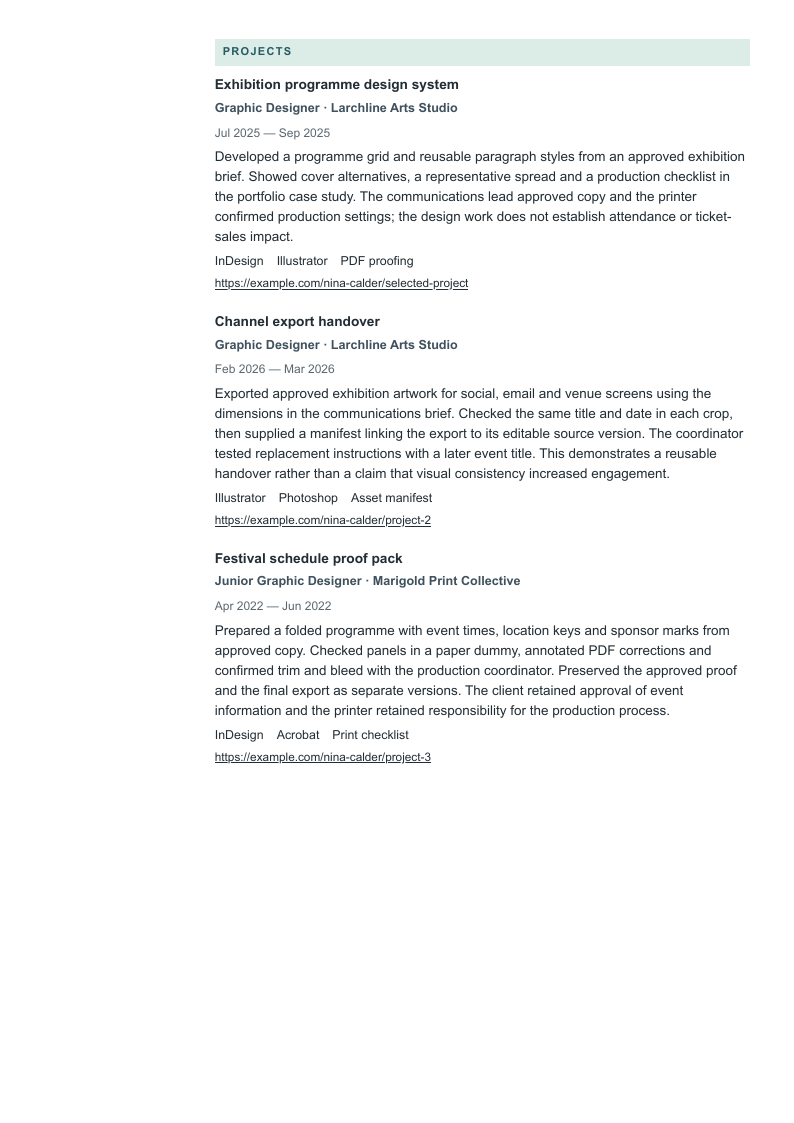
The expanded version preserves the base record and adds the earlier design intern position plus two dated projects: Channel export handover and Festival schedule proof pack. Each project uses the actual title and employer held on those dates. Studio is shown without a photo. Check the final project sentence, earlier role and complete URLs across every page.
Graphic designer developing exhibition and community-program materials from approved brief to print and digital handover. Uses InDesign, Illustrator and Photoshop to build clear typographic systems, manage artwork versions and check production specifications with printers and communications leads.
Skills
InDesign · Illustrator · Photoshop · Typography and layout · Print preparation · Brand systems · Design handover
Experience
Graphic Designer
Larchline Arts Studio
February 2023–Present
Translated an exhibition brief into a poster, programme and social asset system, presenting two typographic directions with audience and legibility notes before the communications lead selected the final route.
Built InDesign programme templates with paragraph styles and anchored image credits, allowing editors to replace approved copy without rebuilding the layout for each event.
Prepared print-ready artwork after checking trim, bleed, image resolution and color settings against the printer specifications; resolved two missing credit lines before proof approval.
Organized approved digital exports by channel and version, with a handover sheet naming crop, dimensions and editable source files for the communications coordinator.
Junior Graphic Designer
Marigold Print Collective
June 2020–January 2023
Adapted a community festival identity into signage and a folded schedule, checking sponsor marks and revised event times against the approved copy before release.
Reviewed PDF proofs with the production coordinator and recorded corrections by page, keeping client approval separate from the final file export.
Design Intern
Marigold Print Collective
June 2019–August 2019
Prepared image contact sheets and checked supplied caption credits for a supervised catalogue project.
Applied approved text corrections to InDesign pages and recorded the proof version for review.
Education
B.A. in Graphic Design · Cedar Coast College
August 2016–May 2020
Projects
Exhibition programme design system
Graphic Designer · Larchline Arts Studio
July 2025–September 2025
InDesign · Illustrator · PDF proofing
Developed a programme grid and reusable paragraph styles from an approved exhibition brief. Showed cover alternatives, a representative spread and a production checklist in the portfolio case study. The communications lead approved copy and the printer confirmed production settings; the design work does not establish attendance or ticket-sales impact.
Exported approved exhibition artwork for social, email and venue screens using the dimensions in the communications brief. Checked the same title and date in each crop, then supplied a manifest linking the export to its editable source version. The coordinator tested replacement instructions with a later event title. This demonstrates a reusable handover rather than a claim that visual consistency increased engagement.
Prepared a folded programme with event times, location keys and sponsor marks from approved copy. Checked panels in a paper dummy, annotated PDF corrections and confirmed trim and bleed with the production coordinator. Preserved the approved proof and the final export as separate versions. The client retained approval of event information and the printer retained responsibility for the production process.
This record exercises continuation pages; it does not prescribe a longer application. Select relevant work before shortening content for appearance. Keep the condition, responsibility or measurement definition needed to understand a bullet.
Check the final download before applying
Read every page at normal size, including the final bullet, project ending, qualifications and date ranges. Check contacts in both photo states.
Copy the PDF text into a plain document and inspect reading order across columns. Open each portfolio and project link and verify that it reaches material you may share.
Use the employer’s requested file format. Check fields populated after upload; a clean visual preview cannot guarantee parsing in every system.
Verify titles, dates, measurement definitions and personal contribution. Replace all fictional details and remove private employer or customer information.
Review your graphic designer resume with the analyzer and judge suggestions against evidence you can support. The Use buttons retain the selected design and photo preference through signup; an account is required. Free-plan PDF downloads include a watermark, while these previews show paid-plan output.
Questions, answered
Should my graphic designer resume be highly decorative?
Choose a layout that keeps your experience, contact and portfolio link readable. The portfolio can show the broader visual range. Check the actual downloaded file and requested application format; a distinctive appearance alone does not establish successful parsing.
What should a portfolio case study explain?
State the brief, audience, constraints, your role, important alternatives, selected direction and handover. Credit collaborators and distinguish commissioned work from a student or self-initiated project. The final image needs enough context to reveal your judgment.
Can I claim marketing results for a design?
Only when you have a defined measurement and a defensible account of your contribution. Delivery counts, approved proofs and reuse are useful evidence without attributing sales or attendance to artwork alone.
How do I describe adapting someone else’s identity?
Name the adaptation, formats and constraints, and credit the original identity where appropriate. Explain what you changed and checked. Applying a brand system is relevant work without claiming that you created it.
Does a senior designer title mean people management?
No. Report direct reports, project leadership and design review separately. The cited Pokémon vacancy explicitly has no people-manager responsibility, illustrating why the actual role description matters.
Does signup retain the chosen design and photo preference?
The Use buttons pass that exact design and current photo preference through signup to the builder. An account is required. The fictional resume and portrait are not inserted into your account. Free-plan PDF downloads include a watermark; the displayed previews show paid-plan output.
Prepared by Resumize with AI-assisted research and drafting for English-language US applications. Three primary employer descriptions with full bodies and application forms were checked on October 29, 2026; publication dates were not shown and availability can change. Occupation and resume guidance below inform scope and presentation. The fictional resume, annotated rewrites and critiques are original editorial examples, not employer endorsements. No Search Console data, search-volume estimate or ranking forecast was available.
Checked October 29, 2026: full description and application form available; publication date not shown. Glen Cove, New York. Brand and editorial craft, typography and portfolio quality; explicitly open to strong early-career work.
Checked October 29, 2026: full description and application form available; publication date not shown. New York. Campaign systems, presentations and brand collateral across licensed lifestyle brands; brand scope is specific to the employer.
Checked October 29, 2026: full description and application form available; publication date not shown. Bellevue, Washington. Long-format editorial systems, InDesign and prepress; this position explicitly has no people-manager responsibility.