Full stack developer resume examples and templates
A full stack developer resume should explain how a user action becomes a reliable application behavior. Show the interface, API contract, data change, tests and release work you actually owned. This guide uses one connected workflow, six annotated rewrites and three real builder designs to make that breadth concrete without claiming expertise in every layer.
These previews use the same layouts as the builder, with identical example content. Open a full preview to inspect the text and spacing.
Fictional candidate, employers, education and results. The optional portrait is AI-generated. Use your own evidence and photo; the example is not inserted into your resume.
Precision
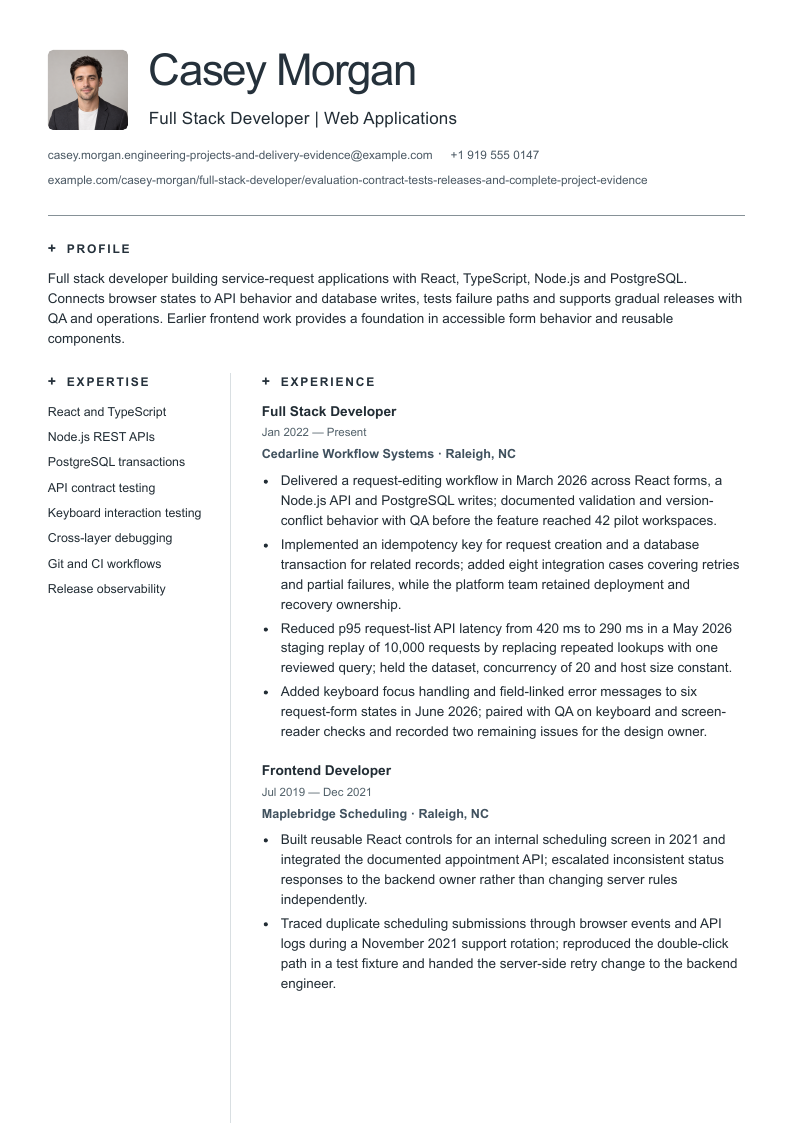
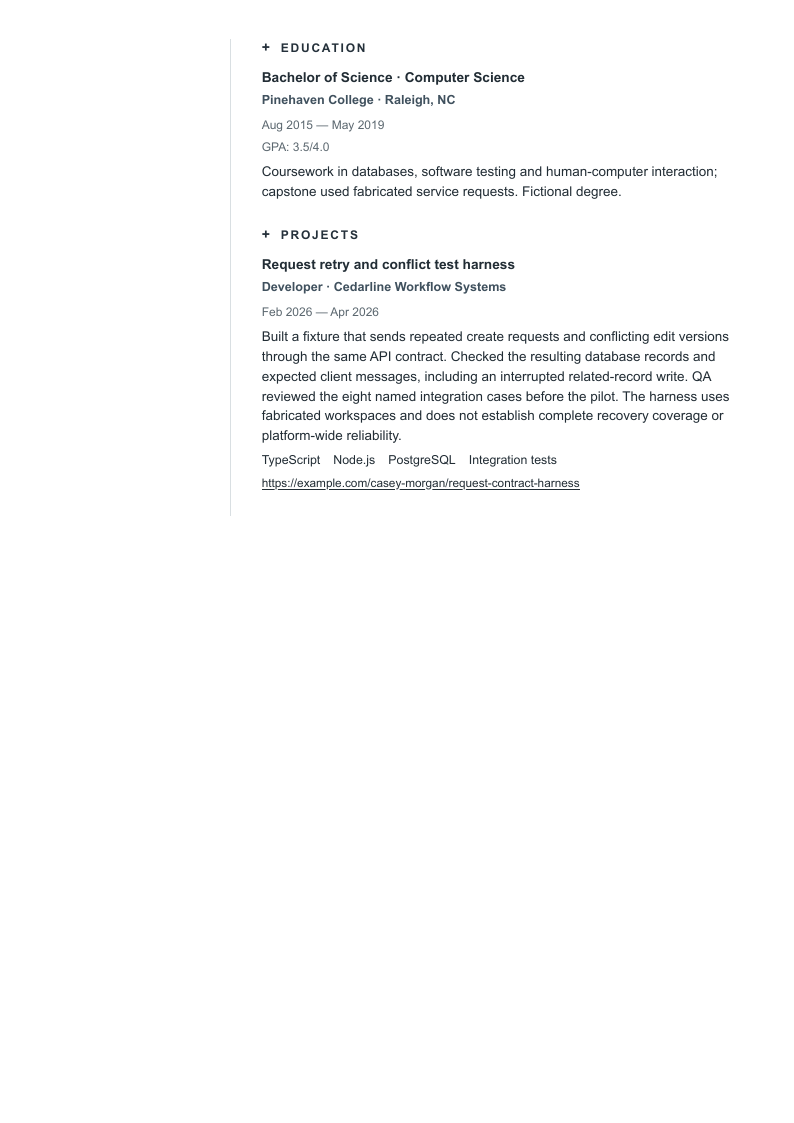
A full-width header and Profile lead into a narrow left Expertise rail beside Experience, Education, optional Certifications and Projects in the wider column. Fine rules separate sections.
Before sending: The skills rail narrows the body. Follow the version-conflict explanation and the complete project through each continuation, including copied text order.
The original Modern design uses a dark identity and contact header, an unheaded summary, then Skills, Experience, Education, Projects and optional Certifications in one column.
Before sending: Its short social label may shorten a portfolio address while retaining the link. Inspect the full email, link destination and education grade in the downloaded file.
A plain left header and restrained headings present Profile, Experience, Expertise, Education, optional Certifications and Projects in one column. Dates occupy a small gutter.
Before sending: The quiet layout depends on specific writing. Keep the test environment and ownership boundaries legible instead of replacing them with a longer technology list.
“Use” opens signup with that design and photo preference selected for the builder. A free account is required. Free-plan PDF downloads include a watermark; see current plans for paid options. Photo conventions vary; follow the employer’s instructions and local expectations.
All three designs show the same fictional record. The default is without a photo; the optional portrait is AI-generated. Compare the full pages before choosing. The template buttons retain the exact design, photo choice and Full Stack Developer role through signup. They do not insert the example career record or portrait into your account.
Casey Morgan is a fictional developer in Raleigh, North Carolina. The current job owns a request workflow across React, Node.js and PostgreSQL; the earlier frontend role integrates an API owned by another engineer. Every person, employer, school, result and date is invented. The portfolio addresses are example.com placeholders, and the optional portrait is AI-generated.
Full stack developer building service-request applications with React, TypeScript, Node.js and PostgreSQL. Connects browser states to API behavior and database writes, tests failure paths and supports gradual releases with QA and operations. Earlier frontend work provides a foundation in accessible form behavior and reusable components.
Skills
React and TypeScript · Node.js REST APIs · PostgreSQL transactions · API contract testing · Keyboard interaction testing · Cross-layer debugging · Git and CI workflows · Release observability
Experience
Full Stack Developer
Cedarline Workflow Systems · Raleigh, NC
January 2022–Present
Delivered a request-editing workflow in March 2026 across React forms, a Node.js API and PostgreSQL writes; documented validation and version-conflict behavior with QA before the feature reached 42 pilot workspaces.
Implemented an idempotency key for request creation and a database transaction for related records; added eight integration cases covering retries and partial failures, while the platform team retained deployment and recovery ownership.
Reduced p95 request-list API latency from 420 ms to 290 ms in a May 2026 staging replay of 10,000 requests by replacing repeated lookups with one reviewed query; held the dataset, concurrency of 20 and host size constant.
Added keyboard focus handling and field-linked error messages to six request-form states in June 2026; paired with QA on keyboard and screen-reader checks and recorded two remaining issues for the design owner.
Frontend Developer
Maplebridge Scheduling · Raleigh, NC
July 2019–December 2021
Built reusable React controls for an internal scheduling screen in 2021 and integrated the documented appointment API; escalated inconsistent status responses to the backend owner rather than changing server rules independently.
Traced duplicate scheduling submissions through browser events and API logs during a November 2021 support rotation; reproduced the double-click path in a test fixture and handed the server-side retry change to the backend engineer.
Education
Bachelor of Science in Computer Science · Pinehaven College · Raleigh, NC
August 2015–May 2019
Coursework in databases, software testing and human-computer interaction; capstone used fabricated service requests. Fictional degree.
Built a fixture that sends repeated create requests and conflicting edit versions through the same API contract. Checked the resulting database records and expected client messages, including an interrupted related-record write. QA reviewed the eight named integration cases before the pilot. The harness uses fabricated workspaces and does not establish complete recovery coverage or platform-wide reliability.
Read the six bullets as a connected account: delivery scope, retry behavior, a controlled performance comparison, accessible form states and an earlier investigation across a client/server boundary. This is a demonstration of evidence selection, not a checklist of technologies every full stack job needs. Casey’s degree and project are shown in full so you can compare the same record across all three layouts.
Prove breadth through one complete workflow
“Full stack” is useful only when a reader can see the boundary between layers. Start with what the user needed to do. Explain the browser state, the service contract and the persistent data change, then identify how you tested the interaction. Casey’s edit workflow includes validation and a version conflict. That is more informative than an unconnected list of React, Node.js and PostgreSQL.
The three employer sources show different versions of the work. Via Logic describes frontend and backend development, API integration, relational data and testing with quality engineers. LightFeather’s senior opening centers modernization of poorly documented legacy workflows. Gametime’s senior role spans product experiences, services, observability and ongoing optimization. These examples support writing about connected delivery; they do not make one language, seniority level or industry universal.
Keep responsibility precise at each boundary. Building a database transaction does not establish ownership of disaster recovery. Handling keyboard focus does not establish formal accessibility conformance. Consuming an API does not make you its author. Naming QA, a platform owner or a backend engineer can strengthen your account because a reader can distinguish your implementation from collaboration and approval.
Read eligibility and domain requirements separately from transferable engineering work. Via Logic and LightFeather describe federal-contract conditions; neither establishes a citizenship or clearance requirement for every developer. Gametime’s role is senior and has its own product scale. Match the actual target vacancy rather than borrowing restrictions, technology claims or millions-of-users figures from an employer’s description.
Six full stack developer rewrites with reasoning
Each after sentence appears verbatim in the base resume. The before statements are deliberately weak or overstated examples, not additional facts. Use the evidence prompts to check your own record, and replace invented sample figures with results you can substantiate and share.
1. Connect the layers
Before: Built amazing applications with every technology.
After: Delivered a request-editing workflow in March 2026 across React forms, a Node.js API and PostgreSQL writes; documented validation and version-conflict behavior with QA before the feature reached 42 pilot workspaces.
Why it works: Names one shipped workflow and three connected layers. The 42 workspaces describe pilot exposure, not unique users, revenue or proof of adoption. QA owns its review rather than disappearing from the story.
Evidence to check: A permission-cleared workflow specification, reviewed API contract, release record and pilot eligibility list.
2. Explain retry behavior
Before: Made the backend perfectly reliable.
After: Implemented an idempotency key for request creation and a database transaction for related records; added eight integration cases covering retries and partial failures, while the platform team retained deployment and recovery ownership.
Why it works: Identifies the failure modes and the candidate’s code contribution. Eight test cases do not prove complete reliability, and request deduplication is bounded by the key and retention rules.
Evidence to check: The key scope and retention specification, transaction boundary, test cases and platform handoff.
3. State a reproducible performance comparison
Before: Improved performance by 90% for all customers.
After: Reduced p95 request-list API latency from 420 ms to 290 ms in a May 2026 staging replay of 10,000 requests by replacing repeated lookups with one reviewed query; held the dataset, concurrency of 20 and host size constant.
Why it works: Keeps the claim within one controlled staging replay. The decrease is 130 ms, approximately 31%, not 90%; production traffic or customer experience was not measured by this test.
Evidence to check: Replay inputs, request count, concurrency, host specification, query plan and before-and-after latency report.
4. Show accessible failure states
Before: Guaranteed accessibility compliance.
After: Added keyboard focus handling and field-linked error messages to six request-form states in June 2026; paired with QA on keyboard and screen-reader checks and recorded two remaining issues for the design owner.
Why it works: Describes checks and unresolved findings rather than a blanket accessibility or legal-conformance claim. Six states are a defined review set, not six applications or all assistive technologies.
Evidence to check: State inventory, manual check notes, tested browser and assistive-technology versions, and tracked remaining issues.
5. Keep earlier scope honest
Before: Owned the entire platform as a frontend developer.
After: Built reusable React controls for an internal scheduling screen in 2021 and integrated the documented appointment API; escalated inconsistent status responses to the backend owner rather than changing server rules independently.
Why it works: Shows a frontend foundation that connects to later cross-layer work. Consuming an API is distinct from owning its implementation; the earlier title and decision boundary stay accurate.
Evidence to check: Reviewed component changes, API examples, status-response issue and the backend owner’s resolution.
6. Describe production investigation
Before: Eliminated every production bug.
After: Traced duplicate scheduling submissions through browser events and API logs during a November 2021 support rotation; reproduced the double-click path in a test fixture and handed the server-side retry change to the backend engineer.
Why it works: A reproducible path is useful evidence without claiming all bugs disappeared. The candidate investigates and tests the client behavior; the backend engineer owns the server change.
Evidence to check: Sanitized event trace, reproducible fixture, support handoff and separately reviewed backend change.
Write the summary around your delivery pattern
Use the summary to make the rest of the resume predictable. Casey names service-request applications, the actual stack, failure-path testing and gradual releases. The experience supplies each claim. An opening such as “expert in all technologies” would be harder to defend and would hide the specific value of connecting an interface to a reliable write.
In experience, explain the difficult seam rather than retelling the entire ticket. A retry can create duplicate records unless the contract handles it; an edit can overwrite a newer version unless a conflict becomes visible. State the behavior your change implemented and the tests you added. A brief reference to the reviewed contract can show more judgment than five additional framework names.
Treat performance as a measurement with a setting. The fictional request-list replay changes p95 latency from 420 ms to 290 ms, a 130 ms decrease, approximately 31%. It uses a fixed staging dataset, 20 concurrent requests and the same host size. It does not measure all production requests, customer satisfaction or revenue. Preserve those boundaries if you adapt this structure to your own results.
List technologies where they explain a decision or implementation. React belongs with form state, Node.js with the API and PostgreSQL with related writes. Add a tool to Skills only when you can connect it to work, coursework or a clearly labeled project. A vacancy’s keyword list is a prompt to check relevance, not permission to claim experience you do not have.
Connect skills to code behavior and review evidence
A useful skill entry has a corresponding work product. The table turns Casey’s technology list into questions a reviewer could explore. Use public code, approved diagrams or sanitized examples where permitted; confidential repositories, tokens and customer traces do not belong in a public portfolio.
Full Stack Developer skills and supporting evidence
Skill
Evidence to gather
Fictional example
React and TypeScript
State transitions, validation and a demonstrated interaction.
Request-editing states include errors and version conflicts.
Node.js APIs
Contract, failure response and integration behavior.
Create requests have an explicit idempotency-key rule.
PostgreSQL
Data invariants, transaction boundary and query reasoning.
Related writes are tested for partial failure.
Integration testing
Named cases, test data and what is not covered.
Eight cases cover retries and interrupted writes.
Performance analysis
Workload, environment and full latency distribution.
10,000-request staging replay at fixed concurrency.
Accessibility implementation
Specific checks and unresolved issues.
Six form states reviewed with QA; two issues remain tracked.
Use education and projects to close an evidence gap
List the degree, field, institution and dates accurately. Casey’s fictional computer science degree includes coursework and GPA 3.5/4.0. GPA is optional; retain it if it helps the application and you can substantiate it. The preview shows it because the supplied record contains it. A design should not silently drop a field you chose to include.
No certification is claimed in this sample. A cloud course or badge can be relevant when earned and accurately labeled, but it does not establish full stack delivery or replace the employer’s stated requirements. Put current credentials under their real issuer and title, and distinguish a course completion from an examination-based certification. Do not add a security clearance merely because one cited vacancy asks for it.
The request-contract project explains the test fixture behind the job bullet. It names repeated create requests, conflicting edits, database checks and QA review. That is additional evidence rather than a second copy of the same achievement. A personal project can serve the same purpose when labeled as such: name synthetic inputs, local deployment limits and the behavior you actually demonstrated.
Build a first full stack application from honest scope
If you are moving from frontend, keep the real job title and show a deeper contribution where it happened. Casey’s earlier role integrated an appointment API and investigated submissions, while another engineer owned server rules. The current role adds API implementation and database behavior. A progression like this is credible without renaming every earlier position “full stack.”
For a graduate or career changer, explain one complete personal or academic flow: input, validation, authorization boundary, API response, database write and a repeatable test. Label local or demonstration-only deployment. Do not imply paying users or production availability from a localhost demo, and do not claim a course group’s whole repository as your individual work.
A concrete early-career statement might describe a synthetic equipment-request form whose errors are associated with fields, whose API rejects invalid writes and whose tests cover duplicate submissions. State what you built and what a supervisor reviewed. Casey’s expanded summer internship supplies that kind of bounded foundation; it overlaps the degree and precedes the first full-time job.
Inspect long contacts with the optional photo
The Precision long-contact export turns the photo on and changes only Casey’s resume email and portfolio URL. User identity, phone, jobs, dates, degree, GPA and projects stay identical. Read the complete email and final URL segment in the accessible record, then compare the actual PDF link. Modern may show a shortened social label; a shortened label must still point to the complete intended destination.
Full stack developer building service-request applications with React, TypeScript, Node.js and PostgreSQL. Connects browser states to API behavior and database writes, tests failure paths and supports gradual releases with QA and operations. Earlier frontend work provides a foundation in accessible form behavior and reusable components.
Skills
React and TypeScript · Node.js REST APIs · PostgreSQL transactions · API contract testing · Keyboard interaction testing · Cross-layer debugging · Git and CI workflows · Release observability
Experience
Full Stack Developer
Cedarline Workflow Systems · Raleigh, NC
January 2022–Present
Delivered a request-editing workflow in March 2026 across React forms, a Node.js API and PostgreSQL writes; documented validation and version-conflict behavior with QA before the feature reached 42 pilot workspaces.
Implemented an idempotency key for request creation and a database transaction for related records; added eight integration cases covering retries and partial failures, while the platform team retained deployment and recovery ownership.
Reduced p95 request-list API latency from 420 ms to 290 ms in a May 2026 staging replay of 10,000 requests by replacing repeated lookups with one reviewed query; held the dataset, concurrency of 20 and host size constant.
Added keyboard focus handling and field-linked error messages to six request-form states in June 2026; paired with QA on keyboard and screen-reader checks and recorded two remaining issues for the design owner.
Frontend Developer
Maplebridge Scheduling · Raleigh, NC
July 2019–December 2021
Built reusable React controls for an internal scheduling screen in 2021 and integrated the documented appointment API; escalated inconsistent status responses to the backend owner rather than changing server rules independently.
Traced duplicate scheduling submissions through browser events and API logs during a November 2021 support rotation; reproduced the double-click path in a test fixture and handed the server-side retry change to the backend engineer.
Education
Bachelor of Science in Computer Science · Pinehaven College · Raleigh, NC
August 2015–May 2019
Coursework in databases, software testing and human-computer interaction; capstone used fabricated service requests. Fictional degree.
Built a fixture that sends repeated create requests and conflicting edit versions through the same API contract. Checked the resulting database records and expected client messages, including an interrupted related-record write. QA reviewed the eight named integration cases before the pilot. The harness uses fabricated workspaces and does not establish complete recovery coverage or platform-wide reliability.
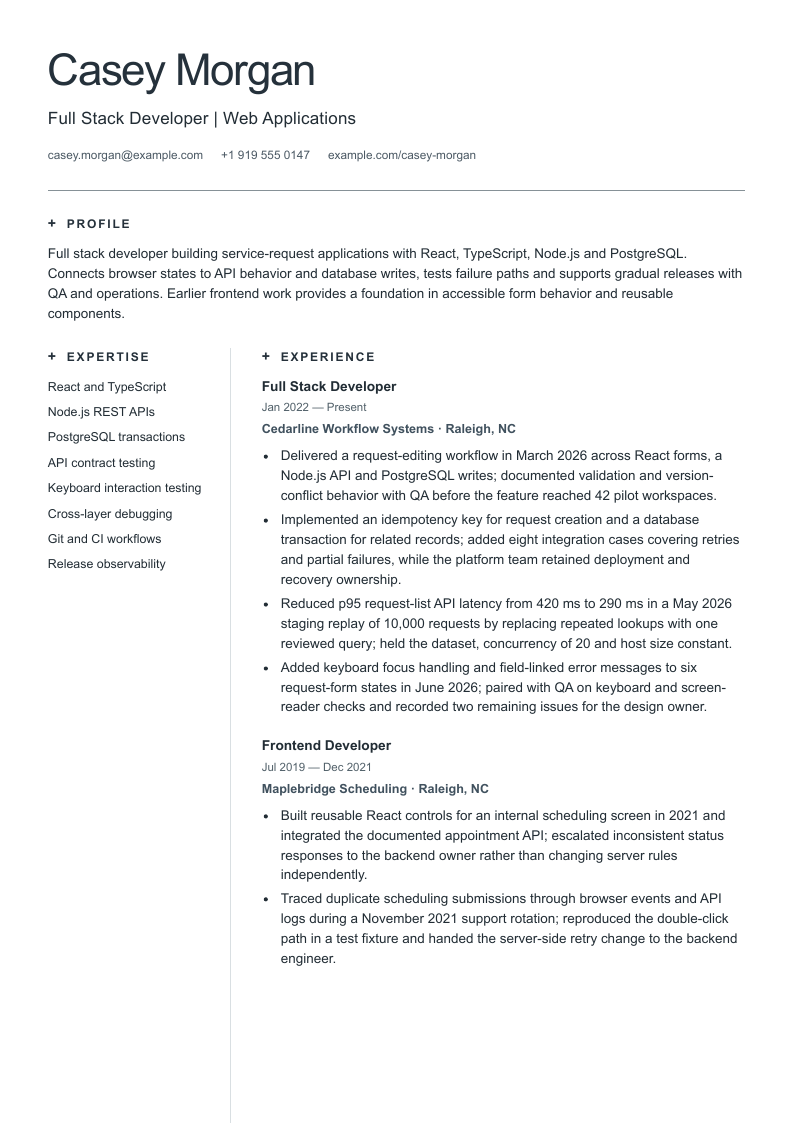
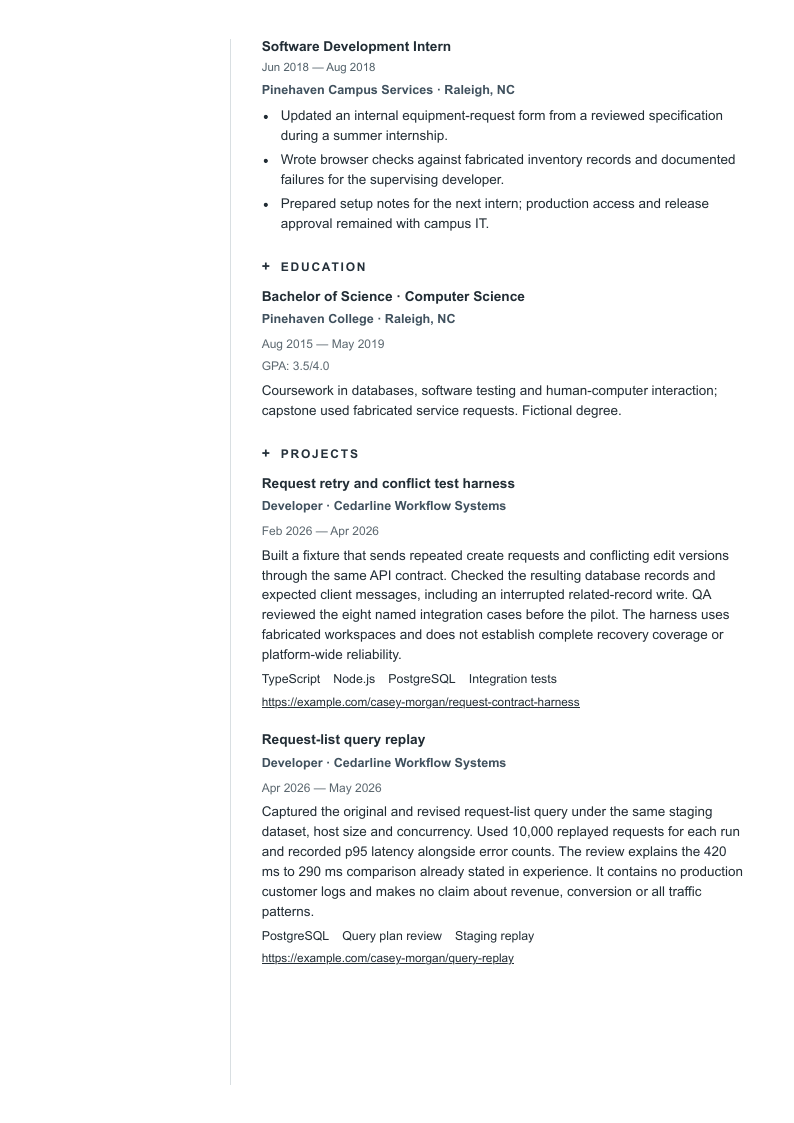
The expanded Precision record has the photo off and preserves the complete base record. It adds the June–August 2018 summer internship, a query-replay project and a scheduling investigation. The internship overlaps the degree and ends before the July 2019 frontend job. These additions test content flow; they do not prescribe a page count or require every applicant to include every project.
Open page 1 at full sizePrecision · Page 1 of 3 · Photo off · Complete paid-plan PDF page, including margins, without a watermark.Open page 2 at full sizePrecision · Page 2 of 3 · Photo off · Complete paid-plan PDF page, including margins, without a watermark.Open page 3 at full sizePrecision · Page 3 of 3 · Photo off · Complete paid-plan PDF page, including margins, without a watermark.Use Precision without a photo
Full stack developer building service-request applications with React, TypeScript, Node.js and PostgreSQL. Connects browser states to API behavior and database writes, tests failure paths and supports gradual releases with QA and operations. Earlier frontend work provides a foundation in accessible form behavior and reusable components.
Skills
React and TypeScript · Node.js REST APIs · PostgreSQL transactions · API contract testing · Keyboard interaction testing · Cross-layer debugging · Git and CI workflows · Release observability
Experience
Full Stack Developer
Cedarline Workflow Systems · Raleigh, NC
January 2022–Present
Delivered a request-editing workflow in March 2026 across React forms, a Node.js API and PostgreSQL writes; documented validation and version-conflict behavior with QA before the feature reached 42 pilot workspaces.
Implemented an idempotency key for request creation and a database transaction for related records; added eight integration cases covering retries and partial failures, while the platform team retained deployment and recovery ownership.
Reduced p95 request-list API latency from 420 ms to 290 ms in a May 2026 staging replay of 10,000 requests by replacing repeated lookups with one reviewed query; held the dataset, concurrency of 20 and host size constant.
Added keyboard focus handling and field-linked error messages to six request-form states in June 2026; paired with QA on keyboard and screen-reader checks and recorded two remaining issues for the design owner.
Frontend Developer
Maplebridge Scheduling · Raleigh, NC
July 2019–December 2021
Built reusable React controls for an internal scheduling screen in 2021 and integrated the documented appointment API; escalated inconsistent status responses to the backend owner rather than changing server rules independently.
Traced duplicate scheduling submissions through browser events and API logs during a November 2021 support rotation; reproduced the double-click path in a test fixture and handed the server-side retry change to the backend engineer.
Software Development Intern
Pinehaven Campus Services · Raleigh, NC
June 2018–August 2018
Updated an internal equipment-request form from a reviewed specification during a summer internship.
Wrote browser checks against fabricated inventory records and documented failures for the supervising developer.
Prepared setup notes for the next intern; production access and release approval remained with campus IT.
Education
Bachelor of Science in Computer Science · Pinehaven College · Raleigh, NC
August 2015–May 2019
Coursework in databases, software testing and human-computer interaction; capstone used fabricated service requests. Fictional degree.
Built a fixture that sends repeated create requests and conflicting edit versions through the same API contract. Checked the resulting database records and expected client messages, including an interrupted related-record write. QA reviewed the eight named integration cases before the pilot. The harness uses fabricated workspaces and does not establish complete recovery coverage or platform-wide reliability.
Captured the original and revised request-list query under the same staging dataset, host size and concurrency. Used 10,000 replayed requests for each run and recorded p95 latency alongside error counts. The review explains the 420 ms to 290 ms comparison already stated in experience. It contains no production customer logs and makes no claim about revenue, conversion or all traffic patterns.
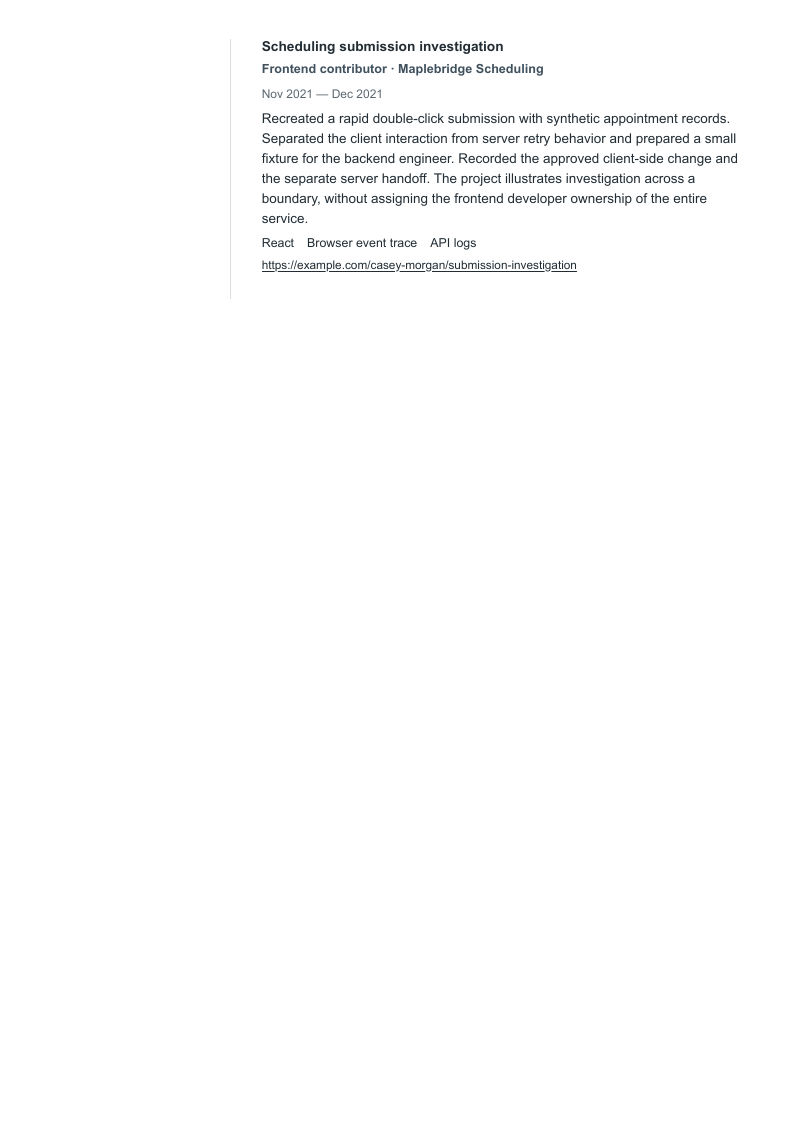
Recreated a rapid double-click submission with synthetic appointment records. Separated the client interaction from server retry behavior and prepared a small fixture for the backend engineer. Recorded the approved client-side change and the separate server handoff. The project illustrates investigation across a boundary, without assigning the frontend developer ownership of the entire service.
Follow the query-replay comparison and scheduling handoff through their final sentences. The narrower Expertise rail and wider narrative column need separate inspection in Precision. Remove repetition when tailoring your own application, but keep the test setting and the boundary between your change and another engineer’s work.
Check the file you will submit
Trace the workflow. Check that the UI behavior, API response and persistent write agree. Distinguish your implementation from design, QA and platform approvals.
Recheck each measurement. Retain workload, environment, percentile and comparison period. A staging p95 result is not a production customer-experience claim.
Inspect every page. Read full contacts, dates, education grade, project links and final qualifiers. In Precision inspect the skills rail; in Modern verify shortened link labels and the complete header.
Test the exported file. Open links, copy text and check the application’s parsed fields. Follow the requested file type and do not assume any template guarantees screening or an interview.
A free account is required for the builder. Free-plan PDF downloads include a watermark; these images show paid-plan output. Use buttons carry your chosen design, photo preference and Full Stack Developer role into signup without copying the fictional example into your account.
Show connected frontend, API and data work, relevant technologies, tests and release or support responsibilities. Use one specific workflow to demonstrate breadth and identify the decisions or systems that remained with other team members.
Do I need equal expertise in frontend and backend?
Describe your actual strengths and the target vacancy. A frontend-heavy role can still include meaningful backend work, but consuming an API is different from implementing it. Avoid claiming every language or the full infrastructure estate from one cross-layer feature.
Can I include a personal project without production users?
Yes, when its context is clear. State that the data is synthetic, identify your contribution, explain the behavior and tests, and label local or demo deployment. Do not invent user counts, revenue or availability.
How should I describe performance improvements?
Name the metric, baseline, comparison, workload and environment. The sample’s 420 ms to 290 ms staging p95 change is approximately 31% lower under a defined replay, not a 90% production or revenue gain.
Which template should I choose?
Compare the same content in Precision, Modern and Essential. Precision has a narrow skills rail, Modern uses its original dark header and shortened social labels, and Essential offers a restrained main column. Check your complete PDF and application fields.
What happens after I choose a design?
The button opens signup with the exact design, photo preference and Full Stack Developer role retained. It does not insert Casey’s fictional resume or AI portrait. A free account is required; free-plan PDF downloads include a watermark.
Prepared by Resumize with AI-assisted research and drafting for English-language US applications. Three current primary employer descriptions were retrieved directly with full responsibilities and application forms on October 28, 2026; no application was submitted. Two sources describe senior roles, and two describe federal eligibility conditions. They illustrate different scopes, not a universal specification. CareerOneStop provides general resume-writing and formatting guidance, not a test or endorsement of these layouts. All career facts and rewrites are original fiction; the portrait is AI-generated. No source or design promises search rankings, parsing success or a job offer.
Retrieved October 28, 2026: Remote, United States; full description and inline application form available, no posting date shown. Covers frontend, backend, APIs, relational data, testing and support. Citizenship, residency and Public Trust conditions apply to this federal-contract vacancy, not to full stack work universally.
Retrieved October 28, 2026: United States, remote with EST hours; full description and application form available, no posting date displayed. The body describes a senior role modernizing legacy workflows with Java/Spring Boot, React, APIs and relational data. Its 7+ years and federal eligibility conditions are specific to the posting.
Retrieved October 28, 2026: United States - Remote; full description and inline application form available, no posting date shown. Describes cross-layer product delivery, APIs, React, backend services, observability and ongoing optimization. Senior-level responsibilities do not become requirements for every full stack applicant.
Read October 28, 2026 through the web reader. US Department of Labor-sponsored guidance on relevant employment context, dates and specific contributions. Fictional examples here are original, not employer achievements.
Read October 28, 2026 through the web reader. Favors clear, consistent presentation and a simple single-column starting point. Does not endorse these designs or guarantee parsing; inspect your own PDF and application fields.