Content Designer · Service Journeys and Accessibility
Content Designer resume examples and templates
A Content Designer resume should follow a user need through a whole journey: information structure, screen states, research, accessibility and the handover that makes the design real. Explain the decision and your contribution before highlighting the wording. A portfolio can show the artifact; the resume should explain why it changed and what evidence informed it.
These previews use the same layouts as the builder, with identical example content. Open a full preview to inspect the text and spacing.
Fictional candidate, employers, education and results. The optional portrait is AI-generated. Use your own evidence and photo; the example is not inserted into your resume.
Studio
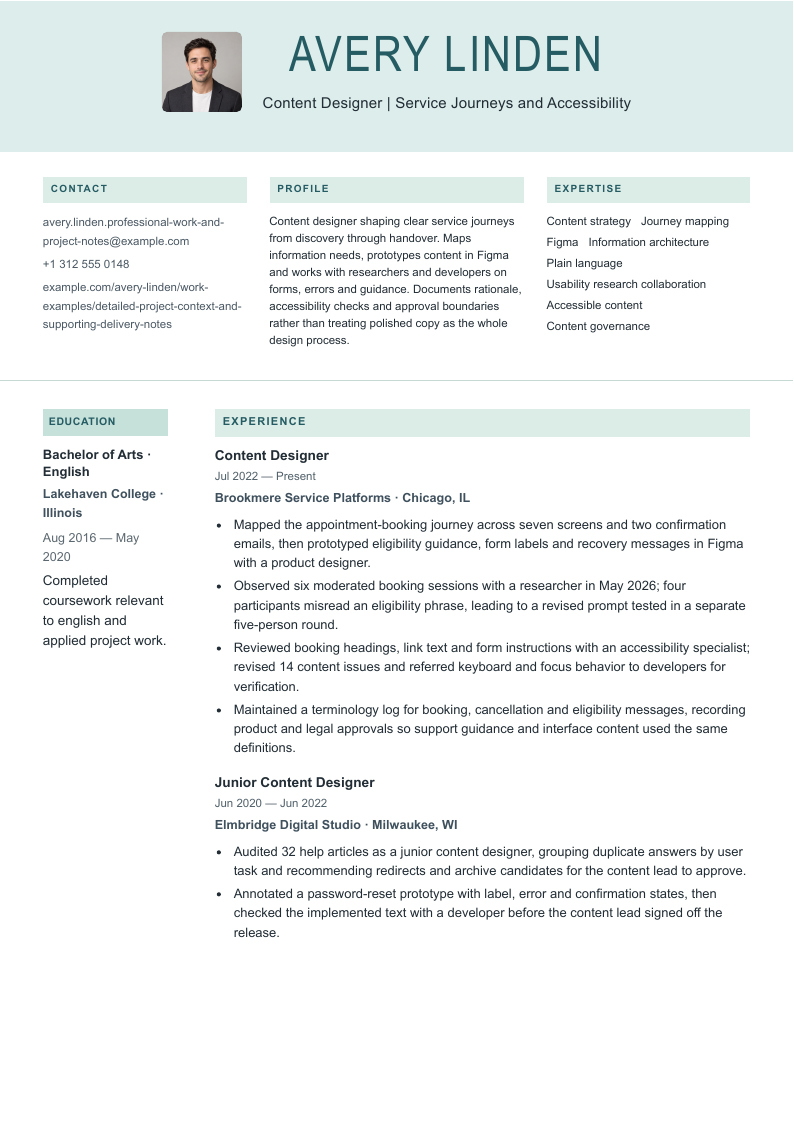
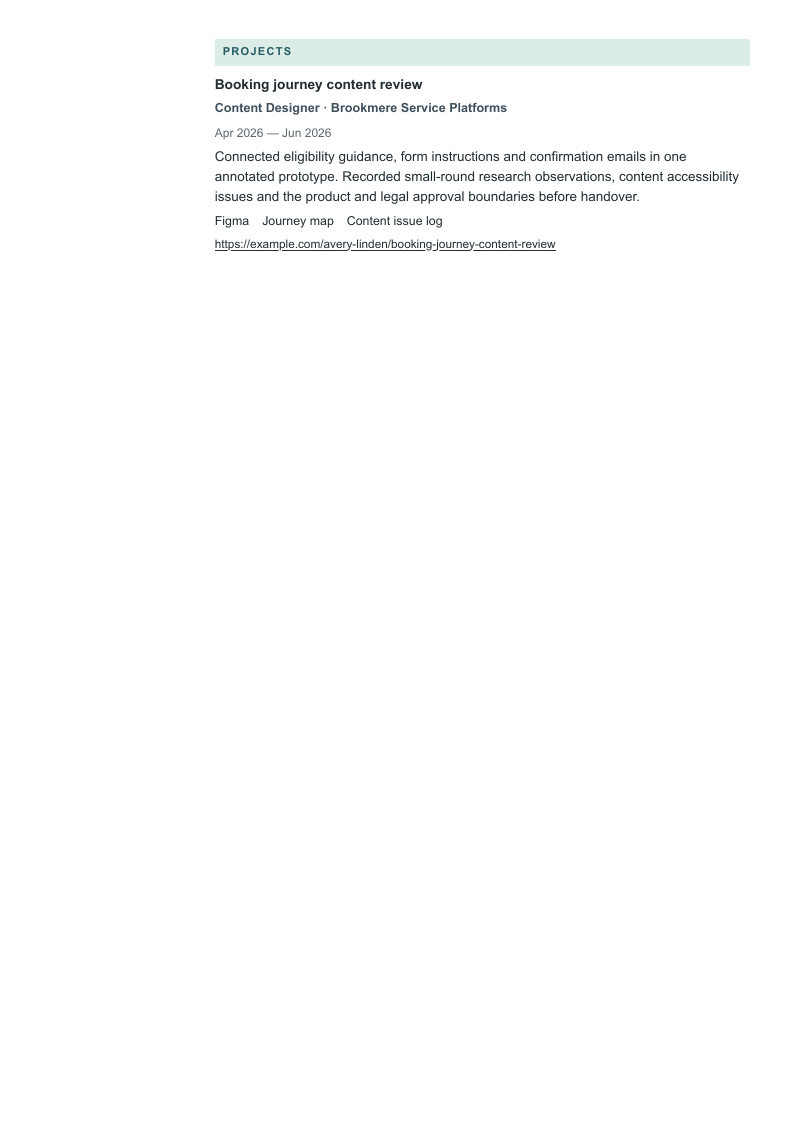
A centered mint header leads into separate Contact, Profile and Expertise areas, then education beside work history.
Before sending: The introductory areas and education sidebar are narrow. Their placement is fixed; longer history continues in the wider right column.
A large light serif name, italic Profile and full-width Projects before Experience, followed by Expertise and bottom qualifications.
Before sending: Projects appear before the employment that explains them. Each selected example needs a clear audience, contribution and approval boundary rather than a dramatic headline.
A dark gray split header, shaded introduction and three-column skills list above a single main column of dated evidence.
Before sending: The narrow contact column wraps long details, and education displays its supplied date range. Review every PDF page when your history grows.
“Use” opens signup with that design and photo preference selected for the builder. A free account is required. Free-plan PDF downloads include a watermark; see current plans for paid options. Photo conventions vary; follow the employer’s instructions and local expectations.
The three designs show the same fictional career. Choose the structure that leaves your most relevant evidence easy to read, then inspect the actual download after changing your information. A different section order does not change your experience or verify a claim.
Studio: A centered mint header leads into separate Contact, Profile and Expertise areas, then education beside work history. The introductory areas and education sidebar are narrow. Their placement is fixed; longer history continues in the wider right column.Read about Studio
Editorial: A large light serif name, italic Profile and full-width Projects before Experience, followed by Expertise and bottom qualifications. Projects appear before the employment that explains them. Each selected example needs a clear audience, contribution and approval boundary rather than a dramatic headline.Read about Editorial
Modern: A dark gray split header, shaded introduction and three-column skills list above a single main column of dated evidence. The narrow contact column wraps long details, and education displays its supplied date range. Review every PDF page when your history grows.Read about Modern
The default is photo off. The optional portrait is AI-generated. Buttons retain the exact design, photo preference and Content Designer role through signup. A free account is required; free-plan PDF downloads include a watermark. These previews show paid-plan output. The example career and portrait are not added to your account.
A complete Content Designer resume example
Avery Linden, all employers, college, dates, career details and results are original fiction. The 555 phone number and example.com links are placeholders. Use the structure with your own supported facts.
Avery Linden
Content Designer | Service Journeys and Accessibility
Content designer shaping clear service journeys from discovery through handover. Maps information needs, prototypes content in Figma and works with researchers and developers on forms, errors and guidance. Documents rationale, accessibility checks and approval boundaries rather than treating polished copy as the whole design process.
Skills
Content strategy · Journey mapping · Figma · Information architecture · Plain language · Usability research collaboration · Accessible content · Content governance
Experience
Content Designer
Brookmere Service Platforms · Chicago, IL
July 2022–Present
Mapped the appointment-booking journey across seven screens and two confirmation emails, then prototyped eligibility guidance, form labels and recovery messages in Figma with a product designer.
Observed six moderated booking sessions with a researcher in May 2026; four participants misread an eligibility phrase, leading to a revised prompt tested in a separate five-person round.
Reviewed booking headings, link text and form instructions with an accessibility specialist; revised 14 content issues and referred keyboard and focus behavior to developers for verification.
Maintained a terminology log for booking, cancellation and eligibility messages, recording product and legal approvals so support guidance and interface content used the same definitions.
Junior Content Designer
Elmbridge Digital Studio · Milwaukee, WI
June 2020–June 2022
Audited 32 help articles as a junior content designer, grouping duplicate answers by user task and recommending redirects and archive candidates for the content lead to approve.
Annotated a password-reset prototype with label, error and confirmation states, then checked the implemented text with a developer before the content lead signed off the release.
Education
Bachelor of Arts in English · Lakehaven College · Illinois
August 2016–May 2020
Completed coursework relevant to english and applied project work.
Projects
Booking journey content review
Content Designer · Brookmere Service Platforms
April 2026–June 2026
Figma · Journey map · Content issue log
Connected eligibility guidance, form instructions and confirmation emails in one annotated prototype. Recorded small-round research observations, content accessibility issues and the product and legal approval boundaries before handover.
Show journeys and decisions beyond individual sentences
Avery’s booking work spans seven screens and two emails. Eligibility guidance, form labels, recovery messages and terminology belong to one service journey. This scope differs from publishing marketing articles or polishing a single interface label. UX writing overlaps with the work, but the example also shows structure, sequencing and governance.
VML’s London opening combines automotive journeys, landing pages, Figma and research collaboration. Affirm’s Content Designer II role is remote in the UK and spans product content through launch. AutoScout24’s senior Berlin or Munich role adds complex dealer journeys, AI interactions and additional language requirements. These are useful scope comparisons, not interchangeable US opportunities.
The UK Government Digital and Data capability framework describes content work from discovery through service journeys and distinguishes role levels. It is an occupational reference here rather than a licensing rule for a US applicant. Apply its useful emphasis on user needs while following the actual employer’s responsibilities and market requirements.
Six annotated Content Designer bullet rewrites
The six after statements are exactly the six bullets in the base work history: four in the current job and two in the earlier job. They demonstrate wording and evidence boundaries. Replace every fictional fact rather than borrowing an unsupported result.
1. Describe a whole journey
Before: Wrote engaging copy for apps.
After: Mapped the appointment-booking journey across seven screens and two confirmation emails, then prototyped eligibility guidance, form labels and recovery messages in Figma with a product designer.
Why it works: Shows connected touchpoints and collaboration instead of isolated copy production.
Evidence to check: Journey map, prototype versions and contribution record.
2. Keep small research honest
Before: Increased usability by 80%.
After: Observed six moderated booking sessions with a researcher in May 2026; four participants misread an eligibility phrase, leading to a revised prompt tested in a separate five-person round.
Why it works: Reports observations and separate rounds without implying a representative uplift.
Evidence to check: Research plan, consented notes and distinct participant rounds.
3. Name accessibility work
Before: Made the entire product WCAG compliant.
After: Reviewed booking headings, link text and form instructions with an accessibility specialist; revised 14 content issues and referred keyboard and focus behavior to developers for verification.
Why it works: Bounds the content contribution and avoids claiming a complete accessibility audit.
Evidence to check: Issue log, review scope and specialist verification.
4. Show governance
Before: Owned all product messaging.
After: Maintained a terminology log for booking, cancellation and eligibility messages, recording product and legal approvals so support guidance and interface content used the same definitions.
Why it works: Explains decisions and owners rather than claiming final approval authority.
Evidence to check: Terminology changes, owners and approval history.
5. Keep junior scope
Before: Led an enterprise content transformation.
After: Audited 32 help articles as a junior content designer, grouping duplicate answers by user task and recommending redirects and archive candidates for the content lead to approve.
Why it works: Keeps the held role and separates recommendation from publication authority.
Evidence to check: Inventory, grouping criteria and content-lead decisions.
6. Connect handover to delivery
Before: Collaborated with developers.
After: Annotated a password-reset prototype with label, error and confirmation states, then checked the implemented text with a developer before the content lead signed off the release.
Why it works: Provides an actual collaboration deliverable and acceptance process.
Evidence to check: Annotations, implementation check and sign-off.
Separate observed research from broad outcome claims
The summary names the specialty and contribution that the work history supports. An early-career summary can identify a labeled project; a senior summary should show real decisions, scope or leadership. Neither years alone nor a confident adjective can replace evidence.
The sample reports six moderated sessions, four observations about one phrase and a separate five-person follow-up. The groups and rounds remain distinct. A small qualitative study can explain a design decision, but it cannot establish a population-wide improvement percentage. Preserve the observed behavior and uncertainty instead of dressing it as a conversion result.
Accessibility work is bounded. Avery revised 14 content issues with a specialist and referred keyboard and focus behavior to developers. That does not certify the entire product against WCAG. Explain headings, link purpose, instructions or error content you addressed, then name the review and implementation checks rather than claiming complete compliance.
Portfolio stories should show an anonymized journey, alternatives considered, evidence, your contribution and approval constraints. If product or legal colleagues approve terminology, keep that boundary visible. Use synthetic or permitted artifacts where customer details, research recordings or confidential product screens cannot be shared.
Connect Content Designer skills to evidence
Choose relevant skills you can explain and use accurate vacancy terminology in context. The work history or portfolio should show the decision, artifact or result behind each important label. Keyword repetition cannot guarantee screening success.
Content Designer skills and supporting evidence
Skill
Evidence to gather
Fictional example
Journey mapping
Connected user tasks and touchpoints.
Seven booking screens and two emails.
Information architecture
Grouping and sequencing rationale.
Eligibility before commitment.
Figma
Annotated states and contribution.
Labels, errors and confirmation prototype.
Research collaboration
Method, rounds and observed behavior.
Six sessions followed by a distinct five-person round.
Accessible content
Scope, issues and specialist review.
14 content issues revised.
Governance
Definitions, reviewers and approval record.
Shared booking and cancellation terminology.
List actual education and relevant credentials
Avery’s English degree is one plausible route, not a universal qualification. List your actual education, practical training or relevant work. The reviewed employers accept different backgrounds; a useful portfolio can show research-informed decisions that a course title alone cannot establish.
No certification is invented for the sample. If you hold content-design or UX training, identify the provider and completion accurately. Distinguish course completion from a professional credential and from a full accessibility audit. Keep the space focused on evidence relevant to the vacancy.
Adapt the evidence for an early-career application
Choose a small public or synthetic service journey and show the information need, sequence, draft states and review questions. Label an unsolicited redesign as independent work and disclose when it has not been tested with users. Heuristic observations are useful, but they are different from actual research findings.
For a move from copywriting, show authentic user-centred work such as reorganizing help content, clarifying a form or responding to observed confusion. Preserve the job title. The expanded example keeps the password-reset project within the Junior Content Designer role and the later terminology alignment within the Content Designer role.
Read the complete long email and portfolio URL
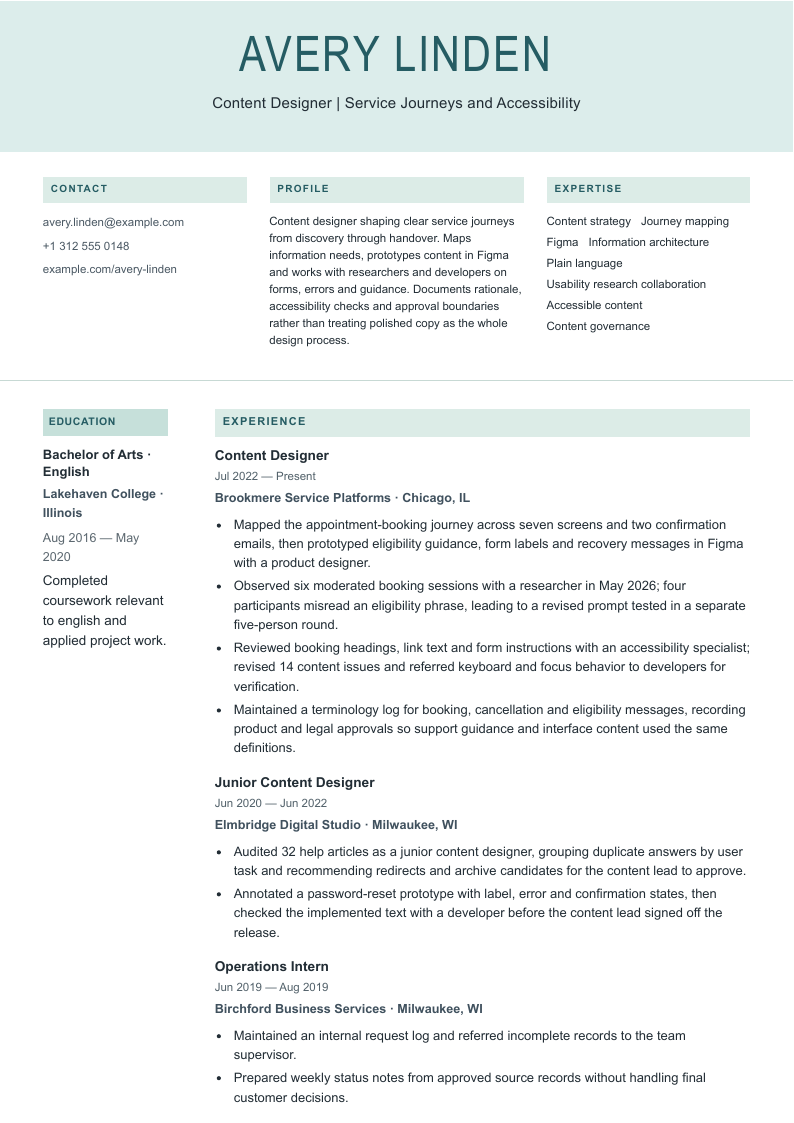
Only the resume email and portfolio URL change in this variant. Studio divides the introduction into narrow contact, profile and expertise areas; read the full address and URL alongside the complete summary, then follow the main history.
Content designer shaping clear service journeys from discovery through handover. Maps information needs, prototypes content in Figma and works with researchers and developers on forms, errors and guidance. Documents rationale, accessibility checks and approval boundaries rather than treating polished copy as the whole design process.
Skills
Content strategy · Journey mapping · Figma · Information architecture · Plain language · Usability research collaboration · Accessible content · Content governance
Experience
Content Designer
Brookmere Service Platforms · Chicago, IL
July 2022–Present
Mapped the appointment-booking journey across seven screens and two confirmation emails, then prototyped eligibility guidance, form labels and recovery messages in Figma with a product designer.
Observed six moderated booking sessions with a researcher in May 2026; four participants misread an eligibility phrase, leading to a revised prompt tested in a separate five-person round.
Reviewed booking headings, link text and form instructions with an accessibility specialist; revised 14 content issues and referred keyboard and focus behavior to developers for verification.
Maintained a terminology log for booking, cancellation and eligibility messages, recording product and legal approvals so support guidance and interface content used the same definitions.
Junior Content Designer
Elmbridge Digital Studio · Milwaukee, WI
June 2020–June 2022
Audited 32 help articles as a junior content designer, grouping duplicate answers by user task and recommending redirects and archive candidates for the content lead to approve.
Annotated a password-reset prototype with label, error and confirmation states, then checked the implemented text with a developer before the content lead signed off the release.
Education
Bachelor of Arts in English · Lakehaven College · Illinois
August 2016–May 2020
Completed coursework relevant to english and applied project work.
Projects
Booking journey content review
Content Designer · Brookmere Service Platforms
April 2026–June 2026
Figma · Journey map · Content issue log
Connected eligibility guidance, form instructions and confirmation emails in one annotated prototype. Recorded small-round research observations, content accessibility issues and the product and legal approval boundaries before handover.
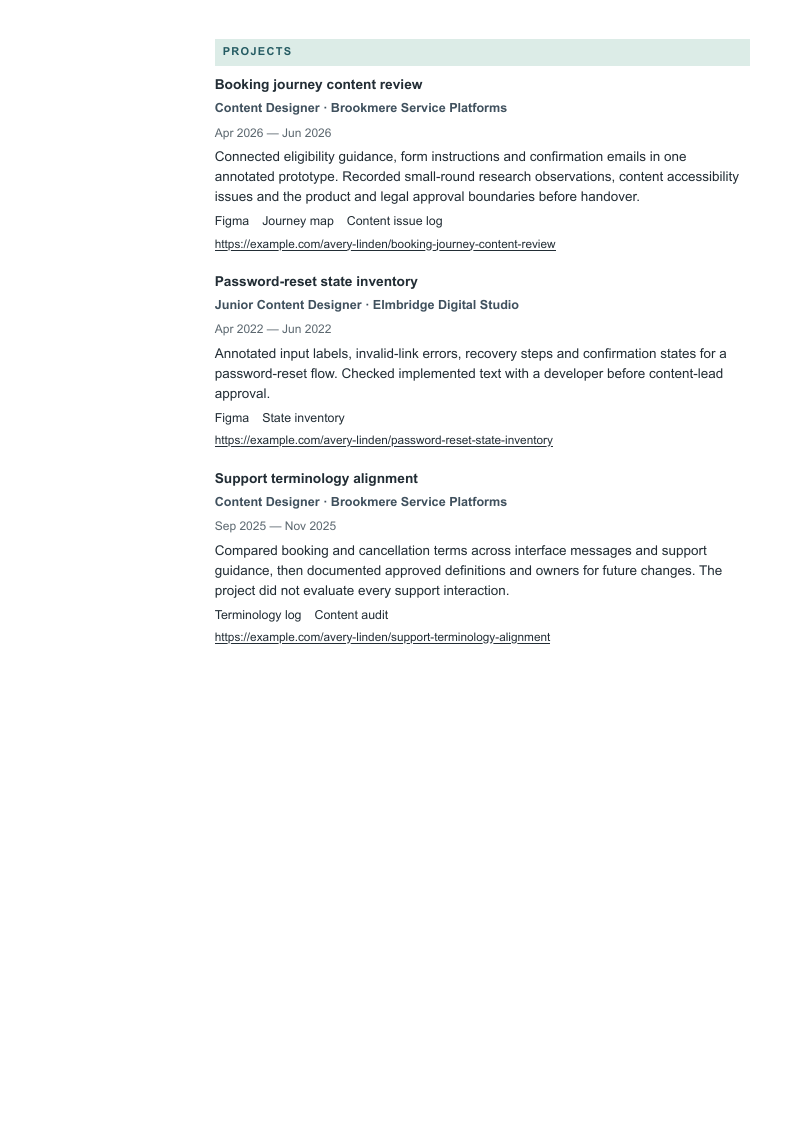
The expanded record adds an earlier operations internship, a junior-role password-reset state inventory and later terminology alignment work. Read project endings and approval boundaries on every page, including any continuation. Neither an independent prototype nor a content issue log proves an entire service became accessible.
Content designer shaping clear service journeys from discovery through handover. Maps information needs, prototypes content in Figma and works with researchers and developers on forms, errors and guidance. Documents rationale, accessibility checks and approval boundaries rather than treating polished copy as the whole design process.
Skills
Content strategy · Journey mapping · Figma · Information architecture · Plain language · Usability research collaboration · Accessible content · Content governance
Experience
Content Designer
Brookmere Service Platforms · Chicago, IL
July 2022–Present
Mapped the appointment-booking journey across seven screens and two confirmation emails, then prototyped eligibility guidance, form labels and recovery messages in Figma with a product designer.
Observed six moderated booking sessions with a researcher in May 2026; four participants misread an eligibility phrase, leading to a revised prompt tested in a separate five-person round.
Reviewed booking headings, link text and form instructions with an accessibility specialist; revised 14 content issues and referred keyboard and focus behavior to developers for verification.
Maintained a terminology log for booking, cancellation and eligibility messages, recording product and legal approvals so support guidance and interface content used the same definitions.
Junior Content Designer
Elmbridge Digital Studio · Milwaukee, WI
June 2020–June 2022
Audited 32 help articles as a junior content designer, grouping duplicate answers by user task and recommending redirects and archive candidates for the content lead to approve.
Annotated a password-reset prototype with label, error and confirmation states, then checked the implemented text with a developer before the content lead signed off the release.
Operations Intern
Birchford Business Services · Milwaukee, WI
June 2019–August 2019
Maintained an internal request log and referred incomplete records to the team supervisor.
Prepared weekly status notes from approved source records without handling final customer decisions.
Education
Bachelor of Arts in English · Lakehaven College · Illinois
August 2016–May 2020
Completed coursework relevant to english and applied project work.
Projects
Booking journey content review
Content Designer · Brookmere Service Platforms
April 2026–June 2026
Figma · Journey map · Content issue log
Connected eligibility guidance, form instructions and confirmation emails in one annotated prototype. Recorded small-round research observations, content accessibility issues and the product and legal approval boundaries before handover.
Junior Content Designer · Elmbridge Digital Studio
April 2022–June 2022
Figma · State inventory
Annotated input labels, invalid-link errors, recovery steps and confirmation states for a password-reset flow. Checked implemented text with a developer before content-lead approval.
Compared booking and cancellation terms across interface messages and support guidance, then documented approved definitions and owners for future changes. The project did not evaluate every support interaction.
Keep relevant evidence readable. Condense repeated duties before removing a denominator, approval boundary or limitation. Inspect isolated headings, detached dates and every final sentence; page count alone cannot establish readability.
Inspect the download before applying
Keep the two research rounds distinct and retain participant counts.
Keep accessibility specialist and developer verification responsibilities visible.
Check portfolio URLs, narrow introductory areas and complete project endings.
Copy PDF text and check application fields when available. Follow the employer’s requested file type and inspect every exported page.
A free account is required. Free-plan PDF downloads include a watermark; previews show paid-plan output. Add your own career details and photo after signup. No template guarantees parsing, interviews or a hiring outcome.
Resume feedback and drafting tools provide suggestions to check against your own facts. Keep unsupported results out of the final application.
Questions, answered
How is content design different from copywriting on a resume?
Show user tasks, information architecture, states, research, accessibility and iteration where you performed them. Good wording matters, but a journey decision requires evidence beyond a polished sentence.
Should I include a portfolio link?
Usually it helps when requested. Use a short working link to permitted case studies that state the problem, your contribution, evidence and limitations. Confidential work can use anonymized descriptions.
Can I claim WCAG compliance?
Only within a defensible verified scope. A resume should normally describe the specific content checks, specialist collaboration and implementation review rather than implying a complete product audit.
What if I have no research access?
Use a clearly labeled independent project and explain what has and has not been tested. Do not invent participant sessions, quotes or measured improvements.
How long should this resume be?
Use the pages needed for relevant readable evidence. Check every exported page, including contacts, dates, section order and complete project text. Condense repetition before removing the qualification behind a result.
What happens when I select a template?
Signup retains the exact design, photo preference and role. A free account is required. Free-plan PDF downloads include a watermark; the examples show paid-plan output. Add your own career and portrait after signup; the fictional example is not inserted into your account.
Prepared by Resumize with AI-assisted research and drafting for English-language US applications. Three current employer descriptions were directly retrieved with full role bodies and application controls on October 29, 2026. Sources below identify different seniority, work markets and ownership levels. Primary professional guidance supports terminology. The fictional resume is not proof of eligibility for every opening. No private search analytics, applicant data, application submission or hiring-outcome test informed this guide.
Read October 29, 2026. London; end-to-end vehicle and landing-page journeys, Figma, accessibility, content audits and research collaboration. Portfolio of practical user-centred work required. Full live responsibilities and application controls directly retrieved with HTTP 200; no posting date inferred.
Read October 29, 2026. Remote UK; product flows, hierarchy, UX writing and cross-functional discovery through launch. Remote label applies to the stated market. Full live responsibilities and application controls directly retrieved with HTTP 200; no posting date inferred.
Read October 29, 2026. Berlin or Munich hybrid, twice-weekly office; complex B2B dealer journeys and AI-mediated experiences. Requires excellent English plus German, French or Italian; senior, not a general US opening. Full live responsibilities and application controls directly retrieved with HTTP 200; no posting date inferred.
Read October 29, 2026. Official UK capability framework, updated August 2026. Covers discovery, end-to-end service journeys and role levels; not a US licensing rule.