Classic
A traditional centered header and simple rules emphasize the written record.
Before sending: Long contacts and the optional portrait can change header spacing.
Clinical laboratory methods and controls · US resume context
A Medical Laboratory Scientist resume should identify the sections, approved methods and quality-control work you performed. Explain exceptions and reporting. Keep specimen acceptance, analytical performance and clinical interpretation distinct.
By Resumize · · AI-assisted research and drafting
Three designs · one example
These previews use the same layouts as the builder, with identical example content. Open a full preview to inspect the text and spacing.
Fictional candidate, employers, education and results. The optional portrait is AI-generated. Use your own evidence and photo; the example is not inserted into your resume.
A traditional centered header and simple rules emphasize the written record.
Before sending: Long contacts and the optional portrait can change header spacing.
A centered identity block and restrained section rules provide a formal presentation.
Before sending: The optional portrait and long contacts can increase header depth.
A quiet single-column hierarchy keeps the evidence prominent.
Before sending: Expanded histories still need review of the complete export.
“Use” opens signup with that design and photo preference selected for the builder. A free account is required. Free-plan PDF downloads include a watermark; see current plans for paid options. Photo conventions vary; follow the employer’s instructions and local expectations.
The three designs use the same fictional career. The default has no photo. Follow the employer’s instructions and local conventions; the optional portrait is AI-generated. Signup retains the exact design, supported photo preference and Medical Laboratory Scientist role. It does not insert the example career or portrait into your account. A free account is required, and free-plan PDF downloads include a watermark. These previews show paid-plan output.
Jamie Mercer, the employers, qualifications, dates, projects and results are original editorial fiction. The example.com addresses and links and the 555 phone number are illustrative placeholders. Replace every field with your own facts. The optional portrait is AI-generated, and all qualifications and any license or registration dates are fictional and contain no valid identifiers. The base record has two jobs, six experience bullets, one education record and one project.
Medical Laboratory Scientist | Laboratory methods and quality control evidence
jamie.mercer@example.com · +1 614 555 0116
Portfolio: https://example.com/jamie-mercer
Medical laboratory scientist performing assigned chemistry and hematology work through approved laboratory procedures. Reviews specimen acceptance, analyzer quality-control records and reportable-result questions with the section lead. Brings laboratory-technologist experience with traceable exceptions and clear separation between technical checks and clinical interpretation.
Clinical chemistry · Hematology · Specimen acceptance · Analyzer quality control · Laboratory documentation · Result escalation
Birchgate Clinical Laboratory · Columbus, OH
April 2022–Present
Cedarfield Diagnostic Laboratory · Columbus, OH
July 2019–March 2022
Bachelor of Science in Medical Laboratory Science · Maplecrest University · Columbus, OH
August 2015–May 2019
ASCP Board of Certification
Issued June 2019
Expires June 2028
Credential Maintenance Program renewal recorded in June 2025; no certification number displayed.
Medical Laboratory Scientist · Birchgate Clinical Laboratory
June 2026–July 2026
Acceptance criteria · De-identified specimen register · Exception log
Reconciled 200 specimens to 184 meeting first-review acceptance checks and 16 requiring clarification or further review. Kept specimen acceptance separate from analytical accuracy, diagnosis and formal method validation.
Jamie’s fictional Ohio laboratory remit concerns automated chemistry and hematology under approved procedures and section-lead review. Earlier technologist work provides technical experience without being expanded into every specialty or laboratory-director authority.
The full employer bodies cover Henry Ford generalist work, Munson scientist/technician work and International SOS laboratory supervision in Iraq. Their degrees, certification wording, specialist scope and deployment conditions differ. The sample does not add blood bank, microbiology, clearance or supervisory experience from those descriptions.
A useful laboratory example names the criterion, technical observation and approved hold or escalation. Keep real specimens, patient results and internal identifiers private. Technical review is not unrestricted clinical diagnosis or treatment authority.
Read the employer descriptions directly: Henry Ford Health Medical Laboratory Scientist; Munson Healthcare Medical Lab Scientist/ Medical Technician; International SOS Government Medical Services Medical Laboratory Technologist Supervisor. This selected dated sample illustrates differences in scope and requirements, rather than a representative labor-market survey.
Each after sentence appears in the base career record. The weak before statements are teaching examples. Use the evidence prompts to check the population, decisions and limitations behind your own wording.
Before: Diagnosed every patient independently.
After: Perform assigned automated chemistry and hematology testing through approved procedures, reviewing specimen and analyzer requirements with the laboratory section lead.
Why it works: Technical testing is distinct from unrestricted clinical diagnosis or every laboratory specialty.
Evidence to check: Assigned sections, procedures, specimen requirements and section-lead review.
Before: Achieved 92% diagnostic accuracy.
After: Reviewed 200 specimens against defined acceptance criteria in June 2026; 184 met the checks at first review and 16 required clarification or further review.
Why it works: The 92% share concerns specimen acceptance checks, not analytical accuracy or diagnostic sensitivity.
Evidence to check: Specimen cohort, acceptance criteria, first review and exception disposition.
Before: Guaranteed every analyzer result was correct.
After: Review assigned analyzer quality-control records before reporting, retain out-of-criterion findings and follow the approved hold and escalation process with the section lead.
Why it works: Quality-control review and escalation do not prove every patient result or establish all method validation.
Evidence to check: Quality-control records, criteria, hold decisions and section-lead review.
Before: Made every treatment decision from lab values.
After: Document technical observations and unresolved result questions, communicate through the approved reporting pathway and retain clinical interpretation with authorized professionals.
Why it works: Technical review and patient-care decisions carry different responsibilities.
Evidence to check: Technical observations, reporting workflow and authorized interpretation responsibility.
Before: Directed the complete laboratory program.
After: Completed assigned chemistry and hematology procedures, checked specimen identifiers and recorded discrepancies for senior technologist review.
Why it works: Earlier technical contribution does not establish laboratory-director authority.
Evidence to check: Assigned procedures, identification checks, discrepancies and senior review.
Before: Released all records publicly to show skill.
After: Maintained approved laboratory records and de-identified handover summaries, retaining missing information and follow-up owners within authorized access.
Why it works: Traceability can be described without exposing patient data or claiming every exception was resolved.
Evidence to check: Approved records, access permissions, de-identified handovers and follow-up owners.
The June population has 200 specimens: 184 meet first-review acceptance criteria and 16 require clarification or further review. The 92% share is specimen acceptance checking, not analytical accuracy, sensitivity or diagnostic performance.
Analyzer quality-control review retains out-of-criterion findings and approved hold decisions. It does not establish all formal method validation or guarantee every patient result. Keep specimen checks, instrument controls and reportable-result review as separate evidence.
Use relevant capabilities that your experience or projects demonstrate. The table connects the sample’s claims to records a candidate should check. A skill keyword is not a substitute for an example, and a private employer record should stay private unless sharing is permitted.
| Capability in context | Evidence to check | Sample work |
|---|---|---|
| Define laboratory scope | Assigned sections, procedures, specimen requirements and section-lead review. | Perform assigned automated chemistry and hematology testing through approved procedures, reviewing specimen and analyzer requirements with the laboratory section lead. |
| Keep acceptance measures precise | Specimen cohort, acceptance criteria, first review and exception disposition. | Reviewed 200 specimens against defined acceptance criteria in June 2026; 184 met the checks at first review and 16 required clarification or further review. |
| Show quality-control actions | Quality-control records, criteria, hold decisions and section-lead review. | Review assigned analyzer quality-control records before reporting, retain out-of-criterion findings and follow the approved hold and escalation process with the section lead. |
| Preserve interpretation boundaries | Technical observations, reporting workflow and authorized interpretation responsibility. | Document technical observations and unresolved result questions, communicate through the approved reporting pathway and retain clinical interpretation with authorized professionals. |
| Keep earlier testing scope accurate | Assigned procedures, identification checks, discrepancies and senior review. | Completed assigned chemistry and hematology procedures, checked specimen identifiers and recorded discrepancies for senior technologist review. |
| Make traceability specific | Approved records, access permissions, de-identified handovers and follow-up owners. | Maintained approved laboratory records and de-identified handover summaries, retaining missing information and follow-up owners within authorized access. |
Jamie’s laboratory-science degree, MLS(ASCP) credential and employers are fictional, with no valid certification number. The credential is awarded June 30, 2019; the illustrative June 2025 CMP renewal runs to June 30, 2028, reflecting ASCP’s three-year maintenance context.
ASCP certification is distinct from state licensure and employer-assigned competencies. No state MLS license, specialist certification or laboratory-director authorization is invented. Verify your actual route, renewal letter, jurisdiction and employer requirements; the sample does not establish real eligibility.
A technologist can show assigned procedures, identifier checks and senior review. Keep the actual scope and avoid converting technical work into laboratory leadership.
A synthetic specimen register can demonstrate acceptance criteria and exceptions without patient data. The expanded record retains Jamie’s supervised student placement and correctly attributed laboratory projects.
Only Jamie Mercer’s resume email and one portfolio contact URL change in this scenario. Identity, phone, employment, qualifications and projects stay identical. Classic uses the optional photo-on view here. Read every final character of the email and URL, and check the link destination against the complete record below.
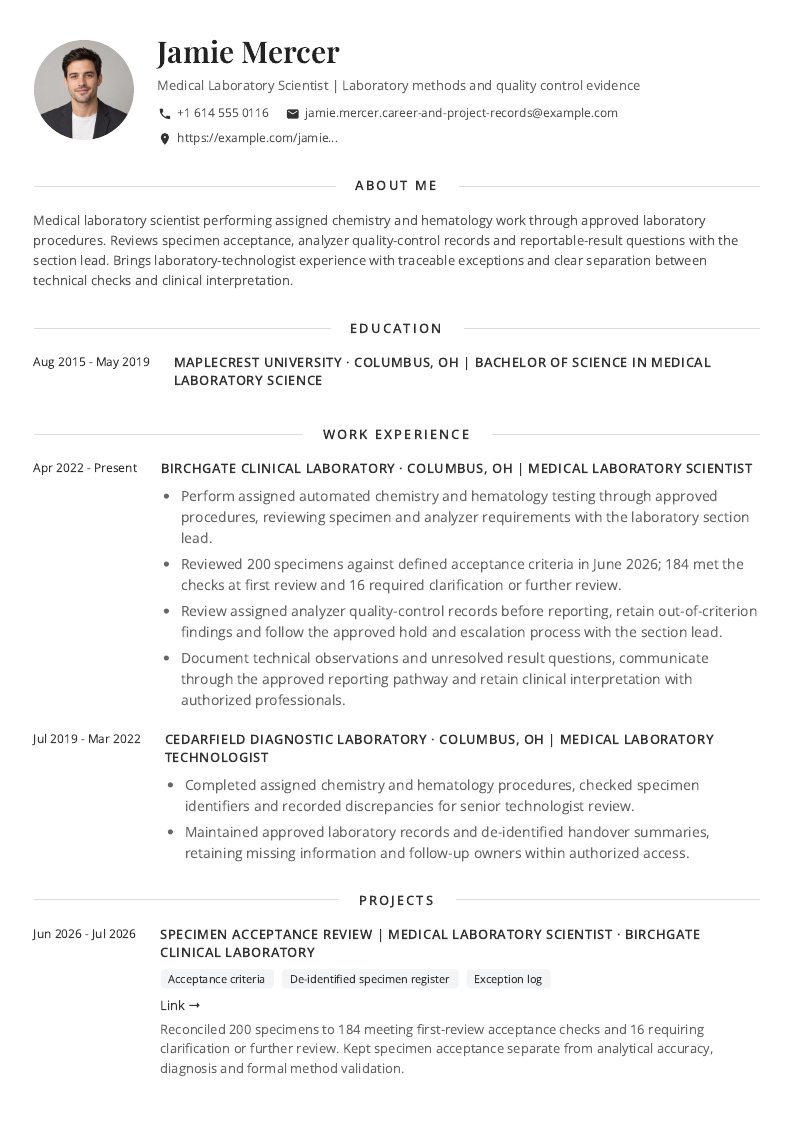 Open page 1 at full size
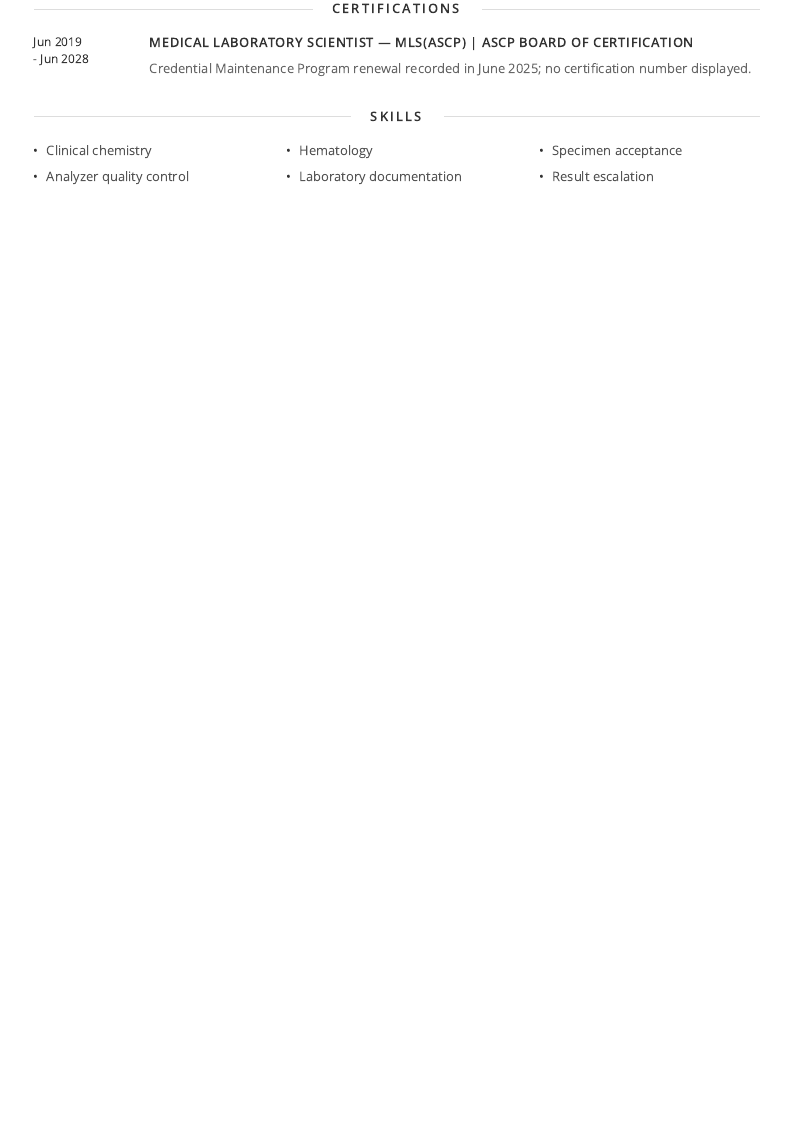 Open page 2 at full size
Medical Laboratory Scientist | Laboratory methods and quality control evidence
jamie.mercer.career-and-project-records@example.com · +1 614 555 0116
Medical laboratory scientist performing assigned chemistry and hematology work through approved laboratory procedures. Reviews specimen acceptance, analyzer quality-control records and reportable-result questions with the section lead. Brings laboratory-technologist experience with traceable exceptions and clear separation between technical checks and clinical interpretation.
Clinical chemistry · Hematology · Specimen acceptance · Analyzer quality control · Laboratory documentation · Result escalation
Birchgate Clinical Laboratory · Columbus, OH
April 2022–Present
Cedarfield Diagnostic Laboratory · Columbus, OH
July 2019–March 2022
Bachelor of Science in Medical Laboratory Science · Maplecrest University · Columbus, OH
August 2015–May 2019
ASCP Board of Certification
Issued June 2019
Expires June 2028
Credential Maintenance Program renewal recorded in June 2025; no certification number displayed.
Medical Laboratory Scientist · Birchgate Clinical Laboratory
June 2026–July 2026
Acceptance criteria · De-identified specimen register · Exception log
Reconciled 200 specimens to 184 meeting first-review acceptance checks and 16 requiring clarification or further review. Kept specimen acceptance separate from analytical accuracy, diagnosis and formal method validation.
The expanded Classic scenario keeps the photo off. It preserves every base field and adds one earlier job and two projects. Project titles and employers reflect the job actually held during their dates, and method lists describe the work in that project. Read the full record, including the final project and its limits.
Condense repeated responsibilities before removing information a reader needs to understand a claim. Review headings, dates and continuation pages after your own changes; the design name alone cannot establish how an expanded career will read.
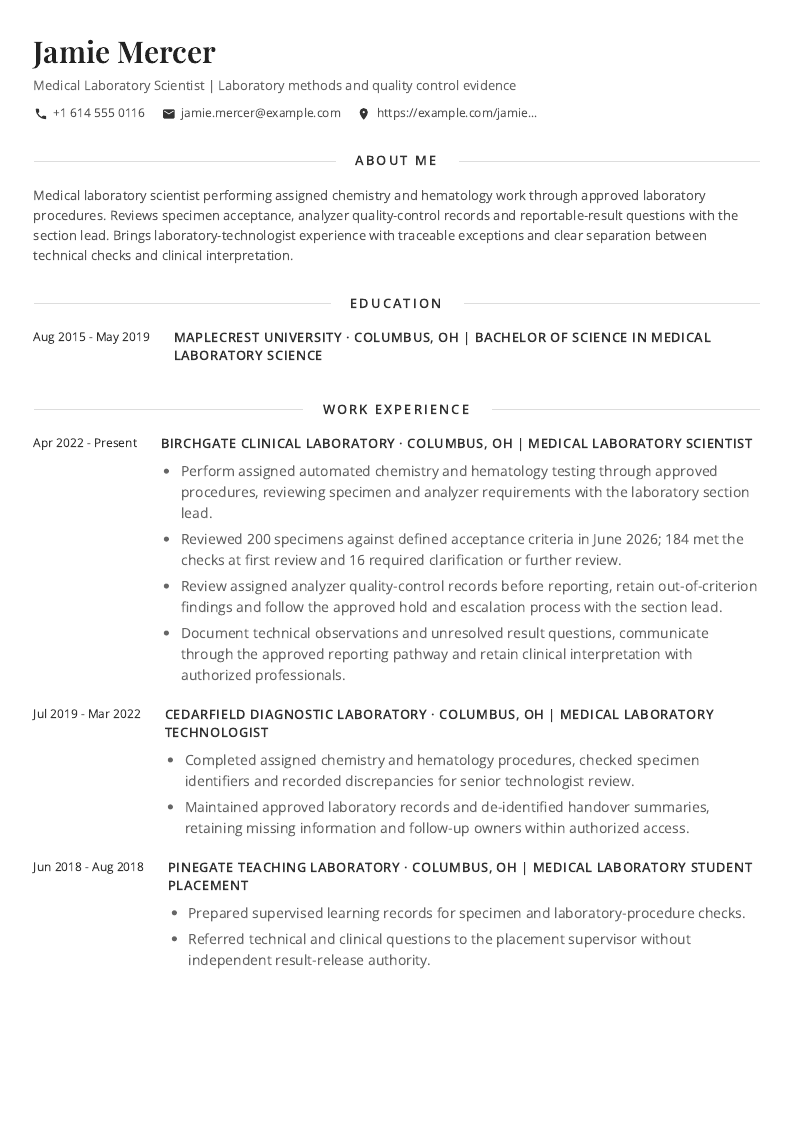 Open page 1 at full size
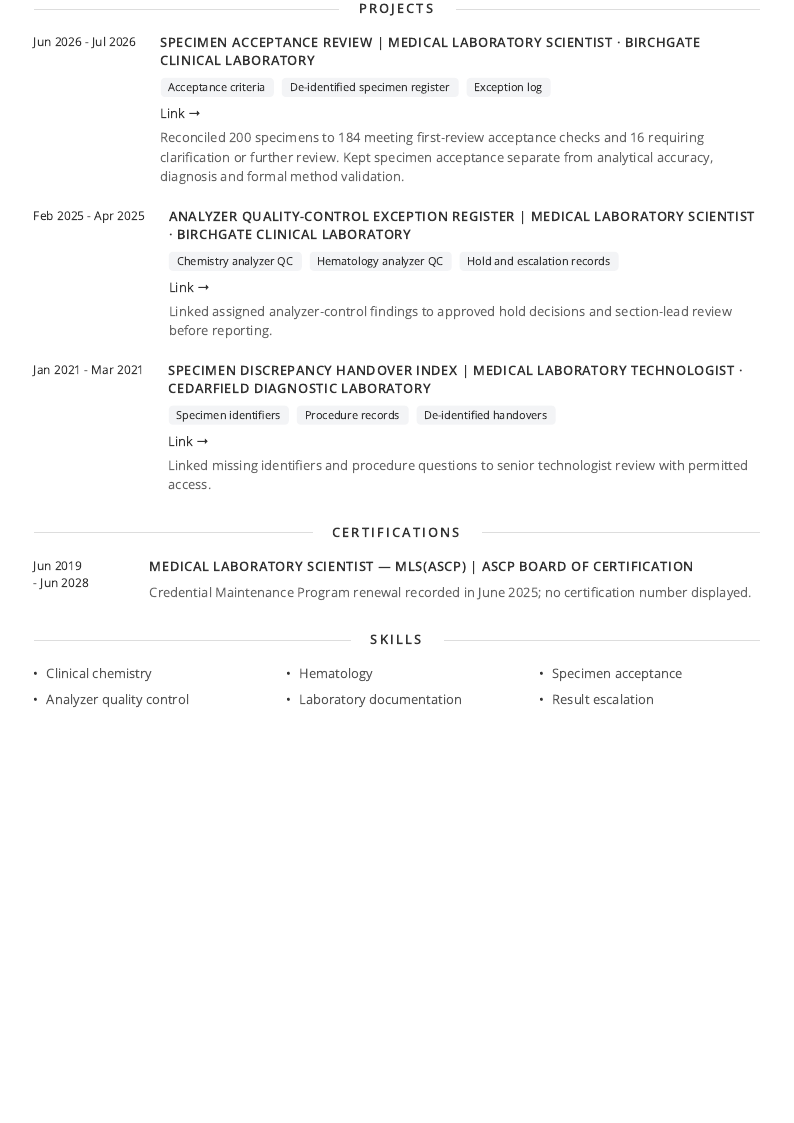 Open page 2 at full size
Medical Laboratory Scientist | Laboratory methods and quality control evidence
jamie.mercer@example.com · +1 614 555 0116
Portfolio: https://example.com/jamie-mercer
Medical laboratory scientist performing assigned chemistry and hematology work through approved laboratory procedures. Reviews specimen acceptance, analyzer quality-control records and reportable-result questions with the section lead. Brings laboratory-technologist experience with traceable exceptions and clear separation between technical checks and clinical interpretation.
Clinical chemistry · Hematology · Specimen acceptance · Analyzer quality control · Laboratory documentation · Result escalation
Birchgate Clinical Laboratory · Columbus, OH
April 2022–Present
Cedarfield Diagnostic Laboratory · Columbus, OH
July 2019–March 2022
Pinegate Teaching Laboratory · Columbus, OH
June 2018–August 2018
Bachelor of Science in Medical Laboratory Science · Maplecrest University · Columbus, OH
August 2015–May 2019
ASCP Board of Certification
Issued June 2019
Expires June 2028
Credential Maintenance Program renewal recorded in June 2025; no certification number displayed.
Medical Laboratory Scientist · Birchgate Clinical Laboratory
June 2026–July 2026
Acceptance criteria · De-identified specimen register · Exception log
Reconciled 200 specimens to 184 meeting first-review acceptance checks and 16 requiring clarification or further review. Kept specimen acceptance separate from analytical accuracy, diagnosis and formal method validation.
Medical Laboratory Scientist · Birchgate Clinical Laboratory
February 2025–April 2025
Chemistry analyzer QC · Hematology analyzer QC · Hold and escalation records
Linked assigned analyzer-control findings to approved hold decisions and section-lead review before reporting.
https://example.com/jamie-mercer/analyzer-quality-control-exception-register
Medical Laboratory Technologist · Cedarfield Diagnostic Laboratory
January 2021–March 2021
Specimen identifiers · Procedure records · De-identified handovers
Linked missing identifiers and procedure questions to senior technologist review with permitted access.
https://example.com/jamie-mercer/specimen-discrepancy-handover-index
Review your resume with the analyzer and check every suggestion against your records. No template guarantees parsing, ranking, an interview or a hiring outcome. A free account is required for the builder; free-plan PDF downloads include a watermark. The examples show paid-plan output.
No. State the specimen population and criteria; analytical and diagnostic performance require their own evidence.
Treat certification, jurisdictional licensure and employer competencies separately. Verify the actual rules and your current records.
Only if you held it. The International SOS supervisory source is explicitly broader than the sample’s section-level technical remit.
Signup retains the exact design, the supported photo setting and Medical Laboratory Scientist role. Compact stays photo-free. The fictional career and portrait are not inserted into your account. A free account is required and free-plan PDF downloads include a watermark.
Prepared by Resumize with AI-assisted research and drafting for English-language US resume context. Employer descriptions from other markets are identified in the discussion and notes. Full employer bodies were checked October 30, 2026; availability, location eligibility and engagement conditions vary and can change. The original fictional records are teaching material, not verified applicants or evidence that this candidate meets every opening. No application was submitted or hiring outcome tested.
Official occupational and credential guidance was reviewed through direct, web-access or indexed text as stated in each note. Retrieval failures remain disclosed. The source notes distinguish these limits from full direct employer retrieval.
Read October 30, 2026. Henry Ford Health, Jackson, Michigan; medical laboratory scientist/generalist context. The body distinguishes degree/coursework routes and preferred certification. Complete primary role body retrieved. Application instructions/controls were present; availability may change.
Read October 30, 2026. Munson Healthcare, Manistee, Michigan; scientist/technician role with specific degree and certification/eligibility wording to check directly. Complete primary role body retrieved. Application instructions/controls were present; availability may change.
Read October 30, 2026. International SOS Government Medical Services, Houston-listed role with Iraq deployment; Medical Laboratory Technologist Supervisor, explicitly broader than the sample’s technical remit. Blood bank, microbiology, supervision, BLS and deployment requirements are not borrowed. Complete primary role body retrieved. Application instructions/controls were present; availability may change.
Official web-access body reviewed October 30, 2026 after direct retrieval returned 403. Identifies MLS(ASCP) and the three-year CMP cycle; renewal letters provide valid dates. The illustrative 2025–2028 period is not real credential verification or state licensure.