Fieldnote
A large sans-serif name, green slash separators and subtle zigzag rules organize a single-column record.
Before sending: Keep complete dates, training details and the final project visible after adding a photo or more content.
Skilled trades · Layout, installation and finished work
A carpenter resume should show what you built or installed, which methods and plans guided the work and how you checked the result. Name the construction setting and your responsibility within the crew. Finished-work evidence gives a foreman more to assess than 'hardworking' or 'expert in all carpentry.'
By Resumize · · AI-assisted research and drafting
Three designs · one example
These previews use the same layouts as the builder, with identical example content. Open a full preview to inspect the text and spacing.
Fictional candidate, employers, education and results. The optional portrait is AI-generated. Use your own evidence and photo; the example is not inserted into your resume.
A large sans-serif name, green slash separators and subtle zigzag rules organize a single-column record.
Before sending: Keep complete dates, training details and the final project visible after adding a photo or more content.
A plain left header, restrained headings and small date gutter organize a single-column record.
Before sending: Simple styling does not prove parsing or evidence quality. Check full contacts and continuation pages.
A centered identity and optional circular portrait lead into a restrained single-column career record.
Before sending: The portrait and centered contacts use vertical space. Inspect complete contacts and all credential and project endings.
“Use” opens signup with that design and photo preference selected for the builder. A free account is required. Free-plan PDF downloads include a watermark; see current plans for paid options. Photo conventions vary; follow the employer’s instructions and local expectations.
All three designs use the same complete fictional career. The default has no photo; the optional portrait is AI-generated. Follow the employer's instructions and local conventions. Signup retains the exact template, photo preference and Carpenter role. It does not insert the example career or portrait into your account. A free account is required; free-plan PDF downloads include a watermark. These previews show paid-plan output.
Casey Brooks, employers, education, dates, projects and results are original fiction. The example.com links are placeholders and the 555 phone number is fictional. This base record contains two jobs, six work-history bullets, 1 education entry and explicitly fictional, nonvalid credential or training examples, plus one project. Use the structure with your own supported facts.
Carpenter | Commercial Interiors
casey.brooks.carpentry@example.com · +1 513 555 0183
Portfolio: https://example.com/casey-brooks-carpentry
Carpenter with commercial interior experience in metal-stud partitions, doors, trim and casework installation. Reads plans, checks layout and fit, coordinates with the foreman and other trades, and records punch-list work with clear limits on crew and inspection responsibility.
Commercial interior carpentry · Blueprint reading · Metal-stud layout · Doors and hardware · Trim and casework · Measurement and fit checks · Punch-list closeout · Hand and power tools
Oakbridge Commercial Interiors · Cincinnati, OH
April 2021–Present
Maple Ridge Building Services · Cincinnati, OH
June 2017–March 2021
Apprenticeship completion in Carpentry · Riverbend Construction Training Partnership · Ohio
June 2017–March 2021
Classroom instruction and supervised paid job training in layout, construction methods and tool use; fictional training provider.
OSHA-authorized outreach trainer
Illustrative training completed in 2025. This is course completion, not an OSHA professional certification or substitute for task-specific employer training.
Carpenter · Oakbridge Commercial Interiors
February 2026–May 2026
Door schedule · Fit checks · Punch list
Matched 22 installed door-and-hardware sets to the current schedule and the foreman's walkthrough notes. Tracked the 19 assigned punch-list items separately: 17 closed before the client walkthrough, two awaiting materials. The synthetic portfolio omits client names, site security details and proprietary drawings.
Casey's fictional career is in commercial interiors in Cincinnati, with metal-stud partitions, doors, trim and casework. The resume names the assigned work and the foreman's review. It does not claim project-manager, building-inspector or design-approval authority.
BLS describes carpentry across frameworks, fixtures, repairs and many materials. A hiring reader needs the relevant part of that range. State whether your experience concerns residential framing, commercial interiors, concrete formwork, finish installation or another specialty, and describe the methods you actually used.
The employer sample illustrates the differences. Triversity focuses on commercial metal-stud framing and drywall around Cincinnati; Novak includes national travel and rough/finish installation; JGBowers asks for experienced commercial carpentry with reporting and broader coordination. Do not add travel availability, budget control or specialist methods simply because another employer lists them.
Each after statement appears exactly in the base work history. The notes explain the evidence that makes it useful and the limits of the claim. Replace invented details with your own work.
Before: Built amazing commercial projects.
After: Laid out metal-stud partitions for a commercial office fit-out from issued drawings, checking dimensions and door openings with the foreman before fastening track.
Why it works: Names the construction system and check rather than borrowing ownership of the entire building.
Evidence to check: Drawing revision, assigned areas, layout checks and foreman review.
Before: Installed everything perfectly.
After: Installed 22 door-and-hardware sets on a 2026 office refurbishment, checking fit and operation against the door schedule before the foreman's walkthrough.
Why it works: A defined installation inventory and checking process are stronger than an absolute quality claim.
Evidence to check: Door schedule, assigned quantity, inspection notes and acceptance owner.
Before: Eliminated all rework on site.
After: Closed 17 of 19 assigned carpentry punch-list items before the scheduled client walkthrough and flagged two material-dependent items to the foreman.
Why it works: Defines the assigned list and review point; open items remain visible.
Evidence to check: Dated punch list, item ownership, completion checks and the two exceptions.
Before: Managed every subcontractor.
After: Coordinated casework installation access with the foreman and electrical crew, confirming clear work areas and reporting plan conflicts before cutting or fixing materials.
Why it works: Shows trade coordination without claiming site management or design-change approval.
Evidence to check: Task sequence, coordination notes, conflict escalation and decision owner.
Before: Worked as a qualified lead from day one.
After: Assisted with measuring, cutting and fitting timber and drywall under journeyperson supervision during the carpentry apprenticeship.
Why it works: Supervised trade development is useful evidence without relabeling the role.
Evidence to check: Apprenticeship dates, assigned tasks, supervisor and training record.
Before: Guaranteed an accident-free site.
After: Checked assigned hand and power tools before use, maintained clear work areas and reported damaged equipment to the supervisor under the site procedure.
Why it works: Identifies actions within the apprentice's responsibility without a site-wide safety guarantee.
Evidence to check: Task training, pre-use checks, reporting route and actual responsibility.
Start a summary with the construction setting and a few supported strengths. Casey names plans, layout, fit checks and coordination because those appear in the work history. Years of experience can add context when accurate, but the examples should still show what you can do.
For an installation bullet, combine the material or system, the assigned quantity or area and the relevant check. Casey's 22 door-and-hardware sets were checked against a door schedule before a foreman's walkthrough. That gives a reviewer a defined piece of work without claiming that the applicant inspected or accepted the entire building.
Tools are most useful in context. Explain layout with measuring devices, cutting and fitting, or safe use of hand and power tools at the level you performed. Do not turn a generic tool list into a claim that you are authorized for every lift, scaffold, rigging or equipment task.
Choose relevant skills you can explain through actual work. Use truthful vacancy language in context, then point the reader to the example that supports it.
| Skill | Evidence to gather | Fictional example |
|---|---|---|
| Plan reading | Issued revision, assigned scope and questions. | Commercial office partition layout. |
| Door installation | Schedule, quantity and fit checks. | 22 door-and-hardware sets. |
| Closeout | Assigned inventory, date and exceptions. | 17 of 19 items before walkthrough. |
| Trade coordination | Sequence, access and decision owner. | Casework access with electrical crew. |
| Measurement | Material, check and supervision. | Apprentice cutting and fitting. |
| Safe work practices | Specific checks and reporting route. | Tool checks and damaged-equipment reporting. |
The punch-list example reports 17 of 19 assigned items closed before a scheduled client walkthrough. Two material-dependent items remained and were flagged to the foreman. This is a useful closeout statement because the reader can see the list, ownership, review point and exceptions.
Other numbers need equally clear definitions. Installed units, area framed, material usage and work accepted at review describe different things. A project finishing early does not prove your individual work caused the schedule gain. Explain your part in sequencing or resolving a problem, and reserve savings or waste percentages for figures you can substantiate.
A portfolio can show permitted finished-work photos and a brief description of your contribution. Obtain permission where needed and avoid client identifiers, site security details and proprietary drawings. A clean final image alone does not show who did the work or which checks were completed.
The fictional record shows an apprenticeship completed through a fictional training partnership, with supervised paid work and classroom instruction. Use the real program, dates and completion status from your own record. An apprentice still in training should say so rather than adopting a completed trade designation.
OSHA's Outreach Program provides 10- and 30-hour awareness training; OSHA says those courses are not professional certifications and do not replace required task-specific training. Employers or jurisdictions can require completion. The sample therefore names an OSHA 30-hour Construction Outreach course completion, even though some job ads use the word certification.
Include relevant current training or licenses only when held. A driver's license, contractor license, site credential and equipment authorization are separate items. Do not label yourself a licensed contractor solely because you completed an apprenticeship or a safety course.
An apprentice can describe the tasks learned, the material or project context and the supervision received. Measuring, cutting, fitting, tool checks and reporting a defect can show useful progression. Keep the apprenticeship title and dates visible; an application for a qualified role does not change the title of earlier work.
If your strongest evidence comes from a trade-school exercise, label it as training. Explain the drawing, the measurement check and the correction you made after feedback. Do not turn a practice assembly into a client installation or claim it passed a statutory inspection.
Casey's expanded example adds a helper role, a casework sequence and a supervised measurement exercise. The extra content broadens the record while retaining the base job history. Keep the resume focused on the methods the vacancy needs, with details you can explain at interview.
The long-contact Fieldnote version has the photo on and changes only the resume email and portfolio URL. The identity, phone and career stay identical. Follow each contact through its final character, then check the full link destination. The complete text below preserves the full address, including any part shortened by the visual label.
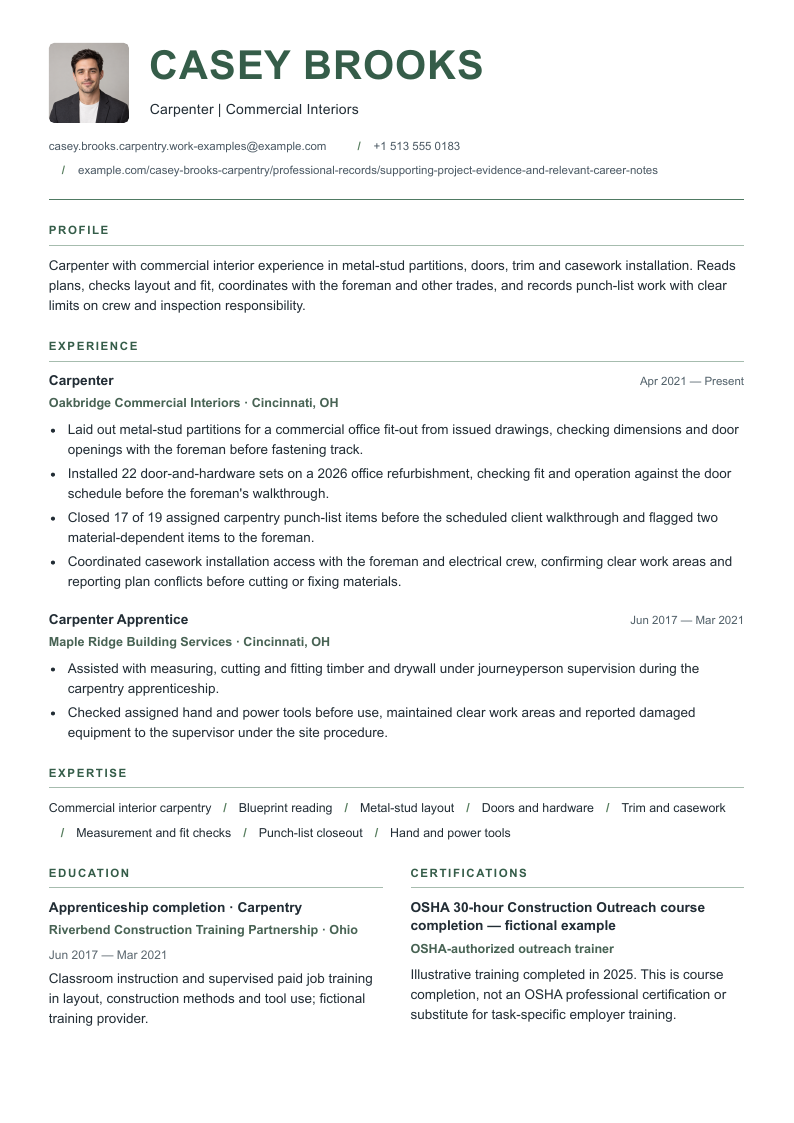 Open page 1 at full size
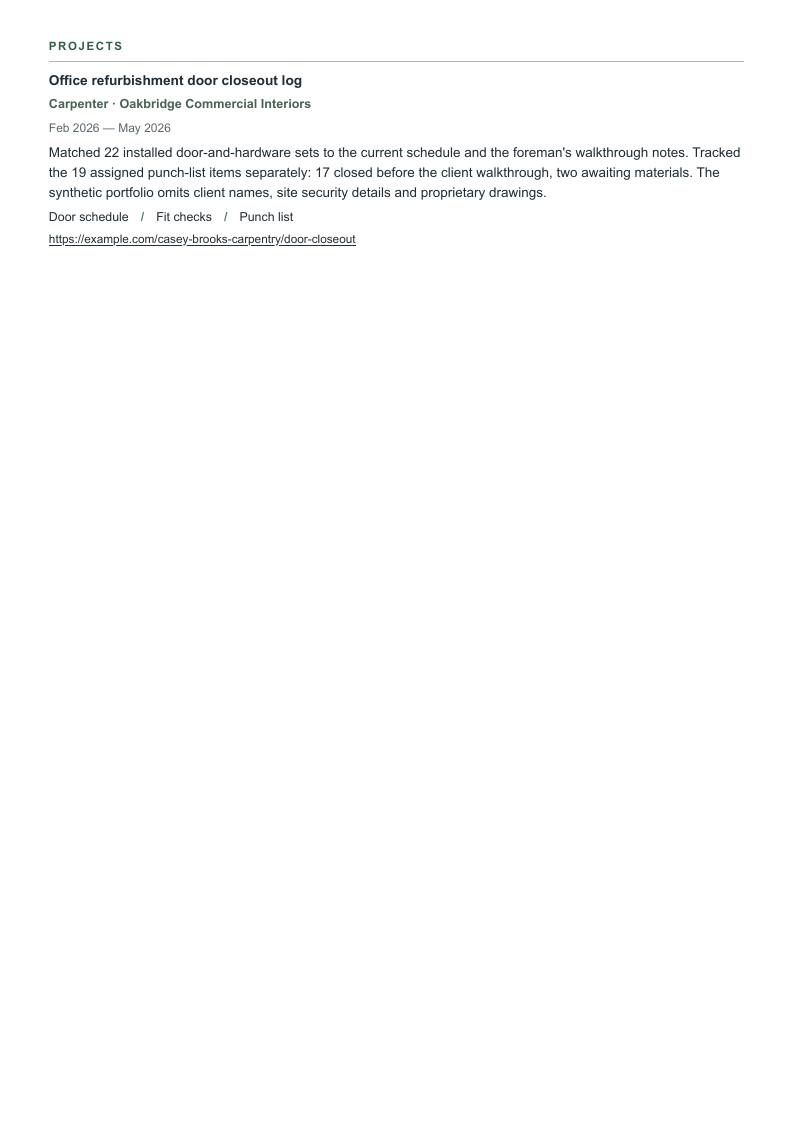 Open page 2 at full size
Carpenter | Commercial Interiors
casey.brooks.carpentry.work-examples@example.com · +1 513 555 0183
Carpenter with commercial interior experience in metal-stud partitions, doors, trim and casework installation. Reads plans, checks layout and fit, coordinates with the foreman and other trades, and records punch-list work with clear limits on crew and inspection responsibility.
Commercial interior carpentry · Blueprint reading · Metal-stud layout · Doors and hardware · Trim and casework · Measurement and fit checks · Punch-list closeout · Hand and power tools
Oakbridge Commercial Interiors · Cincinnati, OH
April 2021–Present
Maple Ridge Building Services · Cincinnati, OH
June 2017–March 2021
Apprenticeship completion in Carpentry · Riverbend Construction Training Partnership · Ohio
June 2017–March 2021
Classroom instruction and supervised paid job training in layout, construction methods and tool use; fictional training provider.
OSHA-authorized outreach trainer
Illustrative training completed in 2025. This is course completion, not an OSHA professional certification or substitute for task-specific employer training.
Carpenter · Oakbridge Commercial Interiors
February 2026–May 2026
Door schedule · Fit checks · Punch list
Matched 22 installed door-and-hardware sets to the current schedule and the foreman's walkthrough notes. Tracked the 19 assigned punch-list items separately: 17 closed before the client walkthrough, two awaiting materials. The synthetic portfolio omits client names, site security details and proprietary drawings.
The expanded Fieldnote version has the photo off. It keeps every base career field and adds an earlier carpenter's helper role plus two projects. Compare the complete text with every preview page, including the last job date, qualification detail and final project ending.
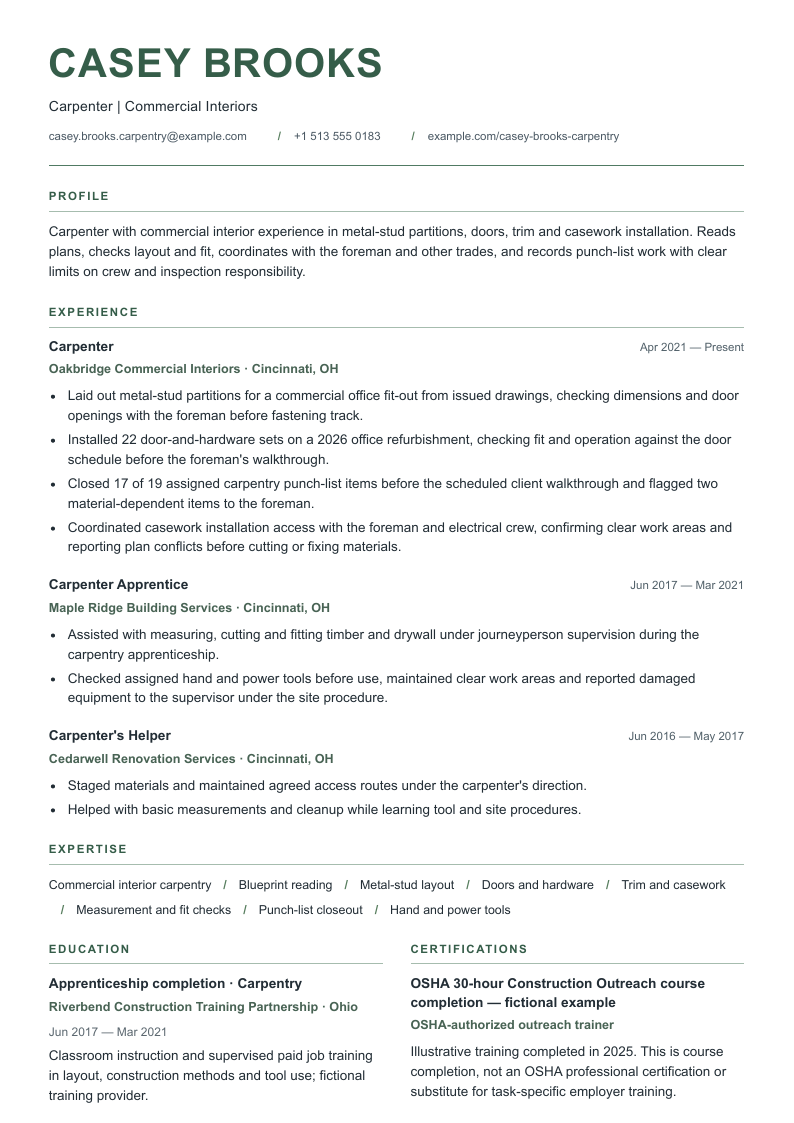 Open page 1 at full size
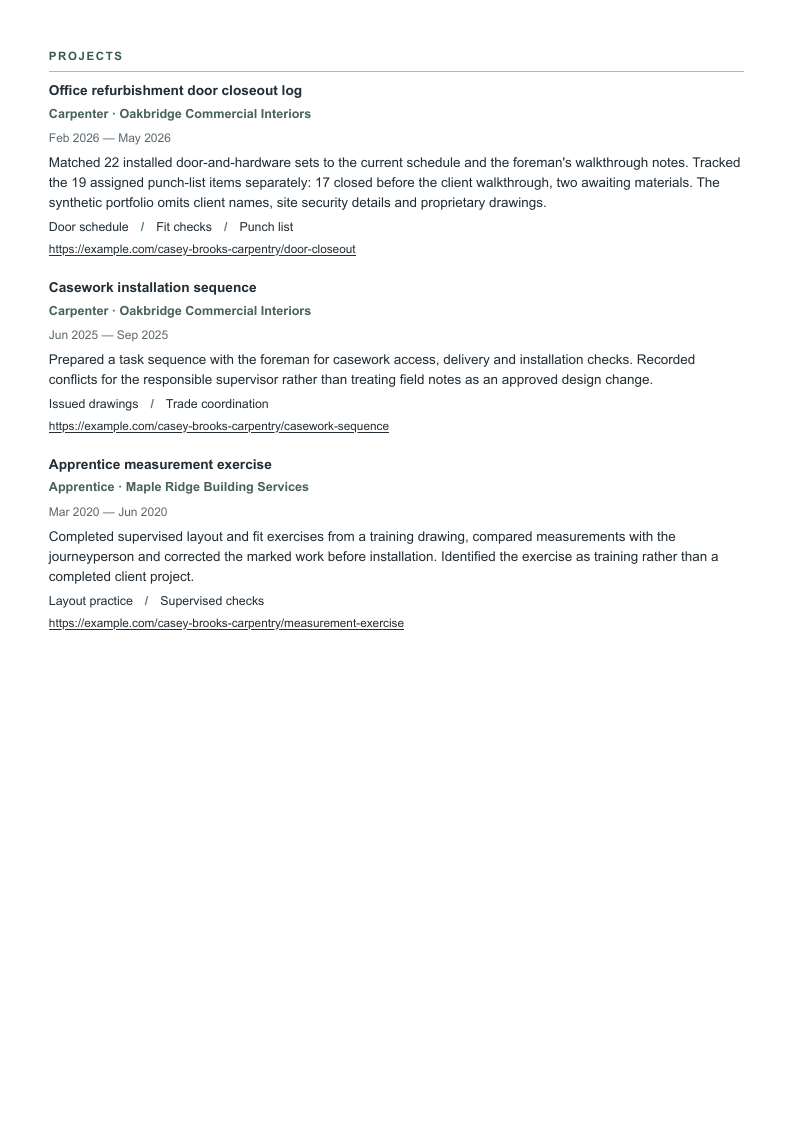 Open page 2 at full size
Carpenter | Commercial Interiors
casey.brooks.carpentry@example.com · +1 513 555 0183
Portfolio: https://example.com/casey-brooks-carpentry
Carpenter with commercial interior experience in metal-stud partitions, doors, trim and casework installation. Reads plans, checks layout and fit, coordinates with the foreman and other trades, and records punch-list work with clear limits on crew and inspection responsibility.
Commercial interior carpentry · Blueprint reading · Metal-stud layout · Doors and hardware · Trim and casework · Measurement and fit checks · Punch-list closeout · Hand and power tools
Oakbridge Commercial Interiors · Cincinnati, OH
April 2021–Present
Maple Ridge Building Services · Cincinnati, OH
June 2017–March 2021
Cedarwell Renovation Services · Cincinnati, OH
June 2016–May 2017
Apprenticeship completion in Carpentry · Riverbend Construction Training Partnership · Ohio
June 2017–March 2021
Classroom instruction and supervised paid job training in layout, construction methods and tool use; fictional training provider.
OSHA-authorized outreach trainer
Illustrative training completed in 2025. This is course completion, not an OSHA professional certification or substitute for task-specific employer training.
Carpenter · Oakbridge Commercial Interiors
February 2026–May 2026
Door schedule · Fit checks · Punch list
Matched 22 installed door-and-hardware sets to the current schedule and the foreman's walkthrough notes. Tracked the 19 assigned punch-list items separately: 17 closed before the client walkthrough, two awaiting materials. The synthetic portfolio omits client names, site security details and proprietary drawings.
Carpenter · Oakbridge Commercial Interiors
June 2025–September 2025
Issued drawings · Trade coordination
Prepared a task sequence with the foreman for casework access, delivery and installation checks. Recorded conflicts for the responsible supervisor rather than treating field notes as an approved design change.
https://example.com/casey-brooks-carpentry/casework-sequence
Apprentice · Maple Ridge Building Services
March 2020–June 2020
Layout practice · Supervised checks
Completed supervised layout and fit exercises from a training drawing, compared measurements with the journeyperson and corrected the marked work before installation. Identified the exercise as training rather than a completed client project.
https://example.com/casey-brooks-carpentry/measurement-exercise
Condense repeated duties before removing useful context. Let relevant evidence use another page when needed, then inspect continuations for isolated headings, detached dates and unfinished sentences. A page count alone cannot establish readability.
Read every exported page with your chosen photo preference. Check complete contacts, dates, qualifications and project endings. Copy text from the PDF and inspect parsed application fields when available; follow the employer's requested file type. Use your own evidence and keep confidential information out of the document.
A free account is required for the builder. Free-plan PDF downloads include a watermark; the previews show paid-plan output. Template buttons retain the exact template, photo preference and Carpenter role. Add your own details and photo after signup.
Use Fieldnote without a photoThe resume analyzer gives advisory feedback. The bullet point generator can help draft from your notes; check every suggestion. No design or wording guarantees parsing, an interview or a hiring outcome.
Use counts or areas you can define: installed units, assigned punch-list items or a clear project scope. Explain the review point and your contribution. Avoid unsupported waste, speed or accident-reduction percentages.
For an Outreach course, name the 10- or 30-hour course completion accurately. OSHA says Outreach courses are not professional certifications and do not replace task-specific training.
Keep the apprentice title and explain the tasks performed under supervision, the methods learned and the checks received. A training exercise should remain labeled as training.
Use permitted photographs with a short explanation of your own work. Remove sensitive site or client details, and do not imply that the entire project was yours if you completed one part.
Use enough space for relevant evidence at a readable size. A shorter record may fit one page; a fuller career may need more. Inspect all exported pages, including contacts, qualifications and final entries.
Signup retains the exact template, photo preference and role. A free account is required. The fictional career and portrait are not inserted into your account. Free-plan PDF downloads include a watermark; the example previews show paid-plan output.
Prepared by Resumize with AI-assisted research and drafting for English-language applications. Three directly readable primary employer descriptions were reviewed on October 29, 2026, alongside the occupational or professional authorities below. Undated postings are identified as undated; a readable Apply control does not establish that a vacancy remains unfilled. This is a small sample with different specialties, settings and requirements, not a market survey or proof that the fictional applicant qualifies for every opening. No application was submitted or hiring outcome tested.
Chicago-based national project travel; rough/finish carpentry, drawings, installation, tools and site safety. Three-plus years commercial/industrial carpentry, extended travel, driver's license and OSHA-30 listed. Full duties, requirements and application controls read October 29, 2026; no posting date shown. Employer uses certification wording for OSHA training; follow OSHA's authority when naming a resume credential.
Cincinnati, Ohio commercial metal-stud framing and drywall; plan reading, framework, fixture installation and safe tool use. Five-plus years building-trades experience; metal-stud/drywall experience desired. Full published duties, requirements and application controls read October 29, 2026; no posting date shown.
Marion, Indiana employer; plans/specifications, materials, site-condition reports and assigned project work. Five years carpentry, driver's license and OSHA-30 listed; degree or equivalent experience recommended. Full duties, requirements and application controls read October 29, 2026; no posting date shown. Budget language in this posting does not make every carpenter a project manager.
Trade scope includes reading plans, measuring/cutting, installing framing and fixtures, and inspecting work. On-the-job learning and apprenticeships are typical pathways; projects and specialization vary. Use OSHA as the authority on Outreach training terminology and requirements. Read October 29, 2026.
Outreach is voluntary at the federal OSHA program level; employers or jurisdictions may require it. Ten- and 30-hour courses are not professional certifications and do not replace training required by specific standards. Name a course completion honestly. Read October 29, 2026.