Studio
A design-oriented hierarchy organizes the identity and creative work evidence.
Before sending: Keep design decisions readable and check every continuation after adding portfolio detail.
Visual identity systems · US resume context
A Brand Designer resume should show the identity decisions you made and how they were applied consistently. Explain the brief, constraints and contribution behind the portfolio. Keep design execution, strategy ownership and observed brand outcomes accurately attributed.
By Resumize · · AI-assisted research and drafting
Three designs · one example
These previews use the same layouts as the builder, with identical example content. Open a full preview to inspect the text and spacing.
Fictional candidate, employers, education and results. The optional portrait is AI-generated. Use your own evidence and photo; the example is not inserted into your resume.
A design-oriented hierarchy organizes the identity and creative work evidence.
Before sending: Keep design decisions readable and check every continuation after adding portfolio detail.
An editorial hierarchy emphasizes the written work with restrained visual accents.
Before sending: Inspect long project descriptions and contact wrapping in the actual export.
A dark header and clear section rhythm organize identity and work evidence.
Before sending: Inspect contact contrast and the header after changing photo or contact length.
“Use” opens signup with that design and photo preference selected for the builder. A free account is required. Free-plan PDF downloads include a watermark; see current plans for paid options. Photo conventions vary; follow the employer’s instructions and local expectations.
The three designs use the same fictional career. The default has no photo. Follow the employer’s instructions and local conventions; the optional portrait is AI-generated. Signup retains the exact design, supported photo preference and Brand Designer role. It does not insert the example career or portrait into your account. A free account is required, and free-plan PDF downloads include a watermark. These previews show paid-plan output.
Robin Avery, the employers, qualifications, dates, projects and results are original editorial fiction. The example.com addresses and links and the 555 phone number are illustrative placeholders. Replace every field with your own facts. The optional portrait is AI-generated, and all qualifications and any license or registration dates are fictional and contain no valid identifiers. The base record has two jobs, six experience bullets, one education record and one project.
Brand Designer | Identity systems and consistent application across channels
robin.avery@example.com · +1 614 555 0118
Portfolio: https://example.com/robin-avery
Brand designer developing visual identity systems and practical application guidance for business clients. Translates approved briefs into typography, color and layout choices and reviews consistency across digital and print assets. Brings graphic-design experience in production checks, version control and collaboration with copy and web teams.
Visual identity design · Typography systems · Brand guidelines · Figma · Adobe Illustrator · Cross-channel consistency review
Cedarbridge Brand Studio · Austin, TX
April 2022–Present
Birchfield Creative · Austin, TX
June 2019–March 2022
Bachelor of Fine Arts in Graphic Design · Maplecrest University · Austin, TX
August 2015–May 2019
Brand Designer · Cedarbridge Brand Studio
June 2026–July 2026
Identity checklist · Figma · Asset register
Reviewed the 30 launch assets, retaining three revision requests and their reasons. Documented approved application examples without claiming a measured increase in brand recognition or sales.
Robin’s fictional studio work develops identity concepts and application rules with a creative lead and client. Figma components and Illustrator assets support web and print collaborators. The earlier graphic-design role produces layouts from supplied guidance rather than retrospectively claiming every rebrand.
The current employer descriptions below span brand work in marketing and technology organizations, with different seniority and channel expectations. Their tools and portfolio preferences are specific to the openings. A strong portfolio should show your role and reasoning, rather than imply you created an entire brand alone.
Use approved client work or clearly labeled personal concepts. A brief, constraints, alternatives and review decisions explain more than an attractive final image. Keep confidential launch material private and separate your authorship from collaborative or supplied assets.
Read the employer descriptions directly: Brand Designer at InMarket; Brand Designer at Tailscale; Senior Brand Designer at Vercel. This selected dated sample illustrates differences in scope and requirements, rather than a representative labor-market survey.
Each after sentence appears in the base career record. The weak before statements are teaching examples. Use the evidence prompts to check the population, decisions and limitations behind your own wording.
Before: Made every brand iconic.
After: Develop identity concepts from approved client briefs, documenting typography, color and layout choices and refining the selected direction with the creative lead and client.
Why it works: Describes design decisions and review rather than claiming brand fame or sole strategy ownership.
Evidence to check: Brief, concept rationale, contribution and approval.
Before: Achieved perfect brand consistency.
After: Reviewed 30 launch assets against the approved identity checklist in June 2026; 27 met the first-review criteria and three required typography or spacing revisions.
Why it works: The 90% first-review share concerns these assets and checklist, not every brand touchpoint.
Evidence to check: Asset list, checklist, first review and revision notes.
Before: Expert in every design tool.
After: Build Figma layout components and Adobe Illustrator identity assets, documenting permitted variations and export guidance for web and print collaborators.
Why it works: Names the tools and deliverables instead of an unexplained software list.
Evidence to check: Component set, asset files and handover guidance.
Before: Designed once for every channel.
After: Adapt approved identity rules for website, presentation and print formats, discussing legibility and production constraints with copywriters and developers before sign-off.
Why it works: Consistent identity can require considered adaptation rather than identical layouts everywhere.
Evidence to check: Channel requirements, reviewed adaptations and sign-off.
Before: Led every client rebrand.
After: Produced digital and print layouts from supplied identity guidance, checking dimensions, typography and linked assets before creative-lead review.
Why it works: Production work is concrete without retroactively claiming identity leadership.
Evidence to check: Brief, production checklist and reviewer.
Before: Delivered flawless files instantly.
After: Maintained version labels and incorporated reviewed feedback, documenting final asset selections and unresolved questions for the next production stage.
Why it works: Version discipline is observable without a speed or perfection claim.
Evidence to check: Version history, feedback and handover.
The 30-asset review has 27 meeting the first-review identity checklist and three needing typography or spacing revisions, a 90% share for that set. The count does not establish consistency across every touchpoint or an improvement in public recognition.
Sales, awareness and preference need their own research and attribution. Robin’s example therefore describes design choices, production constraints and revision records. A considered channel adaptation can demonstrate consistency without forcing identical layouts into every format.
Use relevant capabilities that your experience or projects demonstrate. The table connects the sample’s claims to records a candidate should check. A skill keyword is not a substitute for an example, and a private employer record should stay private unless sharing is permitted.
| Capability in context | Evidence to check | Sample work |
|---|---|---|
| Show the system decision | Brief, concept rationale, contribution and approval. | Develop identity concepts from approved client briefs, documenting typography, color and layout choices and refining the selected direction with the creative lead and client. |
| Keep review findings bounded | Asset list, checklist, first review and revision notes. | Reviewed 30 launch assets against the approved identity checklist in June 2026; 27 met the first-review criteria and three required typography or spacing revisions. |
| Connect tools to work | Component set, asset files and handover guidance. | Build Figma layout components and Adobe Illustrator identity assets, documenting permitted variations and export guidance for web and print collaborators. |
| Explain channel tradeoffs | Channel requirements, reviewed adaptations and sign-off. | Adapt approved identity rules for website, presentation and print formats, discussing legibility and production constraints with copywriters and developers before sign-off. |
| Preserve graphic-design contribution | Brief, production checklist and reviewer. | Produced digital and print layouts from supplied identity guidance, checking dimensions, typography and linked assets before creative-lead review. |
| Show traceable revisions | Version history, feedback and handover. | Maintained version labels and incorporated reviewed feedback, documenting final asset selections and unresolved questions for the next production stage. |
Robin’s graphic-design degree is fictional and no professional certification is supplied. BLS provides broad US graphic-design context, while the employer specifies portfolio and experience expectations. List genuine education and tools you actually used.
A junior designer can show a student identity system, a supervised placement or a personal concept with its true setting. Explain the brief, own contribution and feedback. A concept for a famous company is not commissioned employment.
The expanded record retains Robin’s supervised internship and two dated work projects. Production-version discipline and clear handovers can support a short record without inventing a commercial outcome or client approval.
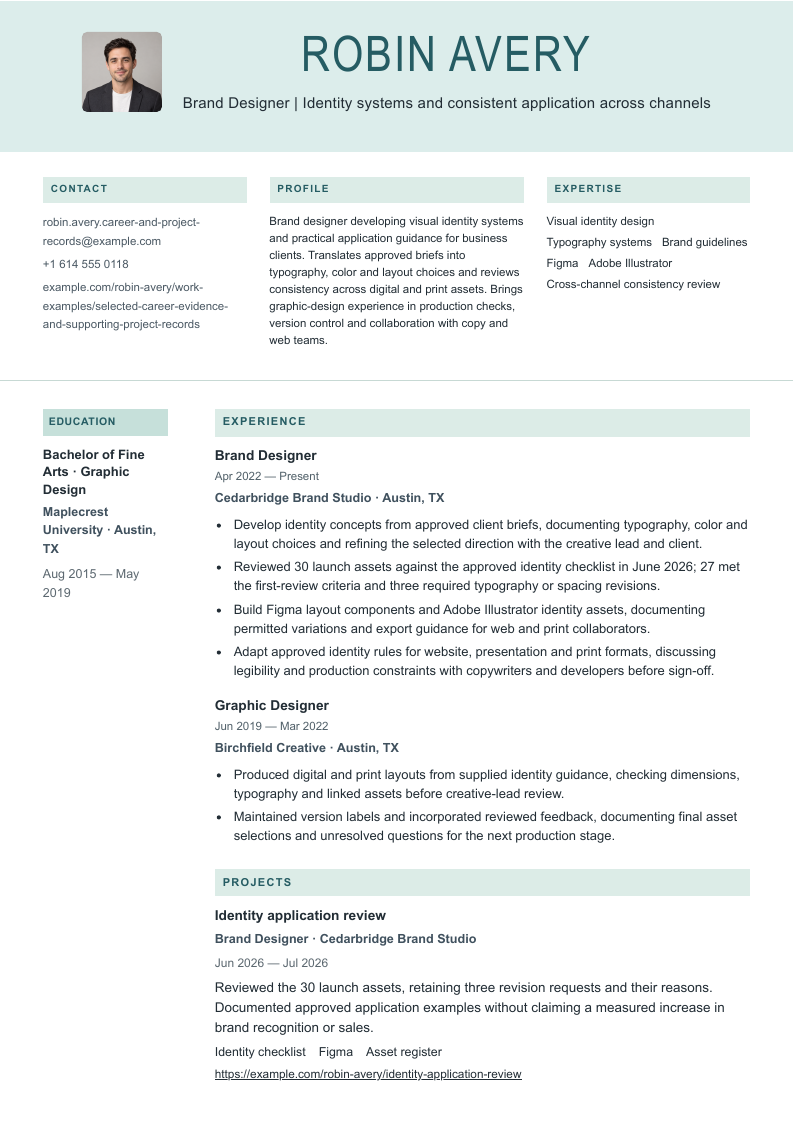
Only Robin Avery’s resume email and one portfolio contact URL change in this scenario. Identity, phone, employment, qualifications and projects stay identical. Studio uses the optional photo-on view here. Read every final character of the email and URL, and check the link destination against the complete record below.
 Open page 1 at full size
Brand Designer | Identity systems and consistent application across channels
robin.avery.career-and-project-records@example.com · +1 614 555 0118
Brand designer developing visual identity systems and practical application guidance for business clients. Translates approved briefs into typography, color and layout choices and reviews consistency across digital and print assets. Brings graphic-design experience in production checks, version control and collaboration with copy and web teams.
Visual identity design · Typography systems · Brand guidelines · Figma · Adobe Illustrator · Cross-channel consistency review
Cedarbridge Brand Studio · Austin, TX
April 2022–Present
Birchfield Creative · Austin, TX
June 2019–March 2022
Bachelor of Fine Arts in Graphic Design · Maplecrest University · Austin, TX
August 2015–May 2019
Brand Designer · Cedarbridge Brand Studio
June 2026–July 2026
Identity checklist · Figma · Asset register
Reviewed the 30 launch assets, retaining three revision requests and their reasons. Documented approved application examples without claiming a measured increase in brand recognition or sales.
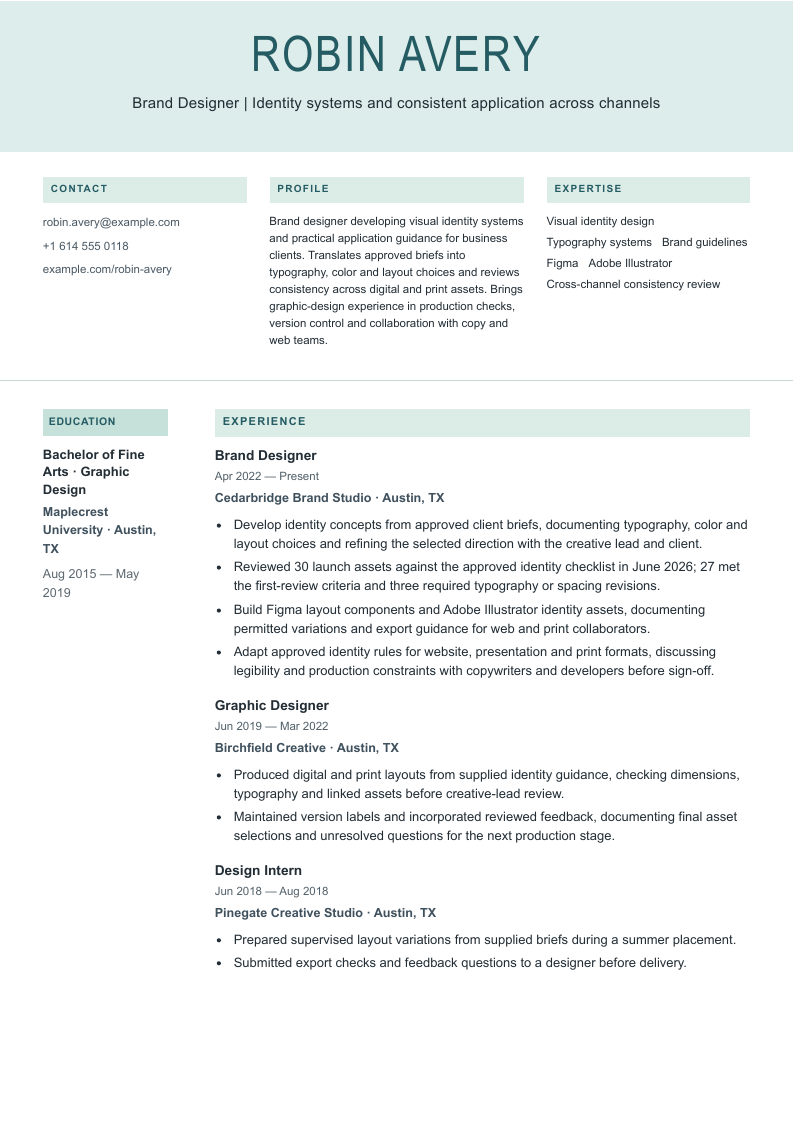
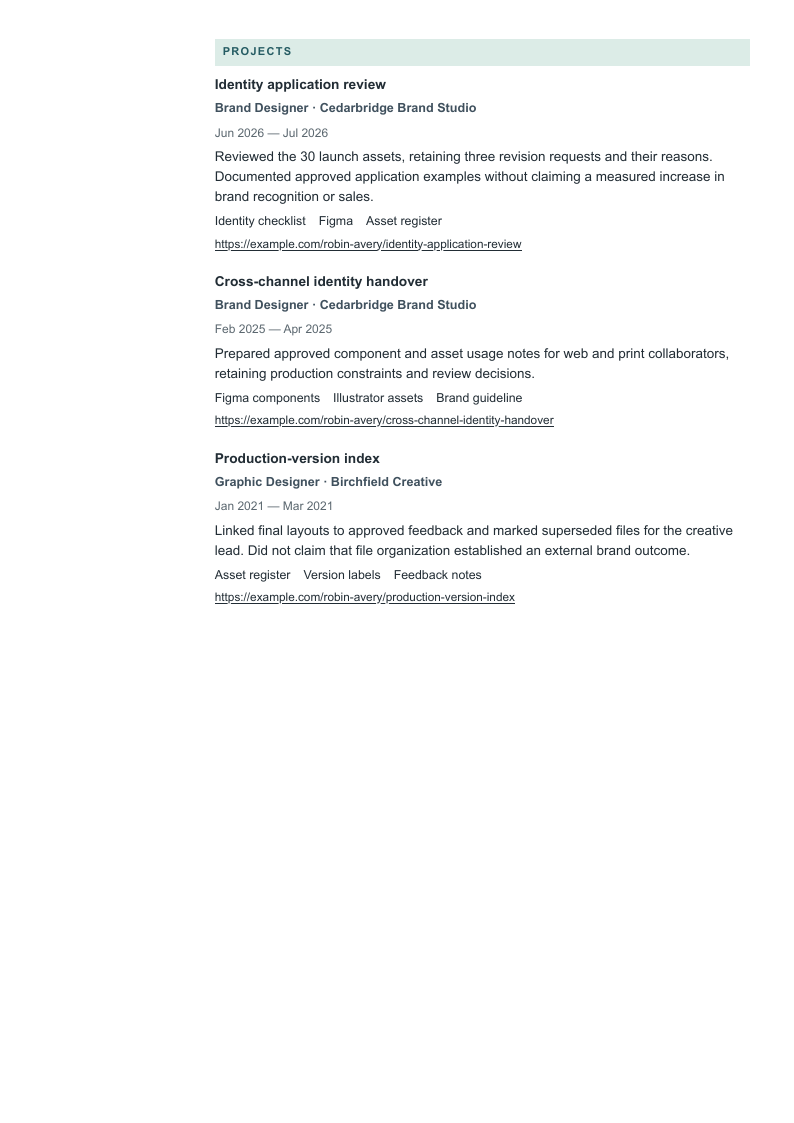
The expanded Studio scenario keeps the photo off. It preserves every base field and adds one earlier job and two projects. Project titles and employers reflect the job actually held during their dates, and method lists describe the work in that project. Read the full record, including the final project and its limits.
Condense repeated responsibilities before removing information a reader needs to understand a claim. Review headings, dates and continuation pages after your own changes; the design name alone cannot establish how an expanded career will read.
 Open page 1 at full size
 Open page 2 at full size
Brand Designer | Identity systems and consistent application across channels
robin.avery@example.com · +1 614 555 0118
Portfolio: https://example.com/robin-avery
Brand designer developing visual identity systems and practical application guidance for business clients. Translates approved briefs into typography, color and layout choices and reviews consistency across digital and print assets. Brings graphic-design experience in production checks, version control and collaboration with copy and web teams.
Visual identity design · Typography systems · Brand guidelines · Figma · Adobe Illustrator · Cross-channel consistency review
Cedarbridge Brand Studio · Austin, TX
April 2022–Present
Birchfield Creative · Austin, TX
June 2019–March 2022
Pinegate Creative Studio · Austin, TX
June 2018–August 2018
Bachelor of Fine Arts in Graphic Design · Maplecrest University · Austin, TX
August 2015–May 2019
Brand Designer · Cedarbridge Brand Studio
June 2026–July 2026
Identity checklist · Figma · Asset register
Reviewed the 30 launch assets, retaining three revision requests and their reasons. Documented approved application examples without claiming a measured increase in brand recognition or sales.
Brand Designer · Cedarbridge Brand Studio
February 2025–April 2025
Figma components · Illustrator assets · Brand guideline
Prepared approved component and asset usage notes for web and print collaborators, retaining production constraints and review decisions.
https://example.com/robin-avery/cross-channel-identity-handover
Graphic Designer · Birchfield Creative
January 2021–March 2021
Asset register · Version labels · Feedback notes
Linked final layouts to approved feedback and marked superseded files for the creative lead. Did not claim that file organization established an external brand outcome.
Review your resume with the analyzer and check every suggestion against your records. No template guarantees parsing, ranking, an interview or a hiring outcome. A free account is required for the builder; free-plan PDF downloads include a watermark. The examples show paid-plan output.
Approved work or labeled personal concepts with the brief, constraints, contribution and decisions behind the final application.
Only with reliable research and accurate attribution. A launch asset review is a different measure.
Use actual relevant tools and connect them to components, identity assets or production work you can explain.
Signup retains the exact design, the supported photo setting and Brand Designer role. Compact stays photo-free. The fictional career and portrait are not inserted into your account. A free account is required and free-plan PDF downloads include a watermark.
Prepared by Resumize with AI-assisted research and drafting for English-language US resume context. Employer descriptions from other markets are identified in the discussion and notes. Full employer bodies were checked October 30, 2026; availability, location eligibility and engagement conditions vary and can change. The original fictional records are teaching material, not verified applicants or evidence that this candidate meets every opening. No application was submitted or hiring outcome tested.
Official occupational and credential guidance was reviewed through direct, web-access or indexed text as stated in each note. Retrieval failures remain disclosed. The source notes distinguish these limits from full direct employer retrieval.
Read October 30, 2026. InMarket, US remote; Brand Designer within marketing. Full employer description retrieved. Application controls were present at review; availability can change.
Read October 30, 2026. Tailscale, US remote; Brand Designer, including an invitation to apply when experience does not match every preferred item. Full employer description retrieved. Application controls were present at review; availability can change.
Read October 30, 2026. Vercel, hybrid San Francisco/New York; Senior Brand Designer. Seniority and product context differ from the fictional studio career. Full employer description retrieved. Application controls were present at review; availability can change.
Reviewed October 30, 2026. Official context for the role or the stated practice; not a credential or proof that the fictional candidate meets every requirement. Direct archival access was restricted; no new detailed regulatory or eligibility claim is inferred from that failed retrieval.