Nonclinical cell-biology research \u00b7 US applications
Biologist resume examples and templates for laboratory research
A biologist resume becomes useful when the reader can see the biological setting, methods you actually used, records you maintained and your contribution to the research. This broad role guide uses a nonclinical mammalian-cell research associate, with complete examples that keep QC exceptions and scientist oversight visible.
These previews use the same layouts as the builder, with identical example content. Open a full preview to inspect the text and spacing.
Fictional candidate, employers, education and results. The optional portrait is AI-generated. Use your own evidence and photo; the example is not inserted into your resume.
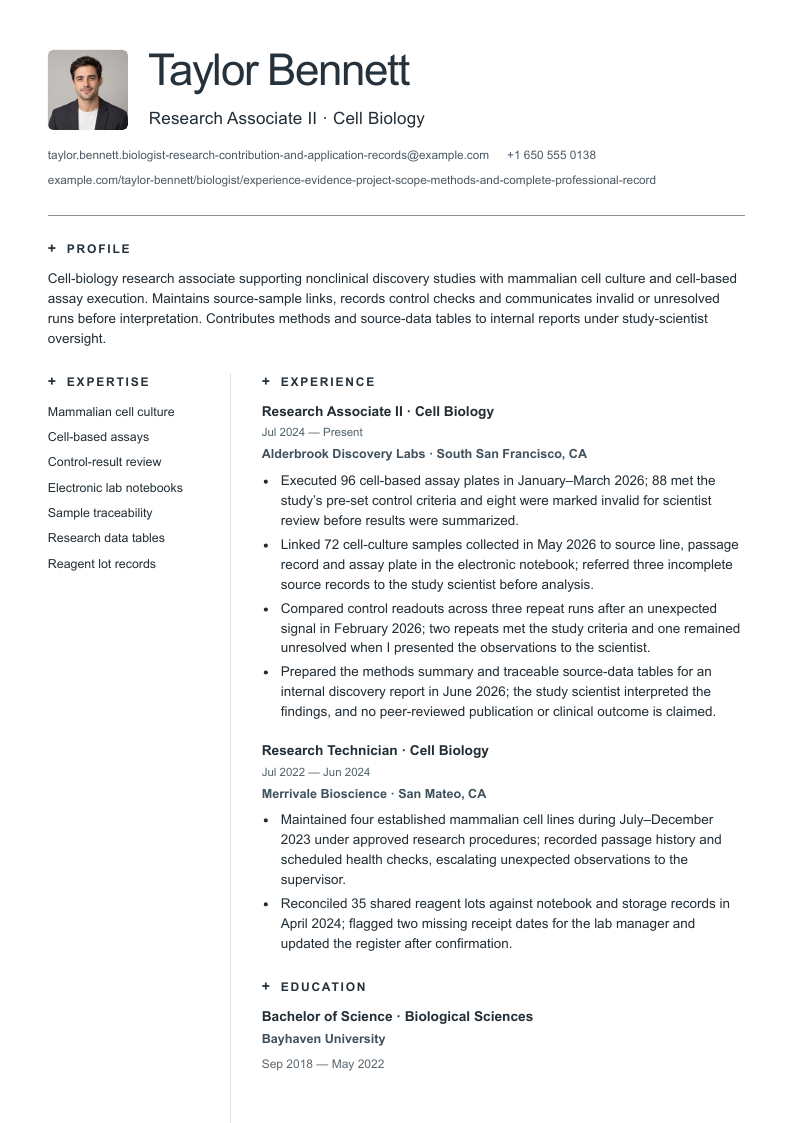
Precision
A full-width identity and summary lead into a narrow expertise column beside experience, education and projects.
Before sending: Method names in the narrow expertise column wrap differently from the detailed QC bullets in the main column. Check that sample counts, invalid-run labels and dates remain readable across the actual export.
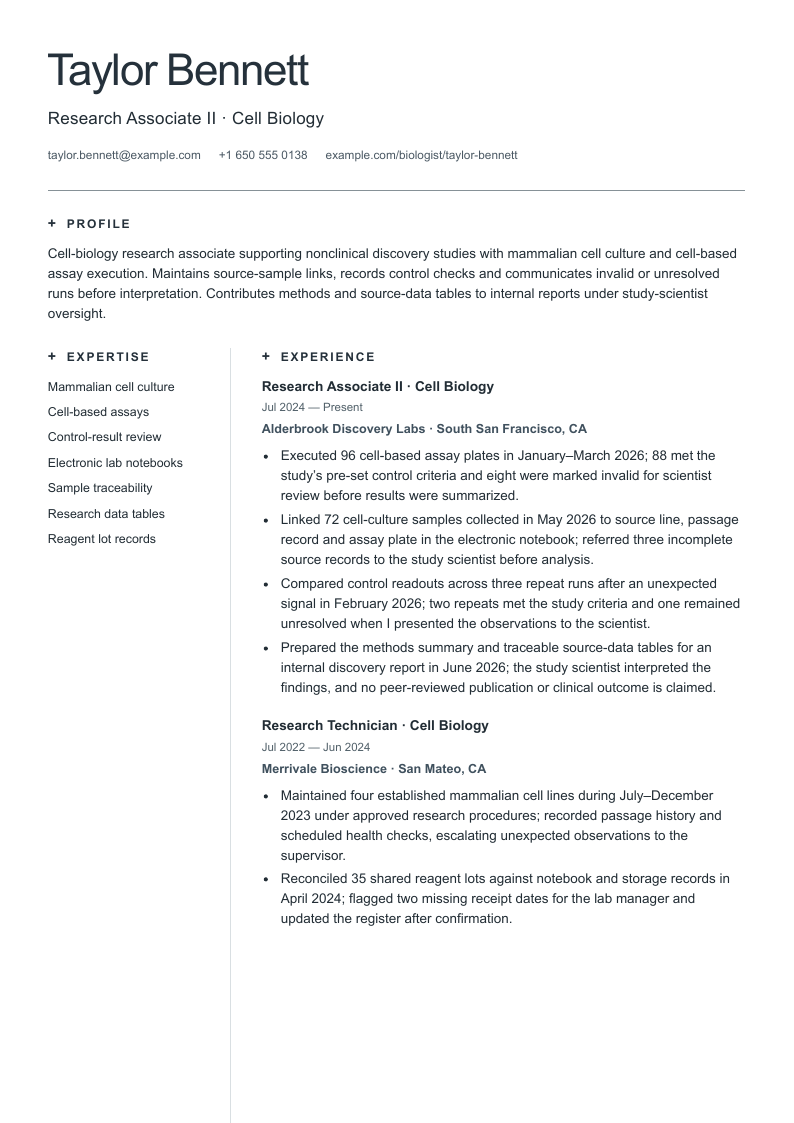
A plain left header and restrained single-column sections foreground dated bench experience before expertise, education and projects.
Before sending: Its straightforward flow still needs a continuation check for the internal-report project and education. The layout cannot distinguish a biological replicate from a repeat run for you.
A centered serif name and section headings with fine horizontal rules offer a traditional single-column alternative for this employed researcher.
Before sending: Scholar is a visual design, not a full academic CV. A publication list is not supplied in this record, and the internal report must not be relabeled as a publication to fill space.
“Use” opens signup with that design and photo preference selected for the builder. A free account is required. Free-plan PDF downloads include a watermark; see current plans for paid options. Photo conventions vary; follow the employer’s instructions and local expectations.
All three designs use the identical fictional record. Open each full preview to inspect every exported page and compare the optional photo. The default is without a photo. The optional portrait is AI-generated; the sample content and portrait are teaching examples and are not inserted into your account.
Precision separates expertise into a narrow column beside the main work record. Essential gives the experience a restrained single-column flow. Scholar uses centered serif headings for the same employed-research record. Choose by how the methods and their evidence read together; the visual name Scholar does not add a publication record or turn the document into a faculty CV.
Taylor Bennett is an invented cell-biology research associate with earlier research-technician work after a 2022 biological-sciences degree. The example concerns established mammalian cell lines and nonclinical discovery assays. It does not claim patient testing, diagnostic authority, independent study leadership or a therapeutic result. All people, employers, schools, qualifications and counts are fictional. The example.com links are placeholders.
Cell-biology research associate supporting nonclinical discovery studies with mammalian cell culture and cell-based assay execution. Maintains source-sample links, records control checks and communicates invalid or unresolved runs before interpretation. Contributes methods and source-data tables to internal reports under study-scientist oversight.
Skills
Mammalian cell culture · Cell-based assays · Control-result review · Electronic lab notebooks · Sample traceability · Research data tables · Reagent lot records
Experience
Research Associate II · Cell Biology
Alderbrook Discovery Labs · South San Francisco, CA
July 2024–Present
Executed 96 cell-based assay plates in January–March 2026; 88 met the study’s pre-set control criteria and eight were marked invalid for scientist review before results were summarized.
Linked 72 cell-culture samples collected in May 2026 to source line, passage record and assay plate in the electronic notebook; referred three incomplete source records to the study scientist before analysis.
Compared control readouts across three repeat runs after an unexpected signal in February 2026; two repeats met the study criteria and one remained unresolved when I presented the observations to the scientist.
Prepared the methods summary and traceable source-data tables for an internal discovery report in June 2026; the study scientist interpreted the findings, and no peer-reviewed publication or clinical outcome is claimed.
Research Technician · Cell Biology
Merrivale Bioscience · San Mateo, CA
July 2022–June 2024
Maintained four established mammalian cell lines during July–December 2023 under approved research procedures; recorded passage history and scheduled health checks, escalating unexpected observations to the supervisor.
Reconciled 35 shared reagent lots against notebook and storage records in April 2024; flagged two missing receipt dates for the lab manager and updated the register after confirmation.
Education
Bachelor of Science in Biological Sciences · Bayhaven University
September 2018–May 2022
Projects
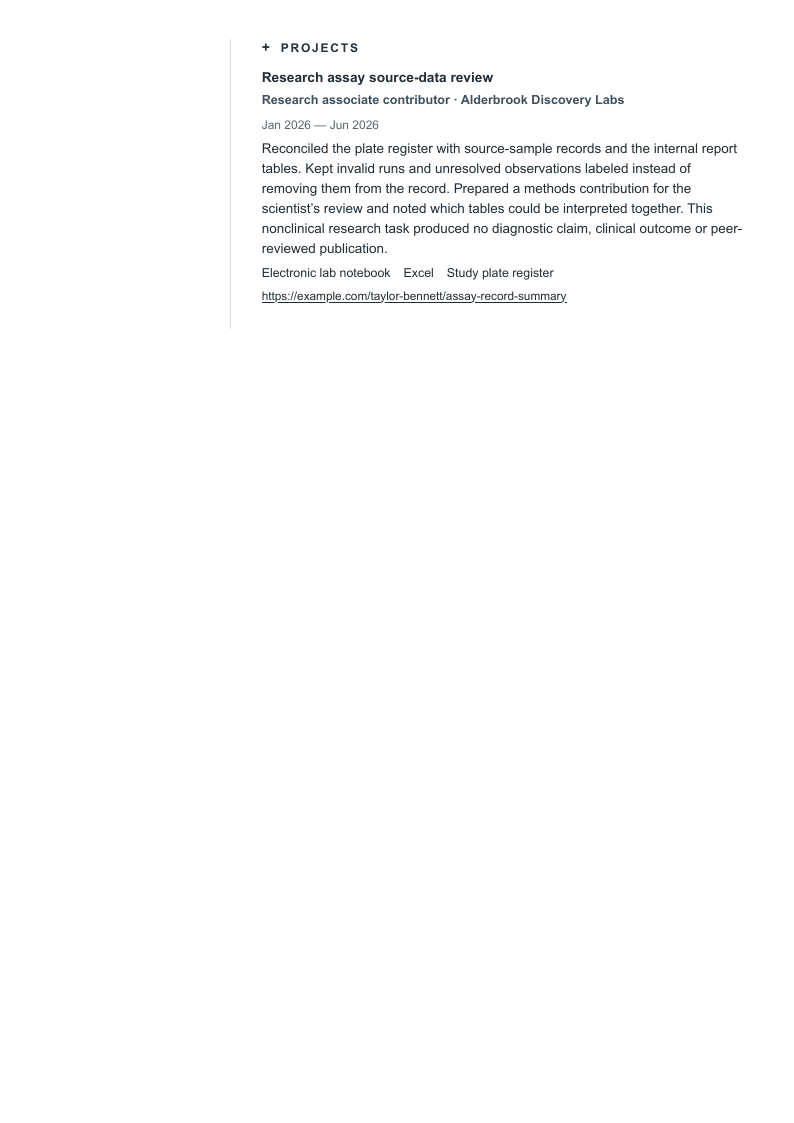
Research assay source-data review
Research associate contributor · Alderbrook Discovery Labs
January 2026–June 2026
Electronic lab notebook · Excel · Study plate register
Reconciled the plate register with source-sample records and the internal report tables. Kept invalid runs and unresolved observations labeled instead of removing them from the record. Prepared a methods contribution for the scientist’s review and noted which tables could be interpreted together. This nonclinical research task produced no diagnostic claim, clinical outcome or peer-reviewed publication.
Read the record as a chain from a source sample to an assay plate, control disposition and report table. The associate executes and documents the work; the study scientist interprets the findings. The project records that handoff and preserves invalid or unresolved observations. No publication is invented to make the resume look more academic.
Define the kind of biology before listing methods
Biology includes laboratory, ecological, computational, agricultural and other work. A wildlife field survey and a mammalian-cell discovery study need different evidence even when both use careful records. This page’s example is for an employed nonclinical bench researcher. For another specialty, state the organism or system, setting, research question and work you performed rather than adopting the sample’s methods.
For a bench role, connect a method to its purpose and level of responsibility. State whether you executed an established procedure, helped troubleshoot a readout, maintained a model, analyzed a defined data set or designed the study. Working to an approved research procedure does not by itself establish regulated clinical testing, a validated diagnostic assay or responsibility for releasing a commercial batch.
Addition Therapeutics describes hands-on research with cell culture, traceable reagent records and QC. Biohub’s cell-biology role combines culture maintenance, experiment execution, notebook records and collaboration with scientists and automation engineers. Anthropic’s Research Associate, Biology explicitly describes a hands-on bench position rather than AI/ML model development. These sources support the importance of actual method and recordkeeping scope; they do not make every listed technique a requirement for all biologists.
Keep study observations separate from claims about the biology. In Taylor’s record, 88 of 96 plates meet that study’s control criteria and eight are invalid. That count does not prove a treatment works, validate a new assay or measure clinical benefit. Likewise, a repeat run is not automatically an independent biological replicate. Give the unit and criteria you can substantiate, and leave interpretation ownership clear.
Six annotated biologist bullet rewrites
Each after version appears in the complete resume above. The rewrites demonstrate reasoning, not achievements to borrow. Replace every fictional number, date and result with evidence that you are permitted to describe.
Assay volume with QC disposition
Before: Ran hundreds of flawless experiments.
After: Executed 96 cell-based assay plates in January–March 2026; 88 met the study’s pre-set control criteria and eight were marked invalid for scientist review before results were summarized.
Why it works: The 96-plate denominator includes the eight invalid plates. This is a QC disposition count for one study period, not a success rate across all experiments or evidence of biological efficacy.
Evidence to check: Plate register, study-specific criteria, control results, invalid-run flags and the scientist-reviewed summary.
Sample traceability rather than a vague quality claim
Before: Maintained perfect samples and improved lab quality.
After: Linked 72 cell-culture samples collected in May 2026 to source line, passage record and assay plate in the electronic notebook; referred three incomplete source records to the study scientist before analysis.
Why it works: The count describes traceable record work and exposes exceptions instead of claiming perfection. Passage and sample records support interpretation but do not prove a cell line’s identity or establish a universal quality standard.
Evidence to check: Dated sample register, electronic notebook links, source records and disposition of the three exceptions.
Troubleshooting with an unresolved result visible
Before: Optimized the assay and eliminated variability.
After: Compared control readouts across three repeat runs after an unexpected signal in February 2026; two repeats met the study criteria and one remained unresolved when I presented the observations to the scientist.
Why it works: Names the troubleshooting task and the complete three-run disposition. Repeat measurements are not necessarily independent biological replicates; the result does not show that variability was eliminated.
Evidence to check: Original anomaly record, repeat-run IDs, relevant controls, acceptance criteria and meeting notes distinguishing observation from hypothesis.
A research contribution without claiming authorship
Before: Published groundbreaking research that proved our therapy works.
After: Prepared the methods summary and traceable source-data tables for an internal discovery report in June 2026; the study scientist interpreted the findings, and no peer-reviewed publication or clinical outcome is claimed.
Why it works: An internal report is not a journal publication. The bullet identifies the associate’s work without claiming authorship, therapeutic efficacy or a clinical result.
Evidence to check: Report version history, source-data references and the agreed contribution statement.
Routine cell work with a defined scope
Before: Expert in every molecular and cell biology technique.
After: Maintained four established mammalian cell lines during July–December 2023 under approved research procedures; recorded passage history and scheduled health checks, escalating unexpected observations to the supervisor.
Why it works: Lists the actual cell-work scope and supervision. Four lines do not prove expertise with every model, technique or clinical specimen, and a scheduled check is not a claim that every culture passed.
Evidence to check: Training record, cell-line assignments, notebook entries and health-check schedule and results.
A reagent handoff with ownership limits
Before: Guaranteed uninterrupted experiments through inventory management.
After: Reconciled 35 shared reagent lots against notebook and storage records in April 2024; flagged two missing receipt dates for the lab manager and updated the register after confirmation.
Why it works: The 35-lot scope and two exceptions are reviewable. The manager confirms missing information; the associate does not claim a guarantee of supply or authority to release regulated material.
Evidence to check: Dated inventory snapshot, lot identifiers, exception log and manager-confirmed updates.
Summarize the research contribution, then substantiate it
Taylor’s summary names mammalian-cell discovery research, established assay execution, source-sample links and communication of exceptions. It avoids “expert in all biology techniques.” A useful introduction lets a laboratory manager identify your relevant setting before reading an instrument list. If your experience is environmental sampling or computational analysis, use that setting and its corresponding evidence instead.
For each role, select a small number of work examples with a method, defined scope and decision or handoff. A cell-line record, invalid-run flag or controlled report contribution may be more informative than a list of routine tasks. Include the skill names you can actually discuss, and distinguish independent operation from training, observation or work completed under close supervision.
The April 2024 reagent review reconciles a dated 35-lot record and escalates two incomplete receipt dates. It does not claim a cost saving or guarantee uninterrupted experiments. The June 2026 internal report names the methods and source tables Taylor prepared and the scientist who interpreted the result. Use the same precision for your own contribution even when there is no percentage to report.
Show methods with evidence and limitations
Choose relevant skills you can explain through your actual record. A tool or keyword is useful when the surrounding work makes its meaning clear. The table separates evidence to check from the invented example.
Biologist skills, evidence to gather and fictional examples
Skill
Evidence to gather
Where it appears in this sample
Cell culture
The systems maintained, recordkeeping and supervision.
Four established mammalian lines; passage records and scheduled checks.
Cell-based assays
A dated assay scope, relevant controls and invalid results.
A 96-plate cohort includes all eight invalid plates.
Sample traceability
Links from source material through the work and reported data.
Seventy-two samples link to source records and assay plates.
Troubleshooting
The observed anomaly, repeat set and unresolved questions.
One of three repeat runs remains unresolved.
Research reporting
An identifiable contribution and interpretation owner.
Methods and source tables support an internal report.
Reagent records
Checked lot records, exceptions and confirmation owner.
Two missing receipt dates go to the lab manager.
Separate degrees, training and publication status
List your degree, field, institution and completion or expected dates. Taylor’s fictional bachelor’s degree is one path in the selected research context. The employer sources describe different education and experience expectations; none establishes a universal license for everyone called a biologist. A job involving clinical, regulated or another specialized practice may have requirements outside this example’s scope.
Name relevant laboratory or safety training only when completed and supportable, and distinguish a course from authorization to work independently. A method mentioned in a job advertisement does not belong on your resume unless you can explain your own experience with it. This sample does not claim RNA-production, flow-cytometry or automation expertise merely because those appear in the cited roles.
Publications, posters, internal reports and manuscripts in preparation are different outputs. State the actual title, authorship contribution and status of an item you choose to include. Do not call a class poster peer reviewed or describe an internal report as published. Respect your employer’s restrictions on unpublished data, proprietary procedures, sample identifiers and collaborative results. A resume can describe the work without exposing the underlying records.
Use supervised and student research honestly
For a first employed research role, relevant coursework and supervised projects can demonstrate careful observation, recordkeeping and communication. Keep “undergraduate research assistant” or the actual student title. Describe the research setting and the part you completed, and label training or a classroom demonstration rather than turning it into paid industry experience.
A concise early-career bullet might explain that you linked assigned sample labels to notebook entries and brought missing information to a supervisor. Add the method only if you used it and can discuss the controls and limits. Taylor’s expanded record keeps a class poster labeled as such and does not add publication credit, independent experimental design or medical authority.
Inspect long contact details with the photo on
Only the resume email and portfolio URL change here. Precision is shown with the optional photo on, while methods, counts, dates and projects remain the same. Compare the entire contact text with the export and open the portfolio destination. The default example has no photo; follow the target employer’s instructions for a US application.
Cell-biology research associate supporting nonclinical discovery studies with mammalian cell culture and cell-based assay execution. Maintains source-sample links, records control checks and communicates invalid or unresolved runs before interpretation. Contributes methods and source-data tables to internal reports under study-scientist oversight.
Skills
Mammalian cell culture · Cell-based assays · Control-result review · Electronic lab notebooks · Sample traceability · Research data tables · Reagent lot records
Experience
Research Associate II · Cell Biology
Alderbrook Discovery Labs · South San Francisco, CA
July 2024–Present
Executed 96 cell-based assay plates in January–March 2026; 88 met the study’s pre-set control criteria and eight were marked invalid for scientist review before results were summarized.
Linked 72 cell-culture samples collected in May 2026 to source line, passage record and assay plate in the electronic notebook; referred three incomplete source records to the study scientist before analysis.
Compared control readouts across three repeat runs after an unexpected signal in February 2026; two repeats met the study criteria and one remained unresolved when I presented the observations to the scientist.
Prepared the methods summary and traceable source-data tables for an internal discovery report in June 2026; the study scientist interpreted the findings, and no peer-reviewed publication or clinical outcome is claimed.
Research Technician · Cell Biology
Merrivale Bioscience · San Mateo, CA
July 2022–June 2024
Maintained four established mammalian cell lines during July–December 2023 under approved research procedures; recorded passage history and scheduled health checks, escalating unexpected observations to the supervisor.
Reconciled 35 shared reagent lots against notebook and storage records in April 2024; flagged two missing receipt dates for the lab manager and updated the register after confirmation.
Education
Bachelor of Science in Biological Sciences · Bayhaven University
September 2018–May 2022
Projects
Research assay source-data review
Research associate contributor · Alderbrook Discovery Labs
January 2026–June 2026
Electronic lab notebook · Excel · Study plate register
Reconciled the plate register with source-sample records and the internal report tables. Kept invalid runs and unresolved observations labeled instead of removing them from the record. Prepared a methods contribution for the scientist’s review and noted which tables could be interpreted together. This nonclinical research task produced no diagnostic claim, clinical outcome or peer-reviewed publication.
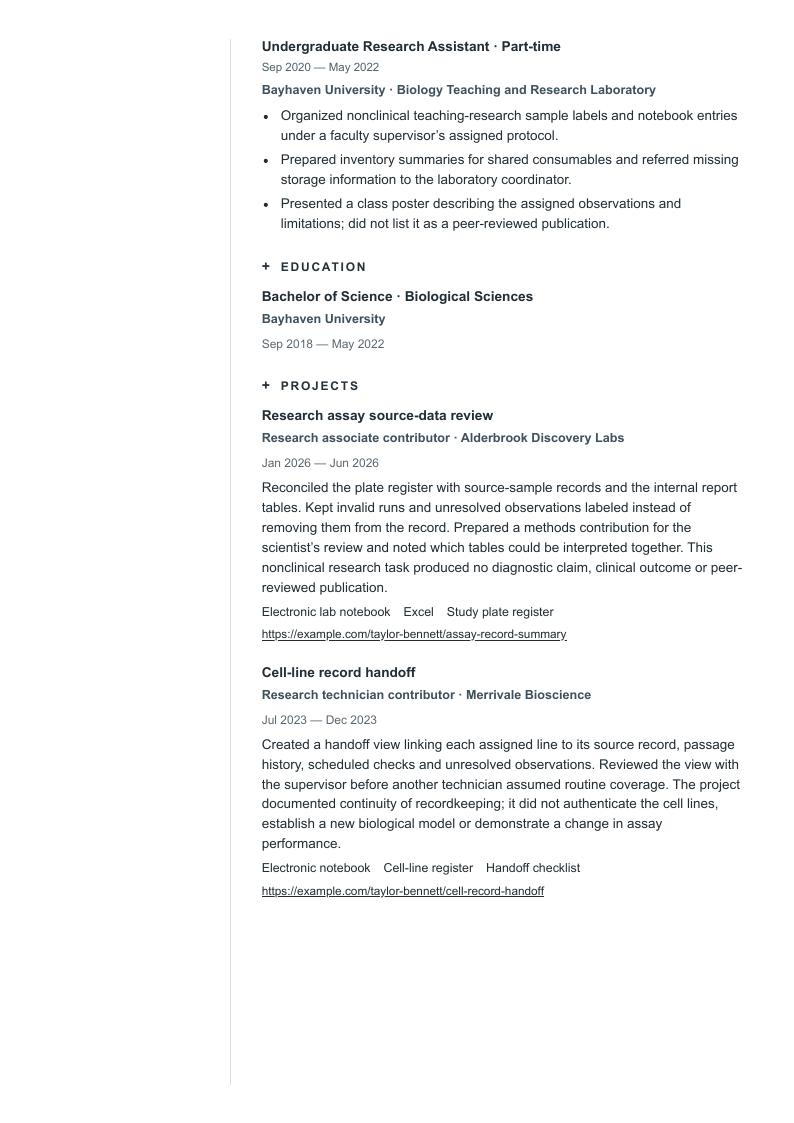
This Precision export has the photo off. It retains the base research record and adds an earlier part-time undergraduate role plus two dated recordkeeping projects. Check the expertise column, the earliest experience, education dates and every project ending on all exported pages. The expanded record checks completeness; it does not make more pages or a longer methods list a hiring advantage.
Open page 1 at full sizePrecision · Page 1 of 3 · Photo off · Complete paid-plan PDF page, including margins, without a watermark.Open page 2 at full sizePrecision · Page 2 of 3 · Photo off · Complete paid-plan PDF page, including margins, without a watermark.Open page 3 at full sizePrecision · Page 3 of 3 · Photo off · Complete paid-plan PDF page, including margins, without a watermark.Use Precision without a photo
Cell-biology research associate supporting nonclinical discovery studies with mammalian cell culture and cell-based assay execution. Maintains source-sample links, records control checks and communicates invalid or unresolved runs before interpretation. Contributes methods and source-data tables to internal reports under study-scientist oversight.
Skills
Mammalian cell culture · Cell-based assays · Control-result review · Electronic lab notebooks · Sample traceability · Research data tables · Reagent lot records
Experience
Research Associate II · Cell Biology
Alderbrook Discovery Labs · South San Francisco, CA
July 2024–Present
Executed 96 cell-based assay plates in January–March 2026; 88 met the study’s pre-set control criteria and eight were marked invalid for scientist review before results were summarized.
Linked 72 cell-culture samples collected in May 2026 to source line, passage record and assay plate in the electronic notebook; referred three incomplete source records to the study scientist before analysis.
Compared control readouts across three repeat runs after an unexpected signal in February 2026; two repeats met the study criteria and one remained unresolved when I presented the observations to the scientist.
Prepared the methods summary and traceable source-data tables for an internal discovery report in June 2026; the study scientist interpreted the findings, and no peer-reviewed publication or clinical outcome is claimed.
Research Technician · Cell Biology
Merrivale Bioscience · San Mateo, CA
July 2022–June 2024
Maintained four established mammalian cell lines during July–December 2023 under approved research procedures; recorded passage history and scheduled health checks, escalating unexpected observations to the supervisor.
Reconciled 35 shared reagent lots against notebook and storage records in April 2024; flagged two missing receipt dates for the lab manager and updated the register after confirmation.
Undergraduate Research Assistant · Part-time
Bayhaven University · Biology Teaching and Research Laboratory
September 2020–May 2022
Organized nonclinical teaching-research sample labels and notebook entries under a faculty supervisor’s assigned protocol.
Prepared inventory summaries for shared consumables and referred missing storage information to the laboratory coordinator.
Presented a class poster describing the assigned observations and limitations; did not list it as a peer-reviewed publication.
Education
Bachelor of Science in Biological Sciences · Bayhaven University
September 2018–May 2022
Projects
Research assay source-data review
Research associate contributor · Alderbrook Discovery Labs
January 2026–June 2026
Electronic lab notebook · Excel · Study plate register
Reconciled the plate register with source-sample records and the internal report tables. Kept invalid runs and unresolved observations labeled instead of removing them from the record. Prepared a methods contribution for the scientist’s review and noted which tables could be interpreted together. This nonclinical research task produced no diagnostic claim, clinical outcome or peer-reviewed publication.
Created a handoff view linking each assigned line to its source record, passage history, scheduled checks and unresolved observations. Reviewed the view with the supervisor before another technician assumed routine coverage. The project documented continuity of recordkeeping; it did not authenticate the cell lines, establish a new biological model or demonstrate a change in assay performance.
Research technician contributor · Merrivale Bioscience
March 2024–April 2024
Inventory register · Excel · Receipt archive
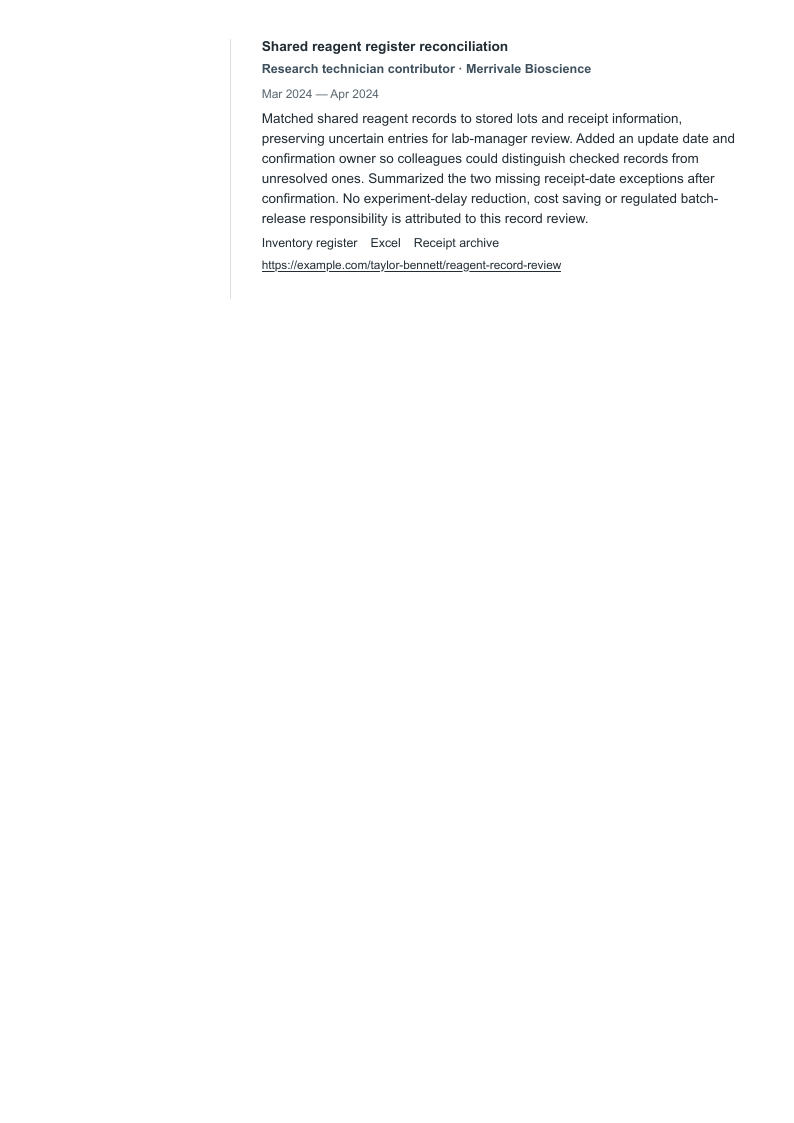
Matched shared reagent records to stored lots and receipt information, preserving uncertain entries for lab-manager review. Added an update date and confirmation owner so colleagues could distinguish checked records from unresolved ones. Summarized the two missing receipt-date exceptions after confirmation. No experiment-delay reduction, cost saving or regulated batch-release responsibility is attributed to this record review.
Check the research claims. Confirm the model or system, technique, period, unit, control criteria and who interpreted the results. Keep invalid and unresolved observations distinct from accepted data.
Read every exported page. Inspect narrow method labels, sample numbers, exception counts, education dates and the final project sentences. A two-column layout needs a reading-order check as well as a visual one.
Inspect text and links. Copy the PDF text and verify the sample-to-report explanation still reads in order. Open destinations without publishing private notebooks, specimen details or unpublished employer data.
Follow the application instructions. Use the requested resume or CV format and file type. Check parsed fields after upload; no template guarantees compatibility or substitutes for the credentials required by a particular vacancy.
Review your resume with the analyzer and check suggestions against your records. The design buttons open signup with the selected template and photo preference. Free-plan PDF downloads include a watermark; these examples show paid-plan output.
Questions, answered
Is this a biology resume or a full academic CV?
It is an employment resume for a nonclinical cell-biology research associate. A faculty, fellowship or other application may request a CV with different research, teaching and publication detail. Follow the actual instructions rather than relying on the visual design’s name.
Should I list every laboratory technique from the job advertisement?
List only methods you have actually used and can describe accurately. Distinguish training, observation, supervised execution and independent responsibility. Techniques named by the cited employers are vacancy-specific and are not automatically skills of this fictional candidate.
How can I quantify research without claiming a breakthrough?
Describe the dated scope, record unit and disposition: samples traced, plates executed, records checked or report contributions. Define controls and unresolved results when relevant. These counts can show your work without asserting therapeutic efficacy or a discovery you did not establish.
Can I list an internal report as a publication?
Call it an internal report and state your contribution. A poster, manuscript in preparation, preprint and peer-reviewed article have different statuses. Include only accurate authorship and shareable information; this example does not claim a journal publication.
Does every biologist need the same license?
This guide does not establish a universal licensing requirement. The sample covers nonclinical discovery research. Check the employer, specialty, work setting and applicable jurisdiction for the actual credentials relevant to your application.
Will the builder keep my selected design and photo preference?
The Use buttons open signup with that design and the selected photo preference for the builder. A free account is required. The fictional candidate record and AI-generated portrait are not inserted into your resume; free-plan PDF downloads include a watermark.
Prepared by Resumize with AI-assisted research and drafting for English-language US applications. The three primary employer descriptions and career guidance below were checked on October 27, 2026. Employer pages displayed application controls or forms as noted; that observation is not proof of a completed application or a guarantee the vacancy remains available. These selected descriptions illustrate different scopes rather than universal hiring requirements. The complete records, rewrites and design comparisons are original editorial examples, not employer endorsements, search-ranking forecasts or promises of hiring results.
Checked October 27, 2026: South San Francisco primary description displayed Apply and a Submit application form; no publication date shown. Covers bench research, mammalian cell culture, reagent and sample tracking, defined QC and electronic notebook documentation. Its specific RNA methods are not asserted as skills in the fictional record. No application submitted.
Checked October 27, 2026: Chicago primary page displayed Apply and an application form with Submit application; no publication date shown. Describes cell maintenance, experiment execution, deviations, notebooks and scientist collaboration. Automation and particular cell-model skills are vacancy-specific, not universal requirements for biologists.
Checked October 27, 2026: San Francisco primary description and application fields were accessible, with Apply shown; no publication date shown. Explicitly describes a hands-on bench role rather than AI/ML model development, including cell lines, foundational molecular methods and scientist-directed experiments. This research employer is a scope comparison, not evidence that all biology roles involve AI.
Read October 27, 2026. Advises tailoring research experience, explaining individual contribution and using deliberate, readable prose. Its audience is student research applicants; this guide applies those writing principles to an invented employed laboratory candidate.
Read October 27, 2026. General guidance on relevant responsibilities, dates and specific contributions. The assay counts, acceptance example and limitations here are original editorial fiction, not laboratory standards.