Education & training
Teaching Drawing: Contour and Negative-Space Exercises
Teaching drawing can begin with observing a simple object rather than judging whether a learner has artistic talent. This original cup exercise isolates contour and negative space. Its illustration supplies a shared reference, while the feedback focuses on visible choices that a learner can revise.
Set up a repeatable observation
The National Gallery of Art’s drawing resources discuss contour and line as ways to examine everyday objects. Our exercise uses an original simplified cup drawing rather than reproducing museum artwork or the gallery’s lesson sequence.
Place a cup where the whole group can see it, or use the reference illustration below. Keep the viewpoint fixed for the first attempt. The task is to compare relationships: the body’s height and width, the rim’s tilt and the shape of the opening within the handle. No single exercise measures overall artistic ability.
Inspect the original reference and the comparison
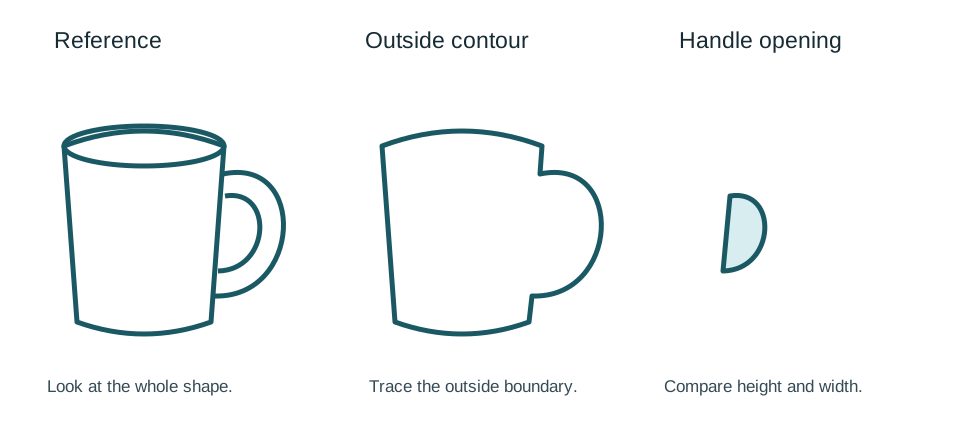
The left panel shows a simplified cup viewed slightly from above. The center isolates its outside contour. The right emphasizes the enclosed opening in the handle as a shape of empty space. These are different observations of the same reference, not three stages of an ideal finished artwork.
Give learners two distinct tasks
Give learners two distinct tasks
Task A — Contour: make a light outline of the cup’s outside boundary. Compare the body’s width with its height before adding detail. Mark where the handle joins the body.
Task B — Negative space: draw the shape of the opening inside the handle on its own. Notice its width at the top, middle and bottom. Then place that shape beside the cup body.
Pause: compare the two sketches with the reference. Does the handle opening occupy a similar proportion of the body’s height? Which line would you change first?
Revision: alter one relationship, such as the handle opening’s width, and state what observation led to the change.
Use a worked feedback comparison
Fictional first attempt: the learner draws a nearly circular handle opening and places its lower join below the base of the cup. The reference shows a narrower, taller opening and a lower join above the base. “Bad proportions” does not tell the learner where to look.
Specific feedback: “Compare the opening’s height with its width. Mark its highest and lowest points, then check where the lower join sits relative to the cup’s base. Redraw the opening before changing the shading.” This directs attention to observable relationships and leaves the learner responsible for making the revision.
Assess observation separately from decoration
Use three questions: did the learner inspect an identifiable relationship, make a deliberate revision and explain the observation behind it? A clean shaded drawing may still avoid those tasks. A rough outline may contain useful evidence of close looking.
For an extension, rotate the real object and ask which relationships change with viewpoint. Keep the original sketch beside the new attempt so learners can compare the rim and handle rather than assuming one memorized cup symbol fits every view. If a learner needs an alternative way to inspect the object, arrange access before assessing what they could observe.
Questions, answered
Does negative space mean the background only?
It can include an enclosed empty shape, such as the opening inside a handle, as well as space around the object.
Should beginners shade immediately?
For this exercise, first inspect the outlined relationships. Add shading later if it serves a separately stated learning goal.
Sources and examples
ResumizeAI team. Examples are fictional teaching material, not customer results. Replace sample details with your own facts.
Your experience. A complete resume.
Build in Resumize with ATS-friendly templates, guided editing and a live preview. Start free, then upgrade when you need more.
Free account required. Free-plan PDF exports include a watermark.