Interview preparation guide
Security Guard Interview Questions and Answers: Practice PDF
Prepare for a security-guard or security-officer interview by explaining how you handle a request within the authority of the post. These original questions focus on an ordinary unarmed private-site role: checking a visitor request, seeking approval, keeping a clear record and handing over unresolved work. The PDF contains the same six answers and worked exercise as the page, plus space for your own practice notes.
Download the complete interview practice
Free printable PDF and editable DOCX. Both include all six original questions, sample answers and explanations, followed by the visitor-authorization exercise and blank practice prompts. The PDF is a reading and printing document, not an interactive form.
Security-guard interview Q&A and worksheet
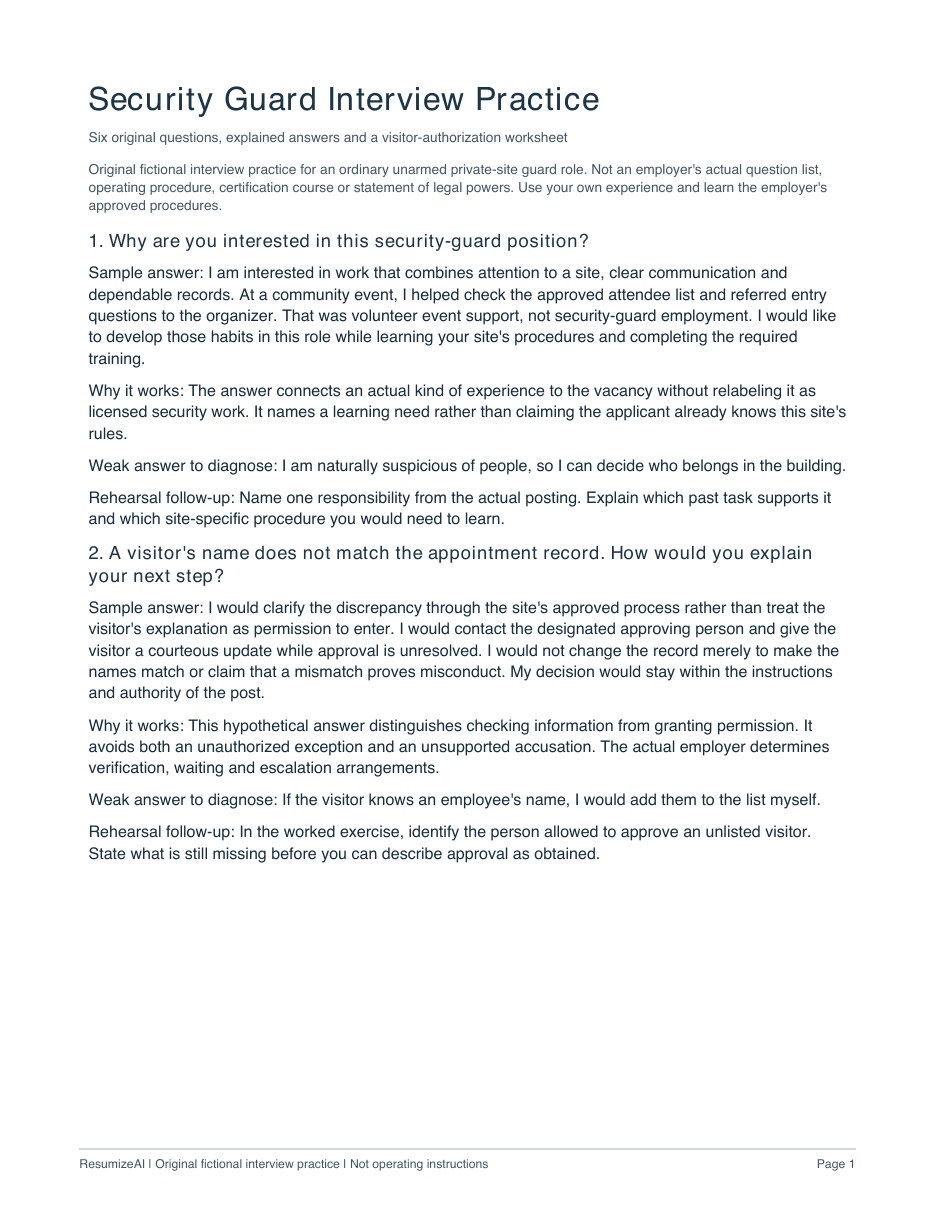
Complete original practice material. The image shows the first page; open the PDF to read every page.
Understand the role before rehearsing
BLS describes guards as controlling access and writing reports about observations; it also uses security officer as a name for the occupation. Duties and training vary with the employer and assignment. Read the actual posting before choosing the examples you will discuss.
Original fictional interview practice for an ordinary unarmed private-site guard role. Not an employer's actual question list, operating procedure, certification course or statement of legal powers. Use your own experience and learn the employer's approved procedures.
Use the printable file to annotate the sample answers, then answer aloud in your own words. A fictional site rule in the worksheet applies only to that exercise. It is not a rule for your future workplace, a licensing decision or guidance on searching, detention or force.
1. Why are you interested in this security-guard position?
Use this original hypothetical answer to examine the reasoning, then replace any personal-history statement with an accurate example of your own.
Sample answer, explanation and follow-up
Sample answer: I am interested in work that combines attention to a site, clear communication and dependable records. At a community event, I helped check the approved attendee list and referred entry questions to the organizer. That was volunteer event support, not security-guard employment. I would like to develop those habits in this role while learning your site's procedures and completing the required training.
Why it works: The answer connects an actual kind of experience to the vacancy without relabeling it as licensed security work. It names a learning need rather than claiming the applicant already knows this site's rules.
Weak answer to diagnose: I am naturally suspicious of people, so I can decide who belongs in the building.
Rehearsal follow-up: Name one responsibility from the actual posting. Explain which past task supports it and which site-specific procedure you would need to learn.
2. A visitor's name does not match the appointment record. How would you explain your next step?
Use this original hypothetical answer to examine the reasoning, then replace any personal-history statement with an accurate example of your own.
Sample answer, explanation and follow-up
Sample answer: I would clarify the discrepancy through the site's approved process rather than treat the visitor's explanation as permission to enter. I would contact the designated approving person and give the visitor a courteous update while approval is unresolved. I would not change the record merely to make the names match or claim that a mismatch proves misconduct. My decision would stay within the instructions and authority of the post.
Why it works: This hypothetical answer distinguishes checking information from granting permission. It avoids both an unauthorized exception and an unsupported accusation. The actual employer determines verification, waiting and escalation arrangements.
Weak answer to diagnose: If the visitor knows an employee's name, I would add them to the list myself.
Rehearsal follow-up: In the worked exercise, identify the person allowed to approve an unlisted visitor. State what is still missing before you can describe approval as obtained.
3. Someone pressures you to make an exception because they are in a hurry. What would you say?
Use this original hypothetical answer to examine the reasoning, then replace any personal-history statement with an accurate example of your own.
Sample answer, explanation and follow-up
Sample answer: I would acknowledge that they are waiting and explain the part I can help with: checking the request and contacting the appropriate colleague. I would keep my wording factual and avoid promising entry before authorization is confirmed. If I could not resolve the request within my authority, I would follow the site's escalation process. I would not invent a different rule to end the conversation more quickly.
Why it works: The answer demonstrates a respectful boundary. It does not prescribe confrontation, detention, searching or force. The point of the interview exercise is to explain an unresolved request clearly.
Weak answer to diagnose: I would make a one-time exception and leave it out of the log so no one complains.
Rehearsal follow-up: Practice one sentence acknowledging the wait and another describing the pending approval. Keep a promised outcome out of both sentences.
4. How would you write a note about the unresolved visitor request?
Use this original hypothetical answer to examine the reasoning, then replace any personal-history statement with an accurate example of your own.
Sample answer, explanation and follow-up
Sample answer: I would use the employer's reporting format and record the relevant time, request, checks completed and current status. I would distinguish what I observed from what someone told me and identify what had not been confirmed. I would include only the information required for the task and use the approved system. If I made a mistake, I would correct it through the agreed amendment process rather than silently replace the earlier account.
Why it works: A useful note supports the authorization decision and continuity of work. It does not turn a claim into a verified fact, include unnecessary personal details or imply that the request has been resolved.
Weak answer to diagnose: I would write that a suspicious person tried to get in, even though I only know their name did not match.
Rehearsal follow-up: Rewrite the weak answer as a neutral note about the mismatch and pending approval. Use the fictional exercise details, not confidential information from a real site.
5. Your shift ends before approval arrives. What should a handoff explain?
Use this original hypothetical answer to examine the reasoning, then replace any personal-history statement with an accurate example of your own.
Sample answer, explanation and follow-up
Sample answer: I would follow the site's handover process and explain the request, the discrepancy, the approving person contacted and the fact that approval is still pending. I would identify any required next check without promising that the next guard can authorize entry. I would make sure the continuing staff member can find the approved record and understands the unresolved status. I would not mark the matter complete merely because my shift is ending.
Why it works: The answer transfers the permission boundary as well as the facts. It prevents an unresolved request from becoming an assumed approval during a change of staff. Actual relief and coverage arrangements belong to the employer.
Weak answer to diagnose: I would tell the next guard that the visitor is probably fine and let them decide without the record.
Rehearsal follow-up: Give a brief handoff using the worked exercise. End with the outstanding authorization, not a guess about the visitor's intentions.
6. How would you discuss training or credentials you have not completed?
Use this original hypothetical answer to examine the reasoning, then replace any personal-history statement with an accurate example of your own.
Sample answer, explanation and follow-up
Sample answer: I would name the training I have actually completed and state what remains pending. I would ask how the employer's requirements apply to this vacancy and what preparation is required before taking an assignment independently. I would not describe a booked course as a qualification already earned. When an instruction is unclear, I would ask the supervisor for clarification rather than claim that confidence replaces training.
Why it works: The answer makes status understandable without inventing a universal qualification rule. Interview preparation does not establish eligibility for a specific guard assignment.
Weak answer to diagnose: I have signed up for a course, so I would put the completed credential on my application now.
Rehearsal follow-up: Write two separate lines: completed training with accurate details, and a pending course with its actual status. Remove any credential you cannot substantiate.
Worked exercise: approval has not been obtained
Fictional practice site: Pinebridge Office Center. For this exercise, only the duty Facilities Lead can approve a visitor who is not on the appointment list. The guard checks the request and contacts that lead; an employee's informal assurance does not replace that approval. The site's actual waiting and verification rules are not supplied by this exercise.
At 18:05, Morgan Lee says they are expected by an employee. The appointment record shows Morgan Lane. The duty Facilities Lead has been contacted, but no response or approval has been received. The guard's scheduled handoff is approaching.
A worked permission-boundary response
Request: Morgan Lee asks to enter for an appointment; the appointment record has a different name.
Designated approver in this fictional exercise: duty Facilities Lead.
Permission status: approval has not been obtained. A name mismatch is not proof of misconduct, and a visitor's claim is not approval.
Courteous update: 'I am checking the appointment discrepancy with the designated colleague. I do not have confirmation yet, so I cannot tell you that approval has been obtained.'
Continuity note: '18:05 request recorded; appointment-name discrepancy remains unresolved. Facilities Lead contacted; response and approval pending at handoff.'
Write your own practice response
The blank prompts appear in the downloadable documents as well. They help you test whether your answer identifies the authorized decision-maker and preserves the pending status. Do not fill them with confidential information from a real site.
After writing, ask a practice partner to interrupt with “Can you just let them in?” or “Is this resolved now?” Your answer should remain courteous and consistent with the fictional briefing. Diagnose a claim of approval when the case supplies none, then explain what is still outstanding.
Blank rehearsal prompts
What is the visitor requesting, and what information does not match?
Who can approve the request under the fictional briefing?
What remains unconfirmed, and what must not be described as approved?
What respectful update would you give without promising an outcome?
What unresolved permission status should the continuing staff member receive?
Which real experience could support your interview answer, and which training or site instructions would you still need?
Take useful questions to the actual interview
Ask how the employer trains new staff on site instructions, reporting and handover. If a qualification or schedule requirement is unclear, ask about that specific vacancy rather than relying on the practice scenario. Explain availability and completed training accurately.
Your preparation should make your judgment and learning needs understandable. It cannot establish your legal authority, complete a required course or guarantee a hiring outcome.
Questions, answered
Does the PDF include answers or only blank questions?
It includes all six sample answers, explanations, weak-answer checks and follow-ups, plus the worked visitor-authorization exercise and blank practice prompts. The editable DOCX contains the same material.
Are these actual security-company interview questions?
No. They are original fictional practice prompts. Use the employer’s actual posting and invitation to prepare for its process.
Can a security officer use this guide?
It can help when security officer describes the same ordinary guard role. Check the specific assignment; the examples do not cover armed work, policing or casino-surveillance training.
Does this guide establish the license I need?
No. Verify the requirements for the actual location and assignment with the appropriate authority and employer. State your own completed or pending qualifications accurately.
Sources and examples
ResumizeAI team. Examples are fictional teaching material, not customer results. Replace sample details with your own facts.
Your experience. A complete resume.
Build in Resumize with ATS-friendly templates, guided editing and a live preview. Start free, then upgrade when you need more.
Free account required. Free-plan PDF exports include a watermark.