Machine learning engineer resume examples and templates
A machine learning engineer resume should connect model quality to the system that serves and monitors it. Explain the data split, metric denominator, model package, release boundary and operating checks. This complete fictional example separates offline evaluation from serving benchmarks and business outcomes, with six annotated rewrites and three actual builder designs.
These previews use the same layouts as the builder, with identical example content. Open a full preview to inspect the text and spacing.
Fictional candidate, employers, education and results. The optional portrait is AI-generated. Use your own evidence and photo; the example is not inserted into your resume.
Fieldnote
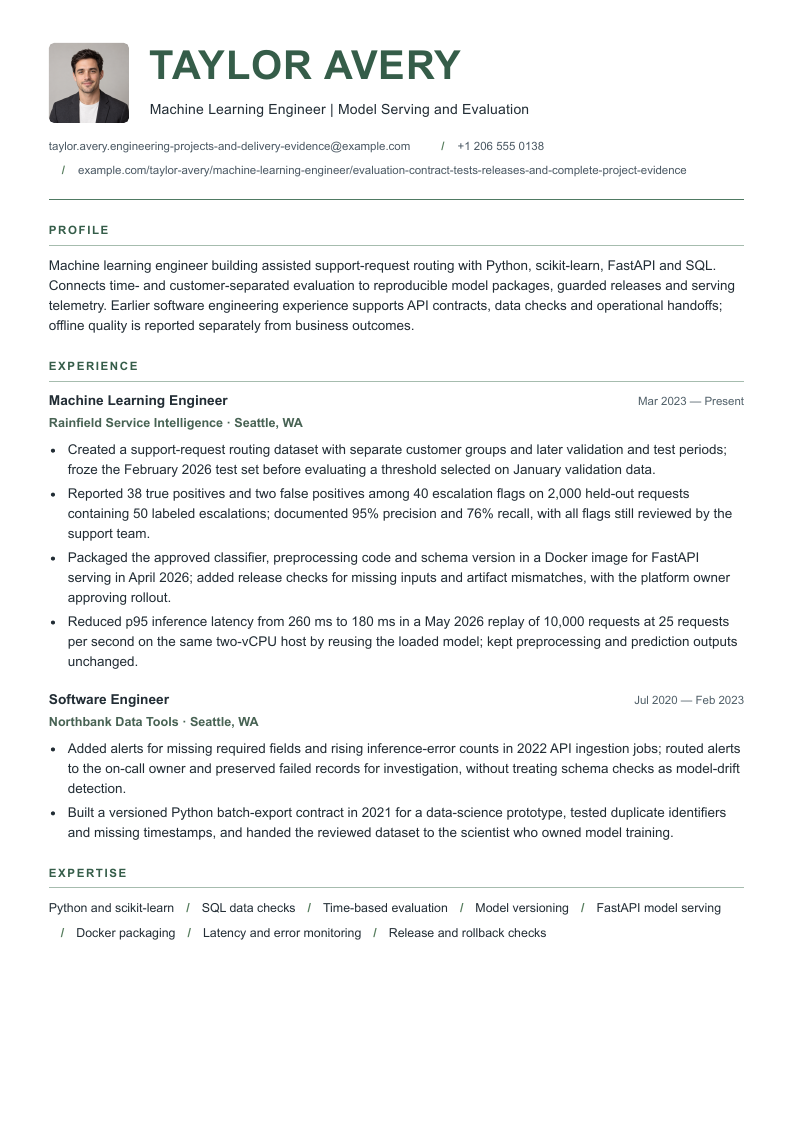
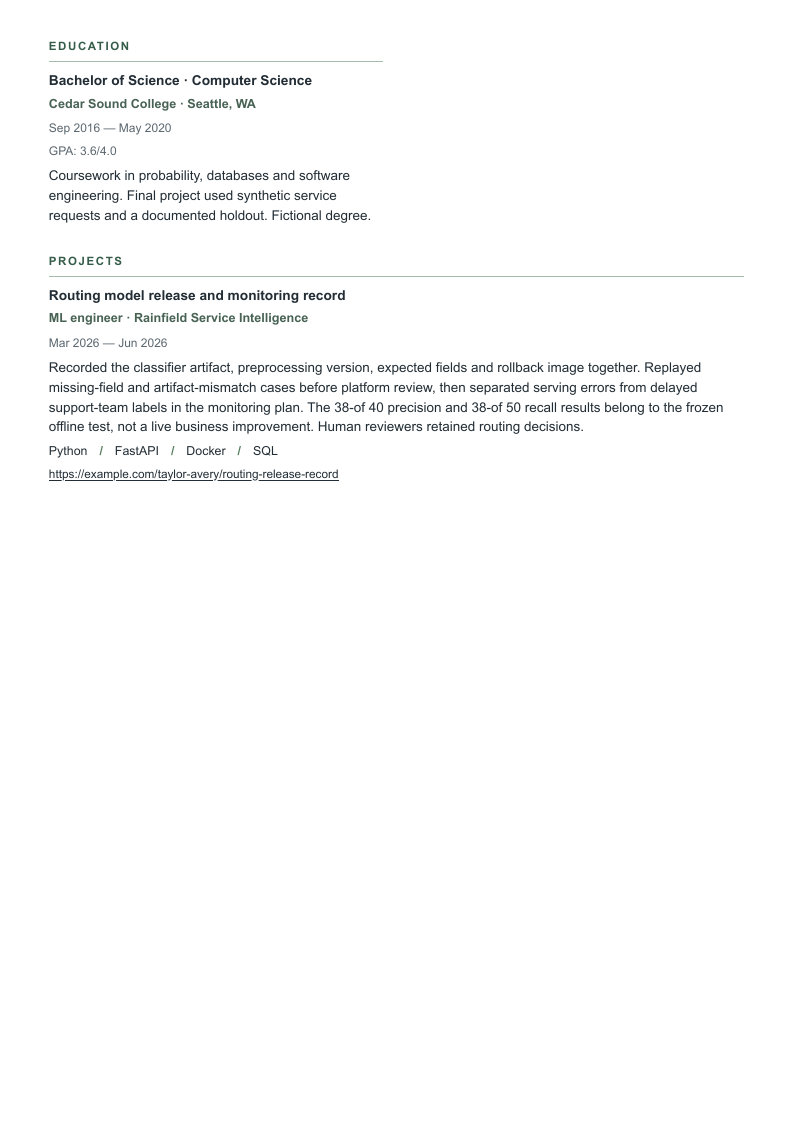
A large sans-serif name, green slash separators and fine green section rules lead into Profile, Experience, Expertise, Education, optional Certifications and Projects in one column.
Before sending: The date gutter and large heading use space. Keep metric denominators and the final project’s offline-versus-live distinction together when inspecting page transitions.
Small square markers, colored section headings and a date gutter organize Profile, Experience, Expertise, Education, optional Certifications and Projects.
Before sending: Long evaluation bullets wrap beside the date gutter. Check the38/40 and38/50 denominators through their final characters rather than selecting a design from the first page alone.
A light full-width header spans a narrow left rail of Projects, Expertise and Education beside the wider Profile and Experience column. Optional Certifications follow education in the rail.
Before sending: The project rail appears before the main column in document order and wraps narrowly. Inspect all project sentences, copied-text order and the qualifications rail in your export.
“Use” opens signup with that design and photo preference selected for the builder. A free account is required. Free-plan PDF downloads include a watermark; see current plans for paid options. Photo conventions vary; follow the employer’s instructions and local expectations.
All three designs show the same fictional record. The default is without a photo; the optional portrait is AI-generated. Compare the full pages before choosing. The template buttons retain the exact design, photo choice and Machine Learning Engineer role through signup. They do not insert the example career record or portrait into your account.
A complete machine learning engineer resume example
Taylor Avery is an invented machine learning engineer in Seattle, Washington, building assisted support-request routing. The earlier job is software engineering, with data-contract and alert work rather than model-training ownership. Every person, employer, degree, metric, date and project is fictional. The example.com links are placeholders; the optional portrait is AI-generated.
Taylor Avery
Machine Learning Engineer | Model Serving and Evaluation
Machine learning engineer building assisted support-request routing with Python, scikit-learn, FastAPI and SQL. Connects time- and customer-separated evaluation to reproducible model packages, guarded releases and serving telemetry. Earlier software engineering experience supports API contracts, data checks and operational handoffs; offline quality is reported separately from business outcomes.
Skills
Python and scikit-learn · SQL data checks · Time-based evaluation · Model versioning · FastAPI model serving · Docker packaging · Latency and error monitoring · Release and rollback checks
Experience
Machine Learning Engineer
Rainfield Service Intelligence · Seattle, WA
March 2023–Present
Created a support-request routing dataset with separate customer groups and later validation and test periods; froze the February 2026 test set before evaluating a threshold selected on January validation data.
Reported 38 true positives and two false positives among 40 escalation flags on 2,000 held-out requests containing 50 labeled escalations; documented 95% precision and 76% recall, with all flags still reviewed by the support team.
Packaged the approved classifier, preprocessing code and schema version in a Docker image for FastAPI serving in April 2026; added release checks for missing inputs and artifact mismatches, with the platform owner approving rollout.
Reduced p95 inference latency from 260 ms to 180 ms in a May 2026 replay of 10,000 requests at 25 requests per second on the same two-vCPU host by reusing the loaded model; kept preprocessing and prediction outputs unchanged.
Software Engineer
Northbank Data Tools · Seattle, WA
July 2020–February 2023
Added alerts for missing required fields and rising inference-error counts in 2022 API ingestion jobs; routed alerts to the on-call owner and preserved failed records for investigation, without treating schema checks as model-drift detection.
Built a versioned Python batch-export contract in 2021 for a data-science prototype, tested duplicate identifiers and missing timestamps, and handed the reviewed dataset to the scientist who owned model training.
Education
Bachelor of Science in Computer Science · Cedar Sound College · Seattle, WA
September 2016–May 2020
Coursework in probability, databases and software engineering. Final project used synthetic service requests and a documented holdout. Fictional degree.
GPA: 3.6/4.0
Projects
Routing model release and monitoring record
ML engineer · Rainfield Service Intelligence
March 2026–June 2026
Python · FastAPI · Docker · SQL
Recorded the classifier artifact, preprocessing version, expected fields and rollback image together. Replayed missing-field and artifact-mismatch cases before platform review, then separated serving errors from delayed support-team labels in the monitoring plan. The 38-of 40 precision and 38-of 50 recall results belong to the frozen offline test, not a live business improvement. Human reviewers retained routing decisions.
The record follows an evaluation boundary into a model package and serving comparison. It retains human support review and does not turn a test-set result into a live customer outcome. The degree, GPA and release-monitoring project are included in full, so you can compare complete information rather than choosing a layout from an abbreviated sample.
Make the route from data to operation visible
Choose an application you can explain from input to monitored output. Taylor’s model flags requests for support review. The record identifies customer-group and time separation, threshold selection before the locked test, preprocessing and schema versions, release checks and serving telemetry. Each link matters: a strong offline score alone does not show that a reproducible version reached a reliable service.
The employer sample covers several distinct ML settings. Reddit describes production lifecycle work across consumer and advertising experiences. AMP’s perception role connects research experiments and computer vision to deployment, with collaboration across data and infrastructure teams. PitchBook emphasizes NLP and insight-generation services, data quality and continuing model maintenance. These domains inform the questions in this guide without making computer vision, LLMs and recommender systems mandatory on every resume.
Keep the boundary between modeling, software and decisions clear. Taylor’s earlier ingestion alerts check missing fields and inference errors; they do not detect all forms of model drift. A platform owner approves rollout, and support reviewers retain routing decisions. If your own remit includes model development, infrastructure or approval authority, show that responsibility directly rather than assuming an ML title proves every part.
The useful distinction from a general data-science application is the operational path you can substantiate: packaging, serving contracts, monitoring and rollback may be central evidence. The titles overlap in practice and employers vary. Do not relabel research prototypes as production systems or add generative-AI terms to a tabular-classifier project because a different employer mentions them.
Six machine learning engineer rewrites with reasoning
Each after sentence appears verbatim in the base resume. The before statements are deliberately weak or overstated examples, not additional facts. Use the evidence prompts to check your own record, and replace invented sample figures with results you can substantiate and share.
1. Define the evaluation boundary
Before: Built an AI model that understood every customer.
After: Created a support-request routing dataset with separate customer groups and later validation and test periods; froze the February 2026 test set before evaluating a threshold selected on January validation data.
Why it works: Shows how evaluation was separated from model and threshold selection. The split needs both customer and time rules; a later timestamp alone does not prevent the same customer from appearing in training.
Evidence to check: Dataset lineage, customer-group exclusions, timestamp cutoffs, label policy and the frozen split manifest.
2. Make quality metrics reconstructable
Before: Achieved 95% accuracy and eliminated manual review.
After: Reported 38 true positives and two false positives among 40 escalation flags on 2,000 held-out requests containing 50 labeled escalations; documented 95% precision and 76% recall, with all flags still reviewed by the support team.
Why it works: The denominators make the metrics interpretable:38/40 precision and 38/50 recall. Twelve labeled escalations were missed. These are offline test results, not accuracy, a production outcome or evidence that human review can be removed.
Evidence to check: Locked test predictions, label review, confusion matrix, threshold decision and the support review policy.
3. Show reproducible deployment
Before: Deployed every model with zero risk.
After: Packaged the approved classifier, preprocessing code and schema version in a Docker image for FastAPI serving in April 2026; added release checks for missing inputs and artifact mismatches, with the platform owner approving rollout.
Why it works: A model artifact alone is not the complete serving dependency. The sentence names preprocessing and schema, tested failure paths and a separate rollout decision; no universal safety claim follows.
Evidence to check: Artifact manifest, image digest, input schema, release-check results and platform approval.
4. Bound a runtime improvement
Before: Cut all customer wait times by 50%.
After: Reduced p95 inference latency from 260 ms to 180 ms in a May 2026 replay of 10,000 requests at 25 requests per second on the same two-vCPU host by reusing the loaded model; kept preprocessing and prediction outputs unchanged.
Why it works: The 80 ms change is a serving benchmark under a defined workload, approximately 31% lower. It does not measure support-response time, queue length or production business impact.
Evidence to check: Replay inputs, host configuration, request rate, output-equivalence check and latency distribution.
5. Keep monitoring claims specific
Before: Detected and fixed all model drift automatically.
After: Added alerts for missing required fields and rising inference-error counts in 2022 API ingestion jobs; routed alerts to the on-call owner and preserved failed records for investigation, without treating schema checks as model-drift detection.
Why it works: Data contract and service-health checks are valuable software work. They do not establish prediction-quality monitoring, concept-drift detection or autonomous retraining.
Evidence to check: Alert definitions, sanitized failure examples, on-call runbook and investigation records.
6. Explain an earlier engineering contribution
Before: Invented the company’s entire machine learning platform.
After: Built a versioned Python batch-export contract in 2021 for a data-science prototype, tested duplicate identifiers and missing timestamps, and handed the reviewed dataset to the scientist who owned model training.
Why it works: Distinguishes dataset delivery and software checks from modeling responsibility. It supports the candidate’s progression without relabeling an earlier software role as end-to-end ML ownership.
Evidence to check: Versioned export schema, test fixtures, identifier checks and data-scientist acceptance notes.
Separate model quality, system behavior and business results
Begin the summary with the application, your real methods and the engineering responsibilities supported below it. Taylor names assisted support routing, Python, scikit-learn, FastAPI and SQL. The bullets explain data separation, model packaging and telemetry. That is more useful than a broad “AI expert” claim with no indication of model family, data context or operating responsibility.
A quality metric needs its unit, population and decision rule. The fictional locked test has 2,000 requests, including 50 labeled escalations. The classifier flags 40: 38 are true positives and two are false positives. Precision is 38/40=95%; recall is 38/50=76%. Twelve labeled escalations are missed. These figures do not mean 95% accuracy, and neither number describes response time or customer satisfaction.
The threshold is selected on January validation data before the February test is scored. Customer-group separation and later periods limit distinct leakage routes; document the exact rule for each. A later timestamp alone does not prevent the same customer, duplicated record or future-derived field from leaking information. If test results guide a new modeling choice, preserve a fresh final evaluation rather than reporting the reused set as untouched.
The serving benchmark answers a different question. Reusing the loaded model changes p95 latency from 260 ms to 180 ms for 10,000 requests at 25 requests per second on the same two-vCPU host, with preprocessing and outputs unchanged. That is an 80 ms reduction under the stated replay, approximately 31%. It does not establish support-response improvement, all-load performance or the classifier’s business value. Keep those claims separate even when the figures share one resume.
Give each ML skill a reproducible artifact
Choose skills whose contribution you can demonstrate. A model family, deployment tool or monitoring term is stronger when linked to a dataset boundary, versioned artifact or reviewed operating behavior. Explain the part you owned and avoid publishing private training examples, identifiers or production credentials.
Machine Learning Engineer skills and supporting evidence
Skill
Evidence to gather
Fictional example
Python and scikit-learn
Model/preprocessing code, versions and reproducible inputs.
Classifier and preprocessing version travel together.
Evaluation design
Split rules, label policy and threshold selection record.
January validation precedes the locked February test.
SQL data checks
Keys, exclusions, timestamps and the intended grain.
Customer-group separation is checked explicitly.
FastAPI serving
Input/output schema and failure behavior.
Missing fields and artifact mismatch block release checks.
Model versioning
Artifact digest, dependency versions and rollback target.
The release record pairs model and expected schema.
Monitoring
Defined signal, alert threshold and responsible responder.
Serving errors stay distinct from delayed quality labels.
Use qualifications and projects for their actual evidence
List the degree, field, institution and dates as earned. Taylor’s fictional bachelor’s degree includes probability and software-engineering coursework plus GPA 3.6/4.0. A graduate applicant can use a relevant capstone to explain evaluation and reproducibility, while an experienced applicant may give more space to operational work. Keep GPA optional and accurate; including it in a record means it should remain visible across previews.
An advanced degree is not a universal rule drawn from these sources. AMP allows a master’s or an equivalent combination of education and experience, Reddit lists an advanced degree among preferred qualifications, and PitchBook specifies a bachelor’s in relevant fields. Check the exact vacancy. This sample claims no certification; a course or cloud badge should use its actual issuer, title and status rather than stand in for delivered ML work.
The release-and-monitoring project adds the artifact manifest, expected fields, rollback image and distinction between immediate service errors and delayed labels. A portfolio should make a result reproducible without exposing private examples or a deployable credential. For a personal project, identify synthetic or properly licensed data, local serving limits and the absence of live business validation. A polished notebook alone does not demonstrate production deployment.
Show a credible move from software or study into ML engineering
Keep earlier titles and contributions intact. Taylor’s software role builds an export contract and alerts; a data scientist owns model training. The later ML job adds evaluation, packaging and serving. This progression demonstrates useful foundations without retrospectively assigning full model ownership to a data handoff or claiming an organization-wide platform from one service.
For a first ML engineering application, show one complete small system rather than a long catalogue of unfinished models. Explain the target and labels, a defensible split, a baseline, the selection process, held-out evaluation and a repeatable serving contract. Label the deployment as local or demonstration-only when appropriate. Include failure cases and limitations that you can explain in an interview.
An academic experiment and an employment achievement need different labels. A dataset challenge score can support evaluation skill, but it does not establish online effectiveness, responsible production use or on-call experience. Taylor’s expanded internship is deliberately bounded to supervised Python export checks during June–August 2019, overlapping the degree and preceding the July 2020 software engineering role.
Inspect long contacts with the optional photo
The Fieldnote long-contact export has the photo on and changes only Taylor’s resume email and portfolio URL. Every job, test denominator, degree, GPA and project remains unchanged. Inspect the entire email and final URL segment against the semantic record and check the PDF’s actual destination. A portrait is optional; follow the employer’s application instructions and inspect the header at normal size.
Machine learning engineer building assisted support-request routing with Python, scikit-learn, FastAPI and SQL. Connects time- and customer-separated evaluation to reproducible model packages, guarded releases and serving telemetry. Earlier software engineering experience supports API contracts, data checks and operational handoffs; offline quality is reported separately from business outcomes.
Skills
Python and scikit-learn · SQL data checks · Time-based evaluation · Model versioning · FastAPI model serving · Docker packaging · Latency and error monitoring · Release and rollback checks
Experience
Machine Learning Engineer
Rainfield Service Intelligence · Seattle, WA
March 2023–Present
Created a support-request routing dataset with separate customer groups and later validation and test periods; froze the February 2026 test set before evaluating a threshold selected on January validation data.
Reported 38 true positives and two false positives among 40 escalation flags on 2,000 held-out requests containing 50 labeled escalations; documented 95% precision and 76% recall, with all flags still reviewed by the support team.
Packaged the approved classifier, preprocessing code and schema version in a Docker image for FastAPI serving in April 2026; added release checks for missing inputs and artifact mismatches, with the platform owner approving rollout.
Reduced p95 inference latency from 260 ms to 180 ms in a May 2026 replay of 10,000 requests at 25 requests per second on the same two-vCPU host by reusing the loaded model; kept preprocessing and prediction outputs unchanged.
Software Engineer
Northbank Data Tools · Seattle, WA
July 2020–February 2023
Added alerts for missing required fields and rising inference-error counts in 2022 API ingestion jobs; routed alerts to the on-call owner and preserved failed records for investigation, without treating schema checks as model-drift detection.
Built a versioned Python batch-export contract in 2021 for a data-science prototype, tested duplicate identifiers and missing timestamps, and handed the reviewed dataset to the scientist who owned model training.
Education
Bachelor of Science in Computer Science · Cedar Sound College · Seattle, WA
September 2016–May 2020
Coursework in probability, databases and software engineering. Final project used synthetic service requests and a documented holdout. Fictional degree.
GPA: 3.6/4.0
Projects
Routing model release and monitoring record
ML engineer · Rainfield Service Intelligence
March 2026–June 2026
Python · FastAPI · Docker · SQL
Recorded the classifier artifact, preprocessing version, expected fields and rollback image together. Replayed missing-field and artifact-mismatch cases before platform review, then separated serving errors from delayed support-team labels in the monitoring plan. The 38-of 40 precision and 38-of 50 recall results belong to the frozen offline test, not a live business improvement. Human reviewers retained routing decisions.
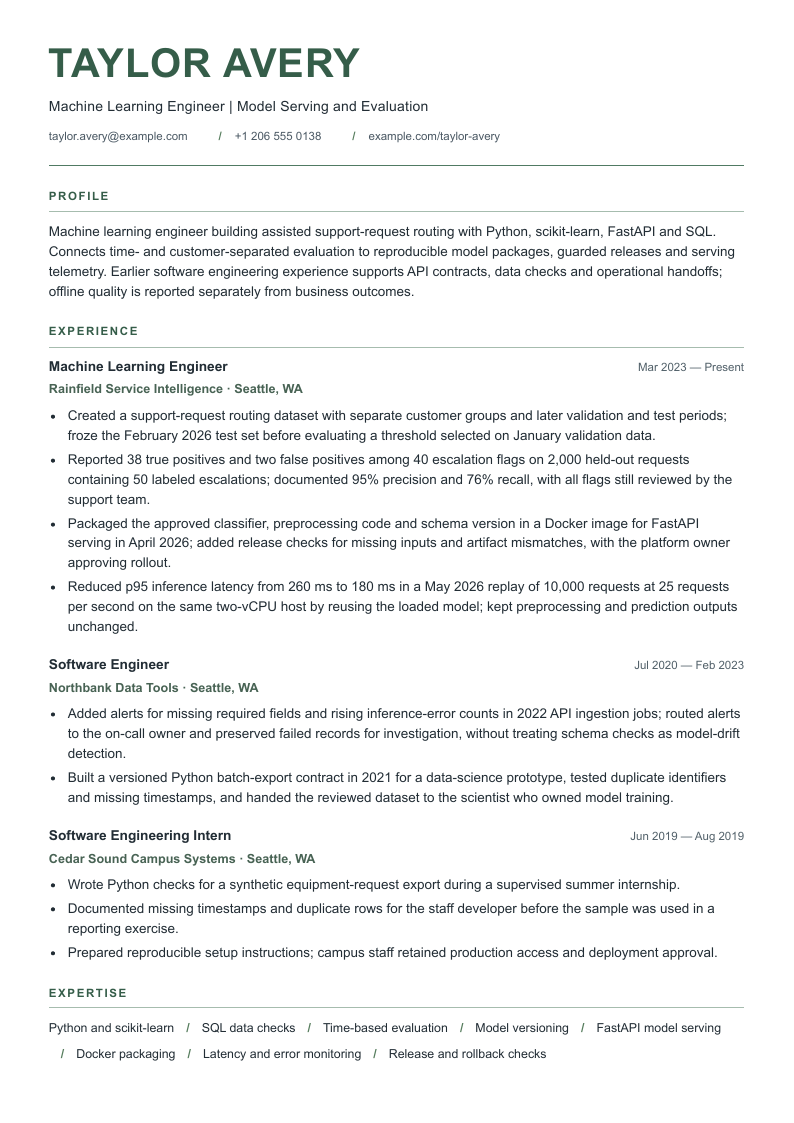
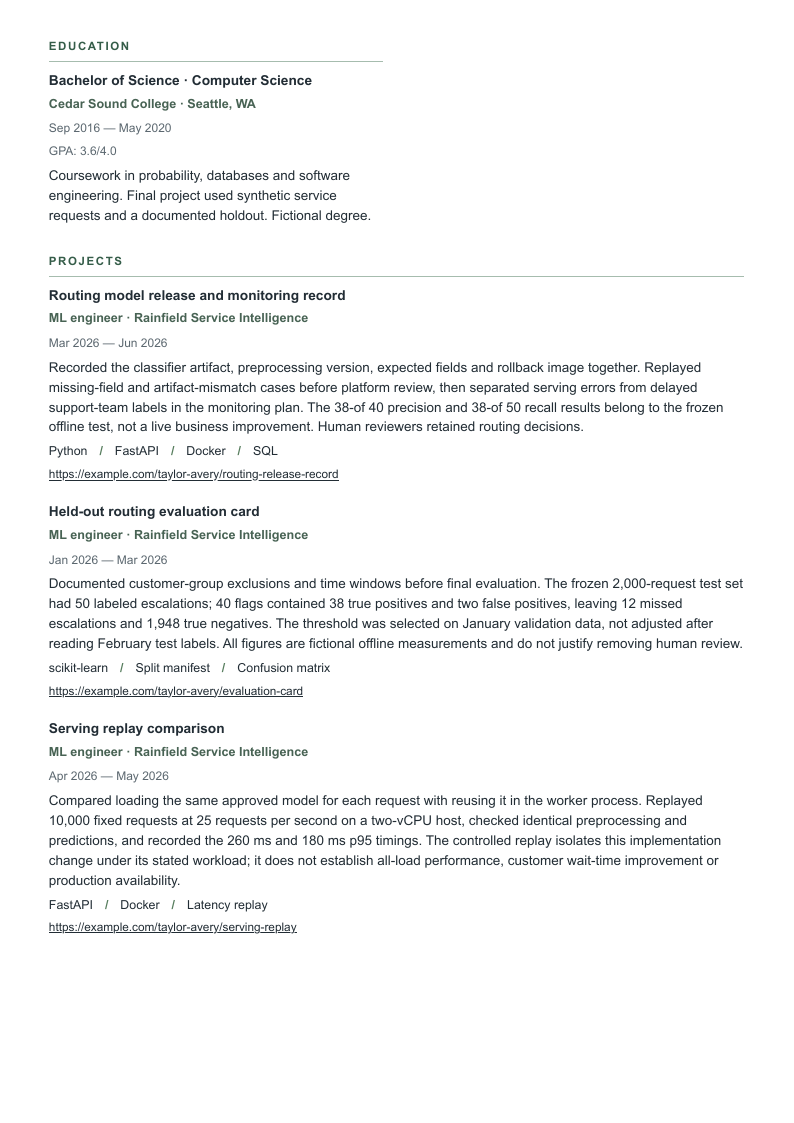
The expanded Fieldnote record has the photo off and retains every base field. It adds the supervised summer internship, a held-out evaluation card and a serving-replay comparison. The evaluation card reconciles 38 true positives, two false positives, 12 false negatives and 1,948 true negatives to the 2,000-request test set. These additions test longer content without introducing a new model outcome or a live business claim.
Machine learning engineer building assisted support-request routing with Python, scikit-learn, FastAPI and SQL. Connects time- and customer-separated evaluation to reproducible model packages, guarded releases and serving telemetry. Earlier software engineering experience supports API contracts, data checks and operational handoffs; offline quality is reported separately from business outcomes.
Skills
Python and scikit-learn · SQL data checks · Time-based evaluation · Model versioning · FastAPI model serving · Docker packaging · Latency and error monitoring · Release and rollback checks
Experience
Machine Learning Engineer
Rainfield Service Intelligence · Seattle, WA
March 2023–Present
Created a support-request routing dataset with separate customer groups and later validation and test periods; froze the February 2026 test set before evaluating a threshold selected on January validation data.
Reported 38 true positives and two false positives among 40 escalation flags on 2,000 held-out requests containing 50 labeled escalations; documented 95% precision and 76% recall, with all flags still reviewed by the support team.
Packaged the approved classifier, preprocessing code and schema version in a Docker image for FastAPI serving in April 2026; added release checks for missing inputs and artifact mismatches, with the platform owner approving rollout.
Reduced p95 inference latency from 260 ms to 180 ms in a May 2026 replay of 10,000 requests at 25 requests per second on the same two-vCPU host by reusing the loaded model; kept preprocessing and prediction outputs unchanged.
Software Engineer
Northbank Data Tools · Seattle, WA
July 2020–February 2023
Added alerts for missing required fields and rising inference-error counts in 2022 API ingestion jobs; routed alerts to the on-call owner and preserved failed records for investigation, without treating schema checks as model-drift detection.
Built a versioned Python batch-export contract in 2021 for a data-science prototype, tested duplicate identifiers and missing timestamps, and handed the reviewed dataset to the scientist who owned model training.
Software Engineering Intern
Cedar Sound Campus Systems · Seattle, WA
June 2019–August 2019
Wrote Python checks for a synthetic equipment-request export during a supervised summer internship.
Documented missing timestamps and duplicate rows for the staff developer before the sample was used in a reporting exercise.
Prepared reproducible setup instructions; campus staff retained production access and deployment approval.
Education
Bachelor of Science in Computer Science · Cedar Sound College · Seattle, WA
September 2016–May 2020
Coursework in probability, databases and software engineering. Final project used synthetic service requests and a documented holdout. Fictional degree.
GPA: 3.6/4.0
Projects
Routing model release and monitoring record
ML engineer · Rainfield Service Intelligence
March 2026–June 2026
Python · FastAPI · Docker · SQL
Recorded the classifier artifact, preprocessing version, expected fields and rollback image together. Replayed missing-field and artifact-mismatch cases before platform review, then separated serving errors from delayed support-team labels in the monitoring plan. The 38-of 40 precision and 38-of 50 recall results belong to the frozen offline test, not a live business improvement. Human reviewers retained routing decisions.
Documented customer-group exclusions and time windows before final evaluation. The frozen 2,000-request test set had 50 labeled escalations; 40 flags contained 38 true positives and two false positives, leaving 12 missed escalations and 1,948 true negatives. The threshold was selected on January validation data, not adjusted after reading February test labels. All figures are fictional offline measurements and do not justify removing human review.
Compared loading the same approved model for each request with reusing it in the worker process. Replayed 10,000 fixed requests at 25 requests per second on a two-vCPU host, checked identical preprocessing and predictions, and recorded the 260 ms and 180 ms p95 timings. The controlled replay isolates this implementation change under its stated workload; it does not establish all-load performance, customer wait-time improvement or production availability.
Read the final qualifiers in both added projects. The evaluation card must retain threshold-selection timing and human review; the replay must retain host and workload limits. In Clarity, also inspect the narrow left project rail and copied-text order. Page count is an export result, not a reason to drop the context that makes a claim accurate.
Check the file you will submit
Reconstruct each metric. Check the population, split, labels, threshold and denominator. Distinguish precision, recall and accuracy; verify missed cases as well as successful flags.
Trace the deployed version. Pair model, preprocessing, schema and dependencies. Keep rollout approval, human review and rollback responsibilities with their actual owners.
Read the complete document. Verify every contact ending, date, GPA, project role and final limitation. Follow Fieldnote’s continuations and Clarity’s narrow project/qualification rail.
Check links and application fields. Open approved work-sample destinations, copy the PDF text and inspect parsed fields. Follow the employer’s file instructions; no layout guarantees parsing, an interview or an offer.
A free account is required for the builder. Free-plan PDF downloads include a watermark; these images show paid-plan output. Use buttons carry your chosen design, photo preference and Machine Learning Engineer role into signup without copying the fictional example into your account.
Connect relevant data and model work to evaluation, reproducible packaging, serving behavior, monitoring and release responsibilities you actually held. Name the application and ownership boundary rather than listing every AI technique.
Should I report precision or accuracy?
Report metrics that fit the task, with a clear population and denominator. Here 38 of 40 flags are correct, so precision is 95%; 38 of 50 labeled escalations are found, so recall is 76%. Those figures do not establish 95% accuracy or remove the need for review.
Can I call a schema alert model-drift monitoring?
Describe what it detects. Missing-field and inference-error alerts check contracts or service behavior; they do not automatically establish a changed input distribution, changed relationship to the target or a loss of predictive quality.
Do I need to include LLMs or a graduate degree?
Only claim methods and qualifications you actually have, and match the specific vacancy. The cited roles span different model domains and degree expectations. A reproducible conventional classifier can be more relevant evidence than an unsupported generative-AI keyword list.
How do I describe a faster model endpoint?
Name workload, request rate, host, percentile, versions and any quality or output checks. A 260 ms to 180 ms replay p95 change is an 80 ms runtime result under that setup, not proof of shorter support waits or better prediction quality.
What does the template button preserve?
Signup retains the selected Fieldnote, Signal or Clarity design, photo preference and Machine Learning Engineer role. It does not insert Taylor’s fictional record or AI portrait. A free account is required; free-plan PDF downloads include a watermark.
Prepared by Resumize with AI-assisted research and drafting for English-language US applications. Reddit, AMP and PitchBook descriptions were retrieved directly with full responsibilities and inline application forms on October 28, 2026. They illustrate consumer/ads, perception and NLP/insight-generation settings; none defines every ML role. AMP describes travel or office options and PitchBook specifies five office days, so their conditions are not interchangeable. CareerOneStop supplies general resume advice, not a validation of these designs. Every resume fact, metric and rewrite is original fiction, with an AI-generated optional portrait and placeholder links. No application was submitted and no ranking, parsing or hiring outcome is promised.
Retrieved October 28, 2026: Remote - United States; full description and inline application form available, no posting date displayed. Covers model development, evaluation, serving, monitoring and cross-functional work across consumer and advertising teams. Its scale and team domains are not universal ML requirements.
Retrieved October 28, 2026: Remote, United States; full description and inline application form available, no posting date shown. Perception individual-contributor role links experiment design and computer-vision research to production. Body allows remote with regular Louisville, CO travel or hybrid/in-office work; it is not a no-travel remote example.
Retrieved October 28, 2026: Seattle, WA, United States; full description and inline application form available, no posting date displayed. NLP/insight-generation example emphasizes production services, data quality, evaluation and maintenance. Body specifies five office days weekly; financial-data context is distinct from this fictional support-routing sample.
Read October 28, 2026 through the web reader. US Department of Labor-sponsored guidance on relevant employment context, dates and specific contributions. Fictional examples here are original, not employer achievements.
Read October 28, 2026 through the web reader. Favors clear, consistent presentation and a simple single-column starting point. Does not endorse these designs or guarantee parsing; inspect your own PDF and application fields.