Allied health · Assessment and functional communication
Speech-Language Pathologist resume examples and templates
A speech-language pathologist resume should show how assessment informed a functional goal, how you delivered treatment and what you recorded about the response. Choose a clear setting and population. Communication rehabilitation, school-based services and specialist voice or swallowing work need different evidence.
Choose a speech-language pathologist resume design
These previews use the same layouts as the builder, with identical example content. Open a full preview to inspect the text and spacing.
Fictional candidate, employers, education and results. The optional portrait is AI-generated. Use your own evidence and photo; the example is not inserted into your resume.
Classic
A prominent serif identity leads into ruled section headings and a chronological record, with education before work experience.
Before sending: Education appears early. Keep professional experience easy to find and inspect long date lines and contacts.
“Use” opens signup with that design and photo preference selected for the builder. A free account is required. Free-plan PDF downloads include a watermark; see current plans for paid options. Photo conventions vary; follow the employer’s instructions and local expectations.
All three designs use the same complete fictional career. The default has no photo; the optional portrait is AI-generated. Follow the employer's instructions and local conventions. Signup retains the exact template, photo preference and Speech-Language Pathologist role. It does not insert the example career or portrait into your account. A free account is required; free-plan PDF downloads include a watermark. These previews show paid-plan output.
A complete fictional Speech-Language Pathologist resume
Jordan Ellis, employers, education, dates, projects and results are original fiction. The example.com links are placeholders and the 555 phone number is fictional. This base record contains two jobs, six work-history bullets, 2 education entries and explicitly fictional, nonvalid credential or training examples, plus one project. Use the structure with your own supported facts.
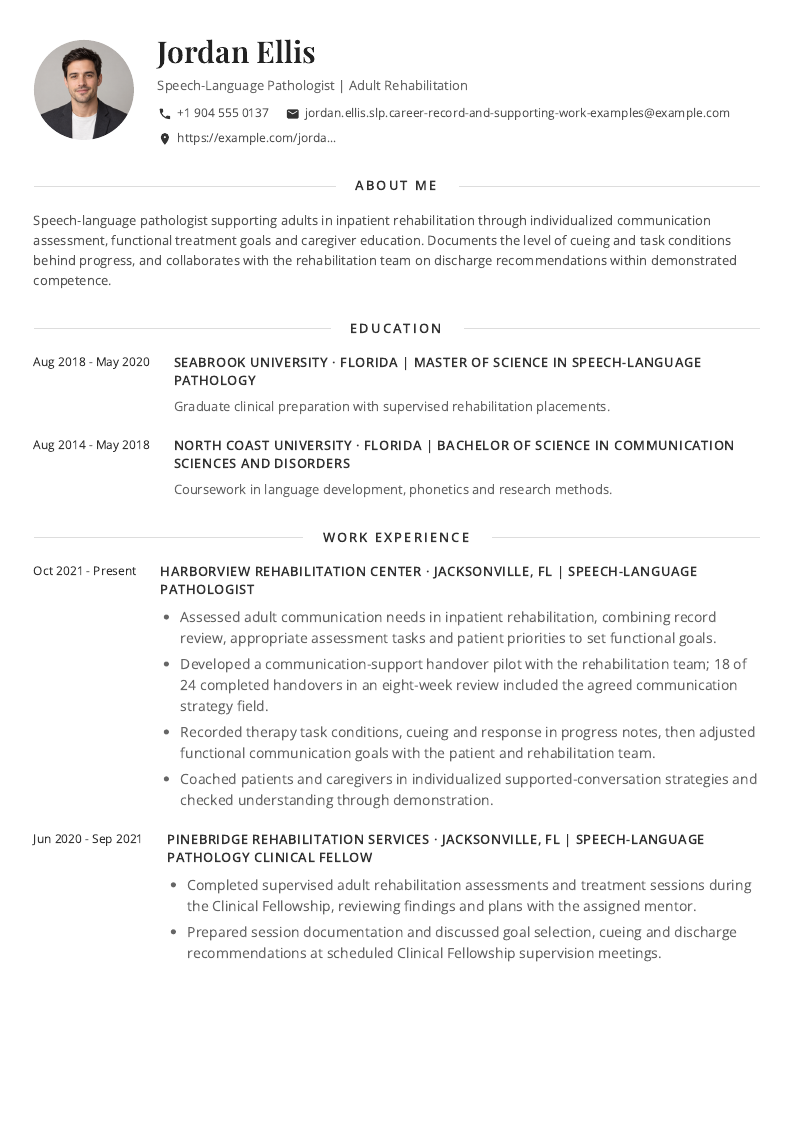
Speech-language pathologist supporting adults in inpatient rehabilitation through individualized communication assessment, functional treatment goals and caregiver education. Documents the level of cueing and task conditions behind progress, and collaborates with the rehabilitation team on discharge recommendations within demonstrated competence.
Harborview Rehabilitation Center · Jacksonville, FL
October 2021–Present
Assessed adult communication needs in inpatient rehabilitation, combining record review, appropriate assessment tasks and patient priorities to set functional goals.
Developed a communication-support handover pilot with the rehabilitation team; 18 of 24 completed handovers in an eight-week review included the agreed communication strategy field.
Recorded therapy task conditions, cueing and response in progress notes, then adjusted functional communication goals with the patient and rehabilitation team.
Coached patients and caregivers in individualized supported-conversation strategies and checked understanding through demonstration.
Completed supervised adult rehabilitation assessments and treatment sessions during the Clinical Fellowship, reviewing findings and plans with the assigned mentor.
Prepared session documentation and discussed goal selection, cueing and discharge recommendations at scheduled Clinical Fellowship supervision meetings.
Education
Master of Science in Speech-Language Pathology · Seabrook University · Florida
August 2018–May 2020
Graduate clinical preparation with supervised rehabilitation placements.
Bachelor of Science in Communication Sciences and Disorders · North Coast University · Florida
August 2014–May 2018
Coursework in language development, phonetics and research methods.
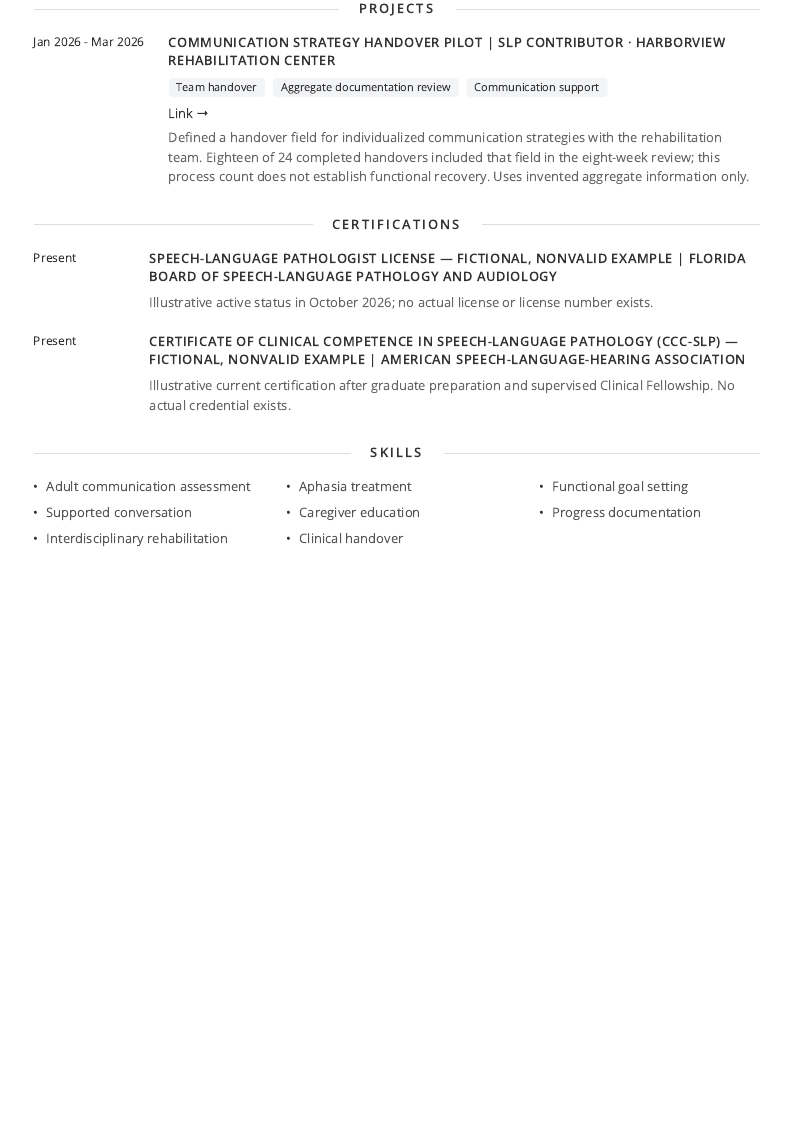
Training and certifications
Speech-Language Pathologist license — fictional, nonvalid example
Florida Board of Speech-Language Pathology and Audiology
Illustrative active status in October 2026; no actual license or license number exists.
Certificate of Clinical Competence in Speech-Language Pathology (CCC-SLP) — fictional, nonvalid example
American Speech-Language-Hearing Association
Illustrative current certification after graduate preparation and supervised Clinical Fellowship. No actual credential exists.
Projects
Communication strategy handover pilot
SLP contributor · Harborview Rehabilitation Center
January 2026–March 2026
Team handover · Aggregate documentation review · Communication support
Defined a handover field for individualized communication strategies with the rehabilitation team. Eighteen of 24 completed handovers included that field in the eight-week review; this process count does not establish functional recovery. Uses invented aggregate information only.
Jordan's fictional career is in adult inpatient rehabilitation in Florida. The summary and work history connect communication assessment, aphasia support, caregiver education and team handover. The example does not claim school IEP ownership, pediatric feeding expertise or every specialist procedure within the profession.
ASHA's scope covers communication and swallowing across the lifespan, but it also distinguishes the profession's broad scope from an individual clinician's competence. A reader needs to know which patients, assessment methods and treatments you have actually worked with. Use a condition or instrument only when your training and experience support it.
The employer sample makes this concrete. Encompass describes individualized rehabilitation plans and progress documentation; Sibley seeks acute-care experience including dysphagia, aphasia and videofluoroscopy; Duke's PRN opening specializes in voice and upper-airway disorders. Their common title does not make those records interchangeable. The fictional adult communication clinician is not presented as qualified for every sampled opening.
Six annotated Speech-Language Pathologist bullet rewrites
Each after statement appears exactly in the base work history. The notes explain the evidence that makes it useful and the limits of the claim. Replace invented details with your own work.
1. Name the clinical setting
Before: Experienced in every kind of speech therapy.
After: Assessed adult communication needs in inpatient rehabilitation, combining record review, appropriate assessment tasks and patient priorities to set functional goals.
Why it works: A defined setting and assessment-to-goal link give the reader more than a list of disorders.
Evidence to check: Population, setting, relevant assessment methods, patient priorities and resulting goals.
2. Separate documentation from recovery
Before: Cured aphasia by improving our handovers.
After: Developed a communication-support handover pilot with the rehabilitation team; 18 of 24 completed handovers in an eight-week review included the agreed communication strategy field.
Why it works: The denominator measures handover content, not recovery from aphasia or a treatment effect.
Evidence to check: Completed-handover definition, review dates, required field and team contribution.
3. Keep progress conditions visible
Before: Improved every patient's speech by 80%.
After: Recorded therapy task conditions, cueing and response in progress notes, then adjusted functional communication goals with the patient and rehabilitation team.
Why it works: Progress depends on what was measured and under which conditions; no uniform recovery percentage is invented.
Evidence to check: Goal definition, permitted baseline and follow-up measures, cueing levels and review interval.
4. Make caregiver education observable
Before: Gave families perfect training.
After: Coached patients and caregivers in individualized supported-conversation strategies and checked understanding through demonstration.
Why it works: Names an education method and a check rather than promising every family mastered it.
Evidence to check: Education topic, demonstration method, documented follow-up and your role.
5. Label the Clinical Fellowship
Before: Practiced independently as soon as I graduated.
After: Completed supervised adult rehabilitation assessments and treatment sessions during the Clinical Fellowship, reviewing findings and plans with the assigned mentor.
Why it works: A fellowship can provide useful clinical evidence while preserving supervision and qualification status.
Evidence to check: Actual fellowship title, dates, mentor arrangement and assigned work.
6. Show clinical reasoning in supervision
Before: Handled all discharge decisions alone.
After: Prepared session documentation and discussed goal selection, cueing and discharge recommendations at scheduled Clinical Fellowship supervision meetings.
Why it works: Explains the fellow's work without assigning unilateral discharge authority.
Evidence to check: Supervision schedule, documentation review, recommendation scope and team decisions.
Connect assessment, goals and treatment decisions
An effective summary names the setting, population and clinical strengths that the following record can substantiate. Jordan describes functional goals, cueing and caregiver education. A more specialist applicant could name a relevant clinical service, but should avoid a summary that lists every disorder or implies equal competence in all assessment methods.
For an assessment bullet, explain the information you brought together and the decision it supported. Record review, suitable assessment tasks and the person's communication priorities can lead to a functional goal. A tool name can be useful when relevant, but a long instrument list without interpretation tells the reader little about clinical reasoning.
Treatment evidence should show what you did and how you adjusted it. If you changed a goal after a review, describe the observed response and decision context. Work within a team can still be specific: distinguish your assessment, education or recommendation from a shared discharge decision.
Connect Speech-Language Pathologist skills to evidence
Choose relevant skills you can explain through actual work. Use truthful vacancy language in context, then point the reader to the example that supports it.
Skill
Evidence to gather
Fictional example
Assessment
Information gathered, methods and resulting goals.
Adult communication priorities.
Functional goal setting
Task, conditions and reason for selection.
Communication goals reviewed with the patient.
Treatment documentation
Cueing, response and review interval.
Task conditions retained in progress notes.
Caregiver education
Strategy taught and understanding check.
Supported-conversation demonstration.
Team handover
Defined required content and review period.
18 of 24 completed handovers.
Clinical supervision
Role, mentor and reviewed work.
Labeled Clinical Fellowship record.
Keep cueing and task conditions with progress
A statement that speech improved by a percentage needs a defined measure. Identify the task, baseline and follow-up, scoring rule, support provided and time period. Accuracy with substantial cueing and independent performance are different observations. Avoid combining unlike goals into one unexplained recovery score.
Jordan's project deliberately uses a process count: 18 of 24 completed handovers contained the agreed communication strategy field during an eight-week review. That count can support a documentation improvement discussion. It cannot establish that the intervention cured aphasia, prevented aspiration or caused functional recovery.
Caregiver education can be described through its method and check. Supported-conversation coaching followed by a demonstration is observable work; perfect understanding is an unsupported conclusion unless you have an appropriate defined assessment. A public example should use synthetic cases or permitted aggregate evidence, with no patient details or copied clinical notes.
Distinguish licensure, certification and fellowship
The sample lists graduate preparation, Florida licensure and ASHA's CCC-SLP separately. ASHA's certification standards address a qualifying postbaccalaureate degree, graduate preparation, supervised clinical experience, Clinical Fellowship and ongoing maintenance. State practice requirements are a separate matter. Use the actual issuer, jurisdiction and status you hold.
Employer wording also needs interpretation. Encompass's description includes an education preference that differs from the specific master's requirements in Duke and Sibley's postings. Do not turn one posting into a universal route to qualification or assume that a listed degree alone satisfies current certification or state licensing requirements.
Jordan's 2020–2021 role remains a supervised Clinical Fellowship. It is useful evidence of assessment, treatment and documentation, but it is not described as fully independent practice. All credentials in the fictional record are nonvalid examples with no actual license number. For a real application, check current details with the issuing bodies.
Adapt for a Clinical Fellow or a change of setting
For a Clinical Fellowship application, place completed graduate preparation, relevant supervised placements and current application or license status where they can be found. State what you assessed or delivered under supervision, how you discussed goals with a mentor and what feedback changed your work. Do not use CCC-SLP after your name before it is awarded.
A clinician moving from schools to adult rehabilitation can explain transferable assessment reasoning, functional goal writing and collaboration while retaining the original setting and title. Identify the medical experience and training you actually have. Do not add swallowing instrumentation merely because an acute-care vacancy requests it.
The expanded example adds a supervised graduate placement, a teaching-material review and a fellowship case presentation. Each remains labeled. If your own record is shorter, a few specific supervised examples will be more useful than inflating your caseload or listing procedures you only observed.
Check long contacts at full size
The long-contact Classic version has the photo on and changes only the resume email and portfolio URL. The identity, phone and career stay identical. Follow each contact through its final character, then check the full link destination. The complete text below preserves the full address, including any part shortened by the visual label.
Speech-language pathologist supporting adults in inpatient rehabilitation through individualized communication assessment, functional treatment goals and caregiver education. Documents the level of cueing and task conditions behind progress, and collaborates with the rehabilitation team on discharge recommendations within demonstrated competence.
Harborview Rehabilitation Center · Jacksonville, FL
October 2021–Present
Assessed adult communication needs in inpatient rehabilitation, combining record review, appropriate assessment tasks and patient priorities to set functional goals.
Developed a communication-support handover pilot with the rehabilitation team; 18 of 24 completed handovers in an eight-week review included the agreed communication strategy field.
Recorded therapy task conditions, cueing and response in progress notes, then adjusted functional communication goals with the patient and rehabilitation team.
Coached patients and caregivers in individualized supported-conversation strategies and checked understanding through demonstration.
Completed supervised adult rehabilitation assessments and treatment sessions during the Clinical Fellowship, reviewing findings and plans with the assigned mentor.
Prepared session documentation and discussed goal selection, cueing and discharge recommendations at scheduled Clinical Fellowship supervision meetings.
Education
Master of Science in Speech-Language Pathology · Seabrook University · Florida
August 2018–May 2020
Graduate clinical preparation with supervised rehabilitation placements.
Bachelor of Science in Communication Sciences and Disorders · North Coast University · Florida
August 2014–May 2018
Coursework in language development, phonetics and research methods.
Training and certifications
Speech-Language Pathologist license — fictional, nonvalid example
Florida Board of Speech-Language Pathology and Audiology
Illustrative active status in October 2026; no actual license or license number exists.
Certificate of Clinical Competence in Speech-Language Pathology (CCC-SLP) — fictional, nonvalid example
American Speech-Language-Hearing Association
Illustrative current certification after graduate preparation and supervised Clinical Fellowship. No actual credential exists.
Projects
Communication strategy handover pilot
SLP contributor · Harborview Rehabilitation Center
January 2026–March 2026
Team handover · Aggregate documentation review · Communication support
Defined a handover field for individualized communication strategies with the rehabilitation team. Eighteen of 24 completed handovers included that field in the eight-week review; this process count does not establish functional recovery. Uses invented aggregate information only.
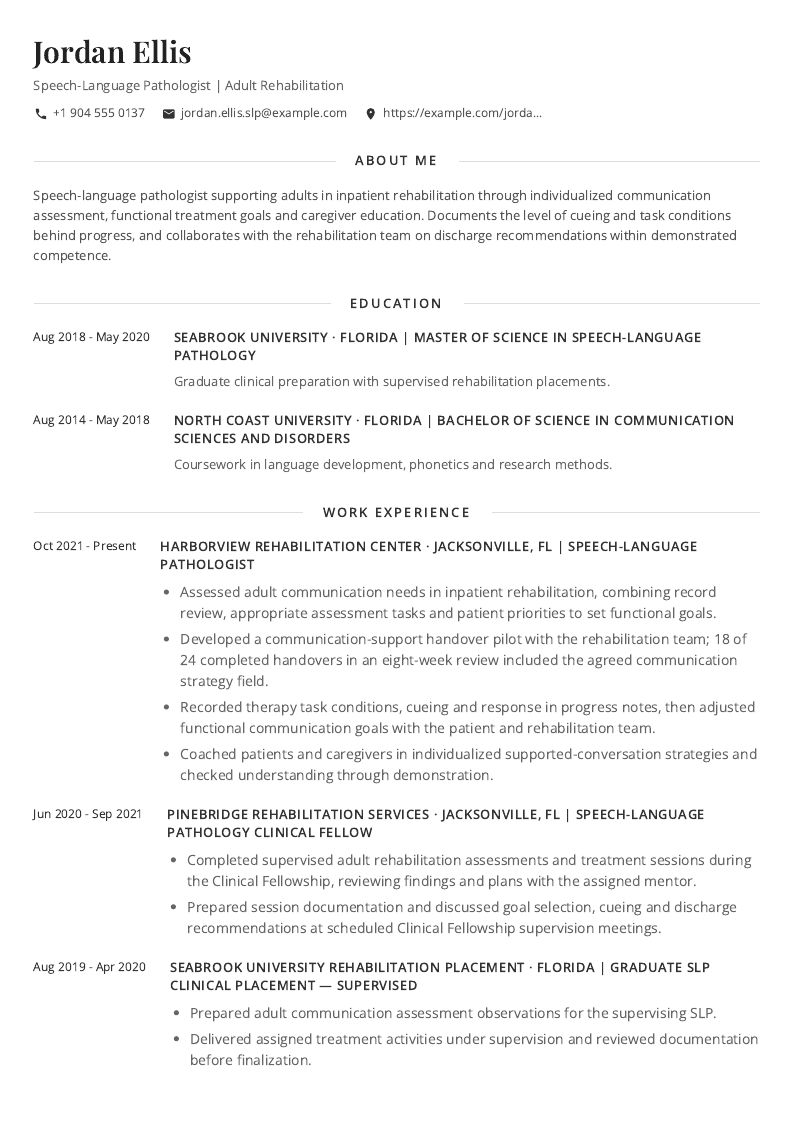
The expanded Classic version has the photo off. It keeps every base career field and adds an earlier graduate slp clinical placement — supervised role plus two projects. Compare the complete text with every preview page, including the last job date, qualification detail and final project ending.
Speech-language pathologist supporting adults in inpatient rehabilitation through individualized communication assessment, functional treatment goals and caregiver education. Documents the level of cueing and task conditions behind progress, and collaborates with the rehabilitation team on discharge recommendations within demonstrated competence.
Harborview Rehabilitation Center · Jacksonville, FL
October 2021–Present
Assessed adult communication needs in inpatient rehabilitation, combining record review, appropriate assessment tasks and patient priorities to set functional goals.
Developed a communication-support handover pilot with the rehabilitation team; 18 of 24 completed handovers in an eight-week review included the agreed communication strategy field.
Recorded therapy task conditions, cueing and response in progress notes, then adjusted functional communication goals with the patient and rehabilitation team.
Coached patients and caregivers in individualized supported-conversation strategies and checked understanding through demonstration.
Completed supervised adult rehabilitation assessments and treatment sessions during the Clinical Fellowship, reviewing findings and plans with the assigned mentor.
Prepared session documentation and discussed goal selection, cueing and discharge recommendations at scheduled Clinical Fellowship supervision meetings.
Graduate SLP Clinical Placement — supervised
Seabrook University rehabilitation placement · Florida
August 2019–April 2020
Prepared adult communication assessment observations for the supervising SLP.
Delivered assigned treatment activities under supervision and reviewed documentation before finalization.
Education
Master of Science in Speech-Language Pathology · Seabrook University · Florida
August 2018–May 2020
Graduate clinical preparation with supervised rehabilitation placements.
Bachelor of Science in Communication Sciences and Disorders · North Coast University · Florida
August 2014–May 2018
Coursework in language development, phonetics and research methods.
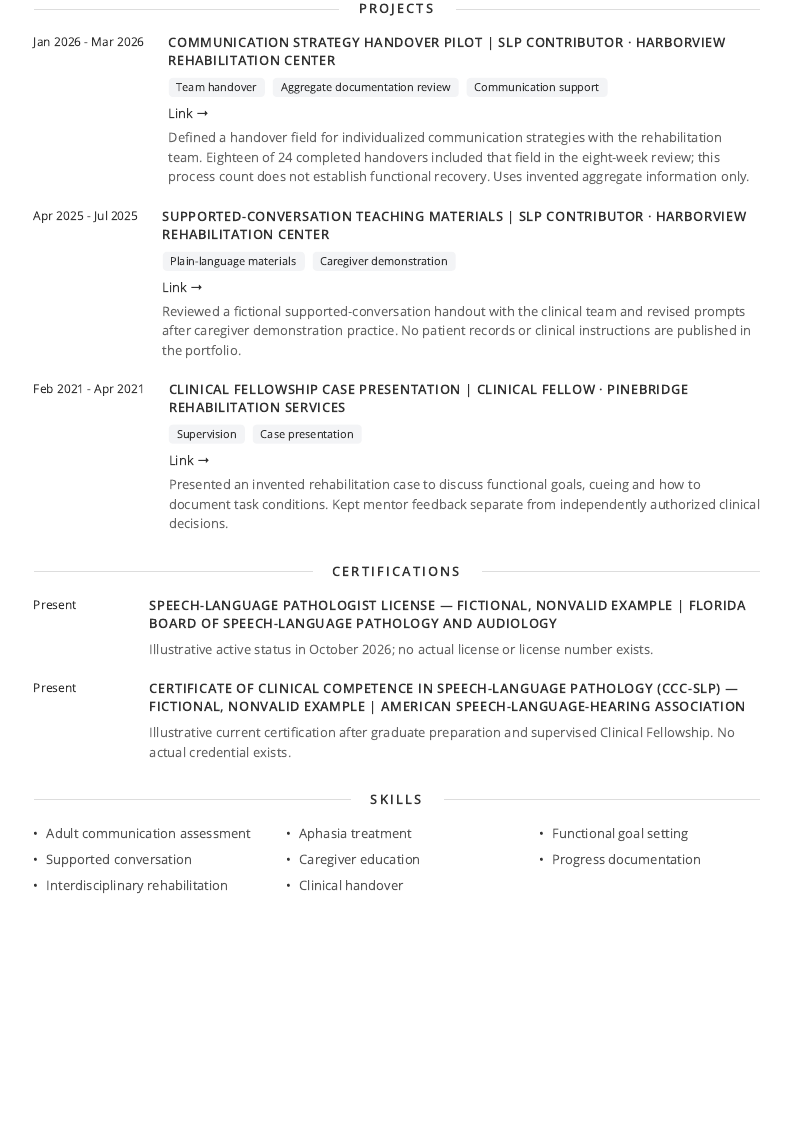
Training and certifications
Speech-Language Pathologist license — fictional, nonvalid example
Florida Board of Speech-Language Pathology and Audiology
Illustrative active status in October 2026; no actual license or license number exists.
Certificate of Clinical Competence in Speech-Language Pathology (CCC-SLP) — fictional, nonvalid example
American Speech-Language-Hearing Association
Illustrative current certification after graduate preparation and supervised Clinical Fellowship. No actual credential exists.
Projects
Communication strategy handover pilot
SLP contributor · Harborview Rehabilitation Center
January 2026–March 2026
Team handover · Aggregate documentation review · Communication support
Defined a handover field for individualized communication strategies with the rehabilitation team. Eighteen of 24 completed handovers included that field in the eight-week review; this process count does not establish functional recovery. Uses invented aggregate information only.
Reviewed a fictional supported-conversation handout with the clinical team and revised prompts after caregiver demonstration practice. No patient records or clinical instructions are published in the portfolio.
Presented an invented rehabilitation case to discuss functional goals, cueing and how to document task conditions. Kept mentor feedback separate from independently authorized clinical decisions.
Condense repeated duties before removing useful context. Let relevant evidence use another page when needed, then inspect continuations for isolated headings, detached dates and unfinished sentences. A page count alone cannot establish readability.
Inspect the download before applying
Read every exported page with your chosen photo preference. Check complete contacts, dates, qualifications and project endings. Copy text from the PDF and inspect parsed application fields when available; follow the employer's requested file type. Use your own evidence and keep confidential information out of the document.
A free account is required for the builder. Free-plan PDF downloads include a watermark; the previews show paid-plan output. Template buttons retain the exact template, photo preference and Speech-Language Pathologist role. Add your own details and photo after signup.
The resume analyzer gives advisory feedback. The bullet point generator can help draft from your notes; check every suggestion. No design or wording guarantees parsing, an interview or a hiring outcome.
Should a general SLP resume include swallowing skills?
Include the swallowing work you are trained and competent to perform when relevant to the vacancy. The adult communication example does not add swallowing procedures simply because they appear in the profession's scope.
How should I describe a caseload?
Give the setting, population and a meaningful time period. Distinguish active caseload, weekly visits and completed evaluations; do not treat them as interchangeable counts.
Can I use patient examples?
Use a high-level permitted description or an original synthetic case. Avoid identifiable clinical details, patient records and small combinations of facts that could identify someone.
How do I adapt this for a school role?
Replace the medical-setting evidence with your actual educational assessment, goal, collaboration and service-delivery work. Keep the school context explicit and review the separate school-based SLP guide for overlap.
How long should this resume be?
Use enough space for relevant evidence at a readable size. A shorter record may fit one page; a fuller career may need more. Inspect all exported pages, including contacts, qualifications and final entries.
What happens when I choose a design?
Signup retains the exact template, photo preference and role. A free account is required. The fictional career and portrait are not inserted into your account. Free-plan PDF downloads include a watermark; the example previews show paid-plan output.
Prepared by Resumize with AI-assisted research and drafting for English-language applications. Three directly readable primary employer descriptions were reviewed on October 29, 2026, alongside the occupational or professional authorities below. Undated postings are identified as undated; a readable Apply control does not establish that a vacancy remains unfilled. This is a small sample with different specialties, settings and requirements, not a market survey or proof that the fictional applicant qualifies for every opening. No application was submitted or hiring outcome tested.
Jacksonville, Florida Inpatient rehabilitation opening describes individualized assessment/treatment, treatment modification and progress documentation. Lists state credentials, CCC and CPR; education wording includes a master's preference or bachelor's with experience. Do not universalize this employer's degree wording: ASHA certification and state qualification requirements need separate authority. Direct page has job ID 2530299 and Apply Now; no posting date shown. Read October 29, 2026.
Durham/Raleigh, North Carolina Posted 2026-10-01 Specialist voice/upper-airway remit includes assessment, documentation, treatment collaboration and swallowing work. Master's preparation and NC/ASHA credentials listed; medical setting experience preferred. Instrumentation such as videolaryngostroboscopy and specialty voice expertise belongs to this role; not a universal skill or automatic part of the fictional rehab candidate's record. Read October 29, 2026.
Washington, DC Inpatient/outpatient clinical work and hospital staff guidance. Requires master's, DC license, CCC, CPR and at least one year acute-care experience including dysphagia, aphasia and videofluoroscopy. Job requisition 666992, no posting date shown; currently readable description and Apply control are not proof vacancy remains unfilled. DC license is not Florida permission. Read October 29, 2026.
Communication and swallowing across the lifespan; assessment, treatment and collaboration are domains. Each practitioner's competence is narrower than the full profession's scope; state licensure rules still apply. Do not add every condition or instrument to Skills. Document is dated 2016, not a new 2026 clinical guideline. Read October 29, 2026.
Degree, accredited graduate preparation, supervised clinical experience, Clinical Fellowship and maintenance standards are distinct from state licensure. Standard VIII was clarified effective January 1, 2026. Read October 29, 2026.
Official Florida licensing pathways and requirements, separate from ASHA certification. Current state-board information should determine eligibility rather than an employer education preference. Read October 29, 2026; no claim that a fictional license is valid.