An SEO specialist resume should let a reader follow your work from diagnosis to a useful change. Define the pages or queries you examined, explain the recommendation, name the implementation owner and show what you checked afterward. This complete fictional example separates technical validation, search performance and business outcomes instead of treating them as interchangeable wins.
These previews use the same layouts as the builder, with identical example content. Open a full preview to inspect the text and spacing.
Fictional candidate, employers, education and results. The optional portrait is AI-generated. Use your own evidence and photo; the example is not inserted into your resume.
Current
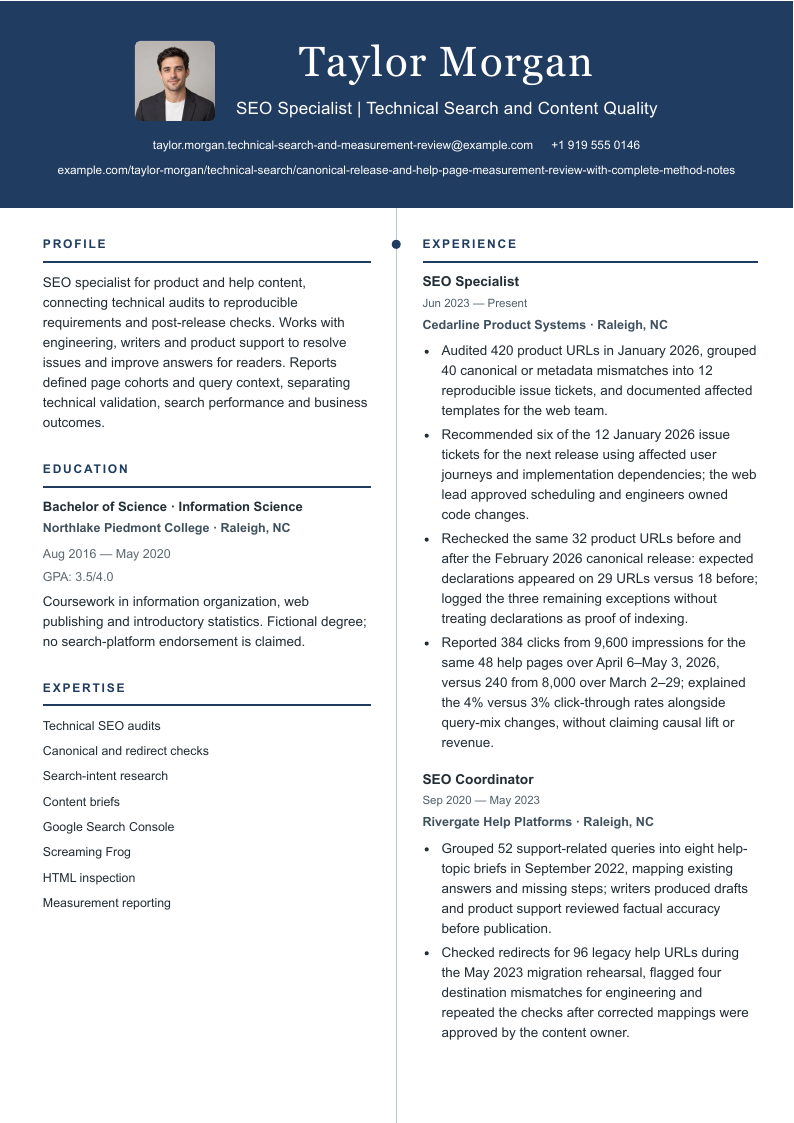
A centered serif identity sits in a blue header. Two equal columns put Profile, Education and Expertise on the left, with Experience and Projects on the right; dots mark main-column section headings.
Before sending: The education and skills column precedes experience in document order. Inspect both columns, especially the measurement caveat and long project link, across every page.
A strong blue header rule and square section markers lead through Profile, Experience, Expertise, Education and Projects in one column. Skills use small shaded labels.
Before sending: Dates share the job-heading row. Long technical titles and the precise reporting windows need inspection at normal size; no design guarantees application-system parsing.
The original Professional design uses a centered contact header followed by Professional Summary, Skills, Experience, Education and Projects in one column. Its optional circular portrait sits above the centered identity.
Before sending: Skills appear before work history. Social link labels can be shortened, so check the actual destination and continue through the final project page.
“Use” opens signup with that design and photo preference selected for the builder. A free account is required. Free-plan PDF downloads include a watermark; see current plans for paid options. Photo conventions vary; follow the employer’s instructions and local expectations.
Current, Signal and original Professional show Taylor’s identical career record. The default has no photo; the optional portrait is AI-generated. The Use buttons keep the chosen design, photo preference and SEO Specialist role through signup. Taylor’s fictional content and portrait are teaching material and are not inserted into your account. A free account is required, and free-plan PDFs include a watermark.
Current puts Profile, Education and Expertise in the left column and Experience and Projects in the right, beneath a centered blue identity header. Signal keeps the body in one column with square markers and a blue header rule. Professional places Skills before Experience and Projects after Education. In Current, the left column comes first in document order; inspect copied text as well as the visual path.
A complete SEO specialist resume example
Taylor Morgan is an invented Raleigh-based specialist moving from help-content coordination into technical product-page work. Every candidate, employer, school, date, result and portfolio item is fictional. The example.com links are placeholders. This guide uses AI-assisted research and drafting; the numbers below are original teaching examples, not measurements from the employer sources or Resumize’s traffic.
Taylor Morgan
SEO Specialist | Technical Search and Content Quality
SEO specialist for product and help content, connecting technical audits to reproducible requirements and post-release checks. Works with engineering, writers and product support to resolve issues and improve answers for readers. Reports defined page cohorts and query context, separating technical validation, search performance and business outcomes.
Skills
Technical SEO audits · Canonical and redirect checks · Search-intent research · Content briefs · Google Search Console · Screaming Frog · HTML inspection · Measurement reporting
Experience
SEO Specialist
Cedarline Product Systems · Raleigh, NC
June 2023–Present
Audited 420 product URLs in January 2026, grouped 40 canonical or metadata mismatches into 12 reproducible issue tickets, and documented affected templates for the web team.
Recommended six of the 12 January 2026 issue tickets for the next release using affected user journeys and implementation dependencies; the web lead approved scheduling and engineers owned code changes.
Rechecked the same 32 product URLs before and after the February 2026 canonical release: expected declarations appeared on 29 URLs versus 18 before; logged the three remaining exceptions without treating declarations as proof of indexing.
Reported 384 clicks from 9,600 impressions for the same 48 help pages over April 6–May 3, 2026, versus 240 from 8,000 over March 2–29; explained the 4% versus 3% click-through rates alongside query-mix changes, without claiming causal lift or revenue.
SEO Coordinator
Rivergate Help Platforms · Raleigh, NC
September 2020–May 2023
Grouped 52 support-related queries into eight help-topic briefs in September 2022, mapping existing answers and missing steps; writers produced drafts and product support reviewed factual accuracy before publication.
Checked redirects for 96 legacy help URLs during the May 2023 migration rehearsal, flagged four destination mismatches for engineering and repeated the checks after corrected mappings were approved by the content owner.
Education
Bachelor of Science in Information Science · Northlake Piedmont College · Raleigh, NC
August 2016–May 2020
Coursework in information organization, web publishing and introductory statistics. Fictional degree; no search-platform endorsement is claimed.
GPA: 3.5/4.0
Projects
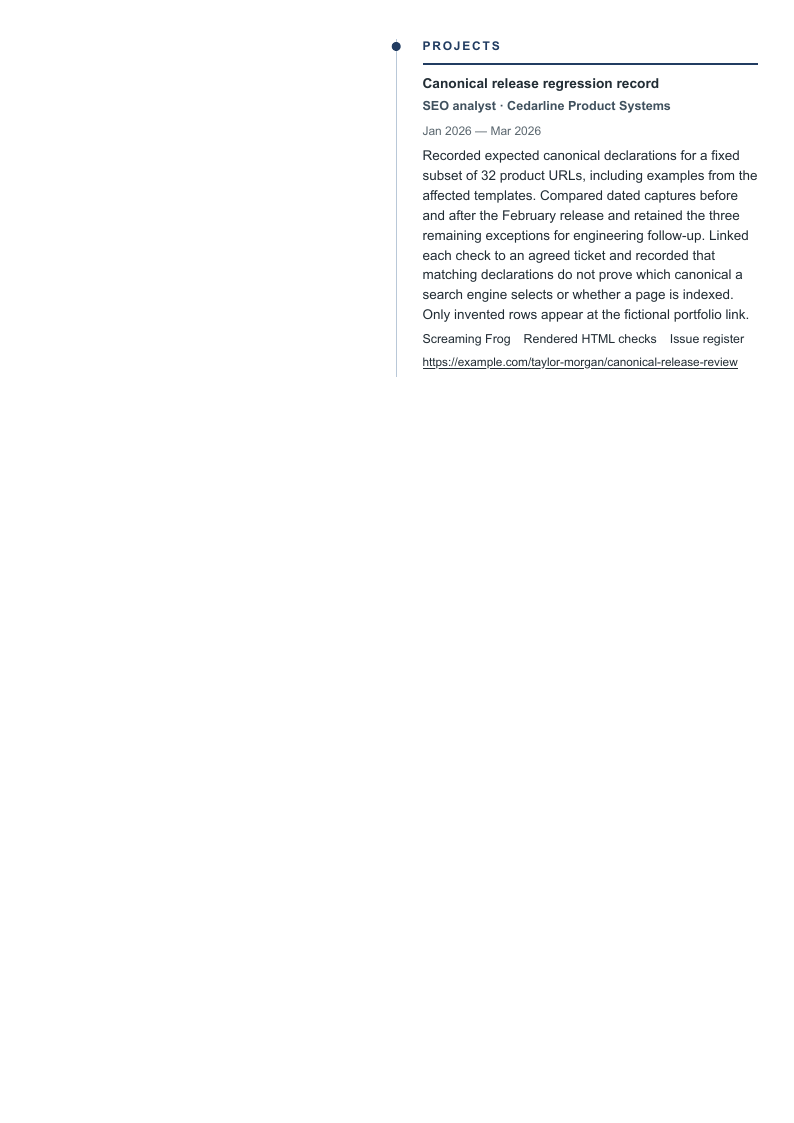
Canonical release regression record
SEO analyst · Cedarline Product Systems
January 2026–March 2026
Screaming Frog · Rendered HTML checks · Issue register
Recorded expected canonical declarations for a fixed subset of 32 product URLs, including examples from the affected templates. Compared dated captures before and after the February release and retained the three remaining exceptions for engineering follow-up. Linked each check to an agreed ticket and recorded that matching declarations do not prove which canonical a search engine selects or whether a page is indexed. Only invented rows appear at the fictional portfolio link.
The strongest thread is the handoff: a crawl becomes a reproducible issue, a priority is agreed, engineering implements a change and the specialist tests the intended behavior. The reporting bullet measures a separate help-page cohort. It is not presented as the effect of the canonical release, so a reader can assess each contribution without connecting unrelated numbers.
Show the work between an audit and an outcome
An audit total is a starting point. Explain the population, the problem you could reproduce and why it mattered to a reader or an important journey. In Taylor’s audit, 420 is the product-URL population, 40 counts mismatches and 12 counts grouped tickets. Those units cannot be combined into an error-resolution rate. The recommendation makes the finding usable by specifying affected templates and reproducible conditions.
Apryse’s specialist vacancy links research to briefs, an actionable backlog and implementation follow-up. Motive’s senior technical role emphasizes engineering-ready requirements and launch checks. Bounteous’s senior contract role adds cross-account specifications and reporting. These illustrate different scopes. A general specialist application need not claim the senior program or account leadership described by the latter two.
Write a recommendation as something another person can act on: affected pages, expected behavior, reproduction steps, user consequence and a completion check. Identify who scheduled and implemented it. Taylor recommends six tickets, the web lead approves the release scope and engineers own code changes. Clear collaboration does not require rewriting an individual contributor as an engineering manager.
Post-release validation should retain the original test population and open exceptions. Matching an expected canonical declaration is a technical observation. It does not establish Google’s selected canonical or prove that the URL is indexed. Search impressions, clicks and downstream conversions require separate definitions and evidence. Keep this chain visible instead of skipping from a tool scan to a revenue claim.
Six SEO specialist bullet rewrites with reasoning
Every after sentence appears verbatim in Taylor’s base experience. The before versions are deliberately weak or overstated. Use the evidence prompts to examine your own work, and replace the invented numbers and scope with facts you can explain.
1. Define the audit population
Before: Audited the whole website and fixed all SEO errors.
After: Audited 420 product URLs in January 2026, grouped 40 canonical or metadata mismatches into 12 reproducible issue tickets, and documented affected templates for the web team.
Why it works: The population is product URLs, while 40 counts URL-level mismatches and 12 counts grouped tickets. The audit identifies problems; it does not establish that all were fixed or that every site page was examined.
Evidence to check: Dated crawl export, URL inclusion rules, issue-to-URL mapping and reproducible ticket examples.
2. Explain the priority and delivery owner
Before: Led developers and implemented an unbeatable SEO strategy.
After: Recommended six of the 12 January 2026 issue tickets for the next release using affected user journeys and implementation dependencies; the web lead approved scheduling and engineers owned code changes.
Why it works: Shows why work was proposed and who made the release decision. A prioritized recommendation is valuable without implying line management, release authority or authorship of the engineering fix.
Evidence to check: Priority rationale, dependency notes, agreed release scope and named implementation owners.
3. Validate the same URLs after release
Before: Improved indexation by 61% with canonical fixes.
After: Rechecked the same 32 product URLs before and after the February 2026 canonical release: expected declarations appeared on 29 URLs versus 18 before; logged the three remaining exceptions without treating declarations as proof of indexing.
Why it works: The 32-URL regression set is a defined subset of the audit, not the entire site. Eighteen rising to 29 measures declared canonicals matching an agreed expectation; it does not measure Google-selected canonicals, indexed pages or search traffic.
Evidence to check: Frozen regression URL set, expected declarations, dated rendered-page captures and three open exceptions.
4. Keep click-through rate and causation separate
Before: Increased organic traffic and revenue by 60%.
After: Reported 384 clicks from 9,600 impressions for the same 48 help pages over April 6–May 3, 2026, versus 240 from 8,000 over March 2–29; explained the 4% versus 3% click-through rates alongside query-mix changes, without claiming causal lift or revenue.
Why it works: Both windows are 28 days and use the same page set. Click-through rate rises one percentage point. Clicks, sessions, leads and revenue are different measures, and a before-and-after report does not isolate a change’s effect.
Evidence to check: Search Console exports with page, country, device, search type and date filters; query-mix review and release annotations.
5. Make a content handoff useful
Before: Wrote hundreds of keyword-rich pages that always ranked first.
After: Grouped 52 support-related queries into eight help-topic briefs in September 2022, mapping existing answers and missing steps; writers produced drafts and product support reviewed factual accuracy before publication.
Why it works: Query rows, briefs and published pages are different units. The contribution is an evidence-led brief and review process; it does not claim sole writing ownership, page volume or a ranking outcome.
Evidence to check: Query grouping criteria, eight briefs, existing-page map, assigned writers and product-support review records.
6. Show migration checks without promising retention
Before: Migrated the website with zero traffic loss.
After: Checked redirects for 96 legacy help URLs during the May 2023 migration rehearsal, flagged four destination mismatches for engineering and repeated the checks after corrected mappings were approved by the content owner.
Why it works: This is a bounded rehearsal check, not proof about every production URL or later traffic. Engineering changes the mappings and the content owner approves destinations; the specialist tests and reports.
Evidence to check: Legacy-to-target map, rehearsal responses, four exception records, destination approval and repeat-check results.
Name your contribution in the summary
Start with your site context and the work you can demonstrate. Taylor names product and help content, reproducible requirements, cross-functional delivery and reporting. The jobs support each statement. An agency applicant can instead name the kinds of accounts and deliverables they handled, while an in-house specialist can explain site types and implementation relationships. Keep client identities private when disclosure is not approved.
For each role, show a decision or completed handoff as well as analysis. Useful evidence might be choosing consolidation over a new page, documenting a rendering defect, validating a migration map or revising a brief after support review. Name your part and the decision owner. Running a tool, attending a meeting or listing a dashboard does not explain what changed because of your work.
In the fictional report, 384 ÷ 9,600 is 4% and 240 ÷ 8,000 is 3%. The click-through rate differs by one percentage point. The two 28-day periods use the same 48 pages, but query mix also changes. These are Search Console clicks and impressions, not analytics sessions, unique people or revenue. A business outcome needs its own definition, attribution method, period and permitted source.
An unresolved issue can demonstrate judgment. Taylor retains three canonical exceptions and records four rehearsal mismatches before repeat checks. Explain the next action or disposition accurately. Do not call a recommendation an implementation, a fixed declaration an indexed page or a rehearsal a guarantee about later traffic.
Tie SEO skills to a checkable work product
Choose skills from the vacancy that your record supports. Search Console is useful here because Taylor defines a reporting population and explains the figures. Screaming Frog supports the URL audit and regression check. Listing either tool does not establish expertise in every feature, international SEO or a separate analytics implementation.
SEO specialist skills, evidence and fictional examples
Skill
Evidence to gather
Example in this record
Technical diagnosis
A defined URL set and reproducible condition.
420 product URLs; 40 mismatches grouped into 12 issue tickets.
Prioritization
User impact, dependencies and scheduling owner.
Six tickets recommended; the web lead approves scheduling.
Release validation
The same inputs, expected state and exceptions.
The same 32 URLs checked, with three exceptions retained.
Search reporting
Period, page cohort, filters and definitions.
48 pages, two 28-day windows, one-percentage-point CTR difference.
Content briefs
Reader question, existing answer and reviewer.
52 queries grouped into eight briefs; writers and support review.
Migration checks
Source-to-target map and repeat validation.
96 rehearsal URLs; four destination mismatches referred to engineering.
Describe AI-search work as an observed method
If you studied AI-generated answers, name the platform, prompt set, dates, sampling method and what you counted. Keep repeated observations and limitations; a small prompt sample cannot represent every user. Google says no special AI file or schema is required for its AI Overviews or AI Mode, and inclusion is not guaranteed. Its Search Console Web totals include these features, so those totals alone cannot establish an isolated AI-traffic result.
Automation needs a concrete boundary: what it helped classify, what you checked against source pages and who approved changes. Google’s guidance centers original material useful to readers and warns against low-value scaled content made to manipulate rankings. An employer’s interest in automation does not establish that unreviewed output is accurate. Add AEO or GEO skills only when you can explain work you performed.
Keep education, credentials and projects factual
List the qualification, institution and dates as awarded. Taylor’s fictional information-science degree includes coursework and an optional GPA. It does not imply that every SEO vacancy requires this degree. One cited senior role requires a bachelor’s degree; that is an employer requirement for that particular position. Current places Education in the left column, so check whether that emphasis suits your evidence.
Add a course or certification only if you earned it, using the issuer’s exact title, issue date and status. This sample contains no certifications and does not invent an official Google SEO credential. A tool course does not prove ranking results, release responsibility or analytics accuracy. Let your work examples demonstrate those abilities.
The canonical-release project adds the method behind a bullet: a fixed test set, expected values, dated captures and unresolved exceptions. It explains the candidate’s role and what the checks cannot prove. Use an approved public sample or a clean invented demonstration. Do not expose private crawl exports, client analytics, queries with personal information or access credentials.
Build a first SEO application from bounded work
A first application can use a course site, volunteer publishing assignment or personal project when labeled accurately. Describe the pages you controlled, the checks you performed and feedback you received. A ten-page demonstration audit can show more judgment than an unsupported claim to have managed a commercial strategy. Do not convert a tutorial into client work or give yourself a supervisor’s title.
An honest starter bullet might read: “Reviewed ten pages on a personal help site, documented two inconsistent heading patterns and corrected the templates after peer review.” This is a separate invented early-career adaptation, not another result in Taylor’s record. A checklist and readable before-and-after pages can support the method without a fabricated traffic-growth percentage.
The digital marketing manager guide covers a broader channel remit, while the content marketing manager guide centers content programs. An SEO specialist application should make diagnosis, recommendations, implementation follow-up and search measurement visible when those match the vacancy.
Inspect complete contact details with the optional photo
This Current scenario turns the photo on and changes only the resume email and portfolio URL. User identity, phone, jobs, degree, GPA and project remain unchanged. Read the full email and final URL segment against the text below, then check the PDF link destination. The main US example defaults to no photo; follow the employer’s instructions and your application context.
SEO specialist for product and help content, connecting technical audits to reproducible requirements and post-release checks. Works with engineering, writers and product support to resolve issues and improve answers for readers. Reports defined page cohorts and query context, separating technical validation, search performance and business outcomes.
Skills
Technical SEO audits · Canonical and redirect checks · Search-intent research · Content briefs · Google Search Console · Screaming Frog · HTML inspection · Measurement reporting
Experience
SEO Specialist
Cedarline Product Systems · Raleigh, NC
June 2023–Present
Audited 420 product URLs in January 2026, grouped 40 canonical or metadata mismatches into 12 reproducible issue tickets, and documented affected templates for the web team.
Recommended six of the 12 January 2026 issue tickets for the next release using affected user journeys and implementation dependencies; the web lead approved scheduling and engineers owned code changes.
Rechecked the same 32 product URLs before and after the February 2026 canonical release: expected declarations appeared on 29 URLs versus 18 before; logged the three remaining exceptions without treating declarations as proof of indexing.
Reported 384 clicks from 9,600 impressions for the same 48 help pages over April 6–May 3, 2026, versus 240 from 8,000 over March 2–29; explained the 4% versus 3% click-through rates alongside query-mix changes, without claiming causal lift or revenue.
SEO Coordinator
Rivergate Help Platforms · Raleigh, NC
September 2020–May 2023
Grouped 52 support-related queries into eight help-topic briefs in September 2022, mapping existing answers and missing steps; writers produced drafts and product support reviewed factual accuracy before publication.
Checked redirects for 96 legacy help URLs during the May 2023 migration rehearsal, flagged four destination mismatches for engineering and repeated the checks after corrected mappings were approved by the content owner.
Education
Bachelor of Science in Information Science · Northlake Piedmont College · Raleigh, NC
August 2016–May 2020
Coursework in information organization, web publishing and introductory statistics. Fictional degree; no search-platform endorsement is claimed.
GPA: 3.5/4.0
Projects
Canonical release regression record
SEO analyst · Cedarline Product Systems
January 2026–March 2026
Screaming Frog · Rendered HTML checks · Issue register
Recorded expected canonical declarations for a fixed subset of 32 product URLs, including examples from the affected templates. Compared dated captures before and after the February release and retained the three remaining exceptions for engineering follow-up. Linked each check to an agreed ticket and recorded that matching declarations do not prove which canonical a search engine selects or whether a page is indexed. Only invented rows appear at the fictional portfolio link.
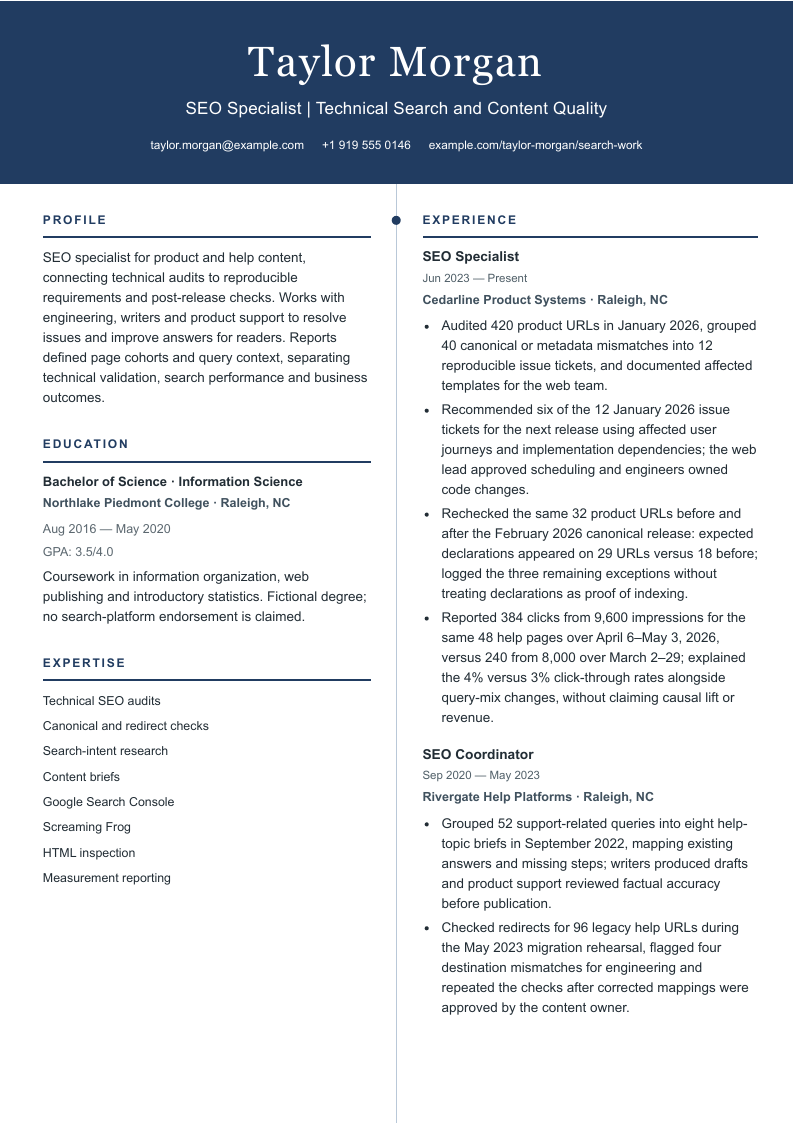
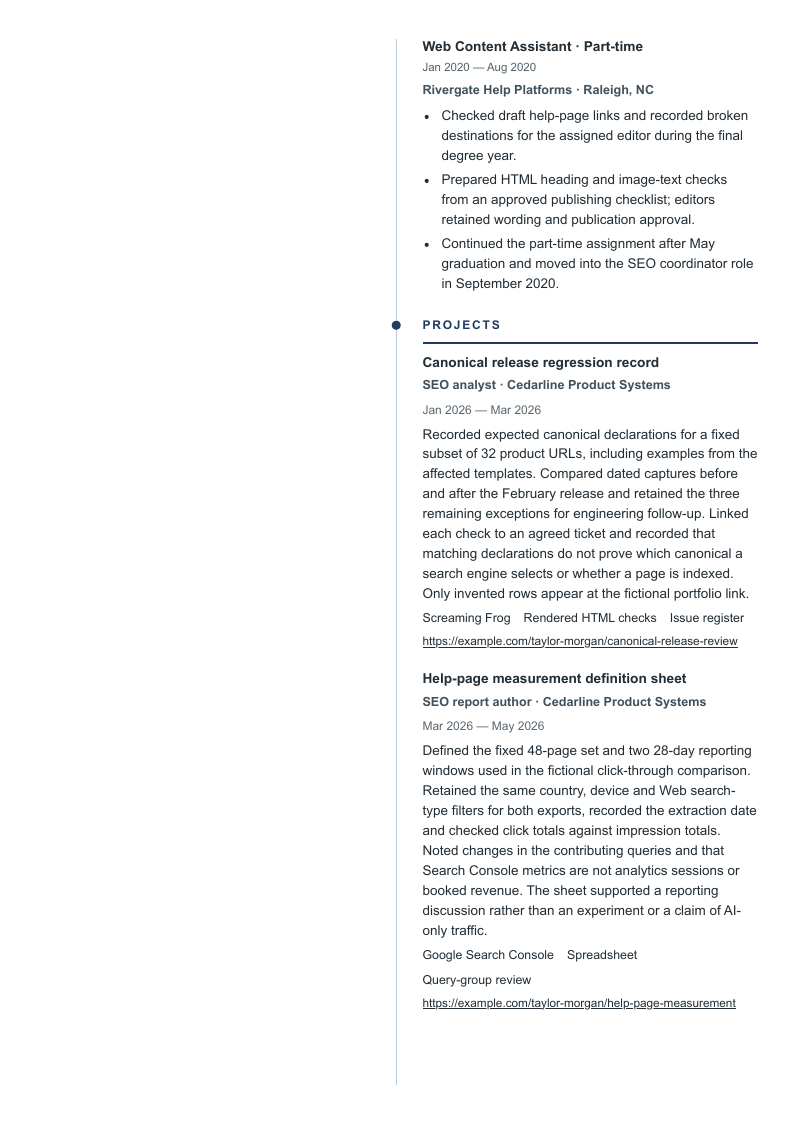
The expanded Current record has the photo off. It preserves every base field and adds the January–August 2020 part-time web-content assignment, a measurement-definition sheet and a migration rehearsal checklist. The assistant work overlaps the final degree term, continues after May graduation and ends before the September coordinator role. The added projects explain the same reporting and migration work without adding traffic or revenue claims.
Open page 1 at full sizeCurrent · Page 1 of 3 · Photo off · Complete paid-plan PDF page, including margins, without a watermark.Open page 2 at full sizeCurrent · Page 2 of 3 · Photo off · Complete paid-plan PDF page, including margins, without a watermark.Open page 3 at full sizeCurrent · Page 3 of 3 · Photo off · Complete paid-plan PDF page, including margins, without a watermark.Use Current without a photo
Taylor Morgan
SEO Specialist | Technical Search and Content Quality
SEO specialist for product and help content, connecting technical audits to reproducible requirements and post-release checks. Works with engineering, writers and product support to resolve issues and improve answers for readers. Reports defined page cohorts and query context, separating technical validation, search performance and business outcomes.
Skills
Technical SEO audits · Canonical and redirect checks · Search-intent research · Content briefs · Google Search Console · Screaming Frog · HTML inspection · Measurement reporting
Experience
SEO Specialist
Cedarline Product Systems · Raleigh, NC
June 2023–Present
Audited 420 product URLs in January 2026, grouped 40 canonical or metadata mismatches into 12 reproducible issue tickets, and documented affected templates for the web team.
Recommended six of the 12 January 2026 issue tickets for the next release using affected user journeys and implementation dependencies; the web lead approved scheduling and engineers owned code changes.
Rechecked the same 32 product URLs before and after the February 2026 canonical release: expected declarations appeared on 29 URLs versus 18 before; logged the three remaining exceptions without treating declarations as proof of indexing.
Reported 384 clicks from 9,600 impressions for the same 48 help pages over April 6–May 3, 2026, versus 240 from 8,000 over March 2–29; explained the 4% versus 3% click-through rates alongside query-mix changes, without claiming causal lift or revenue.
SEO Coordinator
Rivergate Help Platforms · Raleigh, NC
September 2020–May 2023
Grouped 52 support-related queries into eight help-topic briefs in September 2022, mapping existing answers and missing steps; writers produced drafts and product support reviewed factual accuracy before publication.
Checked redirects for 96 legacy help URLs during the May 2023 migration rehearsal, flagged four destination mismatches for engineering and repeated the checks after corrected mappings were approved by the content owner.
Web Content Assistant · Part-time
Rivergate Help Platforms · Raleigh, NC
January 2020–August 2020
Checked draft help-page links and recorded broken destinations for the assigned editor during the final degree year.
Prepared HTML heading and image-text checks from an approved publishing checklist; editors retained wording and publication approval.
Continued the part-time assignment after May graduation and moved into the SEO coordinator role in September 2020.
Education
Bachelor of Science in Information Science · Northlake Piedmont College · Raleigh, NC
August 2016–May 2020
Coursework in information organization, web publishing and introductory statistics. Fictional degree; no search-platform endorsement is claimed.
GPA: 3.5/4.0
Projects
Canonical release regression record
SEO analyst · Cedarline Product Systems
January 2026–March 2026
Screaming Frog · Rendered HTML checks · Issue register
Recorded expected canonical declarations for a fixed subset of 32 product URLs, including examples from the affected templates. Compared dated captures before and after the February release and retained the three remaining exceptions for engineering follow-up. Linked each check to an agreed ticket and recorded that matching declarations do not prove which canonical a search engine selects or whether a page is indexed. Only invented rows appear at the fictional portfolio link.
Google Search Console · Spreadsheet · Query-group review
Defined the fixed 48-page set and two 28-day reporting windows used in the fictional click-through comparison. Retained the same country, device and Web search-type filters for both exports, recorded the extraction date and checked click totals against impression totals. Noted changes in the contributing queries and that Search Console metrics are not analytics sessions or booked revenue. The sheet supported a reporting discussion rather than an experiment or a claim of AI-only traffic.
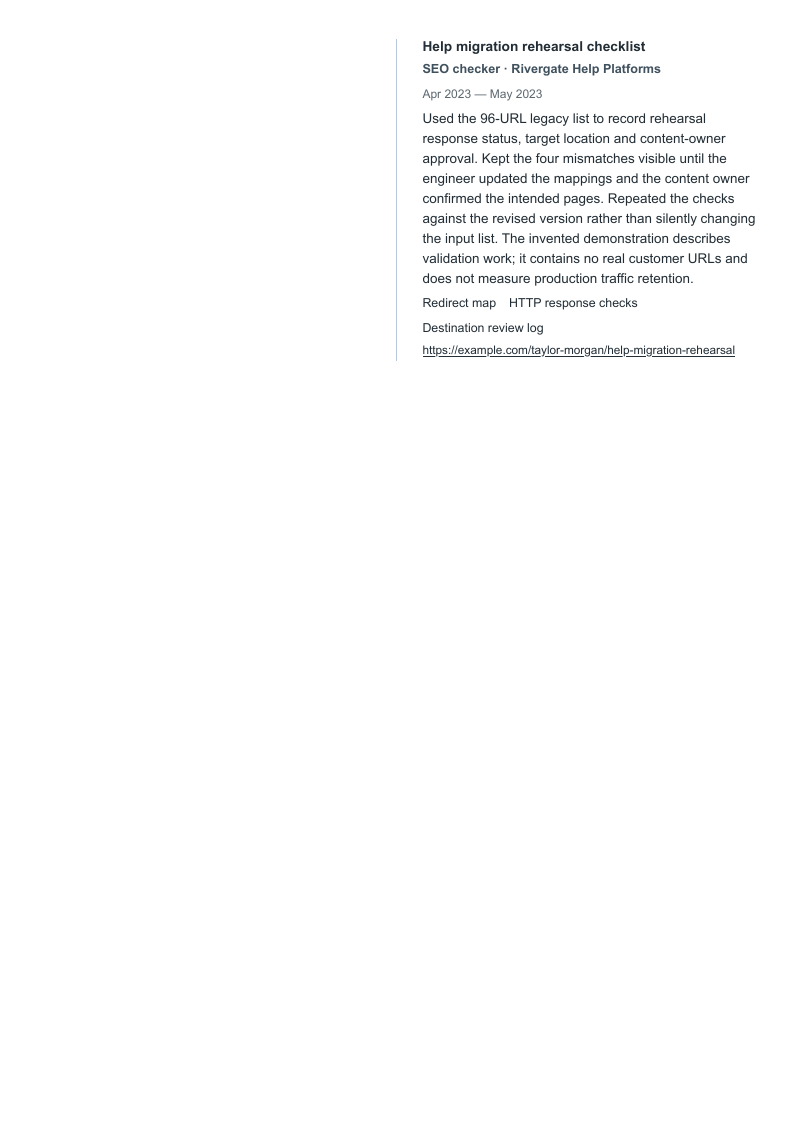
Used the 96-URL legacy list to record rehearsal response status, target location and content-owner approval. Kept the four mismatches visible until the engineer updated the mappings and the content owner confirmed the intended pages. Repeated the checks against the revised version rather than silently changing the input list. The invented demonstration describes validation work; it contains no real customer URLs and does not measure production traffic retention.
Read the final paragraph sentences, degree description and GPA, all dates and both project-link endings. In Current, follow the left qualifications column and right experience column through every continuation. Remove repeated claims before shrinking text or deleting measurement limitations to force a page count.
Check the file and the claims you will submit
Reconcile URLs, issue tickets, queries, briefs, impressions and clicks. Check dates, filters, denominators and percentage points against the permitted record.
Confirm who recommended, scheduled, coded, approved and validated the change. Keep implementation and results you did not own with their actual owners.
Read every exported page at normal size. Check long contacts, date associations, GPA, both Current columns and final project sentences. Open approved portfolio destinations.
Copy the PDF text and review the application’s parsed fields. Use its requested file type. No template guarantees parsing, ranking, an AI citation or a hiring result.
Review your resume with the analyzer and compare suggestions with your actual record. A free account is required for the builder. Use buttons retain the selected design, photo preference and SEO Specialist role for signup; free-plan downloads include a watermark. These article previews show paid-plan PDF output.
Questions, answered
What belongs on an SEO specialist resume?
State site context, job titles and dates, then show a defined diagnosis, a useful recommendation, implementation ownership, validation and appropriately measured results. Select examples that match your work and the individual vacancy.
How can I describe SEO results without overclaiming?
Name the metric, unit, period, population and comparison. A declared canonical is not an indexed URL; a click is not a session or sale. Explain concurrent changes and separate observed differences from causal effects.
Should I list AEO, GEO or AI-search skills?
Include them when you can explain work you performed, including platform, sample, dates and measurement limits. Do not claim a guaranteed citation or imply that a special schema is required for Google AI features.
Do I need a certification to apply?
Check the employer’s requirements. List only awarded credentials with their exact issuer and status. This sample includes a degree and optional GPA, with no certification claim; it does not establish eligibility for every vacancy.
Which design is the default?
Current without a photo. Its qualifications column is left of experience and projects. Signal and original Professional provide one-column alternatives with optional photo previews. Inspect your own export and parsed application fields.
What carries into signup when I choose a template?
Your selected design, photo setting and SEO Specialist role. Taylor’s fictional resume and AI-generated portrait are not copied into your account. A free account is required; free-plan PDF downloads have a watermark.
Prepared by Resumize with AI-assisted research and drafting for English-language US applications. Three direct employer descriptions were retrieved on October 28, 2026 with application controls: Apryse’s individual-contributor role, Motive’s senior technical role and Bounteous’s senior agency contract role. Their different remits inform the discussion without defining every SEO job. No application was submitted; vacancies and eligibility can change.
Google Search Central supplies guidance on its own Search features and content policies; an employer’s ambitions are not a guarantee about search behavior. CareerOneStop supplies general resume structure. The candidate, counts, comparisons, projects and rewrites are original editorial fiction, and the portrait is AI-generated. These sources do not endorse the designs, verify credentials or promise visibility or hiring outcomes.
Retrieved October 28, 2026. Direct full description and Apply for this job control available; separate application form also retrieved. Remote within specified US states, with hiring prioritized in Boston, Denver and Charlotte. No posting date shown. Illustrates an individual contributor turning search research into briefs, implementation follow-up and reporting.
Retrieved October 28, 2026. United States – Remote; full description, Apply control and inline application form present. No posting date shown. Illustrates a senior technical program with engineering-ready requirements and launch validation. Its broader seniority and degree requirements are vacancy-specific, not a checklist for every specialist.
Retrieved October 28, 2026. United States, remote contract; full description and Apply for this job control present, with separate application form retrieved. No posting date shown. Illustrates senior agency specifications, cross-functional delivery and reporting. Employer aspirations about AI visibility do not establish a Google inclusion guarantee.
Read October 28, 2026. Existing SEO principles apply to AI Overviews and AI Mode; no special AI file or schema is required. Eligibility does not guarantee inclusion. Google reports these features within overall Web search performance in Search Console, so this guide does not label its fictional Web totals as isolated AI traffic.
Read October 28, 2026. Used for the distinction between serving an intended audience with original useful material and producing pages mainly for rankings. The fictional briefs check existing answers and missing user steps; they do not set an arbitrary word-count target.
Read October 28, 2026. The scaled-content-abuse policy concerns large amounts of low-value material made to manipulate rankings, regardless of production method. AI assistance is not evidence of quality, and an employer’s desire for scale is not permission to publish unreviewed low-value pages.
Read October 28, 2026. AI can support research and structure, with accuracy, relevance and quality still requiring attention. This guide discloses AI-assisted research and drafting and supplies original worked examples rather than claiming firsthand candidate results.
Read October 28, 2026. US Department of Labor-sponsored resume guidance on relevant work, titles, organizations, dates and specific contributions. Used for resume structure; it does not endorse these designs or promise an application-system result.