Classic
A traditional centered header and simple rules emphasize the written record.
Before sending: Long contacts and the optional portrait can change header spacing.
Policy evidence and decisions · US resume context
A Policy Analyst resume should show the question you investigated, evidence you assessed and options you prepared. Explain uncertainty and the decision owner. Keep consultation responses, representative research and adopted policy as different forms of evidence.
By Resumize · · AI-assisted research and drafting
Three designs · one example
These previews use the same layouts as the builder, with identical example content. Open a full preview to inspect the text and spacing.
Fictional candidate, employers, education and results. The optional portrait is AI-generated. Use your own evidence and photo; the example is not inserted into your resume.
A traditional centered header and simple rules emphasize the written record.
Before sending: Long contacts and the optional portrait can change header spacing.
Formal labels and restrained blue accents suit document-led careers.
Before sending: Check long terms and dates in the exported reading order.
A quiet single-column hierarchy keeps the evidence prominent.
Before sending: Expanded histories still need review of the complete export.
“Use” opens signup with that design and photo preference selected for the builder. A free account is required. Free-plan PDF downloads include a watermark; see current plans for paid options. Photo conventions vary; follow the employer’s instructions and local expectations.
The three designs use the same fictional career. The default has no photo. Follow the employer’s instructions and local conventions; the optional portrait is AI-generated. Signup retains the exact design, supported photo preference and Policy Analyst role. It does not insert the example career or portrait into your account. A free account is required, and free-plan PDF downloads include a watermark. These previews show paid-plan output.
Morgan Avery, the employers, qualifications, dates, projects and results are original editorial fiction. The example.com addresses and links and the 555 phone number are illustrative placeholders. Replace every field with your own facts. The optional portrait is AI-generated, and all qualifications and any license or registration dates are fictional and contain no valid identifiers. The base record has two jobs, six experience bullets, one education record and one project.
Policy Analyst | Policy evidence and decision options
morgan.avery@example.com · +1 614 555 0112
Portfolio: https://example.com/morgan-avery
Policy analyst preparing service-access research and decision options for a public-policy team. Compares evidence, documents assumptions and drafts briefings for senior review. Brings earlier research-officer experience in source checking and consultation summaries, with careful boundaries between recommendations and adopted policy.
Policy option appraisal · Evidence synthesis · Consultation analysis · Briefing preparation · Assumption tracking · Source verification
Cedarbridge Public Policy Office · Columbus, OH
April 2022–Present
Birchfield Civic Research · Columbus, OH
June 2019–March 2022
Bachelor of Arts in Public Policy · Maplecrest University · Columbus, OH
August 2015–May 2019
Policy Analyst · Cedarbridge Public Policy Office
March 2026–May 2026
Submission coding matrix · Review rules · Policy briefing
Reconciled 80 submissions into 48 favorable, 20 opposed and 12 mixed or unclear responses. Documented coding uncertainty and self-selection limits rather than treating the tally as a representative survey.
https://example.com/morgan-avery/service-access-consultation-review
Morgan’s fictional service-access role develops briefs and option comparisons for senior policy staff. Eligibility, implementation effort and distributional effects form part of the analysis. The analyst drafts recommendations but does not claim authority to adopt every policy or direct implementation.
The three employer descriptions below concern different City of New York policy functions. Their topic and division boundaries matter even within the same public employer. The examples are a small set of current descriptions, not a representative survey of every policy analyst role or jurisdiction.
Identify a decision question at a permitted level and show how you evaluated evidence. Keep administrative data, stakeholder accounts and public sources separately labeled. Avoid publishing confidential advice or consultation information to make a bullet more specific.
Read the employer descriptions directly: City of New York Policy Analyst, Fair Housing Policy & Investments; City of New York Policy Analyst for the Division of Program Policy & Innovation; City of New York Policy Analyst for Specialized Populations. This selected dated sample illustrates differences in scope and requirements, rather than a representative labor-market survey.
Each after sentence appears in the base career record. The weak before statements are teaching examples. Use the evidence prompts to check the population, decisions and limitations behind your own wording.
Before: Changed government policy alone.
After: Develop evidence briefs on service-access questions, agree the research scope with senior policy staff and compare options against documented objectives and constraints.
Why it works: Research and recommendation are distinct from adopting policy.
Evidence to check: Research brief, decision criteria and senior review.
Before: Proved everyone supported the proposal.
After: Coded 80 consultation submissions received in a defined review period; 48 favored the proposed access change, 20 opposed it and 12 expressed mixed or unclear positions.
Why it works: The 60% favorable share describes respondents, not representative public opinion.
Evidence to check: Submission cohort, coding rules, mixed categories and review checks.
Before: Found the perfect policy.
After: Compare eligibility, implementation effort and distributional effects across three options, recording evidence gaps and assumptions before drafting a recommendation for senior review.
Why it works: Options and uncertainty are explicit rather than promising an ideal solution.
Evidence to check: Option matrix, assumptions and evidence gaps.
Before: Implemented every recommendation.
After: Prepare decision briefings and consultation summaries for the policy lead, distinguish proposed actions from approved decisions and record requests for further analysis.
Why it works: The analyst’s output stays separate from final policy and implementation authority.
Evidence to check: Brief versions, review requests and decision status.
Before: Was an expert in all regulation.
After: Checked public-source dates and definitions for research tables, documenting missing values and methodological differences for the project lead.
Why it works: Source checking is concrete without a universal expertise claim.
Evidence to check: Source register, definitions and comparison limits.
Before: Verified every stakeholder statement.
After: Summarized stakeholder interviews against a supplied research guide, labeling reported experiences separately from administrative records and published evidence.
Why it works: Different evidence types retain their limits.
Evidence to check: Interview guide, permitted summaries and evidence labels.
The consultation set has 80 submissions: 48 favorable, 20 opposed and 12 mixed or unclear. The 60% favorable share describes submissions received in that period. Respondents self-selected, so the tally does not establish representative public support.
An option matrix can demonstrate judgment without a percentage. Show the criteria, assumptions and unresolved evidence. Preparing a recommendation is a deliverable; a later policy decision or public outcome requires its own record and accurate attribution.
Use relevant capabilities that your experience or projects demonstrate. The table connects the sample’s claims to records a candidate should check. A skill keyword is not a substitute for an example, and a private employer record should stay private unless sharing is permitted.
| Capability in context | Evidence to check | Sample work |
|---|---|---|
| Define the policy question | Research brief, decision criteria and senior review. | Develop evidence briefs on service-access questions, agree the research scope with senior policy staff and compare options against documented objectives and constraints. |
| Retain the consultation population | Submission cohort, coding rules, mixed categories and review checks. | Coded 80 consultation submissions received in a defined review period; 48 favored the proposed access change, 20 opposed it and 12 expressed mixed or unclear positions. |
| Show tradeoffs | Option matrix, assumptions and evidence gaps. | Compare eligibility, implementation effort and distributional effects across three options, recording evidence gaps and assumptions before drafting a recommendation for senior review. |
| Preserve decision authority | Brief versions, review requests and decision status. | Prepare decision briefings and consultation summaries for the policy lead, distinguish proposed actions from approved decisions and record requests for further analysis. |
| Make research work specific | Source register, definitions and comparison limits. | Checked public-source dates and definitions for research tables, documenting missing values and methodological differences for the project lead. |
| Separate reports from observations | Interview guide, permitted summaries and evidence labels. | Summarized stakeholder interviews against a supplied research guide, labeling reported experiences separately from administrative records and published evidence. |
Morgan’s public-policy degree is fictional and no regulated professional qualification is claimed. BLS’s political-scientist profile is adjacent research context rather than a definition of every analyst position. Use the employer’s actual subject, experience and qualification requirements and your genuine awards.
Research, consultation support or a supervised placement can demonstrate source checking, synthesis and clear writing. Keep the real title and reviewer. Collecting evidence is not the same as independently advising a cabinet or adopting policy.
A labeled public-data case can supplement a short record. State source dates, definitions and limitations, and distinguish your proposal from an official recommendation. The expanded record retains Morgan’s research internship and two correctly dated work projects.
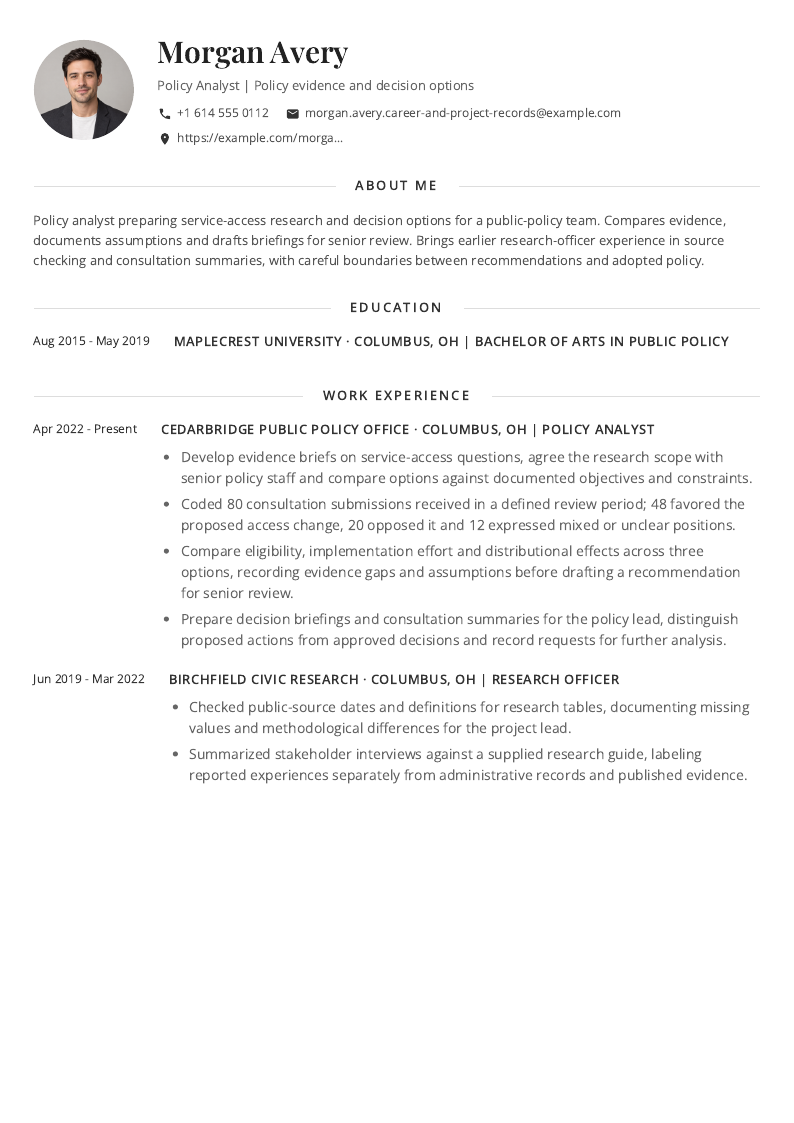
Only Morgan Avery’s resume email and one portfolio contact URL change in this scenario. Identity, phone, employment, qualifications and projects stay identical. Classic uses the optional photo-on view here. Read every final character of the email and URL, and check the link destination against the complete record below.
 Open page 1 at full size
 Open page 2 at full size
Policy Analyst | Policy evidence and decision options
morgan.avery.career-and-project-records@example.com · +1 614 555 0112
Policy analyst preparing service-access research and decision options for a public-policy team. Compares evidence, documents assumptions and drafts briefings for senior review. Brings earlier research-officer experience in source checking and consultation summaries, with careful boundaries between recommendations and adopted policy.
Policy option appraisal · Evidence synthesis · Consultation analysis · Briefing preparation · Assumption tracking · Source verification
Cedarbridge Public Policy Office · Columbus, OH
April 2022–Present
Birchfield Civic Research · Columbus, OH
June 2019–March 2022
Bachelor of Arts in Public Policy · Maplecrest University · Columbus, OH
August 2015–May 2019
Policy Analyst · Cedarbridge Public Policy Office
March 2026–May 2026
Submission coding matrix · Review rules · Policy briefing
Reconciled 80 submissions into 48 favorable, 20 opposed and 12 mixed or unclear responses. Documented coding uncertainty and self-selection limits rather than treating the tally as a representative survey.
https://example.com/morgan-avery/service-access-consultation-review
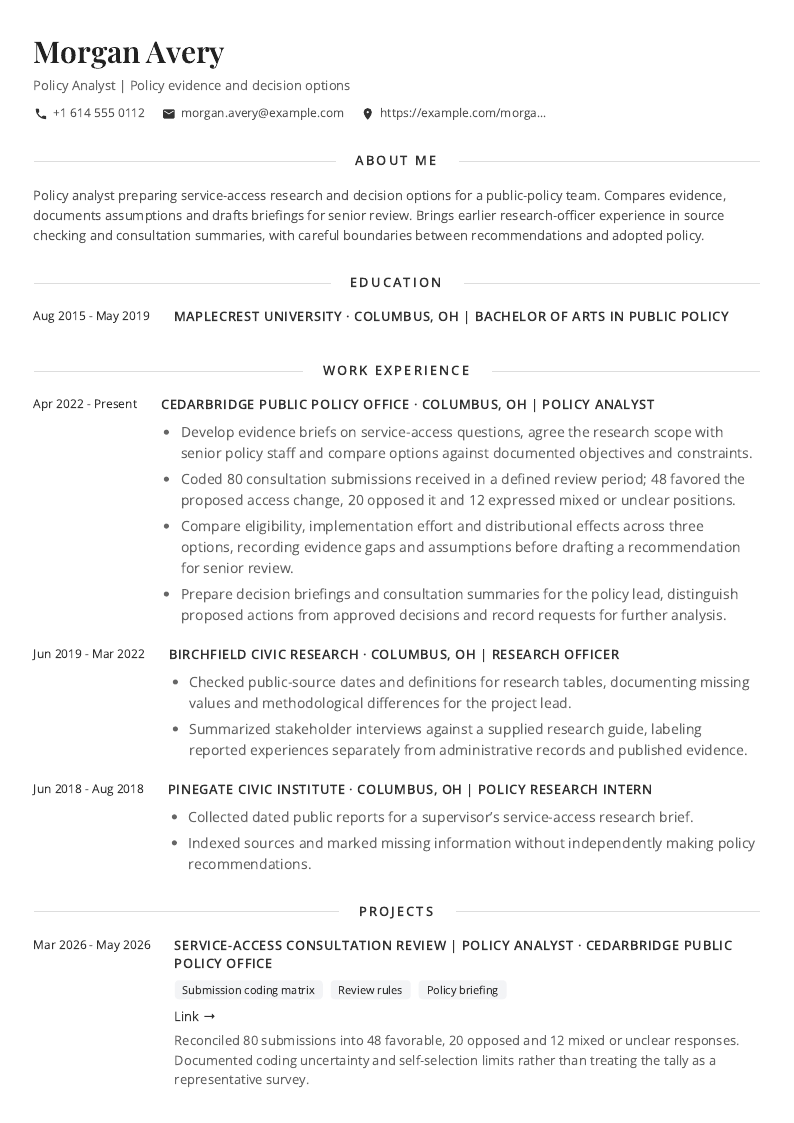
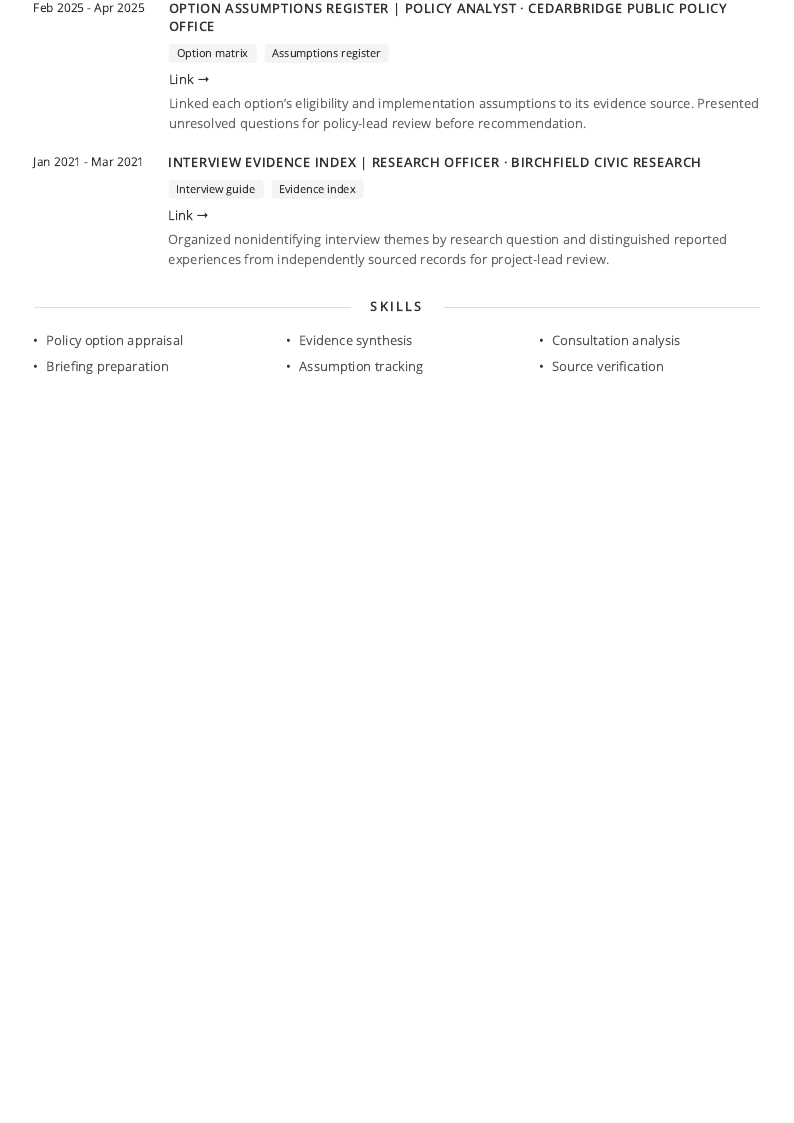
The expanded Classic scenario keeps the photo off. It preserves every base field and adds one earlier job and two projects. Project titles and employers reflect the job actually held during their dates, and method lists describe the work in that project. Read the full record, including the final project and its limits.
Condense repeated responsibilities before removing information a reader needs to understand a claim. Review headings, dates and continuation pages after your own changes; the design name alone cannot establish how an expanded career will read.
 Open page 1 at full size
 Open page 2 at full size
Policy Analyst | Policy evidence and decision options
morgan.avery@example.com · +1 614 555 0112
Portfolio: https://example.com/morgan-avery
Policy analyst preparing service-access research and decision options for a public-policy team. Compares evidence, documents assumptions and drafts briefings for senior review. Brings earlier research-officer experience in source checking and consultation summaries, with careful boundaries between recommendations and adopted policy.
Policy option appraisal · Evidence synthesis · Consultation analysis · Briefing preparation · Assumption tracking · Source verification
Cedarbridge Public Policy Office · Columbus, OH
April 2022–Present
Birchfield Civic Research · Columbus, OH
June 2019–March 2022
Pinegate Civic Institute · Columbus, OH
June 2018–August 2018
Bachelor of Arts in Public Policy · Maplecrest University · Columbus, OH
August 2015–May 2019
Policy Analyst · Cedarbridge Public Policy Office
March 2026–May 2026
Submission coding matrix · Review rules · Policy briefing
Reconciled 80 submissions into 48 favorable, 20 opposed and 12 mixed or unclear responses. Documented coding uncertainty and self-selection limits rather than treating the tally as a representative survey.
https://example.com/morgan-avery/service-access-consultation-review
Policy Analyst · Cedarbridge Public Policy Office
February 2025–April 2025
Option matrix · Assumptions register
Linked each option’s eligibility and implementation assumptions to its evidence source. Presented unresolved questions for policy-lead review before recommendation.
https://example.com/morgan-avery/option-assumptions-register
Research Officer · Birchfield Civic Research
January 2021–March 2021
Interview guide · Evidence index
Organized nonidentifying interview themes by research question and distinguished reported experiences from independently sourced records for project-lead review.
Review your resume with the analyzer and check every suggestion against your records. No template guarantees parsing, ranking, an interview or a hiring outcome. A free account is required for the builder; free-plan PDF downloads include a watermark. The examples show paid-plan output.
Describe who responded and how. A self-selected submission set is not automatically representative public opinion.
Explain the decision supported, evidence gaps and follow-up requested. Do not invent an implementation result.
Use permitted high-level descriptions and protect private advice, data and participant information.
Signup retains the exact design, the supported photo setting and Policy Analyst role. Compact stays photo-free. The fictional career and portrait are not inserted into your account. A free account is required and free-plan PDF downloads include a watermark.
Prepared by Resumize with AI-assisted research and drafting for English-language US resume context. Employer descriptions from other markets are identified in the discussion and notes. Full employer bodies were checked October 30, 2026; availability, location eligibility and engagement conditions vary and can change. The original fictional records are teaching material, not verified applicants or evidence that this candidate meets every opening. No application was submitted or hiring outcome tested.
Official occupational and credential guidance was reviewed through direct, web-access or indexed text as stated in each note. Retrieval failures remain disclosed. The source notes distinguish these limits from full direct employer retrieval.
Read October 30, 2026. City of New York, Fair Housing Policy & Investments; housing-policy setting. Full employer description retrieved. Application controls were present at review; availability can change.
Read October 30, 2026. City of New York, Division of Program Policy & Innovation; division-specific policy work. Full employer description retrieved. Application controls were present at review; availability can change.
Read October 30, 2026. City of New York, Specialized Populations; a distinct policy remit within the same public employer. Full employer description retrieved. Application controls were present at review; availability can change.
Reviewed October 30, 2026. Official context for the role or the stated practice; not a credential or proof that the fictional candidate meets every requirement. Direct archival access was restricted; no new detailed regulatory or eligibility claim is inferred from that failed retrieval.