A legal assistant resume should show how you keep an attorney’s work organized: accurate documents, visible deadlines, approved filings, reliable billing support and clear client communication. Name what you prepared, what you checked and who approved the next step. This guide uses a complete fictional litigation-office record, six annotated rewrites and three existing designs.
These previews use the same layouts as the builder, with identical example content. Open a full preview to inspect the text and spacing.
Fictional candidate, employers, education and results. The optional portrait is AI-generated. Use your own evidence and photo; the example is not inserted into your resume.
Ledger
A centered serif identity, ruled contact strip, italic Profile and gold section rules lead into Experience, Expertise, Education, Certifications and Projects in one column.
Before sending: The centered italic summary is visually prominent. Keep it brief enough that document and calendar evidence remains easy to reach; check long contacts inside the ruled strip.
A white header centers the name, role and contact details, with an optional circular portrait above the identity. The body presents Professional Summary, Skills, Experience, Education, Projects and Certifications.
Before sending: Skills appear before experience as individual tags. Keep the list selective so document and scheduling evidence remains easy to reach, and inspect the extra header height when adding a photo.
A serif name, orange role accents and unruled body place identity, contacts and Profile in the header, followed by Experience, Expertise, Education, Certifications and Projects.
Before sending: The summary shares the header and the body relies on spacing. Inspect a long summary and the transition into the first job; check where the education and project sections continue.
“Use” opens signup with that design and photo preference selected for the builder. A free account is required. Free-plan PDF downloads include a watermark; see current plans for paid options. Photo conventions vary; follow the employer’s instructions and local expectations.
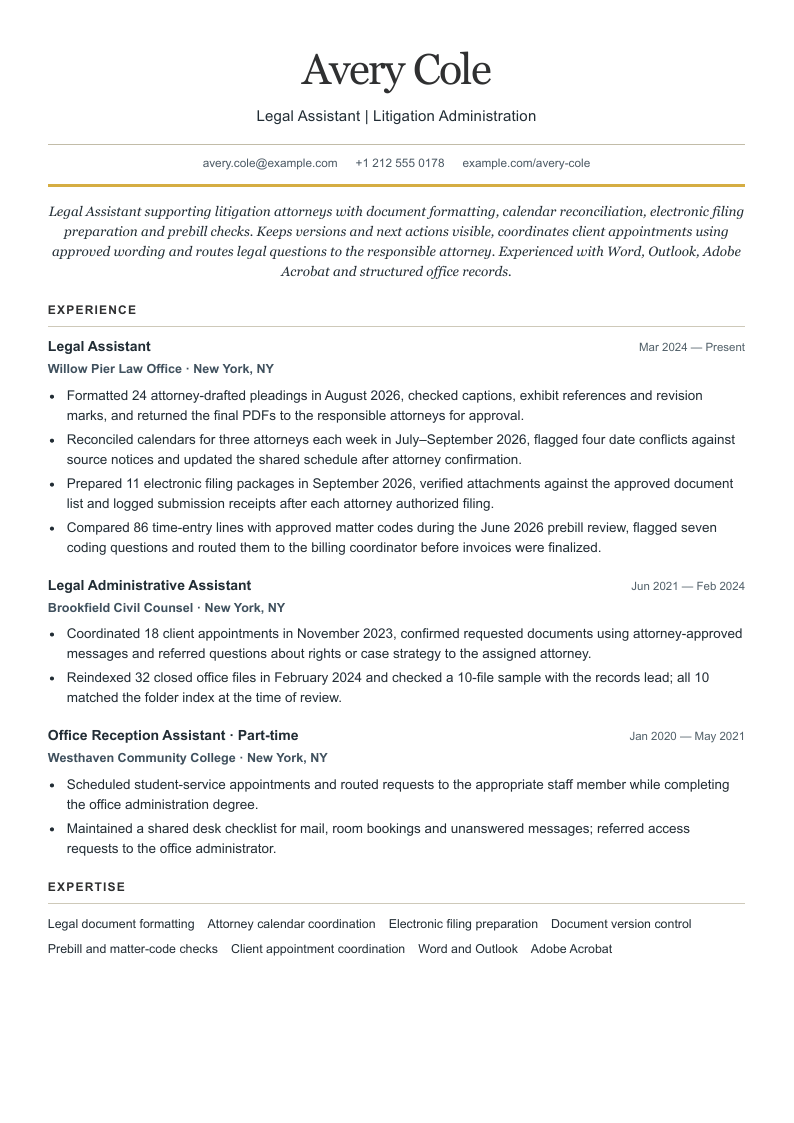
Compare the same facts in Ledger, Professional and Plainspoken. Ledger gives the summary a centered italic treatment; Professional places skill tags before experience; Plainspoken uses an unruled body and warm role accents. All begin without a photo. The optional portrait is AI-generated. Choosing a design retains that exact template, photo preference and Legal Assistant role through signup; it does not add Avery’s career or portrait to your account.
Avery Cole, the employers, college, dates, assignments and results are original fiction. Every portfolio URL is an example.com placeholder, and the phone uses a fictional 555 number. The optional portrait is AI-generated. The example illustrates resume evidence for attorney support; it provides no legal advice or authority to practice law.
Legal Assistant supporting litigation attorneys with document formatting, calendar reconciliation, electronic filing preparation and prebill checks. Keeps versions and next actions visible, coordinates client appointments using approved wording and routes legal questions to the responsible attorney. Experienced with Word, Outlook, Adobe Acrobat and structured office records.
Skills
Legal document formatting · Attorney calendar coordination · Electronic filing preparation · Document version control · Prebill and matter-code checks · Client appointment coordination · Word and Outlook · Adobe Acrobat
Experience
Legal Assistant
Willow Pier Law Office · New York, NY
March 2024–Present
Formatted 24 attorney-drafted pleadings in August 2026, checked captions, exhibit references and revision marks, and returned the final PDFs to the responsible attorneys for approval.
Reconciled calendars for three attorneys each week in July–September 2026, flagged four date conflicts against source notices and updated the shared schedule after attorney confirmation.
Prepared 11 electronic filing packages in September 2026, verified attachments against the approved document list and logged submission receipts after each attorney authorized filing.
Compared 86 time-entry lines with approved matter codes during the June 2026 prebill review, flagged seven coding questions and routed them to the billing coordinator before invoices were finalized.
Legal Administrative Assistant
Brookfield Civil Counsel · New York, NY
June 2021–February 2024
Coordinated 18 client appointments in November 2023, confirmed requested documents using attorney-approved messages and referred questions about rights or case strategy to the assigned attorney.
Reindexed 32 closed office files in February 2024 and checked a 10-file sample with the records lead; all 10 matched the folder index at the time of review.
Education
Associate of Applied Science in Office Administration · Westhaven Community College · New York, NY
August 2019–May 2021
Coursework in business communication, office software and records management; completed a simulated professional-office document project.
Projects
Prebill question register
Legal Assistant contributor · Willow Pier Law Office
Built a question register for the same 86-line prebill review, separating the original code, question owner and response status. The billing coordinator selected the fields and resolved the seven questions. A fabricated demonstration shows the structure without client balances, billing rates or invoice narratives.
The current job covers formatting, calendar checks, filing preparation and prebill review. The earlier position establishes scheduling and records experience. The project expands on the same 86-line prebill review, rather than counting it as a second billing achievement. Education supports the office skills without adding an invented professional certification.
Identify the office and your support responsibility
Legal assistant titles cover different assignments. Read the practice setting and duties before choosing an example. A litigation office may need document formatting and hearing coordination; an internal legal department may prioritize signatures and contract records. State the setting in your summary and preserve your actual job titles. An office support title does not establish that you performed every paralegal function or exercised an attorney’s judgment.
The three current employer examples show the difference. Tyson & Mendes’ New York vacancy describes litigation calendars, document formatting and filing. Lemnis’ legal department opening emphasizes contract status, signatures, forms and coordinated records. CGS’ Washington-area role describes document and office support under a supervisor for federal attorneys. These are three specific openings, not a universal task or education standard. Their experience and eligibility conditions differ.
For document work, distinguish drafting routine correspondence from formatting an attorney’s argument. Explain version checks, exhibit references or preparation of a clean review copy. For court filing, distinguish preparing the packet, obtaining authorization, submitting it and recording a receipt. Do not merge those steps into a claim of independent legal approval. A filing receipt does not prove a court accepted the content or ruled in the client’s favor.
The same precision applies to discovery and trial support. If you arranged files, checked a binder index or coordinated a deposition, describe that contribution. Do not add privilege decisions, legal research memoranda, witness strategy or trial outcomes because another resume includes them. If research was part of your actual assignment, name the research task and attorney review. Access to a legal database is different from authoring legal analysis.
Six legal assistant bullet rewrites with evidence prompts
Each after sentence appears verbatim in the complete base resume. Replace these fictional details with facts you can explain. Where a trustworthy result measure is unavailable, an assigned population, review step or completed output can still show useful work.
1. Show the document workflow
Before: Drafted winning motions without supervision.
After: Formatted 24 attorney-drafted pleadings in August 2026, checked captions, exhibit references and revision marks, and returned the final PDFs to the responsible attorneys for approval.
Why it works: Twenty-four is the number of documents formatted in one month, not cases won or legal arguments authored. The sentence identifies the source draft and final reviewer.
Evidence to check: A permitted aggregate production log and a blank formatting checklist; exclude actual pleadings, client names and attorney comments.
2. Explain calendar reconciliation
Before: Managed deadlines perfectly for the whole firm.
After: Reconciled calendars for three attorneys each week in July–September 2026, flagged four date conflicts against source notices and updated the shared schedule after attorney confirmation.
Why it works: Three is the supported attorney group; four is a conflict count across the stated quarter. The candidate identifies discrepancies rather than independently deciding a legal deadline.
Evidence to check: Your calendar-check routine and an approved aggregate discrepancy count; never publish hearing details, docket numbers or client schedules.
3. Separate filing preparation from approval
Before: Filed everything and guaranteed court acceptance.
After: Prepared 11 electronic filing packages in September 2026, verified attachments against the approved document list and logged submission receipts after each attorney authorized filing.
Why it works: The package is the unit. A recorded receipt documents submission, not acceptance, a court ruling or a guarantee that a deadline was satisfied.
Evidence to check: A blank filing checklist and permitted monthly task count; keep court access credentials and live case material private.
4. Give billing corrections a defined population
Before: Reduced billing errors by 90%.
After: Compared 86 time-entry lines with approved matter codes during the June 2026 prebill review, flagged seven coding questions and routed them to the billing coordinator before invoices were finalized.
Why it works: Seven of 86 lines prompted questions; this is not an error-rate reduction or seven rejected invoices. The billing coordinator owns resolution and final billing.
Evidence to check: A permitted aggregate prebill summary and your review method; omit rates, client balances, invoice copies and narrative time entries.
5. Make client contact concrete
Before: Advised clients and resolved difficult cases.
After: Coordinated 18 client appointments in November 2023, confirmed requested documents using attorney-approved messages and referred questions about rights or case strategy to the assigned attorney.
Why it works: Appointment volume shows scheduling work. Collecting information and routing questions do not establish that the assistant gave advice or resolved the underlying matter.
Evidence to check: An approved communication template and aggregate appointment total; do not share client correspondence or personal circumstances.
6. Describe organized files with a measured check
Before: Made our case files much easier to find.
After: Reindexed 32 closed office files in February 2024 and checked a 10-file sample with the records lead; all 10 matched the folder index at the time of review.
Why it works: The check covers 10 of 32 files, not the entire archive. It establishes a specific observed match and avoids an unsupported retrieval-speed or permanent accuracy claim.
Evidence to check: A blank index and authorized aggregate review note, with the sample method explained; no client files, confidential case descriptions or retention decisions.
Write a summary your experience can support
Begin with the support setting, then choose two or three capabilities proved in the work history. Avery’s summary names document formatting, calendar reconciliation, filing preparation and billing checks. The current role demonstrates those points. It does not promise successful motions, flawless deadlines or a reduction in client disputes. Listing every possible legal task would make the summary less credible and harder to connect to the actual record.
An early-career applicant can name an office administration program, a supervised placement and relevant communication or records work. A mid-career applicant can lead with the practice setting and recurring assignments. A senior applicant should substantiate any staff supervision, workflow ownership or complex trial coordination in the job details. Avoid a senior label or a number of years borrowed from the sample; part-time dates and overlapping positions should remain accurate.
Choose the unit before writing a number. Avery’s 24 pleadings are documents in August, 11 filing packages are a September workload and 18 appointments are a November scheduling count. None is an active matter count. The four calendar conflicts occurred across a quarter; they are not four missed hearings. The seven billing questions came from 86 reviewed lines and are not a 90% error reduction. State the period and denominator when the distinction affects the claim.
The ten-file check illustrates a useful limit. All ten sampled files matched the index at review, but that does not establish a flawless 32-file archive or faster retrieval. A genuine time-saving claim needs a comparable task, timing method and observation period. If an office team adopted a checklist, distinguish creating the draft, approving it and the team’s later results. You can explain your contribution without claiming sole credit for the office’s performance.
Gather evidence through permitted summaries and your own process notes. Keep client names, matter descriptions, attorney comments, invoice narratives and court credentials out of an application or public portfolio. A blank checklist or invented demonstration can explain the work without disclosing a real case. For wording help, use the bullet point generator and check each suggested fact against your records.
Choose legal assistant skills with visible proof
Select skills from the actual opening that you have used. Document preparation, calendaring, filing, records, client intake, billing and office software can support this kind of application. Add a specific court system, case-management platform, research database or e-discovery tool only when you can describe your use. A list of Westlaw, LexisNexis and every litigation product does not show proficiency by itself.
Legal Assistant skills and evidence
Skill
Evidence to gather
Fictional example
Document formatting
Source draft, review checks and approving attorney.
24 attorney-drafted pleadings in August 2026.
Calendar coordination
Attorney group, source notice and conflict resolution.
Three attorneys; four conflicts flagged in one quarter.
Filing preparation
Package checklist, approval and receipt record.
11 packages with attorney authorization before filing.
Billing support
Prebill population and person resolving questions.
Seven coding questions among 86 time-entry lines.
Client communication
Approved wording, scheduling and referral boundary.
18 appointments coordinated in November 2023.
File organization
Inventory scope and a defined review sample.
32 files reindexed; ten checked with the records lead.
Put truthful vacancy language in context: the skills list identifies the capability and a work bullet demonstrates it. Confidentiality and attention to detail become more meaningful when the record shows controlled versions, approved wording and appropriate referrals. Use the employer’s requested file type and inspect parsed fields when available. Repeated keywords cannot establish experience or promise screening success, an interview or an offer.
List relevant education without inventing a credential
Record the actual degree or diploma, institution, subject and dates. Avery’s office administration associate degree supports communication, software and records work; it is not presented as a paralegal certification. The fictional candidate claims no professional license, notary commission or specialist designation. A concise relevant coursework description can help explain a less familiar program.
Compare your record with each employer’s requirements. In this small source sample, Lemnis identifies an associate degree or relevant certification and lists additional preferred qualifications, while the litigation openings emphasize specific experience. Do not turn one employer’s preference into a rule for the whole profession. This guide does not determine licensing or education requirements for a particular jurisdiction.
If you actually hold a relevant certification or commission, verify its exact title, issuer and current status with the issuing authority before listing it. An office course, academic certificate and professional certification should keep their own names. Mark an incomplete program accurately; an expected completion date is not an earned award. There is no benefit in adding an unverifiable credential simply to fill a template section.
Use early-career office evidence honestly
A receptionist, records clerk or administrative placement can provide relevant examples of scheduling, routing messages, checking documents and maintaining files. Keep the original title and setting. Describe who reviewed the work and what you completed; do not turn customer service into legal advice or a class assignment into paid legal practice. Use a clearly labeled simulated project when it is your best evidence of formatting or organization.
The expanded record adds Avery’s part-time college reception role. Its appointment and desk-checklist work explains earlier office experience without pretending it was litigation support. A career changer can make the same connection through accurate dates, transferable tasks and a short explanation of relevant training. Remove a skill you could not demonstrate, even if it appears in the vacancy or one of these examples.
Inspect the complete email and portfolio destination
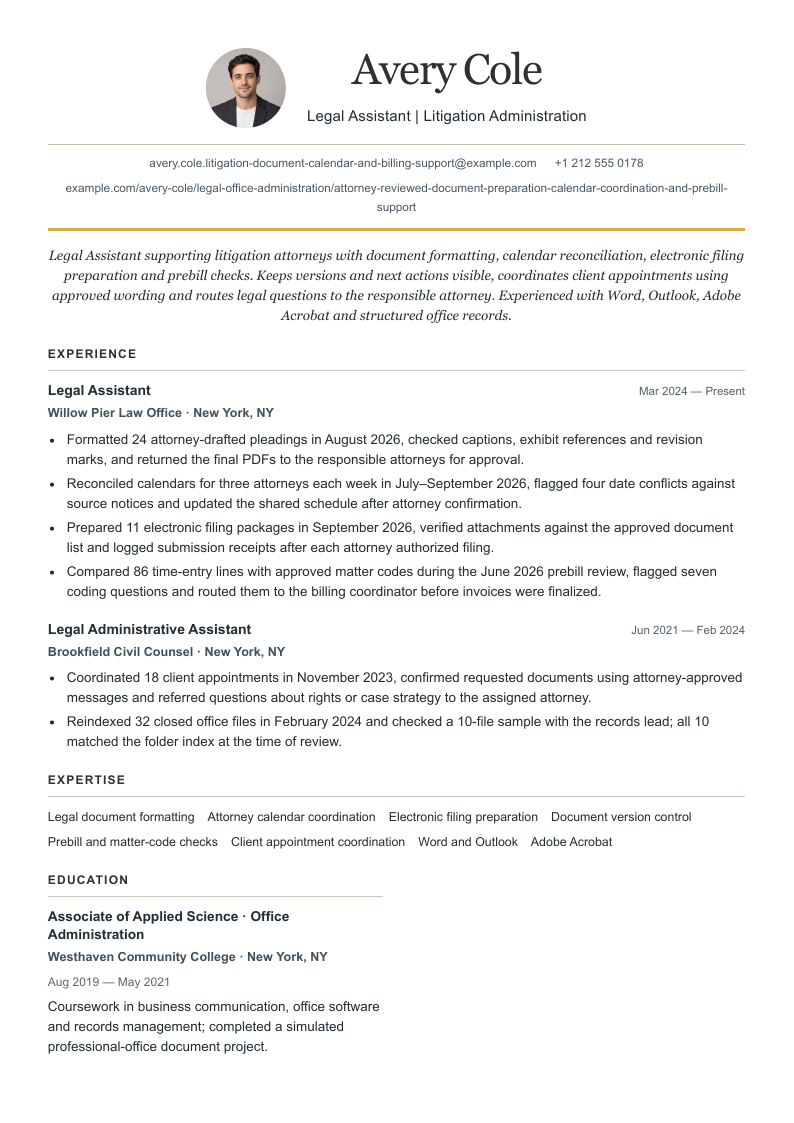
The long-contact Ledger export has the photo on. It changes only the resume email and social URL; identity, phone, jobs, education, skills and project remain the same. Follow the contact strip across every wrapped line and check the final characters. Open the portfolio destination as well as reading its displayed text. A working link cannot compensate for a clipped or hard-to-read email address.
Legal Assistant supporting litigation attorneys with document formatting, calendar reconciliation, electronic filing preparation and prebill checks. Keeps versions and next actions visible, coordinates client appointments using approved wording and routes legal questions to the responsible attorney. Experienced with Word, Outlook, Adobe Acrobat and structured office records.
Skills
Legal document formatting · Attorney calendar coordination · Electronic filing preparation · Document version control · Prebill and matter-code checks · Client appointment coordination · Word and Outlook · Adobe Acrobat
Experience
Legal Assistant
Willow Pier Law Office · New York, NY
March 2024–Present
Formatted 24 attorney-drafted pleadings in August 2026, checked captions, exhibit references and revision marks, and returned the final PDFs to the responsible attorneys for approval.
Reconciled calendars for three attorneys each week in July–September 2026, flagged four date conflicts against source notices and updated the shared schedule after attorney confirmation.
Prepared 11 electronic filing packages in September 2026, verified attachments against the approved document list and logged submission receipts after each attorney authorized filing.
Compared 86 time-entry lines with approved matter codes during the June 2026 prebill review, flagged seven coding questions and routed them to the billing coordinator before invoices were finalized.
Legal Administrative Assistant
Brookfield Civil Counsel · New York, NY
June 2021–February 2024
Coordinated 18 client appointments in November 2023, confirmed requested documents using attorney-approved messages and referred questions about rights or case strategy to the assigned attorney.
Reindexed 32 closed office files in February 2024 and checked a 10-file sample with the records lead; all 10 matched the folder index at the time of review.
Education
Associate of Applied Science in Office Administration · Westhaven Community College · New York, NY
August 2019–May 2021
Coursework in business communication, office software and records management; completed a simulated professional-office document project.
Projects
Prebill question register
Legal Assistant contributor · Willow Pier Law Office
Built a question register for the same 86-line prebill review, separating the original code, question owner and response status. The billing coordinator selected the fields and resolved the seven questions. A fabricated demonstration shows the structure without client balances, billing rates or invoice narratives.
Review the expanded record through its final project
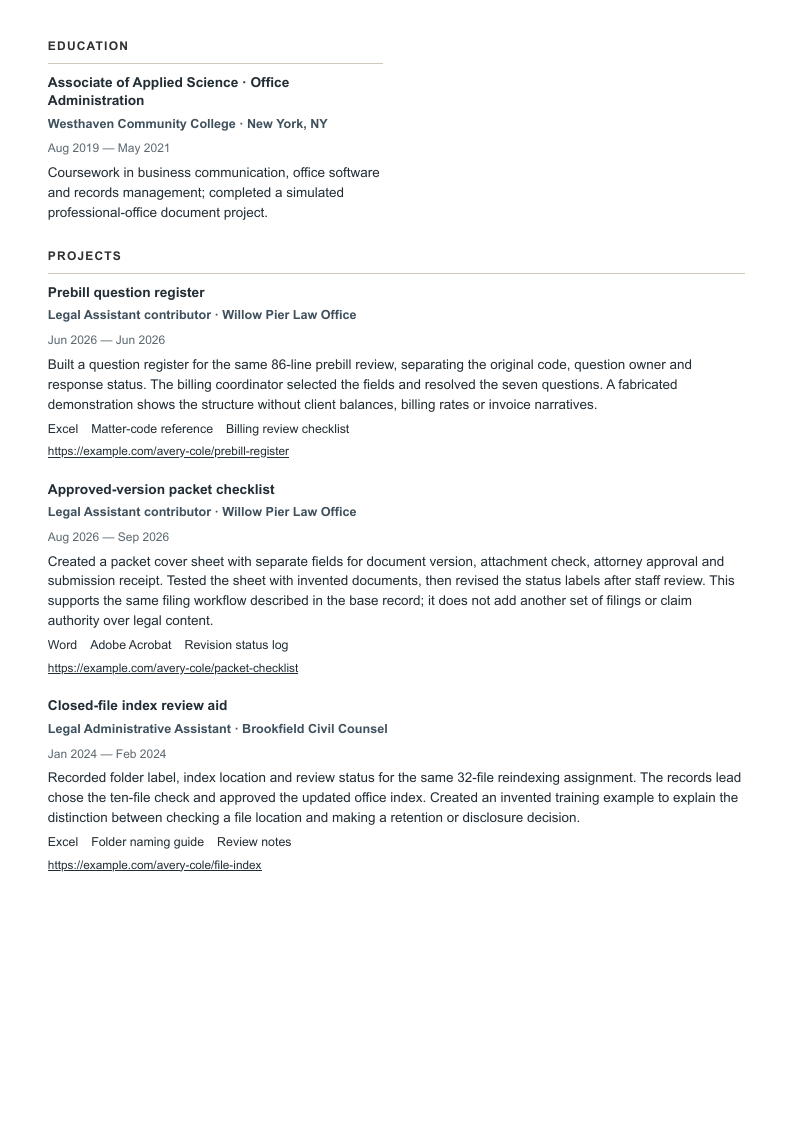
The expanded Ledger export uses the photo-off setting and preserves all base career facts. It adds one older reception job and two projects: a packet checklist and a file-index aid. Both projects explain assignments already counted in the work history. They do not create additional filings or files, and attorney and records-lead approval remain visible. Compare the whole export with the complete text below.
Legal Assistant supporting litigation attorneys with document formatting, calendar reconciliation, electronic filing preparation and prebill checks. Keeps versions and next actions visible, coordinates client appointments using approved wording and routes legal questions to the responsible attorney. Experienced with Word, Outlook, Adobe Acrobat and structured office records.
Skills
Legal document formatting · Attorney calendar coordination · Electronic filing preparation · Document version control · Prebill and matter-code checks · Client appointment coordination · Word and Outlook · Adobe Acrobat
Experience
Legal Assistant
Willow Pier Law Office · New York, NY
March 2024–Present
Formatted 24 attorney-drafted pleadings in August 2026, checked captions, exhibit references and revision marks, and returned the final PDFs to the responsible attorneys for approval.
Reconciled calendars for three attorneys each week in July–September 2026, flagged four date conflicts against source notices and updated the shared schedule after attorney confirmation.
Prepared 11 electronic filing packages in September 2026, verified attachments against the approved document list and logged submission receipts after each attorney authorized filing.
Compared 86 time-entry lines with approved matter codes during the June 2026 prebill review, flagged seven coding questions and routed them to the billing coordinator before invoices were finalized.
Legal Administrative Assistant
Brookfield Civil Counsel · New York, NY
June 2021–February 2024
Coordinated 18 client appointments in November 2023, confirmed requested documents using attorney-approved messages and referred questions about rights or case strategy to the assigned attorney.
Reindexed 32 closed office files in February 2024 and checked a 10-file sample with the records lead; all 10 matched the folder index at the time of review.
Office Reception Assistant · Part-time
Westhaven Community College · New York, NY
January 2020–May 2021
Scheduled student-service appointments and routed requests to the appropriate staff member while completing the office administration degree.
Maintained a shared desk checklist for mail, room bookings and unanswered messages; referred access requests to the office administrator.
Education
Associate of Applied Science in Office Administration · Westhaven Community College · New York, NY
August 2019–May 2021
Coursework in business communication, office software and records management; completed a simulated professional-office document project.
Projects
Prebill question register
Legal Assistant contributor · Willow Pier Law Office
Built a question register for the same 86-line prebill review, separating the original code, question owner and response status. The billing coordinator selected the fields and resolved the seven questions. A fabricated demonstration shows the structure without client balances, billing rates or invoice narratives.
Legal Assistant contributor · Willow Pier Law Office
August 2026–September 2026
Word · Adobe Acrobat · Revision status log
Created a packet cover sheet with separate fields for document version, attachment check, attorney approval and submission receipt. Tested the sheet with invented documents, then revised the status labels after staff review. This supports the same filing workflow described in the base record; it does not add another set of filings or claim authority over legal content.
Recorded folder label, index location and review status for the same 32-file reindexing assignment. The records lead chose the ten-file check and approved the updated office index. Created an invented training example to explain the distinction between checking a file location and making a retention or disclosure decision.
Let relevant evidence determine the length. A brief early-career record may fit one page; a fuller relevant history can use more space. Condense repeated duties before removing an approval boundary, employment date or useful project result. Check headings, job dates and the last project at every page break. A layout name does not establish how many pages your own facts will need.
Check the exported resume before applying
Read every page, including the older job, education description and final project URL.
Check the full email, phone and link destinations in both photo settings.
Keep document counts, time periods and approval steps connected to the correct assignment.
Remove client identifiers, confidential case material, billing narratives and filing credentials.
Copy text from the PDF and inspect the application’s parsed fields when available; follow the requested file type.
A free account is required to use the builder. Free-plan PDF downloads include a watermark; these images show paid-plan output without it. Design buttons retain the exact Ledger, Professional or Plainspoken template, the photo setting and Legal Assistant role through signup. They do not insert the fictional example or AI portrait into your resume. Check your own facts after any writing assistance.
The resume analyzer offers advisory feedback. Review its suggestions against your actual work and the vacancy. No template or tool can guarantee application parsing, an interview or a hiring decision.
Questions, answered
What skills should a Legal Assistant include on their resume?
Use relevant skills you can demonstrate, such as document formatting, calendar coordination, filing preparation, records management, client scheduling and billing support. Add specific software or court systems only when you have used them.
How do I write a Legal Assistant resume summary?
Name the office or practice setting and two or three strengths supported by the work history. Early-career applicants can identify training and supervised office work. Keep titles and years accurate, and avoid unsupported legal outcomes.
What are the key responsibilities of a Legal Assistant?
Duties vary by employer. They can include preparing documents for attorney review, coordinating calendars, assembling approved filing packets, organizing records and handling administrative communication. State what you performed and who approved the next step.
How long should a Legal Assistant resume be?
Use the space needed for relevant, readable evidence. A concise record may fit one page; a fuller relevant career may need more. Inspect the export rather than deleting dates or approval boundaries to reach a fixed target.
What makes a Legal Assistant resume stand out?
Specific work examples make the contribution assessable: document type, review period, supported attorneys, checked population and a clear approval step. Explain your role in team work without taking credit for verdicts or legal advice.
What ATS keywords should a Legal Assistant use?
Use truthful language from the actual vacancy, such as calendaring, document preparation, e-filing, records management or legal billing. Place tools in the work context where appropriate. Keyword repetition cannot establish competence or guarantee screening success.
What happens when I choose a design?
Signup retains the selected Ledger, Professional or Plainspoken design, photo preference and Legal Assistant role. It does not insert Avery’s fictional career or portrait. A free account is required, and free-plan PDF downloads include a watermark.
Prepared by Resumize with AI-assisted research and drafting for English-language US applications. Three current direct employer descriptions were read in full on October 28, 2026 with application controls present: a New York litigation firm, a Portland corporate legal department and Washington-area federal legal services. This small sample informs setting and task distinctions, not a national qualification rule. All candidate details and rewrites are original fiction. No legal advice, licensing determination, client case material or application submission is part of this guide; no hiring outcome was tested.
Retrieved October 28, 2026. Full responsibilities, requirements, Apply control and application form present; no posting date displayed. Supports litigation document formatting, calendars, filing, office software and attorney support. The three-year experience requirement belongs to this vacancy.
Retrieved October 28, 2026. Full description and Apply for this job link present; no posting date displayed. Corporate department example covering contract workflow, signatures, records, templates and coordination. It is a different setting from the fictional litigation office.
Retrieved October 28, 2026. Full description and application link present; no posting date displayed. Illustrates legal-office correspondence, records, scheduling and document support in federal services. Vacancy-specific eligibility conditions are not universal legal assistant requirements.