Elementary school teacher resume examples and templates
An elementary school teacher resume should explain how you teach foundational learning: the grade and subjects, the routines children practice, the assessment you use and the lesson you adjust next. This original example shows those decisions alongside family communication and colleague review, with enough context to understand your contribution.
These previews use the same layouts as the builder, with identical example content. Open a full preview to inspect the text and spacing.
Fictional candidate, employers, education and results. The optional portrait is AI-generated. Use your own evidence and photo; the example is not inserted into your resume.
Scholar
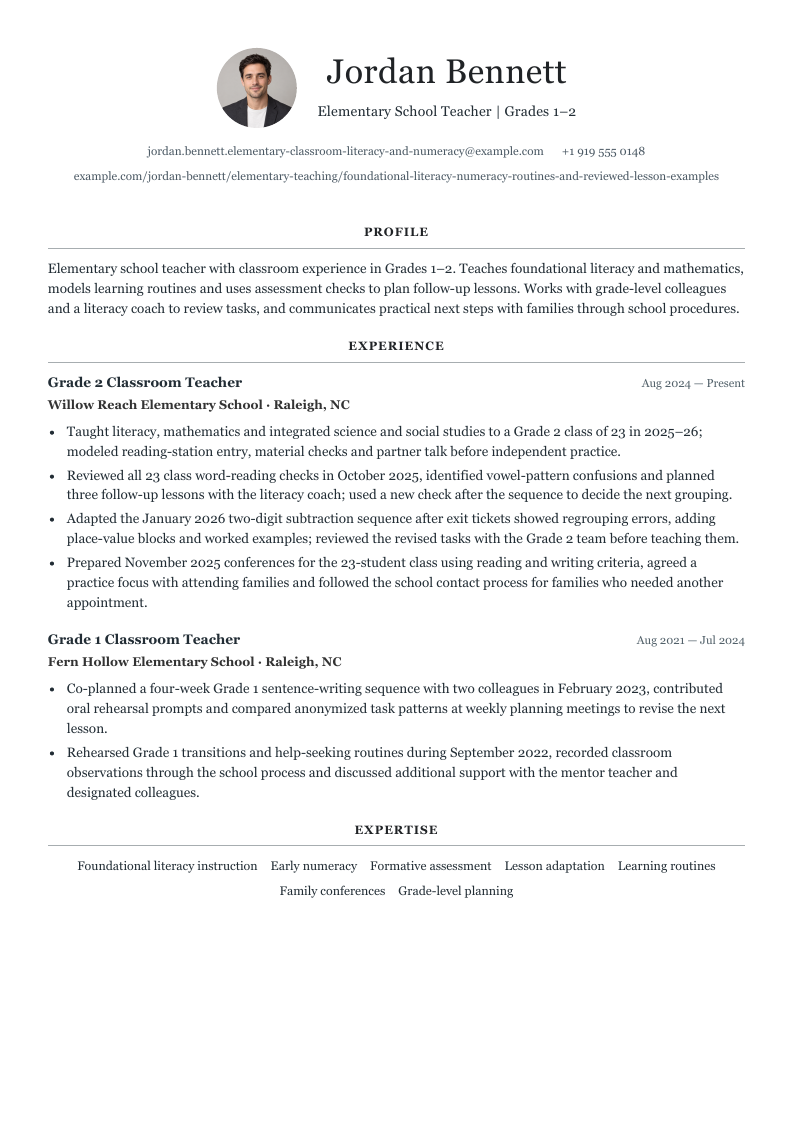
A centered serif identity, centered contact line and ruled headings lead through Profile, Experience and Expertise, then Education, Certifications and Projects.
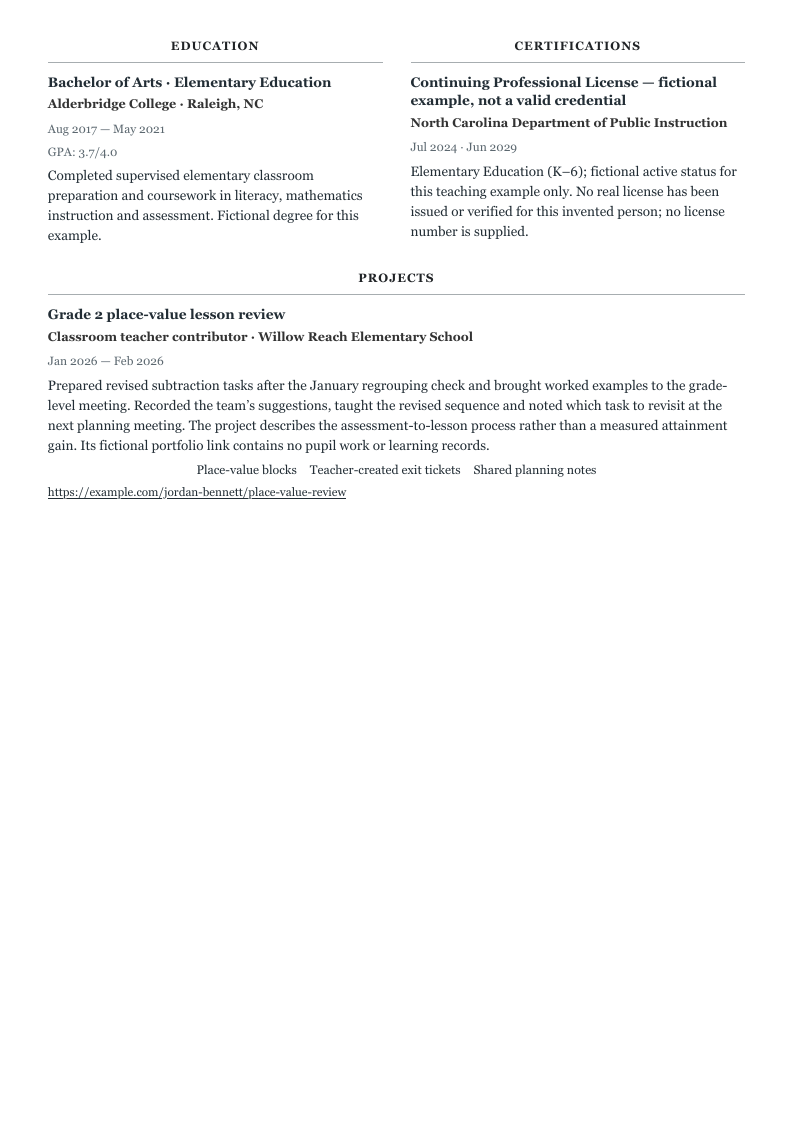
Before sending: The education and credential block follows teaching experience. Inspect the long license description and its dates together on continuation pages.
The original Classic renderer uses a serif name, centered section labels and a left date column. About Me and Education precede Work Experience, Projects, Certifications and Skills.
Before sending: Education appears before work and the date gutter narrows entry text. Its optional circular photo shares the header with contacts; displayed social labels may shorten, so inspect the actual link destination.
A coral identity block sits beside contacts. A left section-label gutter marks Profile, Experience, Expertise, Education, Certifications and Projects.
Before sending: The label gutter reduces room for teaching examples. Read the complete assessment decision and credential description in the export, especially around page transitions.
“Use” opens signup with that design and photo preference selected for the builder. A free account is required. Free-plan PDF downloads include a watermark; see current plans for paid options. Photo conventions vary; follow the employer’s instructions and local expectations.
Scholar, Classic and Civic present Jordan’s identical teaching record. The default has no photo; each design also has an optional photo preview. Open every page at normal reading size. The buttons carry your selected design, photo preference and elementary teacher role into signup. The fictional candidate, career record and portrait are not inserted into your account.
Scholar uses a centered serif identity and ruled headings, with teaching experience before the education and credential block. The original Classic puts Education before Work Experience and assigns dates their own left column; it is a separate builder design. Civic pairs a coral identity block with contacts and a section-label gutter. Choose the version in which your teaching decisions and credential status remain easy to read. No design guarantees screening or hiring results.
A complete elementary school teacher resume
Jordan Bennett is an invented North Carolina teacher with Grade 2 and earlier Grade 1 classroom roles. The 2025–26 class of 23 provides the context for the routines, reading check and conferences. Every person, school, degree, date, count and credential status in the record is fictional. The example.com links are placeholders. The portrait is AI-generated; the guide uses AI-assisted research and drafting.
Elementary school teacher with classroom experience in Grades 1–2. Teaches foundational literacy and mathematics, models learning routines and uses assessment checks to plan follow-up lessons. Works with grade-level colleagues and a literacy coach to review tasks, and communicates practical next steps with families through school procedures.
Taught literacy, mathematics and integrated science and social studies to a Grade 2 class of 23 in 2025–26; modeled reading-station entry, material checks and partner talk before independent practice.
Reviewed all 23 class word-reading checks in October 2025, identified vowel-pattern confusions and planned three follow-up lessons with the literacy coach; used a new check after the sequence to decide the next grouping.
Adapted the January 2026 two-digit subtraction sequence after exit tickets showed regrouping errors, adding place-value blocks and worked examples; reviewed the revised tasks with the Grade 2 team before teaching them.
Prepared November 2025 conferences for the 23-student class using reading and writing criteria, agreed a practice focus with attending families and followed the school contact process for families who needed another appointment.
Grade 1 Classroom Teacher
Fern Hollow Elementary School · Raleigh, NC
August 2021–July 2024
Co-planned a four-week Grade 1 sentence-writing sequence with two colleagues in February 2023, contributed oral rehearsal prompts and compared anonymized task patterns at weekly planning meetings to revise the next lesson.
Rehearsed Grade 1 transitions and help-seeking routines during September 2022, recorded classroom observations through the school process and discussed additional support with the mentor teacher and designated colleagues.
Education
Bachelor of Arts in Elementary Education · Alderbridge College · Raleigh, NC
August 2017–May 2021
Completed supervised elementary classroom preparation and coursework in literacy, mathematics instruction and assessment. Fictional degree for this example.
GPA: 3.7/4.0
Licenses and certifications
Continuing Professional License — fictional example, not a valid credential
North Carolina Department of Public Instruction
Issued July 2024 · Expires June 2029
Elementary Education (K–6); fictional active status for this teaching example only. No real license has been issued or verified for this invented person; no license number is supplied.
Projects
Grade 2 place-value lesson review
Classroom teacher contributor · Willow Reach Elementary School
Prepared revised subtraction tasks after the January regrouping check and brought worked examples to the grade-level meeting. Recorded the team’s suggestions, taught the revised sequence and noted which task to revisit at the next planning meeting. The project describes the assessment-to-lesson process rather than a measured attainment gain. Its fictional portfolio link contains no pupil work or learning records.
The license entry demonstrates how to state an area, issuer, issue date, expiry and status. It is explicitly fictional and is not a valid credential. It does not establish eligibility for any vacancy. Use your actual teaching assignment and issued credential details in your own resume.
Describe foundational learning as a sequence of decisions
A useful elementary example connects a small learning focus to what happened next. In Jordan’s reading example, the teacher reviews word-reading checks, identifies a pattern, plans follow-up lessons with a coach and uses a fresh check to decide grouping. The math example identifies regrouping errors and introduces concrete materials after team review. These are observable teaching actions even without a defensible attainment percentage.
The three employer descriptions illustrate related priorities with different instructional models. BRICK describes assessment-informed adjustments, coaching and family relationships. Classical emphasizes structured classroom culture and lesson revision with coaches. High Tech High’s TK–2 eligibility pool emphasizes project-based lesson design and documented progress. Select evidence that fits the actual vacancy; these descriptions do not create a single national definition of elementary teaching.
Give routines the same specificity as lessons. “Classroom management” alone leaves a reader guessing. Entry to a reading station, preparation of materials, partner talk and asking for help are teachable routines. Explain how you model or revisit them. Do not claim that routines eliminated all behavior concerns or that every child became independent. Keep children’s names, private learning records and individual support details out of the application.
Six annotated experience rewrites
Every “after” sentence below appears verbatim in Jordan’s base experience. The weak versions show common overclaims; they are not additional career facts. Use the evidence prompts to check your own account, then write in your own words. Evidence belongs in authorized school records, not as attachments containing pupil information.
1. Define the class and the learning routine
Before: Managed a classroom and made every child an independent learner.
After: Taught literacy, mathematics and integrated science and social studies to a Grade 2 class of 23 in 2025–26; modeled reading-station entry, material checks and partner talk before independent practice.
The 23 describes one class in one school year. Modeling named routines explains the work without claiming universal independence or a classroom free of interruptions.
Evidence to check: Teaching assignment, dated routine plans and observation feedback; do not attach a class roster.
2. Show what an assessment changed
Before: Used data to dramatically improve reading scores.
After: Reviewed all 23 class word-reading checks in October 2025, identified vowel-pattern confusions and planned three follow-up lessons with the literacy coach; used a new check after the sequence to decide the next grouping.
Connects a defined assessment population to a specific instructional response and a fresh decision. It reports no invented score gain or claim that the lessons alone caused progress.
Evidence to check: Your assessment plan, teacher-created lesson sequence and coach feedback; retain learning records within the school system.
3. Make the numeracy adjustment visible
Before: Differentiated math for every learning style.
After: Adapted the January 2026 two-digit subtraction sequence after exit tickets showed regrouping errors, adding place-value blocks and worked examples; reviewed the revised tasks with the Grade 2 team before teaching them.
Names the concept, observed error, materials and review. Adjusting instruction does not establish a diagnosis or ownership of a school-wide mathematics program.
Evidence to check: Original and revised tasks, dated team notes and your lesson reflection, without identifiable pupil work.
4. Explain communication and follow-through
Before: Built perfect relationships with all parents.
After: Prepared November 2025 conferences for the 23-student class using reading and writing criteria, agreed a practice focus with attending families and followed the school contact process for families who needed another appointment.
Preparation for a class is different from claiming 23 attended conferences. The wording describes an accessible follow-up process without inventing participation or satisfaction rates.
Evidence to check: Your conference preparation checklist and approved communication procedure; keep contact logs and family correspondence private.
5. Connect a foundational writing task to team review
Before: Transformed the whole writing curriculum.
After: Co-planned a four-week Grade 1 sentence-writing sequence with two colleagues in February 2023, contributed oral rehearsal prompts and compared anonymized task patterns at weekly planning meetings to revise the next lesson.
Defines the unit, period, collaborators and contribution. Internal review of anonymized patterns is not permission to publish pupil writing or claim sole curriculum authorship.
Evidence to check: Your planning contributions, shared criteria and meeting decisions; a clean teacher-created prompt may be shareable with school permission.
6. Document observation without overstating authority
Before: Solved all behavior issues and assessed every learning need.
After: Rehearsed Grade 1 transitions and help-seeking routines during September 2022, recorded classroom observations through the school process and discussed additional support with the mentor teacher and designated colleagues.
Shows classroom teaching and an appropriate consultation boundary. It does not turn observations into specialist assessment or promise that all concerns were resolved.
Evidence to check: Routine plans, mentor observation feedback and the consultation process; exclude incident histories and individual support records.
Keep grade, subject and ownership clear
Start the summary with your actual grade range and strongest relevant practice. Jordan’s Grades 1–2 experience supports foundational literacy, early numeracy and routines. The Grade 2 job names literacy, mathematics and integrated science and social studies; it does not imply a specialist subject endorsement. If you taught a departmental subject, a mixed-grade class or a temporary assignment, describe that setting accurately instead of borrowing this sample’s all-subject scope.
Under each job, pair the action with its context and next decision: reviewed what, during which period, changed which task, and with whose input? Distinguish your authored prompts from team planning, a coach’s guidance and decisions made by designated colleagues. The current role starts in August 2024, while the class and assessment examples concern 2025–26; the 23-student count should not be applied to every year of employment.
A class size, unit length or number of planned lessons establishes scope. It does not measure learning gain. If you include attainment evidence, define the assessment, period, population and your contribution, and confirm that the aggregate is safe to disclose. Avoid suggesting that your teaching alone caused a change that also reflects attendance, prior learning, team support or other conditions. A clear lesson adaptation is more useful than a percentage you cannot explain.
Support each teaching skill with a visible example
Choose skills from the posting that you can demonstrate. “Lesson adaptation” gains meaning when the work history names regrouping errors and revised tasks. List a curriculum, assessment platform or classroom technology only if you have used it in the stated context; generic digital confidence does not establish expertise in a named system. Keep the list short enough that the experience can substantiate it.
Elementary school teacher skills and supporting evidence
Skill
Evidence to gather
Fictional example
Foundational literacy
A named reading focus and the next teaching decision.
October word-reading checks informed three vowel-pattern lessons.
Early numeracy
The concept, observed error and revised task.
Regrouping work used place-value blocks and worked examples.
Learning routines
What you explicitly modeled, rehearsed and revisited.
Reading-station entry, material checks and partner talk.
Formative assessment
A defined class, period and instructional response.
All 23 October checks reviewed before planning the next grouping.
Family communication
A shared learning reference and a follow-up process.
Conference criteria, practice focus and alternative appointments.
Collaborative planning
Your contribution and the colleague review.
Oral rehearsal prompts in a four-week Grade 1 writing sequence.
Separate degree completion from an issued teaching license
List the actual degree, field, institution and completion dates. A relevant GPA is optional, particularly beyond the first teaching role; Jordan’s fictional GPA is included in the full text for completeness. In Classic, Education precedes Work Experience; check whether this emphasis suits the application, and confirm the degree details and any grade you choose to include in the final file.
For a license, use the issuing authority’s exact credential title and grade or subject area, then state issued status and expiry accurately. The North Carolina example uses Elementary Education (K–6) and a fictional Continuing Professional License, issued July 2024 with June 2029 expiry. DPI describes a five-year renewal cycle for that license. Degree completion, an application, an exam result and an issued current license are separate facts. Do not turn preparation or a planned renewal into active status.
Requirements vary by jurisdiction, school and assignment. The researched vacancies express different qualification language, including pathway or experience options and a California credential requirement. Check the target employer and the relevant state education authority rather than treating this North Carolina sample as transferable authorization. You can supply verification through the employer’s required process without adding a real license number to a public resume example.
Use supervised preparation honestly in a first teaching application
A new teacher can use student teaching, supervised lessons, tutoring or a clearly labeled course project. Name the setting and supervisor, identify the grade and learning focus, and show how feedback changed a plan. Keep the placement title intact. Preparing a supervised lesson does not establish independent responsibility for a class, family contact or a specialist assessment.
Fictional adaptation for Jordan’s first application in June 2021
Summary: Elementary education graduate with a supervised Grade 1 placement. Planned reading and number lessons, prepared concrete materials and revised written plans after mentor feedback. Seeking a first classroom role; degree complete and teaching-license application pending.
Placement bullet: Planned and taught supervised Grade 1 reading and number lessons during the final degree placement, incorporating mentor feedback into the next written plan.
This is an explicitly historical adaptation. The pending status belongs to the imagined June 2021 application, not Jordan’s current fictional 2024–29 license. The placement appears in the expanded record below and overlaps the final degree term. In your own first application, state the genuine status and expected dates, and check whether the vacancy accepts that stage of preparation.
Read the long contacts with the photo enabled
This Scholar scenario changes only the resume email and portfolio URL. The user identity and all career content match the base record. With the photo on, inspect the contact line through the last character and test the destination in the PDF. The complete text below provides the full address and link for comparison. A portrait is optional here; follow the employer’s instructions for your application.
Elementary school teacher with classroom experience in Grades 1–2. Teaches foundational literacy and mathematics, models learning routines and uses assessment checks to plan follow-up lessons. Works with grade-level colleagues and a literacy coach to review tasks, and communicates practical next steps with families through school procedures.
Taught literacy, mathematics and integrated science and social studies to a Grade 2 class of 23 in 2025–26; modeled reading-station entry, material checks and partner talk before independent practice.
Reviewed all 23 class word-reading checks in October 2025, identified vowel-pattern confusions and planned three follow-up lessons with the literacy coach; used a new check after the sequence to decide the next grouping.
Adapted the January 2026 two-digit subtraction sequence after exit tickets showed regrouping errors, adding place-value blocks and worked examples; reviewed the revised tasks with the Grade 2 team before teaching them.
Prepared November 2025 conferences for the 23-student class using reading and writing criteria, agreed a practice focus with attending families and followed the school contact process for families who needed another appointment.
Grade 1 Classroom Teacher
Fern Hollow Elementary School · Raleigh, NC
August 2021–July 2024
Co-planned a four-week Grade 1 sentence-writing sequence with two colleagues in February 2023, contributed oral rehearsal prompts and compared anonymized task patterns at weekly planning meetings to revise the next lesson.
Rehearsed Grade 1 transitions and help-seeking routines during September 2022, recorded classroom observations through the school process and discussed additional support with the mentor teacher and designated colleagues.
Education
Bachelor of Arts in Elementary Education · Alderbridge College · Raleigh, NC
August 2017–May 2021
Completed supervised elementary classroom preparation and coursework in literacy, mathematics instruction and assessment. Fictional degree for this example.
GPA: 3.7/4.0
Licenses and certifications
Continuing Professional License — fictional example, not a valid credential
North Carolina Department of Public Instruction
Issued July 2024 · Expires June 2029
Elementary Education (K–6); fictional active status for this teaching example only. No real license has been issued or verified for this invented person; no license number is supplied.
Projects
Grade 2 place-value lesson review
Classroom teacher contributor · Willow Reach Elementary School
Prepared revised subtraction tasks after the January regrouping check and brought worked examples to the grade-level meeting. Recorded the team’s suggestions, taught the revised sequence and noted which task to revisit at the next planning meeting. The project describes the assessment-to-lesson process rather than a measured attainment gain. Its fictional portfolio link contains no pupil work or learning records.
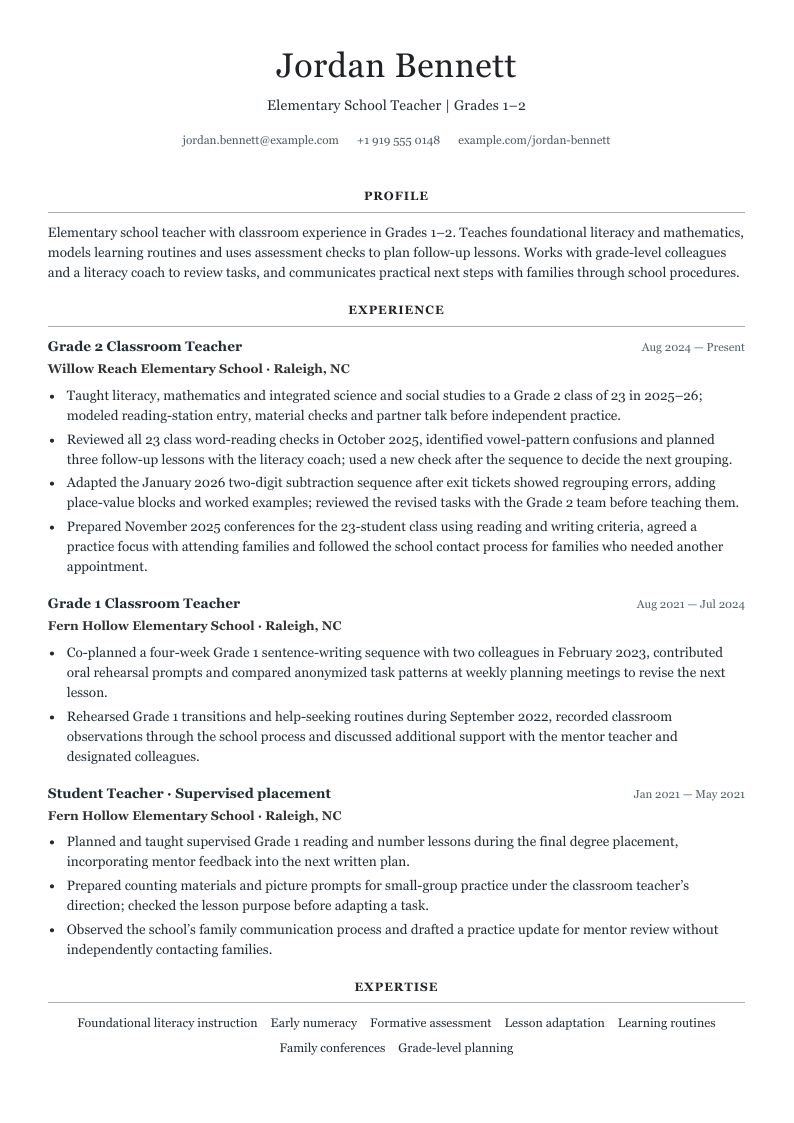
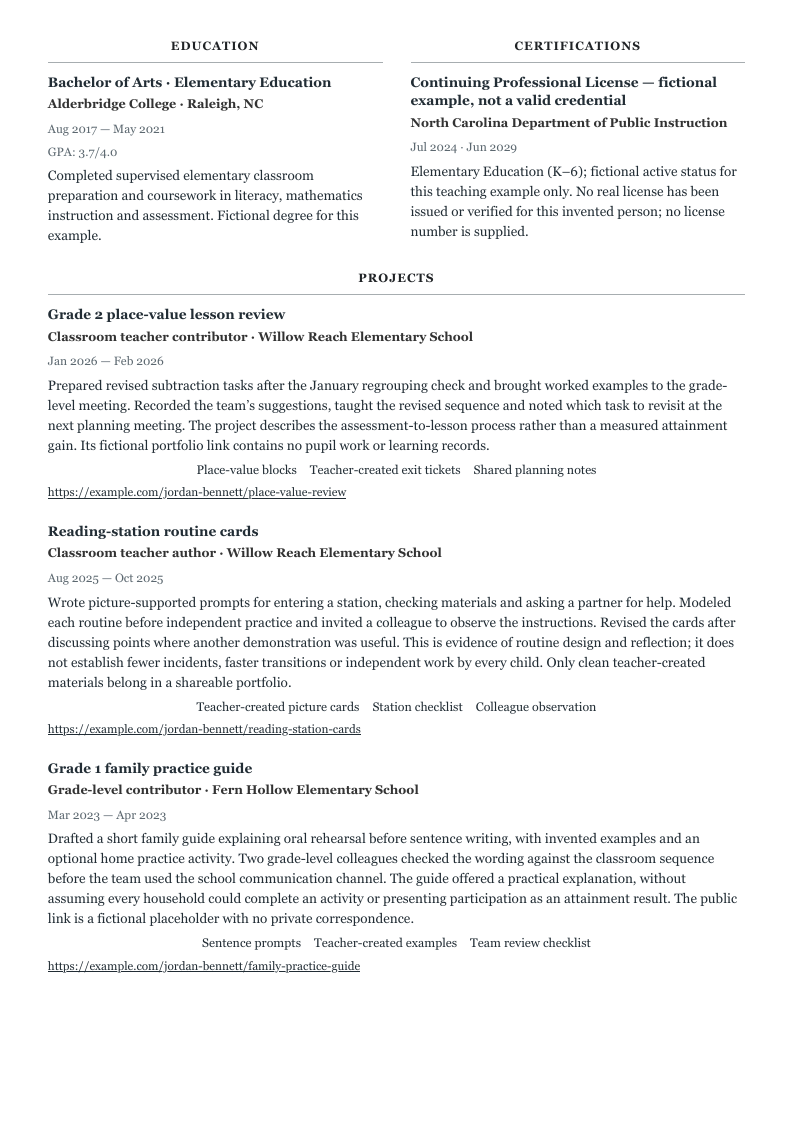
The expanded Scholar example has the photo off. It retains every base field, job, credential and project, then adds Jordan’s supervised January–May 2021 placement and two projects. The placement ends with degree completion before the first classroom job begins in August. Reading-station cards and a family practice guide show additional authored work and review, without adding invented attainment gains.
Elementary school teacher with classroom experience in Grades 1–2. Teaches foundational literacy and mathematics, models learning routines and uses assessment checks to plan follow-up lessons. Works with grade-level colleagues and a literacy coach to review tasks, and communicates practical next steps with families through school procedures.
Taught literacy, mathematics and integrated science and social studies to a Grade 2 class of 23 in 2025–26; modeled reading-station entry, material checks and partner talk before independent practice.
Reviewed all 23 class word-reading checks in October 2025, identified vowel-pattern confusions and planned three follow-up lessons with the literacy coach; used a new check after the sequence to decide the next grouping.
Adapted the January 2026 two-digit subtraction sequence after exit tickets showed regrouping errors, adding place-value blocks and worked examples; reviewed the revised tasks with the Grade 2 team before teaching them.
Prepared November 2025 conferences for the 23-student class using reading and writing criteria, agreed a practice focus with attending families and followed the school contact process for families who needed another appointment.
Grade 1 Classroom Teacher
Fern Hollow Elementary School · Raleigh, NC
August 2021–July 2024
Co-planned a four-week Grade 1 sentence-writing sequence with two colleagues in February 2023, contributed oral rehearsal prompts and compared anonymized task patterns at weekly planning meetings to revise the next lesson.
Rehearsed Grade 1 transitions and help-seeking routines during September 2022, recorded classroom observations through the school process and discussed additional support with the mentor teacher and designated colleagues.
Student Teacher · Supervised placement
Fern Hollow Elementary School · Raleigh, NC
January 2021–May 2021
Planned and taught supervised Grade 1 reading and number lessons during the final degree placement, incorporating mentor feedback into the next written plan.
Prepared counting materials and picture prompts for small-group practice under the classroom teacher’s direction; checked the lesson purpose before adapting a task.
Observed the school’s family communication process and drafted a practice update for mentor review without independently contacting families.
Education
Bachelor of Arts in Elementary Education · Alderbridge College · Raleigh, NC
August 2017–May 2021
Completed supervised elementary classroom preparation and coursework in literacy, mathematics instruction and assessment. Fictional degree for this example.
GPA: 3.7/4.0
Licenses and certifications
Continuing Professional License — fictional example, not a valid credential
North Carolina Department of Public Instruction
Issued July 2024 · Expires June 2029
Elementary Education (K–6); fictional active status for this teaching example only. No real license has been issued or verified for this invented person; no license number is supplied.
Projects
Grade 2 place-value lesson review
Classroom teacher contributor · Willow Reach Elementary School
Prepared revised subtraction tasks after the January regrouping check and brought worked examples to the grade-level meeting. Recorded the team’s suggestions, taught the revised sequence and noted which task to revisit at the next planning meeting. The project describes the assessment-to-lesson process rather than a measured attainment gain. Its fictional portfolio link contains no pupil work or learning records.
Classroom teacher author · Willow Reach Elementary School
August 2025–October 2025
Teacher-created picture cards · Station checklist · Colleague observation
Wrote picture-supported prompts for entering a station, checking materials and asking a partner for help. Modeled each routine before independent practice and invited a colleague to observe the instructions. Revised the cards after discussing points where another demonstration was useful. This is evidence of routine design and reflection; it does not establish fewer incidents, faster transitions or independent work by every child. Only clean teacher-created materials belong in a shareable portfolio.
Grade-level contributor · Fern Hollow Elementary School
March 2023–April 2023
Sentence prompts · Teacher-created examples · Team review checklist
Drafted a short family guide explaining oral rehearsal before sentence writing, with invented examples and an optional home practice activity. Two grade-level colleagues checked the wording against the classroom sequence before the team used the school communication channel. The guide offered a practical explanation, without assuming every household could complete an activity or presenting participation as an attainment result. The public link is a fictional placeholder with no private correspondence.
Follow the last sentence of each job and project through continuation pages. Check that the credential title, issuer and expiry stay understandable together. More material is useful when it answers the vacancy; select relevant evidence in your own resume instead of padding it to match this layout exercise or deleting meaningful limits to force a page count.
Check the resume you will actually submit
Read every exported page at normal size. Check grade and subjects, the 2025–26 class context, assessment dates, collaboration, education and license expiry.
Select and copy the PDF text. Confirm the reading order, full contact details, dates and credential description. Open portfolio and project links; a shortened label can still have the correct destination.
Follow the employer’s requested file type and inspect any parsed application fields after upload. No template guarantees compatibility with every hiring system.
Compare claims with evidence you may disclose. Remove names, private learning records, confidential family communication and unsupported score improvements. Keep supervised and shared responsibilities explicit.
What should an elementary school teacher resume emphasize?
State your actual grade range and subjects, then show foundational instruction, classroom routines, assessment-led lesson adjustments, family communication and colleague review. Choose examples that match the specific vacancy rather than listing every school duty.
Do I need test-score increases in every teaching bullet?
No. A defined assessment check, a revised lesson and a clear next decision demonstrate practice. Report a gain only when you can explain the assessment, period, population and contribution and may disclose the aggregate. A class count or unit length describes scope, not impact.
How should a student teacher describe experience?
Label it as student teaching or a supervised placement, include the grade and dates, and explain the lessons you prepared and how mentor feedback informed changes. Do not claim independent classroom or family-contact authority you did not have.
What teaching license details belong on the resume?
Use the actual credential name, issuer, authorized grade or subject area, issued status and relevant dates. Distinguish pending applications and preparation from a current issued license. Check the employer and state authority; this fictional North Carolina license is not valid or verified.
Which design should I choose, and is a photo required?
Choose a design in which your teaching scope, dates and credential status are readable. Scholar and Civic place experience before education; native Classic places education first. The default is without a photo. Follow employer instructions; the optional portrait does not establish a hiring advantage.
What do the template buttons retain at signup?
The selected design, photo preference and Elementary School Teacher role carry into signup. The fictional resume and AI portrait are not added to your account. Free-plan PDF downloads include a watermark.
Continue with the existing elementary teaching resources
Prepared by Resumize with AI-assisted research and drafting for English-language US elementary school applications. We retrieved three direct employer descriptions on October 28, 2026, each with an Apply control. One is an eligibility pool; an application can close and requirements differ. North Carolina DPI supplies credential context for the invented candidate, and CareerOneStop informs resume structure. The fictional record and AI-generated portrait are teaching materials, without employer endorsement. This guide does not verify credentials or guarantee eligibility, screening results or a job offer.
Retrieved October 28, 2026. Newark, NJ; BRICK Gateway Academy; full-time; Apply control present. No posting date displayed. Describes adopted lessons, assessment-informed adjustments, coaching, grade-level meetings and family relationships. Its credential or active-pathway requirement is employer-specific.
Retrieved October 28, 2026. Bronx, NY; regular full-time; Apply control present. Start described as the 2026–2027 school year; no posting date displayed. Emphasizes structured classroom culture, revised lessons, assessment review and collaboration with coaches. Its certification-or-experience qualification is not a national licensing rule.
Retrieved October 28, 2026. San Diego, California; All Schools Eligibility Pool; Apply control present. Application opening August 1, 2026 and closing June 30, 2027 are displayed, not labeled posting dates. Describes lesson design, project work and documenting progress; lists a bachelor’s degree and California Multiple Subjects credential or out-of-state teaching license.
Retrieved October 28, 2026. Primary issuing-authority guidance on licensure areas, applications and qualifications. Use the actual license area and issued status; an education degree, course or submitted application alone does not demonstrate a current license.
Retrieved October 28, 2026. Describes the five-year Continuing Professional License renewal cycle and current renewal guidance. Supports checking expiry and status; this guide’s invented credential is not an issued license or a credential verification.
Retrieved October 28, 2026. US Department of Labor-sponsored resume guidance on relevant work history, job context, dates and specific actions. Used for writing structure rather than teacher eligibility or a guarantee about hiring systems.