Precision
An open two-column body puts compact skills beside the experience record below the header and profile.
Before sending: Check the skills column and ensure dataset definitions remain attached to their results when copying PDF text.
Technology · Analytics pipelines
A Data Engineer resume should trace data from its source to a usable output: ingestion, transformations, model definitions, scheduling, quality checks and the people who depend on the result. Show the engineering decisions behind a reliable reporting dataset instead of using “big data” as a substitute for scope.
By Resumize · · Sources and scope
Three designs · one example
These previews use the same layouts as the builder, with identical example content. Open a full preview to inspect the text and spacing.
Fictional candidate, employers, education and results. The optional portrait is AI-generated. Use your own evidence and photo; the example is not inserted into your resume.
An open two-column body puts compact skills beside the experience record below the header and profile.
Before sending: Check the skills column and ensure dataset definitions remain attached to their results when copying PDF text.
A white centered header places the optional circular portrait above the identity, followed by restrained sections.
Before sending: Long contacts can wrap across the centered line; check the header and all pages after adding the portrait.
A light header sits over an unfilled left column for projects, skills and education beside profile and experience.
Before sending: The project column is narrower than the work-history column; read every project ending and page transition.
“Use” opens signup with that design and photo preference selected for the builder. A free account is required. Free-plan PDF downloads include a watermark; see current plans for paid options. Photo conventions vary; follow the employer’s instructions and local expectations.
An open two-column body puts compact skills beside the experience record below the header and profile. A white centered header places the optional circular portrait above the identity, followed by restrained sections. A light header sits over an unfilled left column for projects, skills and education beside profile and experience.
Each design shows the same fictional career. The default has no photo; the optional portrait is AI-generated. The buttons retain the exact selected design, photo preference and Data Engineer role through signup. They do not put the example career or portrait into your account. A free account is required; free-plan PDF downloads include a watermark. These images show paid-plan output.
Jordan Hale, the employers, college, career, dates and results are original fiction. All example.com links are placeholders and the 555 phone number is fictional. Use the structure with your own supported facts.
Data Engineer | Analytics Pipelines
jordan.hale@example.com · +1 312 555 0167
Portfolio: https://example.com/jordan-hale
Data engineer developing SQL and Python pipelines for operational reporting. Builds Snowflake models with dbt, schedules batch workflows in Airflow and works with analysts on data definitions and quality checks. Brings experience supporting production datasets from ingestion through documented consumer use.
SQL · Python · Snowflake · dbt · Apache Airflow · Amazon S3 · Dimensional modeling · Data quality and documentation
Stonebridge Commerce Systems · Chicago, IL
July 2022–Present
Hawthorn Reporting Services · Milwaukee, WI
June 2020–June 2022
Bachelor of Science in Information Systems · Lakeford University · Wisconsin
August 2016–May 2020
Coursework in relational databases, programming and business information systems.
Data engineer · Stonebridge Commerce Systems
April 2026–June 2026
dbt · Snowflake · Data dictionary
Created a model dictionary covering order-line grain, refund treatment, product keys and reporting cutoff. Walked the operations analysts through reconciliation checks and late-data escalation so the models could be used with their known limitations.
Jordan’s specialty is batch analytics data: Python ingestion, SQL and dbt transformations, Snowflake models and Airflow dependencies. The work ends with documented outputs that operations analysts can use. This differs from primarily building dashboards or interpreting business trends, and from training or evaluating machine-learning models. Name those other responsibilities only if you actually performed them.
The employer descriptions vary. tastytrade’s Chicago hybrid role seeks two to five years and production dbt, Python and orchestration work. Zeta’s Copenhagen role emphasizes partner-feed evaluation, ingestion and field mappings in AWS. Goodway’s senior opening targets Brazil, Colombia and Mexico and explicitly excludes US candidates. Its remote label does not make it a worldwide or US opportunity.
Keep source, frequency, destination and consumer together. Four daily order feeds are a stronger description than “large-scale ETL” without a volume basis. If your vacancy focuses on Spark batch processing, Kafka streaming, feature stores, cloud migration or governance, use genuine evidence from that specialty. One analytics pipeline does not prove all of these areas.
These examples show how to make scope and evidence assessable. The after statements are exactly the six work-history bullets in the base resume. Replace every invented fact; do not borrow a metric you cannot support.
Before: Built scalable pipelines for big data.
After: Built Python ingestion and dbt transformations for four daily order feeds into Snowflake, publishing documented order and item models used by the operations reporting team.
Why it works: The sources, frequency, destination and consumer show an engineering deliverable rather than a vague claim about scale.
Evidence to check: Feed inventory, schedule, model definitions and permitted consumer examples.
Before: Achieved 100% pipeline reliability.
After: Across 60 scheduled weekday runs in April–June 2026, 57 published the order models before the agreed 08:00 reporting cutoff; investigated the three late runs with upstream owners.
Why it works: The 95% result concerns these runs and this cutoff. It is not infrastructure uptime or a promise about every future run.
Evidence to check: Schedule population, publication timestamps, timezone, cutoff agreement and late-run causes.
Before: Guaranteed perfectly clean data.
After: Added duplicate-key, required-field and reconciliation checks to the order models; routed failed checks to the owning team and held affected outputs from the reporting release pending review.
Why it works: Names failure conditions and the action taken without asserting that all data is correct.
Evidence to check: Test definitions, release behavior, ownership and examples of reviewed failures.
Before: Designed a world-class data warehouse.
After: Defined order-line grain and conformed product keys with analysts, documented refund handling and reviewed reconciliation totals with finance before replacing the legacy weekly extract.
Why it works: Grain and business rules are concrete modeling work. Shared finance review prevents sole credit for the result.
Evidence to check: Model grain, key definitions, refund rules, reconciliation and approval record.
Before: Expert in Airflow automation.
After: Maintained Airflow dependencies for nightly inventory extracts, documented retry and backfill expectations and escalated missing source deliveries before downstream tables were refreshed.
Why it works: Shows scheduling responsibilities and consumer protection without claiming streaming expertise.
Evidence to check: Workflow dependencies, agreed recovery behavior and escalation responsibility.
Before: Cut all company data costs by half.
After: Revised SQL joins in one inventory transformation; median runtime across 10 daily runs per version moved from 24 to 15 minutes in May–June 2022 on the same warehouse size, with the platform team reviewing execution plans.
Why it works: The comparison names a transformation, sample, period and compute setting. It does not establish company-wide savings.
Evidence to check: Run logs, comparable inputs, warehouse size, execution plans and collaborators.
Jordan’s summary identifies the reporting specialty and the tools used to deliver it. An early-career summary can name a labeled ingestion project and validation work. A mid-career summary can explain production ownership and the consumer handover. A senior summary should add real platform decisions, cross-team standards or mentoring rather than treating years of experience as proof of architecture authority.
The readiness result has a schedule and a cutoff: 57 of 60 weekday runs published before 08:00 during April–June 2026. Include the timezone in your own supporting evidence and use the cutoff agreed with consumers. This is a publication measure for selected models, not service uptime. Explain upstream delays and your own corrective work without assigning every late delivery to the pipeline code.
For performance or cost claims, retain comparable input sizes, compute settings and periods. Jordan’s earlier SQL comparison uses 10 daily runs per version and the same warehouse size. Faster runtime alone does not establish lower billed cost, better dashboard adoption or a business saving. Reconciliation and quality checks also need defined rules; “clean data” without a failure condition is hard to assess.
Documentation is part of delivery. Order-line grain, product keys and refund treatment explain what a model means. Airflow’s official architecture overview describes task dependencies and workflow order; the resume should show what you scheduled, how missing inputs were handled and who was told when a publication was held.
Choose a short, relevant list from work you can explain. Use the vacancy’s wording when accurate, then support it with decisions and outcomes in the history. A keyword list cannot establish competence or guarantee screening success.
| Skill | Evidence to gather | Fictional example |
|---|---|---|
| SQL and Python | Transformation or ingestion logic and its use. | Four daily order feeds into reporting models. |
| Modeling | Grain, keys and business rules. | Order-line grain and reviewed refund treatment. |
| Orchestration | Dependencies, schedule and recovery expectations. | Nightly extracts with missing-feed escalation. |
| Quality | Failure conditions and release response. | Duplicate-key, required-field and reconciliation checks. |
| Cloud warehouse | Actual platform tasks and compute assumptions. | Snowflake models and comparable warehouse-size runs. |
| Consumer handover | Definitions, limitations and ownership. | Operations analysts receive a model dictionary. |
Jordan lists an information systems degree and database and programming coursework. Use the education you earned; keep dates and institution names accurate. A database assignment can be a project when clearly labeled, but should not be presented as production pipeline employment. A GPA is optional and only useful when it adds relevant evidence.
The sample has no certification. If an opening values a vendor credential you actually hold, use its current issuer title, issue date, expiry or status and an appropriate verification link. Training attendance is not the same as certification. Do not claim AWS, Snowflake, Databricks or every other platform merely because one course mentioned it.
A useful early-career project can ingest a public or synthetic source, transform it into a defined model and demonstrate a few meaningful checks. State the refresh schedule, model grain and intended consumer. Show a failed-check example and the expected response. A small complete pipeline tells more than several copied tutorials with no ownership or validation.
For a move from analysis, keep the analyst title and explain the engineering portion you actually owned: scheduled ingestion, reviewed transformations or model testing. Do not relabel ad hoc SQL as production orchestration. The expanded record includes an earlier data operations internship, a runtime review and a synthetic recovery exercise, preserving the distinction between work, measurement and practice.
The long-contact Precision export uses the photo-on setting and changes only Jordan’s resume email and portfolio URL. The career record and user identity remain the same. Read both contact endings and verify the link destination; the long-contact variant is a layout check, not a different applicant.
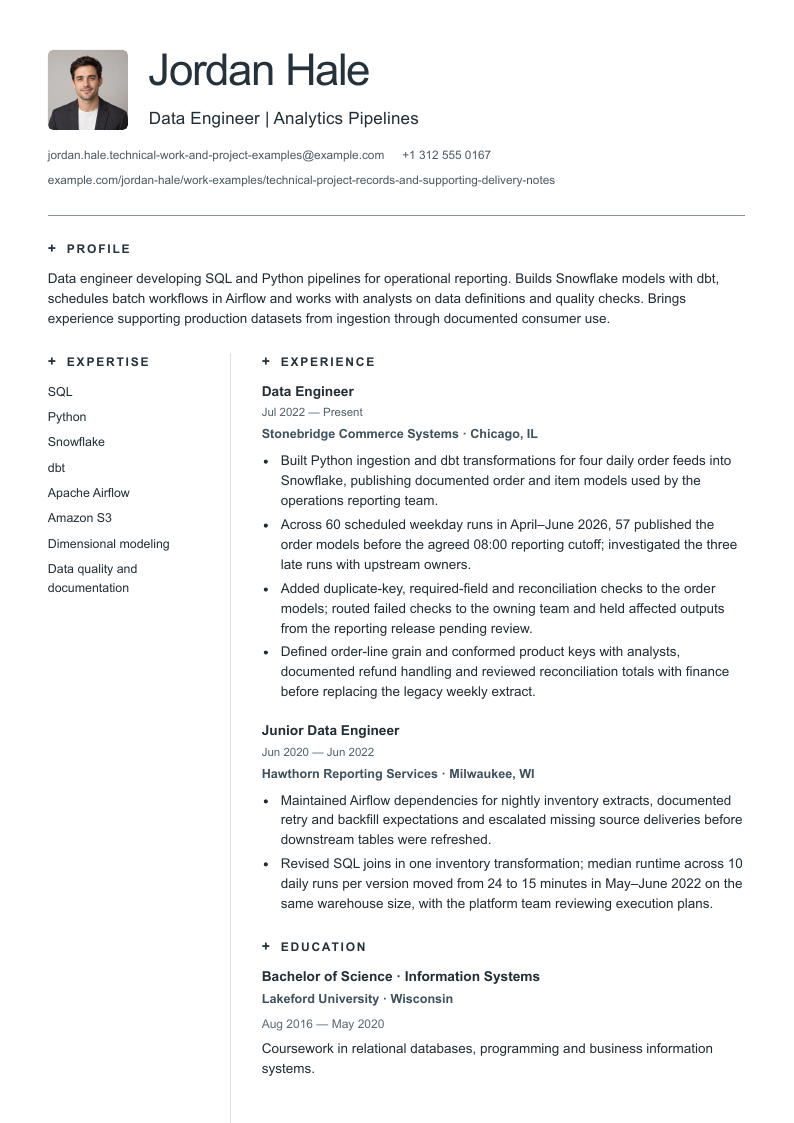 Open page 1 at full size
 Open page 2 at full size
Data Engineer | Analytics Pipelines
jordan.hale.technical-work-and-project-examples@example.com · +1 312 555 0167
Data engineer developing SQL and Python pipelines for operational reporting. Builds Snowflake models with dbt, schedules batch workflows in Airflow and works with analysts on data definitions and quality checks. Brings experience supporting production datasets from ingestion through documented consumer use.
SQL · Python · Snowflake · dbt · Apache Airflow · Amazon S3 · Dimensional modeling · Data quality and documentation
Stonebridge Commerce Systems · Chicago, IL
July 2022–Present
Hawthorn Reporting Services · Milwaukee, WI
June 2020–June 2022
Bachelor of Science in Information Systems · Lakeford University · Wisconsin
August 2016–May 2020
Coursework in relational databases, programming and business information systems.
Data engineer · Stonebridge Commerce Systems
April 2026–June 2026
dbt · Snowflake · Data dictionary
Created a model dictionary covering order-line grain, refund treatment, product keys and reporting cutoff. Walked the operations analysts through reconciliation checks and late-data escalation so the models could be used with their known limitations.
The expanded Precision export uses the photo-off setting. It adds an older data operations internship, an inventory transformation review and a synthetic late-feed exercise while retaining all base fields. Follow every project ending and keep model grain, cutoff and runtime qualifiers attached to the statements they explain.
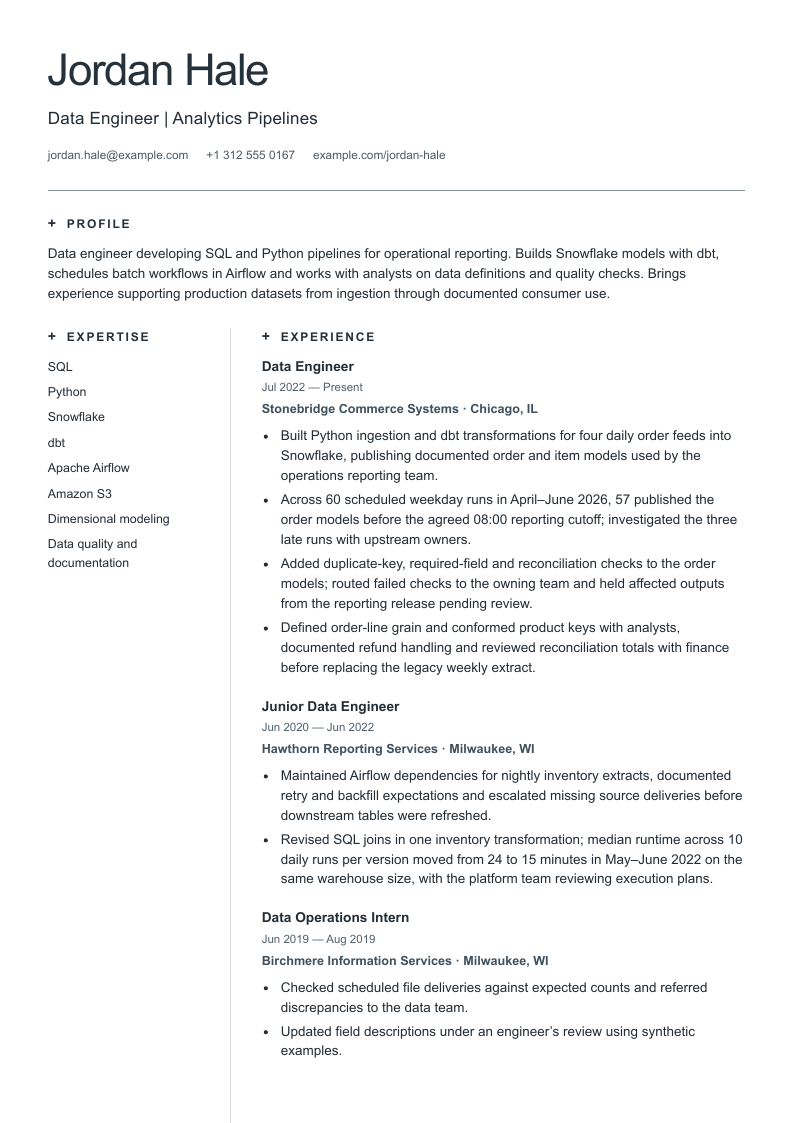 Open page 1 at full size
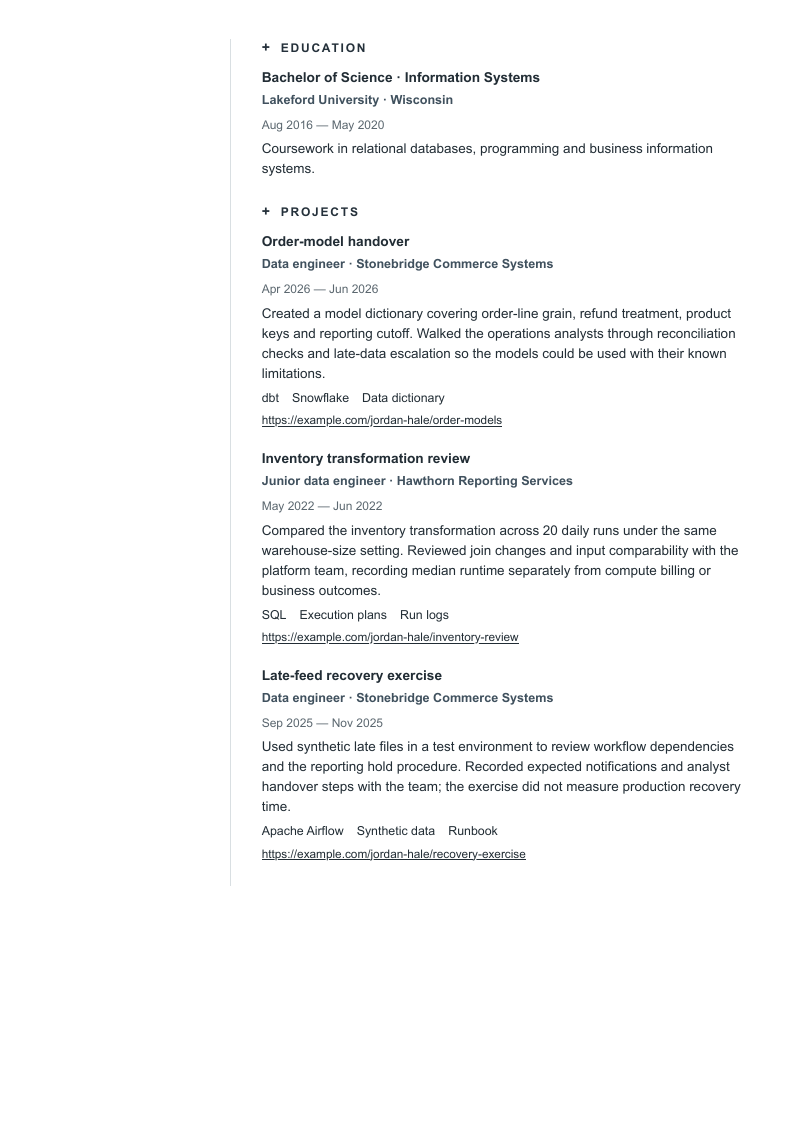 Open page 2 at full size
Data Engineer | Analytics Pipelines
jordan.hale@example.com · +1 312 555 0167
Portfolio: https://example.com/jordan-hale
Data engineer developing SQL and Python pipelines for operational reporting. Builds Snowflake models with dbt, schedules batch workflows in Airflow and works with analysts on data definitions and quality checks. Brings experience supporting production datasets from ingestion through documented consumer use.
SQL · Python · Snowflake · dbt · Apache Airflow · Amazon S3 · Dimensional modeling · Data quality and documentation
Stonebridge Commerce Systems · Chicago, IL
July 2022–Present
Hawthorn Reporting Services · Milwaukee, WI
June 2020–June 2022
Birchmere Information Services · Milwaukee, WI
June 2019–August 2019
Bachelor of Science in Information Systems · Lakeford University · Wisconsin
August 2016–May 2020
Coursework in relational databases, programming and business information systems.
Data engineer · Stonebridge Commerce Systems
April 2026–June 2026
dbt · Snowflake · Data dictionary
Created a model dictionary covering order-line grain, refund treatment, product keys and reporting cutoff. Walked the operations analysts through reconciliation checks and late-data escalation so the models could be used with their known limitations.
Junior data engineer · Hawthorn Reporting Services
May 2022–June 2022
SQL · Execution plans · Run logs
Compared the inventory transformation across 20 daily runs under the same warehouse-size setting. Reviewed join changes and input comparability with the platform team, recording median runtime separately from compute billing or business outcomes.
Data engineer · Stonebridge Commerce Systems
September 2025–November 2025
Apache Airflow · Synthetic data · Runbook
Used synthetic late files in a test environment to review workflow dependencies and the reporting hold procedure. Recorded expected notifications and analyst handover steps with the team; the exercise did not measure production recovery time.
Condense repeated duties before removing the definition behind a result. Use another page when relevant evidence needs it. Check for isolated headings, detached dates and qualifiers separated from metrics; page count alone cannot establish readability.
A free account is required for the builder. Free-plan PDF downloads include a watermark; the previews show paid-plan output. Template buttons retain the exact design, photo preference and Data Engineer role. Add your own career details and photo after signup.
The resume analyzer gives advisory feedback. For drafting help, use the bullet point generator and check every suggestion against your facts. No design guarantees parsing, interviews or a hiring outcome.
Choose relevant SQL, Python, ETL/ELT, modeling, orchestration, warehouse, quality and documentation skills you can support. Spark, Kafka, streaming, CI/CD and governance can matter to specific openings; they are not mandatory additions to every resume.
Identify your data specialty, production scope and supported strengths. An early project, a reporting pipeline and a senior platform program should have different descriptions and levels of ownership.
They can include ingestion, transformation, modeling, scheduling, validation, monitoring, recovery and consumer documentation. Streaming systems, feature stores, migrations and infrastructure ownership depend on the team and vacancy.
Use accurate terms from the opening in context, such as SQL, Python, dbt, Airflow, Snowflake, ETL or ELT. Do not add Spark, Kafka or every cloud provider unless you can explain the work. Keyword repetition cannot guarantee screening success.
A complete source-to-consumer story, a clear model grain and defensible quality or publication measures let a reader judge the work. Explain your contribution alongside upstream producers, analysts and platform colleagues.
Use the space needed for relevant, readable evidence. A short early-career record may fit one page; a fuller record can need two. Check every exported page rather than shrinking the type to meet an arbitrary limit.
Signup retains the exact design, photo preference and role. A free account is required. Free-plan PDF downloads include a watermark; these examples show paid-plan output. The fictional career and AI portrait are not inserted into your account.
Prepared by Resumize with AI-assisted research and drafting for English-language applications. Three employer descriptions were directly retrieved with full responsibilities and Apply forms on October 28, 2026: tastytrade in Chicago, Zeta in Copenhagen and Goodway’s senior LATAM opening. Their tools, experience levels and location requirements differ. Official Apache Airflow documentation supports workflow terminology. This is not a representative market survey or proof that the sample satisfies all three vacancies. No application was submitted, private account or customer data used, or hiring outcome tested.
Read October 28, 2026. Chicago hybrid, three office days per week; two to five years of data engineering. Production dbt, Python, Airflow and Snowflake with upstream producers and downstream consumers. Full description and Apply/application form directly retrieved with HTTP 200; no posting date displayed.
Read October 28, 2026. Copenhagen with regular office commuting. Practical partner-data ingestion, AWS workflows, validation and field mappings; different commercial and platform context from the sample. Full description and Apply/application form directly retrieved with HTTP 200; no posting date displayed.
Read October 28, 2026. Senior role targeting Brazil, Colombia and Mexico; explicitly excludes US candidates. Snowflake, Airflow, Python, AWS, modeling and quality. Not a US remote opportunity. Full description and Apply/application form directly retrieved with HTTP 200; no posting date displayed.
Read October 28, 2026. Official documentation explains workflows, tasks and dependency order. Supports orchestration terminology rather than a claim that Airflow itself transforms every dataset.