A UX Writer resume should reveal how language helps someone complete a product task. Show the flow, the content decision, the people you worked with and the evidence you used. A polished sentence matters, but so do the error state it explains, the action it makes clear and the constraints behind it.
By Resumize · Updated October 28, 2026 · AI-assisted research and drafting
Three designs · one example
Choose a ux writer resume design
These previews use the same layouts as the builder, with identical example content. Open a full preview to inspect the text and spacing.
Fictional candidate, employers, education and results. The optional portrait is AI-generated. Use your own evidence and photo; the example is not inserted into your resume.
Editorial
A large thin serif name and italic introduction lead into project rows before experience; skills and education sit in a bottom grid.
Before sending: Put a decision-rich case study in the project section and check that the work history and bottom qualifications remain easy to find.
“Use” opens signup with that design and photo preference selected for the builder. A free account is required. Free-plan PDF downloads include a watermark; see current plans for paid options. Photo conventions vary; follow the employer’s instructions and local expectations.
All three designs use the same fictional career. Start without a photo and follow the employer’s instructions and local conventions. The optional portrait is AI-generated. Signup retains the exact selected design, photo preference and UX Writer role; it does not insert this career or portrait into your account. Preview images show paid-plan PDF output; free-plan downloads include a watermark.
Jordan Vale, employers, education, dates, projects and results are original fiction. All example.com contacts and portfolio links are invented placeholders, and the 555 phone number is illustrative. Use your own evidence. This base record contains two jobs, six experience bullets, one education record and one project, with no certification claim.
UX writer shaping onboarding, account and scheduling journeys for software products. Connects product language to user tasks, partners with researchers on comprehension questions and works with designers and engineers on accessible instructions and recoverable errors. Maintains terminology and reusable patterns with clear review ownership.
Skills
UX writing and microcopy · Content design · Figma collaboration · User flows and content mapping · Content testing collaboration · Accessible product language · Terminology and content patterns · Cross-functional reviews
Experience
UX Writer
Pinehaven Scheduling Software · Chicago, IL
June 2022–Present
Designed onboarding labels, empty states and recovery messages for a scheduling product; worked in Figma with design and engineering to align each message with the action available to the user.
Partnered with a researcher on eight moderated scheduling tasks in February 2026; revised a timezone label after five participants misread its scope and documented the question for a later validation round.
Reviewed field instructions and error text with design and engineering, replacing direction based only on color with explicit recovery guidance and checking that visible labels and implementation notes agreed.
Maintained a terminology register and 12 reusable message patterns for the scheduling area; resolved competing terms with product and support leads and added usage notes for designers reviewing new flows.
Product Content Writer
Cedarbridge Applications · Evanston, IL
August 2019–May 2022
Drafted subscription-change and cancellation messages with product designers, reviewed policy language with the legal partner and handed approved strings and edge-case notes to engineers before release.
Mapped 26 help topics to account-setup tasks, proposed clearer navigation labels and worked with support to retire duplicate guidance after the product owner approved the revised information structure.
Education
Bachelor of Arts in English · Westmere College · Chicago, IL
August 2015–May 2019
Coursework in rhetoric, editing and information design.
Projects
Scheduling terminology decision record
UX writer · Pinehaven Scheduling Software
February 2026–April 2026
Figma · Content inventory · Review notes
Documented the timezone-label decision and its alternatives in a portfolio case-study outline. Separated the researcher’s study planning from the writing contribution and marked the later validation question as unresolved.
A UX writer works on the language inside an experience: onboarding steps, buttons, forms, tooltips, navigation, notifications, help and recovery messages. Explain what the user was trying to do and what made that task difficult. Writing a headline for a campaign and resolving an ambiguous account-recovery message require different evidence, even when both involve clear writing.
Jordan’s fictional scheduling record connects microcopy to available actions, a timezone misunderstanding, accessible instructions and terminology decisions. The earlier role adds subscription messages and a task-based help structure. These examples support content-design work without presenting Jordan as the owner of every design, research or legal decision.
The current employer sample illustrates the range. Emergent’s Bangalore UX Writer role covers product states and reusable patterns. iCapital’s Utah opening combines senior writing, governance and regulated reviews. VML’s London Content Designer role emphasizes journeys and testing. Their geography, seniority and hiring criteria differ; none defines a universal UX Writer checklist.
For a vacancy emphasizing localization, describe source-string preparation, context notes and review with language specialists if you did that work. Distinguish creating translation-ready content from being fluent in every supported language. For a voice-and-tone responsibility, show the situation where tone changes while terminology stays consistent; “friendly brand voice” alone says little about a product decision.
Six before-and-after UX Writer resume bullets
The six “after” examples are the six experience bullets in the complete resume. Use their evidence structure with your own work; each annotation explains a decision or claim boundary.
1. Write the interaction, not just the words
Before: Wrote compelling copy for the app.
After: Designed onboarding labels, empty states and recovery messages for a scheduling product; worked in Figma with design and engineering to align each message with the action available to the user.
Why it works: Names product surfaces and the relationship between language and behavior. This is product content work rather than a claim about advertising copy.
Evidence to check: Approved flow versions, your writing responsibility and the implemented states.
2. Use testing without overstating the sample
Before: My copy made every user understand the product.
After: Partnered with a researcher on eight moderated scheduling tasks in February 2026; revised a timezone label after five participants misread its scope and documented the question for a later validation round.
Why it works: Eight participants are a small qualitative sample. Five misunderstandings explain a decision; they do not establish a population failure rate or a measured improvement.
Evidence to check: Task definition, aggregate observations, revised wording and ownership of research versus writing; exclude recordings and participant identities.
3. Make accessibility work concrete
Before: Made the entire platform fully accessible.
After: Reviewed field instructions and error text with design and engineering, replacing direction based only on color with explicit recovery guidance and checking that visible labels and implementation notes agreed.
Why it works: Describes specific content checks and collaboration. Copy review alone cannot establish platform conformance with an accessibility standard.
Evidence to check: A permitted example of the problem, content rationale, engineering handoff and the scope of any wider audit.
4. Explain content governance
Before: Created a style guide everyone loved.
After: Maintained a terminology register and 12 reusable message patterns for the scheduling area; resolved competing terms with product and support leads and added usage notes for designers reviewing new flows.
Why it works: States the size, product boundary and decisions behind a content system without treating document creation as proof of adoption.
Evidence to check: Register versions, pattern inventory, decision owners and real review examples.
5. Show collaboration and approval boundaries
Before: Owned every launch and all legal approvals.
After: Drafted subscription-change and cancellation messages with product designers, reviewed policy language with the legal partner and handed approved strings and edge-case notes to engineers before release.
Why it works: Shows writing ownership while keeping policy approval with the appropriate reviewer. Release participation does not imply sole launch ownership.
Evidence to check: Approved public-safe artifacts, the review sequence and your handoff contribution.
6. Describe the information problem
Before: Rewrote help content and boosted customer happiness.
After: Mapped 26 help topics to account-setup tasks, proposed clearer navigation labels and worked with support to retire duplicate guidance after the product owner approved the revised information structure.
Why it works: Counts topics reviewed, not users helped. The change has a defined user task and approval step without an invented satisfaction result.
Evidence to check: Topic inventory, task map, permitted label examples and your role in the approval process.
Build a summary around surfaces, users and evidence
Jordan’s summary names the product journeys and connects writing to testing and implementation. Follow that structure with your own facts: the audience or product, two relevant content strengths and the way you work with other disciplines. Replace a list of adjectives with a specific writing remit. Keep the summary consistent with the examples below it.
An early applicant can lead with a truthful self-directed flow redesign or an adjacent support/content role. A mid-career writer can describe product areas and reusable patterns. A senior applicant can add content governance, mentoring or multi-team decisions only when the work history supports that scope. Years alone do not establish management responsibility.
The test example reports five misunderstandings among eight participants doing a defined task in February 2026. It explains why wording changed and says validation remains open. It does not turn a small qualitative study into a representative percentage or claim that the revision solved the problem. Name your writing contribution separately from the researcher’s recruitment, facilitation and analysis.
If you have a genuine A/B test, name the variants, eligible population, period and measured event, and keep the test’s uncertainty with the result. Activation, task completion and support contacts are different measures. An observational change after a release can reflect other product changes, seasonality or audience mix. A clear content decision without a numerical result is better than an invented lift.
Connect UX Writer skills to evidence
Select skills from the opening that you can demonstrate in a flow, a decision record or a permitted work sample. Put important terms in supported context, rather than repeating them to chase a screening score.
UX Writer skills and supporting evidence
Skill
Evidence to gather
Fictional example
Microcopy and user flows
The task, relevant states and next action.
Onboarding labels, empty states and recovery messages.
Content strategy and information architecture
Audience needs, content relationships and the decision owner.
26 help topics mapped to account-setup tasks.
Testing and user understanding
Study/task context and your role in interpreting findings.
A timezone-label question from eight moderated tasks.
Accessible content
A concrete language issue and implementation review.
Explicit guidance where color alone had carried meaning.
Voice, tone and governance
Pattern scope, terminology decisions and usage notes.
12 reusable scheduling-area message patterns.
Collaboration and handoff
Review partners, approvals and edge cases.
Subscription strings reviewed with legal and engineering.
Keep education relevant and training honestly labeled
Jordan lists an English degree with relevant coursework and no GPA. Use the education you actually completed, with the correct institution and dates. You can explain a relevant course or capstone without implying that every UX writing opening demands that major. The employer sample varies in its treatment of degrees and equivalent experience.
A portfolio and a credible explanation of your decisions can do more work than a decorative credential list. If you completed UX or content-design training, use the exact course or qualification name, issuer, dates and actual completion status. Attendance, an assessed course and a professional certification are different claims. Do not imply that a short course establishes accessibility compliance expertise.
Keep the skills list selective. Figma, a content management system, an analytics product or a localization workflow belongs when you can explain what you did with it. Listing every tool mentioned in an opening can obscure the stronger evidence in your product writing.
Build an honest early-career case study
For a first UX writing role, a small original flow can be enough to show your method: define an audience and task, sketch the states, write alternatives and explain a tradeoff. Label the work as self-directed, coursework or volunteer work. State when you have not tested it with users. Do not borrow a known product’s wording and present it as your shipped work.
A useful portfolio case study includes the problem, your remit, constraints, alternatives, decision and remaining question. Give a reader a clear sample link and a short explanation of what it contains. All example.com portfolio and project links on this page are invented placeholders, not real work samples.
For real projects, share only material you have permission to publish. Recreate a generic flow with original wording when necessary and label it as a reconstruction; leave out participant identities, private research recordings, customer details and proprietary product text. A support-writing background can demonstrate information structure and clear explanations without changing the job title to UX Writer.
The expanded example keeps Jordan’s earlier editorial role and adds two projects about recovery states and subscription handoff. The additions show transferable judgment. They do not recast editorial assistance as product leadership or pretend an untested project produced a commercial result.
Make the portfolio link earn its place
Use one or two resume lines to introduce a relevant case study, then let the portfolio explain the decisions. A hiring reader should be able to find your role, the original problem, alternatives and the outcome or remaining question without guessing which words you wrote. A collection of attractive screens without context can hide the reasoning the resume is trying to show.
For a content audit, name the inventory and classification method: duplicate help topics, inconsistent labels or states without recovery instructions. For an accessibility example, name the content issue and review scope rather than declaring a whole product compliant. For localization, record constraints such as string context and reviewer feedback without publishing private translation files.
Separate usability and persuasion. A clearer cancellation flow may help a user leave with confidence; it should not be described as a conversion failure merely because fewer people encounter friction. Explain the task and intended outcome, then use evidence that measures that outcome.
Check long contact details at full size
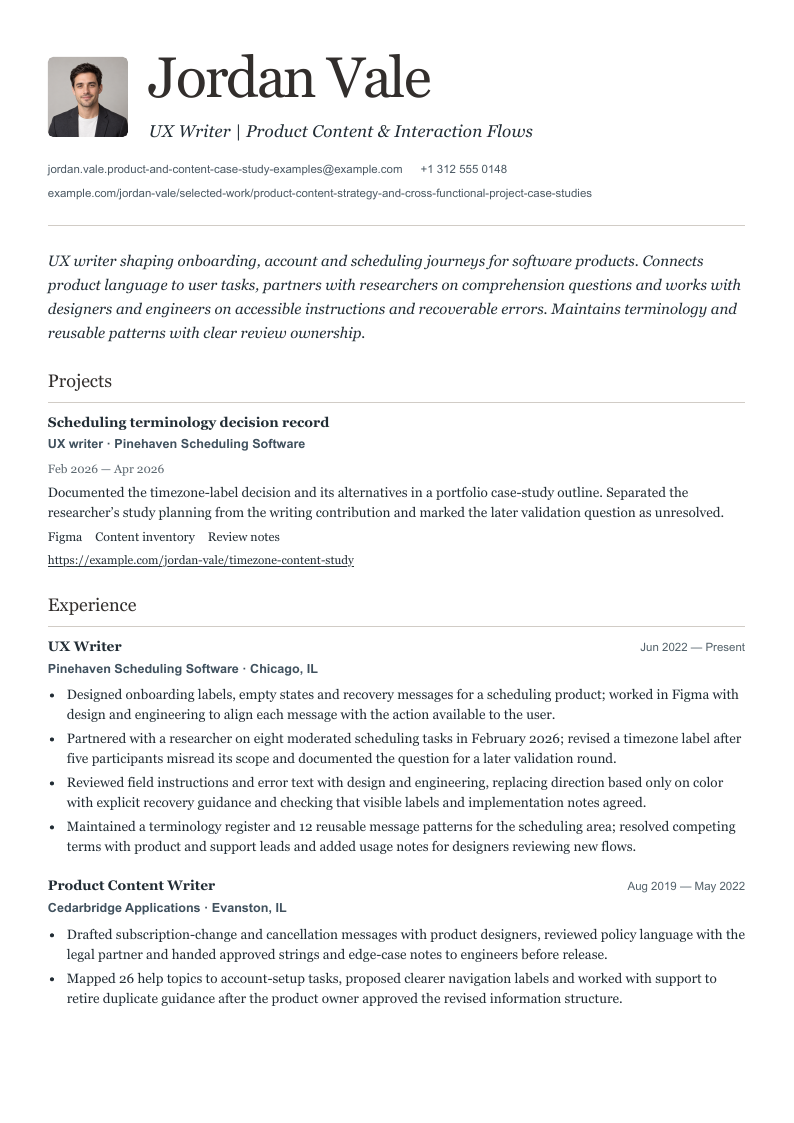
The long-contact Editorial export uses the photo-on setting and changes only the resume email and portfolio URL. Jordan’s account identity, phone, summary, jobs, education and project remain unchanged. Read the final characters of the email and URL, then check the link destination. A portfolio address should be easy to use as well as visually tidy.
UX writer shaping onboarding, account and scheduling journeys for software products. Connects product language to user tasks, partners with researchers on comprehension questions and works with designers and engineers on accessible instructions and recoverable errors. Maintains terminology and reusable patterns with clear review ownership.
Skills
UX writing and microcopy · Content design · Figma collaboration · User flows and content mapping · Content testing collaboration · Accessible product language · Terminology and content patterns · Cross-functional reviews
Experience
UX Writer
Pinehaven Scheduling Software · Chicago, IL
June 2022–Present
Designed onboarding labels, empty states and recovery messages for a scheduling product; worked in Figma with design and engineering to align each message with the action available to the user.
Partnered with a researcher on eight moderated scheduling tasks in February 2026; revised a timezone label after five participants misread its scope and documented the question for a later validation round.
Reviewed field instructions and error text with design and engineering, replacing direction based only on color with explicit recovery guidance and checking that visible labels and implementation notes agreed.
Maintained a terminology register and 12 reusable message patterns for the scheduling area; resolved competing terms with product and support leads and added usage notes for designers reviewing new flows.
Product Content Writer
Cedarbridge Applications · Evanston, IL
August 2019–May 2022
Drafted subscription-change and cancellation messages with product designers, reviewed policy language with the legal partner and handed approved strings and edge-case notes to engineers before release.
Mapped 26 help topics to account-setup tasks, proposed clearer navigation labels and worked with support to retire duplicate guidance after the product owner approved the revised information structure.
Education
Bachelor of Arts in English · Westmere College · Chicago, IL
August 2015–May 2019
Coursework in rhetoric, editing and information design.
Projects
Scheduling terminology decision record
UX writer · Pinehaven Scheduling Software
February 2026–April 2026
Figma · Content inventory · Review notes
Documented the timezone-label decision and its alternatives in a portfolio case-study outline. Separated the researcher’s study planning from the writing contribution and marked the later validation question as unresolved.
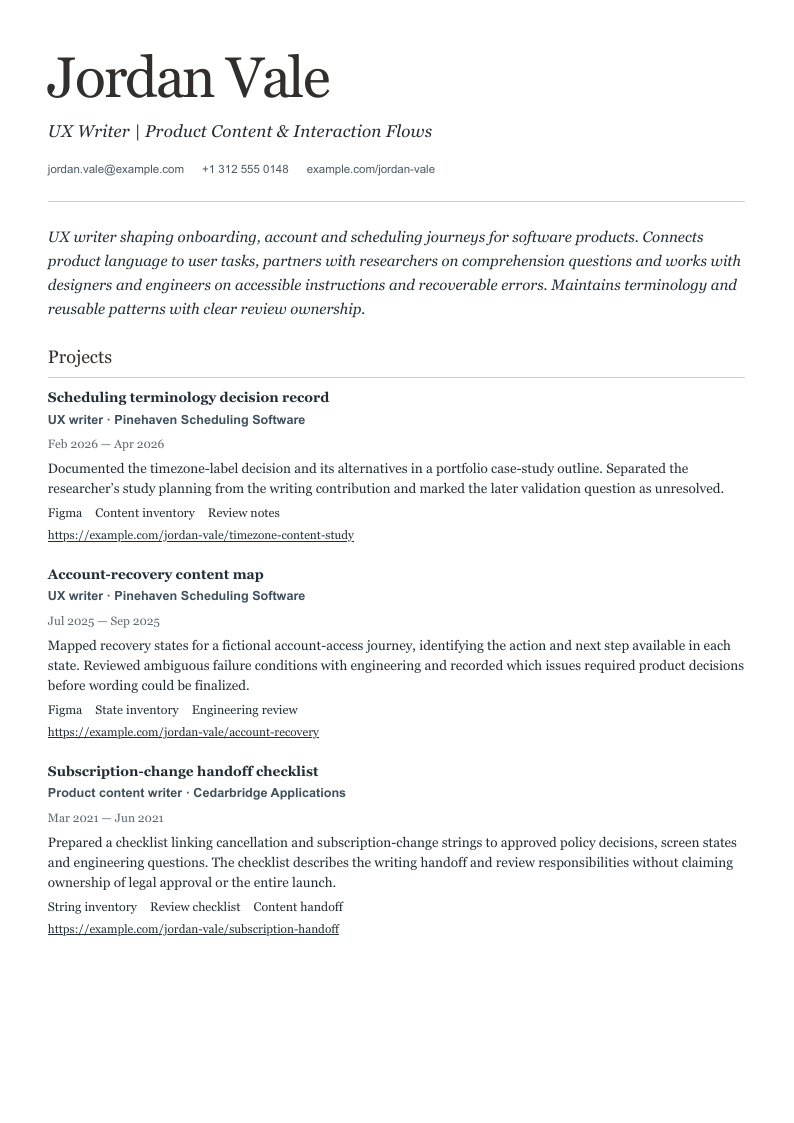
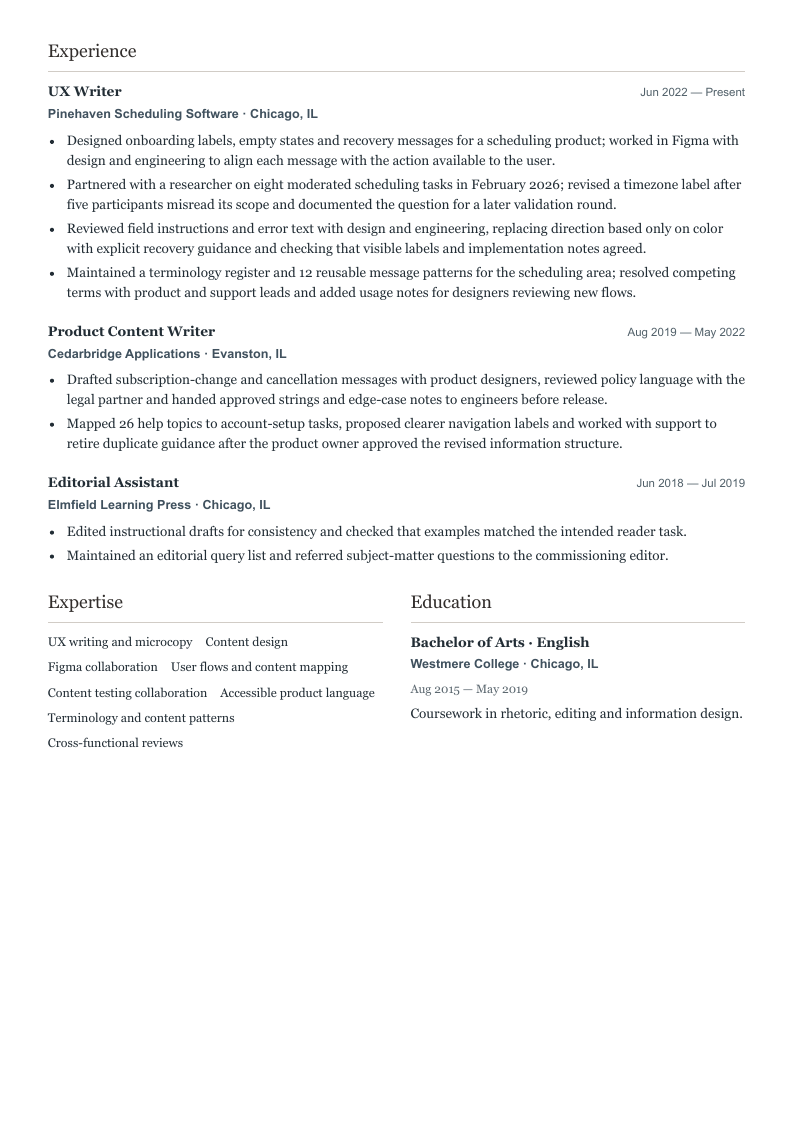
The expanded Editorial example has the photo off. It preserves the base career and adds one earlier editorial job and two projects. Editorial places projects before experience and qualifications in a bottom grid, so read in that layout order as well as checking the complete text below. Keep dates with the right job and check the last lines of the qualifications.
Condense repeated descriptions before removing the user task or evidence limitation that makes a case study understandable. Add a page when relevant work needs the space, then inspect every page for isolated headings and interrupted examples. A single-page target should not force tiny text or remove the boundary between writing and research ownership.
UX writer shaping onboarding, account and scheduling journeys for software products. Connects product language to user tasks, partners with researchers on comprehension questions and works with designers and engineers on accessible instructions and recoverable errors. Maintains terminology and reusable patterns with clear review ownership.
Skills
UX writing and microcopy · Content design · Figma collaboration · User flows and content mapping · Content testing collaboration · Accessible product language · Terminology and content patterns · Cross-functional reviews
Experience
UX Writer
Pinehaven Scheduling Software · Chicago, IL
June 2022–Present
Designed onboarding labels, empty states and recovery messages for a scheduling product; worked in Figma with design and engineering to align each message with the action available to the user.
Partnered with a researcher on eight moderated scheduling tasks in February 2026; revised a timezone label after five participants misread its scope and documented the question for a later validation round.
Reviewed field instructions and error text with design and engineering, replacing direction based only on color with explicit recovery guidance and checking that visible labels and implementation notes agreed.
Maintained a terminology register and 12 reusable message patterns for the scheduling area; resolved competing terms with product and support leads and added usage notes for designers reviewing new flows.
Product Content Writer
Cedarbridge Applications · Evanston, IL
August 2019–May 2022
Drafted subscription-change and cancellation messages with product designers, reviewed policy language with the legal partner and handed approved strings and edge-case notes to engineers before release.
Mapped 26 help topics to account-setup tasks, proposed clearer navigation labels and worked with support to retire duplicate guidance after the product owner approved the revised information structure.
Editorial Assistant
Elmfield Learning Press · Chicago, IL
June 2018–July 2019
Edited instructional drafts for consistency and checked that examples matched the intended reader task.
Maintained an editorial query list and referred subject-matter questions to the commissioning editor.
Education
Bachelor of Arts in English · Westmere College · Chicago, IL
August 2015–May 2019
Coursework in rhetoric, editing and information design.
Projects
Scheduling terminology decision record
UX writer · Pinehaven Scheduling Software
February 2026–April 2026
Figma · Content inventory · Review notes
Documented the timezone-label decision and its alternatives in a portfolio case-study outline. Separated the researcher’s study planning from the writing contribution and marked the later validation question as unresolved.
Mapped recovery states for a fictional account-access journey, identifying the action and next step available in each state. Reviewed ambiguous failure conditions with engineering and recorded which issues required product decisions before wording could be finalized.
Prepared a checklist linking cancellation and subscription-change strings to approved policy decisions, screen states and engineering questions. The checklist describes the writing handoff and review responsibilities without claiming ownership of legal approval or the entire launch.
Open every portfolio link and ensure the destination is publicly shareable.
Confirm the resume identifies your contribution and who owned research or policy approval.
Keep participant counts, periods and unresolved test questions accurate.
Review the final project, education dates and all long contact characters.
Copy text from the PDF and check parsed application fields when the employer provides them.
A free account is required for the builder. Free-plan PDF downloads include a watermark; these previews show paid-plan output. The buttons retain the exact template, photo setting and UX Writer role through signup. Add your own career details and photo in your account, and follow the employer’s requested file format.
The resume analyzer offers advisory feedback. Use the bullet point generator to draft from your own notes, then review each suggestion. No design or wording guarantees parsing, ranking, an interview or a hiring outcome.
Questions, answered
What skills should a UX Writer include on a resume?
Use supported product-writing skills such as microcopy, content design, user flows, voice and tone, testing collaboration, accessible language and information architecture. Name tools you have actually used and connect them to work examples.
How do I write a UX Writer resume summary?
Name the product or audience, your relevant writing surfaces and two strengths supported by your history. Early applicants can describe labeled project work; senior applicants should substantiate governance, mentoring or leadership claims.
What are the key responsibilities of a UX Writer?
Depending on the opening, they can include product microcopy, flow and content audits, terminology and pattern development, testing collaboration, localization support and engineering handoff. Writing responsibility does not automatically include owning all research or approving policy.
Do I need a portfolio for a UX Writer application?
Read the opening: all three employer descriptions reviewed here request work examples or a portfolio. Include a clear link when requested and explain the problem, your contribution and the decision. These three openings do not establish a rule for every employer.
How long should a UX Writer resume be?
Use enough space for relevant evidence at a readable size. An early record may fit one page; a fuller career may need more. Inspect every exported page and let the portfolio carry detailed case studies.
What makes a UX Writer resume stand out?
Specific decisions about user tasks, states and terminology help a reader assess your judgment. Explain how research or implementation constraints affected the wording and avoid unsupported conversion claims.
What ATS keywords should a UX Writer use?
Use accurate language from the vacancy, such as UX writing, content design, microcopy, accessibility, content testing or localization. Put terms in evidence-bearing sentences; no keyword list or template guarantees an interview.
What happens when I choose a design?
Signup retains the chosen design, photo preference and UX Writer role. It requires a free account and does not copy this fictional career or AI portrait into your account. Free-plan PDF downloads include a watermark; these images show paid-plan output.
Prepared by Resumize with AI-assisted research and drafting for English-language applications. Three primary employer descriptions were directly retrieved with readable responsibilities, qualifications and application controls on October 28, 2026. They cover Bangalore, Salt Lake City and London and are a small, geographically varied sample, not a representative labor-market survey. No application was submitted, private research used or hiring outcome tested. The guide and sample are original educational examples; the optional portrait is AI-generated.
Bangalore; job 4423806009. Full responsibilities, qualifications and Apply Now retrieved with HTTP 200 on October 28, 2026; no publication date displayed. Product flows, reusable patterns, researcher collaboration and a portfolio are explicit. Experience and location requirements belong to this opening.
Salt Lake City, Utah; job 8534763002. Full description and application form retrieved with HTTP 200 on October 28, 2026; no publication date displayed. Combines hands-on content, governance, accessibility and legal/compliance collaboration; asks for seven-plus years and a work link. The fictional sample is not a qualification match for every senior opening.
London; job 8893969002. Full description and Apply control retrieved with HTTP 200 on October 28, 2026; no publication date displayed. Covers journey mapping, Figma, content testing and accessibility. This adjacent title illustrates content-design overlap, with UK-specific employment context.