Special Education Teacher resume examples and templates
A special education teacher resume should show the learners and setting you support, the instruction you adapt and your contribution to a collaborative IEP process. Separate a learning measure from a broad claim about disability or compliance. This guide uses six annotated rewrites and one fictional grades 6–8 career record in three existing designs.
These previews use the same layouts as the builder, with identical example content. Open a full preview to inspect the text and spacing.
Fictional candidate, employers, education and results. The optional portrait is AI-generated. Use your own evidence and photo; the example is not inserted into your resume.
Botanical
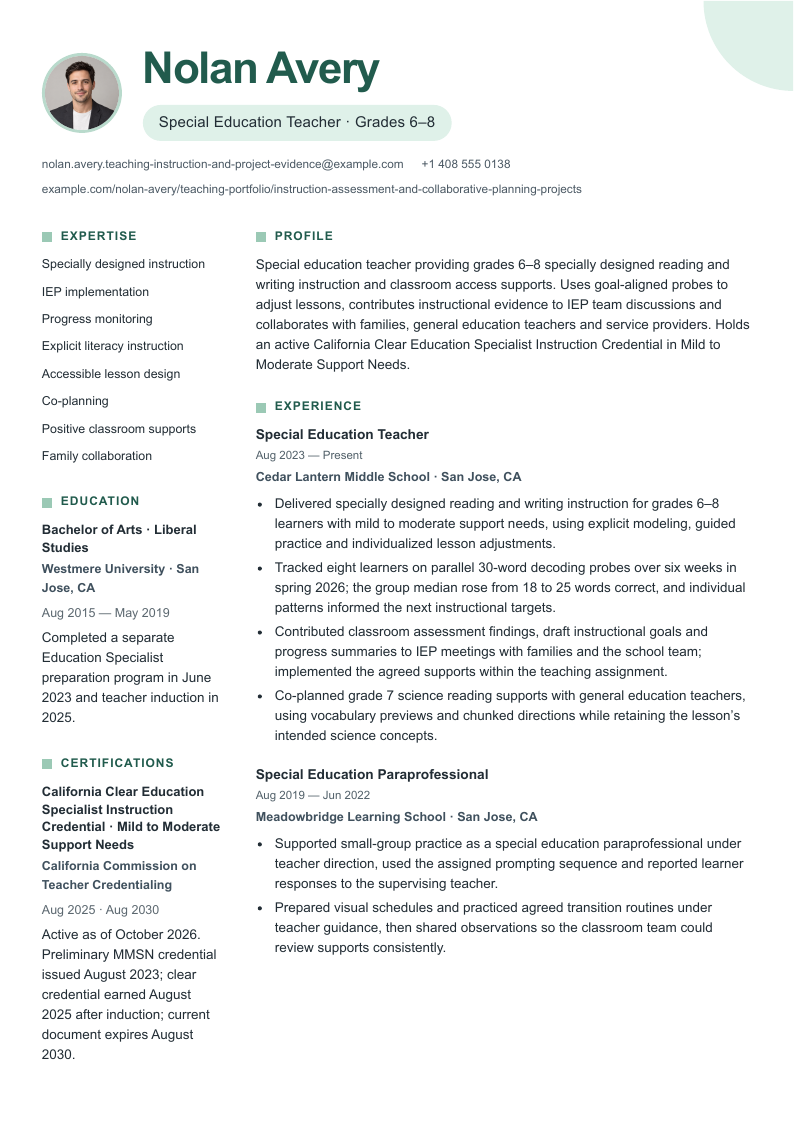
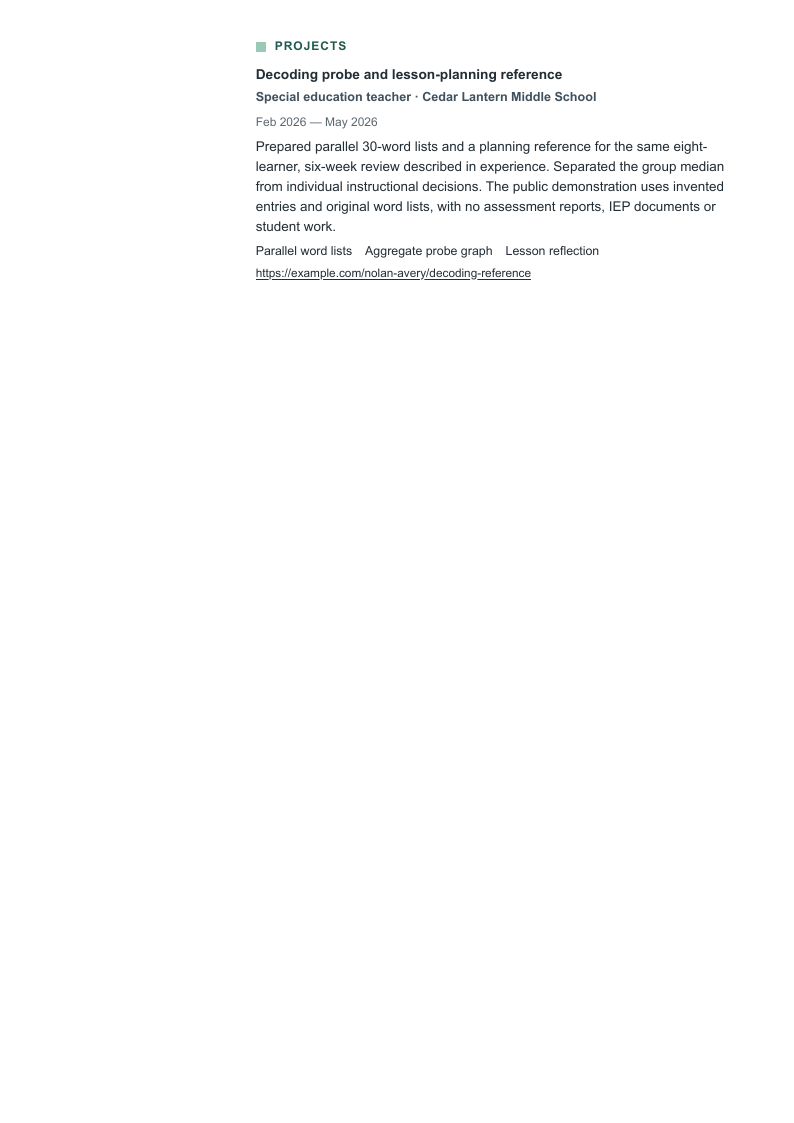
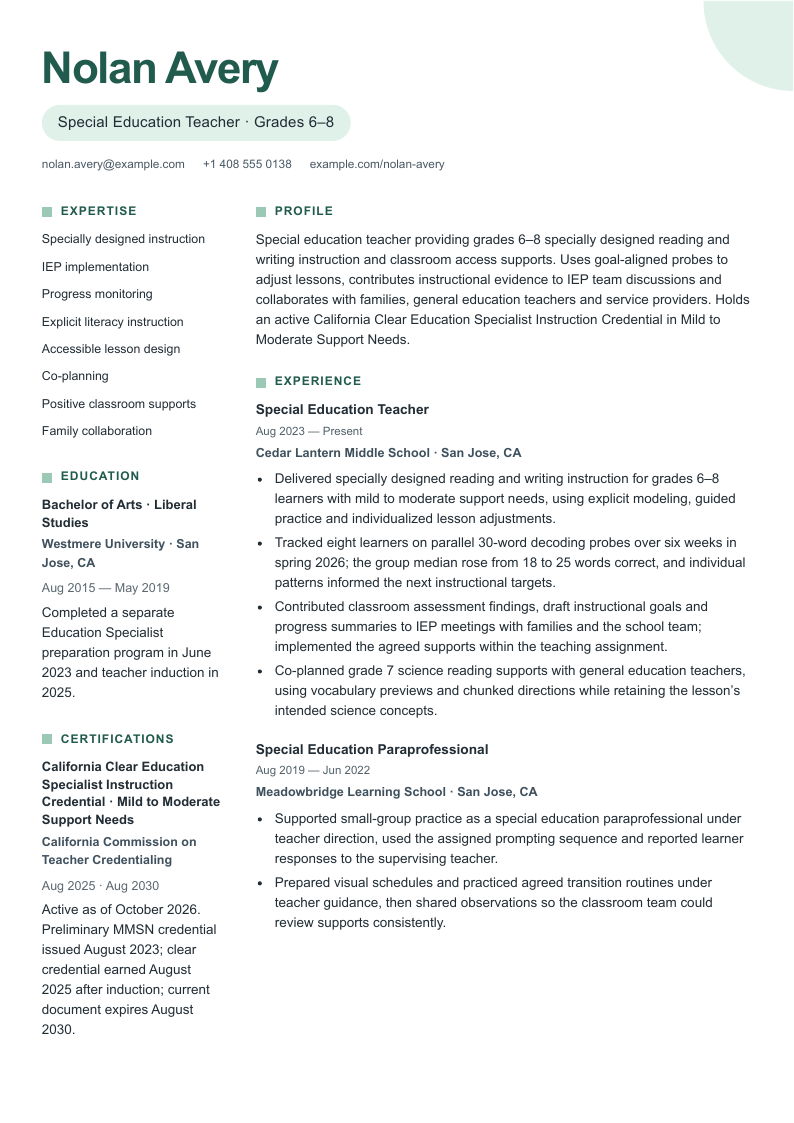
A mint rounded role band and soft accent introduce a two-column layout: Expertise, Education and Certifications in the left rail; Profile, Experience and Projects in the main column.
Before sending: The credential title and its current status use the narrower rail. Follow that rail and the instructional narrative independently through every page, including with the optional portrait.
The original Professional design centers identity and the optional portrait above contacts, then shows summary, skills, experience, education, projects and credentials.
Before sending: The long credential name follows projects. Check all authorization words and dates, and verify full destinations behind shortened social labels.
A large sans-serif name, green slash separators and subtle zigzag rules organize Profile, Experience, Expertise, an Education and Certifications bottom grid, then Projects.
Before sending: Education and credentials occupy separate bottom-grid widths. Read the full support-needs authorization and the eight-learner probe definition wherever the export breaks.
“Use” opens signup with that design and photo preference selected for the builder. A free account is required. Free-plan PDF downloads include a watermark; see current plans for paid options. Photo conventions vary; follow the employer’s instructions and local expectations.
All three designs use the same fictional career. The default is without a photo; the optional portrait is AI-generated. Template buttons retain the exact design, photo preference and Special Education Teacher role through signup. They do not insert the fictional candidate, career record or portrait into your account.
A complete special education teacher resume example
Nolan Avery is an invented California special education teacher. All candidate, employer, institution, credential, date, number and result details in this career are original fiction. No real credential is verified and the invented university is not an accreditation claim. All example.com links are placeholders and the optional portrait is AI-generated. No real student records, assessment reports, IEP files or family correspondence are used.
Special education teacher providing grades 6–8 specially designed reading and writing instruction and classroom access supports. Uses goal-aligned probes to adjust lessons, contributes instructional evidence to IEP team discussions and collaborates with families, general education teachers and service providers. Holds an active California Clear Education Specialist Instruction Credential in Mild to Moderate Support Needs.
Delivered specially designed reading and writing instruction for grades 6–8 learners with mild to moderate support needs, using explicit modeling, guided practice and individualized lesson adjustments.
Tracked eight learners on parallel 30-word decoding probes over six weeks in spring 2026; the group median rose from 18 to 25 words correct, and individual patterns informed the next instructional targets.
Contributed classroom assessment findings, draft instructional goals and progress summaries to IEP meetings with families and the school team; implemented the agreed supports within the teaching assignment.
Co-planned grade 7 science reading supports with general education teachers, using vocabulary previews and chunked directions while retaining the lesson’s intended science concepts.
Special Education Paraprofessional
Meadowbridge Learning School · San Jose, CA
August 2019–June 2022
Supported small-group practice as a special education paraprofessional under teacher direction, used the assigned prompting sequence and reported learner responses to the supervising teacher.
Prepared visual schedules and practiced agreed transition routines under teacher guidance, then shared observations so the classroom team could review supports consistently.
Education
Bachelor of Arts in Liberal Studies · Westmere University · San Jose, CA
August 2015–May 2019
Completed a separate Education Specialist preparation program in June 2023 and teacher induction in 2025.
Teaching credentials
California Clear Education Specialist Instruction Credential · Mild to Moderate Support Needs
California Commission on Teacher Credentialing
Issued August 2025
Expires August 2030
Active as of October 2026. Preliminary MMSN credential issued August 2023; clear credential earned August 2025 after induction; current document expires August 2030.
Projects
Decoding probe and lesson-planning reference
Special education teacher · Cedar Lantern Middle School
February 2026–May 2026
Parallel word lists · Aggregate probe graph · Lesson reflection
Prepared parallel 30-word lists and a planning reference for the same eight-learner, six-week review described in experience. Separated the group median from individual instructional decisions. The public demonstration uses invented entries and original word lists, with no assessment reports, IEP documents or student work.
Special education assignments vary by grade band, learner needs, service model and authorization. Nolan’s fictional work concerns grades 6–8 reading and writing instruction for learners with mild to moderate support needs. It does not claim extensive-needs expertise, early-childhood authorization, school psychology or competence in every related service.
Describe specially designed instruction through your actual work: explicit modeling, guided practice, a goal-aligned probe, an adapted task or collaboration that gives access to a general education lesson. “Helped special-needs students” is too broad to show teaching judgment. Use respectful language and explain the instructional need without turning a student’s diagnosis or personal story into a resume achievement.
The researched openings show why the setting matters. Alpha’s California role involves an extensive-needs learning environment, specialized instruction and coordination with paraprofessionals and providers. Aspire’s Connecticut program serves K–12 academic and social/behavioral needs. United Charter’s New York high school humanities position emphasizes co-planning, co-teaching, co-assessment and transition support. These are different assignments, not a single national job checklist.
If you supervised or coached paraprofessionals, distinguish assigned classroom coordination from personnel management. Name assistive technology, behavior support training or transition planning only when it belongs to your actual experience. A sample based on one grade band should not silently acquire the duties and credentials from all three researched settings.
Six special education teacher rewrites with reasoning
Each after sentence appears verbatim in the base resume. The before statements are deliberately weak or overstated examples. Replace the fictional details with your own supported facts; the evidence prompts show what to check without publishing private learner information.
1. Identify the teaching assignment
Before: Taught all disabilities at every age.
After: Delivered specially designed reading and writing instruction for grades 6–8 learners with mild to moderate support needs, using explicit modeling, guided practice and individualized lesson adjustments.
Why it works: Names the actual age band, instructional area and support context. It does not claim every disability specialty or qualification for all settings.
Evidence to check: Teaching assignment, credential authorization and permitted lesson plans.
2. Define a learning probe
Before: Cured reading difficulties and doubled achievement.
After: Tracked eight learners on parallel 30-word decoding probes over six weeks in spring 2026; the group median rose from 18 to 25 words correct, and individual patterns informed the next instructional targets.
Why it works: This is a bounded word-reading probe with the same eight learners, not a diagnosis, reading grade level or evidence that disability was removed. A group median does not show that every learner improved.
Evidence to check: Approved aggregate probe summary, parallel-list design, administration conditions and individual planning process without identifiers.
3. Describe the IEP contribution
Before: Single-handedly decided eligibility and all IEP placements.
After: Contributed classroom assessment findings, draft instructional goals and progress summaries to IEP meetings with families and the school team; implemented the agreed supports within the teaching assignment.
Why it works: Shows the teacher’s evidence and implementation role while preserving team decisions. Avoid claiming sole eligibility, placement or related-service authority.
Evidence to check: Role description, team process and a wholly invented meeting-planning example rather than an IEP file.
4. Show access and collaboration
Before: Made every lesson universally accessible.
After: Co-planned grade 7 science reading supports with general education teachers, using vocabulary previews and chunked directions while retaining the lesson’s intended science concepts.
Why it works: Names a concrete access strategy and learning objective. It does not imply that one set of supports meets every learner’s needs or changes every course standard.
Evidence to check: Co-planning notes, original accessible materials and the intended learning objective.
5. Keep paraprofessional scope accurate
Before: Led the special education department before qualifying.
After: Supported small-group practice as a special education paraprofessional under teacher direction, used the assigned prompting sequence and reported learner responses to the supervising teacher.
Why it works: The earlier support role remains distinct from independently planning services or licensed teaching. Its supervision and contribution are visible.
Evidence to check: Original job title, supervision record and approved description of assigned support tasks.
6. Describe positive supports respectfully
Before: Fixed disruptive students through discipline.
After: Prepared visual schedules and practiced agreed transition routines under teacher guidance, then shared observations so the classroom team could review supports consistently.
Why it works: Describes a respectful classroom support process without labeling learners, claiming behavioral treatment expertise or promising that support eliminated all difficulties.
Evidence to check: Assigned classroom routine, training and generic observation method without behavior records.
Show instruction and the IEP team contribution
Nolan’s summary previews individualized literacy instruction, progress monitoring and collaboration. The experience supports it with explicit teaching, a bounded decoding review and classroom evidence contributed to team discussions. It does not promise to eliminate a disability or claim that one educator controls all eligibility, placement or service decisions.
Spell out individualized education program (IEP) on first use for a broad audience. Explain your own contribution: classroom assessment findings, draft instructional goals, progress summaries, family communication or implementation of agreed supports. A teacher can be deeply involved while decisions remain part of the applicable team process and authorized responsibilities.
The earlier paraprofessional job is deliberately preserved under its actual title. Following a prompting sequence, preparing materials and reporting responses to the supervising teacher show relevant experience. They do not become independent IEP case management or licensed teaching simply because Nolan later earned a credential.
Describe progress without overstating it
The fictional probe follows the same eight learners over six weeks in spring 2026 using parallel 30-word decoding lists. The group median rises from 18 to 25 words correct. That is a seven-word difference between group medians on this task. It is not a reading age, a standardized score, evidence that every learner improved or proof that disability-related needs disappeared.
Check the administration conditions, list comparability and missing observations before using a measure. A group summary should not replace individual instructional review. Nolan’s bullet keeps the next teaching targets visible because learners can have different response patterns even when the group median increases.
Do not combine unlike IEP goals into a convenient success percentage without a defensible definition. Goals can concern different skills, baselines and observation periods; progress toward one goal is not the same as mastery of all goals or quality of an entire service program. If an aggregate cannot be shared or interpreted responsibly, describe the teaching decision and review process instead.
Avoid “100% compliance” unless you can state precisely what was reviewed, by whom and over which period. Meeting a document deadline does not establish the quality of instruction or the legality of every decision. This sample focuses on teaching and collaboration rather than treating paperwork completion as student learning.
Connect selected skills to teaching evidence
Choose truthful terms from the actual vacancy, then explain the teaching task behind them. A skills list helps a reader find relevant experience; it cannot establish an authorization or guarantee screening success. Do not list every platform, assessment or support method because another school mentions it.
Special Education Teacher skills and evidence
Skill
Evidence to gather
Fictional example
Specially designed instruction
Learning target and how the lesson was adjusted
Explicit modeling and guided literacy practice
Progress monitoring
Measure, conditions, timeframe and interpretation
Eight learners on parallel 30-word probes
IEP collaboration
Your contribution and decision boundary
Classroom findings and draft instructional goals
Accessible curriculum
Barrier, support and retained objective
Vocabulary previews for grade 7 science
Positive supports
Assigned routine and observed response
Visual schedules under teacher guidance
Family collaboration
Purpose and team communication process
Progress discussion with families and school team
State the exact specialty and credential stage
Nolan completed a BA in Liberal Studies in May 2019, an Education Specialist preparation program in June 2023 and induction in 2025. The fictional preliminary MMSN credential begins in August 2023, before the teacher job; the clear document runs from August 2025 to August 2030 and is active as of October 2026. The earlier paraprofessional work does not require pretending that Nolan already held this teaching credential.
California’s official Education Specialist leaflet distinguishes specialty areas and the preliminary and clear stages. The sample names Mild to Moderate Support Needs rather than a generic license valid for every disability and setting. The current document issue date is separate from the initial preliminary issue date. Use the words on your own credential and check the scope actually authorized.
The Commission’s renewal guidance distinguishes clearing a preliminary document from renewing a clear one. A preparation course, degree or certificate of clearance is not itself the active teaching credential shown in the sample. Label pending applications and expired documents accurately, and verify the issuer’s current record before applying.
Connecticut, New York and California credential language differs in the researched postings. Do not copy New York students-with-disabilities certification or a Connecticut alternative route into a California credential entry. Add a genuine endorsement or current specialist qualification only when held, with the issuer and relevant dates.
Build evidence without sharing student files
An early-career teacher can describe supervised fieldwork, student teaching or a genuine support role. State supervision, grade band, service context and the lesson task. A training simulation should remain a simulation. Nolan’s later credential does not retrospectively turn the older paraprofessional role into independent teaching.
A useful portfolio can contain original lesson materials, invented model responses and a reflection about instructional decisions. Nolan’s decoding project explains the same eight-learner review as the bullet; it does not create another group. It shows how a parallel probe could inform planning while using only invented demonstration entries.
Do not upload an IEP, assessment report, service schedule, student work or a recognizable case story to prove a resume bullet. Removing a name alone may leave a learner identifiable. Use a permitted generic description or wholly fictional model, following the school’s information-sharing rules.
The expanded example adds an earlier after-school assistant role and two original planning projects. Science access materials retain the intended science concepts; the progress-discussion prompts distinguish observation, recommendation and team decision. These additions demonstrate planning without claiming clinical therapy or sole eligibility authority.
Inspect long contacts with the optional photo
The Botanical long-contact scenario has the photo on. Only Nolan’s resume email and portfolio URL change; user identity and every career fact remain fixed. Inspect the full email ending and final URL segment. Botanical’s contact header and credential rail have different widths, so check both before choosing it. Professional may shorten the visible social label while retaining the full destination.
Special education teacher providing grades 6–8 specially designed reading and writing instruction and classroom access supports. Uses goal-aligned probes to adjust lessons, contributes instructional evidence to IEP team discussions and collaborates with families, general education teachers and service providers. Holds an active California Clear Education Specialist Instruction Credential in Mild to Moderate Support Needs.
Delivered specially designed reading and writing instruction for grades 6–8 learners with mild to moderate support needs, using explicit modeling, guided practice and individualized lesson adjustments.
Tracked eight learners on parallel 30-word decoding probes over six weeks in spring 2026; the group median rose from 18 to 25 words correct, and individual patterns informed the next instructional targets.
Contributed classroom assessment findings, draft instructional goals and progress summaries to IEP meetings with families and the school team; implemented the agreed supports within the teaching assignment.
Co-planned grade 7 science reading supports with general education teachers, using vocabulary previews and chunked directions while retaining the lesson’s intended science concepts.
Special Education Paraprofessional
Meadowbridge Learning School · San Jose, CA
August 2019–June 2022
Supported small-group practice as a special education paraprofessional under teacher direction, used the assigned prompting sequence and reported learner responses to the supervising teacher.
Prepared visual schedules and practiced agreed transition routines under teacher guidance, then shared observations so the classroom team could review supports consistently.
Education
Bachelor of Arts in Liberal Studies · Westmere University · San Jose, CA
August 2015–May 2019
Completed a separate Education Specialist preparation program in June 2023 and teacher induction in 2025.
Teaching credentials
California Clear Education Specialist Instruction Credential · Mild to Moderate Support Needs
California Commission on Teacher Credentialing
Issued August 2025
Expires August 2030
Active as of October 2026. Preliminary MMSN credential issued August 2023; clear credential earned August 2025 after induction; current document expires August 2030.
Projects
Decoding probe and lesson-planning reference
Special education teacher · Cedar Lantern Middle School
February 2026–May 2026
Parallel word lists · Aggregate probe graph · Lesson reflection
Prepared parallel 30-word lists and a planning reference for the same eight-learner, six-week review described in experience. Separated the group median from individual instructional decisions. The public demonstration uses invented entries and original word lists, with no assessment reports, IEP documents or student work.
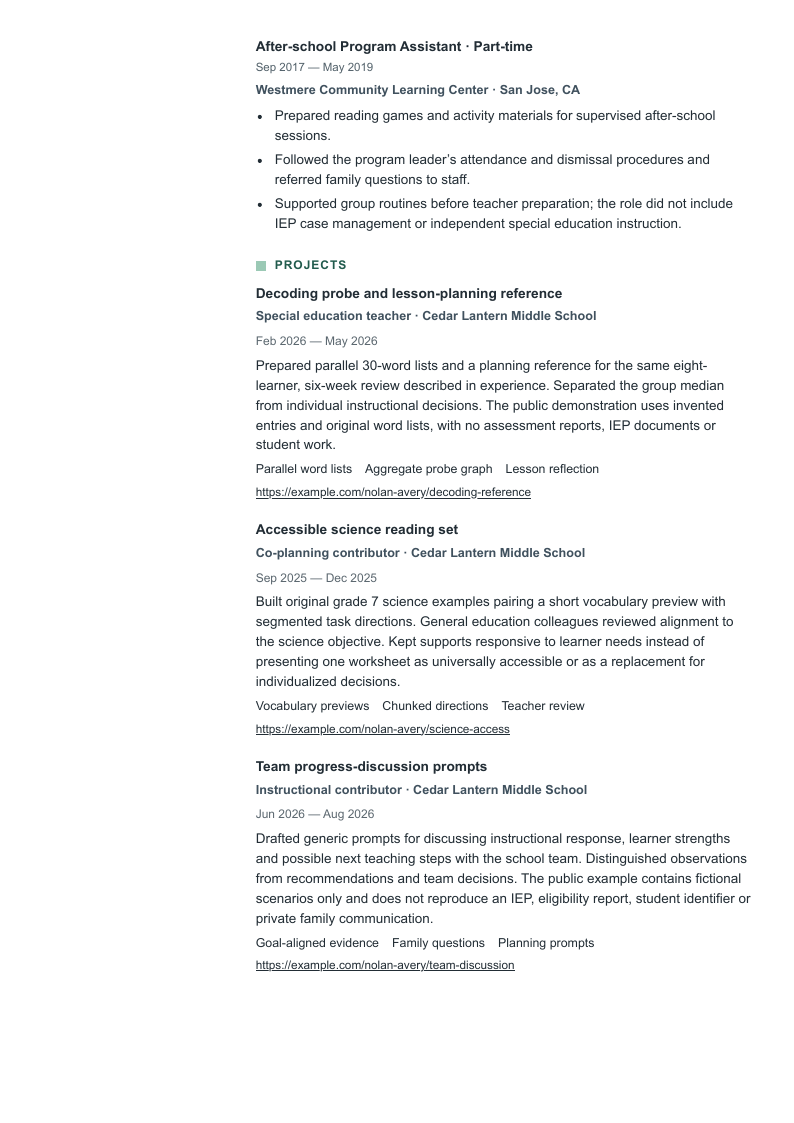
The expanded Botanical scenario has the photo off and retains every base fact. It adds one older after-school program job and two projects: accessible science materials and team progress-discussion prompts. Follow the narrow credential rail and the main narrative separately through every PDF page. The extra assistant role is not additional licensed teaching experience.
Special education teacher providing grades 6–8 specially designed reading and writing instruction and classroom access supports. Uses goal-aligned probes to adjust lessons, contributes instructional evidence to IEP team discussions and collaborates with families, general education teachers and service providers. Holds an active California Clear Education Specialist Instruction Credential in Mild to Moderate Support Needs.
Delivered specially designed reading and writing instruction for grades 6–8 learners with mild to moderate support needs, using explicit modeling, guided practice and individualized lesson adjustments.
Tracked eight learners on parallel 30-word decoding probes over six weeks in spring 2026; the group median rose from 18 to 25 words correct, and individual patterns informed the next instructional targets.
Contributed classroom assessment findings, draft instructional goals and progress summaries to IEP meetings with families and the school team; implemented the agreed supports within the teaching assignment.
Co-planned grade 7 science reading supports with general education teachers, using vocabulary previews and chunked directions while retaining the lesson’s intended science concepts.
Special Education Paraprofessional
Meadowbridge Learning School · San Jose, CA
August 2019–June 2022
Supported small-group practice as a special education paraprofessional under teacher direction, used the assigned prompting sequence and reported learner responses to the supervising teacher.
Prepared visual schedules and practiced agreed transition routines under teacher guidance, then shared observations so the classroom team could review supports consistently.
After-school Program Assistant · Part-time
Westmere Community Learning Center · San Jose, CA
September 2017–May 2019
Prepared reading games and activity materials for supervised after-school sessions.
Followed the program leader’s attendance and dismissal procedures and referred family questions to staff.
Supported group routines before teacher preparation; the role did not include IEP case management or independent special education instruction.
Education
Bachelor of Arts in Liberal Studies · Westmere University · San Jose, CA
August 2015–May 2019
Completed a separate Education Specialist preparation program in June 2023 and teacher induction in 2025.
Teaching credentials
California Clear Education Specialist Instruction Credential · Mild to Moderate Support Needs
California Commission on Teacher Credentialing
Issued August 2025
Expires August 2030
Active as of October 2026. Preliminary MMSN credential issued August 2023; clear credential earned August 2025 after induction; current document expires August 2030.
Projects
Decoding probe and lesson-planning reference
Special education teacher · Cedar Lantern Middle School
February 2026–May 2026
Parallel word lists · Aggregate probe graph · Lesson reflection
Prepared parallel 30-word lists and a planning reference for the same eight-learner, six-week review described in experience. Separated the group median from individual instructional decisions. The public demonstration uses invented entries and original word lists, with no assessment reports, IEP documents or student work.
Built original grade 7 science examples pairing a short vocabulary preview with segmented task directions. General education colleagues reviewed alignment to the science objective. Kept supports responsive to learner needs instead of presenting one worksheet as universally accessible or as a replacement for individualized decisions.
Instructional contributor · Cedar Lantern Middle School
June 2026–August 2026
Goal-aligned evidence · Family questions · Planning prompts
Drafted generic prompts for discussing instructional response, learner strengths and possible next teaching steps with the school team. Distinguished observations from recommendations and team decisions. The public example contains fictional scenarios only and does not reproduce an IEP, eligibility report, student identifier or private family communication.
Check the full Mild to Moderate Support Needs authorization, issue and expiry dates, the eight-learner probe definition and the boundary between paraprofessional and teacher duties. Review all pages, copied text, links and parsed application fields. A short file is useful only when it preserves the evidence and remains readable.
Verify your actual degree, credential issuer, authorization, status and dates against your records.
Keep the learning measure, timeframe and limits intact; a group result is not every learner’s result.
Read contact endings, credential details and every final project sentence. Confirm full link destinations.
Follow the employer’s requested file type and inspect parsed fields. No design guarantees accurate parsing, an interview or an offer.
A free account is required for the builder. Free-plan PDF downloads include a watermark; these preview images show paid-plan output. Use buttons carry the chosen design, photo preference and Special Education Teacher role into signup without copying the fictional career or AI portrait.
What should a special education teacher include on a resume?
Identify the grade band, support setting and actual instruction. Show progress monitoring, implementation of agreed supports and your contribution to IEP collaboration. List the exact current credential and specialty separately from education.
How do I describe IEP work without overstating authority?
Name the evidence, draft goals, progress summaries or implementation you contributed, and identify collaboration with families and the school team. Do not imply sole responsibility for eligibility, placement or related-service decisions.
How should I report student learning progress?
State the task or measure, timeframe, group and conditions, retaining missing data and differences between group and individual results. A decoding probe is not a diagnosis or proof that every learner improved. Use only permitted aggregate evidence.
Can paraprofessional experience help a new teacher resume?
Yes. Keep the actual title and supervision visible, and describe assigned practice, materials, routines and communication. Do not relabel support work as independent special education teaching or retrospective IEP case management.
Which special education keywords and resume length should I use?
Select truthful vacancy terms such as specially designed instruction, progress monitoring, IEP implementation or co-teaching. Use enough space for relevant evidence and credentials, then inspect every page. Neither keyword repetition nor page count guarantees screening success.
What happens when I choose Botanical, Professional or Fieldnote?
Signup retains the exact chosen design, photo preference and Special Education Teacher role. It does not insert Nolan’s fictional career or AI portrait. A free account is required and free-plan PDF downloads include a watermark.
Prepared by Resumize with AI-assisted research and drafting for English-language US applications. Three primary employer descriptions were read October 28, 2026 with full responsibilities and Apply controls: California extensive-needs services, a Connecticut K–12 program and New York high school humanities support. They illustrate different settings and jurisdiction requirements, not universal duties. Official California Commission on Teacher Credentialing pages support the limited credential distinctions. All sample careers, credentials and measurements are fiction. This is resume guidance, not a student-specific education, eligibility or licensing decision. No application was submitted.
Checked October 28, 2026: San Jose, CA; current published primary API record, full HTTP 200 description and application available. Extensive-needs classroom, specialized instruction, IEP implementation and team coordination; California credential wording includes ESN preferred or MMSN. This extensive-needs vacancy is not the sample’s grades 6–8 MMSN assignment or a universal scope statement.
Checked October 28, 2026: Stamford, CT; primary API updated September 28, 2026; full HTTP 200 job description and Apply available. State-approved K–12 program covers academic and social/behavioral needs. Connecticut certification/alternative eligibility and employer-specific driving or method preferences do not become requirements for all special education teachers.
Checked October 28, 2026: Bronx, NY; primary API updated August 12, 2026; full HTTP 200 description and Apply available. High school role includes team co-planning, co-teaching, co-assessment, family collaboration and transition support. NY students-with-disabilities certification wording describes this opening and is not substituted for California authorization.
Read October 28, 2026 through readable official web retrieval; page updated October 1, 2026. Identifies MMSN and other specialty areas, preliminary/clear stages and instructional support within authorization. The sample’s August 2023 preliminary and August 2025 clear dates are fictional, not a real credential verification.
Read October 28, 2026 through readable official web retrieval; page updated October 1, 2026. Supports the sample’s five-year clear document term and distinction between clearing a preliminary document and renewing a clear one. Direct Python access returned 403; saved official web text was readable.