A high school teacher resume should identify the subject, grade band and instructional decisions behind the work. Show how you plan lessons, evaluate learning and communicate with the school community. This guide follows an English teacher’s fictional career through six annotated rewrites and three existing designs.
These previews use the same layouts as the builder, with identical example content. Open a full preview to inspect the text and spacing.
Fictional candidate, employers, education and results. The optional portrait is AI-generated. Use your own evidence and photo; the example is not inserted into your resume.
Scholar
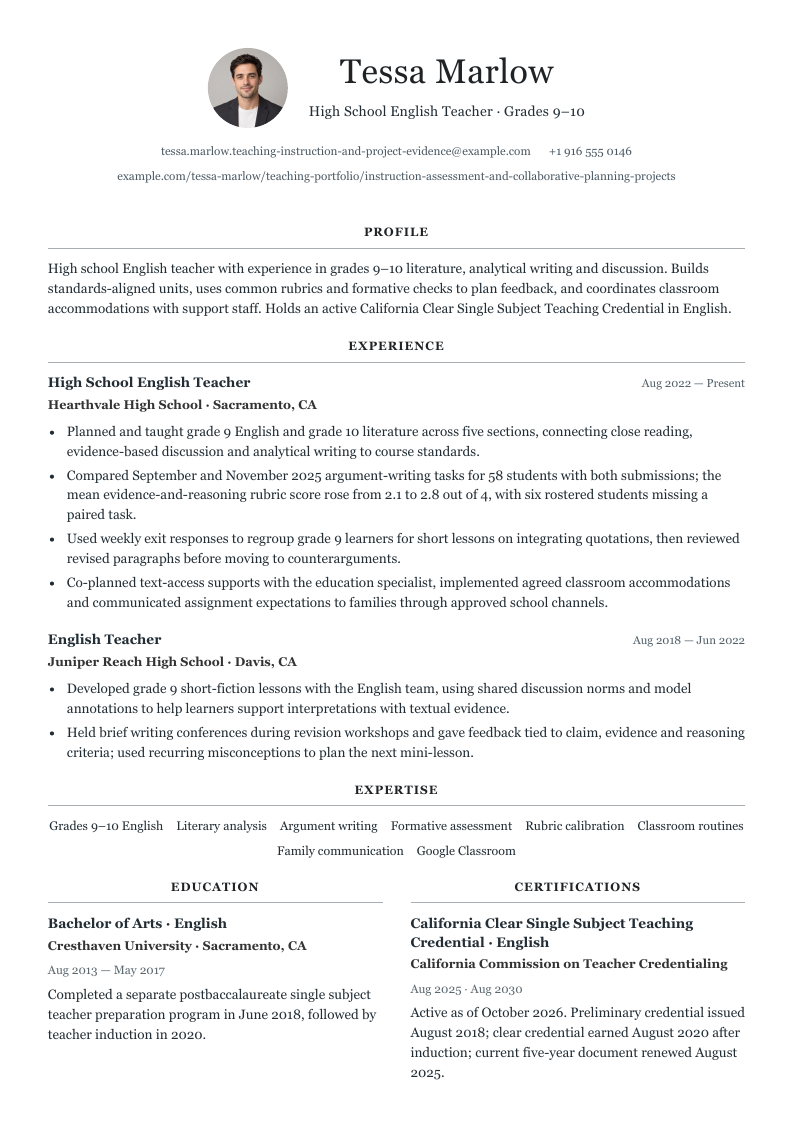
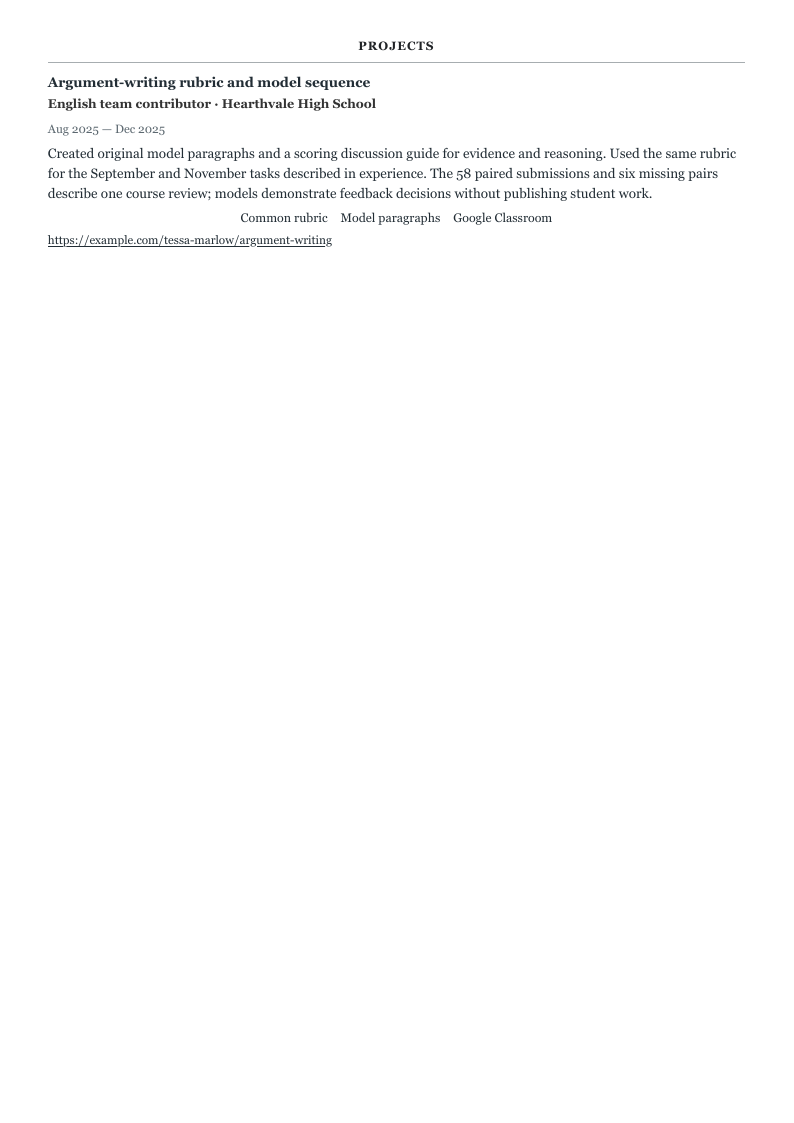
Centered serif identity and section headings with thin rules lead through Profile, Experience, Expertise, Education and Certifications in a bottom grid, then Projects.
Before sending: The bottom grid gives education and credentials separate widths. Inspect the full English authorization, renewal chronology and rubric qualifiers at page breaks.
The original Professional design centers identity and the optional portrait above contacts, then presents summary, skills, experience, education, projects and credentials.
Before sending: Credentials follow projects, so confirm that the active English credential remains easy to find on every page; shortened social labels still need a complete link destination.
A serif name, orange role labels and an unruled main body place the summary in the header, then Experience, Expertise, an Education and Certifications grid, and Projects.
Before sending: The summary sits above the contact row in the visual header. Inspect reading order, long contact endings and the full renewal statement rather than assuming a one-page result.
“Use” opens signup with that design and photo preference selected for the builder. A free account is required. Free-plan PDF downloads include a watermark; see current plans for paid options. Photo conventions vary; follow the employer’s instructions and local expectations.
All three designs use the same fictional career. The default is without a photo; the optional portrait is AI-generated. Template buttons retain the exact design, photo preference and High School Teacher role through signup. They do not insert the fictional candidate, career record or portrait into your account.
Tessa Marlow is an invented California English teacher. Every candidate, employer, institution, credential, date, number and result in this career record is original fiction. No real teaching credential is being verified and the invented university is not an accreditation claim. All example.com destinations are placeholders; the optional portrait is AI-generated. No actual student work, marks or family messages appear here.
High school English teacher with experience in grades 9–10 literature, analytical writing and discussion. Builds standards-aligned units, uses common rubrics and formative checks to plan feedback, and coordinates classroom accommodations with support staff. Holds an active California Clear Single Subject Teaching Credential in English.
Skills
Grades 9–10 English · Literary analysis · Argument writing · Formative assessment · Rubric calibration · Classroom routines · Family communication · Google Classroom
Experience
High School English Teacher
Hearthvale High School · Sacramento, CA
August 2022–Present
Planned and taught grade 9 English and grade 10 literature across five sections, connecting close reading, evidence-based discussion and analytical writing to course standards.
Compared September and November 2025 argument-writing tasks for 58 students with both submissions; the mean evidence-and-reasoning rubric score rose from 2.1 to 2.8 out of 4, with six rostered students missing a paired task.
Used weekly exit responses to regroup grade 9 learners for short lessons on integrating quotations, then reviewed revised paragraphs before moving to counterarguments.
Co-planned text-access supports with the education specialist, implemented agreed classroom accommodations and communicated assignment expectations to families through approved school channels.
English Teacher
Juniper Reach High School · Davis, CA
August 2018–June 2022
Developed grade 9 short-fiction lessons with the English team, using shared discussion norms and model annotations to help learners support interpretations with textual evidence.
Held brief writing conferences during revision workshops and gave feedback tied to claim, evidence and reasoning criteria; used recurring misconceptions to plan the next mini-lesson.
Education
Bachelor of Arts in English · Cresthaven University · Sacramento, CA
August 2013–May 2017
Completed a separate postbaccalaureate single subject teacher preparation program in June 2018, followed by teacher induction in 2020.
Teaching credentials
California Clear Single Subject Teaching Credential · English
California Commission on Teacher Credentialing
Issued August 2025
Expires August 2030
Active as of October 2026. Preliminary credential issued August 2018; clear credential earned August 2020 after induction; current five-year document renewed August 2025.
Projects
Argument-writing rubric and model sequence
English team contributor · Hearthvale High School
August 2025–December 2025
Common rubric · Model paragraphs · Google Classroom
Created original model paragraphs and a scoring discussion guide for evidence and reasoning. Used the same rubric for the September and November tasks described in experience. The 58 paired submissions and six missing pairs describe one course review; models demonstrate feedback decisions without publishing student work.
“High school teacher” is the occupation, but English 9, Algebra II, chemistry and US history are different assignments. Put your genuine subject and grade experience close to the top. Tessa’s example identifies grades 9–10 English and five sections; it does not describe five separate preparations, Advanced Placement authorization or expertise across the full high school curriculum.
For an English application, close reading, argument writing, textual evidence and discussion are useful only when linked to an actual lesson or assessment. A science teacher might instead show laboratory planning, investigation and safety responsibilities within their role. A mathematics teacher could explain how worked examples and formative checks informed the next lesson. Select the evidence for the vacancy rather than copying another subject’s achievements.
The current employer descriptions illustrate different expectations. Freedom Prep seeks an English II teacher in Memphis and describes subject standards, assessment and collaboration. Democracy Prep’s New York mathematics opening emphasizes curriculum implementation and classroom expectations. Success Academy’s Bronx mathematics opening describes studying supplied lesson plans and feedback. These three charter-school examples do not represent every district, subject, seniority level or state.
Keep the classroom and wider school contribution separate. An advisory group, debate club, mentoring assignment or curriculum committee can help when you actually held that responsibility. State the role and period. Teaching a unit does not establish department leadership, and providing an accommodation does not make the subject teacher the sole decision-maker for special education services.
Six high school teacher rewrites with reasoning
Each after sentence appears verbatim in the base resume. The before statements are deliberately weak or overstated examples. Replace the fictional details with your own supported facts; the evidence prompts show what to check without publishing private learner information.
1. Name subject and grade band
Before: Taught everything to every high school student.
After: Planned and taught grade 9 English and grade 10 literature across five sections, connecting close reading, evidence-based discussion and analytical writing to course standards.
Why it works: The subject, grades and five sections establish scope. They do not claim competence in every high school subject or five distinct course preparations.
Evidence to check: Teaching assignment, unit sequence and permitted lesson plans.
2. Interpret a writing measure
Before: Raised every student’s writing ability by 40%.
After: Compared September and November 2025 argument-writing tasks for 58 students with both submissions; the mean evidence-and-reasoning rubric score rose from 2.1 to 2.8 out of 4, with six rostered students missing a paired task.
Why it works: The paired group and rubric scale are explicit. A 0.7-point increase is not a 40% proficiency gain, a standardized-test result or proof that one teacher caused the change.
Evidence to check: Approved aggregate rubric summary, comparable prompts, scoring criteria and missing-submission definition.
3. Show the instructional response
Before: Used data to make all learners successful.
After: Used weekly exit responses to regroup grade 9 learners for short lessons on integrating quotations, then reviewed revised paragraphs before moving to counterarguments.
Why it works: Explains a specific instructional decision. It does not claim that every learner mastered writing or that the regrouping was a controlled experiment.
Evidence to check: Exit-task examples, planning notes and anonymized or wholly invented model paragraphs.
4. Explain collaborative access
Before: Personally managed all special education services.
After: Co-planned text-access supports with the education specialist, implemented agreed classroom accommodations and communicated assignment expectations to families through approved school channels.
Why it works: The English teacher implements classroom supports with colleagues. This is not independent authority over eligibility, services or a student’s entire IEP.
Evidence to check: Assigned classroom responsibilities, approved communication process and a generic support plan without student records.
5. Make earlier experience relevant
Before: Transformed the school’s curriculum single-handedly.
After: Developed grade 9 short-fiction lessons with the English team, using shared discussion norms and model annotations to help learners support interpretations with textual evidence.
Why it works: Names the earlier contribution and collaborators rather than claiming sole ownership of an institution-wide curriculum change.
Evidence to check: Team unit plans, contribution history and mentor feedback.
6. Describe feedback practice
Before: Graded hundreds of essays perfectly.
After: Held brief writing conferences during revision workshops and gave feedback tied to claim, evidence and reasoning criteria; used recurring misconceptions to plan the next mini-lesson.
Why it works: Shows the purpose and sequence of feedback without inventing a volume, flawless marking rate or guaranteed score improvement.
Evidence to check: Conference routine, rubric and permitted planning reflection.
Connect your summary to the lessons below it
Tessa’s summary names English instruction, common rubrics, formative checks and collaboration. The six experience bullets then demonstrate those claims. This is more credible than describing yourself as a transformational educator with no subject, age group or concrete teaching practice. Use two or three relevant strengths and place the supporting examples in the experience section.
Keep dates and job titles faithful to your employment record. Show a long-term substitute, intern, teaching assistant or student-teaching assignment under its actual title. If you changed grade bands or taught in a different country, make the context clear rather than converting the earlier job into the exact title in the new advertisement.
Use the school’s approved channels and a nonidentifying description when mentioning family communication. The fictional bullet concerns assignment expectations and classroom accommodations. It does not publish a family’s circumstances or suggest that the English teacher independently prescribed a student’s services.
Explain what a student-growth number measures
In the fictional writing review, 58 students have both September and November 2025 submissions. The mean evidence-and-reasoning score moves from 2.1 to 2.8 on a four-point rubric, while six rostered students lack a paired task. The 0.7-point change describes that rubric dimension in that paired group. It is not an increase of 40 percentage points, a standardized-test proficiency result or evidence that every student improved.
Before using your own result, check whether the tasks were comparable, the same rubric was used, the same learners contributed at both points and scoring expectations were consistent. A mean can rise while some individuals remain unchanged or need further support. Keep missing work and the time period visible, and avoid implying that a simple classroom comparison isolates your causal effect.
An honest teaching bullet can describe a decision without a number. Tessa uses exit responses to plan quotation-integration lessons and reviews revised paragraphs before teaching counterarguments. That sequence demonstrates assessment literacy even without a claimed percentage gain. Do not manufacture scores because a template seems to demand them.
Connect selected skills to teaching evidence
Choose truthful terms from the actual vacancy, then explain the teaching task behind them. A skills list helps a reader find relevant experience; it cannot establish an authorization or guarantee screening success. Do not list every platform, assessment or support method because another school mentions it.
High School Teacher skills and evidence
Skill
Evidence to gather
Fictional example
Subject instruction
Course assignment and actual unit sequence
Grades 9–10 English across five sections
Assessment
Task comparability, rubric and paired sample
58 paired writing tasks; six missing pairs
Instructional response
Evidence that changed the next lesson
Quotation integration before counterarguments
Access supports
Classroom responsibility and collaboration
Co-planning with the education specialist
Family communication
Purpose and approved communication channel
Clear assignment expectations
Learning technology
Actual teaching workflow
Google Classroom for models and revision
Separate the degree, preparation and current credential
The sample lists a BA in English completed in May 2017 and separately identifies postbaccalaureate preparation completed in June 2018. Its preliminary California credential begins in August 2018, before the first teacher job; the clear credential follows induction in August 2020. The currently displayed document runs from August 2025 to August 2030 after renewal. The credential’s issue date therefore describes the current document, not the start of Tessa’s career.
California’s Single Subject leaflet identifies subject-specific authorization for departmentalized teaching. Its renewal guidance distinguishes clearing a preliminary credential from renewing a clear document. Use your actual issuer, subject authorization, stage, status and dates. A degree, test pass, certificate of clearance or enrollment in preparation should not be relabeled as an active teaching credential.
Requirements differ across jurisdictions and employers. The researched Freedom Prep opening specifies Tennessee eligibility routes; the two New York mathematics postings treat certification differently. Their wording does not determine California requirements. Check the issuing authority and the actual opening before describing reciprocity, an endorsement or a pending application. Do not invent a universal “US teacher license.”
An experienced applicant can usually omit GPA unless the employer asks or it adds useful early-career context. Include a master’s degree or a subject endorsement only if earned. The sample does not claim the preferred qualifications from every researched posting.
Use supervised experience and projects accurately
For a first teaching application, describe student teaching with the school setting, subject, grade band, supervision and tasks you actually completed. Label a placement as a placement. Lesson planning, observed instruction and feedback cycles can demonstrate preparation without pretending that a supervised assignment was independent licensed employment.
The base project explains the same argument-writing review as the experience bullet. It adds model paragraphs and rubric discussion rather than another 58 students. An original lesson plan or invented model can demonstrate your thinking without uploading actual grades, student writing, classroom recordings or private learning plans.
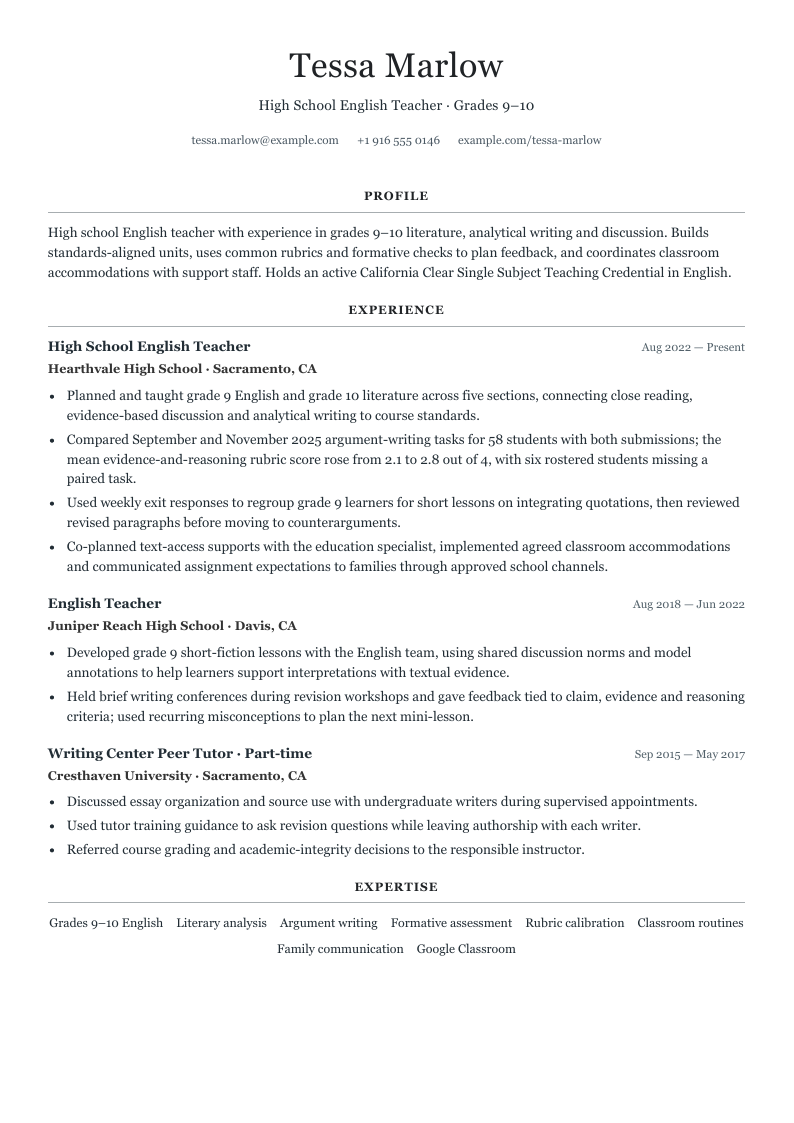
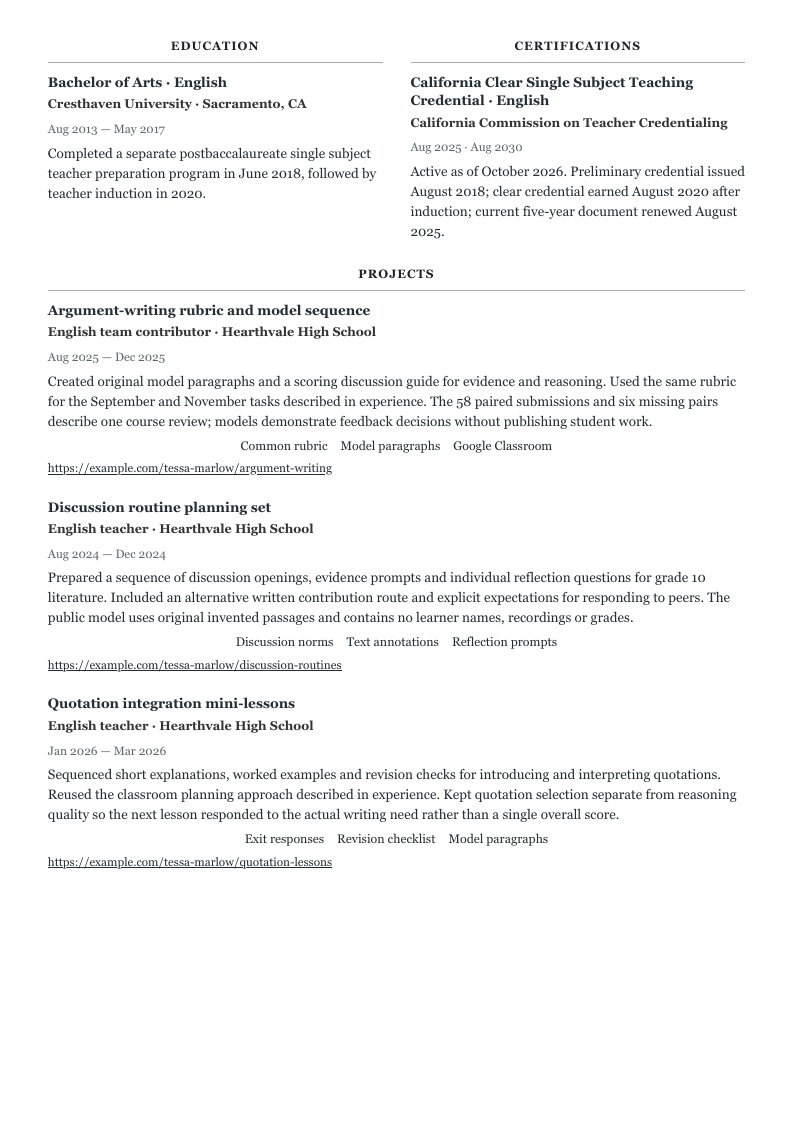
The expanded record adds Tessa’s earlier university writing-center role and two planning projects. Peer tutoring predates teacher preparation and remains a supervised support assignment. A relevant older role can explain the career foundation, but it need not displace more useful subject teaching evidence in the version you submit.
Inspect long contacts with the optional photo
The Scholar long-contact scenario uses the optional photo and changes only Tessa’s resume email and portfolio URL. The user identity, phone and every career fact stay fixed. Read the final email characters and the last URL segment, then open the link destination. Professional can shorten the visible social label, so the complete destination matters as well as the printed label.
High school English teacher with experience in grades 9–10 literature, analytical writing and discussion. Builds standards-aligned units, uses common rubrics and formative checks to plan feedback, and coordinates classroom accommodations with support staff. Holds an active California Clear Single Subject Teaching Credential in English.
Skills
Grades 9–10 English · Literary analysis · Argument writing · Formative assessment · Rubric calibration · Classroom routines · Family communication · Google Classroom
Experience
High School English Teacher
Hearthvale High School · Sacramento, CA
August 2022–Present
Planned and taught grade 9 English and grade 10 literature across five sections, connecting close reading, evidence-based discussion and analytical writing to course standards.
Compared September and November 2025 argument-writing tasks for 58 students with both submissions; the mean evidence-and-reasoning rubric score rose from 2.1 to 2.8 out of 4, with six rostered students missing a paired task.
Used weekly exit responses to regroup grade 9 learners for short lessons on integrating quotations, then reviewed revised paragraphs before moving to counterarguments.
Co-planned text-access supports with the education specialist, implemented agreed classroom accommodations and communicated assignment expectations to families through approved school channels.
English Teacher
Juniper Reach High School · Davis, CA
August 2018–June 2022
Developed grade 9 short-fiction lessons with the English team, using shared discussion norms and model annotations to help learners support interpretations with textual evidence.
Held brief writing conferences during revision workshops and gave feedback tied to claim, evidence and reasoning criteria; used recurring misconceptions to plan the next mini-lesson.
Education
Bachelor of Arts in English · Cresthaven University · Sacramento, CA
August 2013–May 2017
Completed a separate postbaccalaureate single subject teacher preparation program in June 2018, followed by teacher induction in 2020.
Teaching credentials
California Clear Single Subject Teaching Credential · English
California Commission on Teacher Credentialing
Issued August 2025
Expires August 2030
Active as of October 2026. Preliminary credential issued August 2018; clear credential earned August 2020 after induction; current five-year document renewed August 2025.
Projects
Argument-writing rubric and model sequence
English team contributor · Hearthvale High School
August 2025–December 2025
Common rubric · Model paragraphs · Google Classroom
Created original model paragraphs and a scoring discussion guide for evidence and reasoning. Used the same rubric for the September and November tasks described in experience. The 58 paired submissions and six missing pairs describe one course review; models demonstrate feedback decisions without publishing student work.
The expanded Scholar scenario has the photo off. It preserves the base record and adds the earlier peer-tutor role, a discussion-routine planning set and quotation mini-lessons. Follow the credential and project details through every PDF page; the extra content does not establish additional teaching qualifications or a second measured cohort.
High school English teacher with experience in grades 9–10 literature, analytical writing and discussion. Builds standards-aligned units, uses common rubrics and formative checks to plan feedback, and coordinates classroom accommodations with support staff. Holds an active California Clear Single Subject Teaching Credential in English.
Skills
Grades 9–10 English · Literary analysis · Argument writing · Formative assessment · Rubric calibration · Classroom routines · Family communication · Google Classroom
Experience
High School English Teacher
Hearthvale High School · Sacramento, CA
August 2022–Present
Planned and taught grade 9 English and grade 10 literature across five sections, connecting close reading, evidence-based discussion and analytical writing to course standards.
Compared September and November 2025 argument-writing tasks for 58 students with both submissions; the mean evidence-and-reasoning rubric score rose from 2.1 to 2.8 out of 4, with six rostered students missing a paired task.
Used weekly exit responses to regroup grade 9 learners for short lessons on integrating quotations, then reviewed revised paragraphs before moving to counterarguments.
Co-planned text-access supports with the education specialist, implemented agreed classroom accommodations and communicated assignment expectations to families through approved school channels.
English Teacher
Juniper Reach High School · Davis, CA
August 2018–June 2022
Developed grade 9 short-fiction lessons with the English team, using shared discussion norms and model annotations to help learners support interpretations with textual evidence.
Held brief writing conferences during revision workshops and gave feedback tied to claim, evidence and reasoning criteria; used recurring misconceptions to plan the next mini-lesson.
Writing Center Peer Tutor · Part-time
Cresthaven University · Sacramento, CA
September 2015–May 2017
Discussed essay organization and source use with undergraduate writers during supervised appointments.
Used tutor training guidance to ask revision questions while leaving authorship with each writer.
Referred course grading and academic-integrity decisions to the responsible instructor.
Education
Bachelor of Arts in English · Cresthaven University · Sacramento, CA
August 2013–May 2017
Completed a separate postbaccalaureate single subject teacher preparation program in June 2018, followed by teacher induction in 2020.
Teaching credentials
California Clear Single Subject Teaching Credential · English
California Commission on Teacher Credentialing
Issued August 2025
Expires August 2030
Active as of October 2026. Preliminary credential issued August 2018; clear credential earned August 2020 after induction; current five-year document renewed August 2025.
Projects
Argument-writing rubric and model sequence
English team contributor · Hearthvale High School
August 2025–December 2025
Common rubric · Model paragraphs · Google Classroom
Created original model paragraphs and a scoring discussion guide for evidence and reasoning. Used the same rubric for the September and November tasks described in experience. The 58 paired submissions and six missing pairs describe one course review; models demonstrate feedback decisions without publishing student work.
Discussion norms · Text annotations · Reflection prompts
Prepared a sequence of discussion openings, evidence prompts and individual reflection questions for grade 10 literature. Included an alternative written contribution route and explicit expectations for responding to peers. The public model uses original invented passages and contains no learner names, recordings or grades.
Exit responses · Revision checklist · Model paragraphs
Sequenced short explanations, worked examples and revision checks for introducing and interpreting quotations. Reused the classroom planning approach described in experience. Kept quotation selection separate from reasoning quality so the next lesson responded to the actual writing need rather than a single overall score.
Check the English authorization and current credential dates, the 58 paired submissions and six missing pairs, and the final sentence of each teaching bullet. Review copied PDF text and the application’s parsed fields. Choose length by relevant evidence and readability rather than an automatic one-page rule.
Verify your actual degree, credential issuer, authorization, status and dates against your records.
Keep the learning measure, timeframe and limits intact; a group result is not every learner’s result.
Read contact endings, credential details and every final project sentence. Confirm full link destinations.
Follow the employer’s requested file type and inspect parsed fields. No design guarantees accurate parsing, an interview or an offer.
A free account is required for the builder. Free-plan PDF downloads include a watermark; these preview images show paid-plan output. Use buttons carry the chosen design, photo preference and High School Teacher role into signup without copying the fictional career or AI portrait.
What should a high school teacher put on a resume?
Name your subject and grade band, show relevant planning and assessment decisions, describe classroom and family collaboration, and list the exact current credential separately from education. Use accomplishments you can substantiate.
How should I write a high school teacher summary?
Identify the subject, genuine teaching context and two or three strengths demonstrated below. A new teacher can describe preparation and supervised experience accurately; do not invent years, test gains or department leadership.
Can I include student results?
Use only permitted aggregate evidence, naming the measure, dates, paired group and missing data. A classroom rubric change is not a standardized proficiency result or proof that one teacher caused improvement. Keep individual student information private.
Is a teaching degree the same as a current credential?
No. Show the degree, preparation and jurisdiction-specific credential as distinct records. State the actual subject authorization, stage, status and document dates; check the issuer and opening for requirements.
How long should a teacher resume be, and which keywords help?
Use enough space for relevant evidence without padding. Choose vacancy terms such as formative assessment or standards alignment only when you can demonstrate them. Inspect every page and parsed field; no keyword list or layout guarantees an interview.
What happens when I choose Scholar, Professional or Plainspoken?
Signup retains the exact chosen design, photo preference and High School Teacher role. It does not insert Tessa’s fictional career or AI portrait. A free account is required and free-plan PDF downloads include a watermark.
Prepared by Resumize with AI-assisted research and drafting for English-language US applications. Three current primary employer descriptions were reviewed October 28, 2026 with readable duties and Apply controls; the English II and mathematics vacancies represent different subjects and employer models. California Commission on Teacher Credentialing sources support the limited qualification distinctions. Three openings are a small editorial sample, not universal duties, a salary survey or a ranking forecast. Every example career fact and result is fiction. No application was submitted.
Read October 28, 2026 via readable primary web retrieval: Memphis, TN; onsite full-time 2026–27 role; full responsibilities, qualifications and Apply for this job link available; no posting date displayed. English II, standards, assessment and cross-curricular collaboration are explicit. The posting also contains an inconsistent “special education teachers” subheading, so that label is not used as evidence of this English role’s specialty. Tennessee eligibility routes and preferred experience are vacancy-specific. Direct Python retrieval returned 403; saved web retrieval supplies the readable evidence.
Checked October 28, 2026: New York, NY; 2026–27 anticipated start, onsite; full published primary API record and HTTP 200 job page with Apply available. Mathematics opening illustrates curriculum preparation, assessment and classroom expectations in another subject. State certification and two years of experience are preferences in this posting, not universal US requirements.
Checked October 28, 2026: Bronx, NY; school year 2026–27; full primary description and Apply available. Role emphasizes studying and implementing supplied lessons, assessment and feedback. It explicitly does not require teaching certification or a master’s for this opening; this does not establish authorization rules in other states or schools.
Read October 28, 2026 through readable official web retrieval; page updated October 1, 2026. Supports the subject-specific departmentalized teaching distinction and preliminary-to-clear structure. Sample English credential chronology is invented; no issuer record is claimed.
Read October 28, 2026 through readable official web retrieval; page updated October 1, 2026. Clear renewal and five-year term guidance informs the sample August 2025–August 2030 document; preliminary credentials are not simply renewable. Direct Python access returned 403; saved official web text was readable.