Scholar
An academic hierarchy gives teaching context, education and program specialist credentials distinct sections.
Before sending: Preserve the paired-task denominator and the limits of the classroom rubric.
Education · Language development and differentiation
An ESL Teacher resume should tell a school whom you teach, what language learning looks like in your classroom and how evidence changes your next lesson. Explain differentiation and collaboration without turning a classroom rubric into a standardized proficiency result. State the exact teaching and ESL credentials for the intended jurisdiction and preserve learners’ privacy.
By Resumize · · Sources and scope
Three designs · one example
These previews use the same layouts as the builder, with identical example content. Open a full preview to inspect the text and spacing.
Fictional candidate, employers, education and results. The optional portrait is AI-generated. Use your own evidence and photo; the example is not inserted into your resume.
An academic hierarchy gives teaching context, education and program specialist credentials distinct sections.
Before sending: Preserve the paired-task denominator and the limits of the classroom rubric.
A traditional work history makes the move from classroom teaching to ESL easy to follow.
Before sending: Check the two Pennsylvania credentials separately rather than merging them into a generic TESOL claim.
Clear rules and public-service styling suit a school-based instructional record.
Before sending: Review lengthy certification names and the final project description on every page.
“Use” opens signup with that design and photo preference selected for the builder. A free account is required. Free-plan PDF downloads include a watermark; see current plans for paid options. Photo conventions vary; follow the employer’s instructions and local expectations.
Scholar centers serif identity text and section headings with thin rules. Classic presents a traditional single-column record. Civic uses a coral name block, opposite contact area and a left section-label gutter. Compare the same elementary language-development example, including both credentials and the full writing-task explanation.
The default has no photo. Every design uses the same fictional career, and its button keeps the exact design, photo preference and ESL Teacher role through signup. The example career and portrait are not added to your account. A free account is required; free-plan PDF downloads include a watermark. These images show paid-plan output. Follow the employer’s photo and file-format instructions.
Casey Rivera, the schools, college and teaching outcomes are original fiction. The two Pennsylvania certificate entries illustrate one credential combination. Contact details are placeholders, and the optional portrait is AI-generated. The work-example links contain no real student work, learner histories or family communications.
ESL Teacher | Elementary English Language Development
casey.rivera@example.com · +1 260 555 0142
Work examples: https://example.com/casey-rivera
ESL teacher supporting multilingual learners in grades 1–4 through explicit language objectives, differentiated small-group instruction and co-planning with classroom teachers. Uses common classroom rubrics and student work to adjust scaffolds, coordinates family communication with interpreters, and keeps language-learning evidence separate from disability identification.
English language development · Language objectives · Differentiated instruction · Formative assessment · Co-planning · Academic vocabulary · Family communication · Student record stewardship
Maplehaven Public School · Philadelphia, PA
August 2021–Present
Westbrook Learning School · Philadelphia, PA
August 2017–June 2021
Bachelor of Science in Elementary Education · Pinecrest Valley College · Pennsylvania
August 2013–May 2017
Teacher preparation with supervised elementary placements; later ESL program study completed in 2021.
Pennsylvania Department of Education
Issued August 2020
Does not expire
Fictional active teaching certificate; continuing education obligations remain applicable.
Pennsylvania Department of Education
Issued July 2021
Does not expire
Fictional program specialist certificate held with the Instructional II certificate; not a universal license for every subject.
ESL teacher · Maplehaven Public School
September 2025–January 2026
Common rubric · Visual supports · Co-planning notes
Built a set of four grade-level science lesson adaptations linking a content task to an observable language objective. Included modeled vocabulary, visuals and optional sentence supports, while preserving access to the same content rather than lowering expectations for multilingual learners.
Casey teaches English language development in grades 1–4 in a fictional Pennsylvania public-school setting. That context is different from adult community classes, a private language school, overseas EFL or general English language arts. State age group, setting and instructional responsibility before listing methods. A resume for adult literacy should explain that work rather than inherit elementary school terminology.
The three employer descriptions show useful differences. KIPP Oklahoma’s elementary opening includes differentiated lessons, proficiency monitoring and classroom collaboration. KIPP Indianapolis describes a high-school multilingual teacher of record with individual learning plans. Mastery’s Philadelphia elementary role connects social and academic language to content access and family relationships. Two postings belong to different regions of the KIPP network, so this is a small sample rather than a broad survey of independent school systems.
Explain the actual instructional choice: visuals for a new concept, oral rehearsal before writing, a modeled vocabulary task or temporary sentence support. Preserve the content objective and avoid treating limited English proficiency as limited academic potential. List another language only at an accurate proficiency level; arranging interpretation does not establish that you speak every family’s language.
Each after statement is exactly one of the six bullets in the base work history. All facts and numbers are fictional. Use the structure to explain your own contribution and evidence, replacing every invented detail.
Before: Taught English to everyone.
After: Planned English language development for multilingual learners in grades 1–4, pairing explicit language objectives with grade-level content and adjusting supports for different proficiency levels.
Why it works: Defines grades, instructional purpose and differentiation without erasing learners’ existing strengths.
Evidence to check: Teaching assignment, lesson plans and permitted synthetic examples.
Before: Raised English proficiency by 100%.
After: Compared September and December 2025 writing tasks for 18 learners using the same classroom rubric; 12 improved at least one descriptor, four were unchanged and two lacked paired samples.
Why it works: Twelve plus four plus two accounts for the cohort; classroom descriptors are not official proficiency levels.
Evidence to check: Authorized aggregate rubric table, paired-task definitions and missing-data treatment.
Before: Managed every classroom teacher.
After: Co-planned four science lesson adaptations with grade-level teachers, adding visual models, vocabulary practice and structured partner talk while retaining the original content objective.
Why it works: Specific adaptations show collaboration without claiming supervisory authority.
Evidence to check: Co-planning record, original content objective and adapted materials.
Before: Translated every language for parents.
After: Coordinated 14 family conferences through the school’s interpreter process, shared language-learning goals, and recorded agreed follow-up without using children as interpreters.
Why it works: Explains access and follow-up while avoiding unsupported fluency claims.
Evidence to check: Aggregate conference log, approved interpretation arrangements and follow-up process.
Before: Used data-driven differentiation.
After: Used exit tickets and oral rehearsal to identify unclear vocabulary, then regrouped learners for short practice sessions and checked the same target in a later task.
Why it works: A concrete feedback loop explains how assessment changed instruction.
Evidence to check: Task target, grouping rationale and anonymized or synthetic practice materials.
Before: Diagnosed learning disabilities in English learners.
After: Documented classroom language supports and response patterns, discussed persistent concerns with the school team, and contributed teaching observations without making disability diagnoses.
Why it works: Preserves the difference between instruction, team referral and professional diagnosis.
Evidence to check: School referral process and authorized role description; exclude identifiable student cases.
A clear summary combines the learners’ grades, English language-development role, differentiation and a supported assessment practice. Casey’s history backs each part with co-planning and a classroom comparison. Use a familiar method name only when you can explain how you applied it. Adding every curriculum acronym does not show that you taught it.
The writing review includes 18 learners: 12 improved a descriptor, four were unchanged and two had no paired sample. That leaves 16 paired comparisons. The text reports the missing data rather than placing both incomplete learners in a success calculation. It is one classroom rubric across two tasks, not a change in an official proficiency classification, proof of fluency or an isolated causal effect of the teacher. Explain cohort changes if you report progress in your own classroom.
| Skill | Evidence to gather | Fictional example |
|---|---|---|
| Language objectives | Observable language task paired with a content goal. | Grades 1–4 ELD with differentiated support. |
| Formative assessment | Same target, rubric and treatment of incomplete pairs. | 18 learners with 16 paired writing comparisons. |
| Differentiation | Reason for support and the retained content objective. | Visual models, vocabulary and partner talk. |
| Co-planning | Your contribution and colleagues’ responsibilities. | Four science lesson adaptations. |
| Family partnership | Interpretation process and agreed follow-up. | 14 interpreter-supported conferences. |
| Referral contribution | Teaching observations without diagnosis. | Supports and response patterns shared with the team. |
Use the employer’s terminology only where your history supports it. Explain a tool, method or credential in context; a keyword list cannot replace the work it describes.
Pennsylvania’s CSPG 68 explains the ESL Program Specialist PK–12 credential and its relationship with Instructional I or II certification, including a specified out-of-state route. The example holds an Instructional II elementary certificate and the ESL Program Specialist. The PK–12 ESL scope does not give the applicant permission to teach every content subject at every grade.
KIPP’s Oklahoma and Indiana postings use their own state terminology and conditions. A TEFL course, a TESOL degree and a public-school teaching certificate are different records; do not collapse them into “internationally licensed.” For an in-progress credential, give the true status and expected completion only when supported. Check official current requirements for the intended assignment rather than relying on an advertisement alone.
For a first ESL application, use supervised student teaching, a practicum, tutoring or classroom support with the role clearly labeled. Describe the target language skill, task and feedback. A synthetic lesson plan can demonstrate scaffolding, an oral-language prompt and a check for understanding without inventing a pupil’s progress or claiming teacher-of-record responsibility.
Career changers can show relevant classroom collaboration and preparation while keeping the chronology accurate. State who assessed or approved the work. Do not publish student names, immigration histories, learning plans, family messages or small-group details that could identify a learner. A fabricated portfolio example must be labeled synthetic; it should not be presented as anonymized evidence from a real class.
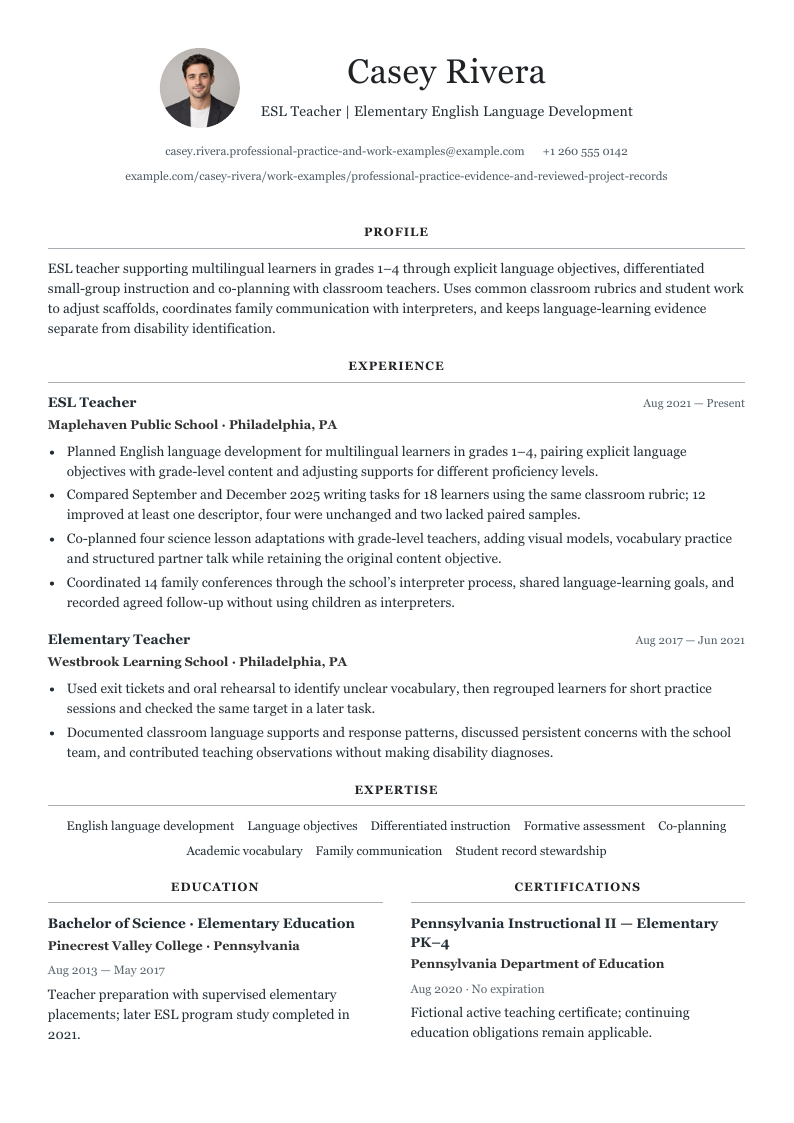
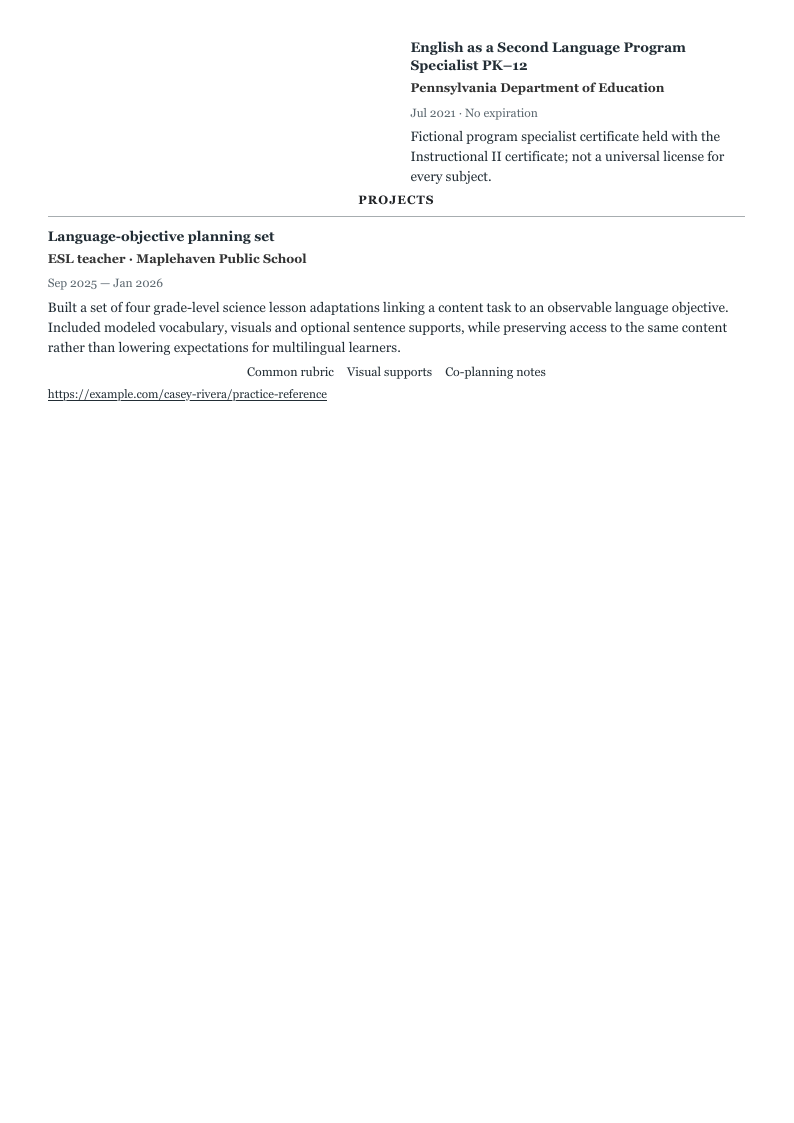
The long-contact Scholar example changes Casey’s email and work-examples URL with the photo on. The phone, paired-task figures, school history and credentials remain identical. Check the full URL and that the contact area does not crowd the summary or first teaching entry.
 Open page 1 at full size
 Open page 2 at full size
ESL Teacher | Elementary English Language Development
casey.rivera.professional-practice-and-work-examples@example.com · +1 260 555 0142
Work examples: https://example.com/casey-rivera/work-examples/professional-practice-evidence-and-reviewed-project-records
ESL teacher supporting multilingual learners in grades 1–4 through explicit language objectives, differentiated small-group instruction and co-planning with classroom teachers. Uses common classroom rubrics and student work to adjust scaffolds, coordinates family communication with interpreters, and keeps language-learning evidence separate from disability identification.
English language development · Language objectives · Differentiated instruction · Formative assessment · Co-planning · Academic vocabulary · Family communication · Student record stewardship
Maplehaven Public School · Philadelphia, PA
August 2021–Present
Westbrook Learning School · Philadelphia, PA
August 2017–June 2021
Bachelor of Science in Elementary Education · Pinecrest Valley College · Pennsylvania
August 2013–May 2017
Teacher preparation with supervised elementary placements; later ESL program study completed in 2021.
Pennsylvania Department of Education
Issued August 2020
Does not expire
Fictional active teaching certificate; continuing education obligations remain applicable.
Pennsylvania Department of Education
Issued July 2021
Does not expire
Fictional program specialist certificate held with the Instructional II certificate; not a universal license for every subject.
ESL teacher · Maplehaven Public School
September 2025–January 2026
Common rubric · Visual supports · Co-planning notes
Built a set of four grade-level science lesson adaptations linking a content task to an observable language objective. Included modeled vocabulary, visuals and optional sentence supports, while preserving access to the same content rather than lowering expectations for multilingual learners.
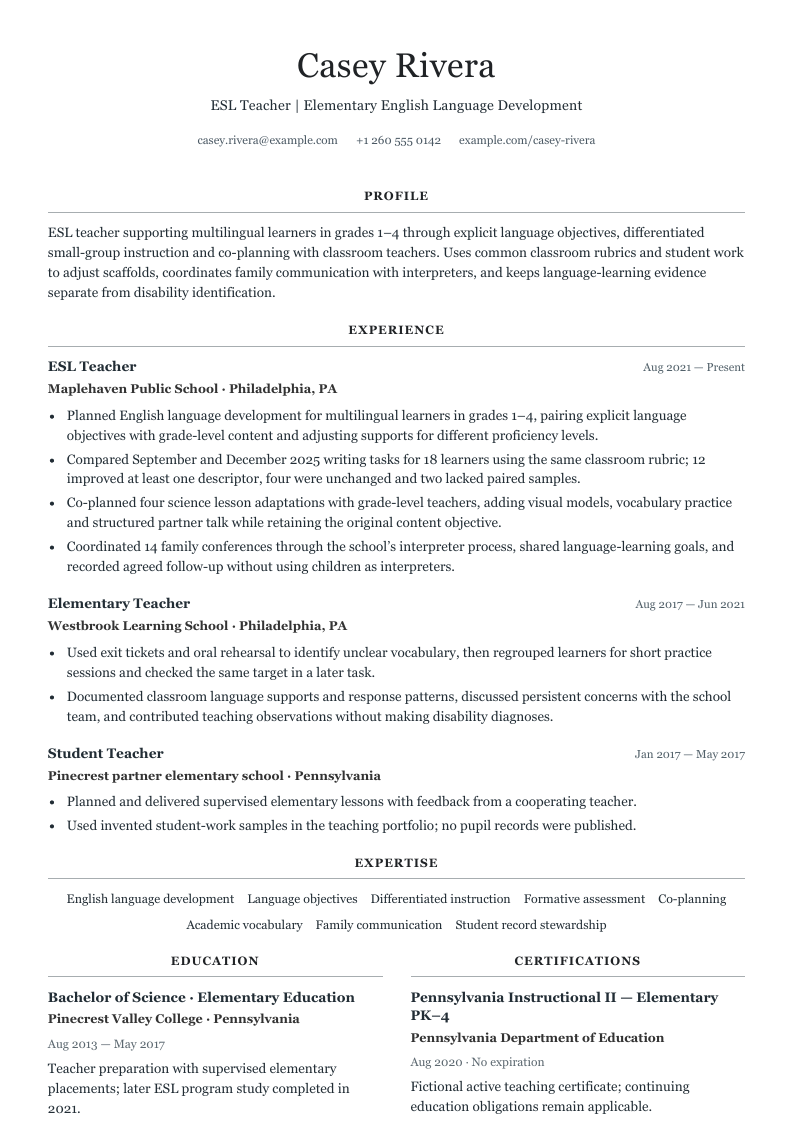
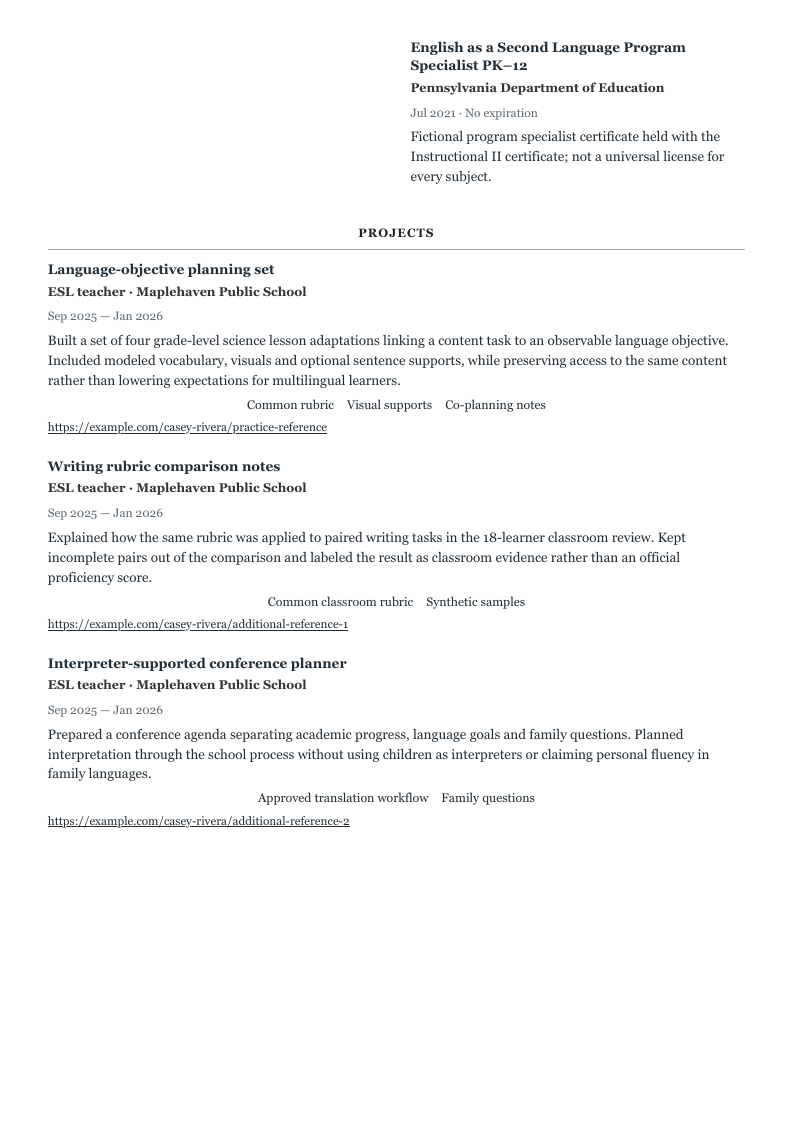
The expanded Scholar record keeps the base career and adds a supervised student-teaching placement, writing-rubric comparison notes and an interpreter-supported conference planner. The projects explain the same teaching evidence rather than claiming additional learner cohorts. Follow every page to the final conference-planning sentence and keep the student-teacher role distinct from licensed employment.
 Open page 1 at full size
 Open page 2 at full size
ESL Teacher | Elementary English Language Development
casey.rivera@example.com · +1 260 555 0142
Work examples: https://example.com/casey-rivera
ESL teacher supporting multilingual learners in grades 1–4 through explicit language objectives, differentiated small-group instruction and co-planning with classroom teachers. Uses common classroom rubrics and student work to adjust scaffolds, coordinates family communication with interpreters, and keeps language-learning evidence separate from disability identification.
English language development · Language objectives · Differentiated instruction · Formative assessment · Co-planning · Academic vocabulary · Family communication · Student record stewardship
Maplehaven Public School · Philadelphia, PA
August 2021–Present
Westbrook Learning School · Philadelphia, PA
August 2017–June 2021
Pinecrest partner elementary school · Pennsylvania
January 2017–May 2017
Bachelor of Science in Elementary Education · Pinecrest Valley College · Pennsylvania
August 2013–May 2017
Teacher preparation with supervised elementary placements; later ESL program study completed in 2021.
Pennsylvania Department of Education
Issued August 2020
Does not expire
Fictional active teaching certificate; continuing education obligations remain applicable.
Pennsylvania Department of Education
Issued July 2021
Does not expire
Fictional program specialist certificate held with the Instructional II certificate; not a universal license for every subject.
ESL teacher · Maplehaven Public School
September 2025–January 2026
Common rubric · Visual supports · Co-planning notes
Built a set of four grade-level science lesson adaptations linking a content task to an observable language objective. Included modeled vocabulary, visuals and optional sentence supports, while preserving access to the same content rather than lowering expectations for multilingual learners.
ESL teacher · Maplehaven Public School
September 2025–January 2026
Common classroom rubric · Synthetic samples
Explained how the same rubric was applied to paired writing tasks in the 18-learner classroom review. Kept incomplete pairs out of the comparison and labeled the result as classroom evidence rather than an official proficiency score.
ESL teacher · Maplehaven Public School
September 2025–January 2026
Approved translation workflow · Family questions
Prepared a conference agenda separating academic progress, language goals and family questions. Planned interpretation through the school process without using children as interpreters or claiming personal fluency in family languages.
Use enough space to keep relevant evidence readable. Condense repetition before removing a measure’s definition or your responsibility boundary. An isolated heading, detached date or lost final qualifier needs attention regardless of page count.
The resume analyzer offers advisory feedback. Use the bullet point generator for drafting, then verify each suggestion. Follow the employer’s requested format and review text copied from your PDF. A design cannot guarantee parsing, interviews or an offer.
Name the learners, setting and language-development work. Explain scaffolds, content access and how assessment changes instruction, with the correct credentials for the intended assignment.
Only describe what the assessment actually measures. A classroom rubric comparison is not automatically a standardized proficiency level or proof that your teaching alone caused the change.
They are different credentials. List the exact issuer, award and status, then check the official requirements for the school system and location.
Clearly labeled practicum, supervised teaching, tutoring or support work can show preparation. A synthetic lesson example can demonstrate your instructional thinking without fabricated learner results.
Keep relevant evidence readable and follow the employer’s instructions. Condense repeated duties before removing dates, credential scope or a result’s definition. Read every page of the exported PDF rather than judging length from a thumbnail.
Signup retains the exact design, photo preference and ESL Teacher role. A free account is required. Free-plan PDF downloads include a watermark; these example images show paid-plan output. The fictional career and portrait are not inserted into your account.
Prepared by Resumize with AI-assisted research and drafting. Three complete 2026–2027 employer descriptions were read on October 29, 2026: KIPP Oklahoma, KIPP Indianapolis and Mastery Philadelphia. The KIPP postings are separate regional openings in one network. Pennsylvania’s staffing guidance supports the sample’s credential distinction. This small K–12 sample does not establish rules for adult, private-language or overseas EFL teaching. All learner counts and work samples are invented; no student records, applications or hiring outcomes were used. Openings and credential guidance can change; check the current primary source for your own application.
Read October 29, 2026. Elementary Oklahoma City opening; differentiated lessons, proficiency monitoring, classroom-teacher collaboration and family communication. Its Oklahoma certification wording belongs to that market. Direct full description read.
Read October 29, 2026. High-school multilingual teacher-of-record role with individual learning plans, scaffolding and content-team collaboration. Lists an Indiana license with EL certification or eligibility. Direct full description read; no publication date displayed.
Read October 29, 2026. Philadelphia opening at Hardy Williams Elementary; social and academic language, curriculum access, assessment and family relationships. Direct full description and application link read; certification-completion wording is not a substitute for state requirements.
Read October 29, 2026. Primary staffing guidance, modified July 1, 2023, explains ESL Program Specialist and Instructional I/II pairing and an out-of-state exception. Content subjects still require appropriate instructional certification. This guide illustrates the paired Pennsylvania route and does not adjudicate eligibility.